


Overview
Communalism, in the Indian sense, is aggressive chauvinism based on religious identity: an ideology that treats a religious community as a political bloc whose interests differ from, and are even hostile to, those of other communities. It is about politics, not religion, and communal violence is its symptom rather than its cause. India's answer to it is secularism, written into the Constitution as equal respect for all religions.
Communalism Meaning: What Communalism Is in India
What Is Communalism? Definition and Indian Meaning
In everyday Indian usage, communalism means aggressive chauvinism based on religious identity. Chauvinism is the attitude that one's own group is the only legitimate or worthy one and other groups are inferior, illegitimate and opposed. Put simply, communalism is an aggressive political ideology linked to religion. The meaning is peculiarly South Asian: in ordinary English, communal only means related to a community rather than an individual, a neutral sense.
A fuller definition treats communalism as an ideology: the belief that society is divided into religious communities whose economic, political, social and cultural interests diverge, and are even hostile to each other, because of their religious differences. It is a belief system through which society, economy and politics are explained and around which politics is organised. On this view it is akin to racialism and anti-Semitism, and the historian Bipan Chandra called it the Indian form of fascism.
Communalism Is About Politics, Not Religion: Religiosity and Communalism
Communalism is about politics, not religion. Communalists are intensely involved with religion, but there is no necessary link between personal faith and communalism: a communalist may or may not be devout, and a devout believer may or may not be a communalist. What every communalist shares is belief in a political identity based on religion, and an aggressive attitude to people with other identities.
| Aspect | Religiosity | Communal politics |
|---|---|---|
| What it is | Personal faith and practice | A political identity built on religion |
| Towards others | Can coexist with respect for other faiths | Sets one community against others |
| Requires devotion? | Yes, by definition | No: a communalist may not be devout |
| Constitution | Protected by Articles 25 to 28 | Countered by secularism and criminal law |
Types and Stages of Communalism and Its Characteristics
Three Stages of Communalism: Communal Nationalism, Liberal and Extreme
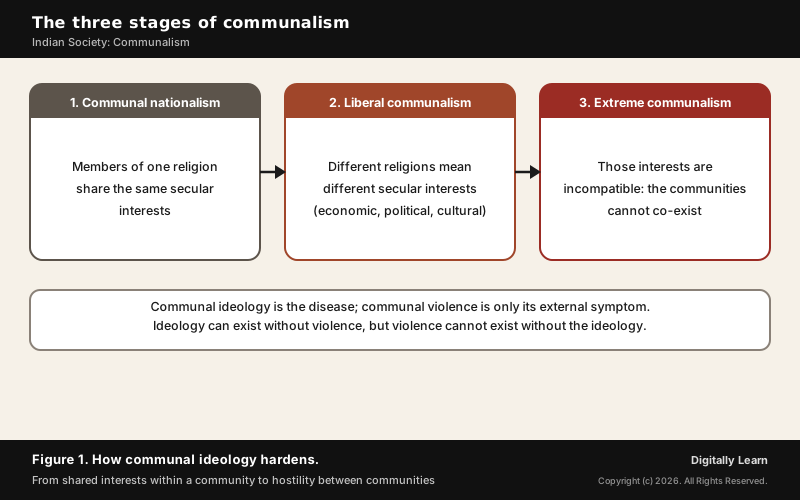
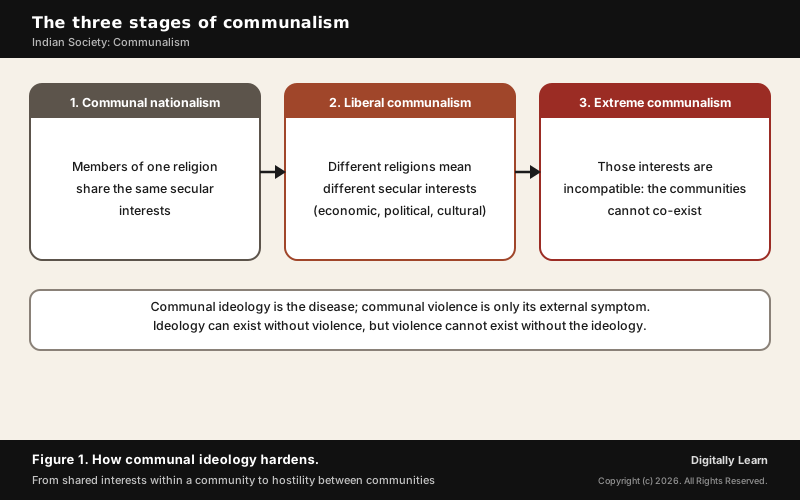
Communal ideology in India is usually described as having evolved through three stages, each harder than the last:
- Communal nationalism: Because people belong to one religious community, their secular interests are the same, even in matters that have nothing to do with religion.
- Liberal communalism: Because two communities have different religious interests, they also have different interests in the secular sphere, in economic, political and cultural life.
- Extreme communalism: The interests of different communities are not only different but incompatible, so the communities cannot co-exist.
Until 1937, Muslim communal politics was largely liberal communalism, centred on safeguards and reservations. After that it turned to extreme communalism, based on fear, hatred and violence of word and deed, the road that led to the demand for Pakistan, told in Communal Politics, the Muslim League and the Two-Nation Theory.
Features of Communal Ideology: A Homogenised and Hostile Identity
- Politics of hatred: It seeks to unify one community around a religious identity in hostile opposition to another, suppressing distinctions within the community and presenting the identity as natural and fixed.
- Religion over everything: Religious identity is claimed to override class, caste, occupation, region and political belief; all Hindus, or all Muslims or Sikhs, are treated as one.
- Homogenising: Large and diverse groups are presented as single and uniform, one’s own group as well as others. It denies that Hindus, Muslims and Christians of Kerala may have more in common with each other than with co-religionists elsewhere.
- A distorted picture of society: What it declares to be the social reality, the causes of discontent and the solutions are none of these; it is itself a social malady.
- Modern, not ancient: It grew out of modern politics based on mass mobilisation and popular participation, and its social roots lay in the rising middle classes.
- Majority and minority alike: In the same analysis, majority and minority communalisms are variants of the same ideology and equally dangerous; minority communalism can end in separatism, majority communalism can take the form of fascism.
One point holds the rest together: communal ideology is the disease and communal violence only its external symptom. Ideology can prevail without violence, but violence cannot exist without the ideology behind it. In this analysis, those who organise riots aim less at killing than at communalising the masses.
Causes of Communalism in India
Colonial Roots: Divide and Rule and Separate Electorates
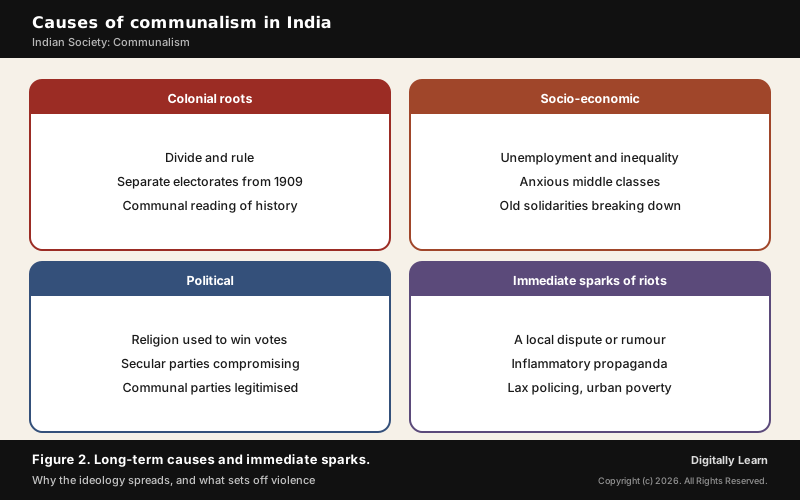
Communal riots go back to before Independence, often as a result of the divide-and-rule policy of the colonial rulers, though colonialism did not invent inter-community conflict and cannot be blamed for riots after 1947. After the 1870s, as nationalism grew, the Government turned to rallying Muslims behind it through concessions, favours and reservations, and used them against the nationalist movement.
- Separate electorates, 1909: The Morley-Minto Reforms let Muslim members be elected only by Muslim voters. The Act is said to have legalised communalism, and Lord Minto came to be known as the Father of Communal Electorate.
- 1919 Act: Extended communal representation with separate electorates for Sikhs, Indian Christians, Anglo-Indians and Europeans; it also brought dyarchy in the provinces and separated central and provincial subjects.
- Communal Award, 1932: Ramsay MacDonald continued separate electorates and extended them to the depressed classes; the Poona Pact then kept a joint electorate for Hindus with seats reserved for the depressed classes.
- Communal history writing: A reading of Indian history that called the ancient phase Hindu and the medieval phase Muslim, and exaggerated the conflicts of rulers into Hindu-Muslim conflicts.
- Reaction and counter-reaction: Minority communalism drew a reaction from the majority community, with the Hindu Mahasabha founded in 1915 and the RSS in 1925.
How separate electorates shaped reservation is traced on the reservation in India page.
Socio-Economic Causes: Relative Deprivation and Anxious Middle Classes
Historians of modern India trace communalism to a real social base, even though its diagnosis of that base is false. Poverty, unemployment and inequality breed frustration and unhealthy competition for scarce jobs and opportunities, and aspirations rise faster than they can be met. The middle classes felt this most: once the first push of jobs after Independence ran out by the mid-1960s, job scarcity, rivalry and discontent returned, and the anxious turned to blaming other communities.
- Relative deprivation: Unable to see the real reasons for their distress, people blame another religious or caste group.
- Social transition: Old supports of caste, joint family, village and neighbourhood were breaking down faster than new ones such as unions and voluntary bodies could replace them, so many turned to communal organisations for solidarity.
- Moral vacuum: The profit motive and a winner-takes-all outlook eroded shared values, leaving room for ideologies of fear and hate.
- Lost idealism: The unifying idealism of the national movement faded after 1947 without a new vision to replace it.
Political Causes and the Immediate Triggers of Communal Riots
Politics supplies the fuel. Communal parties are built around communal ideology, but secular parties have also helped communalism grow by opportunism: allying with communal parties for short-term electoral gain, or pandering to communal sentiment through concessions to one community or another. Such compromises made communal parties respectable and legitimised communalism.
Riots themselves need a spark, but only after an area has been communalised. The immediate causes are usually local and specific:
- A minor religious dispute, the teasing of a girl or a quarrel between two people of different faiths.
- Inflammatory propaganda, and the failure to act against those who spread it.
- The urban poor and lumpen elements, swelled by migration into overcrowded cities, and criminal gangs settling scores.
- Laxity, and at times partisanship, of the police and administration, when the state alone has the means to stop the violence.
Communalism in Modern Indian History: Before and After Independence
Communalism Before Independence: From Separate Electorates to Partition
Organised communal politics began in the first decades of the twentieth century. The All-India Muslim League was founded at Dacca on 30 December 1906 and was soon taken over by the Muslim elite of the United Provinces. Separate electorates, created in 1909 and expanded in 1919, tempted politicians to use sectarian slogans and reward their own religious group, so the logic of electoral politics deepened and hardened religious identities. In the Lucknow Pact of December 1916 the Congress accepted separate electorates.
- 1920s and 1930s: Tension grew over music before mosques, cow protection and the Arya Samaj’s shuddhi (reconversion), and on the other side over tabligh and tanzim after 1923; every riot left memories that deepened differences.
- 1937 elections: The Muslim League polled only 4.4 per cent of the Muslim vote; after the Congress refused a coalition in the United Provinces, the League redoubled its efforts to widen its support.
- Lahore Resolution, 23 March 1940: The League demanded a separate state for Muslims.
- 1946: The League won an overwhelming majority of the seats reserved for Muslims; after the Cabinet Mission failed, Jinnah called a Direct Action Day on 16 August 1946, and riots spread from Calcutta to rural Bengal, Bihar, the United Provinces and the Punjab.
Communal Riots After Independence
After Partition, the national movement's legacy, Gandhiji's martyrdom and Nehru's commitment made secularism dominant in the 1950s, and communal parties fared poorly in the elections of 1952, 1957 and 1962. But communalism has passive and active phases. Deaths in riots rose from 7 in 1958 to 41 in 1959 and 108 in 1961; the Jabalpur riot of 1961 shook the nation, and Nehru responded with the National Integration Council, first convened in 1961.
- 1960s: 1,070 riots in 1964, with 1,919 people killed.
- 1971 to 1977: A lull; riots did not exceed 250 in any year.
- From 1978: Communal violence rose again and spread to regions once thought immune, such as Kerala, Tamil Nadu, Andhra Pradesh, West Bengal and Orissa, and to villages; riots became more planned and longer.
- 1984 and 2002: The anti-Sikh riots of Delhi in 1984 took place under a Congress government, and the anti-Muslim violence in Gujarat in 2002 under a BJP government; no ruling party can claim to be blameless.
- Ayodhya: The Babri Masjid was demolished on 6 December 1992, followed by violence in which almost 3,000 people died; the Supreme Court gave its final judgment in the dispute on 9 November 2019.
No region has been wholly free of communal violence, and every community has faced it, though the impact is far more traumatic for minorities. History offers good examples too: a long tradition of peaceful co-existence and syncretism, seen in the Bhakti and Sufi movements. Regional and ethnic conflicts are covered in regionalism, separatism and insurgency.
Indian Secularism: The Constitutional Answer to Communalism
Indian Secularism Compared With Western Secularism
In the Western sense, secularism means the separation of church and state, part of a wider retreat of religion from public life that came with modernity, science and rationality. The Indian meaning includes this but adds more: secular is the opposite of communal, a state that does not favour any religion, and it implies equal respect for all religions rather than distance. The Indian state declares public holidays for the festivals of all religions.
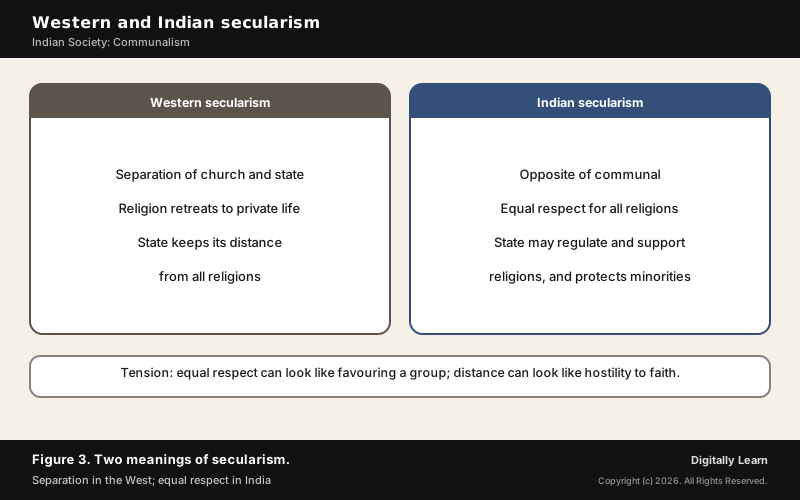
- Distance or respect: Should a secular state subsidise pilgrimages, manage temple complexes or ban cow slaughter? Each choice upsets supporters of the other sense of secularism.
- Secularism and minorities: Protecting minorities invites the charge of appeasement; without protection, secularism can become a cover for imposing majority norms.
Despite these tensions, India's Constitution and laws have proved reasonably effective in handling communalism, and voters have repeatedly backed a secular Constitution. The Constitution adopts the positive concept of secularism: all religions have the same status and support from the state.
Constitutional and Legal Safeguards Against Communalism
- Preamble: The word secular was added by the 42nd Amendment of 1976; the Preamble secures liberty of belief, faith and worship.
- Equality: Equality before law (Article 14) and no discrimination on grounds of religion (Article 15).
- Freedom of religion: Articles 25 to 28, subject to public order, morality and health.
- Minorities: Article 29 protects a distinct language, script or culture; Article 30 lets religious and linguistic minorities run their own educational institutions.
- No communal representation: The old system of reserving legislative seats by religion was abolished.
- Basic structure: In S. R. Bommai v. Union of India (1994) the Supreme Court held that in matters of State religion has no place, and that a State government pursuing unsecular policies is open to action under Article 356.
Ordinary laws back this up. The Bharatiya Nyaya Sanhita punishes promoting enmity between groups on grounds of religion (section 196) and deliberate acts meant to outrage religious feelings (section 299). Under the Representation of the People Act, an appeal for votes on the ground of religion is a corrupt practice. The citizen's side is Article 51A(e), the duty to promote harmony, explained on the Fundamental Duties page.
Effects of Communalism and Measures to Curb It
Effects of Communalism on Indian Society and Polity
Communalism has been called the most serious danger facing Indian society and polity: it undermines secularism, threatens the hard-won unity of the Indian people and, left unchecked, could destroy that unity and hamper development. Its effects run from the street to the state:
- Violence and fear: In riots people become faceless members of their communities, willing to kill, rape and loot to avenge wrongs, real or imagined, near or in the distant past.
- Lasting distrust: Every riot deepens differences and leaves disturbing memories of violence, which later communal politics can revive.
- Burden on minorities: Every community has suffered, but the proportionate impact is far more traumatic for minorities.
- Distorted politics: Real problems of poverty and unemployment are recast as quarrels between communities, so they go unsolved.
- Pressure on institutions: Where the police and administration are communalised or passive, the state fails at its first duty of protecting citizens.
How India Can Curb Communalism: Ideology, State and Society
Because the ideology is the disease, the remedy must work on ideas as well as on riots. Experience at home and abroad suggests that communal movements cannot prevail without state support, or at least the neutrality and passivity of state power; firm and timely action by the state is the only viable way to deal with communal violence.
- Firm administration: Prompt police action and use of existing laws against those who incite hatred and organise violence.
- No compromise by secular parties: Refusing alliances with communal forces and concessions to communal sentiment, which legitimise communalism.
- Education and history: Secular, scientific history teaching that counters communal readings of the past.
- Social and economic change: Reducing the unemployment, inequality and insecurity in which communalism grows.
- Institutions: Bodies such as the National Integration Council, which address communalism, casteism and regionalism.
- A shared heritage: Drawing on India’s syncretic traditions, from Kabir to the Sufi saints.
Previous Year UPSC-CSE Questions
Previous Year UPSC-CSE Questions By the end you will be able to draft model answers for the following UPSC questions. Each question carries a collapsible framework showing how to approach it in the exam.
- UPSC Mains 2017 GS-IDistinguish between religiousness/religiosity and communalism giving one example of how the former has got transformed into the latter in independent India.
How to structure the answer in the exam
Introduction: Religiosity is personal faith; communalism is an aggressive political ideology built on religious identity.
Body (sub-themes to develop):
- No necessary link between faith and communalism: a communalist need not be devout, and a devout person need not be communal.
- The change comes when religion is used to build a political identity set against other communities.
- Example: the use of a religious issue to mobilise politically from the 1980s, and the riots that followed.
Conclusion: Conclude that faith is protected by the Constitution; its political misuse is what secularism guards against.
- UPSC Mains 2018 GS-I‘Communalism arises either due to power struggle or relative deprivation.’ Argue by giving suitable illustrations.
How to structure the answer in the exam
Introduction: Communalism has a social base: its roots lie in competition for power and in the anxieties of people who feel deprived.
Body (sub-themes to develop):
- Relative deprivation: unemployment, inequality and blocked mobility turned against another community.
- Power struggle: communal parties and electoral mobilisation on religious lines; separate electorates in the colonial era.
- Both combine: deprivation supplies the anxiety, politics supplies the target.
Conclusion: Conclude that remedies must address both economic insecurity and communal politics.
- UPSC Mains 2023 GS-IDiscuss the impact of post-liberal economy on ethnic identity and communalism.
How to structure the answer in the exam
Introduction: A fast-changing economy raises aspirations and inequality together.
Body (sub-themes to develop):
- Frustration and competition for scarce jobs, felt most by the middle classes.
- Breakdown of old solidarities pushes people towards identity-based groups.
- Communal politics converts insecurity into hostility against other communities.
Conclusion: Conclude that inclusive growth and secular politics weaken the link.
- UPSC Mains 2018 GS-IHow the Indian concept of secularism is different from the western model of secularism? Discuss.
How to structure the answer in the exam
Introduction: Western secularism separates religion and state; Indian secularism gives equal respect to all religions.
Body (sub-themes to develop):
- West: separation, retreat of religion to private life.
- India: positive secularism, protection of minorities, state support and regulation.
- Tensions: appeasement charge versus majoritarian imposition.
Conclusion: Conclude that the Indian model suits a deeply religious, plural society.
- UPSC Mains 2022 GS-IAre tolerance, assimilation and pluralism the key elements in the making of an Indian form of secularism? Justify your answer.
How to structure the answer in the exam
Introduction: Indian secularism grew from a plural society with traditions of tolerance and syncretism.
Body (sub-themes to develop):
- Tolerance: equal respect for all religions, the positive concept of secularism.
- Pluralism: minority rights under Articles 29 and 30; freedom of religion under Articles 25 to 28.
- Assimilation and syncretism: the Bhakti and Sufi traditions.
Conclusion: Conclude that these elements make secularism Indian, not an imported separation.
- UPSC Prelims 2012 Prelims-GSWhich of the following is/are the principal feature(s) of the Government of India Act, 1919?
- Introduction of dyarchy in the executive government of the provinces
- Introduction of separate communal electorates for Muslims
- Devolution of legislative authority by the Centre to the provinces
How to approach this Prelims question
Approach: Date each feature to its Act.
Trap to watch: Separate electorates for Muslims were introduced by the 1909 Act, not the 1919 Act, which extended them to other groups.
Key facts to recall:
- 1909: separate electorates for Muslims
- 1919: dyarchy; central and provincial subjects
Answer signal: 1 and 3 only: option (c).
Sources and Further Reading
- NCERT: Indian Society (Class XII Sociology), Chapter 6, The Challenges of Cultural Diversity
- Legislative Department: The Constitution of India
- India Code: The Bharatiya Nyaya Sanhita, 2023
- National Crime Records Bureau: IPC to BNS corresponding section table
- India Code: The Representation of the People Act, 1951
- Wikipedia: Communalism (South Asia)
- Wikipedia: Secularism in India
- Wikipedia: National Integration Council
- Wikipedia: Ayodhya dispute
- UPSC: Previous year question papers
Editorial Disclaimer
This article explains communalism from the NCERT sociology textbook, standard histories of modern India, the Constitution and the other sources listed below. It describes ideas and events, not any community.


