


Overview
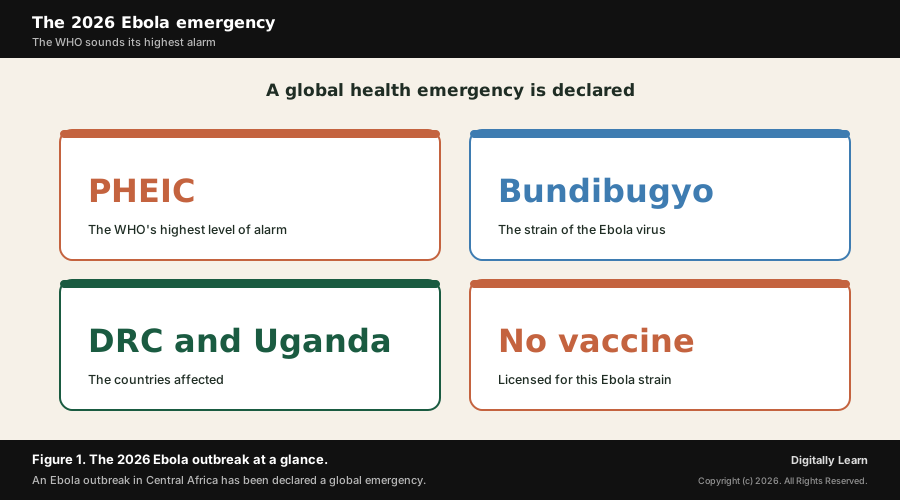
The World Health Organization has declared an outbreak of Ebola, a severe and often deadly viral disease, in the Democratic Republic of the Congo and Uganda a Public Health Emergency of International Concern, its highest level of alarm. The outbreak, caused by the Bundibugyo strain of the Ebola virus, was reported in May 2026. The declaration is meant to mobilise a coordinated global response to a disease that can cross borders and for which this strain has no licensed vaccine.
WHO Declares the Ebola Outbreak a Global Emergency
The highest level of global alarm
In May 2026, the Democratic Republic of the Congo and Uganda declared an outbreak of Ebola, caused by the Bundibugyo strain of the virus. Days later, the World Health Organization declared it a Public Health Emergency of International Concern, the highest alarm it can raise.
The outbreak spread quickly, with cases reported in the eastern provinces of the Democratic Republic of the Congo and across the border in Uganda. As of late May, the WHO reported hundreds of suspected cases and scores of deaths, with figures rising as surveillance expanded.
A worrying feature is that, unlike the better-known Ebola strain, the Bundibugyo strain has no licensed vaccine or specific treatment. This makes early detection, isolation and care all the more important in containing the spread.
Why a Global Health Emergency Matters
An outbreak anywhere is a risk everywhere
Why it matters is that a severe, contagious disease does not respect borders. Ebola can travel with people, and an outbreak in one region can become a threat to others, as past epidemics have shown.
Declaring a global emergency is the WHO's way of marshalling the world's attention and resources. It signals that the outbreak is serious, calls for coordinated action, and reminds countries, including India, that health security is a shared concern.
What the Declaration Signifies
A call to act, not a verdict of doom
What is the significance of this declaration lies in what it triggers. A Public Health Emergency of International Concern is not a prediction of disaster; it is a formal call for stronger surveillance, funding and cooperation while there is still time to contain the outbreak.
Under the declaration, the WHO can issue temporary recommendations, coordinate the supply of medical teams and equipment, and press for an internationally coordinated response. The aim is to stop the outbreak at its source before it spreads further.
Ebola, the PHEIC and the Global Response
The 2026 Ebola outbreak at a glance
The table sets out the key facts of the outbreak and what each one means. Together they show a serious regional outbreak that has been raised to the level of a global concern.
| Feature | Detail |
|---|---|
| Disease | Ebola, caused by the Bundibugyo strain of the virus |
| Where | The Democratic Republic of the Congo and Uganda |
| Declared | An outbreak in mid-May 2026 |
| WHO alert | A Public Health Emergency of International Concern |
| Regional alert | A continental health emergency declared for Africa |
| Vaccine | No licensed vaccine for this strain of Ebola |
Read together, the rows show why the response is urgent: a deadly disease, spreading across a border, with no ready vaccine for this strain.
What Ebola Is and What a PHEIC Means
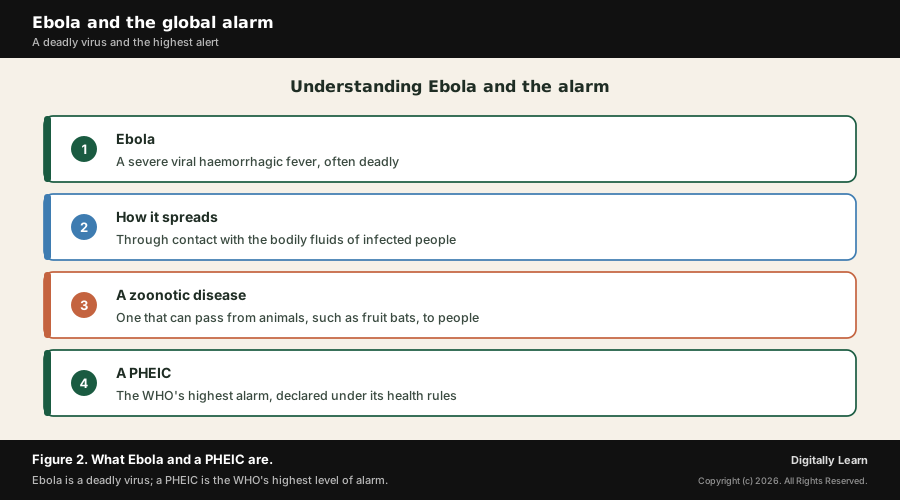
Ebola is a severe viral haemorrhagic fever. It is a zoonotic disease, meaning it can pass from animals such as fruit bats to humans, and it then spreads between people through contact with bodily fluids. It is not spread through the air like a cold.
A Public Health Emergency of International Concern is the WHO's highest level of alarm, declared by its Director-General under the International Health Regulations. It marks an event that poses a risk to other countries and may need a coordinated international response.
What to Watch in the Outbreak
Three things to track from here
The declaration points to three developments worth following, since the course of an outbreak depends on how quickly it is contained.
- (a) Containment. Whether surveillance, isolation and treatment slow the spread within and beyond the affected countries.
- (b) Medical tools. Whether candidate vaccines or treatments for this Ebola strain can be advanced and deployed.
- (c) Cross-border spread. Whether the outbreak is kept from reaching other countries, including through travel screening.
The real test is whether a coordinated response contains the outbreak at its source before it grows into a wider regional and global health crisis.
Global Health Security and India's Stake
The WHO, health rules and One Health
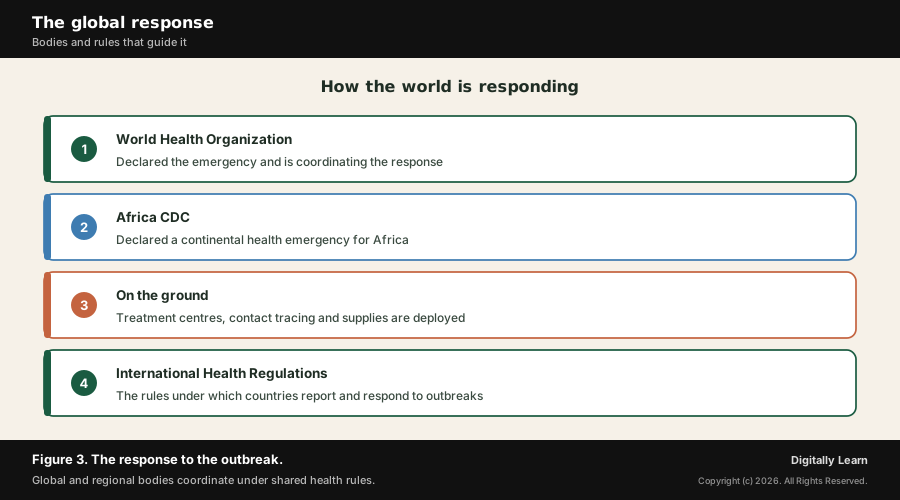
Contemporary linkages tie this outbreak to the system of global health security. The World Health Organization, the United Nations agency for health, coordinates the response, supported by regional bodies such as the Africa Centres for Disease Control and Prevention.
The framework for this is the International Health Regulations, a legally binding agreement under which countries must detect, report and respond to health events that could spread across borders. A PHEIC is declared under these regulations.
Such outbreaks underline the idea of One Health, the recognition that human, animal and environmental health are linked, since diseases like Ebola spill over from animals. Preventing the next outbreak means watching this animal-human boundary.
For India, the lesson is the value of preparedness: strong surveillance, the ability to make vaccines and medicines, and cooperation with global bodies, so that a distant outbreak does not become a domestic crisis.
UPSC Relevance and Exam Focus
Where this fits in the UPSC-CSE syllabus
This topic maps to General Studies Paper II: issues relating to health, and important international institutions, with links to science and technology in Paper III through disease and vaccines.
For Prelims, hold the high-yield facts: Ebola as a viral haemorrhagic fever, the meaning of a Public Health Emergency of International Concern, the International Health Regulations, and the roles of the WHO and bodies like Doctors Without Borders.
For Mains, two framings recur: the role of the WHO in global health security, and how India can strengthen its preparedness against epidemics.
Recurring linked concepts an aspirant should keep in working memory:
- PHEIC: the WHO’s highest alarm, declared under the International Health Regulations.
- International Health Regulations: the binding rules for detecting and reporting cross-border health events.
- Zoonotic disease: one that passes from animals to humans, such as Ebola.
- One Health: the idea that human, animal and environmental health are linked.
A common Prelims trap is to think Ebola spreads through the air; it spreads through contact with the bodily fluids of infected people.
A common Mains trap is to treat an outbreak abroad as someone else's problem. Global health security means an outbreak anywhere can become a risk everywhere.
Previous Year UPSC-CSE Questions By the end you will be able to draft model answers for the following UPSC questions. Each question carries a collapsible framework showing how to approach it in the exam.
- UPSC Mains 2020 GS-IICritically examine the role of WHO in providing global health security during the COVID-19 Pandemic.
How to structure the answer in the exam
Introduction: Open with the WHO's mandate for global health security.
Body (sub-themes to develop):
- Strengths: surveillance, emergency declarations, coordination and guidance.
- Tools: the International Health Regulations and emergency mechanisms.
- Weaknesses: dependence on member reporting, limited enforcement, funding.
- Reform: strengthening early warning and pandemic preparedness.
Conclusion: Conclude that the WHO is central to global health security but needs stronger tools.
- UPSC Prelims 2015 GS-IAmong the following, which were frequently mentioned in the news for the outbreak of Ebola virus recently?
How to approach this Prelims question
Approach: Recall the countries of the major Ebola outbreaks.
Trap to watch: Ebola outbreaks are centred in West and Central Africa, not Asia or the Caribbean.
Key facts to recall:
- The large 2014-16 Ebola epidemic was centred on Guinea, Sierra Leone and Liberia in West Africa.
- Ebola outbreaks recur in Central Africa, such as the Democratic Republic of the Congo.
Answer signal: Guinea, Sierra Leone and Liberia are the West African Ebola countries.
- UPSC Prelims 2016 GS-I'Doctors Without Borders (Medecins Sans Frontieres)', often in the news, is
How to approach this Prelims question
Approach: Recall what kind of body Doctors Without Borders is.
Trap to watch: It is not part of the WHO or the UN; it is an independent non-governmental organisation.
Key facts to recall:
- Doctors Without Borders is a non-governmental international medical humanitarian organisation.
- It is a frequent responder to disease outbreaks and conflicts.
Answer signal: It is a non-governmental international organisation.
Sources and Further Reading
- World Health Organization: Ebola epidemic in the DRC and Uganda determined a public health emergency of international concern
- World Health Organization: Ebola outbreak, Democratic Republic of the Congo 2026
- World Health Organization: Disease Outbreak News, Ebola (Bundibugyo virus)
- Press Information Bureau: WHO declares Ebola outbreak a Public Health Emergency of International Concern
Editorial Disclaimer
This briefing is for UPSC preparation. Verify the latest outbreak figures against the official World Health Organization sources before relying on them.


