


Overview
The MV Hondius Cluster
WHO confirmed a rare rodent-borne outbreak on a cruise ship off Cape Verde, testing cross-border outbreak law.
On 4 May 2026 the World Health Organization confirmed five hantavirus cases (three deaths) among passengers and crew of the MV Hondius cruise ship anchored off Cape Verde, raising fresh questions on cross-border zoonotic-outbreak response and the International Health Regulations framework that governs such events.
The MV Hondius outbreak and the WHO confirmation
Cruise ship at sea, eight reported cases, three deaths
Trigger event: On 4 May 2026, the World Health Organization confirmed five hantavirus cases with three additional suspected, including three deaths, among passengers and crew of the Dutch-flagged cruise ship MV Hondius, now anchored off Cape Verde.
Definition: Hantavirus is a rodent-borne viral infection that produces hantavirus pulmonary syndrome and hemorrhagic fever with renal syndrome. Transmission is typically via inhalation of contaminated rodent excreta. Person-to-person spread is rare but under active investigation in this cluster.
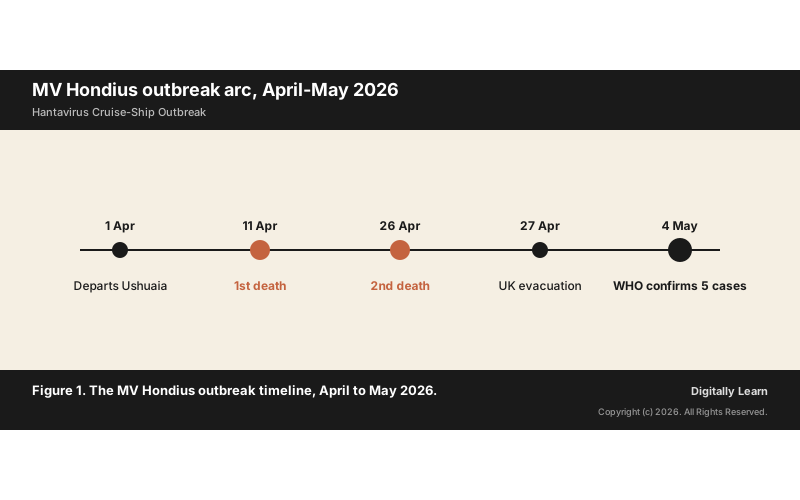
- 1 April 2026: MV Hondius departs Ushuaia in southern Argentina on a polar expedition.
- 11 April 2026: A 70-year-old Dutch passenger dies of respiratory distress on board.
- 24 April 2026: Body disembarked at St Helena; the wife accompanies the repatriation.
- 26 April 2026: The 69-year-old wife dies in a Johannesburg hospital after onset during transit.
- 27 April 2026: A critically ill British passenger evacuated to South Africa for ICU care.
- 3 May 2026: WHO publicly announces investigation of a cruise-ship cluster.
- 4 May 2026: WHO confirms five cases and three deaths; risk to the wider public assessed as low.
Rodent reservoirs and polar-expedition exposure are the working hypothesis for this cluster. Hantavirus typically circulates in wild rodent populations and crosses into humans through inhalation of dust contaminated with rodent excreta. The MV Hondius itinerary covered St Helena, Tristan da Cunha and South Atlantic islands where rodent ecology overlaps human habitation. WHO investigators are testing whether shore excursions, cabin or hold contamination, or pre-boarding exposure in South America explains the initial cluster.
Public health, maritime response and Indian crew exposure
Risk classification, quarantine measures and India angle
Why it matters: Hantavirus outbreaks remain rare, and the global public-health risk in this cluster is judged low because the pathogen does not transmit easily between humans. But the event surfaces deeper questions for India on cross-border zoonotic surveillance, port-of-entry refusal protocols and consular protection of seafarers.
Quarantine on board the Hondius is consequential: Passengers and crew were isolated in cabins with maximal physical distancing. Cape Verde refused docking on public-health grounds. Two sick crew members showed respiratory symptoms and required urgent medical care.
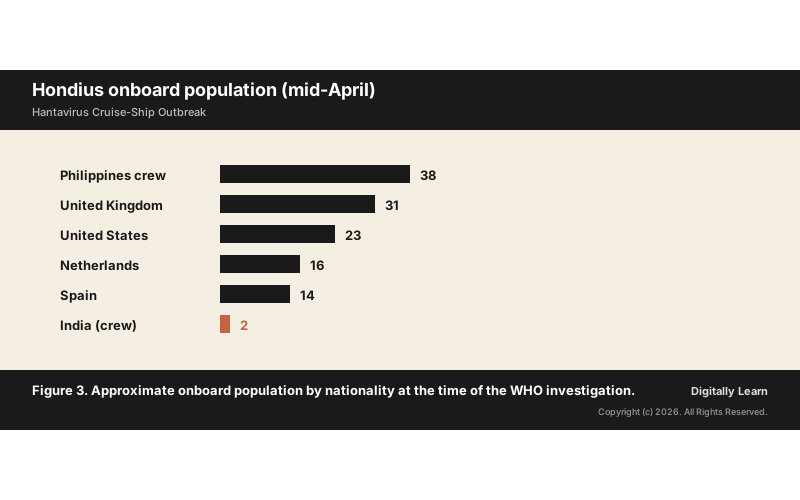
The Indian angle is concrete: Two of the 61 crew members are Indian nationals. Their isolation status, evacuation pathway and consular liaison are an MEA-of-India function under the standard distress-response protocol for Indian seafarers.
India seafarer-distress protocol is the operating framework. Indian Embassies and Missions abroad maintain a Welfare of Indian Citizens Abroad mechanism through which crew on foreign-flagged vessels can be reached during a medical emergency.
The protocol covers onboard medical liaison, host-state evacuation coordination and family communication. Press reporting confirms the two Indian crew aboard the Hondius are in stable cabin isolation, with the Indian Mission in Cabo Verde acting as a consular liaison through the Oceanwide Expeditions corporate channel and the WHO country office.
The 28-nationality crew profile raises a second-order question. International outbreak law treats the flag state (Netherlands), the port state (Cabo Verde) and the worker home states as parallel jurisdictions, none of which holds full authority. In a hantavirus event the question of who pays for evacuation, who runs lab confirmation and who carries liability for delayed care must be settled bilaterally before each next move.
What the outbreak signals for global health governance
WHO coordination, IHR notification and the One Health frame
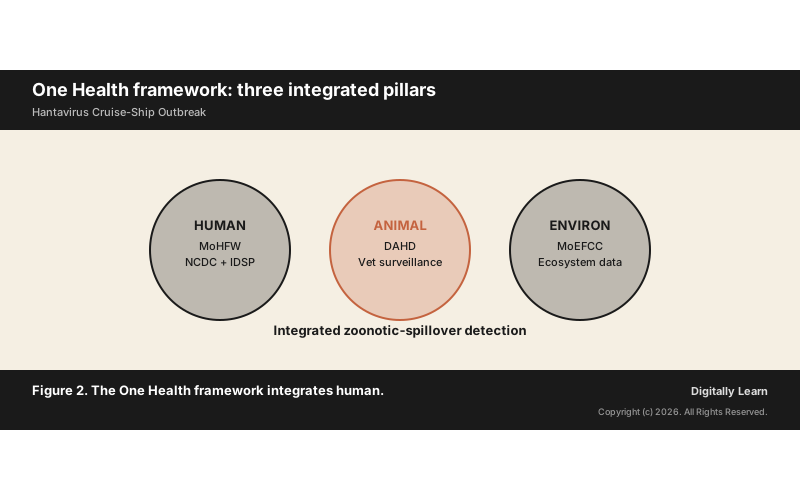
What is the significance of this hantavirus cluster: The episode tests three interlocking frameworks: the International Health Regulations 2005 on cross-border notification, the WHO outbreak-investigation machinery, and the One Health approach that links animal, human and environmental health surveillance.
In governance terms: A cruise-ship outbreak in international waters with multinational passengers stresses every joint in the framework: port-state refusal of entry, flag-state responsibility, evacuation jurisdiction, and laboratory-confirmation timelines across separate national health authorities.
- International Health Regulations 2005: state-party obligations to notify WHO of events that may constitute a public-health emergency of international concern.
- WHO outbreak machinery: case-confirmation, contact-tracing and risk-assessment coordination across Cape Verde, South Africa, the Netherlands and the UK.
- One Health: integrates human-health surveillance with animal and environmental data on rodent reservoirs and zoonotic-spillover risk.
- Maritime public-health: port-state versus flag-state authority over a vessel under quarantine outside territorial waters.
IHR 2005 mechanics structure every notified outbreak. Article 6 sets a 24-hour window for state-party assessment after detection; Article 7 obliges notification of unexpected or unusual events that may constitute a Public Health Emergency of International Concern. The WHO Director-General, advised by an Emergency Committee under Article 12, decides whether a PHEIC designation is justified. The MV Hondius cluster has not been declared a PHEIC; the WHO has classified the wider public-health risk as low while keeping the investigation open.
The Pandemic Agreement state of play is the second layer. Member states are negotiating an instrument to operationalise pathogen-access and benefit-sharing, sustainable financing and equitable distribution of medical countermeasures. The Hondius cluster shows what such an agreement must cover beyond respiratory pandemics: cross-border vessel events, rare zoonotic pathogens, and the One Health interface where rodent reservoirs and travelling-host populations meet.
What sets this cruise outbreak apart
Three architectural features of the Hondius episode
Distinguishing features: Three features separate this outbreak from earlier cruise-ship clusters such as Diamond Princess 2020.
- (i) Rare pathogen, low secondary attack rate. Hantavirus is typically rodent-borne and rarely transmits between humans; the WHO is still investigating whether the Hondius cluster reflects human-to-human spread or a shared environmental exposure.
- (ii) No vaccine, no specific antiviral. Management is supportive care only, with respiratory support and intensive-care escalation; early detection is the principal lever against fatality.
- (iii) Port refusal by Cape Verde. The host country invoked public-health grounds to keep the vessel offshore, requiring at-sea medical teams and an offshore-evacuation strategy rather than dock-side hospital transfer.
| Outbreak characteristic | Diamond Princess 2020 | MV Hondius 2026 |
|---|---|---|
| Pathogen | SARS-CoV-2 (respiratory virus, high R) | Hantavirus (rodent-borne, rare human-to-human) |
| Onboard population | About 3,700 passengers and crew | About 150 passengers and crew, 28 nationalities |
| Quarantine site | Yokohama port, Japan | At-sea anchorage off Cape Verde |
| Public-health risk classification | High | Low (WHO assessment) |
| Treatment options | Supportive then later vaccines and antivirals | Supportive care only, no vaccine or antiviral |
The quarantine calculus differs for rare-pathogen versus respiratory-virus outbreaks. A respiratory virus with a high secondary attack rate (such as SARS-CoV-2 on the Diamond Princess) demands dense onboard isolation to break a fast chain. A rare-pathogen cluster with low human-to-human transmissibility (such as hantavirus on the Hondius) is less about chain-breaking and more about case identification, environmental decontamination and supportive care.
The clinical urgency is asymmetric: Hantavirus has no vaccine and no specific antiviral, which forces a heavy reliance on early respiratory support and intensive-care escalation. The case-fatality ratio of hantavirus pulmonary syndrome is high, commonly cited by the WHO at around 40 per cent and reported even higher in some laboratory-confirmed series, far above the typical respiratory-virus baseline. Early evacuation therefore matters more in clinical terms than it does for chain-of-transmission control.
Outcomes the response cycle is producing
Four trackable consequences across diplomatic and health channels
Observable outcomes: The 4 May confirmation produces four trackable consequences across diplomatic, health-system, scientific and policy channels.
- (a) WHO is coordinating a full public-health risk assessment, with laboratory testing across Cape Verde, South Africa and the Netherlands plus an active investigation into possible human-to-human transmission.
- (b) Maritime evacuation pathway opened: Spanish authorities cleared the Hondius to sail to Tenerife in the Canary Islands, with an expected arrival around 10 May 2026.
- (c) Contact tracing widened to a passenger flight between St Helena and Johannesburg that carried the second fatality.
- (d) India consular liaison follows the standard MEA protocol for distressed seafarers; the two Indian crew members are reported in stable health within the cabin-isolation regime.
Contact-tracing geography is unusually wide for this cluster. The second fatality, the 69-year-old Dutch woman, fell ill during a commercial flight from St Helena to Johannesburg between 24 and 26 April. WHO-coordinated tracing now covers fellow passengers on that flight, airport ground staff and the South African hospital network that treated her and the evacuated British patient.
The travel-history dimension is critical: Press reporting records that the index Dutch couple had travelled in Argentina and elsewhere in South America before boarding. WHO investigators are testing whether the source exposure preceded embarkation. If confirmed, this would push the response framework toward port-of-departure screening rather than mid-voyage detection, with implications for cruise-operator pre-boarding health-screening protocols across the global passenger fleet.
The South African ICU referral pathway is the operational backbone of the response. Both the second fatality (the Dutch woman) and the critically ill British passenger were referred to Johannesburg hospitals after evacuation flights from St Helena and Ascension.
Laboratory confirmation of the British patient was returned within days; the Dutch woman's posthumous test was returned 4 May. The South African testing capacity therefore carried the analytical load even though neither the index country nor the host port performed the confirmatory work.
Connections to recent pandemic preparedness
Connecting hantavirus to the COVID and zoonotic-outbreak arc
Contemporary linkages: The Hondius episode is the latest in a series of cross-border outbreak events that connect maritime quarantine, WHO coordination, IHR notification and India domestic readiness through the National Centre for Disease Control.
- The 2020 Diamond Princess outbreak set the modern template for cruise-ship quarantine and remains the standard reference for port-state versus flag-state authority.
- India’s National Centre for Disease Control runs the Integrated Disease Surveillance Programme with weekly outbreak reporting from district units.
- India’s One Health approach was codified after the 2020 COVID-19 cycle, with veterinary, public-health and environmental agencies integrated under a single platform.
- The WHO Pandemic Agreement negotiations carry forward the question of who pays for shared laboratory capacity, sequencing and stockpiles during cross-border events.
India domestic surveillance mechanics close the loop. The Integrated Disease Surveillance Programme runs through district surveillance units that file weekly outbreak reports up to the National Centre for Disease Control. The Integrated Health Information Platform is the digital backbone that supports near-real-time outbreak intelligence with case-line data, laboratory linkage and geo-tagging.
The One Health institutional thread is operationally newer. The Department of Animal Husbandry and Dairying, the Ministry of Environment, Forest and Climate Change and MoHFW co-chair a national One Health platform that integrates animal, environmental and human surveillance signals. The hantavirus cluster is a useful test of whether that platform can flag rodent-borne zoonotic risk at India's port-of-entry surveillance perimeter.
UPSC Relevance
GS Paper II Health and GS Paper III Science links
Where it fits: The outbreak sits at the intersection of GS Paper II on Health and on Global Bodies (WHO and the IHR framework) and GS Paper III on Science and Technology, specifically zoonotic-pathogen surveillance and the One Health approach.
For Prelims, the high-yield facts cluster around hantavirus transmission, the WHO outbreak-response architecture, the IHR 2005 PHEIC categorisation, and India's Integrated Disease Surveillance Programme.
- Hantavirus: rodent-borne; HPS and HFRS clinical syndromes; no vaccine, supportive care.
- WHO headquarters: Geneva; created 1948; IHR adopted 1969 and revised 2005.
- PHEIC: Public Health Emergency of International Concern, declared by the WHO Director-General.
- India’s National Centre for Disease Control: under MoHFW; runs IDSP and the Integrated Health Information Platform.
For Mains, two framings recur. First, the WHO global-health-security question (the GS-II 2020 theme): whether the WHO can respond to multinational outbreaks while sovereignty constraints persist. Second, the One Health architecture question: how India should integrate animal, human and environmental surveillance to detect zoonotic spillover early.
The WHO Pandemic Agreement track is the operative reform conversation. Member states have been negotiating an instrument with chapters on pathogen-access and benefit-sharing, sustainable financing through assessed contributions, and coordinated production of vaccines and therapeutics. The Hondius episode adds the case for explicit clauses on cross-border vessel events and on the One Health interface where rodent and human populations meet.
India's interest in reform is concrete: As a major contributor to the global vaccine supply and as a state with significant overseas seafarer and migrant populations, India argues for stronger notification timelines, faster pathogen sequencing sharing and predictable funding for rapid-response platforms. The Hondius cluster, while clinically narrow, surfaces every one of those reform threads at once.
Past-year questions linked to this briefing
Prelims 2022 vaccines and Mains 2020 WHO-COVID links
How this links to PYQs: The hantavirus cluster activates two past-year items: a Prelims 2022 Q39 on COVID-19 vaccine platforms, and a Mains 2020 GS-II Q9 on the WHO role in global health security during the COVID-19 pandemic. Both link directly to outbreak-response architecture.
The 2020 Mains prompt is operationally re-tested in this cluster. The 2020 GS-II question asked candidates to critically examine the WHO role during the COVID-19 pandemic; the Hondius episode supplies a fresh 2026 case for the same architecture, but with a rare zoonotic pathogen instead of a respiratory virus. The port-state versus flag-state coordination question, the contact-tracing across multinational jurisdictions, and the question of who pays for laboratory confirmation across borders all sit live in the 2020 framework today.
Previous Year UPSC-CSE Questions By the end you will be able to draft model answers for the following UPSC questions. Each question carries a collapsible framework showing how to approach it in the exam.
- UPSC Prelims 2022In the context of vaccines manufactured to prevent COVID-19 pandemic, consider the following statements:
- The Serum Institute of India produced COVID-19 vaccine named Covishield using mRNA platform.
- Sputnik V vaccine is manufactured using vector based platform.
- COVAXIN is an inactivated pathogen based vaccine.
Which of the statements given above are correct?
How to approach this Prelims question
Approach: Verify each statement against vaccine-platform fact: Covishield is adenoviral vector (not mRNA); Sputnik V is vector; COVAXIN is inactivated pathogen.
Trap to watch: Mistaking Covishield for an mRNA vaccine confuses it with the Pfizer/Moderna platform.
Key facts to recall:
- Covishield: adenoviral vector platform (ChAdOx1 from AstraZeneca/Oxford).
- Sputnik V: vector-based platform.
- COVAXIN: inactivated whole-pathogen platform (Bharat Biotech).
Answer signal: Statement 1 is incorrect; statements 2 and 3 are correct; option (b) is the answer.
- UPSC Mains 2020 GS-IICritically examine the role of WHO in providing global health security during the COVID-19 Pandemic.
How to structure the answer in the exam
Introduction: The World Health Organization sits at the apex of the global health-security architecture. Its mandate covers outbreak notification, technical guidance, vaccine equity and the International Health Regulations.
Body (sub-themes to develop):
- Strengths: rapid technical notes, the IHR framework, vaccine platforms support and global situation reports.
- Limits: sovereignty constraints on member-state data sharing, funding cap, dependence on voluntary contributions.
- 2020 example: COVID-19 cycle exposed both notification delays and the inequity of vaccine distribution.
- 2026 example: the Hondius hantavirus cluster activates port-state versus flag-state coordination and rare-pathogen surveillance.
- Reform options: the WHO Pandemic Agreement, IHR 2005 amendments, sustainable financing through assessed contributions.
Conclusion: The WHO remains indispensable to outbreak response but the recurring stress test from cross-border events demands deeper authority on data, finance and the One Health interface.
Sources and Further Reading
- Hindu National: Hantavirus outbreak: Seven cases confirmed or suspected on stranded cruise ship (5 May 2026)
- Hindu International: Hantavirus outbreak cruise ship with 150 aboard waits for help, not allowed to dock (5 May 2026)
- Hindu International: MV Hondius cruise ship hantavirus outbreak what we know so far (6 May 2026)
- Indian Express: Inside the MV Hondius hantavirus cruise ship outbreak (7 May 2026)
- World Health Organization: Hantavirus health topic
- US Centers for Disease Control and Prevention: About Hantavirus
- National Centre for Disease Control, India
- Wikipedia: Orthohantavirus
Editorial Disclaimer
This article is compiled from the reference materials listed in the Sources section. It is an explainer for UPSC preparation and is not a substitute for primary documents (NCERTs, GoI ministry releases, IMD bulletins, RBI / CEA / MoEFCC publications, and Standing-Committee reports).


