


Overview
India's clean-cooking-fuel mission
The Pradhan Mantri Ujjwala Yojana, launched in 2016 by the Ministry of Petroleum and Natural Gas through the oil marketing companies, gives an adult woman of a poor household a deposit-free LPG connection, moving the kitchen away from firewood, dung and indoor smoke towards clean cooking fuel, women's health and SDG-7 energy access.
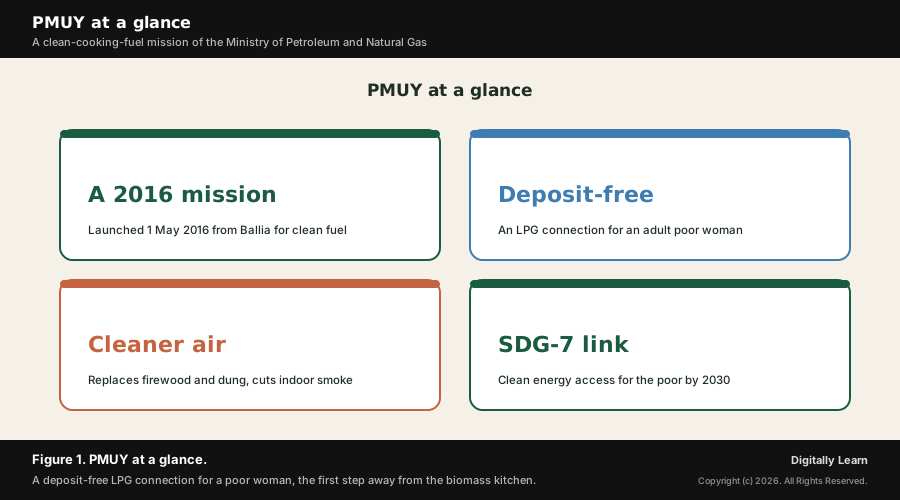
PMUY, the Pradhan Mantri Ujjwala Yojana, is India's flagship clean-cooking-fuel mission, launched on 1 May 2016 from Ballia in Uttar Pradesh to put clean LPG in place of firewood, coal and cow-dung in the kitchens of the poor. It is delivered by the Ministry of Petroleum and Natural Gas through the oil marketing companies, and its core offer is a deposit-free LPG connection given to an adult woman of a poor household, with a first refill and a stove free of cost. By moving the household off biomass, the mission attacks the indoor air pollution that harms women and children most, and it ties the kitchen to women's health, the refill subsidy paid by Direct Benefit Transfer and the goal of SDG-7 clean energy access.
What PMUY Is: A National Mission to Put Clean Cooking Fuel in Poor Kitchens
The 2016 clean-cooking mission, the biomass kitchen and why clean fuel matters
The Pradhan Mantri Ujjwala Yojana, known as PMUY, is the programme through which the Indian state set out to give a poor household a clean cooking fuel in place of the wood and dung it had always burned. It was launched on 1 May 2016 from Ballia in Uttar Pradesh as a flagship mission of the Ministry of Petroleum and Natural Gas, and it is delivered on the ground by the oil marketing companies, the public-sector fuel firms that already run the country's network of LPG distributors. Its purpose was stated plainly: to make liquefied petroleum gas, a clean fuel, available to the rural and deprived households that were otherwise using firewood, coal and cow-dung cakes.
The problem PMUY attacks is the biomass kitchen, the condition in which a poor family cooks over an open fire of firewood, crop waste or cow-dung, filling the home with smoke. Burning these solid fuels indoors produces a dense haze of soot and harmful gases, and the woman who tends the hearth and the small children beside her breathe it for hours each day. This household air pollution is no minor discomfort: the World Health Organization treats it as a leading cause of disease and early death among the poor, which the next section examines in detail. The figure below sets out the headline features of the mission before the detail that follows.
Why it matters is that access to a clean fuel changes far more than the cooking. A clean flame removes the smoke that scars the lungs, frees the hours a woman once spent gathering and carrying firewood, and spares the forest the daily cutting that fuel-gathering brings. By making the deposit-free connection the first step, the mission aims to draw the poor onto a fuel that is cleaner, quicker and safer, and to make a service that the city had long enjoyed reach the village kitchen. The headline design that delivers this is summarised in the figure that follows.
The Clean-Cooking Problem: Biomass, Indoor Air Pollution and the Burden on Women
Solid fuels and household air pollution, the toll on women and children and the burden of fuel-gathering
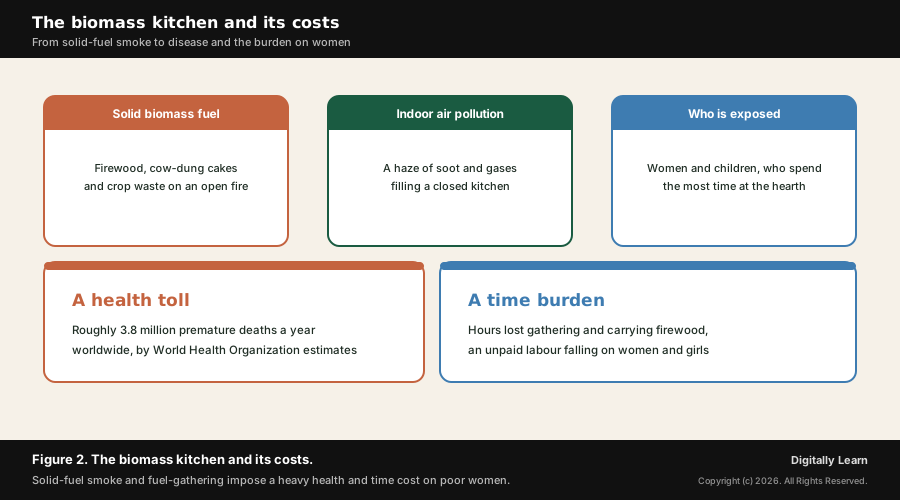
To grasp why PMUY matters, one must first see the kitchen it was built to change. Across much of rural India a meal is cooked on a chulha, an open mud stove fed with firewood, dried cow-dung cakes and crop residue, all of them solid biomass fuels. Burned in the open, these fuels never combust cleanly: they release a thick smoke of fine soot particles and toxic gases into a closed room, producing what is called household air pollution. The woman bent over the fire and the infant on her hip inhale this haze for hours at every meal, day after day, with no chimney to carry it away.
The health toll is heavy and well documented. The World Health Organization estimates that household air pollution from the inefficient burning of solid fuels and kerosene causes roughly 3.8 million premature deaths a year worldwide, and it notes that the exposure falls hardest on the women and young children who spend the most time near the hearth. The smoke is linked to pneumonia in small children, and to stroke, heart disease, chronic lung disease and lung cancer in adults, so that the daily act of cooking quietly becomes a cause of grave illness. A clean fuel removes the source of that smoke at a stroke.
Beyond illness there is the burden of time and drudgery. Where a household cooks on biomass, someone, almost always a woman or a girl, must gather and carry the fuel, walking long distances to collect headloads of wood, an unpaid labour that eats into the hours she could give to rest, to earning or to a child's schooling. This is the time-poverty that fuel scarcity imposes on poor women. A clean LPG flame, lit at the turn of a knob, returns those hours and lifts that load, which is why the mission is treated as much a measure for women as a measure for energy. The figure below sets out the chain from the biomass kitchen to its costs.
The Design of PMUY: The Deposit-Free Connection, Eligibility and the Connection-Refill Distinction
What the deposit-free connection waives, who is eligible and the free first refill and stove
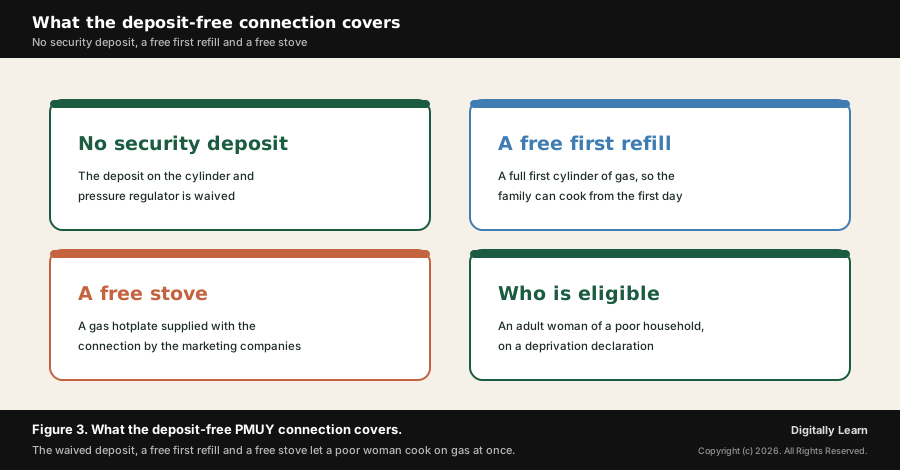
The heart of PMUY is the deposit-free connection, designed to remove the very cost that had kept the poor off gas. A new LPG connection normally requires a household to pay a security deposit on the cylinder and the pressure regulator, a sum a poor family cannot spare. Under the mission the Government meets this security deposit, so the woman receives the cylinder, the regulator, the safety hose and the consumer card without paying the upfront amount that had been the true barrier. The connection is thus free at the point of entry, which is what allowed it to reach families that the ordinary commercial connection never touched.
Eligibility is framed around the poor woman. The applicant must be an adult woman, eighteen years of age or older, who belongs to a poor household, and the connection is issued in her name, a deliberate choice that puts the asset and the cooking decision in a woman's hands. At launch the scheme drew its beneficiaries from below-poverty-line families identified through the socio-economic data, and over time the eligible categories were widened to cover other deprived groups so that more of the genuinely poor could be reached. A household is treated as eligible on a deprivation declaration in the prescribed form, a self-statement that keeps the paperwork within reach of the applicant.
To make the gas usable from day one, the connection comes with start-up support. Every PMUY beneficiary is given a first refill and a stove, the gas hotplate, both free of cost, supplied by the oil marketing companies along with the deposit-free connection. This matters because a connection without a burner or a first cylinder of gas would be an empty gesture; by handing over a full cylinder and a stove together, the mission lets the woman cook her first clean meal at once. The figure below sets out exactly what the deposit-free connection covers.
The crucial distinction between giving a connection and sustaining the refill
One distinction runs through every debate about PMUY and must be grasped at the outset: the difference between the connection and the refill. The mission's deposit-free offer is about the connection, the one-time act of putting a cylinder, a regulator and a stove in a poor woman's kitchen. But cooking on gas is a recurring expense, because once the free first cylinder is used the household must buy each refill at the market price, and a poor family on an uncertain income may find that price hard to meet month after month.
This is why the count of connections released and the rate of refills bought are two very different measures of success, and why the mission's later additions, the targeted refill subsidy and the sustained-use effort examined further on, were aimed squarely at the refill rather than the connection. A scheme that gives a clean stove but leaves the family unable to afford the gas would change the kitchen on paper alone. Holding this connection-versus-refill distinction in mind is the key to reading both the achievements of PMUY and the critiques levelled against it.
Ujjwala 2.0: The Expansion, the Migrant Self-Declaration and the Deeper Push
The 2021 expansion, the additional connections and address proof by self-declaration for migrants
The first phase of PMUY ran from 2016 with a target framed in crores of connections, and once that target was met the Government opened a second phase to reach those still left out. Ujjwala 2.0 was launched on 10 August 2021 to provide an additional tranche of connections, beginning with about one crore families who had been missed in the first round, again as a deposit-free connection with a free first refill and stove. The second phase kept the core design but widened the door, so that a household which had slipped through the first count could now come in.
The most important change in Ujjwala 2.0 was a procedural one that mattered greatly to the poorest: the acceptance of self-declaration for address. A large number of the urban poor are migrants, people who have moved for work and who lack a ration card or an address proof for the place they now live, and the old requirement of such documents had shut many of them out. Under the second phase a migrant could submit a self-declaration of family composition and of the current address, in a prescribed annexure, in place of formal proof, so that the want of a local document no longer barred a genuinely poor migrant from a clean cooking connection.
Ujjwala 2.0 also carried forward the wider intent of deepening clean-fuel use rather than merely adding names to a list. By easing entry for migrants and by pairing the new connections with the refill support that the sustained-use effort had introduced, the second phase tried to ensure that the families brought in would actually keep cooking on gas. The expansion thus did two things at once: it stretched the reach of the mission to the last excluded households, and it leaned against the very refill weakness that the first phase had exposed. The table below contrasts the two phases of the mission.
| Feature | PMUY phase one (from 2016) | Ujjwala 2.0 (from 2021) |
|---|---|---|
| Core offer | Deposit-free LPG connection with a free first refill and stove | The same deposit-free connection, extended to those left out |
| Whom it reaches | Adult women of poor households, drawn from below-poverty-line and widened categories | An additional tranche, beginning with about one crore left-out families |
| Address proof | Ordinary documents, including a ration card, required | A self-declaration of address accepted, easing entry for migrants |
| Emphasis | Mass roll-out of connections | Reaching the last households and supporting sustained refill use |
The Delivery Architecture: The Ministry, the Oil Marketing Companies, Distributors and DBT
The Ministry of Petroleum and Natural Gas, the oil marketing companies, the distributor network and the subsidy by Direct Benefit Transfer
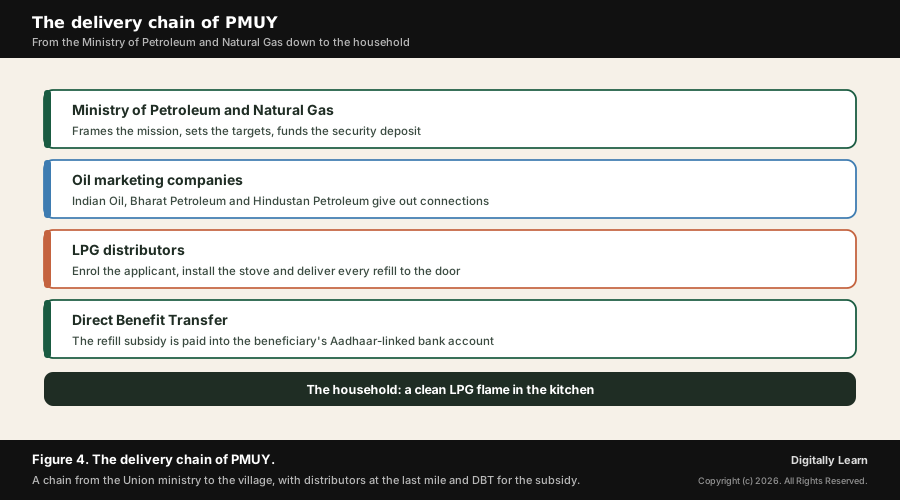
PMUY is delivered through a chain that runs from a Union ministry to the village kitchen, and understanding that chain is essential to judging the scheme. At the top is the Ministry of Petroleum and Natural Gas, the Union ministry in charge of oil and gas, which frames the mission, sets the targets and provides the funds that meet the security deposit on each connection. It is a scheme driven through administrative machinery rather than a single statute, so the ministry's task is to steer the fuel industry it oversees towards the goal of clean-cooking access for the poor.
The actual work of giving out connections is done by the oil marketing companies, the public-sector fuel firms, Indian Oil, Bharat Petroleum and Hindustan Petroleum, that bottle and sell LPG across the country. Beneath them sits a vast network of LPG distributors, the local agencies that enrol the applicant, verify her eligibility, install the cylinder and the stove and deliver every refill to her door. This distributor network is the true last mile of the mission, the point at which a national policy becomes a cylinder carried into a poor woman's home, and its reach into rural areas is what allowed PMUY to operate at the scale it did.
The money side runs on Direct Benefit Transfer. The refill subsidy a beneficiary is owed is not handed over at the counter as a discount; instead the customer pays for the cylinder and the subsidy is credited straight into her bank account, a method built on the earlier reform that moved the LPG subsidy onto direct transfer. Aadhaar and the bank account are used to route the payment to the right person and to weed out duplicate and ghost beneficiaries, so that the subsidy reaches the genuine cardholder rather than leaking on the way. The figure below maps this delivery chain from the ministry to the household.
Affordability and the Targeted Refill Subsidy: The Price of Sustained Use
The refill-affordability question and the targeted subsidy for PMUY consumers
The single hardest question PMUY faced was not how to give a connection but how to keep the family cooking on it, and that question is one of affordability. The mission solved the upfront barrier through the deposit-free connection, but the recurring cost of a refill remained, and when the market price of a cylinder rose, a poor household on an unsteady income could quietly drift back to the free firewood it had always used. The gap between owning a connection and being able to afford the gas became the central refill challenge of the scheme.
The Government's answer was a targeted subsidy for PMUY consumers, aimed at the refill rather than the connection. The Union Cabinet has approved a targeted subsidy for PMUY beneficiaries, credited directly into the beneficiary's bank account on each cylinder, to bring the effective price of a refill within reach and so encourage sustained use. The per-cylinder amount and the number of subsidised refills in a year have been revised over time as official decisions are renewed, so the precise rupee figure is best read as the current approved level rather than a fixed feature, but the design is constant: a direct, account-credited subsidy that targets the poor PMUY customer specifically.
This targeted subsidy reflects a deliberate shift in how the state subsidises fuel. Rather than selling LPG below cost to everyone, which leaks gain to the well-off, the subsidy is now targeted at the identified poor consumer and delivered by Direct Benefit Transfer into her account, so that the benefit reaches the person it is meant for and the better-off pay the market price. Whether the subsidy is generous enough, and stable enough, to keep every poor family refilling is a live policy question, but the instrument squarely addresses the affordability gap that the connection alone could not close.
The Outcomes: Connections Released, Wider LPG Coverage and the Reach to Women
Crores of connections, the rise in LPG coverage and the gains for women's health and time
The first and most visible outcome of PMUY is the sheer number of connections released. Over the years of the mission, crores of deposit-free connections have been given to poor households, taking the count well past the early target, which was raised as the scheme outran its first goal. The expansion drew into the LPG fold families that the ordinary commercial connection had never reached, so that a service once concentrated in towns now extends deep into the countryside. The precise running total moves with each official report and is best read as over ten crore connections, an indicative scale rather than a fixed figure.
A second outcome is the broad rise in LPG coverage across the country. By adding so many new households at the bottom, the mission lifted India's overall access to clean cooking fuel markedly, narrowing the gap between rich and poor in the kind of fuel they cook on. This is the contribution that ties PMUY to SDG-7, the global goal of clean energy access for all, since the spread of LPG to the deprived is exactly the kind of progress that goal measures. The depth of that coverage, however, depends on the refill question, which is why coverage and sustained use must be read together.
A third outcome lies in the reach to women. Because every connection is issued to an adult woman, the mission placed a valuable household asset and the cooking choice in women's hands on a vast scale, and the move off biomass eased both the health harm of indoor smoke and the time lost to gathering fuel. A clean flame means fewer hours bent over a smoking fire and fewer journeys for firewood, returning time and protecting the lungs of the very women and children who had borne the worst of the old kitchen. These gains are real, even as their full measure depends on how steadily the gas is actually used.
The Critiques and Debates: Refill Rates, Subsidy Cost, Fuel Stacking and the Last Mile
Low refill and sustained use, the fiscal cost of the subsidy, stacking with biomass and last-mile leakage
A balanced reading sets the gains against persistent critiques, presented here as they are argued by independent researchers, economists and audit bodies. The most common concern is low refill and sustained use: critics point out that a household which holds a connection may still buy too few refills to cook on gas all the time, so that the headline count of connections can run ahead of the real shift away from smoke. On this view, opening a connection is not the same as changing the fuel a family actually cooks on day to day.
A second debate is over the fiscal cost of the subsidy and the question of fuel stacking. Keeping refills affordable for crores of poor households through a targeted subsidy is a heavy and recurring charge on the exchequer, and critics ask how far that cost can be sustained and whether it is well targeted. Linked to this is fuel stacking, the common practice by which a family keeps both the gas and the old chulha, using LPG for some cooking and free firewood for the rest to save money, so that the clean fuel only partly displaces the dirty one and the health gain is diluted.
Further concerns cluster around the last mile and around leakage. In remote areas the delivery of a heavy cylinder over poor roads can be slow and costly, so that a distant household may struggle to get timely refills even when it can pay, a weakness of last-mile reach. Critics also press on the targeting of beneficiaries and the risk of leakage, asking whether every connection went to a genuinely poor woman, though the use of Aadhaar and bank-account transfer is meant to limit such error. On the central question, whether PMUY has turned mass connection-giving into a lasting move to clean cooking, a careful answer treats the matter as open and weighs both sides.
The Wider Linkages: SDG-7, Women's Empowerment and the LPG Subsidy Reform
SDG-7 clean energy access, the empowerment and health dividend and the place of DBT in LPG subsidy reform
PMUY sits inside a set of larger themes that an examiner expects a candidate to connect. The first is SDG-7, the United Nations goal of ensuring access to affordable, reliable and modern energy for all by 2030, whose clean-cooking target is precisely about moving households off polluting fuels. The world is far from that target, with a great many people still cooking on polluting fuels, and a national mission that brings clean LPG to crores of the poor is among the most direct ways a country can advance the clean-cooking side of SDG-7.
The second linkage is to women's empowerment and health. By issuing the connection to a woman, easing the indoor smoke that the World Health Organization links to grave disease, and returning the hours once lost to fuel-gathering, the mission has a clear gender dividend that ties it to the wider effort to lift the status of women. It is studied alongside the schemes that give women an account, an asset or a livelihood, as one of the levers through which welfare policy seeks to widen a woman's autonomy and protect her health at the same time.
The third linkage is to LPG subsidy reform and the role of Direct Benefit Transfer. PMUY's refill subsidy is built on the earlier reform that moved the cooking-gas subsidy away from a below-cost counter price and onto a direct, account-credited transfer, a landmark case of replacing a price subsidy with DBT. That reform showed how routing a subsidy through an Aadhaar-linked bank account can cut duplicate and ghost claims and target the genuine poor, and PMUY now rides on exactly this machinery, which is why the mission is read as a case study in the modern, targeted welfare state as much as in clean energy.
Understanding the Significance: Clean Air, Women's Welfare and Energy Justice
A health intervention, a measure for women and a step in energy justice
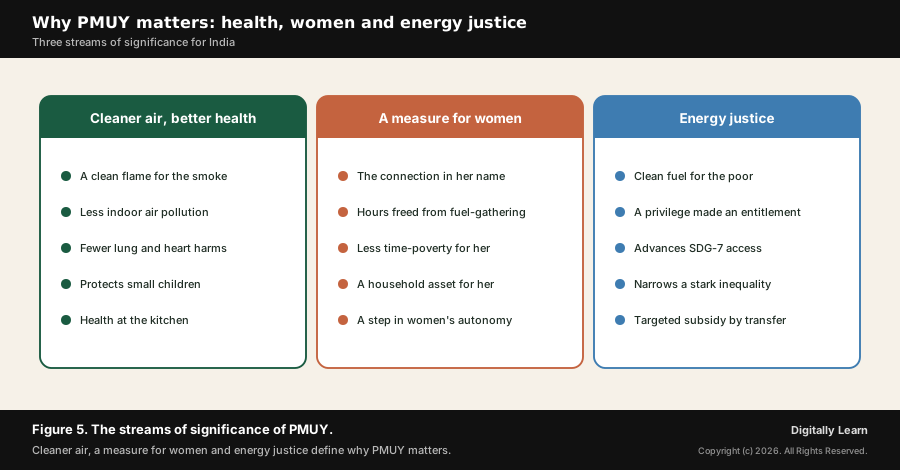
What is the significance of PMUY lies first in its character as a public-health intervention disguised as an energy scheme. By replacing the smoking chulha with a clean flame, the mission strikes at indoor air pollution, one of the largest environmental causes of disease among the poor, and so prevents the pneumonia, heart disease and lung damage that the old kitchen quietly inflicted. This makes PMUY far more than a fuel programme; it is a measure that buys better health for the poorest at the point where they are most exposed, the kitchen.
Its second significance is as a measure for women. Because the connection is a woman's and the burden it lifts is a woman's, the mission carries a direct gender meaning: it eases the time-poverty of endless fuel-gathering, protects the health of the one most exposed to smoke, and places a real household asset in her name. Read this way, PMUY belongs with the policies that try to widen women's autonomy, and its reach to crores of poor women is among the largest such interventions attempted anywhere.
Its third significance is as a step in energy justice and the meeting of SDG-7. Clean cooking fuel had long been a comfort of the better-off, and the mission's deepest claim is that it makes a clean flame the entitlement of the poor rather than a privilege of the rich, narrowing one of the starkest inequalities of daily life. By advancing the clean-cooking side of SDG-7 on a vast scale, PMUY is treated as a landmark in India's social and energy policy. The figure below maps these strands of significance.
The Way Forward: From Connection to Refill, Affordable Gas and Deeper Clean-Fuel Use
Turning connections into sustained refills, keeping the gas affordable and strengthening the last mile
The way forward follows directly from the critiques. The first priority is to move from the connection to the refill: to ensure that the households already connected actually cook on gas through the year, by keeping the price within reach and by steady awareness about the health cost of the old smoke, so that a connection given on paper becomes a clean flame burning in fact and the depth of the shift catches up with its breadth.
The second priority is to keep the gas affordable and to strengthen the last mile. A stable, well-targeted refill subsidy, paid promptly by transfer, would steady a poor family's ability to refill when prices rise, while better delivery into remote areas, with reliable distributors and timely supply, would close the gap that leaves a distant household waiting for its cylinder. Alongside this, smaller cylinder sizes and easier booking can lower the hurdle that a full refill at one go can pose to the poorest, easing them into regular use rather than back to firewood.
The third priority is to deepen clean-fuel use rather than rest on the connection count. Tackling fuel stacking, the habit of cooking partly on gas and partly on free biomass, through awareness and affordability, and continuing to reach the last excluded and migrant households, would turn the mission from a drive that handed out connections into one that genuinely changed the air in the kitchen. Pursued together, these measures would move PMUY closer to its founding promise: not merely a cylinder in every poor home, but a clean flame that the family can afford to keep lit.
UPSC Relevance and Exam Focus
Where PMUY fits in the UPSC-CSE syllabus
This topic maps most directly to General Studies Paper II: government policies and interventions for development in various sectors, and issues arising out of their design and implementation; and welfare schemes for vulnerable sections, since PMUY is a flagship welfare mission whose design and delivery are routinely examined. It also links strongly to General Studies Paper III, where energy security, the environment and the targeting of subsidies are core themes, and it supplies rich material on the reform of fuel subsidies through Direct Benefit Transfer and on the meeting of global goals such as SDG-7.
For Prelims, hold the high-yield facts: PMUY is a 2016 clean-cooking-fuel mission launched from Ballia and run by the Ministry of Petroleum and Natural Gas through the oil marketing companies; its core offer is a deposit-free LPG connection to an adult woman of a poor household, with a free first refill and a free stove; Ujjwala 2.0 of 2021 added connections for the left-out and accepted a self-declaration of address for migrants; and a targeted refill subsidy is paid into the beneficiary's bank account by Direct Benefit Transfer to support sustained use.
For Mains, the recurring framing is to assess the scheme as a study in welfare design and subsidy reform: how the deposit-free connection brought clean fuel to the poor, how the refill subsidy was moved from a below-cost price to a targeted Direct Benefit Transfer, and how far low refill rates, fuel stacking and last-mile reach have limited the real shift to clean cooking. A strong answer treats PMUY as a case study in subsidy reform and welfare delivery, weighing its real gains in access and women's health against the unresolved questions of affordability and sustained use.
Recurring linked concepts an aspirant should keep in working memory:
- Household air pollution: The indoor smoke from burning solid fuels that the World Health Organization links to grave disease, the harm PMUY sets out to remove.
- SDG-7: The United Nations goal of affordable, reliable, modern energy access for all by 2030, whose clean-cooking target PMUY advances.
- Direct Benefit Transfer: The payment of the refill subsidy straight into the beneficiary’s bank account, replacing a below-cost price subsidy.
- Fuel stacking: The practice of cooking partly on gas and partly on free biomass, which dilutes the health gain and is a key critique of the scheme.
A common Prelims trap is to confuse the bodies and the benefits; hold that PMUY is run by the Ministry of Petroleum and Natural Gas through the oil marketing companies, not by a rural-development or finance department, that the connection is deposit-free rather than wholly free of all future cost, and that the refill subsidy is paid by Direct Benefit Transfer into a bank account rather than as a counter discount.
A common Mains trap is to praise the connection count and stop there. The exam value lies in a balanced judgment: the real achievements in clean-fuel access, women's health and SDG-7, set honestly against the open problems of refill affordability, fuel stacking and last-mile reach that decide whether the gas is truly used.
Previous Year UPSC-CSE Questions By the end you will be able to draft model answers for the following UPSC questions. Each question carries a collapsible framework showing how to approach it in the exam.
- UPSC Mains 2015 GS-IIIDiscuss how replacing a price subsidy with Direct Benefit Transfer (DBT) could change the subsidy scenario in India, that is, what difference cash-into-the-account targeting makes to leakage, ghost beneficiaries, targeting and fiscal cost.
How to structure the answer in the exam
Body (sub-themes to develop):
- What changes: a benefit once given as a below-cost counter price is credited straight into the beneficiary's Aadhaar-linked bank account, so the customer pays the market price and receives the subsidy directly.
- Better targeting and less leakage: linking the transfer to Aadhaar and a bank account weeds out duplicate and ghost beneficiaries and directs the subsidy to the identified poor, as PMUY's targeted refill subsidy does.
- Fiscal and governance effects: DBT makes the subsidy visible and auditable and can allow the better-off to be excluded, though a targeted subsidy for crores of households remains a heavy recurring charge on the exchequer.
- Limits and cautions: DBT depends on a bank account, Aadhaar seeding and reliable transfer, and even a well-paid subsidy may not close the affordability gap if prices rise, as the PMUY refill experience shows.
- Reasoned judgment: replacing a price subsidy with DBT can sharpen targeting, cut leakage and improve transparency, but its success depends on the financial-inclusion plumbing beneath it and on keeping the benefit adequate.
Sources and Further Reading
- Ministry of Petroleum and Natural Gas: Pradhan Mantri Ujjwala Yojana, About
- Pradhan Mantri Ujjwala Yojana: New Ujjwala 2.0 Connection
- Ministry of Petroleum and Natural Gas: Ujjwala 2.0
- Ministry of Petroleum and Natural Gas: Targeted Subsidy to PMUY Consumers
- Press Information Bureau: Cabinet approves continuation of targeted subsidy to PM Ujjwala Yojana consumers
- Petroleum Planning and Analysis Cell: State-wise active domestic customers of LPG
- World Health Organization: Household air pollution and health, fact sheet
- United Nations: Sustainable Development Goal 7, energy
- Wikipedia: Pradhan Mantri Ujjwala Yojana
Editorial Disclaimer
This briefing is for UPSC preparation. Verify the facts and figures against the official Ministry of Petroleum and Natural Gas, PMUY and PIB sources before relying on them.


