


Overview
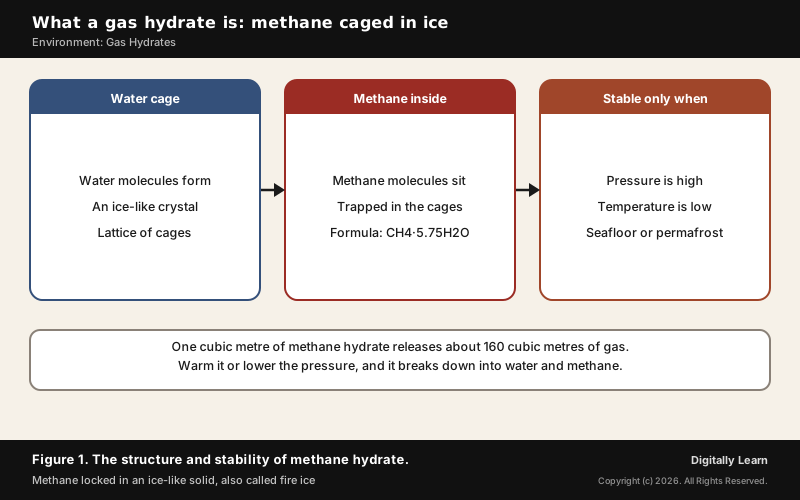
A methane hydrate, or gas hydrate, is an ice-like solid in which molecules of methane are trapped inside cages of frozen water. It forms only at high pressure and low temperature, in seafloor sediments and permafrost, and is often called fire ice. Gas hydrates hold one of the largest stores of hydrocarbons on Earth, including deposits off India's coast, but they are hard to extract and a possible source of greenhouse gas if they break down.
What Is Methane Hydrate? Gas Hydrates Explained
Methane Hydrate Meaning: Fire Ice, Formula and Structure
A gas hydrate is a crystalline solid in which molecules of gas are combined with molecules of water. The most common is methane hydrate, also called methane clathrate, methane ice, natural gas hydrate or fire ice: a solid clathrate compound in which a large amount of methane is trapped within a crystal structure of water, forming a solid similar to ice. A clathrate is a cage compound: water molecules build the cages and gas molecules sit inside.
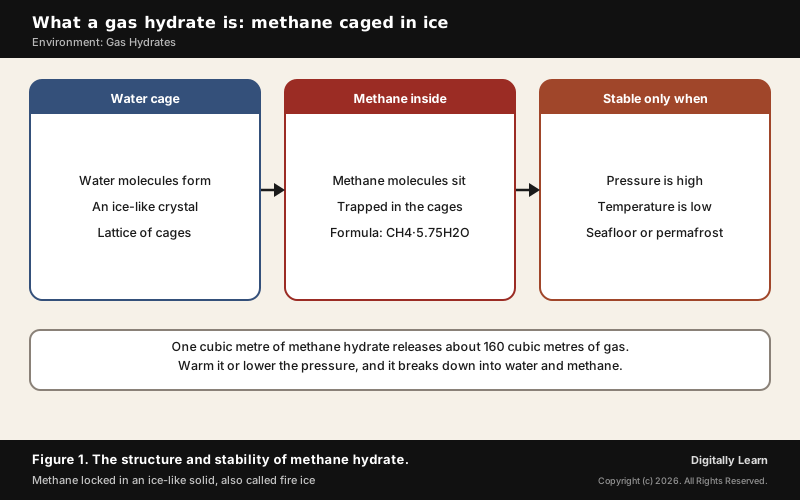
- Formula: Methane hydrate is written as CH4·5.75H2O, or 4CH4·23H2O.
- Energy density: One litre of fully saturated methane clathrate holds about 120 grams of methane; one cubic metre releases about 160 cubic metres of gas.
- Why fire ice: It looks like ice, yet the methane it releases burns; in the first offshore extraction the gas was piped to the surface and ignited to prove its presence.
How Gas Hydrates Form: High Pressure, Low Temperature and Stability
Methane hydrate forms when hydrogen-bonded water and methane gas come into contact at high pressures and low temperatures in oceans. Hydrates are believed to form when methane migrating up from deep sediments along geological faults meets water within the seabed at the right temperature and pressure. Because it needs both conditions, the hydrate of methane occurs commonly in ocean sediments, with smaller amounts in permafrost regions.
- Seafloor: Significant deposits lie under sediments on the ocean floors, around 1,100 metres below the sea surface.
- Permafrost: Frozen ground in the Arctic also holds hydrates, as at the Mallik site in the Mackenzie River delta of Canada.
- Instability: A rise in temperature or a fall in pressure can turn the hydrate into a mixture of gas and ice or water, releasing methane.
These conditions confine hydrates to the shallow lithosphere, less than 2,000 m deep. On land they occur in polar sedimentary rocks where average surface temperatures are below 0 °C, as in Siberia and Alaska at less than 800 m depth; in the oceans they occur in sediments under water deeper than 300 m, where bottom water is around 2 °C. Deep freshwater lakes such as Lake Baikal can hold them too. Most oceanic hydrate is methane in a structure I crystal, produced by microbes in the sediment.
Gas Hydrate Reserves: The World and India
Global Gas Hydrate Deposits and Their Energy Potential
Global estimates put the methane stored in hydrate at around 10^16 kg, one of the largest sources of hydrocarbons on Earth: there is about twice as much carbon stored in gas hydrates as in all other fossil fuels put together, which is why several countries have invested in hydrate research.
Recent estimates based on direct sampling are smaller: a global inventory of 1 to 5 x 10^15 cubic metres, or 500 to 2,500 gigatonnes of carbon. That is less than the 5,000 gigatonnes in all other geo-organic fuel reserves, but far more than the roughly 230 gigatonnes in other natural gas sources. Arctic permafrost holds an estimated 400 gigatonnes of carbon in hydrates.
- Japan: Estimates at least 1.1 trillion cubic metres of methane in the Nankai Trough, enough to meet its needs for more than ten years; it produced gas offshore from the Nankai Trough, 50 kilometres from central Japan.
- China: Announced in 2006 a plan to spend 800 million yuan over ten years on hydrate research; in May 2017 China and Japan both announced a breakthrough in mining methane hydrates, with methane extracted in the South China Sea.
- Canada: Canadian and Japanese researchers extracted a constant stream of gas from the Mallik site in 2008.
- United States: A potentially economic reserve in the Gulf of Mexico may contain about 100 billion cubic metres of gas.
Gas Hydrates in India: KG Basin, NGHP Expeditions and Detection
Based on available geological and geophysical data, the prognosticated reserves of gas hydrates in India are 1,894 trillion cubic metres. The Ministry of Petroleum and Natural Gas formulated the National Gas Hydrates Programme (NGHP) in 2000 to support research, share knowledge and scientific data, and keep Indian scientists abreast of international developments.
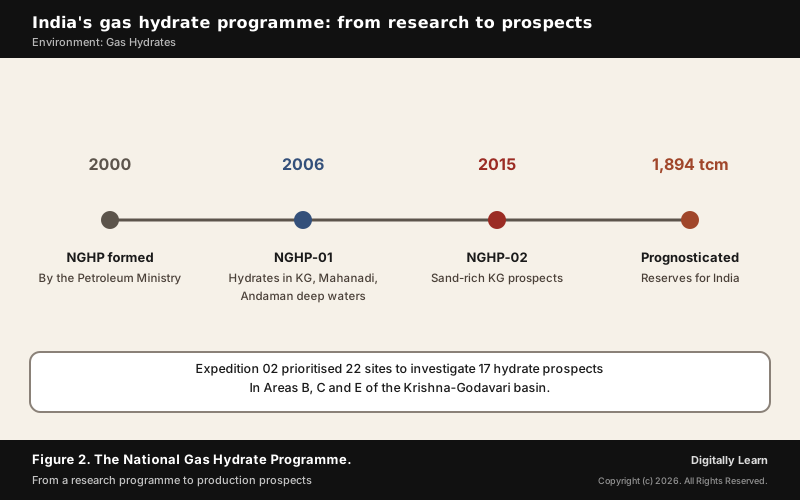
- NGHP Expedition 01 (2006): Surveyed the western, eastern and Andaman Sea offshore; 21 cores were collected and 39 holes drilled, establishing gas hydrates in the Krishna-Godavari (KG) and Mahanadi basins and the Andaman deep waters.
- NGHP Expedition 02 (2015): Focused on deep-water hydrate accumulations in sand-dominated settings; after geological, geophysical and 3D seismic studies of Areas B, C and E of the KG basin, the 22 most promising sites were prioritised to investigate 17 gas hydrate prospects.
- Policy status: Gas hydrates remain at the research and development stage, so there is no separate national policy on them yet.
Hydrates are found first with seismic surveys. The key sign is a bottom-simulating reflector (BSR): a seismic reflection at the boundary between normal sediment and sediment laced with clathrate, caused by their unequal densities.
- Seismic prospecting: India’s second expedition adapted conventional petroleum methods of seismic amplitude evaluation to find sand-rich systems within the hydrate stability zone.
- Structures: In Area B of the Krishna-Godavari basin, prospecting focused on a large anticlinal structure with a prominent bottom-simulating reflector; in Area C, on a very large deep-water channel-levee-fan system.
- Drilling and logging: Expedition 01 collected 21 cores from 39 holes; for Expedition 02 the plan announced in 2014 identified 20 sand-prone sites for logging while drilling, wireline logging and coring, and the final review prioritised 22.
Extracting Gas Hydrates: Methods and Challenges
Extracting Methane From Gas Hydrates: Methods, Challenges and Other Uses
Because hydrates are stable only under pressure and cold, producing gas means upsetting that balance in a controlled way so the methane separates from the ice, then collecting it. Three approaches have been tried:
- Heating: The first drilling at Mallik, in 2002, used heat to release methane.
- Depressurisation: In Japan’s offshore test, specialised equipment drilled into the deposit and depressurised it, so the methane separated from the ice and was piped to the surface.
- Carbon dioxide exchange: Researchers at the University of Bergen developed a method of injecting carbon dioxide into hydrates to push out methane by direct exchange, field-tested with Japanese partners.
Gas hydrates remain a future resource, not a present one. The deposits lie offshore under deep water, and the methane is locked in a solid that must be broken down without losing control of the gas.
- Cost: After Japan’s first offshore extraction, researchers said the next step was to see how far costs could be brought down to make the technology economically viable.
- Drilling hazard: Hydrate instability can be a hazard during drilling, causing blow-outs as gas builds up after warming.
- Finding the right reservoir: India’s second expedition deliberately prospected for sand-rich depositional systems within the hydrate stability zone, adapting conventional petroleum exploration methods.
- Environment: Any methane that escapes during production adds a potent greenhouse gas to the atmosphere.
Hydrates matter to industry in other ways too. Hydrocarbon clathrates can form inside gas pipelines and block them; this was discovered in 1934, and it led to research on preventing hydrate formation. The same cage structure also makes hydrates useful:
- Carbon storage: Depositing carbon dioxide clathrate in the deep sea has been proposed as a way to remove this greenhouse gas from the atmosphere.
- Other applications: Hydrates are being studied for seawater desalination, gas storage, carbon dioxide capture and storage, and cooling for data centres and district cooling.
- Yield on melting: One cubic metre of methane hydrate yields about 164 cubic metres of methane and 0.87 cubic metres of fresh water when it dissociates.
Gas Hydrates, Methane and Climate Change
Methane Release, the Clathrate Gun Hypothesis and Global Warming
Methane is a potent greenhouse gas: its global warming potential over 100 years is 27.9 times that of carbon dioxide. In the atmosphere it breaks down to carbon dioxide and water, with a lifetime of about 12 years. How it drives warming is explained in global warming: causes, effects and control measures.
- Feedback risk: Warming will increase the decomposition of gas hydrates, releasing methane that causes more warming, a positive feedback.
- Clathrate gun hypothesis: It proposes that changes in ocean waters caused methane clathrate on upper continental slopes to accumulate and sometimes be released, explaining periods of rapid warming during the Quaternary.
- Past events: The Permian-Triassic extinction and the Paleocene-Eocene Thermal Maximum have been linked to methane hydrate release.
- Present assessment: The IPCC’s Sixth Assessment Report states that no detectable impact on global temperature will occur this century through this mechanism, though this remains uncertain.
Unconventional Natural Gas in India: Shale Gas and Coalbed Methane
Conventional and Unconventional Natural Gas in India
Natural gas in India is an important clean energy resource, found with or without petroleum and used both as a fuel and as a raw material for the petrochemical industry. It is considered an environment-friendly fuel because of its low carbon dioxide emissions. The Gas Authority of India Limited was set up in 1984 to transport and market it.
- Conventional reserves: Large reserves have been found in the Krishna-Godavari basin; on the west coast, Mumbai High and allied fields are supplemented by finds in the Gulf of Cambay; the Andaman and Nicobar islands also hold large reserves.
- Other areas: Exclusive gas reserves lie along the eastern coast in Tamil Nadu, Odisha and Andhra Pradesh, and in Tripura, Rajasthan and offshore wells in Gujarat and Maharashtra.
- Unconventional gas: Sources other than conventional gas fields, namely shale gas, coalbed methane, tight sandstones and methane hydrates.
The Krishna-Godavari basin thus matters twice over: it holds conventional gas fields and India's most studied hydrate prospects.
Shale Gas in India: Basins, Policy and Issues
Shale gas is natural gas trapped within shale formations. Since the 1990s, a combination of horizontal drilling and hydraulic fracturing (fracking) has made large volumes of it economical to produce. Mature, organic-rich shale makes shale oil and gas likely in basins such as Cambay, Krishna-Godavari and Cauvery, and international agencies have assessed probable in-place shale gas of 100 to 200 trillion cubic feet in five Indian basins.
- Policy: On 14 October 2013 the government announced guidelines letting ONGC and Oil India explore shale gas and oil in their nomination blocks; ONGC identified 50 blocks and OIL 6, most in Gujarat, Andhra Pradesh and Tamil Nadu.
- Progress: ONGC’s first shale wells were drilled in the Cambay basin; exploration has remained at an early stage.
- Water: Fracking uses large amounts of water, a problem where water is short.
- Pollution: Surface water can be contaminated by spills, and groundwater if fracturing fluids escape; methane can leak into groundwater.
- Earthquakes: Fracking causes tiny induced tremors, and waste-water disposal wells have been linked to larger earthquakes elsewhere.
Coalbed Methane and a Comparison of Unconventional Gases
Coalbed methane (CBM), or coal-seam gas, is a form of natural gas extracted from coal beds. Most of the gas is adsorbed on the coal; when a well is put into production, water in the fractures is pumped off first, which lowers the pressure and frees the gas from the coal. It is mostly methane, with very little of heavier hydrocarbons such as propane or butane.
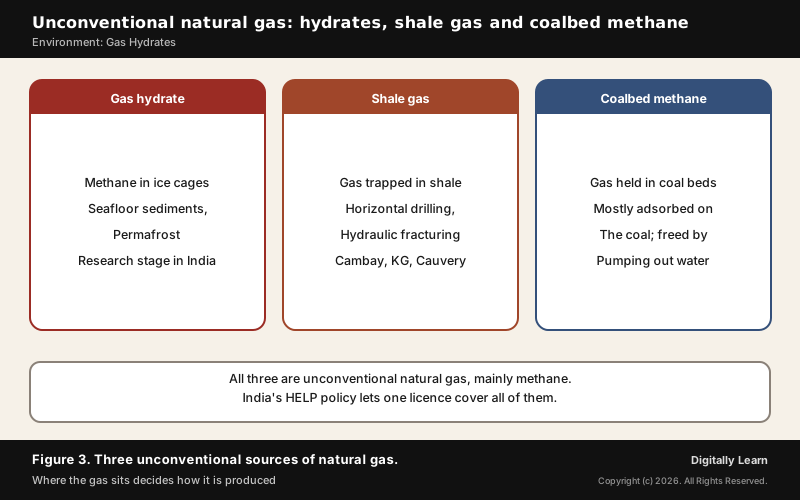
| Type of gas | Where the gas is | How it is produced |
|---|---|---|
| Gas hydrate | Caged in ice in seafloor sediments and permafrost | Heating, lowering pressure or CO2 exchange |
| Shale gas | Trapped in shale rock | Horizontal drilling and fracking |
| Coalbed methane | Adsorbed on coal in coal beds | Pumping out water to lower pressure |
India's Hydrocarbon Exploration and Licensing Policy lets companies explore and produce all kinds of hydrocarbons, including shale oil and gas, CBM and gas hydrate, under a single licence. Earlier contracts had kept these apart, so a CBM contractor could not produce any other hydrocarbon.
Previous Year UPSC-CSE Questions
Previous Year UPSC-CSE Questions By the end you will be able to draft model answers for the following UPSC questions. Each question carries a collapsible framework showing how to approach it in the exam.
- UPSC Mains 2013 GS-IIt is said that India has substantial reserves of shale oil and gas, which can feed the needs of the country for a quarter century. However, tapping of the resources doesn’t appear to be high on the agenda. Discuss critically the availability and issues involved.
How to structure the answer in the exam
Introduction: India's sedimentary basins hold substantial shale oil and gas, but exploration remains at an early stage.
Body (sub-themes to develop):
- Availability: Cambay, Krishna-Godavari, Cauvery; 100 to 200 tcf in place in five basins.
- Policy: 2013 guidelines for ONGC and OIL; 56 blocks; HELP single licence.
- Issues: water-intensive fracking, groundwater and surface pollution, induced seismicity, early-stage technology.
Conclusion: Conclude that shale can add to energy security only with water-sensitive regulation and technology.
- UPSC Prelims 2019 Prelims-GSWhich of the following statements are correct about the deposits of ‘methane hydrate’?
- Global warming might trigger the release of methane gas from these deposits.
- Large deposits of ‘methane hydrate’ are found in Arctic Tundra and under the seafloor.
- Methane in atmosphere oxidizes to carbon dioxide after a decade or two.
Select the correct answer using the code given below:
How to approach this Prelims question
Approach: Check each statement against the formation and climate sections.
Trap to watch: Statement 3 looks technical but is true: methane's atmospheric lifetime is about a decade.
Key facts to recall:
- Seafloor and permafrost deposits
- Warming destabilises hydrates
- Methane lifetime about 12 years
Answer signal: All three: option (d).
- UPSC Prelims 2016 Prelims-GSIn which of the following regions of India are shale gas resources found?
- Cambay Basin
- Cauvery Basin
- Krishna-Godavari Basin
Select the correct answer using the code given below.
How to approach this Prelims question
Approach: Recall the basins named for shale gas.
Trap to watch: All three basins are listed; do not drop Cauvery.
Key facts to recall:
- Cambay, Krishna-Godavari, Cauvery
Answer signal: 1, 2 and 3: option (d).
- UPSC Prelims 2014 Prelims-GSWith reference to two non-conventional energy sources called ‘coalbed methane’ and ‘shale gas’, consider the following statements :
- Coalbed methane is the pure methane gas extracted from coal seams, while shale gas is a mixture of propane and butane only that can be extracted from fine-grained sedimentary rocks.
- In India, abundant coalbed methane sources exist, but so far no shale gas sources have been found.
Which of the statements given above is/are correct?
How to approach this Prelims question
Approach: Test the composition claim and the India claim.
Trap to watch: Shale gas is natural gas (mainly methane), and India has identified shale blocks.
Key facts to recall:
- CBM: natural gas from coal beds
- Shale gas in Cambay, KG, Cauvery
Answer signal: Neither: option (d).
Sources and Further Reading
- NCERT: Contemporary India II (Class X Geography), Chapter 5, Minerals and Energy Resources
- NCERT: India, People and Economy (Class XII Geography), Chapter 7, Mineral and Energy Resources
- PIB: Methane Hydrates Reserves (Lok Sabha reply, 25 November 2014)
- PIB: Shale Gas Exploration Status in the Country (28 November 2016)
- PIB: Shale Oil and Gas (Lok Sabha reply)
- PIB: Cabinet approves Policy Framework for exploration and exploitation of Unconventional Hydrocarbons
- USGS: National Gas Hydrate Program Expedition 02: identification of gas hydrate prospects in the Krishna-Godavari Basin, offshore India
- IPCC Sixth Assessment Report, Working Group I, Chapter 5: Global Carbon and Other Biogeochemical Cycles and Feedbacks
- Wikipedia: Methane clathrate
- Wikipedia: Clathrate gun hypothesis
- Wikipedia: Shale gas
- Wikipedia: Coalbed methane
- Wikipedia: Environmental impact of hydraulic fracturing
- Wikipedia: Global warming potential
- UPSC: Previous year question papers
Editorial Disclaimer
This article explains gas hydrates from official Government of India releases, a published scientific paper on India's hydrate expedition, a physical geography textbook and the other sources listed below.


