


Overview
The National Mission for Clean Ganga, its components and the Arth Ganga model
Namami Gange is India's flagship integrated mission to abate pollution and rejuvenate the National River Ganga, run by the National Mission for Clean Ganga under the Ministry of Jal Shakti.
Namami Gange is India's flagship integrated mission to abate pollution in, and to conserve and rejuvenate, the National River Ganga and its tributaries. Approved as a Flagship Programme by the Union Government in June 2014, it is run by the National Mission for Clean Ganga (NMCG) under the Ministry of Jal Shakti. The mission is not a single project but a basket of interventions: sewage-treatment infrastructure, river-surface cleaning, riverfront and ghat development, afforestation, biodiversity conservation, public participation and industrial-effluent monitoring. It draws statutory strength from the Environment (Protection) Act 1986, through the National Ganga Council and the River Ganga Authorities Order 2016, and it now carries an economic dimension through the Arth Ganga model. Mission-II has extended the effort at a larger outlay up to 2026.
What Namami Gange Is: An Integrated Mission to Rejuvenate the Ganga
A flagship, integrated programme to clean and rejuvenate the National River Ganga
Namami Gange is India's flagship integrated mission to clean and rejuvenate the National River Ganga and its tributaries. Approved as a Flagship Programme in June 2014 with an initial outlay of Rs.20,000 crore, it set out to do two things at once: to abate the pollution that fouls the river, and to revive the river as a living ecosystem. It is run by the National Mission for Clean Ganga under the Ministry of Jal Shakti.
The word integrated is the heart of the idea. Earlier river-cleaning efforts had focused narrowly on building treatment plants; Namami Gange instead treats the river as a whole system. It brings together sewage infrastructure, industrial-effluent control, river-surface cleaning, riverfront work, afforestation, biodiversity protection and public participation under one mission, so that the many causes of the river's decline are tackled together.
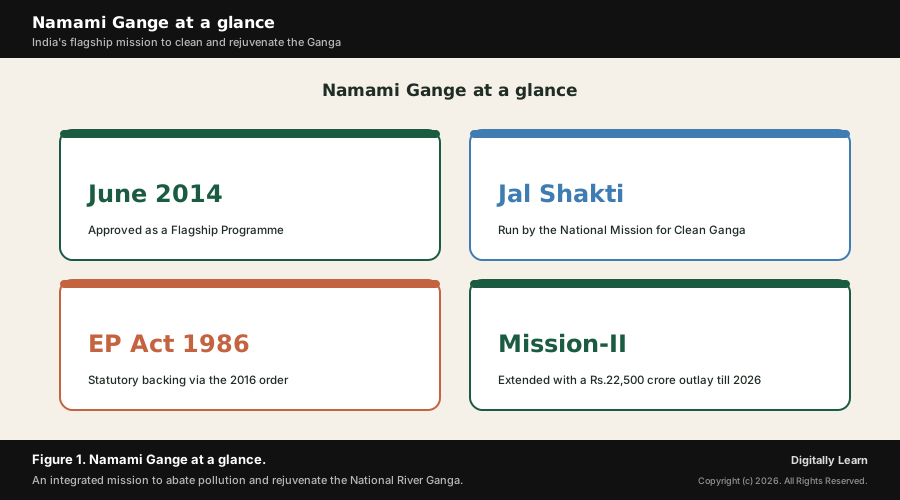
It also has scale and reach. The Ganga basin is the largest river basin in India, covering a very large share of the country's geographical area and sustaining a vast share of its population, with many major cities on the river's banks. A programme to clean the Ganga is therefore not a local clean-up but a basin-wide effort across several States. The figure below sets out the headline facts.
Why Namami Gange Is in the News: Mission-II and the Extension to 2026
The extension of the mission and a larger outlay up to 2026
Why it matters now is that the mission has been renewed and widened. The first phase ran from 2014-15 up to 31 March 2021; the government then approved Namami Gange Mission-II with a budgetary outlay of Rs.22,500 crore up to 2026, carrying forward existing commitments and adding new interventions. The renewal keeps the river-cleaning effort live and well-funded at a time when its results are being closely watched.
The second phase also broadens the agenda. Alongside the original work on sewage treatment and pollution control, Mission-II places more weight on the river as an ecosystem and as an economic resource, through expanded biodiversity work and the Arth Ganga model. This shift, from a clean-up project toward a longer-term programme of river rejuvenation and a river economy, is exactly why the mission remains a live subject for the exam.
Understanding the Significance of Namami Gange for India
Public health, ecology and the test of running a flagship scheme
What is the significance of Namami Gange lies first in public health and livelihoods. The Ganga basin sustains a vast population and many large cities, and the river supplies water for drinking, farming and industry. Cutting the flow of untreated sewage and effluent into the river directly affects the health of millions and the livelihoods of farmers and fishers who depend on clean water, so the mission is a public-health intervention as much as an environmental one.
Its second significance is ecological. The Ganga is a major freshwater ecosystem and the home of India's National Aquatic Animal, the Gangetic dolphin, along with threatened turtles and other aquatic life. By improving water quality, restoring habitat and conserving these species, the mission protects biodiversity that is found nowhere else, and uses the health of that wildlife as a real measure of whether the river itself is recovering.
Its third significance is as a test of governance. Namami Gange is one of India's most prominent flagship schemes, spanning several States, many agencies and a long timeline, and it has pioneered tools such as the Hybrid Annuity Model for sewage treatment and the Arth Ganga economic approach. How well it cleans the river is therefore also a test of how India designs, finances and sustains a large, cross-State programme, which carries lessons for river rejuvenation across the country.
The Institutional and Legal Architecture: Council, NMCG and the EP Act 1986
From the NGRBA to the National Ganga Council and statutory mission status
The architecture of Namami Gange grew out of an earlier body. The National Mission for Clean Ganga was registered as a society on 12 August 2011 under the Societies Registration Act 1860, and at first acted as the implementation arm of the National Ganga River Basin Authority (NGRBA). The NGRBA had itself been constituted under the Environment (Protection) Act 1986, giving the effort an environmental-law foundation from the start.
This was restructured in 2016. The NGRBA was dissolved with effect from 7 October 2016, and the government issued the River Ganga (Rejuvenation, Protection and Management) Authorities Order 2016. The order set up a new tiered structure headed by the National Ganga Council, and it gave the NMCG mission status with powers under the Environment (Protection) Act 1986. This step turned a society into a body able to issue directions with statutory force.
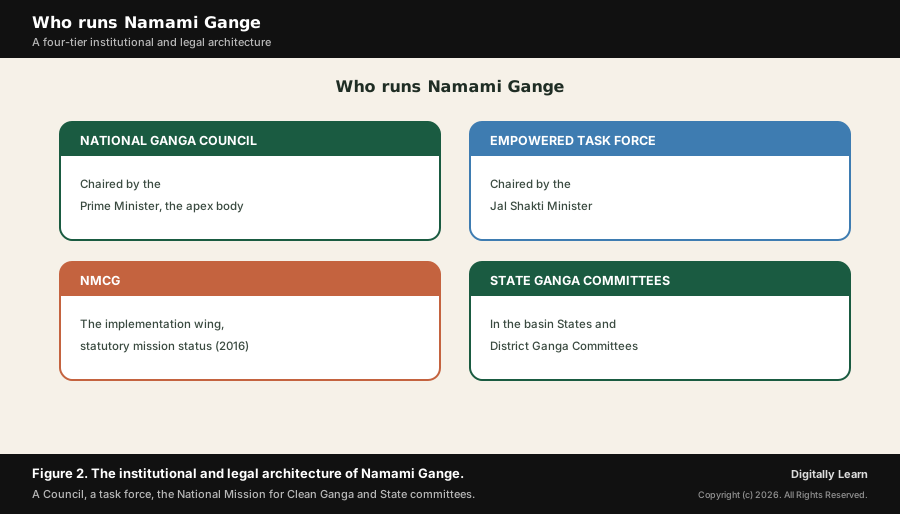
The tiers fit together as a chain of command. At the top sits the National Ganga Council, formally the National Council for Rejuvenation, Protection and Management of River Ganga, chaired by the Prime Minister; below it an Empowered Task Force chaired by the Jal Shakti Minister; then the NMCG as the implementation wing; and in the basin States, State and District Ganga Committees. The figure below sets out this structure.
| Tier | Body | Role |
|---|---|---|
| Apex | National Ganga Council (PM chair) | Overall policy direction and oversight |
| Coordination | Empowered Task Force (Jal Shakti Minister) | Inter-ministerial coordination |
| Implementation | National Mission for Clean Ganga (NMCG) | Executes projects with statutory powers |
| State and district | State and District Ganga Committees | On-the-ground action in the basin States |
Reading the tiers together shows the design: a single apex Council to set direction, a statutory mission to act, and committees in the States and districts to carry the work to the riverbank, all resting on the authority of the Environment (Protection) Act 1986.
The Components of Namami Gange: Sewage, Riverfront, Ecology and People
Sewage-treatment infrastructure, the Hybrid Annuity Model and One City One Operator
The largest single component is sewage-treatment infrastructure, because untreated municipal sewage is the biggest source of pollution in the Ganga. Under the mission, a network of Sewage Treatment Plants (STPs) and sewer lines is being built and rehabilitated across the river's towns and cities to intercept and treat wastewater before it reaches the river, with creation of new STP capacity measured in millions of litres per day.
To keep these plants working for the long term, the mission pioneered the Hybrid Annuity Model (HAM), a public-private-partnership mode for sewage treatment. Under HAM the government pays part of the capital cost during construction and the rest as an annuity spread over a fifteen-year operation-and-maintenance phase, and crucially both the annuity and the operation payments are linked to the plant's performance. This ties the operator's revenue to running the plant well, not just to building it.
A related idea is the One City – One Operator concept. Rather than splitting a city's sewerage among many contracts, a single operator is made responsible for all the sewage assets of a city, which fixes accountability for the whole chain from the sewer to the treated outflow. Together, HAM and One City One Operator are designed to close the gap between building treatment capacity and actually running it, the weakness of earlier efforts.
River-surface cleaning, riverfront and ghat development
A second set of components works on the river and its banks directly. River-surface cleaning uses trash skimmers and collection boats to remove floating solid waste, garlands and other material from the water at major towns, giving an immediate, visible improvement while the slower sewage work proceeds underneath.
Alongside this, the mission funds riverfront and ghat development: the building and repair of bathing ghats, the modernisation of crematoria so that funeral practices add less pollution to the river, and the improvement of the public spaces along the banks. These works matter for the river's cultural and religious life as well as its cleanliness, and they make the mission visible to the millions who use the ghats.
Afforestation, biodiversity conservation and the Gangetic dolphin
A third set of components restores the river's ecology. Afforestation along the basin, planned with the forest departments, plants native species in the riverside landscape to reduce erosion, recharge groundwater and improve the health of the catchment that feeds the river.
The mission also runs a major biodiversity conservation effort. The Gangetic dolphin, declared India's National Aquatic Animal, is its flagship species, supported by conservation, rescue and monitoring work; threatened turtles and other aquatic life are also protected. Much of this is carried out through the Wildlife Institute of India under a dedicated biodiversity project, on the principle that thriving aquatic life is the truest sign of a healthy river.
Public participation, the Ganga Praharis and industrial-effluent monitoring
A fourth set of components works through people and through enforcement. Public participation is built into the mission, most visibly through the Ganga Praharis: trained volunteers from riverside communities, organised through the Wildlife Institute of India, who carry out cleanliness and plantation drives, biodiversity monitoring and awareness work, turning local people into custodians of the river.
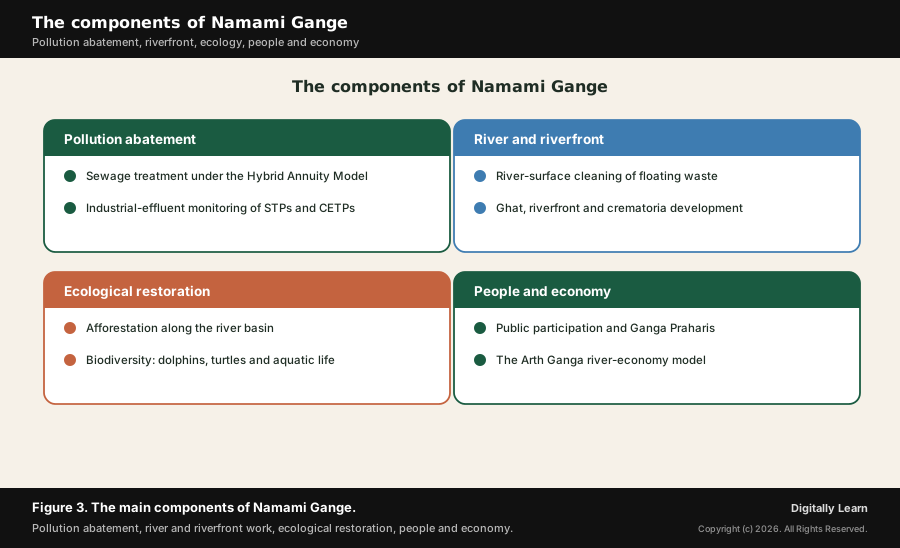
On the enforcement side, the mission includes industrial-effluent monitoring. The NMCG monitors the STPs and Common Effluent Treatment Plants (CETPs) on the river and its tributaries, and grossly polluting industries are inspected for compliance, with directions issued where treatment plants are not performing. This component targets the industrial share of the pollution load, alongside the larger municipal-sewage effort. The figure below groups the mission's components.
The Arth Ganga Model: An Economic Bridge Between the River and Its People
A river economy through six verticals
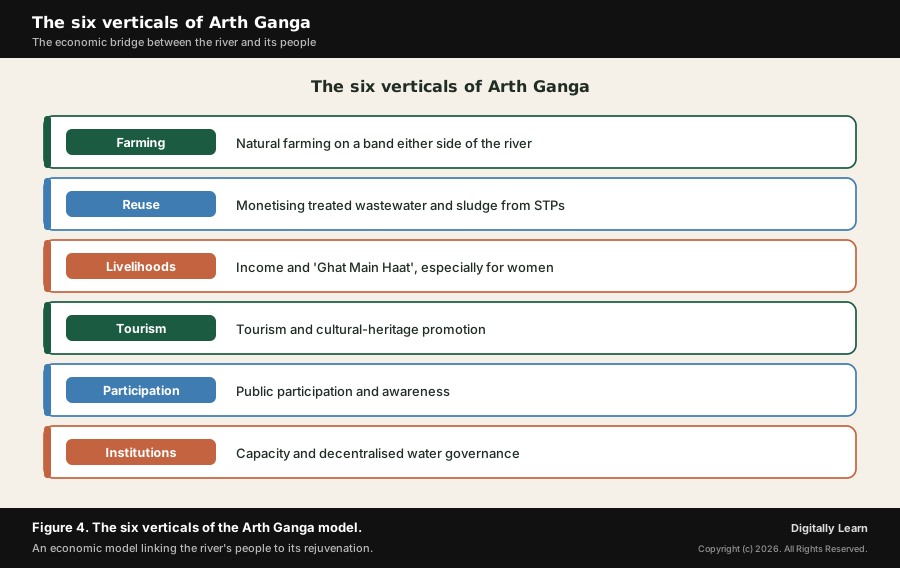
Arth Ganga is the economic model of Namami Gange. Its purpose is to give people who live along the river a direct economic stake in keeping it clean, on the reasoning that a river the community profits from is a river the community will protect. It is described as a model for an economic river-people connect that uses an economic bridge to make rejuvenation self-sustaining, built around six verticals.
The first verticals turn the river's own resources into income. Natural farming is promoted on a band of land on either side of the river, cutting chemical run-off while raising farm incomes; and the treated wastewater and sludge from the STPs are monetised and reused, the water for irrigation and the sludge as manure or building material, so that pollution control also earns revenue.
The remaining verticals work through people and institutions. They cover livelihood generation, especially for women, including riverside markets such as 'Ghat Main Haat'; the promotion of tourism and cultural heritage; public participation and awareness; and the building of local institutions for decentralised water governance. Taken together, the verticals convert river cleaning from a cost the state alone bears into a shared economic gain. The figure below sets them out.
Challenges and Debates: The Pollution Load, the Sewage Gap and E-Flows
The treatment gap, encroachment, e-flows and cross-State coordination
A balanced reading must weigh the debates around the mission. The central one is the pollution load and the persistent sewage-treatment gap. Even as treatment capacity has grown and the mission reports falling pollution loads in stretches of the river, the sewage generated by the basin's growing cities can still outpace the capacity built and made fully operational. Closing this gap is the mission's hardest test, and views differ on how far it has been closed.
A second debate concerns environmental flows, or e-flows: the minimum flow a river must keep to stay healthy. The Central Government notified minimum e-flows for the Ganga in 2018, but campaigners argue that dams, barrages and large withdrawals for irrigation and power still leave some stretches with too little flow to dilute pollution. How strictly the notified flows are maintained, against competing demands for water, remains contested.
Further challenges are structural. Encroachment on floodplains, and the discharge from grossly polluting industries, add to the load and are hard to police. Because the Ganga runs through several States, the mission also depends on coordination across many State governments, urban local bodies and agencies, where capacity and commitment vary. These debates are best read in measured terms: documented progress on capacity and on some indicators, set against a pollution challenge that is far from solved.
The Way Forward for Ganga Rejuvenation
Operational treatment, e-flow discipline and a self-sustaining river economy
The way forward follows from the challenges. The first priority is to close the sewage gap by ensuring that the treatment capacity built is actually operated to standard, which is the logic behind the Hybrid Annuity Model and performance-linked payments, and by keeping pace with the sewage that growing cities generate. Treated water that is reused, rather than simply discharged, eases the burden further.
A second priority is to hold the line on environmental flows and on the basin's ecology: maintaining the notified e-flows against competing demands, curbing encroachment, and continuing the biodiversity and afforestation work that keeps the river alive. A third is to make Arth Ganga deliver, so a self-sustaining river economy gives communities a lasting reason to protect the Ganga. Sustained cross-State coordination ties these together, and the model that works on the Ganga can then guide rejuvenation across India.
UPSC Relevance and Exam Focus
Where Namami Gange fits in the UPSC-CSE syllabus
This topic maps most directly to General Studies Paper III: conservation, environmental pollution and degradation, where river pollution and its abatement are recurring themes. It also fits General Studies Paper II: government policies and interventions and issues arising from their design and implementation, because Namami Gange is a flagship scheme whose institutional design and delivery are themselves examinable.
For Prelims, hold the high-yield facts: Namami Gange was approved as a Flagship Programme in 2014 and is run by the National Mission for Clean Ganga under the Ministry of Jal Shakti; the apex body is the National Ganga Council chaired by the Prime Minister; the mission draws statutory backing from the Environment (Protection) Act 1986; the Gangetic dolphin is the National Aquatic Animal; and the economic model is called Arth Ganga.
For Mains, the recurring framing is to assess Namami Gange as a model of river rejuvenation: its integrated design, its institutional and legal architecture, the components from sewage treatment to biodiversity, the Arth Ganga approach, and a balanced evaluation of the pollution load, the sewage gap, e-flows and cross-State coordination. A strong answer treats it as both an environmental and a governance question.
Recurring linked concepts an aspirant should keep in working memory:
- Environment (Protection) Act 1986: The umbrella environmental law that gives the National Ganga Council and the NMCG their statutory powers.
- Environmental flows (e-flows): The minimum flow a river must keep to stay healthy, notified for the Ganga in 2018.
- Hybrid Annuity Model and One City One Operator: The public-private-partnership tools used to build and run sewage-treatment infrastructure.
- Arth Ganga: The river-economy model that links the basin’s people economically to the river’s rejuvenation.
A common Prelims trap is to place Namami Gange under the wrong ministry or to confuse the National Ganga Council with the older NGRBA; hold that the mission runs under the Ministry of Jal Shakti and that the 2016 order replaced the NGRBA with the National Ganga Council and gave the NMCG statutory mission status.
A common Mains trap is to present the mission as either a complete success or a complete failure. Its exam value lies in a balanced judgment: genuine progress on treatment capacity, biodiversity and some pollution indicators, set honestly against the persistent sewage gap, the e-flow and encroachment debates and the difficulty of cross-State coordination.
Previous Year UPSC-CSE Questions By the end you will be able to draft model answers for the following UPSC questions. Each question carries a collapsible framework showing how to approach it in the exam.
- UPSC Mains 2024 GS-IIIDiscuss industrial pollution of river water in India, the measures to mitigate it, and the government's initiatives in this regard.
How to structure the answer in the exam
Body (sub-themes to develop):
- The problem: grossly polluting industries discharge effluent into rivers such as the Ganga, adding to the pollution load alongside untreated municipal sewage and degrading water quality, aquatic life and public health.
- Regulatory mitigation: monitoring and inspection of polluting industries, Common Effluent Treatment Plants (CETPs) and Sewage Treatment Plants (STPs), with directions issued for compliance, under the authority of the Environment (Protection) Act 1986.
- Infrastructural mitigation: building and properly operating sewage and effluent treatment capacity, using performance-linked models such as the Hybrid Annuity Model and the One City One Operator concept, plus river-surface cleaning and the reuse of treated water.
- Ecological mitigation: maintaining environmental flows to dilute pollutants, afforestation in the catchment and biodiversity conservation to restore the river as a living system.
- The government's initiatives: Namami Gange and the National Mission for Clean Ganga under the Ministry of Jal Shakti, its institutional and legal architecture, the Mission-II extension and the Arth Ganga economic model, evaluated against the persistent treatment gap.
Sources and Further Reading
- National Mission for Clean Ganga: Namami Gange Programme
- National Mission for Clean Ganga: About NMCG
- National Mission for Clean Ganga: Aquatic Biodiversity Conservation in Ganga River Basin
- Press Information Bureau: A Holistic Approach for Cleanliness of River Ganga
- Press Information Bureau: Namami Gange Mission-II approved with a budgetary outlay of Rs.22,500 crore till 2026
- Press Information Bureau: Cabinet approves the River Ganga (Rejuvenation, Protection and Management) Authorities Order, 2016
- Press Information Bureau: Important Interventions Under 'Arth Ganga'
- Press Information Bureau: Dolphin declared as a National Aquatic Animal
- Wildlife Institute of India: Ganga Prahari and biodiversity conservation
- Department of Water Resources, River Development and Ganga Rejuvenation, Ministry of Jal Shakti: National Mission for Clean Ganga
- Ministry of Environment, Forest and Climate Change: Status Paper on River Ganga
- India Code: The Environment (Protection) Act, 1986
- Wikipedia: Namami Gange Programme
Editorial Disclaimer
This briefing is for UPSC preparation. Verify the facts and provisions against the official NMCG and PIB sources before relying on them.


