


Overview
The NITI Aayog semiconductor roadmap, titled 'Future of India's Semiconductor Industry' and released by NITI Aayog's Frontier Tech Hub in May 2026, is India's first comprehensive ten-year roadmap for the chip sector. It sets a target of a USD 120 to 150 billion domestic semiconductor value chain by 2035 and rising chip self-sufficiency. Rather than chasing the cutting-edge wafer race, it adopts a More-than-Moore strategy, concentrating on mature logic nodes, advanced packaging and compound materials. The roadmap reinforces the India Semiconductor Mission, marking a shift from building the ecosystem to deepening it.
Why the semiconductor roadmap is in focus
India's first ten-year chip roadmap
In May 2026, NITI Aayog's Frontier Tech Hub released 'Future of India's Semiconductor Industry', described as India's first comprehensive ten-year roadmap for the chip sector.
A semiconductor is the material at the heart of every chip, and the value chain spans design, materials, fabrication, packaging and testing. A roadmap sets where a country should invest along that chain.
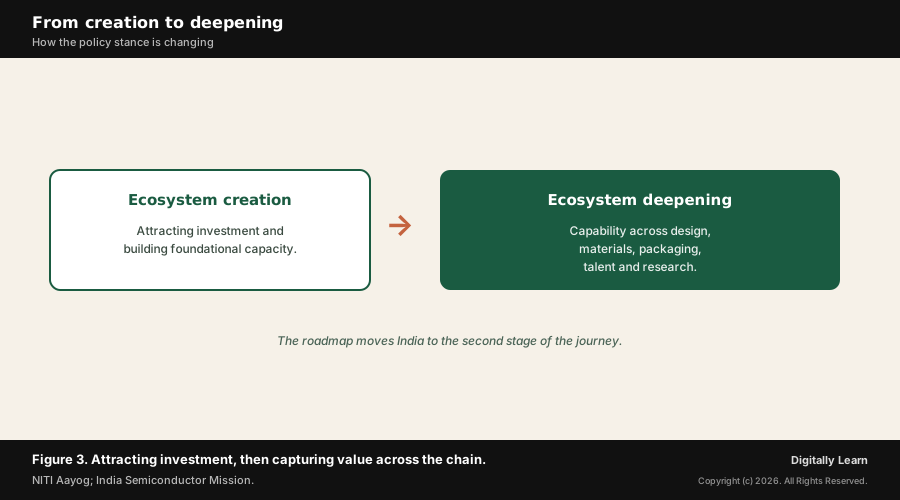
The roadmap reinforces the India Semiconductor Mission and the priorities of the Union Budget 2026. It marks a shift from attracting first investments towards deepening capability across the chain.
The headline elements of the roadmap are:
- Horizon: India’s first comprehensive ten-year roadmap for the sector.
- Target: a USD 120 to 150 billion domestic value chain by 2035.
- Strategy: a More-than-Moore approach rather than the cutting-edge wafer race.
- Anchor: alignment with the India Semiconductor Mission and Budget 2026.
Why the roadmap matters
Chips, self-reliance and the economy
Semiconductors power everything from phones to cars to defence systems. A country that cannot make or secure chips is exposed, so a roadmap to build domestic capability is a strategic priority.
India still imports most of its chips. The roadmap's push for self-sufficiency aims to cut that dependence in stages, reducing exposure to global supply shocks and export controls.
It also matters for the economy. A large domestic value chain would add high-value manufacturing, skilled jobs and exports, deepening India's place in global electronics supply chains.
What the roadmap signifies
A different bet, deepening, and resilience
Three threads carry the weight: a strategic choice of where to compete, the deepening of the ecosystem, and supply-chain resilience.
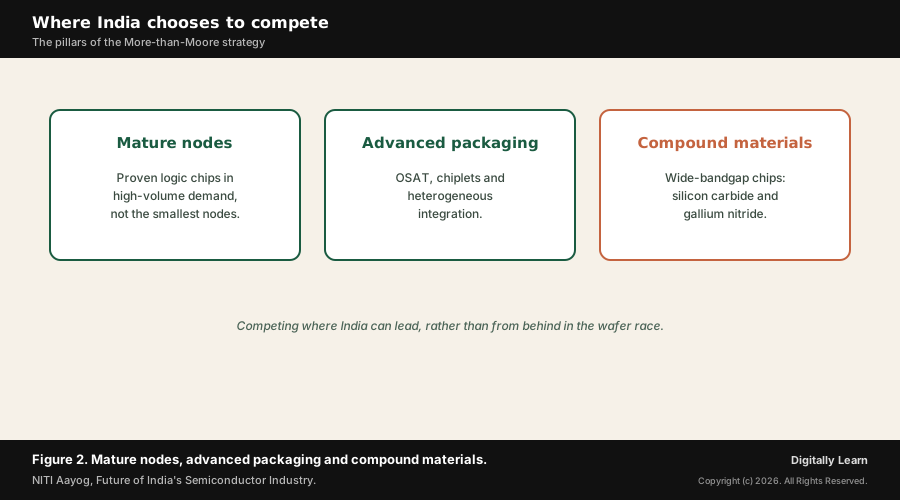
First, the strategic bet. Instead of chasing the most advanced nodes, the roadmap backs a More-than-Moore approach, betting on mature nodes, packaging and compound materials where India can lead.
Second, deepening. The plan moves beyond attracting fabs to building design talent, materials, packaging and research, so value is captured across the chain, not just in assembly.
Third, resilience. By raising self-sufficiency in stages, India seeks to reduce its exposure to import disruptions and the geopolitics of chip supply.
Distinguishing features of the roadmap
The roadmap targets at a glance
The table sets out the roadmap's headline goals, so its ambition and time horizon are visible at a glance.
| Goal | Target |
|---|---|
| Domestic value chain by 2035 | USD 120 to 150 billion |
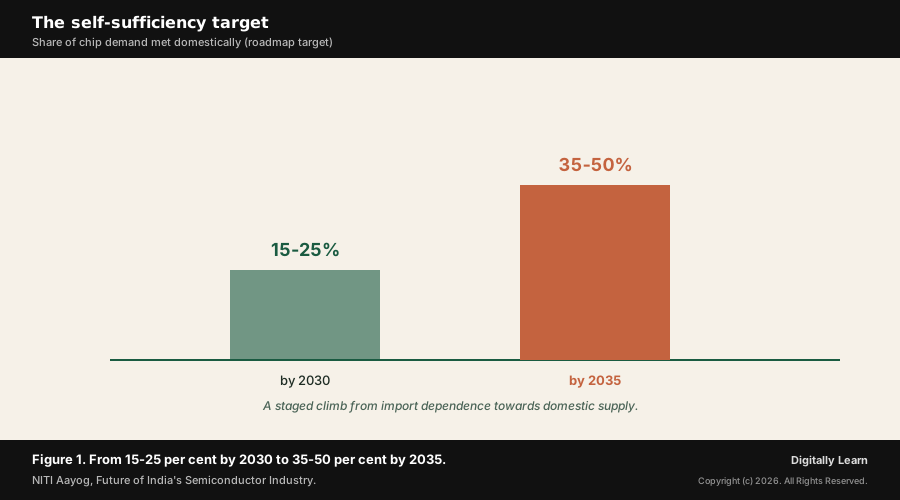
| Chip self-sufficiency by 2030 | 15 to 25 per cent |
| Chip self-sufficiency by 2035 | 35 to 50 per cent |
| Global market position | A top-three destination for advanced packaging |
Three features that define the roadmap
Three choices set this roadmap apart from a generic industrial plan:
- (i) More-than-Moore. It prioritises mature logic nodes, advanced packaging and compound materials over the race for the smallest transistors.
- (ii) Whole value chain. It spans design, materials, manufacturing, packaging, talent and research, not a single stage.
- (iii) Strength-led. It builds on India’s design talent, software and domestic demand rather than copying other countries’ models.
Observable outcomes
Three trackable outcomes
The roadmap translates into three developments to watch over the next decade.
- (a) Packaging and materials units. New investment can flow into advanced packaging, OSAT and compound-material plants.
- (b) Rising self-sufficiency. The share of chip demand met at home is the headline metric to track against the 2030 and 2035 targets.
- (c) Talent and research. Expansion of chip-design education and R&D programmes can deepen the skills base.
The targets are projections, not guarantees. Whether the value chain reaches the upper or lower end of the range depends on sustained investment and execution.
Semiconductors and the wider economy
India Semiconductor Mission, supply chains and geopolitics
The roadmap sits on top of the India Semiconductor Mission, the scheme through which India has courted fabs and packaging units, and turns it into a longer-term strategy.
It connects to critical-mineral and materials security. Compound semiconductors and packaging need specialised materials, linking chip policy to India's wider drive for resilient supply chains.
The roadmap also reflects chip geopolitics. As major powers restrict advanced-chip technology, India's choice to deepen capability in mature nodes and packaging is a hedge against those pressures.
UPSC relevance and exam focus
Where this fits in the UPSC-CSE syllabus
This topic maps to General Studies Paper III: science and technology, indigenisation of technology, and the mobilisation of resources for industry, with a link to the economy.
For Prelims, hold the high-yield facts: the roadmap's release by NITI Aayog, the 2035 value-chain target, the More-than-Moore strategy, and the India Semiconductor Mission link.
For Mains, two framings recur: the role of manufacturing and high technology in growth, and how India can build self-reliance in critical technologies.
Recurring linked concepts an aspirant should keep in working memory:
- India Semiconductor Mission: the scheme to build a domestic chip ecosystem.
- More-than-Moore: competing in packaging and mature nodes, not only the smallest transistors.
- OSAT: outsourced assembly and test, the packaging stage of the chain.
- Compound semiconductors: wide-bandgap materials such as silicon carbide and gallium nitride.
The roadmap targets are projections for 2030 and 2035, not achieved figures. Treating a target self-sufficiency share as the current level is an easy error.
Do not equate the strategy with chasing the most advanced chips. The roadmap deliberately bets on packaging, mature nodes and materials where India can compete.
Previous Year UPSC-CSE Questions By the end you will be able to draft model answers for the following UPSC questions. Each question carries a collapsible framework showing how to approach it in the exam.
- UPSC Prelims 2025Consider the following statements regarding critical minerals in India:
- India has joined the Minerals Security Partnership as a member.
- India is a resource-rich country in all the 30 critical minerals that it has identified.
- Parliament in 2023 amended the Mines and Minerals (Development and Regulation) Act, 1957 to let the Central Government exclusively auction leases for certain critical minerals.
Which of the statements given above are correct?
How to approach this Prelims question
Approach: Check each statement on India's critical-mineral position and law.
Trap to watch: Statement II is the trap: India is not resource-rich in all its identified critical minerals; many are import-dependent.
Key facts to recall:
- India joined the Minerals Security Partnership.
- India is not self-sufficient in all its critical minerals.
- The MMDR Act was amended in 2023 for critical-mineral auctions.
Answer signal: Statements I and III are correct; II is not. Correct answer: I and III only.
- UPSC Mains 2023 GS-IIIFaster economic growth requires increased share of the manufacturing sector in GDP, particularly of MSMEs. Comment on the present policies of the Government in this regard.
How to structure the answer in the exam
Introduction: Open with the low manufacturing share of India's GDP and the goal of raising it for jobs and growth.
Body (sub-themes to develop):
- Policies: Make in India, production-linked incentives and the India Semiconductor Mission.
- MSMEs: credit, formalisation and integration into value chains.
- High-tech manufacturing: semiconductors, electronics and the NITI roadmap.
- Challenges: skills, infrastructure, materials and global competition.
- Self-reliance: deepening value chains rather than only assembly.
Conclusion: Conclude that raising the manufacturing share needs MSME strength alongside high-value sectors like chips.
Sources and Further Reading
- NITI Aayog: Future of India's Semiconductor Industry (report)
- NITI Aayog: Future of India's Semiconductor Industry (page)
- Press Information Bureau: NITI Aayog releases the semiconductor roadmap
- Ministry of Electronics and Information Technology (India Semiconductor Mission)
- National Portal of India
- Wikipedia: Semiconductor industry in India
Editorial Disclaimer
This article is compiled from the reference materials listed in the Sources section. It is an explainer for UPSC preparation and is not a substitute for primary documents (NCERTs, GoI ministry releases, IMD bulletins, RBI / CEA / MoEFCC publications, and Standing-Committee reports).


