


Overview
India's quantum computing and communication programme
The National Quantum Mission (NQM) is India's ₹6,003.65 crore programme, approved by the Union Cabinet on 19 April 2023 for 2023‑24 to 2030‑31, to build quantum computers of 50 to 1,000 physical qubits, secure quantum communication over 2,000 km, precise quantum sensors and quantum materials. The Department of Science and Technology runs it through four thematic hubs.
National Quantum Mission: Approval, Outlay and Aims
Cabinet Approval of April 2023 and the ₹6,003.65 Crore Outlay
In approving the mission, the Cabinet stated its purpose as seeding, nurturing and scaling up scientific and industrial research in quantum technology, building an ecosystem around it and making India one of the leading nations in quantum technologies and their applications.
- Nodal department: The Department of Science and Technology (DST) implements the mission.
- Place in policy: The NQM is one of nine initiatives under the Prime Minister's Science, Technology and Innovation Advisory Council.
- Approval and launch: Cabinet approval came in April 2023; the four thematic hubs were set up in 2024‑25, and the government dates the mission's launch in operation to October 2024.
- Sectors it serves: Communication, health, finance and energy, along with drug design and space applications.
The mission also feeds national programmes such as Digital India, Make in India, Skill India, Start-up India and Self-reliant India. In February 2026 the government told Parliament that the mission was meant to reduce critical technology dependence and strengthen secure communication and advanced computing for strategic sectors.
Mission Targets: Qubits, Secure Links, Sensors and Materials
The mission's deliverables fall due in three stages, at three, five and eight years. They cover all four fields of quantum technology, and each carries a measurable target.
| Field | Target | What it means |
|---|---|---|
| Quantum computing | Intermediate-scale quantum computers of 20 to 50 physical qubits in 3 years, 50 to 100 in 5 years and 50 to 1,000 in 8 years | Machines on platforms such as superconducting and photonic technology |
| Quantum communication | Satellite-based secure links between two ground stations 2,000 km apart within India, and long-distance links with other countries | Keys shared through a satellite rather than a fibre |
| Quantum key distribution | Inter-city links over 2,000 km with trusted nodes on existing optical fibre | Uses wavelength division multiplexing on the fibre already laid |
| Quantum network | A multi-node network (2 to 3 nodes) with quantum memories, entanglement swapping and repeaters | Stores and relays quantum states between nodes |
| Quantum sensing | Magnetometers of 1 femto-tesla per root hertz in atomic systems, gravity sensors and atomic clocks of 10−19 fractional instability | Precision timing, communication and navigation |
| Quantum materials | Superconductors, novel semiconductor structures and topological materials | The raw material for qubits, single-photon sources and detectors |
The targets build on one another. Materials and single-photon sources feed the qubits and the quantum links; quantum memories and repeaters are needed before links can grow into a network; and clocks and sensors turn the same physics into instruments. The computing target is the one most often quoted, and it rises in three steps.

Quantum Computing Meaning: Qubits, Superposition and Entanglement
What Is Quantum Computing in Simple Terms
Quantum computing is computing that follows the laws of quantum mechanics, the physics of matter and light at atomic and smaller scales. An ordinary processor is built from billions of transistors, each either on or off, so its basic unit of data, the bit, is either 1 or 0.
A quantum computer replaces the bit with the qubit, or quantum bit, which can be in a combination of 0 and 1 at the same time. This property is superposition. Qubits can also be entangled, so that their states are linked whatever the distance between them, and measuring one fixes the result that a measurement of the other will give. Together these let a quantum computer weigh many possible solutions at once.

The same physics makes qubits fragile. Any contact with the surroundings, even a stray particle of light, makes a qubit lose its quantum state, a process called decoherence. Qubits are therefore isolated and cooled to near absolute zero, and today's processors still make an error in one of every 100 to 1,000 operations, against far rarer errors in ordinary computers.
Quantum error correction is the answer researchers pursue, in which several physical qubits are made to work together as one more reliable logical qubit. In 2024 Google's Willow processor showed that, once each qubit is good enough, adding qubits to a logical qubit lowers its error rate. Physicist John Preskill named the present stage noisy intermediate-scale quantum computing, and the NQM's own targets are for intermediate-scale machines.
Qubit Platforms: Superconducting, Photonic, Trapped Ion and Topological
Qubits can be built in several ways, and the NQM names superconducting and photonic technology among its platforms.
- Superconducting qubits: Built from a Josephson junction, two superconductors separated by a thin barrier; Google's Willow, launched in December 2024, is one.
- Photonic qubits: Particles of light, manipulated one by one; single photons also carry quantum communication.
- Trapped-ion qubits: Individual ions, trapped and manipulated one at a time.
- Quantum-dot qubits: Tiny particles of semiconductors such as silicon or germanium.
- Topological qubits: Designed to store information in a way that resists noise; in February 2025 Microsoft announced Majorana 1, a chip it said is built on topological qubits, though many scientists question the claim. Majorana 1 is quantum hardware and has nothing to do with deep learning, the branch of machine learning, itself a part of artificial intelligence, that trains many-layered neural networks.
Four Thematic Hubs and the Hub-Spoke-Spike Model
T-Hubs at IISc, IIT Madras, IIT Bombay and IIT Delhi
The mission's work is divided among four Thematic Hubs (T-Hubs), chosen through a competitive process and set up in 2024‑25 at the Indian Institute of Science (IISc), Bengaluru, and three campuses of the Indian Institute of Technology (IIT). Each host institution has incorporated its hub as a not-for-profit Section‑8 company with its own Hub Governing Board.
| Field | Host institution | Section‑8 company |
|---|---|---|
| Quantum computing | IISc Bengaluru, Karnataka | Foundation for QC (Quantum Computing) Innovation |
| Quantum communication | IIT Madras, Tamil Nadu, with the Centre for Development of Telematics (C‑DOT), New Delhi | IITM CDOT Samgnya Technologies Foundation |
| Quantum sensing and metrology | IIT Bombay, Maharashtra | Qmet Tech Foundation |
| Quantum materials and devices | IIT Delhi, Delhi | QMD Foundation |
Each T-Hub follows a hub-spoke-spike model. The hub is the central node, research projects linked to it are the spokes, and individual research groups are the spikes. The design lets institutions share costly equipment and expertise instead of duplicating it.
- Reach: 14 technical groups with 152 researchers from 43 institutions in 17 States and 2 Union Territories.
- Facilities: Fabrication and central facilities are being built at IISc Bengaluru, IIT Bombay, IIT Kanpur and IIT Delhi.
- Start-ups: In April 2026 support was extended to nine more start-ups, taking the total to 17, in fields from quantum biosensors to quantum positioning systems.
Andhra Pradesh is building around the mission too. On 8 February 2026 the foundation stone of the Amaravati Quantum Valley was laid, with an IBM‑TCS Quantum Innovation Centre and a Quantum Reference Facility at SRM University, and on 14 April 2026 India's first open-access quantum reference facilities opened at Amaravati.
Quantum Communication in India: QKD and the 1,000-km Network
Quantum Key Distribution and Detecting an Eavesdropper
Quantum key distribution (QKD) is a way for two parties to share a secret key whose security rests on physics rather than on hard mathematics. The key is encoded on single photons. Light energy comes in discrete units, or quanta, and the particle that carries one quantum of light is the photon. Because measuring a quantum state disturbs it, an eavesdropper who reads the photons leaves a trace that the two parties can detect.
- The sender encodes the key bits on single photons.
- The photons travel through an optical fibre or by a satellite link.
- The receiver measures them, and the two sides compare a small sample over an ordinary channel.
- If the error rate is too high, someone was listening and the key is discarded; if not, the key encrypts the message.

QKD shares the key, not the message; the key then encrypts the message by ordinary means. Over long fibre routes the key is passed through trusted nodes, which is how the mission's inter-city target of 2,000 km is framed. The Centre for Development of Telematics has developed QKD systems, post-quantum cryptography and quantum-secure video phones.
The 1,000-km QNu Labs Network of April 2026
On 8 April 2026 the Ministry of Science and Technology announced that a 1,000-km quantum communication network had been demonstrated under the mission, one of the longest QKD deployments in the world. It was built on indigenous technology from QNu Labs, a start-up supported under the mission, and covers half of the 2,000-km target in under two years of operation.
- Who it protects: Secure communication for defence, financial systems and critical infrastructure.
- Terrain: The technology is designed to work across underwater and underground networks.
- Still ahead: The satellite-based link between two ground stations 2,000 km apart, and links with other countries.
Post-Quantum Cryptography and a Quantum-Safe India
Q-Day, Shor's Algorithm and Harvest Now, Decrypt Later
Public-key cryptography secures online identity, bank transactions and government communication. It works because certain mathematical problems take ordinary computers impractically long to solve. A sufficiently capable quantum computer running Shor's algorithm could solve them in minutes or hours.
- Q-Day: The day quantum computers can break public-key cryptography in practice; experts disagree on when it will come.
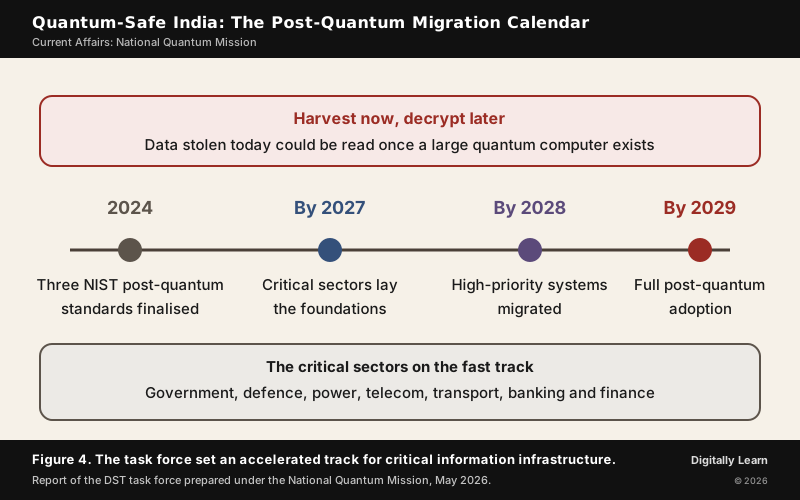
- Harvest now, decrypt later: An adversary can store encrypted data today and read it once such a computer exists, so the danger begins before Q-Day.
- Symmetric encryption: Schemes such as AES are less threatened; the real exposure lies in public-key systems.
Post-quantum cryptography (PQC) is the defence. It uses new algorithms that run on ordinary computers but resist attack by quantum computers. The US National Institute of Standards and Technology (NIST) finalised the first three such standards in August 2024. Unlike QKD, PQC needs no new physical network, which is why it can be rolled out across existing systems.
DST Task Force Roadmap of May 2026 for Critical Sectors
In May 2026 a task force constituted by the DST, whose report was prepared under the National Quantum Mission, recommended a phased switch to post-quantum cryptography for India's critical sectors. It was chaired by Rajkumar Upadhyay, chief executive of C‑DOT, with Manindra Agrawal, Director of IIT Kanpur, as co-chair.
The critical sectors are government, defence, power, telecom, transport, and banking and finance. The report sets a three-step calendar for them.
- By 2027: Critical Information Infrastructure sectors lay the foundations.
- By 2028: They migrate high-priority systems.
- By 2029: They complete the move to post-quantum cryptography; other enterprises follow a slightly slower schedule.
The report warns that failure to act in time may cause irreversible compromise of confidential data and a forced emergency migration in a crisis. Where higher security is needed, it recommends QKD as well. Earlier work feeds the same goal. The Defence Research and Development Organisation is testing quantum-resilient security schemes, and the Society for Electronic Transactions and Security has built PQC into authentication tokens and Internet of Things security. The rollout sits within India's wider cyber security framework.
Finance is preparing separately. On 25 May 2026 the Reserve Bank of India set up an eight-member expert committee to study quantum technology in the financial sector, from portfolio optimisation and risk assessment to macroeconomic modelling.
Quantum Sensing, Atomic Clocks and Quantum Materials
Magnetometers, Atomic Clocks and Quantum Materials for Devices
Quantum sensing uses the extreme sensitivity of quantum states to measure physical quantities with great precision. Metrology, the science of measurement, gains from the same effect. The mission's targets show how fine these measurements are meant to be.
- Magnetometers: 1 femto-tesla per root hertz in atomic systems and better than 1 pico-tesla per root hertz in nitrogen-vacancy centres in diamond.
- Gravity sensors: Sensitivity better than 100 nm/s2 using atoms.
- Atomic clocks: A fractional instability of 10−19.
Such instruments matter well beyond the laboratory, and the government expects quantum technology to change defence, cyber security and healthcare.
Every other field rests on materials. The mission supports the design and synthesis of superconductors, novel semiconductor structures and topological materials, and the fabrication of single-photon sources and detectors and entangled-photon sources. These are the parts from which qubits, quantum links and sensors are made.
Fundamental physics feeds this work. Jainendra K. Jain, the first scientist of Indian origin to win the Wolf Prize in physics (2025), explained the composite fermion; certain composite-fermion states are predicted to hold exotic particles that could form unusually robust qubits.
Quantum Computing in India: Progress, Global Race and Challenges
Indian Quantum Computer Efforts, the Global Race and the Challenges
India's own quantum processors are still small, and its researchers run their largest experiments on machines abroad. The mission funds algorithms and runs the computing hub in Bengaluru. In July 2026 scientists at the Birla Institute of Technology and Science (BITS), Pilani, working with IBM Quantum, simulated the behaviour of subatomic particles on 120 qubits of an IBM processor. The Quantum Advantage Tracker, a public list of results that may show a quantum computer solving a problem beyond classical computers, accepted the result as an active claim, a first for an Indian laboratory.
Abroad, the race is led by large companies and national programmes. As of July 2026, Google expected the first useful applications within five years and IBM planned a fault-tolerant quantum computer by 2029, yet no one had shown a commercially relevant problem that quantum computers solve and a classical supercomputer cannot. Researchers caution against hype for that reason.
The obstacles that remain are practical ones.
- Noise and errors: Decoherence and imperfect control keep error rates high, and error correction is still young.
- Cooling and helium: Some quantum computer devices are cooled with liquid helium, which boils at −269 °C; helium is a non-renewable gas, and its price in Northeast Asia nearly doubled between late 2025 and June 2026.
- Talent: Engineers for technologies such as QKD are rare, so the mission funds teaching laboratories and start-ups.
- From invention to industry: India built early capability in semiconductors and computers, through bodies such as the Semiconductor Complex Limited set up in the 1970s, but did not scale it into global industries; quantum research likewise has to become competitive products.
National Quantum Mission and the UPSC Syllabus
Quantum Technology in the UPSC and PCS Syllabus
The National Quantum Mission belongs to General Studies Paper III, under science and technology and the indigenisation of technology, with links to security and cyber security. State PCS papers ask about the same missions.
- Prelims facts: The range of 50 to 1,000 physical qubits is the eight-year target, not the first one. There are four T-Hubs, one of them shared by IIT Madras and C‑DOT. The 1,000-km network of April 2026 covers half of the 2,000-km goal for quantum links.
- Concepts: Qubit, superposition, entanglement, decoherence, QKD, post-quantum cryptography and Shor's algorithm.
- Mains analysis: Quantum technology and national security, the post-quantum migration, and how India can turn research into an industry.
Previous Year UPSC‑CSE Questions
Each question is explained option by option.
- UPSC Prelims 2026Which of the following statements with regard to the National Quantum Mission (NQM) is/are correct?
- It aims at developing intermediate-scale quantum computers with 50‑1000 physical qubits.
- Its implementation includes setting up of four Thematic Hubs (T-Hubs) in academic and national R&D institutes across India.
Select the answer using the code given below:
How to approach this Prelims question
Approach: Check each statement against the Cabinet's approval of the mission.
- Step 1: The target is intermediate-scale quantum computers with 50 to 1,000 physical qubits in eight years, so statement 1 is correct.
- Step 2: Implementation runs through four Thematic Hubs (T-Hubs) in top academic and national R&D institutes, so statement 2 is correct as well.
Trap to watch: Option (b) tempts students who remember the first target of 20 to 50 qubits, but 50 to 1,000 is the eight-year target that statement 1 quotes.
Why each option is right or wrong:
- (a) 1 only: Wrong. Statement 2 is also correct; the mission works through four T-Hubs.
- (b) 2 only: Wrong. Statement 1 is also correct; 50 to 1,000 physical qubits is the eight-year target.
- (c) Both 1 and 2: Correct. Both the qubit target and the four T-Hubs are stated in the Cabinet approval.
- (d) Neither 1 nor 2: Wrong. Both statements match the mission as approved.
Answer: (c) Both 1 and 2.
- UPSC Prelims 2025Consider the following statements:
- I. It is expected that Majorana 1 chip will enable quantum computing.
- II. Majorana 1 chip has been introduced by Amazon Web Services (AWS).
- III. Deep learning is a subset of machine learning.
Which of the statements given above are correct?
How to approach this Prelims question
Approach: Judge each statement on its own facts.
- Step 1: Majorana 1 is meant to enable quantum computing, so statement I is correct.
- Step 2: Majorana 1 was announced by Microsoft, not Amazon Web Services, so statement II is wrong.
- Step 3: Deep learning is a subset of machine learning, so statement III is correct.
Trap to watch: Option (d) tempts students who link cloud quantum services with Amazon, but Majorana 1 is Microsoft's chip.
Why each option is right or wrong:
- (a) I and II only: Wrong. Statement II is false; Majorana 1 is Microsoft's chip.
- (b) II and III only: Wrong. Statement II is false and statement I is true.
- (c) I and III only: Correct. Majorana 1 is a quantum computing chip, and deep learning is part of machine learning.
- (d) I, II and III: Wrong. Statement II is false.
Answer: (c) I and III only.
- UPSC Prelims 2022Which one of the following is the context in which the term "qubit" is mentioned?
How to approach this Prelims question
Approach: Ask which field uses the qubit as its unit of information.
- Step 1: A qubit is a quantum bit, the unit of information in quantum computing.
- Step 2: Cloud services, visible light communication and wireless communication all use ordinary bits, so the answer is (b).
Trap to watch: Visible light communication sounds quantum because it uses light, but it carries ordinary bits.
Why each option is right or wrong:
- (a) Cloud Services: Wrong. Cloud services run on ordinary computers that use bits.
- (b) Quantum Computing: Correct. The qubit is the basic unit of a quantum computer.
- (c) Visible Light Communication Technologies: Wrong. These send ordinary bits on light, not qubits.
- (d) Wireless Communication Technologies: Wrong. Radio links carry ordinary bits.
Answer: (b) Quantum Computing.
Sources
- Press Information Bureau: Cabinet approves National Quantum Mission, 19 April 2023
- Press Information Bureau: National Quantum Mission, India's Quantum Leap (backgrounder), 17 March 2025
- Press Information Bureau: Parliament question on the National Quantum Mission, 4 February 2026
- Press Information Bureau: Amaravati Quantum Valley foundation ceremony, 8 February 2026
- Press Information Bureau: 1,000-km secure communication milestone, 8 April 2026
- Office of the Principal Scientific Adviser: National Quantum Mission
- NCERT: Physics, Part II (Class XII), Chapter 11, Dual Nature of Radiation and Matter
- Wikipedia: Quantum key distribution
- Wikipedia: Post-quantum cryptography
- Wikipedia: Majorana 1
- Wikipedia: Deep learning
- The Hindu, Delhi, 15 April 2026: Open-access quantum reference facilities at Amaravati
- The Hindu, Delhi, 26 May 2026: RBI panel to study quantum technology in finance
- The Hindu, Delhi, 28 May 2026: Critical sectors must have quantum-safe encryption, task force
- The Hindu, Delhi, 29 May 2026: Editorial, Quantum-safe thinking
- The Hindu, Delhi, 9 July 2026: Science page on quantum computing hardware and errors
- The Hindu, Delhi, 12 July 2026: Indian lab designs quantum algorithm to beat computers
- The Hindu, Delhi, 13 July 2026: China's ban on helium exports
- The Hindu, Delhi, 2 August 2026: Jainendra K. Jain and the Lodha Theoretical Physics Institute
- UPSC: Previous year question papers, Civil Services Examination
Editorial Disclaimer
This article draws mainly on releases of the Press Information Bureau and on the mission page of the Office of the Principal Scientific Adviser.
See more of our UPSC articles in Google Search
Add to Preferred Sources

