


Overview
The National Quantum Mission (NQM) is India's flagship programme to build quantum technologies, approved by the Union Cabinet on 19 April 2023 with an outlay of Rs 6,003.65 crore for 2023-24 to 2030-31. On 8 April 2026, the mission demonstrated a 1,000-km quantum-secure communication link using quantum key distribution, one of the longest such deployments in the world. The achievement, built on indigenous technology, marks rapid progress towards the mission's eight-year target of 2,000 km.
Why the quantum milestone is in focus
A 1,000-km quantum-secure link is demonstrated
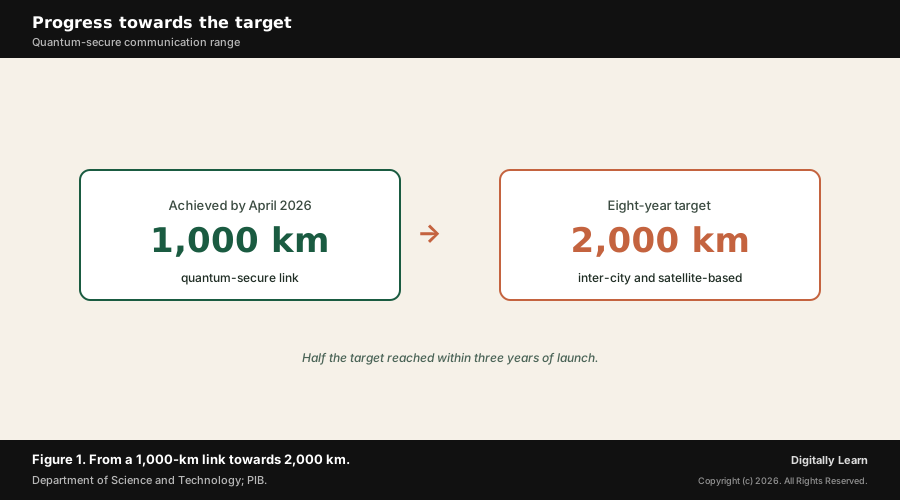
On 8 April 2026, the National Quantum Mission announced a 1,000-km quantum-secure communication link, demonstrated with indigenous technology. It is among the longest such deployments anywhere in the world.
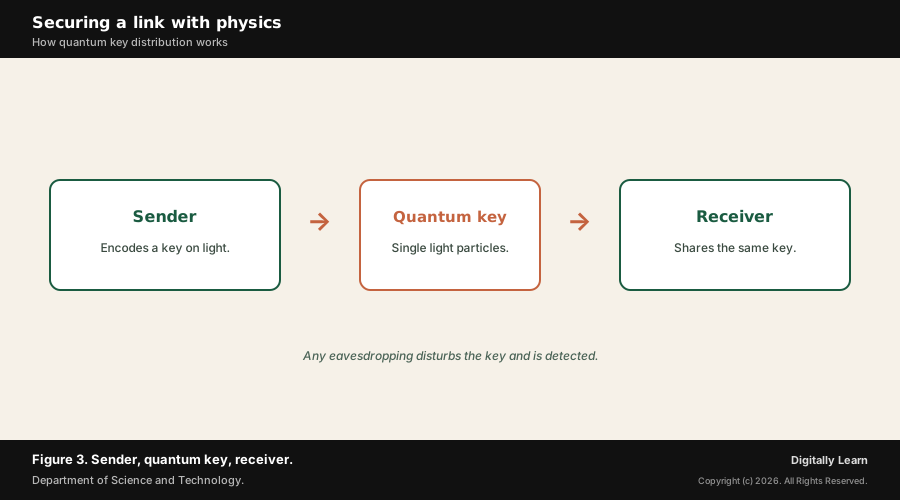
Quantum key distribution shares an encryption key encoded on single particles of light, so any attempt to intercept it disturbs the key and is detected. The National Quantum Mission is India's eight-year programme to build such quantum technologies.
The achievement matters because it arrives within three years of the mission's launch, well ahead of the timeline set for the 2,000 km target. The Secretary of the Department of Science and Technology called it a landmark advance in secure quantum communication.
The key elements of the development are:
- Milestone: a 1,000-km quantum-secure communication link, announced on 8 April 2026.
- Method: quantum key distribution, which exposes any eavesdropping.
- Mission: the National Quantum Mission, with a Rs 6,003.65 crore outlay.
- Target: secure links over 2,000 km within the eight-year mission.
Why the milestone matters
Secure communication and a sovereign capability
A quantum-secured link cannot be tapped without leaving a trace, so the 1,000-km demonstration directly strengthens the security of sensitive communication for defence, financial systems and critical infrastructure.
The link rests on indigenous technology from a startup supported under the mission, reducing dependence on foreign systems for the most sensitive layer of communication.
It also signals pace. Reaching 1,000 km within three years, half of the 2,000 km target, shows the mission is moving faster than its envisaged timeline.
What the milestone signifies
Security, self-reliance and a head start in a strategic race
Three threads carry the weight: communication security, indigenous capability, and a head start in a strategic global race.
First, communication security. Quantum-secured links protect the most sensitive traffic, in defence and finance, against interception that ordinary encryption may one day fail to stop.
Second, indigenous capability. The link uses home-grown technology developed under the mission, placing the core of secure communication in Indian hands rather than imported systems.
Third, the strategic race. Quantum technology is a contested frontier among major powers, and an early lead in secure communication gives India both leverage and resilience.
Distinguishing features of the mission
The mission at a glance
The table sets out the key facts, so the shape and scale of the National Quantum Mission are visible at a glance.
| Feature | Detail |
|---|---|
| Mission | National Quantum Mission (NQM) |
| Outlay | Rs 6,003.65 crore (2023-24 to 2030-31) |
| Approved | Union Cabinet, 19 April 2023 |
| Latest milestone | 1,000-km quantum-secure link, 8 April 2026 |
| Communication target | Secure links over 2,000 km |
Three features that define the mission
Three traits set the National Quantum Mission apart from a single research grant:
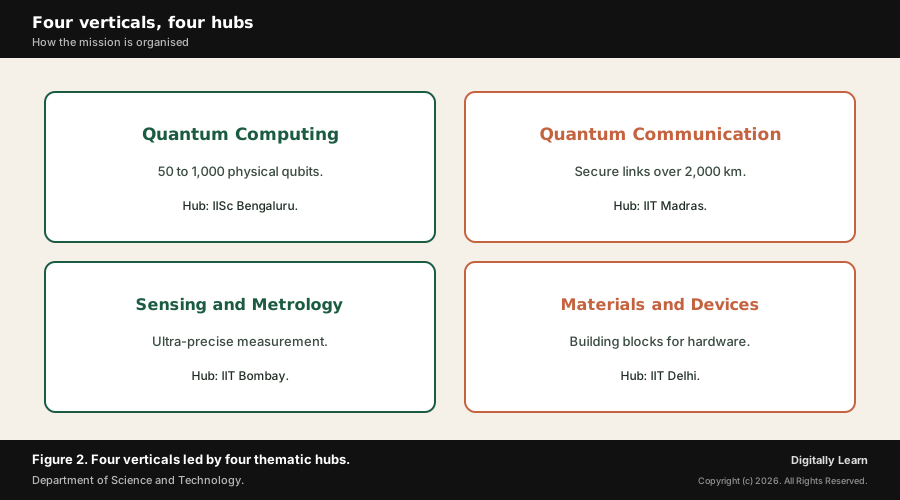
- (i) Four thematic verticals. It works across quantum computing, communication, sensing and metrology, and materials and devices.
- (ii) Four thematic hubs. Dedicated hubs sit at IISc Bengaluru and the IITs at Madras, Bombay and Delhi, each leading one vertical.
- (iii) Concrete targets. It aims for quantum computers with 50 to 1,000 physical qubits and secure links over 2,000 km within eight years.
Observable outcomes
Three trackable outcomes
The 1,000-km demonstration translates into three developments to watch in the mission.
- (a) Longer links. The next step is to extend secure communication towards the 2,000 km target, across cities and via satellite.
- (b) Real deployment. The technology is meant to move from demonstration to use in defence, banking and government networks.
- (c) Wider ecosystem. The thematic hubs and supported startups are expected to deliver more quantum hardware and applications.
A demonstration over a test link is a beginning. Reliable, round-the-clock operation on live national networks is what will prove the technology at scale.
Cyber security, the post-quantum threat and digital sovereignty
Why quantum-secure links matter for India's digital future
The milestone connects to cyber security, because quantum key distribution offers a defence whose strength rests on the laws of physics rather than on the difficulty of a calculation.
It answers the post-quantum threat, the worry that powerful quantum computers could one day break the encryption that protects banking, defence and government data.
It also advances digital sovereignty, since owning the secure-communication layer at home reduces reliance on foreign technology for the nation's most sensitive traffic.
UPSC relevance and exam focus
Where this fits in the UPSC-CSE syllabus
This topic maps to General Studies Paper III: developments in science and technology, indigenisation of technology, and cyber security, with links to internal security.
For Prelims, hold the high-yield facts: the mission's outlay and timeframe, the four verticals, the thematic hubs, and what quantum key distribution does.
For Mains, two framings recur: quantum technology in India's cyber-security architecture, and indigenisation of strategic technologies.
Recurring linked concepts an aspirant should keep in working memory:
- National Quantum Mission: Rs 6,003.65 crore, 2023-24 to 2030-31, four verticals.
- Quantum key distribution: secure communication where tapping is detectable.
- Thematic hubs: IISc Bengaluru and IITs Madras, Bombay and Delhi.
- Post-quantum threat: the risk that quantum computers break current encryption.
Quantum key distribution secures the sharing of an encryption key; it is not the same as a general-purpose quantum computer. Confusing the two is an error.
Do not treat quantum technology as only a research story. A balanced answer links it to security, the economy and strategic competition.
Previous Year UPSC-CSE Questions By the end you will be able to draft model answers for the following UPSC questions. Each question carries a collapsible framework showing how to approach it in the exam.
- UPSC Mains 2022 GS-IIIWhat are the different elements of cyber security? Keeping in view the challenges in cyber security, examine the extent to which India has successfully developed a comprehensive National Cyber Security Strategy.
How to structure the answer in the exam
Introduction: Open by defining cyber security and naming its core elements.
Body (sub-themes to develop):
- Elements: network, application, data, and communication security.
- Challenges: cross-border attacks, data theft, and evolving threats.
- Capability: quantum-secure communication under the National Quantum Mission.
- Gaps: coordination, skilled workforce, and a comprehensive strategy.
- The 1,000-km quantum link as a step in strengthening secure communication.
Conclusion: Conclude that India is building strong capabilities but needs a comprehensive, well-coordinated cyber-security strategy.
Sources and Further Reading
- Press Information Bureau: National Quantum Mission achieves 1,000-km secure communication milestone
- Department of Science and Technology: National Quantum Mission (NQM)
- Department of Science and Technology: Cabinet approves National Quantum Mission
- Department of Science and Technology: Establishment of Thematic Hubs and Technical Groups under the National Quantum Mission
- Press Information Bureau: National Quantum Mission, India's Quantum Leap
- Wikipedia: National Quantum Mission
Editorial Disclaimer
This briefing explains the National Quantum Mission milestone for UPSC preparation. The facts are drawn from the Department of Science and Technology and the Press Information Bureau. It is an explainer, not a substitute for official communications.


