


Overview
BRICS is a plurilateral grouping of major emerging economies that began as Brazil, Russia, India, China, with South Africa joining in 2010. Under its 2026 chairship, India hosted the BRICS Foreign Ministers' Meeting in New Delhi on 14-15 May 2026, opened by the External Affairs Minister. The grouping, now expanded to ten confirmed members (eleven in official lists that include Saudi Arabia), issued a Chair's Statement on cooperation across the Global South, covering multilateral reform and emerging issues. The meeting set the agenda ahead of the leaders' summit later in the chairship year.
That leaders' summit was held in New Delhi on 12 and 13 September 2026, where the members adopted the New Delhi Declaration by consensus; its outcomes are explained in BRICS Summit 2026: New Delhi Declaration, Members and India's Chairship.
Why the BRICS ministerial is in focus
India hosts the foreign ministers in New Delhi
India hosted the BRICS Foreign Ministers' Meeting in New Delhi on 14-15 May 2026. It was the first major ministerial of India's 2026 chairship of the grouping.
BRICS is a plurilateral platform of major emerging economies, not a treaty-based alliance. It coordinates positions on global governance, development finance and reform of multilateral institutions.
The External Affairs Minister opened the two-day meeting, which brought together member states and invited partners. It concluded with a Chair's Statement setting out the agenda for India's chairship year.
The headline elements of the meeting are:
- Host and chair: India, holding the rotating BRICS chairship for 2026.
- Venue and dates: New Delhi, on 14 and 15 May 2026.
- Outcome: a Chair’s Statement on Global South cooperation and multilateral reform.
- Membership: a ten-member grouping after the recent expansion.
Why the meeting matters
A platform for the Global South
BRICS now represents a large share of the world's population and output. A ministerial it hosts gives India a stage to shape the priorities of the Global South and the reform of global institutions.
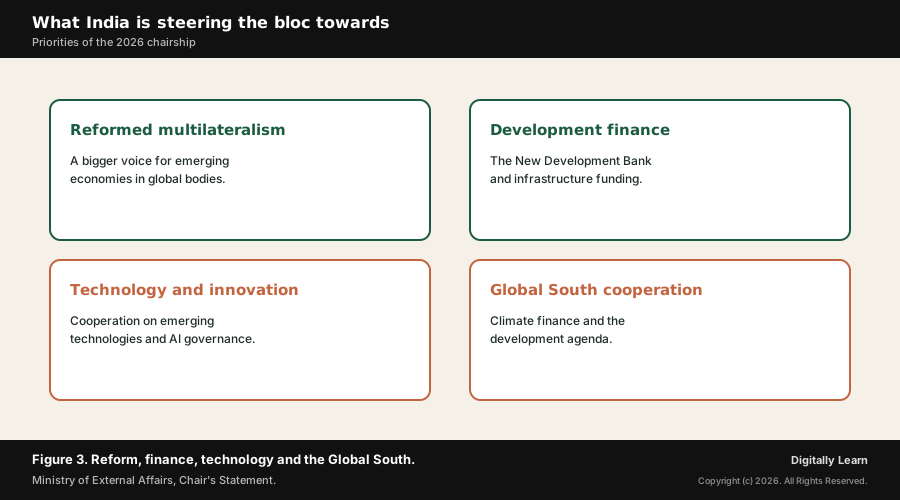
The chairship is significant for India's diplomacy. Setting the agenda lets New Delhi steer the bloc towards issues it values, such as development finance, technology and a fairer multilateral order, ahead of the leaders' summit.
The meeting also tests cohesion. With an expanded and diverse membership, the group must reconcile differing interests, so a consensus Chair's Statement is itself a measure of the bloc's coherence.
What India's chairship signifies
Agenda-setting, cohesion and reform
Three threads carry the weight: India's power to set the agenda, the cohesion of an enlarged bloc, and the push for reform of global institutions.
First, agenda-setting. As chair, India shapes the priorities, from development finance to technology and the concerns of the Global South, and frames the Chair's Statement that records them.
Second, cohesion. An expanded membership brings more voices and more friction, so reaching consensus tests whether the group can act together despite divergent national interests.
Third, reform. BRICS has long sought a greater say for emerging economies in bodies such as the United Nations and the international financial institutions, and the ministerial renews that demand.
Distinguishing features of BRICS
The membership and its expansion
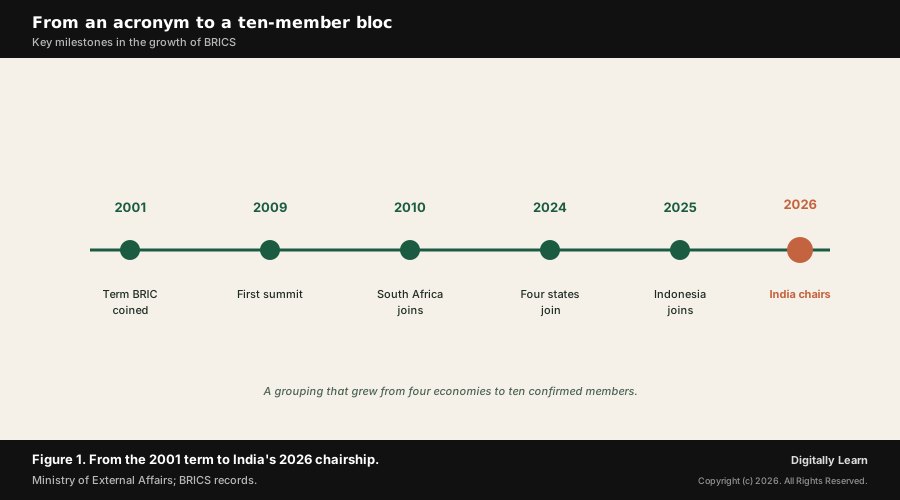
The table sets out how BRICS grew from its founding economies to a ten-member grouping, so the recent expansion is visible at a glance.
| Stage | Members added | Year |
|---|---|---|
| Founding economies | Brazil, Russia, India, China | 2009 |
| First expansion | South Africa | 2010 |
| Second expansion | Egypt, Ethiopia, Iran, UAE | 2024 |
| Third expansion | Indonesia | 2025 |
Three features that define the bloc
Three elements set BRICS apart from a formal alliance:
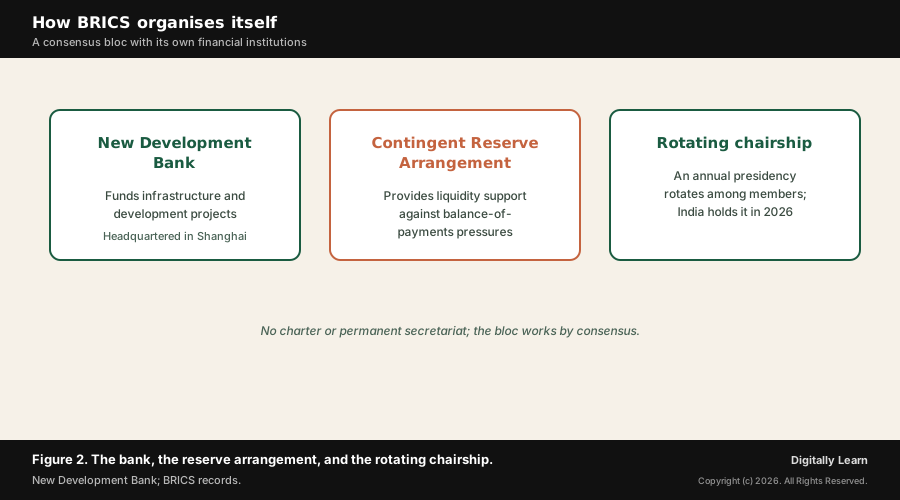
- (i) Plurilateral, not treaty-based. BRICS has no founding charter or secretariat; it works by consensus through a rotating chairship.
- (ii) Its own institutions. The grouping created the New Development Bank and a Contingent Reserve Arrangement to fund development and provide liquidity support.
- (iii) Reform-oriented. It positions itself as a voice for the Global South and for a more representative international order.
Observable outcomes
Three trackable outcomes
The ministerial translates into three developments to watch through India's chairship year.
- (a) The Chair’s Statement. The document frames the priorities that India will carry into the leaders’ summit later in the year.
- (b) Agenda follow-through. Working groups take forward themes such as development finance, technology and reform of multilateral bodies.
- (c) Partner engagement. Invited partner countries signal the bloc’s widening reach beyond its ten confirmed members.
Consensus is harder in a larger bloc. The real test is whether the expanded BRICS can convert statements into common positions at the United Nations and other forums.
BRICS in the wider world order
Global South, multipolarity and India's balancing act
The meeting fits India's wider pursuit of a multipolar world, where it engages many groupings at once, from the Quad to the SCO to BRICS, without joining a single bloc.
It connects to the demand for reformed multilateralism. BRICS members press for a bigger voice in the United Nations Security Council and the international financial institutions, a theme India champions.
The grouping also tests India's balancing. With both China and Russia inside BRICS and partners like the United States outside it, India must protect its interests while keeping the bloc useful.
UPSC relevance and exam focus
Where this fits in the UPSC-CSE syllabus
This topic maps to General Studies Paper II: important international institutions, agencies and groupings, and bilateral and regional groupings involving India.
For Prelims, hold the high-yield facts: the founding members and the 2024 and 2025 expansion, the New Development Bank, the rotating chairship, and India's 2026 chairship.
For Mains, two framings recur: the role of BRICS in reforming global governance, and how India balances its many overlapping memberships in a multipolar world.
Recurring linked concepts an aspirant should keep in working memory:
- New Development Bank: the BRICS bank, headquartered in Shanghai.
- Contingent Reserve Arrangement: the bloc’s liquidity-support mechanism.
- Rotating chairship: the annual presidency that India holds in 2026.
- Global South: the developing-world constituency BRICS seeks to represent.
Egypt, Ethiopia, Iran and the UAE joined in 2024, while Indonesia joined in 2025. Mixing up the year of accession of these members is a frequent error.
Do not present BRICS as an anti-Western alliance. It is a plurilateral, consensus-based platform, and India participates in it alongside groupings such as the Quad.
Previous Year UPSC-CSE Questions By the end you will be able to draft model answers for the following UPSC questions. Each question carries a collapsible framework showing how to approach it in the exam.
- UPSC Prelims 2025Consider the following statements with regard to BRICS:
- 16th BRICS Summit was held under the Chairship of Russia in Kazan.
- Indonesia has become a full member of BRICS.
- The theme of the 16th BRICS Summit was Strengthening Multiculturalism for Just Global Development and Security.
Which of the statements given above is/are correct?
How to approach this Prelims question
Approach: Check each statement against the facts of the Kazan summit and the BRICS theme.
Trap to watch: Statement III is the trap: the actual theme used 'Multilateralism', not 'Multiculturalism', so III is incorrect.
Key facts to recall:
- The 16th BRICS Summit was held in Kazan under Russia's chairship.
- Indonesia became a full member of BRICS in January 2025.
- The Kazan theme referred to multilateralism, not multiculturalism.
Answer signal: Statements I and II are correct; III is not. Correct answer: I and II.
- UPSC Mains 2014 GS-IIIndia has recently signed to become founding member of New Development Bank (NDB) and also the Asian Infrastructure Investment Bank (AIIB). How will the role of the two Banks be different? Discuss the strategic significance of these two Banks for India.
How to structure the answer in the exam
Introduction: Open with the NDB as the BRICS bank and the AIIB as the China-led infrastructure bank, both alternatives to legacy institutions.
Body (sub-themes to develop):
- NDB: BRICS-led, equal shareholding, funds infrastructure and sustainable development.
- AIIB: broader membership, China the largest shareholder, infrastructure focus.
- Strategic value: alternative development finance and a bigger voice for India.
- BRICS link: the NDB anchors the bloc's financial cooperation alongside the Contingent Reserve Arrangement.
- Caution: balancing participation with concerns over China's influence.
Conclusion: Conclude that both banks widen India's options while it presses for reform of existing institutions.
Sources and Further Reading
Editorial Disclaimer
This article is compiled from the reference materials listed in the Sources section. It is an explainer for UPSC preparation and is not a substitute for primary documents (NCERTs, GoI ministry releases, IMD bulletins, RBI / CEA / MoEFCC publications, and Standing-Committee reports).


