


Overview
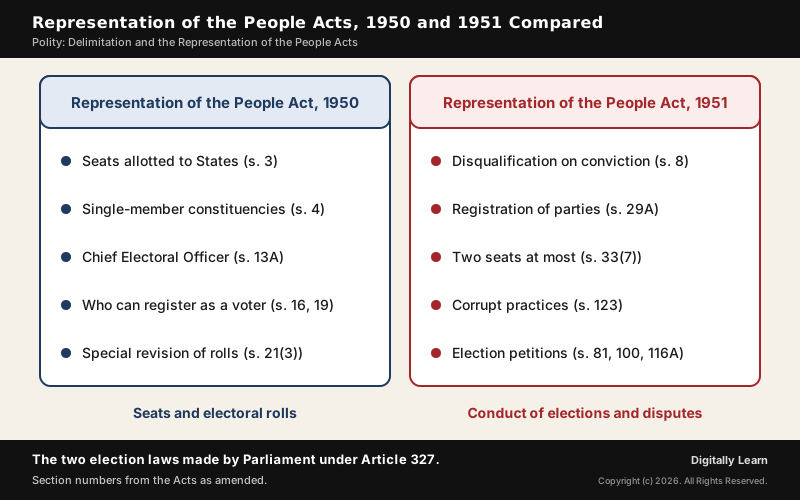
Delimitation is the process of fixing the number of seats and the boundaries of constituencies for the Lok Sabha and the State Assemblies after a census. It works under Article 82 and the laws of Parliament, chiefly the Representation of the People Acts of 1950 and 1951, which also govern how elections are held.
Delimitation in India: Meaning, Constitutional Basis and the Commissions
Delimitation Meaning: Articles 82, 327 and 329
Delimitation is the process of fixing the number of seats and the boundaries of the territorial constituencies in each State for the Lok Sabha and the Legislative Assemblies. It rests on a simple democratic idea: Article 81(2) says that the ratio between the number of seats and the population of a State should, as far as practicable, be the same for all States, so that one person's vote carries the same value everywhere.
Article 82 requires that, on the completion of each census, the allocation of Lok Sabha seats to the States and the division of each State into constituencies be readjusted by such authority and in such manner as Parliament may by law determine. Article 327 gives Parliament the power to make law on the delimitation of constituencies, and Parliament has used it through the Delimitation Commission Acts.
Article 329(a) shields the result from litigation: the validity of any law relating to the delimitation of constituencies or the allotment of seats cannot be called in question in any court. The Delimitation Commission is an independent body, and its orders cannot be challenged in a court of law either.
Delimitation Commission of India: 1952, 1963, 1973 and 2002
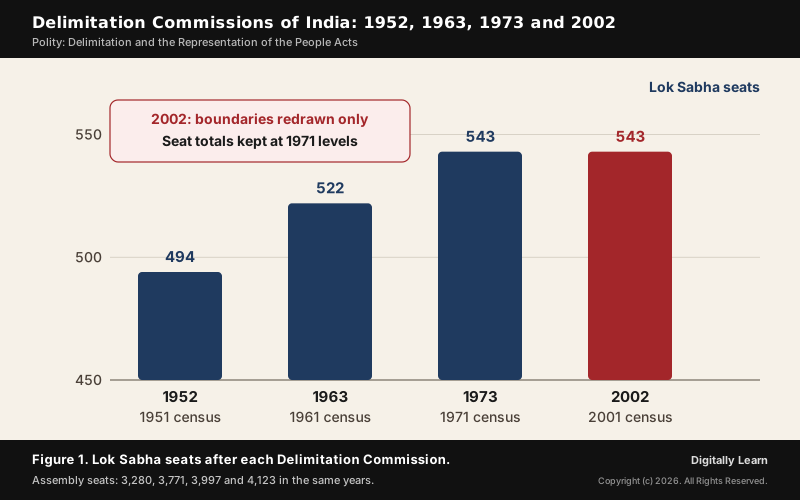
Delimitation Commissions have been set up four times, under the Delimitation Commission Acts of 1952, 1962 and 1972 and the Delimitation Act, 2002, each working on the latest census. The 1952, 1973 and 2002 Commissions were chaired by retired Supreme Court judges.
| Commission | Census used | Lok Sabha seats | Assembly seats | What changed |
|---|---|---|---|---|
| 1952 | 1951 | 494 | 3,280 | First exercise after independence; chaired by Justice N. Chandrasekhara Aiyar |
| 1963 | 1961 | 522 | 3,771 | First exercise after the reorganisation of States in 1956 |
| 1973 | 1971 | 543 | 3,997 | Lok Sabha seats raised; chaired by Justice J. L. Kapur |
| 2002 | 2001 | 543 | 4,123 | Boundaries redrawn; no change in seats or their allocation among States |
The 2002 Commission was set up on 12 July 2002 under Justice Kuldip Singh. Its orders took effect from 19 February 2008 for most States, and the Karnataka Assembly election of May 2008 was the first held on the new boundaries. Delimitation in Assam, Arunachal Pradesh, Nagaland and Manipur was deferred by presidential orders of 8 February 2008 for security reasons; in March 2020 a Commission under Justice Ranjana Prakash Desai was set up for these four States and Jammu and Kashmir, and the four north-eastern States were taken out of its purview in March 2021.
A Commission's orders are laid before the Lok Sabha and the State Assemblies concerned, but those Houses cannot modify them. The orders take effect from the date the President specifies.
Freeze on Lok Sabha Seats and the Delimitation Bill, 2026
Why Lok Sabha Seats Are Frozen on the 1971 Census
Population grew unevenly in the five decades after 1971. States such as Uttar Pradesh, Bihar, Madhya Pradesh and Rajasthan grew much faster than Kerala, Tamil Nadu, Karnataka and Andhra Pradesh. Redistributing seats strictly by population would have shifted seats towards the fast-growing States and penalised those that had controlled population, so Parliament froze the allocation instead.
- 42nd Amendment, 1976: Froze the allocation of seats among States on the 1971 census until 2000.
- 84th Amendment, 2001: Extended the freeze until the figures of the first census taken after 2026 are published.
- 87th Amendment, 2003: Allowed constituencies within each State to be redrawn on the 2001 census, without changing each State’s number of seats.
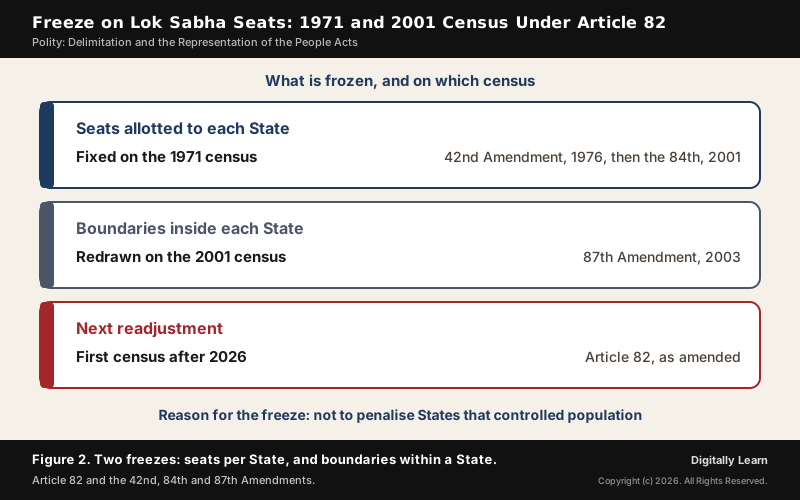
The freeze kept political peace but left wide gaps in constituency size: the largest constituency came to have over three million electors and the smallest fewer than 50,000. The 543 seats fixed on the 1971 census, when India's population was 54.8 crore, worked out to about 10.1 lakh people per constituency.
Delimitation Bill, 2026, Women's Reservation and the Federal Debate
The 106th Amendment of 2023 reserved one-third of the seats in the Lok Sabha and the State Assemblies for women, to take effect through a delimitation based on the next census, due in 2027. That linked the next delimitation to women's reservation.
In April 2026 the government introduced three Bills together: the Constitution (131st Amendment) Bill, 2026, to implement women's reservation by the 2029 Lok Sabha election; the Delimitation Bill, 2026, to readjust parliamentary and Assembly constituencies through a Delimitation Commission; and the Union Territories Laws (Amendment) Bill, 2026, to extend the reservation to the legislatures of Delhi, Puducherry and Jammu and Kashmir. In the debate the Home Minister said the Lok Sabha would have 816 seats after the exercise and that the five southern States would go from 129 to 195 seats.
On 17 April 2026 the Constitution (131st Amendment) Bill was defeated: 298 members voted for it and 230 against, in a House of 528 members present, short of the two-thirds mark of 352 that a Constitution Amendment Bill needs. The government then withdrew the Delimitation Bill and the Union Territories Laws Bill, which depended on it.
Representation of the People Act, 1950: Seats and Electoral Rolls
Representation of the People Act 1950: Allocation of Seats and Election Officers
Parliament made its two main election laws under Article 327. The Representation of the People Act, 1950 provides for the qualifications of voters, the preparation of electoral rolls, the delimitation of constituencies and the allocation of seats in Parliament and the State Legislatures. The first delimitation after independence, the Delimitation of Parliamentary and Assembly Constituencies Order, 1951, was made under this Act.
Section 3 allocates Lok Sabha seats to the States, and the seats reserved for Scheduled Castes and Scheduled Tribes in each, as shown in the First Schedule; section 4 says that every parliamentary constituency is a single-member constituency. The same Act creates the officers who run the rolls under the Election Commission.
- Chief Electoral Officer (section 13A): One for each State, an officer of the State Government designated by the Election Commission in consultation with that Government; supervises the preparation and revision of all rolls in the State.
- District Election Officer (section 13AA): Designated for each district by the Election Commission in consultation with the State Government.
- Electoral Registration Officer (section 13B): Prepares and revises the roll of each Assembly constituency.
Electoral Rolls Under the 1950 Act: Who Can Register as a Voter
Every constituency has an electoral roll prepared under the superintendence, direction and control of the Election Commission (section 15). Section 19 entitles a person to be registered if two conditions are met: the person is not less than eighteen years of age on the qualifying date, and is ordinarily resident in the constituency.
- Who is barred (section 16): A person who is not a citizen of India, is of unsound mind and so declared by a competent court, or is disqualified from voting under the law on corrupt practices and election offences.
- One entry only (sections 17 and 18): No one may be registered in more than one constituency, or more than once in any constituency.
- Ordinarily resident (section 20): Owning a house in a constituency does not by itself make a person ordinarily resident there, and a temporary absence does not end ordinary residence.
- Overseas electors (section 20A): A citizen living abroad for work, education or otherwise, who has not taken another country’s citizenship, may be registered at the place of residence in India shown in the passport.
A person left off the roll can apply to the Electoral Registration Officer for inclusion (section 23), and an appeal lies first to the district magistrate or an officer of equivalent rank and then to the Chief Electoral Officer (section 24). Section 21(3) lets the Election Commission direct a special revision of the roll for any constituency at any time, for reasons to be recorded. The Special Intensive Revision of 2025 and 2026 was read as an exercise of this power; the revision and the Supreme Court's ruling on it are explained in the article on the Election Commission of India.
Representation of the People Act, 1951: Conduct of Elections and Disputes
Representation of the People Act 1951: Nomination, Deposits and Polling
The Representation of the People Act, 1951 provides for the actual conduct of elections: the administrative machinery, the poll, election offences, election disputes, by-elections and the registration of political parties. Several of its rules decide who can stand and how.
- Nomination (section 33): A candidate set up by a recognised party needs one proposer; any other candidate needs ten proposers from the constituency.
- Two seats at most (section 33(7)): Since 1 August 1996 no one can be nominated from more than two Parliamentary constituencies in a general election, or more than two Assembly constituencies in a State.
- Deposits (section 34): Rs 25,000 for a Lok Sabha seat (Rs 12,500 for a Scheduled Caste or Scheduled Tribe candidate) and Rs 10,000 for an Assembly seat (Rs 5,000); the amounts were raised in 1996 and again from 2010.
- Death of a candidate (section 52): The poll is adjourned only if the candidate who dies was set up by a recognised political party.
- Silence period (section 126): No public meeting or display of election matter in the polling area during the 48 hours before the poll closes.
- Expenses (section 77): Every candidate keeps an account of election expenditure from nomination to the result.
Registration of Political Parties and Disqualification of Members
Under section 29A, an association of citizens that wants to be treated as a political party must apply to the Election Commission for registration. The Commission then recognises registered parties as national or State parties on the strength of their poll performance.
Section 8 disqualifies a person convicted of certain offences, among them promoting enmity between groups, bribery at elections, untouchability offences and offences under the Prevention of Insults to National Honour Act, 1971. If the sentence is only a fine, the disqualification runs for six years from conviction; if it is imprisonment, it runs from the conviction until six years after release. For any other offence, a sentence of at least two years brings the same disqualification. On 10 July 2013, in Lily Thomas v. Union of India, the Supreme Court struck down section 8(4), which had given sitting members three months to appeal and let them keep their seats meanwhile, so a member now loses the seat on conviction.
Corrupt practices are listed in section 123: bribery, undue influence, appeals on the ground of religion, race, caste, community or language, promoting enmity between classes, publishing false statements about a candidate, hiring vehicles to carry voters, spending beyond the limit, and obtaining the help of government servants. Under section 8A, a person found guilty of a corrupt practice is referred to the President, who decides on the disqualification, for at most six years, after obtaining the Election Commission's opinion and acting on it.
Election Petitions and Disputes Under the Representation of the People Act 1951
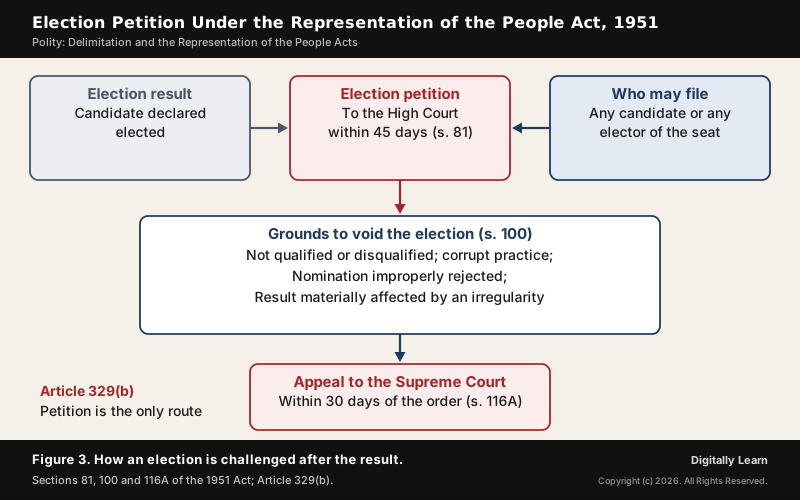
Article 329(b) allows an election to be questioned only through an election petition. Since the 19th Amendment of 1966 abolished the election tribunals, such petitions are heard by the High Courts. Under section 81, any candidate or any elector of the constituency may present a petition within 45 days of the result.
Section 100 sets out when the High Court must declare an election void: the winner was not qualified or was disqualified on the date of election; the winner or the election agent committed a corrupt practice; a nomination was improperly rejected; or the result was materially affected by an improperly accepted nomination, by a corrupt practice of another agent, by the improper reception or rejection of votes, or by any breach of the Constitution or the Act. Under section 116A, an appeal lies to the Supreme Court, on law and on facts, within 30 days of the High Court's order.
Two cases show how the system works. In N. P. Ponnuswami (1952), the Supreme Court held that the right to vote or to stand for election is a creature of statute, so its disputes follow the route the statute provides. On 12 June 1975 the Allahabad High Court, deciding an election petition filed by Raj Narain, set aside Indira Gandhi's election under section 123(7) and barred her for six years; on 7 November 1975 the Supreme Court overturned that finding but struck down clauses (4) and (5) of Article 329A, inserted by the 39th Amendment, holding that they violated the basic structure.
Previous Year UPSC-CSE Questions
Previous Year UPSC-CSE Questions By the end you will be able to draft model answers for the following UPSC questions. Each question carries a collapsible framework showing how to approach it in the exam.
- UPSC Prelims 2024 Prelims-GSHow many Delimitation Commissions have been constituted by the Government of India till December 2023 ?
How to approach this Prelims question
Approach: Step 1: count the Commissions set up after independence. Step 2: they were constituted under the Delimitation Commission Acts of 1952, 1962 and 1972 and the Delimitation Act, 2002. Step 3: that makes four.
Trap to watch: The 2020 Commission for Jammu and Kashmir and four north-eastern States can tempt a count of five; it was a reconstitution for particular areas, not a fresh national exercise.
Key facts to recall:
- (a) One: wrong. Commissions were set up four times.
- (b) Two: wrong. There were Commissions in 1952, 1963, 1973 and 2002.
- (c) Three: wrong. It leaves out the 2002 Commission under Justice Kuldip Singh.
- (d) Four: right. The Commissions of 1952, 1963, 1973 and 2002.
Answer signal: Four: option (d), the official answer, because Commissions were set up under four Acts.
- UPSC Prelims 2012 Prelims-GSWith reference to the Delimitation Commission, consider the following statements:
- The orders of the Delimitation Commission cannot be challenged in a Court of Law.
- When the orders of the Delimitation Commission are laid before the Lok Sabha or State Legislative Assembly, they cannot effect any modifications in the orders.
Which of the statements given above is/are correct?
How to approach this Prelims question
Approach: Step 1: statement 1 holds. Article 329(a) bars courts from questioning laws on delimitation, and the Commission's orders cannot be challenged in a court of law. Step 2: statement 2 holds. The orders are laid before the Lok Sabha and the State Assemblies, but no modification is permitted.
Trap to watch: Statement 2 tempts a 'no' because Houses usually can amend what is laid before them; delimitation orders are an exception.
Key facts to recall:
- (a) 1 only: wrong. Statement 2 is also correct.
- (b) 2 only: wrong. Statement 1 is also correct.
- (c) Both 1 and 2: right. Courts cannot question the orders and the Houses cannot modify them.
- (d) Neither 1 nor 2: wrong. Both statements are correct.
Answer signal: Both 1 and 2: option (c), the official answer, because the orders are final in court and in the House.
- UPSC Prelims 1999 Prelims-GSConsider the following statements about the recent amendments to the Election Law by the Representation of the People (Amendment) Act, 1996:
- I. Any conviction for the offence of insulting the Indian National Flag or the Constitution of India shall entail disqualification for contesting elections to Parliament and State Legislatures for six years from the date of conviction.
- II. There is an increase in the security deposit which a candidate has to make to contest the election to the Lok Sabha.
- III. A candidate cannot now stand for election from more than one Parliamentary constituency.
- IV. No election will now be countermanded on the death of a contesting candidate.
Which of the above statements are correct?
How to approach this Prelims question
Approach: Step 1: statement I holds. Conviction under the Prevention of Insults to National Honour Act, 1971 now disqualifies for six years. Step 2: statement II holds. Deposits were raised by the 1996 amendment. Step 3: statement III fails. A candidate may still stand from two constituencies, not only one. Step 4: statement IV holds as UPSC framed it: a poll is no longer countermanded on the death of an independent candidate, and is adjourned only if the candidate was set up by a recognised party.
Trap to watch: Statement III tempts because the 1996 amendment did limit candidature; the limit is two seats, not one.
Key facts to recall:
- (a) I and III: wrong. Statement III is wrong, and it leaves out II and IV.
- (b) I, II and IV: right. These match the 1996 amendment.
- (c) I, II and III: wrong. Statement III is wrong: the limit is two constituencies.
- (d) I, II, III and IV: wrong. Statement III is wrong.
Answer signal: I, II and IV: option (b), the official answer, because the limit is two constituencies, not one.
- UPSC Mains 2022 GS-IIDiscuss the procedures to decide the disputes arising out of the election of a Member of the Parliament or State Legislature under The Representation of the People Act, 1951. What are the grounds on which the election of any returned candidate may be declared void? What remedy is available to the aggrieved party against the decision? Refer to the case laws.
Answer outline: how to structure the answer
What the question asks, the main arguments, relevant examples and the direction of the conclusion. This is not a full model answer.
Introduction: Open with Article 329(b): an election to Parliament or a State Legislature can be questioned only through an election petition under the 1951 Act.
Body (sub-themes to develop):
- Procedure: petition to the High Court by a candidate or elector within 45 days (section 81); High Courts hear petitions since the 19th Amendment of 1966 abolished election tribunals.
- Grounds (section 100): not qualified or disqualified; corrupt practice by the winner or the election agent; improper rejection of a nomination; result materially affected by an irregularity.
- Remedy: appeal to the Supreme Court on law and fact within 30 days (section 116A).
- Case law: N. P. Ponnuswami (1952) on the statutory nature of the right; the Raj Narain petition (Allahabad High Court, 1975) and Indira Gandhi v. Raj Narain (1975) on judicial review of elections.
Conclusion: Conclude that the petition route keeps elections final during the poll while leaving every result open to judicial scrutiny afterwards.
Sources and Further Reading
- Legislative Department, Ministry of Law and Justice: The Constitution of India
- The Representation of the People Act, 1950 (consolidated text, Chief Electoral Officer, Telangana)
- The Representation of the People Act, 1951 (consolidated text, Chief Electoral Officer, Telangana)
- Supreme Court of India: In re Section 6A of the Citizenship Act, 1955, judgment of 17 October 2024
- NCERT: Indian Constitution at Work, Class 11, Chapter 3, Election and Representation
- The Hindu (Delhi): Constitution Amendment Bill, part of delimitation package, defeated, 18 April 2026
- The Hindu (Delhi): South's seat share won't be cut, say PM and Shah, 17 April 2026
- The Hindu (Delhi): The federal dilemma of delimitation, 17 August 2026
- Wikipedia: Delimitation Commission of India
- Wikipedia: Disqualification of convicted representatives in India
- Wikipedia: State of Uttar Pradesh v. Raj Narain
- Wikipedia: Indira Gandhi v. Raj Narain
- Wikipedia: Special Intensive Revision
Editorial Disclaimer
This article explains delimitation and the election laws from the Constitution's text, the Representation of the People Acts, court judgments and the other sources listed.


