


Overview
The Supreme Court ruling of 29 July 2026
An ex post facto environmental clearance is approval given to a project after it has started work without the prior environmental clearance that the Environment Impact Assessment (EIA) Notification, 2006 requires. On 29 July 2026 the Supreme Court quashed the Environment Ministry's 2021 office memorandum that had made such clearances a standing route, and left only narrow, time-bound amnesties by proper notification.
Ex Post Facto Environmental Clearance: The Supreme Court Ruling of 29 July 2026
Vanashakti Judgment 2026: What the Supreme Court Decided
The Bench of Chief Justice Surya Kant and Justices Joymalya Bagchi and Vipul M. Pancholi heard writ petitions led by the environmental group Vanashakti. In an 80-page judgment written by Justice Bagchi, the Court quashed the Environment Ministry's Office Memorandum of 7 July 2021, which had laid down a procedure for clearing projects begun without prior clearance.
- Prior clearance is mandatory: The 2006 Notification requires clearance before any construction or preparation of land, and work begun without it is a breach that a later penalty does not cure.
- No amnesty by office order: An administrative instruction cannot supplant delegated legislation, so the 2021 Office Memorandum was ultra vires and violated Articles 14 and 21.
- Amnesty only by notification: The Centre may still issue a narrowly tailored, time-bound amnesty notification under section 3 of the Environment (Protection) Act, 1986, for projects whose survival serves a supervening public interest.
- The 2017 Notification survives: The one-time window of 2017 was upheld as valid delegated legislation.
- Article 142 untouched: The Supreme Court itself may still grant a post facto clearance to do complete justice in a particular case.
Prospective Effect: Existing Clearances, Pending Applications and Public Projects
The Court quashed the Office Memorandum with prospective effect, using its powers under Article 142, for two reasons: years of conflicting orders had left the law uncertain, and several public projects had gone ahead on the strength of it. It named the AIIMS Medical College and Hospital building in Odisha, the Centre of Excellence for Cancer Diseases in Tamil Nadu, Vijayapura Airport in Karnataka, medical colleges, slum rehabilitation projects and irrigation projects for drought-prone areas.
- Clearances already granted: Those under the 2017 Notification or the 2021 Office Memorandum remain valid unless challenged individually.
- Pending applications: These are to be decided in accordance with law, and those rejected only because of the stay of 2 January 2024 or the 2025 judgment may be reconsidered.
- No fresh applications: None may be made under either instrument, and the government may not issue such administrative orders again.
EIA Notification 2006: Prior Environmental Clearance and Its Four Stages
Legal Basis, Categories and Who Grants the Clearance
Environmental clearance in India rests on section 3 of the Environment (Protection) Act, 1986, which empowers the Centre to restrict industries and projects to protect the environment. The EIA Notification of 27 January 1994 first required clearance for listed projects; the EIA Notification of 2006, which replaced it, uses the word "prior" throughout.
| Category | Who grants the clearance | Who appraises |
|---|---|---|
| A (larger potential impact) | Central Government, in the Environment Ministry | Expert Appraisal Committee |
| B (lesser impact, by the Schedule's thresholds) | State Environment Impact Assessment Authority (SEIAA) | State Level Expert Appraisal Committee |
| B2 mining of minor minerals up to five hectares | District Environment Impact Assessment Authority | District Level Expert Appraisal Committee |
The Centre constitutes each SEIAA under section 3(3) of the 1986 Act. The Central Pollution Control Board (CPCB) is a statutory organisation constituted in September 1974 under the Water (Prevention and Control of Pollution) Act, not an executive creation; its functions are to promote cleanliness of streams and wells and, under the Air Act of 1981, to improve the quality of air. With the State boards it monitors water quality at 507 stations, though laws such as the Water Act and the 1986 Act have long been weakly enforced.
Disputes reach the National Green Tribunal, set up in 2010 under the National Green Tribunal Act for effective and expeditious disposal of environmental cases. Its dedicated jurisdiction is meant to give speedy environmental justice and to reduce the burden of litigation in the higher courts, and it aims to decide cases within six months. It was the tribunal's order of 2021 that produced the office memorandum the Court has now quashed.
Environmental Impact Assessment Stages: Screening, Scoping, Hearing and Appraisal
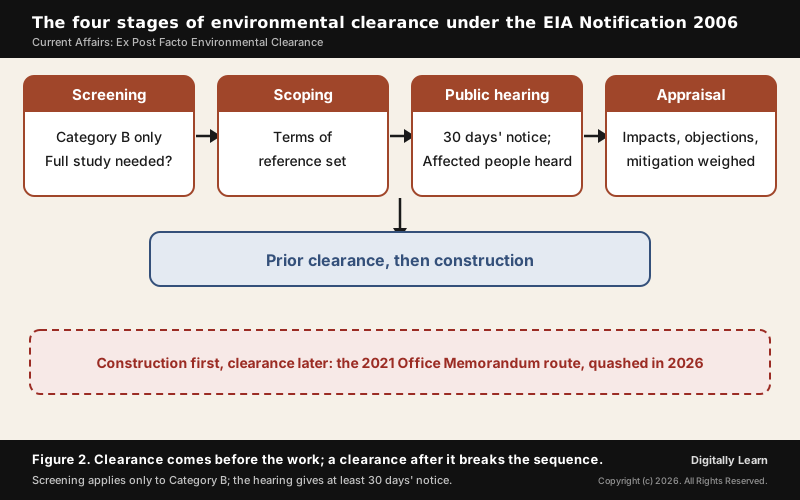
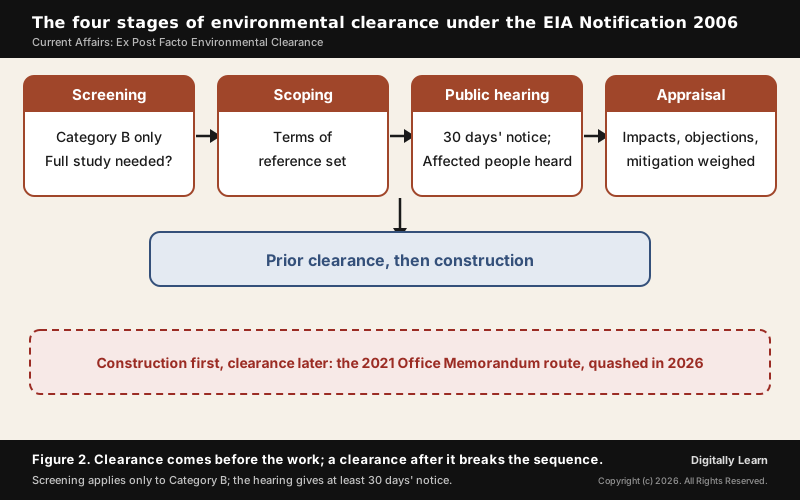
The environmental impact assessment process for a new project has up to four stages, all of them before any work begins on the site.
- Screening: Only for Category B; the State committee decides whether a project needs a full EIA study.
- Scoping: The committee sets the terms of reference that the EIA report must answer.
- Public consultation: The State Pollution Control Board holds a public hearing with at least 30 days’ notice, so that people likely to be affected are heard before their surroundings change.
- Appraisal: The committee weighs the impacts, the objections and the mitigation proposed, and recommends a decision to the regulatory authority.
Every stage comes before the work, because each is a judgement on harm that is still preventable; the Court called this the notification's philosophy of "look before you leap". After clearance the project must file half-yearly compliance reports on 1 June and 1 December, and these reports are public documents.
Retrospective Clearances Before the Courts, 2017 to 2026
Common Cause, Alembic and the One-Time Window of 2017
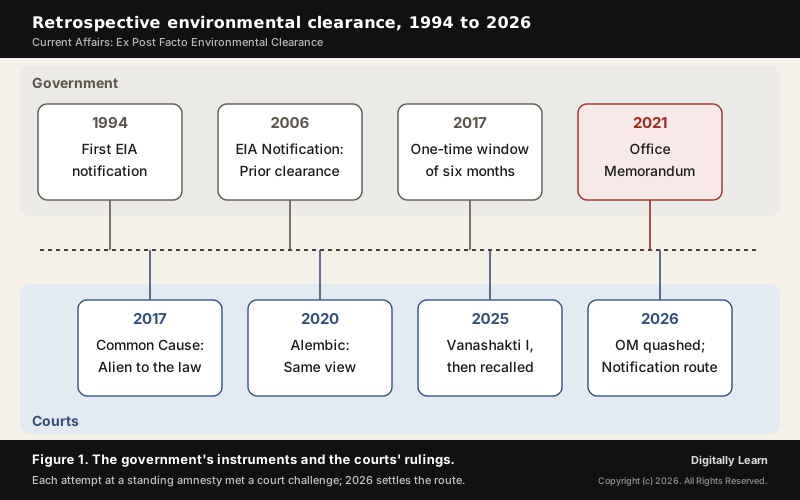
In Common Cause (2 August 2017) and Alembic Pharmaceuticals v. Rohit Prajapati (1 April 2020), the Supreme Court declared a retrospective clearance alien to environmental jurisprudence. The 2026 ruling reads those words in the context of the law as it then stood, which had no amnesty provision at all.
The Ministry had meanwhile issued a notification on 14 March 2017 that let projects already in violation apply for clearance within six months, after assessment of the damage, remediation and community resource augmentation. When it was challenged, the Centre undertook before the Madras High Court that it was a one-time measure, and the window was later extended only once, to 13 April 2018.
The 2021 Office Memorandum, Vanashakti 2025 and the Review
On 24 May 2021 the National Green Tribunal, in Tanaji B. Gambhire, directed the Ministry to lay down a standard procedure for violation cases, and the Office Memorandum of 7 July 2021 followed. A project not permissible for clearance was to be demolished or closed; a permissible one stayed closed until cleared, after damage assessment and a remediation plan. Compensation was fixed at 1% of the project cost plus 0.25% of turnover during the violation, halved if the violation was self-reported, with no cut-off date.
- 2 January 2024: A two-judge Bench of the Supreme Court stayed the Office Memorandum.
- 30 August 2024: The Madras High Court quashed it, with prospective effect.
- 16 May 2025: In Vanashakti I, Justices Abhay S. Oka and Ujjal Bhuyan struck down both the 2017 Notification and the 2021 Office Memorandum, calling such clearances a gross illegality.
- 18 November 2025: On a review by the Confederation of Real Estate Developers of India (CREDAI), a three-judge Bench recalled that judgment by 2:1, warning of a devastating effect on public projects worth thousands of crores; Justice Bhuyan dissented.
- 29 July 2026: The restored petitions were decided by the Bench led by the Chief Justice.
Why the Court Drew the Line Between a Notification and an Office Memorandum
Delegated Legislation, Article 14 and the Jan Vishwas Penalties
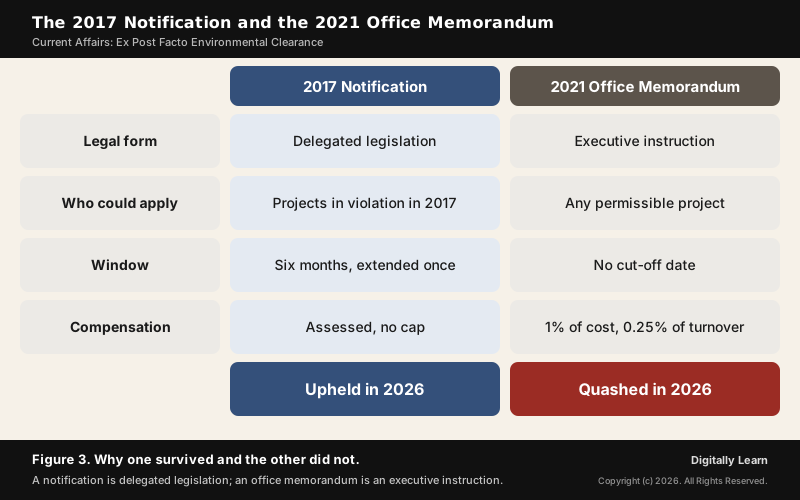
A notification under section 3 is delegated legislation: law made by the executive under power given by an Act of Parliament, with the force of law. An office memorandum is an executive instruction; it may fill a gap in the rules but cannot alter them. The 2021 order did alter them, by changing the enquiry and the criteria for clearance under the 2006 Notification.
| Feature | 2017 Notification | 2021 Office Memorandum |
|---|---|---|
| Legal form | Notification under section 3 (delegated legislation) | Office memorandum (executive instruction) |
| Who could apply | Projects in violation on 14 March 2017 | Any permissible project, at any time |
| Window | Six months, extended once to 13 April 2018 | No cut-off date |
| Appraisal | Central Expert Appraisal Committee, even for Category B | Appraised as a new proposal |
| Damage and remediation | Assessed by accredited laboratories; no cap on damages | 1% of project cost plus 0.25% of turnover; halved if self-reported |
| Verdict of 2026 | Valid | Quashed, with prospective effect |
The Court found the 2021 order a perpetual amnesty for every permissible project. It laid down no intelligible differentia for choosing projects with a rational nexus to public interest, so it failed the tests of reasonableness and proportionality under Articles 14 and 21. The Court said it had yielded to a principle of "pollute and then pay" rather than sustainable development.
Before the Jan Vishwas (Amendment of Provisions) Act, 2023, starting a project without prior clearance was an offence under section 15 of the 1986 Act, punishable with imprisonment of up to five years, a fine of up to Rs 1 lakh, or both. From 1 April 2024 civil penalties replaced prosecution, ranging from Rs 10,000 to Rs 15 lakh.
The Court drew two conclusions. Decriminalisation shows that Parliament left the Centre room to frame amnesty notifications for classes of projects; but paying a penalty does not cure the breach, because the prior-clearance requirement itself was never repealed.
Debate After the Ruling and the Draft EIA Notification 2020
Fig-Leaf or Firm Line? Concerns About the Notification Route
- A door left open: Critics say the distinction between an office order and a notification is a procedural nicety, since the Centre can now legalise violations by notification.
- Late detection: When State appraisal bodies and pollution boards find violations only after a highway, port or steel plant is built, a post facto clearance becomes the design rather than the exception.
- A cost of business: With imprisonment gone, a well-funded proponent can budget for the penalty.
- Non-regression: In his 2025 dissent Justice Bhuyan held that the principle of non-regression forbids rolling back existing levels of environmental protection.
The judgment answers that a valid amnesty must be a rare exception, finite in time and confined to its class, and that the regime of prior clearance across highways, airports, real estate and mining remains mandatory.
Draft EIA Notification 2020 Compared With the 2006 Notification
The same question ran through the draft EIA Notification of 2020, issued to supersede the 2006 Notification. Its preamble recalled the 2017 window and argued that violations would keep coming to notice, so a standing procedure was needed.
| Feature | EIA Notification 2006 | Draft EIA Notification 2020 |
|---|---|---|
| Projects begun without clearance | No standing procedure; only the one-time 2017 window | Clause 22: a permanent procedure for violation cases, taken up on the proponent's own application or on a report by an authority |
| Public hearing notice | At least 30 days | At least 20 days |
| Compliance reports | Half-yearly, on 1 June and 1 December | Yearly, by 30 June |
| Smaller projects | Category B, screened by the State committee | Category B2 split off, with some projects needing only a prior environment permission without appraisal |
The violation clause was the most contested change, because it would have turned the one-time window of 2017 into a permanent route, with cases taken up even on a proponent's own application after work had begun. The 2026 judgment now settles that such a route can never be opened by an office order, and only by a narrow notification.
Environmental Impact Assessment for UPSC: GS Paper III Links
Environmental Impact Assessment in the UPSC and PCS Syllabus
Environmental impact assessment appears by name in the General Studies Paper III syllabus, beside conservation and environmental pollution and degradation, and State PCS papers test the same law.
- Prelims facts: Clearance rests on section 3 of the Environment (Protection) Act, 1986; first EIA notification 1994, current one 2006; Category A by the Centre, Category B by the SEIAA; four stages, screening only for Category B; National Green Tribunal set up in 2010; CPCB set up under the Water Act, 1974.
- Mains analysis: Precaution against regularisation, notification against office order, decriminalisation and deterrence, public projects and public participation, and the role of litigants such as Vanashakti and Common Cause in shaping EIA law.
Previous Year UPSC-CSE Questions By the end you will be able to draft model answers for the following UPSC questions. Each question carries a collapsible framework showing how to approach it in the exam.
- UPSC Mains 2020 GS-IIIHow does the draft Environment Impact Assessment (EIA) Notification, 2020 differ from the existing EIA Notification, 2006?
Answer outline: how to structure the answer
What the question asks, the main arguments, relevant examples and the direction of the conclusion. This is not a full model answer.
Introduction: Introduce the EIA Notification 2006 under section 3 of the Environment (Protection) Act, 1986, and the 2020 draft issued to supersede it.
Body (sub-themes to develop):
- Violation cases: the draft's clause 22 makes a permanent procedure, taken up on the proponent's own application or an authority's report; 2006 has none beyond the one-time 2017 window.
- Public participation: notice for a public hearing cut from at least 30 days to at least 20 days.
- Monitoring: compliance reports yearly by 30 June, against half-yearly on 1 June and 1 December.
- Categorisation: a Category B2, with some projects needing only a prior environment permission without appraisal.
Conclusion: Conclude that the draft eased procedure, but its standing post facto route cut against the precautionary principle, the very point the Supreme Court addressed in 2026.
- UPSC Prelims 2018 Prelims-GSHow is the National Green Tribunal (NGT) different from the Central Pollution Control Board (CPCB)?
- The NGT has been established by an Act whereas the CPCB has been created by an executive order of the Government.
- The NGT provides environmental justice and helps reduce the burden of litigation in the higher courts whereas the CPCB promotes cleanliness of streams and wells, and aims to improve the quality of air in the country.
Which of the statements given above is/are correct?
How to approach this Prelims question
Approach: Step 1: statement 1, the CPCB created by an executive order: wrong, because the CPCB was constituted in September 1974 under the Water (Prevention and Control of Pollution) Act, a statute; only the first half (NGT set up by an Act) is right. Step 2: statement 2: right, because the NGT's dedicated jurisdiction gives speedy environmental justice and reduces the burden of litigation in the higher courts, and the CPCB's functions under the Water and Air Acts are to promote cleanliness of streams and wells and to improve air quality. So only 2.
Trap to watch: Both bodies are statutory; the statement on the CPCB fails on its origin, not on the NGT.
Key facts to recall:
- (a) 1 only: wrong. Statement 1 is wrong because the CPCB is statutory, set up under the Water Act, 1974.
- (b) 2 only: right. Statement 2 correctly gives the role of each body.
- (c) Both 1 and 2: wrong. Statement 1 is wrong.
- (d) Neither 1 nor 2: wrong. Statement 2 is correct.
Answer signal: Only statement 2 is correct: option (b), the official answer.
Sources
- Supreme Court of India: Vanashakti v. Union of India, W.P.(C) No. 1394 of 2023, judgment of 29 July 2026
- Ministry of Environment, Forest and Climate Change: EIA Notification, 2006 and its amendments (consolidated text to March 2025)
- Ministry of Environment, Forest and Climate Change: Draft EIA Notification, 2020
- Central Pollution Control Board: Introduction and functions
- National Green Tribunal: About the Tribunal
- NCERT: India: People and Economy (Class XII), Chapter 6, Water Resources
- Wikipedia: National Green Tribunal
- The Hindu, Delhi, 30 July 2026: SC restricts 'retrospective' environmental clearances; Supreme Court restricts 'retrospective' approvals
- The Hindu, Delhi, 31 July 2026: Clearance in reverse (editorial)
- UPSC: Civil Services Examination question papers
Editorial Disclaimer
This article draws on the judgment of the Supreme Court, the EIA notifications and the other sources listed on this page.


