


Overview
Count as Wetlands?
The Supreme Court issues notice on whether Rule 2(g) wrongly drops human-made wetlands from protection.
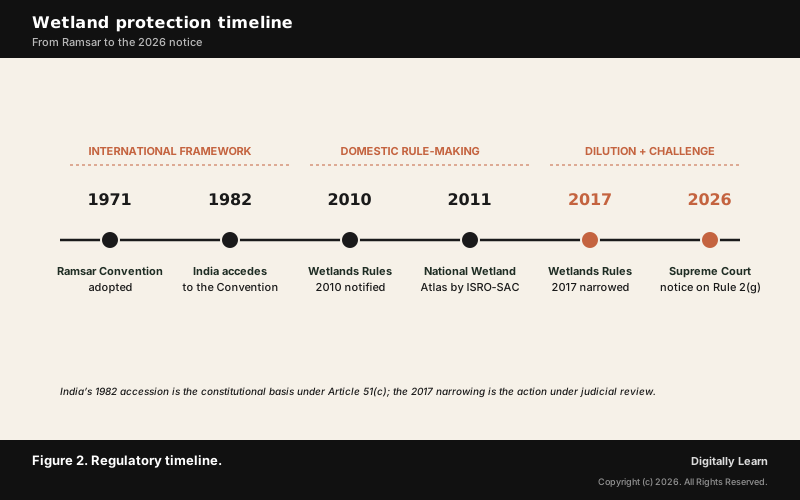
A wetland, in the framework adopted by the Ramsar Convention of 1971, refers to an area of marsh, fen, peatland, or water (natural or artificial, permanent or temporary, with water that is static or flowing, fresh, brackish, or salt), including marine waters not exceeding six metres in depth at low tide. India acceded to the Convention in 1982. The 2017 Wetlands Rules govern domestic conservation under the Environment (Protection) Act, 1986.
What the Supreme Court did on 26 May 2026
The notice and the petitioners
The Supreme Court issued formal notice to the Union Government on Tuesday, 26 May 2026. The notice came in a petition challenging the constitutional validity of the definition of wetlands in the Wetlands (Conservation and Management) Rules, 2017. A Bench headed by the Chief Justice of India, Surya Kant, agreed to examine whether Rule 2(g) of the 2017 Rules arbitrarily excludes human-made and historically developed wetlands from environmental protection.
The petition was filed by a group of environmental activists and professionals led by Ravindra Sinha. Senior advocate Gopal Sankaranarayanan and advocate Anindita Mitra appeared for the petitioners. The petitioners argue that the 2017 definition is inconsistent with India's binding obligations under the Ramsar Convention, 1971, and that it dilutes a protective framework established under the earlier 2010 Rules.
Definition: A wetland, in the formulation adopted by the Ramsar Convention, refers to an area of marsh, fen, peatland, or water, whether natural or artificial, permanent or temporary, with water that is static or flowing, fresh, brackish, or salt, including marine waters not exceeding six metres in depth at low tide. India acceded to the Convention in 1982 and bears treaty obligations on every wetland category the Convention recognises.
Why the case matters
The 2017 narrowing and the non-regression argument
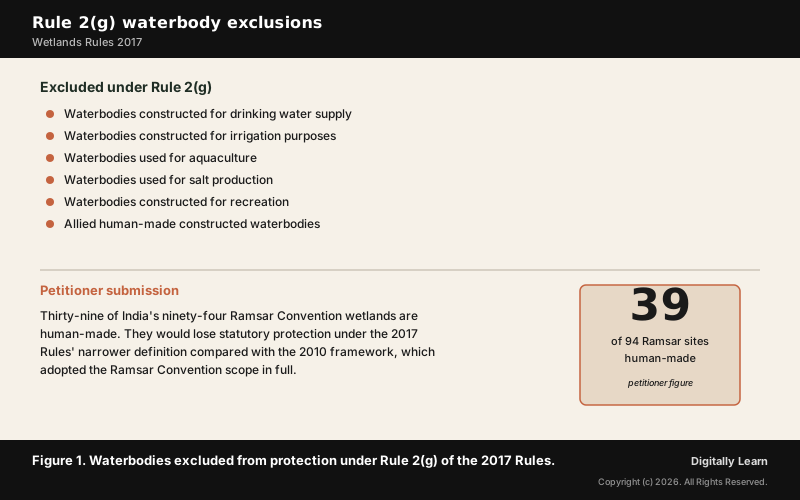
Why it matters: The petition argues that Rule 2(g) of the 2017 Rules removes human-made wetlands constructed for drinking water, irrigation, aquaculture, salt production, and recreation from the protective framework. The petitioners submit that 39 of India's 94 Ramsar Convention wetlands are human-made and would lose statutory protection under the narrower definition. The Rules' predecessor, the 2010 Rules, adopted the Ramsar definition in full and protected human-made waterbodies including tanks.
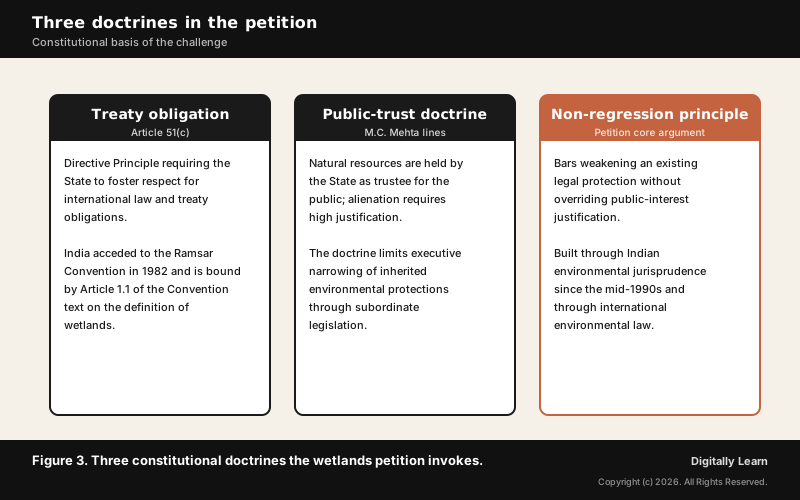
The 2017 redrafting therefore engages the non-regression principle. This doctrine prohibits governments from weakening an existing legal protection without overriding justification. The principle has emerged through international environmental law and through judicial interpretation in Indian environmental cases over the last three decades.
Significance for environmental jurisprudence
What is the significance of this issue: The case sits at the intersection of three constitutional doctrines that have shaped post-1996 environmental law in India. The first is the obligation under Article 51(c) of the Constitution to foster respect for international treaty obligations. The second is the public-trust doctrine articulated in the M.C. Mehta line of cases. The third is the non-regression principle developed through environmental jurisprudence over the last three decades.
A ruling in favour of the petitioners would compel the executive to align subordinate legislation with the international treaty India accepted four decades ago. A ruling against would acknowledge wider executive latitude to redefine statutory categories even where treaty obligations attach. Either outcome will shape how courts treat future executive narrowing of inherited environmental protections.
How the 2017 framework differs from its 2010 predecessor
How the Wetlands Rules 2017 differ from the 2010 framework
Distinguishing features: Three structural differences separate the two frameworks.
- (i) The 2010 Rules adopted the Ramsar Convention definition in full, including artificial and human-made wetlands. The 2017 Rules excluded specified human-made waterbodies through Rule 2(g).
- (ii) The 2010 Rules established a Central Wetland Regulatory Authority with a national mandate. The 2017 Rules abolished that body and devolved oversight to State Wetlands Authorities, decentralising both monitoring and enforcement.
- (iii) The 2010 Rules carried an explicit schedule of prohibited activities, including reclamation and permanent construction. The 2017 Rules removed that schedule and replaced it with more general principles, leaving prohibition to be determined case by case.
| Regulatory dimension | 2010 Rules | 2017 Rules |
|---|---|---|
| Definitional scope | Adopts Ramsar Convention definition in full; includes human-made wetlands | Excludes specified human-made waterbodies under Rule 2(g) |
| Central authority | Central Wetland Regulatory Authority | Abolished; oversight devolved to State Wetlands Authorities |
| Prohibited activities | Explicit schedule including reclamation and permanent construction | Schedule removed; principles-based assessment |
| Identification basis | Functional characteristics including hydrology and biodiversity | Origin-based exclusions through Rule 2(g) |
Concept link for UPSC examination preparation
Concept link: The case connects to UPSC examination preparation through General Studies Paper III (Environmental Conservation, Pollution and Degradation) and General Studies Paper II (Statutory Bodies and Government Policy). The underlying concept of the non-regression principle holds that domestic legal protections, once granted, cannot be diluted by subordinate legislation without strong public-interest justification. Aspirants preparing the topic should note the constitutional source of treaty obligations in Article 51(c), the role of Article 14 in arbitrariness challenges, and the doctrinal lineage running from Indian Council for Enviro-Legal Action v. Union of India through Vellore Citizens Welfare Forum to the present petition.
What the outcome could change
Observable outcomes if the Court rules in favour of the petitioners
Observable outcomes: Three concrete shifts would follow from a ruling that strikes down or reads down Rule 2(g).
- (a) Wetlands currently excluded would re-enter the protective framework of the principal Act, restoring development-control obligations on State authorities.
- (b) State Wetlands Authorities would need to reassess inventories and notify additional waterbodies, with attendant land-use and revenue implications for adjacent local bodies.
- (c) Subsequent challenges to other environmental sub-rules drafted after 2014 would likely follow the same non-regression logic, raising the constitutional bar on dilution of inherited protections.
How the National Wetland Atlas figures in the dispute
The petitioners rely on the National Wetland Atlas, 2011, prepared by the Indian Space Research Organisation's Space Applications Centre. The petitioners cite the Atlas as having inventoried 2,01,503 wetlands across India. They submit that the Atlas treats natural and artificial wetlands as a single ecological continuum, classifying them by hydrology, soil saturation, and biodiversity function rather than by origin.
The Court in M.K. Balakrishnan v. Union of India had directed implementation of protection covering all wetlands recorded in the Atlas. The petitioners argue that the 2017 narrowing defeats that direction by removing definitional eligibility for protection from the excluded human-made categories.
Contemporary linkages
The case in India's environmental regulatory trajectory
Contemporary linkages: The petition arrives during a wider judicial reassessment of executive narrowing in environmental subordinate legislation. The Environmental Impact Assessment notifications drafted after 2014 have faced multiple challenges at the National Green Tribunal on similar grounds. The Western Ghats notification process has stalled amid intergovernmental disagreement on boundary delimitation. The wetlands petition, if accepted on merits, would establish how courts treat treaty-aligned subordinate legislation that the executive subsequently narrows.
Maharashtra's recent completion of documentation for over twenty-three thousand wetlands offers a contrasting state-level example. The state used a unified inventory approach, distinguishing wetlands by ecological function rather than origin, and tracked both natural waterbodies and human-made tanks under a common protective framework. The Maharashtra approach demonstrates that the operational case for the broader definition is administratively workable. The wider question before the Supreme Court is whether the precautionary and non-regression principles function as binding constraints on rule-making or remain interpretive aids.
Sources and Further Reading
- Supreme Court to examine if law is diluting India's wetland count
- Maharashtra completes documentation of over 23,000 wetlands
- Ramsar Convention on Wetlands of International Importance Especially as Waterfowl Habitat, 1971
- Ramsar Convention
- List of Ramsar sites in India
- Wetlands (Conservation and Management) Rules, 2017
- National Wetland Atlas, 2011
- M.K. Balakrishnan v. Union of India
Editorial Disclaimer
Specific submissions, numerical claims, and doctrinal arguments attributed to the petitioners reflect what was placed before the Supreme Court and have not been independently verified against the underlying petition. Readers preparing for the UPSC examination should consult the principal Wetlands (Conservation and Management) Rules notification and the Supreme Court order text once issued.


