


Overview
The Public Examinations Act, amended
The anti-paper leak law is the Public Examinations (Prevention of Unfair Means) Act, 2024, which punishes leaks, impersonation, tampering and other unfair means in examinations held by the UPSC, the SSC, the Railway Recruitment Boards, the IBPS, the National Testing Agency and central recruiting bodies. Parliament amended it on 29 and 30 July 2026, after the NEET-UG 2026 leak, to raise penalties and fix deadlines for investigation, trial and appeal.
Paper Leak Law in India: What Parliament Passed in July 2026
NEET-UG 2026: Cancellation, Re-Test and the Demand for a Stronger Law
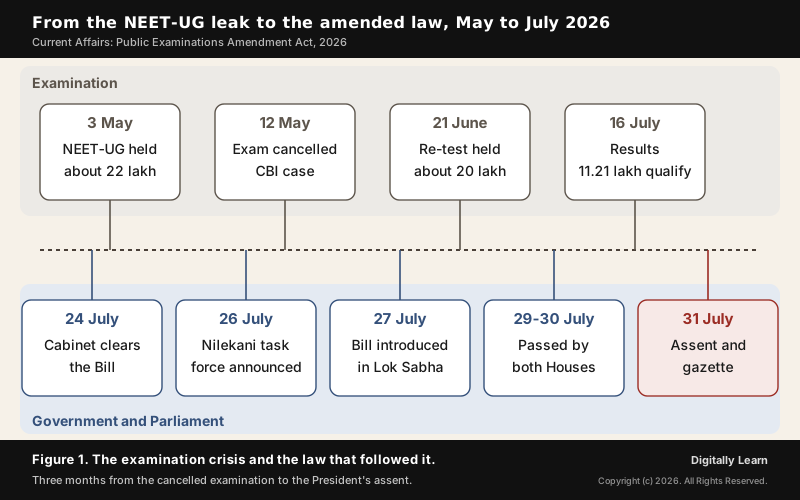
The National Eligibility-cum-Entrance Test for undergraduate medical courses (NEET-UG) was held on 3 May 2026 in 551 cities in India and 14 abroad, and almost 22 lakh students sat it. Four days later a whistle-blower's message led investigators to a "guess paper" that carried a significant number of the questions actually asked. On 12 May the National Testing Agency (NTA) cancelled the examination, and the Central Bureau of Investigation (CBI) registered a case on a complaint from the Ministry of Education. The FIR invoked the 2024 anti-cheating Act itself, along with offences under the Bharatiya Nyaya Sanhita and the Prevention of Corruption Act.
This was the first full cancellation and re-test since NEET began in 2013; in 2024 only 1,563 candidates had been re-tested after grace marks were given for lost time. The re-test of 21 June drew nearly 20 lakh candidates, and on 16 July the NTA declared that 11.21 lakh had qualified. Student protests over paper leaks spread through July, and the government answered with a tougher law, a shake-up of the NTA and a task force on examination reform.
Passage of the Amendment: Cabinet, Lok Sabha, Rajya Sabha and Assent
- 24 July: The Union Cabinet cleared amendments to the Public Examinations (Prevention of Unfair Means) Act, 2024, and the Centre terminated the services of up to 47 NTA officials as part of an overhaul of the agency.
- 27 July: Minister of State Jitendra Singh introduced the Amendment Bill in the Lok Sabha.
- 29 July: The Lok Sabha passed the Bill after the debate; the Minister told the House that 52 FIRs had been registered since the 2024 law came into force.
- 30 July: The Rajya Sabha passed it after a seven-hour debate.
- 31 July: The Union Law Ministry notified in the Gazette that the President had given her assent, so the amended law applies from that day.
Public Examinations Act 2024: Scope, Offences and Investigation
Examinations and Authorities Covered by the 2024 Act
Parliament passed the Public Examinations (Prevention of Unfair Means) Act in February 2024, and it came into force on 21 June 2024. Before it, no specific central law dealt with unfair means in examinations held by the Central Government and its agencies. A public examination under the Act is one conducted by an authority named in its Schedule, or by another authority the Centre notifies.
| Covered by the Act | Not covered by the Act |
|---|---|
| Union Public Service Commission; Staff Selection Commission; Railway Recruitment Boards | University examinations and State school board examinations |
| Institute of Banking Personnel Selection; National Testing Agency, which runs NEET-UG and UGC-NET | State public service commission and other State-level examinations, which are left to State laws |
| Ministries and Departments of the Centre, and their attached and subordinate offices, for recruitment | Candidates themselves: they remain under the examining body's own administrative rules |
The Statement of Objects and Reasons of the 2024 Bill said that it would serve as a model draft for States to adopt at their discretion, so that States could keep criminal elements out of their own examinations. The Act thus targets the people who exploit the system, such as gangs, insiders and service providers, rather than the student who cheats.
Unfair Means, Offences and Paper Leak Meaning Under the Act
Section 3 lists fifteen kinds of unfair means done for money or wrongful gain, and the list is open-ended. The main groups are these.
- Leaks: Leaking a question paper or answer key, or any part of it, and colluding to leak it.
- Help inside the hall: Solving questions for a candidate or assisting a candidate without authority.
- Tampering: With answer sheets, including OMR sheets, with assessment, with documents used for merit lists, or with a computer network or system.
- Rigging the conduct: Manipulating seating, dates or shifts, and breaching security measures.
- Fraud: Fake websites, fake examinations, and fake admit cards or offer letters.
All offences are cognizable, non-bailable and non-compoundable, so the police can arrest without a warrant, bail is not a right and the parties cannot settle the case. An officer not below the rank of Deputy Superintendent or Assistant Commissioner of Police investigates, and the Centre may hand the case to a central agency. An institution involved in organised crime faces attachment and forfeiture of its property.
Public Examinations Amendment Act 2026: Penalties, Fast-Track Courts and Timelines
Higher Penalties for Individuals, Service Providers and Organised Crime
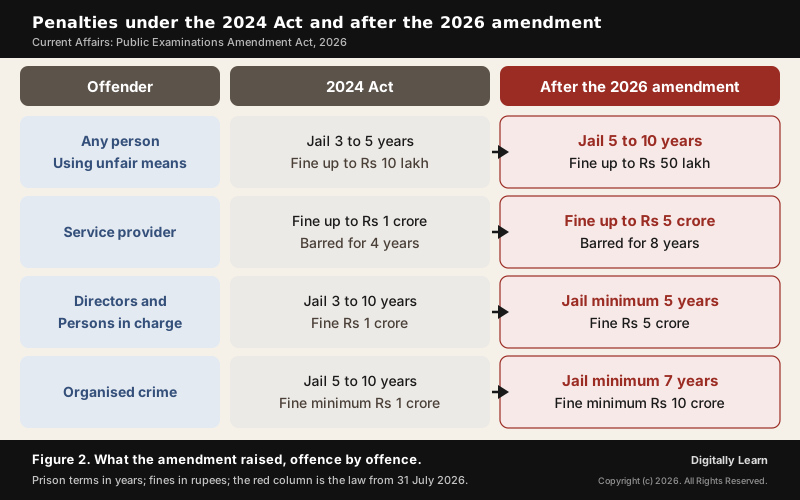
The amendment raises every penalty in sections 10 and 11 of the 2024 Act. The steepest rise is for organised crime, whose minimum fine goes up tenfold, from Rs 1 crore to Rs 10 crore.
| Offender | 2024 Act | After the 2026 amendment |
|---|---|---|
| Any person using unfair means | 3 to 5 years; fine up to Rs 10 lakh | 5 to 10 years; fine up to Rs 50 lakh |
| Service provider | Fine up to Rs 1 crore; barred for 4 years | Fine up to Rs 5 crore; barred for 8 years |
| Directors or persons in charge of the provider | 3 to 10 years; fine of Rs 1 crore | At least 5 years; fine of Rs 5 crore |
| Organised crime | 5 to 10 years; fine of at least Rs 1 crore | At least 7 years; fine of at least Rs 10 crore |
A service provider is any agency or firm that the examining body engages to conduct an examination, including its sub-contractors and those who supply computer resources or materials. Besides the fine, the firm must repay the proportionate cost of the examination, and the eight-year bar keeps it out of every public examination.
Special Task Force, Special Fast Track Courts and Appeals
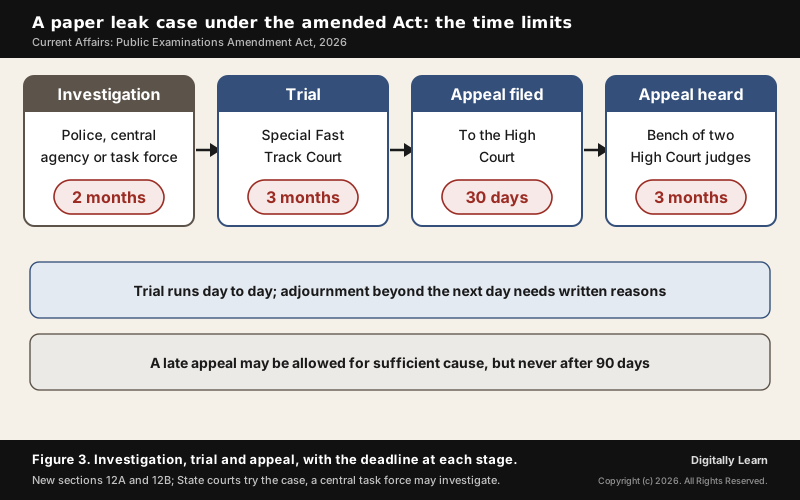
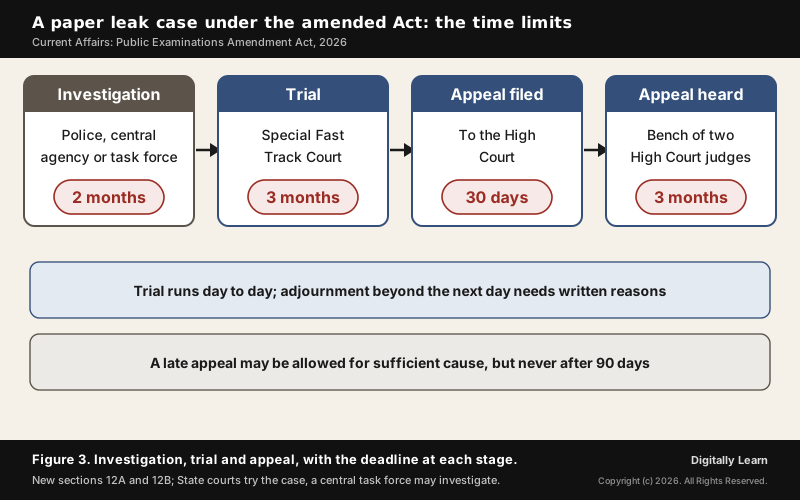
New sections 12A and 12B put a clock on every stage of a case. The Centre may now set up a Special Task Force by notification, and once it does, only that force investigates. Whoever investigates, whether local police, a central agency or the task force, must finish within two months.
- Special Fast Track Courts: Each State and Union Territory, in consultation with the Chief Justice of its High Court, designates a Court of Session to try these offences, along with connected offences under the Bharatiya Nyaya Sanhita, 2023 in the same trial.
- Day-to-day trial: Hearings continue every day until the witnesses present are examined; an adjournment beyond the next day needs written reasons, and the trial must end within three months of the chargesheet.
- Pending cases: All pending cases move to these courts and must be finished within three months of transfer.
- Prosecutors: Each State appoints one or more Special Public Prosecutors for every such court.
- Appeals: Appeals go to a bench of two High Court judges within 30 days, with a late appeal allowed for sufficient cause but never after 90 days, and are to be decided, as far as possible, within three months.
A Court of Session is the court of the District and Sessions Judge, the highest judicial authority in a district: the same judge is called the district judge in civil cases and the sessions judge in criminal ones. Under Article 233 the Governor appoints district judges in consultation with the High Court, either by promotion within the State judicial service or from the Bar after seven years as an advocate or pleader. A sessions judge can pass any sentence, but a death sentence needs the High Court's confirmation, whether or not there is an appeal. These trial courts sit at the base of an integrated judicial system, in which an appeal moves up to a higher court.
Concerns About the Amendment: Deadlines, Courts and the States
Fixed Deadlines in Criminal Trials: The 2002 Ruling and Missing Safeguards
A three-month limit for trials may run into a Supreme Court ruling of 2002, which held that prescribing an outer limit for criminal proceedings is neither advisable, nor feasible, nor judicially permissible. The two-month limit for investigation raises a different problem: the law does not say what happens if it is missed.
Other laws handle this explicitly. The Lokpal and Lokayuktas Act, 2013 requires reasons in writing to extend an inquiry or investigation, and under the Scheduled Castes and the Scheduled Tribes (Prevention of Atrocities) Act, 1989 the officer must explain in writing any delay beyond 60 days. Without such a provision, a missed deadline may simply be ignored.
Fast-Track Courts, Convictions and the Role of the States
Fast-track courts already exist for rape and POCSO cases, and they are overloaded. As of 30 April 2026, 775 Fast Track Special Courts, including 398 exclusive POCSO courts, worked in 29 States and Union Territories; they had 2,45,579 pending cases at the end of 2025, after registering 1,43,936 new cases that year and disposing of 66,500.
- Convictions: The 2024 Act had not secured a single conviction in its first two years, so the test of the amendment is enforcement, not the size of the penalty.
- Federal balance: States must designate the courts and appoint the prosecutors, while the Centre alone can create the task force and take over the investigation; Opposition members argued that this leaves the States as spectators.
- NEET itself: DMK members renewed the demand to scrap NEET, arguing that a single national examination disadvantages first-generation learners and State-board students.
NTA Reforms and the Exam Reforms Task Force After the 2026 Leak
National Testing Agency: Staffing, the Nilekani Task Force and the Radhakrishnan Blueprint
The NTA, under the Union Ministry of Education, runs the major national entrance examinations; it took over NEET from the Central Board of Secondary Education in 2019. NEET alone draws 20 to 24 lakh candidates a year for over 2.5 lakh seats across all courses.
The agency is thinly staffed. In July the government told the Rajya Sabha that 15 of the 39 posts created for the NTA were vacant, that its 24 employees were all on deputation, and that it engaged 73 officials on contract and 124 outsourced personnel. Its credibility had already been dented by an impersonation scam in Tamil Nadu in 2019, the paper leak and grace-marks controversy of 2024, and the cancellation and re-holding of UGC-NET in 2024.
On 26 July the Prime Minister announced a high-powered task force under Nandan Nilekani, who helped build Aadhaar and UPI, to make the examination system leak-proof and technology-driven. Its members are former ISRO Chairman S. Somanath, former Intelligence Bureau Director Tapan Deka, IIT Madras Director V. Kamakoti, former Education Secretary Anita Karwal and logistics expert Amrit Lal Meena.
The task force is expected to put into effect the blueprint of the committee under former ISRO Chairman K. Radhakrishnan, set up in 2024, whose October 2024 report was largely stalled for 18 months.
- Structure: A statutory NTA modelled on the UPSC, under a Director General and two Additional Directors General, with 10 functional verticals such as cybersecurity, psychometrics and forensics.
- Testing: A thousand standardised testing centres, multi-stage testing, a hybrid of paper and computer tests, and a move towards computer-adaptive testing.
- Security: A Digi-Exam biometric framework using Aadhaar, facial recognition and continuous surveillance, and strong links with State and district authorities.
Anti-Paper Leak Law for UPSC: GS Paper II Links
Examination Integrity in the UPSC and PCS Syllabus
Examination integrity falls under General Studies Paper II: government policies and interventions, issues relating to education and human resources, and statutory bodies such as the NTA. State PCS papers ask about the same law because State recruitment examinations face the same leaks.
- Prelims facts: Act in force from 21 June 2024; covers UPSC, SSC, Railway Recruitment Boards, IBPS, NTA and central recruitment; offences cognizable, non-bailable and non-compoundable; amendment passed on 29 and 30 July 2026; investigation in two months, trial in three; organised crime at least 7 years and Rs 10 crore.
- Mains analysis: Deterrence against prevention, central law against State examinations, fixed deadlines against fair trial, and the NTA’s institutional capacity.
Previous Year UPSC-CSE Questions By the end you will be able to draft model answers for the following UPSC questions. Each question carries a collapsible framework showing how to approach it in the exam.
- UPSC Mains 2024 GS-IIWhat are the aims and objects of recently passed and enforced, The Public Examination (Prevention of Unfair Means) Act, 2024? Whether University/State Education Board examinations, too, are covered under the Act?
Answer outline: how to structure the answer
What the question asks, the main arguments, relevant examples and the direction of the conclusion. This is not a full model answer.
Introduction: Introduce the Act as India's first central law against unfair means in public examinations, passed in February 2024 and in force from 21 June 2024, after repeated leaks and cancellations.
Body (sub-themes to develop):
- Aims and objects: transparency, fairness and credibility of public examinations; reassuring youth that honest effort will be rewarded; deterring persons, organised groups and institutions that use unfair means for money.
- Main provisions: fifteen kinds of unfair means in section 3; offences cognizable, non-bailable and non-compoundable; three to five years and up to Rs 10 lakh for individuals; at least Rs 1 crore and property attachment for organised crime; investigation by an officer of DSP or ACP rank, or a central agency; candidates left to administrative rules.
- Coverage: only examinations of the authorities in the Schedule (UPSC, SSC, Railway Recruitment Boards, IBPS, NTA, central Ministries for recruitment) or those notified by the Centre; university and State board examinations are not covered, and the Act is a model for States to adopt.
- Update: the 2026 amendment after the NEET-UG 2026 leak raised penalties, set two-month investigations and three-month trials in Special Fast Track Courts, and allowed a Special Task Force.
Conclusion: Conclude that a central law deters organised leaks in national examinations, but State laws and a stronger NTA are needed for the examinations the Act does not reach.
- UPSC Prelims 2004 Prelims-GSConsider the following statements:
- The highest criminal court of the district is the Court of District and Sessions Judge.
- District Judge are appointed by the Governor in consultation with the High Courts.
- A person to be eligible for appointment as a District Judge should be an advocate or a pleader of seven years' standing or more, or a member of a judicial service of the State.
- When the Sessions Judge awards death sentence, it must be confirmed by the High Court before it is carried out.
Which of these statements given above are correct?
How to approach this Prelims question
Approach: Step 1: statement 1, the Court of District and Sessions Judge is the highest criminal court of the district: right, because the district judge is the highest judicial authority in the district and is called the sessions judge when hearing criminal cases. Step 2: statement 2, appointment by the Governor in consultation with the High Court: right, under Article 233. Step 3: statement 3, eligibility of seven years as an advocate or pleader, or service in the State judicial service: right, as district judges come either from the Bar after seven years or by promotion within the judicial service. Step 4: statement 4, a death sentence by a sessions judge must be confirmed by the High Court: right, whether or not there is an appeal. All four are correct.
Trap to watch: Statement 4 looks like an appeal rule, but confirmation by the High Court is needed even when the convict does not appeal.
Key facts to recall:
- (a) 1 and 2: wrong. Statements 3 and 4 are also correct.
- (b) 2, 3 and 4: wrong. Statement 1 is also correct: the sessions court is the highest criminal court of the district.
- (c) 1 and 3: wrong. Statements 2 and 4 are also correct.
- (d) 1, 2, 3 and 4: right. Every statement matches Article 233 and the powers of the sessions judge.
Answer signal: All four statements are correct: option (d), the official answer.
Sources
- Gazette of India: The Public Examinations (Prevention of Unfair Means) Bill, 2024, as introduced in the Lok Sabha on 5 February 2024
- Lok Sabha: The Public Examinations (Prevention of Unfair Means) Amendment Bill, 2026 (Bill No. 139 of 2026)
- PIB: CBI registers case in alleged paper leak in NEET-UG 2026 (12 May 2026)
- NCERT: Social and Political Life III (Class VIII), Chapter 5, Judiciary
- The Hindu, Delhi, 4 May 2026: NEET-UG 2026 held across 551 cities in India and 14 abroad
- The Hindu, Delhi, 13 May 2026: NEET-UG 2026 cancelled after question paper leak; Experts say NTA needs to be structurally reformed
- The Hindu, Delhi, 14 May 2026: Testing troubles (editorial)
- The Hindu, Delhi, 17 July 2026: 11.21 lakh candidates clear NEET-UG re-test
- The Hindu, Delhi, 24 July 2026: 15 of 39 posts in NTA are vacant, Centre informs Rajya Sabha
- The Hindu, Delhi, 25 July 2026: Centre sacks 47 NTA officials, tightens law to tackle paper leaks; data on fast-track special courts
- The Hindu, Delhi, 27 July 2026: Nilekani to lead high-powered task force on exam reforms
- The Hindu, Delhi, 28 July 2026: Govt. introduces paper leak Bill in Lok Sabha
- The Hindu, Delhi, 29 July 2026: Paper leak Bill a milestone, says govt.
- The Hindu, Delhi, 30 July 2026: Lingering challenges (editorial); LS passes paper leak Bill; Bill lacks clarity on provisions if probe timeline is surpassed
- The Hindu, Delhi, 31 July 2026: Parliament passes paper leak Bill
- The Hindu, Delhi, 2 August 2026: Amendment to paper leak Bill gets assent from President
- The Hindu, Delhi, 5 August 2026: What can be done to curb paper leaks and ensure institutional accountability?
- UPSC: Civil Services Examination question papers
Editorial Disclaimer
This article draws on the Gazette text of the original Bill, the amendment Bill and the other sources listed on this page.


