


Overview
India's first education policy of the 21st century
The National Education Policy 2020, approved by the Union Cabinet on 29 July 2020 and run by the Ministry of Education, replaces the 1986 policy with a 5-3-3-4 school structure, makes foundational literacy and numeracy the first priority, opens a flexible four-year degree, and sets the goal of 6 percent of GDP on education.
NEP 2020, the National Education Policy 2020, is India's overarching framework for reforming school and higher education, approved by the Union Cabinet on 29 July 2020 and run by the Ministry of Education. It replaces the National Policy on Education of 1986 and is the first such policy of the twenty-first century. Drafted by a committee chaired by K. Kasturirangan, it sets out a new 5-3-3-4 school structure, makes foundational literacy and numeracy the highest early priority, and promotes teaching in the mother tongue in the early grades. For higher education it opens a flexible four-year undergraduate course with multiple entry and exit, an Academic Bank of Credits and a proposed Higher Education Commission of India, and it targets public spending of 6 percent of GDP on education.
What NEP 2020 Is: A New Education Framework Replacing the 1986 Policy
The 2020 policy, the Kasturirangan committee and why a new framework was needed
The National Education Policy 2020, known as NEP 2020, is the framework through which the Indian state set out to remake the way the country teaches, from the first years of school to the university degree. It was approved by the Union Cabinet on 29 July 2020 and is run by the Ministry of Education, the renamed Ministry of Human Resource Development. The policy was drafted by a committee chaired by the scientist K. Kasturirangan, whose draft was submitted in 2019 and shaped, after wide consultation, into the final document that the Cabinet cleared.
NEP 2020 replaces the National Policy on Education of 1986, modified in 1992, the framework that had governed Indian schools and colleges for more than three decades. It is the third such national policy, after those of 1968 and 1986, and the first of the twenty-first century. Because so much had changed in the economy, in technology and in what employers and citizens need, the Government held that the older framework no longer matched the country's needs, and that a fresh, comprehensive reform of both school and higher education was overdue. The new policy was therefore framed as a once-in-a-generation reset rather than a routine revision.
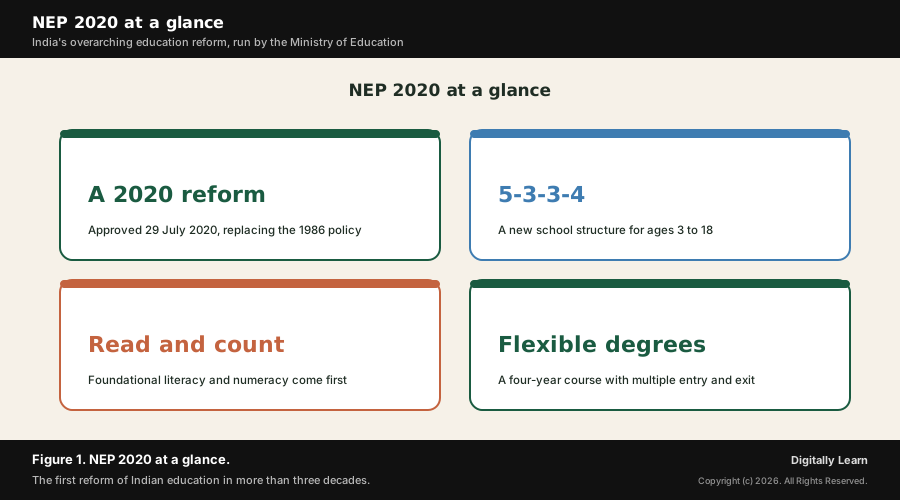
The case for a new policy rested on several stubborn weaknesses. A large share of children were reaching the middle grades without being able to read a simple text or do basic arithmetic, a crisis of learning that the older system had not solved. Higher education was criticised as rigid and over-specialised, fragmented across many narrow institutions, and weakly regulated. And public spending on education had long fallen short of the level the country itself had set as a goal. NEP 2020 was designed to confront all of these at once, and the figure below sets out its headline elements before the detail that follows.
School Education Reforms: The 5-3-3-4 Structure, Foundational Literacy and Mother-Tongue Medium
The 5-3-3-4 curricular structure, the foundational stage and early childhood care
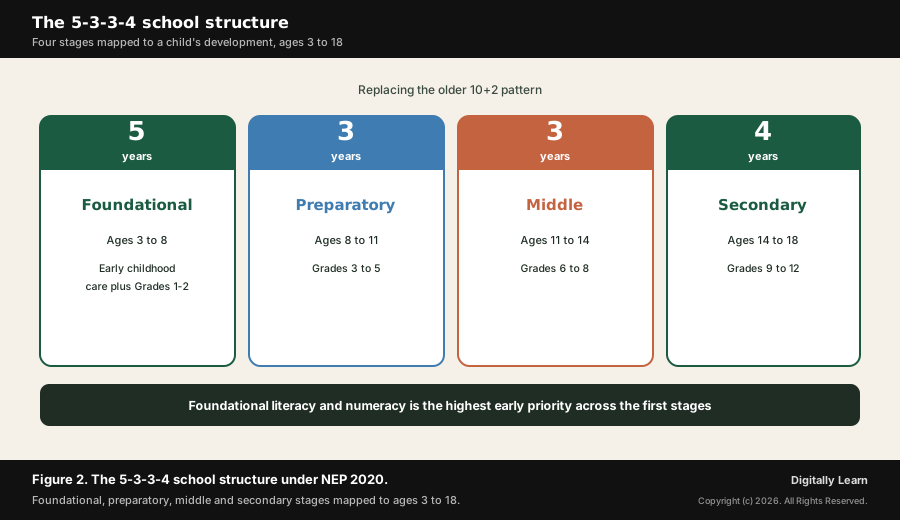
The most visible school reform is a new curricular and pedagogical structure of 5-3-3-4, which replaces the long-standing 10+2 pattern. The numbers describe four stages mapped to a child's development: a foundational stage of five years, a preparatory stage of three years, a middle stage of three years, and a secondary stage of four years. Together these cover the ages of roughly three to eighteen, so that the years of early childhood, long left outside the school system, are brought formally within it for the first time.
The first stage matters most. The foundational stage spans the years of early childhood care and education and the first two grades of primary school, and it rests on the recognition that the early years are when a child's capacity to learn is shaped. By drawing the three-to-six age group into a structured curriculum, the policy aims to give every child a sound start through play-based and activity-based learning, rather than leaving the youngest years to chance. The later stages then build on this base, moving from the preparatory and middle years into a secondary stage designed to offer greater choice of subjects and less rigid separation between streams.
Above this structure sits the policy's single highest early priority: foundational literacy and numeracy, the ability of a young child to read with understanding and to do basic arithmetic. NEP 2020 declares that achieving universal foundational literacy and numeracy in the early grades is the most urgent goal of the whole system, on the reasoning that a child who cannot read or count by the end of the early years struggles with everything that follows. To drive this, the Ministry of Education set up a dedicated national mission, examined below, that gives the goal a concrete vehicle. The figure that follows sets out the four stages of the new structure.
NIPUN Bharat, mother-tongue medium, board-exam reform and holistic report cards
The vehicle for the foundational goal is the NIPUN Bharat mission, the National Initiative for Proficiency in Reading with Understanding and Numeracy, launched by the Department of School Education and Literacy in 2021. Its purpose is to ensure that every child attains foundational literacy and numeracy by the end of Grade 3, and it works through teacher training, the supply of better learning material, and the tracking of each child's progress against clear learning goals. NIPUN Bharat turns a policy aspiration into a measurable mission with targets, so that the early-learning crisis is addressed directly rather than left as a slogan.
A second school reform concerns the medium of instruction. NEP 2020 holds that, wherever possible, the medium until at least Grade 5, and preferably to Grade 8 and beyond, should be the child's home language, mother tongue or regional language. The reasoning rests on evidence that young children learn concepts faster and more deeply in a language they already speak, so teaching the early years in the mother tongue is meant to improve understanding rather than to exclude any language. The policy frames this as a flexible recommendation, not a rigid imposition, and pairs it with a broad emphasis on multilingualism across the school years.
Two further changes reshape how learning is judged. The policy seeks to make board examinations easier and less high-stakes, testing core understanding rather than months of memorised content, and to reduce the fear and coaching pressure that the old exams created. Alongside this, it promotes a holistic progress card, a fuller record of a child that captures not only marks but also skills, attitudes and progress over time, supported by a shift towards competency-based and formative assessment. Taken together, the structure, the foundational mission, the language policy and the assessment reforms reorient the school system away from rote learning and towards understanding.
The Higher-Education Overhaul: Multidisciplinary Institutions, the Four-Year Degree and a New Regulator
Multidisciplinary institutions, the four-year degree with multiple entry and exit and the Academic Bank of Credits
For higher education, NEP 2020 sets out to replace a fragmented and over-specialised landscape with large, multidisciplinary institutions. The policy envisions universities and colleges that teach the sciences, the arts, the humanities and the professions together, rather than narrow single-stream colleges, on the view that a graduate is better served by a broad education that builds critical thinking and the ability to learn across fields. It sets the ambitious goal of raising the Gross Enrolment Ratio in higher education to 50 percent by 2035, a sharp increase in the share of young people who go on to study beyond school.
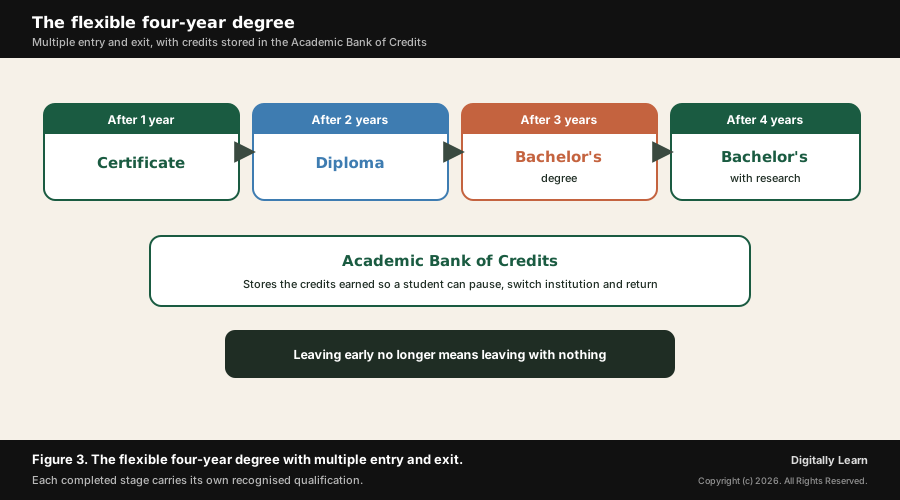
The most striking change is a flexible undergraduate degree. The policy allows a four-year undergraduate course, with multiple entry and exit points, so that a student may leave with a certificate after one year, a diploma after two, a bachelor's degree after three, and a bachelor's with research after four, and may also re-enter to complete the degree later. This design is meant to end the harshness of a system in which leaving early meant leaving with nothing, giving each completed stage its own recognised value and letting students move in and out of study as their circumstances allow.
Underpinning this flexibility is the Academic Bank of Credits. This is a digital store in which a student's earned credits are deposited and held, so that credits gained at one institution can be carried to another and counted towards a final degree. It makes the multiple-entry-and-exit system workable in practice, since a student who pauses does not lose the work already done, and it supports mobility between institutions. The policy also opens the door to internationalisation, allowing selected foreign universities to operate in India and Indian institutions to widen their global links. The figure below sets out the flexible-degree design.
The proposed Higher Education Commission of India and its four regulatory verticals
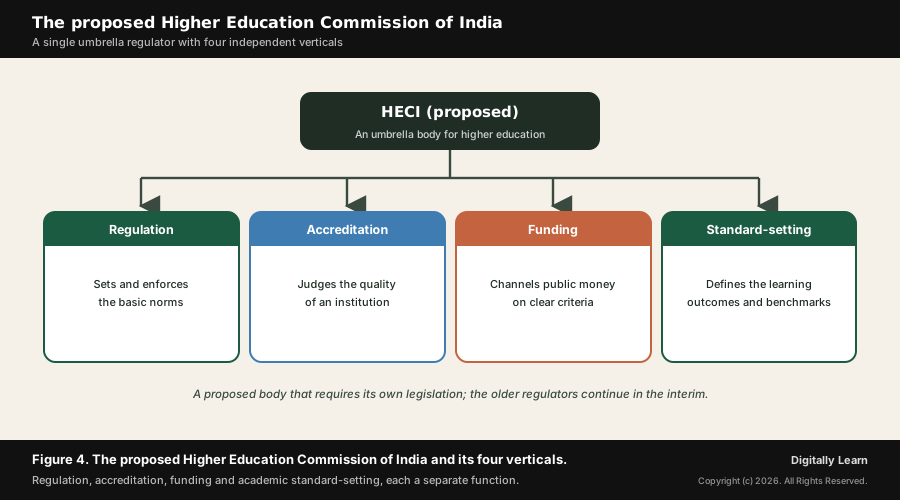
NEP 2020 proposes to recast the way higher education is regulated. In place of the several separate bodies that govern universities, technical education and other streams, the policy envisions a single umbrella regulator, the Higher Education Commission of India, often called HECI, for the whole of higher education apart from medical and legal education. The aim is to end the overlapping and sometimes conflicting controls that the older arrangement produced, and to separate the distinct jobs that a regulator must do so that no single body both runs and judges the system.
The proposed commission is built around four independent verticals, each with one clear function. One vertical handles regulation, setting and enforcing the basic norms that institutions must meet; a second handles accreditation, judging the quality of an institution; a third handles funding, channelling public money on transparent criteria; and a fourth handles academic standard-setting, defining the learning outcomes and benchmarks that degrees should reflect. By splitting these roles, the design seeks to remove the conflicts of interest that arise when one body performs several of them at once, and to make regulation lighter but firmer.
It is important to be precise about status. The Higher Education Commission of India is a proposed body that requires its own legislation, and at the time of writing the legal framework to establish it has not been finally enacted, so the older regulators continue to function in the interim. The four-vertical model nonetheless shapes the direction of reform, and several of its ideas, lighter-touch regulation, an emphasis on accreditation and outcomes, and transparent funding, already inform how the system is being steered. The table below summarises the four proposed verticals and what each is meant to do.
| Vertical | Function | What it is meant to do |
|---|---|---|
| Regulation | Setting and enforcing basic norms | Lay down the minimum standards every institution must meet and enforce them |
| Accreditation | Judging institutional quality | Assess and grade the quality of institutions on a transparent basis |
| Funding | Channelling public money | Allocate public grants to institutions on clear, criteria-based rules |
| Academic standard-setting | Defining learning outcomes | Set the benchmarks and outcomes that degrees and programmes should reflect |
Vocational Integration and the Governance and Financing Architecture
Vocational education from Grade 6 with internships and the integration of skills
NEP 2020 sets out to dissolve the old wall between academic and vocational learning, which had long treated skills training as a lesser path for those who could not study further. The policy provides that vocational education will begin in schools from Grade 6, accompanied by internships, so that children gain early, hands-on exposure to crafts, trades and practical work alongside their academic subjects. The aim is to give every student some experience of vocational skills, and to remove the stigma that has surrounded them, treating skill and knowledge as parts of one education rather than as rival tracks.
This early start is meant to build towards a workforce that is both educated and skilled. By weaving vocational exposure through the school years and into higher education, the policy seeks to raise the share of young people who leave the system with a usable, certified skill, and to align education more closely with the needs of the economy. The integration of skills is therefore not a side programme but a thread running through the whole structure, from the middle school years to the flexible degree, reflecting the policy's view that employability and broad learning must advance together.
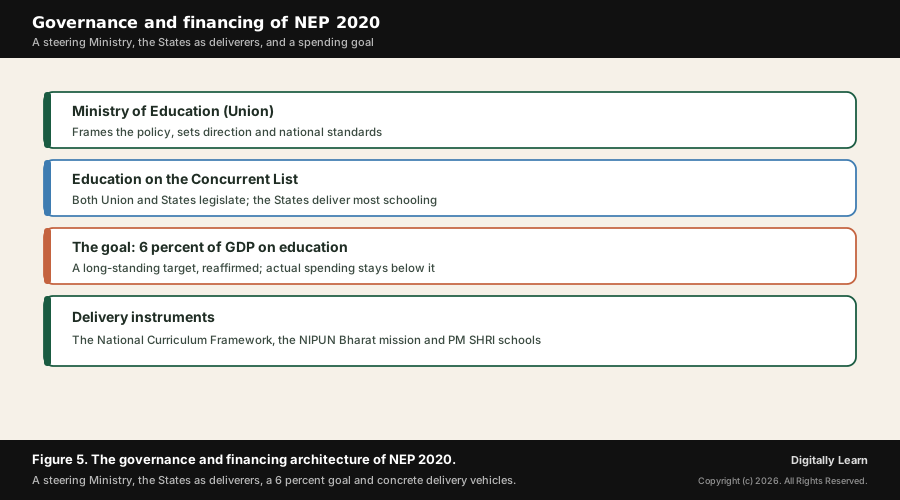
The Ministry of Education, the concurrent-list dimension and the 6 percent of GDP goal
NEP 2020 is steered by the Ministry of Education at the centre, but education in India is not a purely central subject. It sits on the Concurrent List of the Constitution, which means that both the Union and the States may legislate on it, and that schooling in practice is delivered very largely by the States. A national policy can therefore set direction and standards, but its real-world rollout depends on the States adopting and adapting it, which makes cooperation between the two levels of government central to the whole reform and, as the critiques below show, a source of friction.
On financing, the policy restates a long-standing national goal: to raise public investment in education, by the centre and the States together, to 6 percent of GDP. This figure is not new to NEP 2020; it was set as far back as the 1986 policy and has been reaffirmed since, yet actual public spending on education has for years remained well below that mark. The policy treats reaching the goal as essential, because the structural reforms it proposes, from early-childhood teachers to a wider higher-education system, cannot be delivered without a substantial rise in resources, which is why the gap between the stated goal and actual spending is so often raised.
Beyond money and the centre-State balance, the policy relies on a set of institutions to carry it through. Curriculum direction comes through a renewed National Curriculum Framework; the foundational mission runs through NIPUN Bharat; and a national scheme to upgrade schools into model institutions, PM SHRI, gives the reform visible vehicles on the ground. The governance design thus combines a steering Ministry, a shared constitutional responsibility with the States, a demanding spending goal, and a set of delivery instruments, and the figure below maps this architecture.
Implementation Progress and the Independent Critiques and Debates
Early implementation: NIPUN Bharat, the curriculum framework and the four-year degree
Implementation of NEP 2020 has begun on several fronts, though it is a long process that will run for years. The foundational mission NIPUN Bharat has been rolled out across States with targets for early-grade reading and arithmetic; a renewed National Curriculum Framework has been developed to translate the policy into syllabi and textbooks; and many universities have begun offering the four-year undergraduate course with the credit-based, multiple-exit design. The progress is real but uneven across States, and its pace and quality are best read as a work in motion rather than a finished result.
Because education sits with the States, adoption has varied. Some States have moved quickly to align their school structures and degree rules with the policy, while others have adopted it more cautiously or sought to modify particular elements, especially on language and structure. The honest position is that the headline reforms are being put in place gradually, that exact figures on coverage and outcomes move with each official report and so are best treated as indicative, and that the deeper test, whether the reforms actually lift learning, will only be answered over a longer horizon.
Centralisation and federalism, the language debate, the funding gap, capacity and the digital divide
A balanced reading sets the policy's ambition against a set of critiques, presented here as they are argued by independent researchers, State governments and education scholars. The first is the worry about centralisation versus federalism. Because education is on the Concurrent List, some States argue that a sweeping national policy, however well intentioned, encroaches on their domain and was framed with too little say for them, and a few have resisted or amended parts of it, making the centre-State balance the sharpest point of contention.
A second debate surrounds language. The emphasis on the mother tongue and on the three-language approach drew protest in several States, where critics feared that it could become a route to imposing a particular language or could disadvantage students who need strong English for work and mobility. The Government has stressed that the language provisions are recommendations and that the choice of languages rests with States and students, but the concern that a national framing could narrow real choice remains live, and it is closely tied to the federalism debate above.
Three further concerns are commonly raised. The first is the funding gap: critics note that the 6 percent of GDP goal has been stated for decades without being met, and doubt that the reforms can be delivered without the money to back them. The second is implementation capacity, the question of whether there are enough trained teachers, infrastructure and administrative strength to carry so large a change across a vast and unequal system. The third is equity and the digital divide, the fear that the policy's reliance on technology and online learning could widen the gap between the well-off and the poor, the urban and the rural, unless access is made genuinely universal. On whether NEP 2020 will reorient Indian education for the better, a careful answer treats the matter as open and weighs both the promise and these risks.
Understanding the Significance: Human Capital, Equity and the SDG-4 Connection
A reform of human capital, a drive for equity and the bridge to Sustainable Development Goal 4
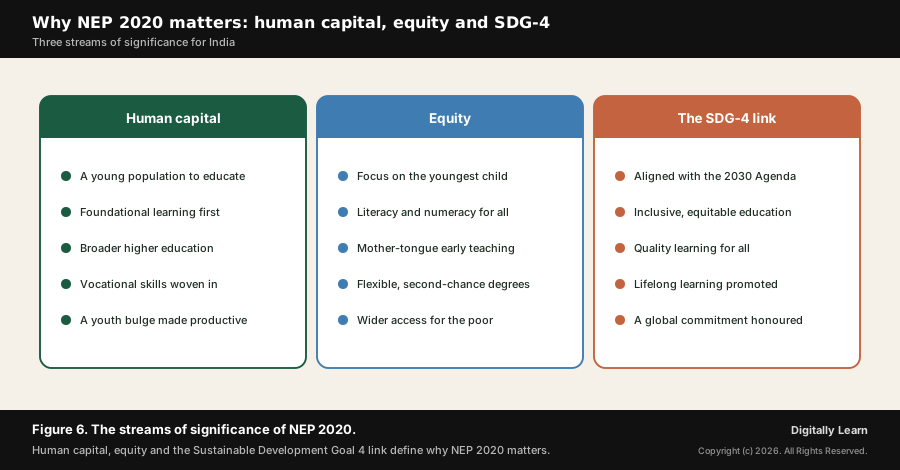
What is the significance of NEP 2020 lies first in its bearing on India's human capital. A country with one of the world's largest young populations depends, for its growth and its place in the world, on how well that population is educated and skilled. By trying to fix the early-learning crisis, broaden higher education and weave in vocational skills, the policy aims to convert a demographic youth bulge into a productive, capable workforce, which is why it is treated as a piece of economic strategy as much as of education reform.
Its second significance is for equity. Many of its central ideas, the focus on the youngest children, foundational literacy and numeracy for all, mother-tongue teaching in the early years, and a flexible degree that lets a student leave and return, are aimed squarely at the disadvantaged, who are the most likely to be failed by a rigid, exam-driven system. If delivered, these measures could widen access and reduce the steep inequalities that mark Indian education, though, as the critiques show, the digital and resource gaps could equally deepen them, so the equity case is a promise to be tested, not a result already won.
Its third significance is its place in a global commitment. The policy is explicitly aligned with Sustainable Development Goal 4, the goal of the United Nations 2030 Agenda to ensure inclusive and equitable quality education and to promote lifelong learning for all. NEP 2020 itself recognises that meeting this goal requires reconfiguring the whole system to support learning, and its themes of universal access, quality and lifelong learning mirror the language of SDG-4. Read together, human capital, equity and the SDG-4 link explain why the policy is treated as a landmark, and the figure below maps these streams.
The Way Forward: From Policy to Classroom, Cooperative Federalism and Adequate Funding
Turning the policy into classroom change, building State partnership and closing the resource gap
The way forward follows directly from the critiques. The first priority is to move the policy from the document to the classroom: to translate the structure, the foundational mission and the flexible degree into real change in teaching, which depends above all on teachers, their training, their support and their numbers, since no reform on paper improves learning unless the person in front of the class can deliver it.
The second priority is to make the reform a genuinely cooperative effort with the States. Because education is a shared responsibility, the centre needs to carry the States as partners rather than impose on them, addressing their concerns on language and structure, giving them room to adapt the policy to local conditions, and resolving the federalism tensions through dialogue rather than friction. A reform that the States own is far more likely to reach the classroom than one they resist.
The third priority is to close the resource gap. Meeting, or moving meaningfully towards, the 6 percent of GDP goal, and spending the money well on teachers, early-childhood centres, infrastructure and bridging the digital divide, is what would give the policy the means to match its ambitions. Pursued together, better delivery, true federal partnership and adequate funding would move NEP 2020 from a bold blueprint towards its founding promise: an education system that actually teaches every child to read, reason and thrive.
UPSC Relevance and Exam Focus
Where NEP 2020 fits in the UPSC-CSE syllabus
This topic maps most directly to General Studies Paper II: government policies and interventions for development in various sectors, and issues arising out of their design and implementation; and issues relating to the development and management of the social sector or services relating to education, since NEP 2020 is a flagship reform whose design, delivery and federal dimension are routinely examined. It also links to General Studies Paper III, inclusive growth and human-resource development, and to Paper I society, where education, equity and social mobility are recurring themes.
For Prelims, hold the high-yield facts: NEP 2020 was approved on 29 July 2020, is run by the Ministry of Education and replaces the 1986 policy; it sets a 5-3-3-4 school structure for ages three to eighteen; it makes foundational literacy and numeracy the first priority, driven by NIPUN Bharat; the medium until at least Grade 5 should preferably be the mother tongue; higher education gains a four-year degree with multiple entry and exit, an Academic Bank of Credits and a proposed Higher Education Commission of India with four verticals; vocational education starts from Grade 6; and the goals are a 50 percent higher-education enrolment ratio by 2035 and 6 percent of GDP on education.
For Mains, the recurring framing is to assess whether the policy can restructure and reorient Indian education and how far it conforms to Sustainable Development Goal 4. A strong answer explains the school and higher-education reforms, links them to the SDG-4 commitment of inclusive, equitable, lifelong learning, and then weighs them critically against the open problems of federalism, language, funding, capacity and the digital divide, treating NEP 2020 as a case study in reform and cooperative federalism rather than as a settled success.
Recurring linked concepts an aspirant should keep in working memory:
- Foundational literacy and numeracy: The ability of a young child to read with understanding and do basic arithmetic, made the policy’s first priority and driven by NIPUN Bharat.
- Multiple entry and exit: The flexible-degree design that lets a student leave with a recognised qualification at each stage and return later, supported by the Academic Bank of Credits.
- Higher Education Commission of India: The proposed single umbrella regulator with four verticals for regulation, accreditation, funding and academic standard-setting.
- Concurrent List: The constitutional placement of education that makes its delivery a shared Union and State responsibility, the root of the federalism debate.
A common Prelims trap is to confuse the bodies and the numbers; hold that NEP 2020 is run by the Ministry of Education, that the mother-tongue medium is recommended until at least Grade 5 and is not compulsory, that the Higher Education Commission of India is a proposed body still requiring legislation, and that the 50 percent enrolment ratio by 2035 and the 6 percent of GDP are stated goals rather than figures already achieved.
A common Mains trap is to describe the reforms and stop there. The exam value lies in a balanced judgment: the genuine promise in foundational learning, flexible degrees and the SDG-4 alignment, set honestly against the unresolved questions of federalism, language, funding, capacity and equity that decide whether the policy reshapes the classroom or remains on paper.
Previous Year UPSC-CSE Questions By the end you will be able to draft model answers for the following UPSC questions. Each question carries a collapsible framework showing how to approach it in the exam.
- UPSC Mains 2020 GS-IICritically examine whether NEP 2020 conforms to Sustainable Development Goal 4 (2030) and whether it genuinely restructures and reorients the Indian education system, weighing both its strengths and its weaknesses.
How to structure the answer in the exam
Body (sub-themes to develop):
- Conformity with SDG-4: the policy's drive for universal foundational literacy and numeracy, wider access, equity for the disadvantaged and lifelong, flexible learning mirrors the inclusive, equitable and lifelong-learning language of SDG-4.
- Restructuring: the 5-3-3-4 school structure replacing 10+2, the early-childhood foundational stage, the multidisciplinary higher-education institutions, the four-year degree with multiple entry and exit, the Academic Bank of Credits and the proposed Higher Education Commission of India.
- Reorientation: foundational literacy and numeracy and NIPUN Bharat, mother-tongue medium in the early grades, board-exam and competency-based assessment reform, and vocational education from Grade 6, all shifting the system from rote learning towards understanding and skills.
- Critical qualifications: centralisation versus federalism and the Concurrent List, the language debate, the funding gap against the 6 percent of GDP goal, implementation capacity and the equity and digital-divide concerns.
- Reasoned judgment: NEP 2020 conforms to SDG-4 in its aims and genuinely restructures and reorients the system on paper, but its success in practice turns on delivery, federal partnership and resources.
Sources and Further Reading
- Ministry of Education: National Education Policy 2020, overview
- Press Information Bureau: Cabinet approves National Education Policy 2020
- University Grants Commission: Salient features of NEP 2020, higher education
- Ministry of Education: Understanding Foundational Literacy and Numeracy
- NITI Aayog: Education division and the National Education Policy
- UNESCO: Sustainable Development Goal 4, Education 2030
- Ministry of Finance, Economic Survey: social sector and education spending
- Wikipedia: National Education Policy 2020
Editorial Disclaimer
This briefing is for UPSC preparation. Verify the facts and figures against the official Ministry of Education, NEP and PIB sources before relying on them.


