


Overview
Who Taxes India's Minerals
The MMDR Amendment Act 2026 amends the Mines and Minerals (Development and Regulation) Act, 1957 so that States may not impose any fresh tax, cess or levy on mineral rights or mineral-bearing land except within conditions set by the Centre, and it cancels State levies not yet collected. Parliament completed its passage on 13 August 2026, two years after the Supreme Court held that royalty is not a tax and that the power to tax mineral rights belongs to the States.
MMDR Amendment Act 2026: What Parliament Changed in August
What Is the MMDR Amendment Act 2026: Section 9D Explained
Section 9D is where the change lies. It takes away the States' freedom to add new levies on minerals, a freedom the Supreme Court had confirmed in 2024, and leaves it to the Centre to set the conditions on which any such levy may be imposed. The Centre calls the result a uniform and balanced fiscal framework for mining; the mineral-rich States call it an attack on their taxing powers.
- New Section 9D: No tax, cess or other levy, by whatever name called, may be imposed by a State on mineral rights or mineral-bearing lands, whether it is based on mineral quantity, mineral value, royalty or any other basis, except as the Centre’s conditions allow.
- Wider reach in Section 2: The words “and mineral-bearing land” are added after “regulation of mines”, so the Union’s control extends to the land that holds minerals, not only to the mines.
- Past levies: Any State levy not paid or collected before the amendment applies is treated as invalid, but amounts already deposited or recovered are not refunded.
- Rules under Section 13: The Central Government gets the power to make rules prescribing the conditions under which States may impose such levies.
Is the MMDR Bill Passed? Passage Without Debate and Presidential Assent
The MMDR Bill was passed and is now law. The Ministry of Mines put its proposals out for public consultation on 1 January 2026. In the Monsoon Session, Coal and Mines Minister G. Kishan Reddy introduced it, arguing that divergent State levies had created uncertainty and could raise costs, encourage imports and undermine domestic supply chains; RSP member N.K. Premachandran opposed its introduction as being against federalism.
- Lok Sabha, 12 August: Passed without a debate, amid Opposition protests, with Jagdambika Pal in the Chair.
- Rajya Sabha, 13 August: Passed after the Opposition’s demand for a Parliamentary Standing Committee was declined and Chairman C.P. Radhakrishnan rejected a notice to disallow the Bill.
- Assent: The Bill became an Act on receiving the assent of President Droupadi Murmu.
Who Can Tax Minerals: The Seventh Schedule and the Courts
Entry 54 of List I and Entries 23, 49 and 50 of List II
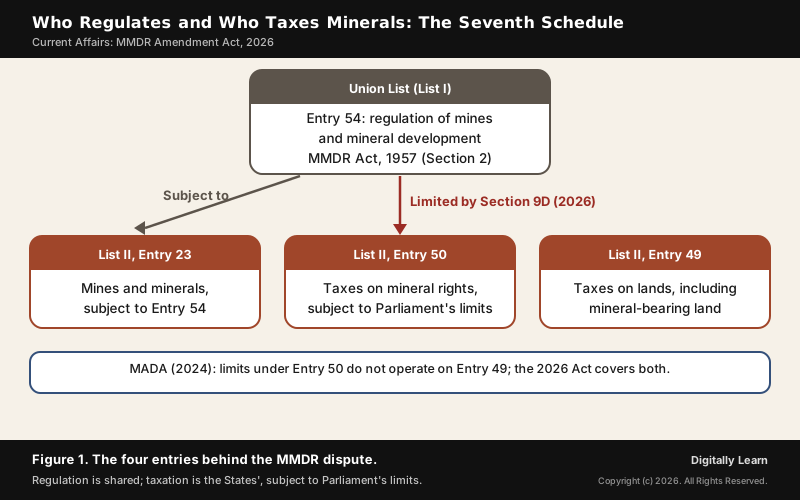
Mining sits in both the Union List and the State List, which is why the question of who may tax it keeps returning to the courts. Regulation of mines and mineral development is Entry 54 of List I and Entry 23 of List II, and the State entry is subject to the Union entry. Parliament made the required declaration in Section 2 of the MMDR Act, which states that it is expedient in the public interest for the Union to take the regulation of mines and the development of minerals under its control.
| Entry | List | What it covers | Who acts under it |
|---|---|---|---|
| Entry 54 | List I (Union) | Regulation of mines and mineral development, to the extent Parliament declares | Parliament: the MMDR Act, 1957 |
| Entry 23 | List II (State) | Regulation of mines and mineral development, subject to Entry 54 of List I | State legislatures, beyond the reach of the MMDR Act |
| Entry 50 | List II (State) | Taxes on mineral rights, subject to any limitations imposed by Parliament by law relating to mineral development | States tax; Parliament may limit |
| Entry 49 | List II (State) | Taxes on lands and buildings, including mineral-bearing land | States tax |
Is Royalty a Tax? The Nine-Judge MADA Ruling of July 2024
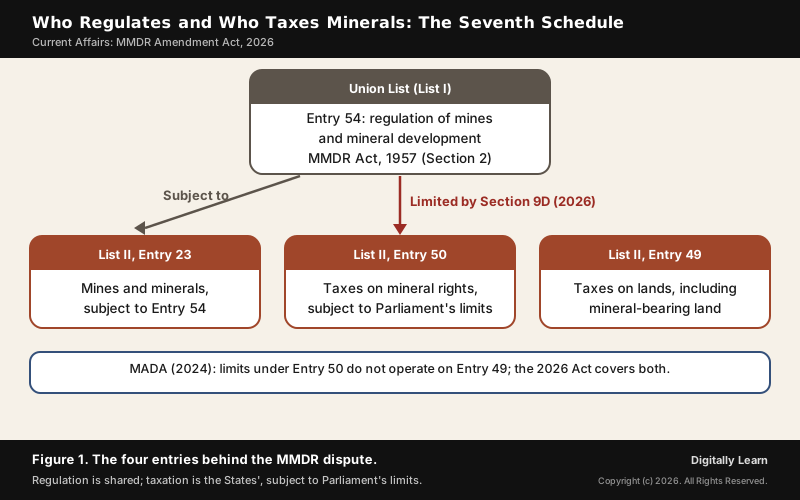
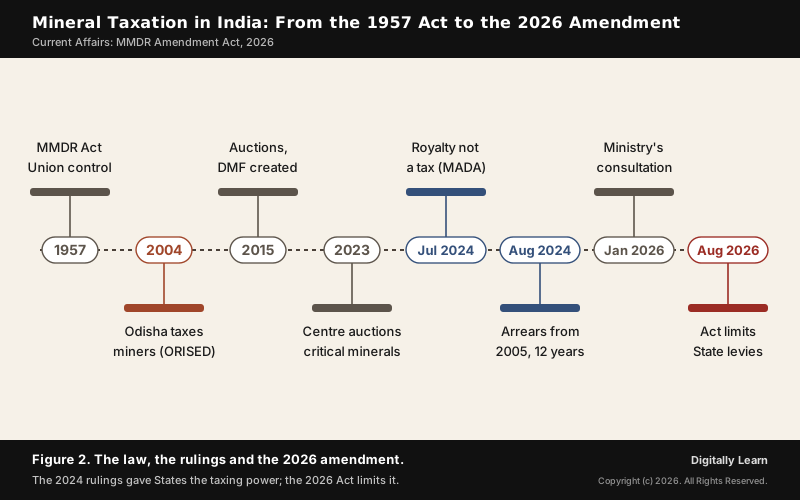
Royalty is not a tax. That was the central holding in Mineral Area Development Authority v. Steel Authority of India, decided by a nine-judge Bench on 25 July 2024: royalty is a contractual consideration that a mining lessee pays the lessor for enjoying mineral rights. The ruling overruled India Cement Ltd. v. State of Tamil Nadu, in which a seven-judge Bench had held royalty to be a tax and denied the States the power to tax mineral rights.
- States hold the taxing power: The power to tax mineral rights vests in the State legislatures; Parliament cannot tax mineral rights under Entry 54, which is a general entry.
- Parliament may limit it: Under Entry 50, Parliament can impose “any limitations”, wide enough to include restrictions, conditions, principles and even a prohibition, but the MMDR Act as it then stood imposed none.
- Land is separate: States can tax mineral-bearing land under Entry 49, using the quantity of mineral produced or the royalty as the measure, and limitations imposed under Entry 50 do not operate on Entry 49.
The August 2024 Order: Arrears From 2005 in Twelve-Year Instalments
After the July ruling, the mining companies and the Centre asked the Court to apply it only for the future, since India Cement had held the field for thirty-five years. On 14 August 2024 the Court refused to make it prospective but softened its effect on the past.
- States could levy or renew tax demands under Entries 49 and 50, but not on transactions made before 1 April 2005.
- The demands were to be paid in instalments over twelve years, beginning on 1 April 2026.
- Interest and penalty on demands for the period before 25 July 2024 were waived for all assessees.
These dates explain the timing of the 2026 Act. The first instalments could have been collected from 1 April 2026, and the Act now treats every levy not collected before it came into force as invalid.
Federal Supremacy and Harmonious Construction in the MADA Case
Two principles that courts use to settle conflicts over legislative power run through the case. The principle of federal supremacy comes from Article 246: in an inevitable conflict, Parliament's power over a List I subject prevails over a State's power over a List II subject. It cannot be invoked unless the conflict between the entries is direct and irreconcilable.
Harmonious construction is the duty to read overlapping entries so that both can operate and neither is reduced to a dead letter. The majority's reasoning in MADA reflects both: it read Entries 49 and 50 as distinct fields, held that Parliament cannot acquire the States' taxing power under the guise of a regulatory entry, and said federal supremacy does not apply where there is no direct conflict.
What the MMDR Act Means for State Revenue
Royalty, Auction Premium, DMF and the Other Mining Levies
States already collect most of what mining pays. By the Centre's count, they impose around 14 taxes, charges and fees on mining, including royalty, auction premium, dead rent, payments to the District Mineral Foundation, GST and transit fees, and some had begun taxing mineral-bearing land at rates as high as 20 percent.
- Share: Nearly 90 percent of mining-sector revenue accrues to the States.
- Major mineral States: Over Rs 5 lakh crore accrued to them between 2015-16 and 2025-26, against about Rs 82,000 crore to the Centre.
- Auction premium: A source created by the 2015 auction regime; major mining States collected more than Rs 96,000 crore of it between 2020-21 and 2025-26.
- One consignment: At an average sale price of Rs 3,000 a tonne of iron ore, the mining company pays Rs 3,150, of which Rs 3,016 goes to the State.
These figures are the Centre's case that States lose little. The States' answer is that the Act removes a source the Supreme Court had just confirmed, and the arrears that came with it.
Minor Minerals and District Mineral Foundations Stay With the States
Minor minerals are building stones, gravel, ordinary clay, ordinary sand other than sand used for prescribed purposes, and any other mineral the Central Government declares to be a minor mineral by notification (Section 3(e)). The definition is the Centre's to extend; the regulation is the States'.
- Rules for minor minerals: Under Section 15, State governments make the rules for quarry leases, mining leases and other concessions for minor minerals, and Sections 5 to 13 do not apply to them.
- Untouched by the 2026 Act: Nearly 50 minor minerals, including sand, gravel, clay, silica, granite, marble, gypsum and laterite, remain completely under State control.
- District Mineral Foundation: Under Section 9B, the State government sets up this non-profit trust in every district affected by mining-related operations, to work for the interest and benefit of persons and areas affected by mining.
Mineral Revenue of the States: Who Mines and Who Collects
Mineral wealth is concentrated, so the Act's cost falls on a few States. In 2024-25, about 97.70% of the value of mineral production (excluding atomic, fuel and minor minerals) came from eight States.
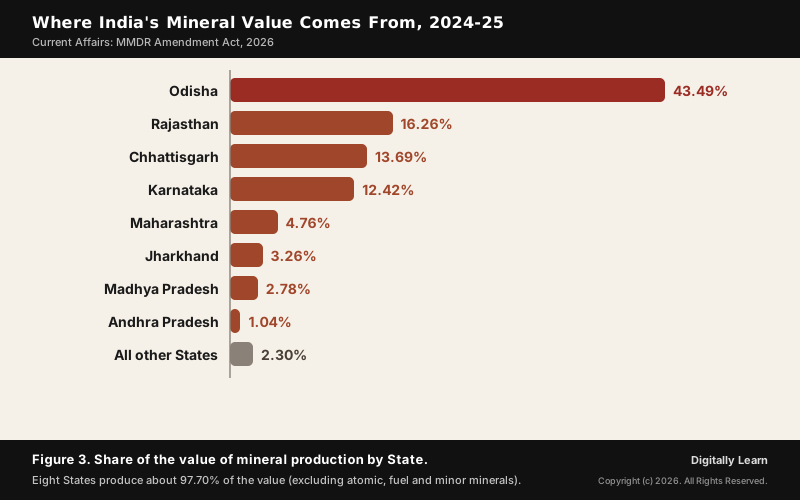
Odisha produced minerals valued at Rs 67,955.89 crore, the highest of any State, and mining accounts for 37.59% of its projected State revenue in 2026-27. Jharkhand holds about 40% of the country's total minerals. Both are among the States leading the challenge to the Act.
Their revenue has grown with the auctions. Since 2014, revenue to States from mineral production has grown by 354 percent, and they have received more than Rs 7 lakh crore, including coal. Major mineral States received Rs 13,586.16 crore in 2013-14 and Rs 82,366.19 crore in 2025-26; in coal, the States' share of revenue rose from 55.6 percent in 2014-15 to 89.5 percent in 2025-26.
MMDR Act Debate: Uniform Mineral Taxation Against Fiscal Federalism
The Centre's Case: Uniformity, Imports and Critical Minerals
The Centre argues that mineral wealth lies in a few States but supports the whole national economy, so its taxation is a national question. Uneven State levies, it says, make Indian minerals dearer than imported ones.
- Imports: India imported minerals worth Rs 10,12,529 crore in 2025-26, and steelmakers turn to imports when domestic minerals cost more.
- Strategic minerals: Levies reach critical minerals such as graphite and atomic minerals such as uranium, which can make their extraction uneconomical.
- One national market: Widely differing State levies fragment the market and raise transport and logistics costs; a levy at the mine passes on through steel, cement and electricity to households.
- Jobs and investment: Coal employs over 5 lakh people and the non-coal sector more than 1 crore, and investors commit capital only under a stable tax regime.
Industry agrees. The FICCI Mining Committee's chair, also NMDC's chief, said the Act would bring uniformity and predictability to the levy regime.
The States' Case: Odisha, Jharkhand and Kerala
- Odisha: A former Union Minister puts the State’s claim at over Rs 1 lakh crore in dues since 2005, collectable from 1 April 2026, plus Rs 50,000 crore a year in cess; the State has not made an official estimate. Of a Rs 22,000 crore penalty imposed on miners in 2021-22 for excess mining, Rs 16,000 crore had been collected; the rest is now beyond reach.
- Jharkhand: Chief Minister Hemant Soren called it a “black Bill” passed without consulting the States; the State puts its revenue loss at around Rs 14,000 crore and will move the Supreme Court.
- Kerala: The Chief Minister, V.D. Satheesan, objected that the Act brings land, Entry 18 of the State List, within the Centre’s sphere, and pointed to the mineral sands of the Chavara belt in Kollam, with ilmenite, rutile, garnet and monazite.
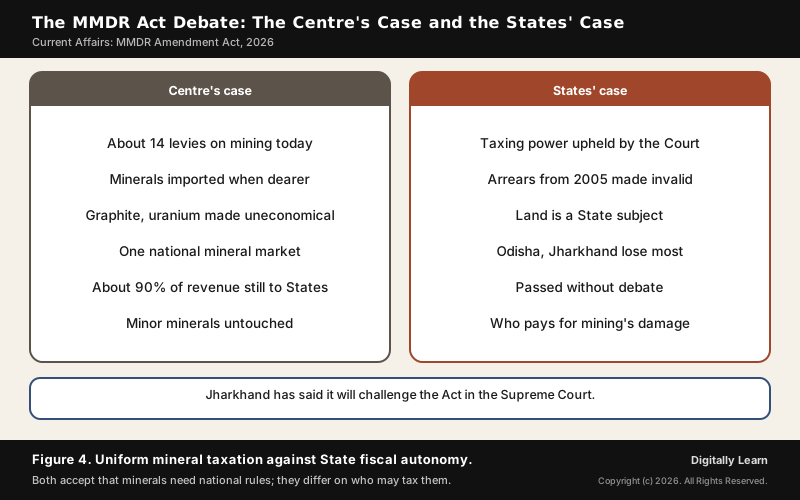
Odisha's dispute is two decades old. In 2004 it enacted the Odisha Rural Infrastructure and Socio Economic Development Act to tax miners; the Orissa High Court struck it down and the State appealed. Critics also ask who answers for mining's damage, from chromite pollution in the Sukinda valley to displacement, once the State loses its taxing power.
Fiscal Federalism and the Coming Supreme Court Challenge
Fiscal federalism is the division of taxing and spending powers between the Union and the States. For the first time, the MMDR Act now carries a limitation under Entry 50 on State taxes on mineral rights, the route MADA said was open.
The dispute fits a long pattern. The Constitution centralises economic and financial powers in the hands of the central government, while the States have immense responsibilities but very meagre revenue sources; demands for State autonomy have long included independent sources of revenue and greater control over resources, known as financial autonomy. For the mineral States, a tax on minerals was one such source.
The harder question is land. MADA held that limitations under Entry 50 do not reach the States' power to tax land under Entry 49, while the 2026 Act covers mineral-bearing land as well as mineral rights. A court will also be asked whether a law can make unpaid tax demands invalid when the Supreme Court had allowed them.
MMDR Act 1957 Explained: Auctions, DMF and Critical Minerals
The MMDR Act 1957 and Its 2015 and 2023 Amendments
The MMDR Act, 1957 is the central law on prospecting and mining: it lays down who may hold a mineral concession, for how long and on what payments. The States grant most concessions and collect the revenue under it.
- 2015 amendment: Mining concessions were to be allocated by auction, ending discretionary allocation; District Mineral Foundations and a National Mineral Exploration Trust were created; leases ran for 50 years instead of 30.
- Auctions since: 723 major mineral blocks have been auctioned across 17 States, and 2025-26 was the best year, with a record 212 blocks auctioned.
- 2023 amendment: The Central Government auctions the mining lease or composite licence for critical minerals listed in Part D of the First Schedule (Section 11D), but the royalty and auction amount still accrue to the State, and exploration licences were introduced.
- National Critical Mineral Mission: Approved on 29 January 2025 with an outlay of Rs 16,300 crore up to 2030-31.
MMDR Act for UPSC: GS Paper II and III Links
Where the Mineral Tax Dispute Sits in the Syllabus
The MMDR Act belongs to General Studies Paper II, under the federal structure, the distribution of powers between the Union and the States and issues of fiscal federalism, and to Paper III, under mineral resources and infrastructure. State PCS papers test the same ground.
- Prelims facts: Entry 54 of List I; Entries 23, 49 and 50 of List II; MADA, 25 July 2024, royalty not a tax; arrears from 1 April 2005 in twelve-year instalments from 1 April 2026; Section 9D; minor minerals under Section 15; District Mineral Foundations under Section 9B.
- Mains analysis: Federal supremacy and harmonious construction; uniform taxation against State fiscal autonomy; revenue of mineral-rich States; the rights of mining-affected people.
Previous Year UPSC-CSE Questions By the end you will be able to draft model answers for the following UPSC questions. Each question carries a collapsible framework showing how to approach it in the exam.
- UPSC Mains 2019 GS-IIFrom the resolution of contentious issues regarding distribution of legislative powers by the courts, ‘Principle of Federal Supremacy’ and ‘Harmonious Construction’ have emerged. Explain.
Answer outline: how to structure the answer
What the question asks, the main arguments, relevant examples and the direction of the conclusion. This is not a full model answer.
Introduction: Introduce the three Lists of the Seventh Schedule and note that overlapping entries force courts to decide whose law prevails.
Body (sub-themes to develop):
- Federal supremacy: from Article 246, where clause (1) prevails over clauses (2) and (3); a List I power prevails over a List II power, but only in a direct and irreconcilable conflict.
- Harmonious construction: entries are read together so that neither becomes a dead letter; it is tried before supremacy is invoked.
- Illustration: in MADA (2024) the regulatory Entry 54 of List I could not absorb the States' power to tax mineral rights (Entry 50) and land (Entry 49), read as distinct fields; Parliament may only limit Entry 50, which the MMDR Amendment Act 2026 now does.
Conclusion: Conclude that the two principles together keep the Union's primacy without emptying the States' entries, which is how the Constitution balances a strong Centre with federalism.
- UPSC Prelims 2025 Prelims-GSConsider the following statements:
- Statement I: In India, State Governments have no power for making rules for grant of concessions in respect of extraction of minor minerals even though such minerals are located in their territories.
- Statement II: In India, the Central Government has the power to notify minor minerals under the relevant law.
Which one of the following is correct in respect of the above statements?
How to approach this Prelims question
Approach: Step 1: Statement I says States have no power to make rules for concessions of minor minerals: incorrect, because Section 15 gives State governments exactly that power. Step 2: Statement II says the Centre can notify minor minerals: correct, because Section 3(e) lets the Central Government declare any other mineral to be a minor mineral by notification. Step 3: I incorrect, II correct, option (d).
Trap to watch: Who notifies a minor mineral (the Centre) is different from who makes the rules for granting it (the State).
Key facts to recall:
- (a) Both correct, II explains I: wrong. Statement I is incorrect; States make the rules under Section 15.
- (b) Both correct, II does not explain I: wrong. Statement I is incorrect.
- (c) I correct, II incorrect: wrong. It is the other way round.
- (d) I incorrect, II correct: right. States make the rules; the Centre notifies minor minerals.
Answer signal: Statement I incorrect, Statement II correct: option (d), the official answer.
- UPSC Prelims 2016 Prelims-GSWhat is/are the purpose/purposes of 'District Mineral Foundations' in India?
- Promoting mineral exploration activities in mineral-rich districts
- Protecting the interests of the persons affected by mining operations
- Authorizing State Governments to issue licences for mineral exploration
Select the correct answer using the code given below.
How to approach this Prelims question
Approach: Step 1: statement 1, promoting mineral exploration: wrong, the Foundation's object is the welfare of people and areas affected by mining; exploration has its own trust. Step 2: statement 2, protecting the interests of persons affected by mining: right, it is the Foundation's stated object under Section 9B. Step 3: statement 3, authorising States to issue exploration licences: wrong, licences come from the Act's concession provisions, not from the Foundation. So 2 only.
Trap to watch: The National Mineral Exploration Trust promotes exploration; the District Mineral Foundation serves people and areas affected by mining.
Key facts to recall:
- (a) 1 and 2 only: wrong. Promoting exploration is not the Foundation's purpose.
- (b) 2 only: right. Its object is the interest and benefit of persons and areas affected by mining.
- (c) 1 and 3 only: wrong. Neither exploration nor licensing is its purpose.
- (d) 1, 2 and 3: wrong. Only statement 2 is a purpose of the Foundation.
Answer signal: 2 only: option (b), the official answer.
Sources
- The Hindu, Delhi, 13 and 14 August 2026: Lok Sabha and Rajya Sabha pass the Mines and Minerals Amendment Bill
- The Hindu, Delhi, 24 August 2026: what the MMDR amendment means for Odisha
- The Hindu, Delhi, 14 to 28 August 2026: Jharkhand, Kerala and industry on the Act
- The Hindu, Delhi, 30 August to 10 September 2026: Odisha protests and the memorandum to the President
- PIB factsheet: The Mines and Minerals (Development and Regulation) Amendment Act, 2026
- PIB, Ministry of Mines: MMDR Amendment to bring long term stability in major minerals sector (14 August 2026)
- Ministry of Mines: notice for public consultation on the MMDR Amendment Bill, 2026 (7 January 2026)
- Ministry of Mines: The Mines and Minerals (Development and Regulation) Act, 1957 (consolidated text)
- Gazette of India: The Mines and Minerals (Development and Regulation) Amendment Act, 2023
- Supreme Court of India: Mineral Area Development Authority v. Steel Authority of India, judgment of 25 July 2024
- Supreme Court of India: Mineral Area Development Authority v. Steel Authority of India, order of 14 August 2024
- NCERT: Indian Constitution at Work (Class XI), Chapter 7, Federalism
- Wikipedia: Mines and Minerals (Development and Regulation) Amendment Act, 2015
- UPSC: Civil Services Examination question papers
Editorial Disclaimer
This article draws on the Act, the Supreme Court judgments, NCERT, the PIB documents and the other sources listed on this page.


