


Overview
The nine-judge ruling of 2026
The definition of industry decides which workers can use India's industrial-dispute law. On 20 August 2026 a nine-judge Bench of the Supreme Court held that the broad 1978 reading, the triple test of the Bangalore Water Supply case, will not anchor the meaning of industry under Section 2(p) of the Industrial Relations Code, 2020, though pending cases under the repealed 1947 Act keep it.
Supreme Court Nine-Judge Bench Ruling of 20 August 2026 on Industry
What the Supreme Court Held in State of U.P. v. Jai Bir Singh
The reference arose in State of Uttar Pradesh v. Jai Bir Singh and asked whether the 1978 judgment in Bangalore Water Supply and Sewerage Board v. A. Rajappa had defined industry correctly. That seven-judge ruling, written by Justice V.R. Krishna Iyer, read Section 2(j) of the 1947 Act so widely that hospitals, educational institutions and municipalities came within it, and only core sovereign functions such as the judiciary, law and order and defence stayed outside.
For 48 years that reading let workers in a wide range of jobs take employers to labour courts and bargain collectively against unfair labour practices. The new ruling does not take that protection away from pending cases, but it cuts the link between the old precedent and the new Code, so the meaning of industry under the Code starts on a clean slate.
Reference to Nine Judges: Jai Bir Singh (2005) and the Four Questions
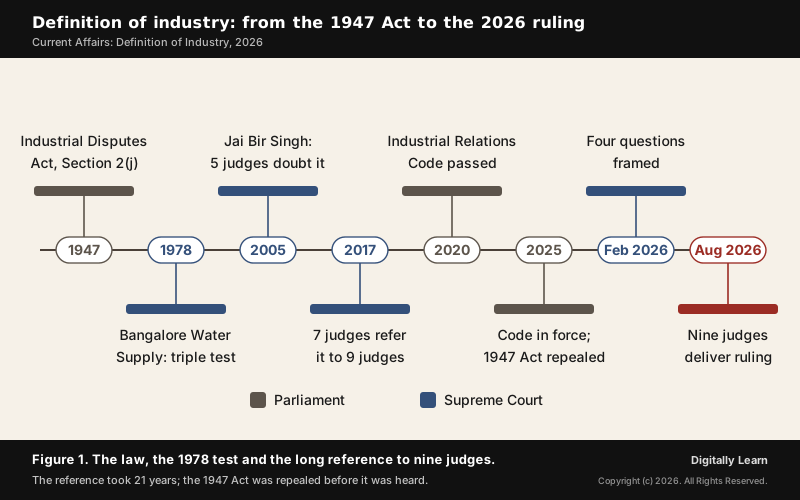
The doubt about the 1978 test is two decades old. In 2005 a five-judge Bench in Jai Bir Singh questioned the Bangalore Water Supply judgment and referred it for reconsideration; a seven-judge Bench, by an order of 2 January 2017, sent the matter on to nine judges. On 16 February 2026 the nine-judge Bench framed four questions.
- Whether the test laid down in the 1978 judgment is correct.
- What effect the 1982 amendment and the Industrial Relations Code, 2020 have on the definition.
- Whether the welfare activities of the government are industrial activities.
- What the scope of sovereign functions is under Section 2(j).
By the time the questions were framed, the Industrial Relations Code had come into force on 21 November 2025 and repealed the 1947 Act. Several judges therefore found the reference had lost its point: no future case can arise under a repealed Act, and the interpretation of Section 2(p) of the Code was not itself before the Court.
Bangalore Water Supply Case and the Triple Test in Labour Law
Triple Test of 1978 under Section 2(j) of the Industrial Disputes Act 1947
The Industrial Disputes Act, 1947 was enacted on 11 March 1947 and came into force on 1 April 1947 to settle industrial disputes through conciliation, arbitration and adjudication. Its protections, from a reference to a labour court to the rules on retrenchment, depended on whether the employer ran an industry, so the definition in Section 2(j) decided who was protected.
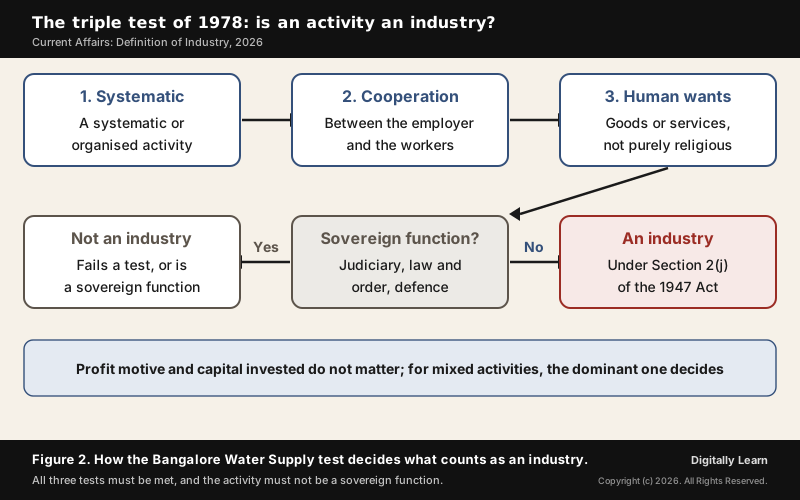
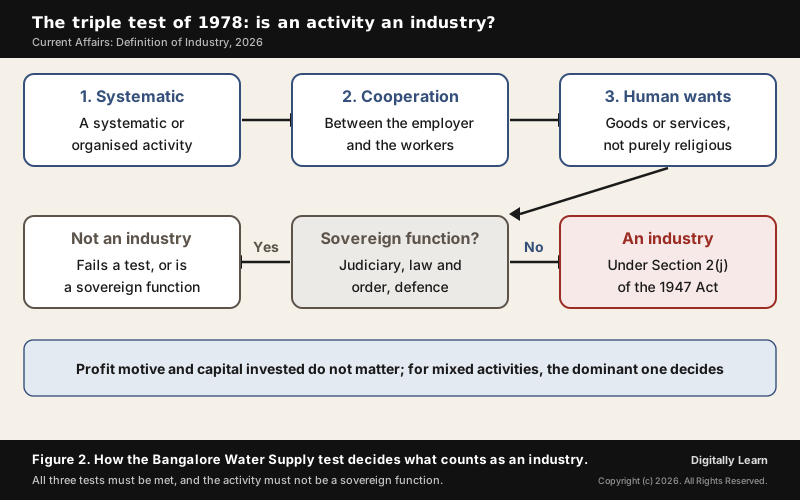
The 1978 judgment turned that definition into the triple test. An activity is an industry when three conditions are met together:
- Systematic activity: The work is systematic or organised.
- Cooperation: It is carried on through cooperation between employer and employees.
- Human wants: It produces or distributes goods or services to satisfy human wants and wishes, other than those that are purely religious or spiritual.
Profit motive was held irrelevant: what mattered was the nature of the activity, not who ran it or why. For an organisation doing several things at once, the judgment applied a dominant nature test, under which the main activity decides whether the whole is an industry.
Industrial Relations Code 2020: Section 2(p) and What It Changed
The Industrial Relations Code, 2020 consolidates three laws: the Trade Unions Act, 1926, the Industrial Employment (Standing Orders) Act, 1946 and the Industrial Disputes Act, 1947. Parliament passed it in September 2020, the Lok Sabha on the 22nd and the Rajya Sabha on the 23rd, the President assented on 28 September 2020, and it came into force on 21 November 2025. It follows the recommendations of the Second National Commission on Labour.
Section 2(p) of the Code defines industry as any systematic activity carried on by cooperation between employer and worker, whether or not capital is invested and whether or not profit is intended, which brings non-profit and low-capital activities within it. The Code excludes sovereign functions and institutions of a charitable, social or philanthropic kind; employees of the Department of Space, for instance, are outside the definition and organise as service associations under the Central Civil Services (Recognition of Service Associations) Rules, 1993, not as trade unions.
| Feature | Industrial Disputes Act, 1947 | Industrial Relations Code, 2020 |
|---|---|---|
| Definition of industry | Section 2(j), read through the 1978 triple test | Section 2(p): systematic activity by employer-worker cooperation, capital and profit irrelevant |
| Worker | Narrower definition | Section 2(zr) adds sales promotion employees, working journalists and supervisors earning up to Rs 18,000 a month |
| Lay-off, retrenchment, closure | Prior government permission above 100 workers | Prior permission above 300 workers |
| Adjudication | Reference by the government | Two-member industrial tribunals, one judicial and one administrative |
The Code also requires 14 days' notice before a strike in every establishment and treats mass casual leave by more than half the workers on a day as a strike. It cut the number of rules from 105 to 51 and forms from 37 to 18, introduced fixed-term employment, and lets a union with 51 per cent membership act as the negotiating union for collective bargaining. Because Section 2(p) keeps much of the triple test's essence, the question before courts is whether the Code's words should be read through the 1978 judgment or afresh; the nine judges chose afresh.
Four Labour Codes: 29 Central Laws Consolidated and Progress So Far
The Industrial Relations Code is one of four Labour Codes that together consolidate 29 central labour laws. All four were announced as in force from 21 November 2025, and the Union government made them fully operational in May 2026 through more than 30 gazette notifications of rules, after publishing draft rules in December 2025.
- Wages: The Code on Wages, 2019 replaces the Payment of Wages Act 1936, the Minimum Wages Act 1948, the Payment of Bonus Act 1965 and the Equal Remuneration Act 1976, and makes minimum wages and timely payment universal for all workers.
- Industrial relations: The Industrial Relations Code covers trade unions, standing orders and industrial disputes.
- Social security: The Code on Social Security, 2020 brings the unorganised sector and gig and platform workers within social security schemes.
- Safety and working conditions: The Occupational Safety, Health and Working Conditions Code, 2020 replaces 13 central labour laws.
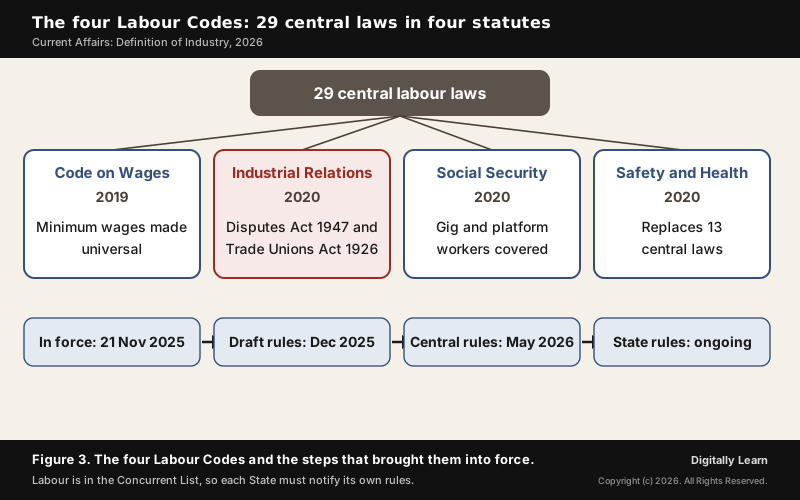
The case for the Codes is simpler compliance, a wider definition of worker and industry, and social security for workers the old laws missed. The case against comes from trade unions: ten central trade unions protested when the rules were published, and Opposition parties called them an attack on workers' rights. The Industrial Relations Code adds conditions for strikes and raises the lay-off threshold from 100 to 300 workers, which gives employers more freedom to hire and fire without government permission. Because labour is in the Concurrent List, the Codes work fully only when each State notifies its own rules; Gujarat has notified rules under all four, while other industrial States are still finalising theirs.
How the Nine Judges Divided: Majority, Separate and Dissenting Opinions
Majority Opinion of Chief Justice Surya Kant and the Reformulated Test
Chief Justice Surya Kant wrote the main opinion, joined by Justices Satish Chandra Sharma, Alok Aradhe and Vipul M. Pancholi; Justices P.S. Narasimha and Joymalya Bagchi agreed in separate opinions that the 1978 judgment will not be the sheet anchor for Section 2(p). The Code, the opinion says, is an independent legislative enactment to be read on its own terms, having regard to its text, scheme and object.
The opinion accepted that the core principles of the 1978 test had stood the test of time, but said its elements could have been articulated differently, and it set out a reformulated triple test. That reformulation was labelled a considered opinion and operates only prospectively: it does not disturb pending proceedings or reopen decided cases, and with the 1947 Act repealed there is no future case for it to govern. Justice Narasimha added that an authoritative reading of Section 2(j) had lost its immediacy once the Code came into force.
| Judges | Was the reference needed? | 1978 test for the 2020 Code |
|---|---|---|
| Chief Justice Surya Kant, Justices Sharma, Aradhe and Pancholi | Answered it, with a reformulated test called hypothetical and prospective only | Not the sheet anchor; the Code is read on its own text |
| Justice P.S. Narasimha | Compelling when made, now unnecessary after the repeal | Agreed: not the sheet anchor |
| Justice Joymalya Bagchi | Supported the reference but refused to reformulate the test | Agreed: not the sheet anchor |
| Justices B.V. Nagarathna, Dipankar Datta and Ujjal Bhuyan | Unwarranted; the reference needs no answer | Disturbing the 1978 reading will cast a shadow on the Code |
Justice Nagarathna's Dissent and Justice Bagchi's Separate Opinion
Justice B.V. Nagarathna held the reference unwarranted and the exercise only academic; Justice Dipankar Datta, in an opinion shared with Justice Ujjal Bhuyan, held that the reference requires no answer and that institutional credibility rests on respecting finality. Justice Nagarathna argued that the inclusive definition matters more now than in 1978, because liberalisation and privatisation after 1991 moved many workers from secure public employment to private employers.
- Industrial peace: Tinkering with a definition that stood for nearly 50 years would cast a shadow on the Code and create uncertainty.
- Sovereign functions: The involvement of the state in an activity does not by itself make it a sovereign function.
- Dominant nature test: For organisations with many activities, the dominant activity should still decide.
Justice Joymalya Bagchi supported the reference but would not reformulate the test, calling it unwise to re-draft Justice Krishna Iyer's formula. The fear that it turned every organised activity into an industry was misplaced, he said; the state can enter functions that are not sovereign, the idea of sovereignty has changed with time, and the absence of a profit motive does not take an activity out of industry.
Impact on Workers and Labour Law: Criticism and Defence of the Ruling
Criticism from Trade Unions and the Case for the Triple Test
Trade unions read the ruling as a tilt towards management. The All India Trade Union Congress said the majority had left crucial questions to future litigation and that the Code's exclusions for sovereign functions and for charitable, social or philanthropic institutions need strict reading, because government activity is not automatically a sovereign function; the Centre of Indian Trade Unions said both legislature and judiciary had failed to protect workers' rights.
The Congress argued that the majority's reformulation asks for a discernible commercial character resembling trade or business and widens the sovereign-function exemption, and that leaving such a hypothesis on record invites litigation before labour courts and industrial tribunals. The majority's own answer is that the reformulation binds no pending or decided case, and that a new statute deserves a reading of its own.
The stakes are larger because labour law reaches only part of the workforce. Labour laws protect workers in the formal or organised sector, meaning all public sector establishments and private establishments with 10 or more hired workers; these workers form trade unions and bargain with employers for better wages and social security. Most other workers, from farm labourers to construction workers, are in the informal sector.
For employers, a clean slate means the Code's exclusions will be argued on their own wording; for workers in hospitals, schools, municipal bodies and charities, it means the protection that came automatically under the 1978 reading will now depend on how labour courts read Section 2(p).
Industry Ruling and Labour Codes for UPSC: GS Papers II and III
Labour Reforms, the Labour Bureau and the Syllabus Links
The ruling sits in two parts of the syllabus: the Supreme Court and the separation of powers in GS Paper II, and labour market reforms under Indian economy in GS Paper III. Data on industrial disputes, closures, retrenchments and lay-offs come from the Labour Bureau, an attached office of the Ministry of Labour and Employment at Chandigarh, which publishes them in the Indian Labour Journal and the Pocket Book of Labour Statistics.
- Prelims facts: Industrial Disputes Act 1947, Section 2(j); Bangalore Water Supply (1978), seven judges, Justice Krishna Iyer, triple test; Jai Bir Singh (2005); Industrial Relations Code 2020, Section 2(p), in force from 21 November 2025; nine-judge ruling of 20 August 2026; Labour Bureau, Chandigarh.
- Mains analysis: Worker protection against flexibility for employers, the four Labour Codes and their State rules, judicial interpretation of a repealed law, and finality of precedent.
Previous Year UPSC-CSE Questions By the end you will be able to draft model answers for the following UPSC questions. Each question carries a collapsible framework showing how to approach it in the exam.
- UPSC Mains 2024 GS-IIIDiscuss the merits and demerits of the four ‘Labour Codes’ in the context of labour market reforms in India. What has been the progress so far in this regard?
Answer outline: how to structure the answer
What the question asks, the main arguments, relevant examples and the direction of the conclusion. This is not a full model answer.
Introduction: Open with the consolidation of 29 central labour laws into four Codes, in force from 21 November 2025.
Body (sub-themes to develop):
- Merits: rules cut from 105 to 51 and forms from 37 to 18; universal minimum wages under the Code on Wages; social security for gig and platform workers; a wider definition of worker and of industry (Section 2(p), capital and profit irrelevant).
- Demerits: lay-off threshold raised from 100 to 300 workers; 14 days' notice before any strike; trade union protests; uncertainty over who counts as an industry after the 20 August 2026 ruling.
- Progress: draft rules December 2025; central rules through more than 30 gazette notifications in May 2026; labour in the Concurrent List, so States must notify rules (Gujarat has, others are finalising).
Conclusion: Conclude that the Codes can balance flexibility for employers with security for workers only if State rules and labour courts' reading of the new definitions keep pace.
- UPSC Prelims 2022 Prelims-GSIn India, which one of the following compiles information on industrial disputes, closures, retrenchments and lay-offs in factories employing workers?
How to approach this Prelims question
Approach: Step 1: the data asked for are labour data (disputes, closures, retrenchments, lay-offs), so the compiler sits under the Ministry of Labour and Employment. Step 2: the Labour Bureau, its attached office at Chandigarh, publishes industrial-disputes statistics in the Indian Labour Journal and the Pocket Book of Labour Statistics. Step 3: none of the other three bodies is the labour ministry's statistical office.
Trap to watch: The word industrial points towards the Department for Promotion of Industry and Internal Trade, but the question is about labour data.
Key facts to recall:
- (a) Central Statistics Office: wrong. The returns on industrial disputes, closures and lay-offs are compiled by the labour ministry's own office, not by the national statistics office.
- (b) Department for Promotion of Industry and Internal Trade: wrong. It sits under the Ministry of Commerce and Industry, while these are labour data of the Ministry of Labour and Employment.
- (c) Labour Bureau: right. The attached office of the Ministry of Labour and Employment compiles and publishes statistics on industrial disputes, closures, retrenchments and lay-offs.
- (d) National Technical Manpower Information System: wrong. As its name says, it is an information system on technical manpower; the returns on industrial disputes and lay-offs are the Labour Bureau's work.
Answer signal: The Labour Bureau compiles these data, so the answer is option (c).
Sources
- PIB: Industrial Relations Code, 2020: Promoting Harmony and Ease of Doing Business (23 November 2025)
- Labour Bureau, Ministry of Labour and Employment: About Us
- Labour Bureau: Publications
- NCERT: Indian Economic Development (Class XI), Chapter 7, Employment: Growth, Informalisation and Other Issues
- The Hindu, Delhi, 21 August 2026: 1978 'industry' definition void under new code: SC; Justice Nagarathna differs
- The Hindu, Delhi, 22 August 2026: Trade unions sound the alarm over Supreme Court judgment on the definition of industry
- The Hindu, Delhi, 23 August 2026: Cong. flags concerns over SC's ruling on 'industry' definition
- The Hindu, Delhi, 24 August 2026: Triple test, adrift (editorial)
- The Hindu, Delhi, 25 August 2026: lead article on the reference; How the SC ruling redefined 'industry' (explainer)
- The Hindu, Delhi, 7 September 2026: ISRO's role is by no means diminishing
- The Hindu, Delhi, 10 May 2026: Centre operationalises Labour Codes, publishes Rules
- The Hindu, Delhi, 9 October 2026: investment, courts and the labour codes (lead article)
- Wikipedia: Industrial Disputes Act, 1947
- Wikipedia: Industrial Relations Code, 2020
- Wikipedia: Code on Wages, 2019
- Wikipedia: Code on Social Security, 2020
- Wikipedia: Occupational Safety, Health and Working Conditions Code, 2020
- UPSC: Civil Services Examination question papers
Editorial Disclaimer
This article draws on the PIB note on the Industrial Relations Code, the Labour Bureau and the other sources listed on this page.


