


Overview
The National Tribunals Commission
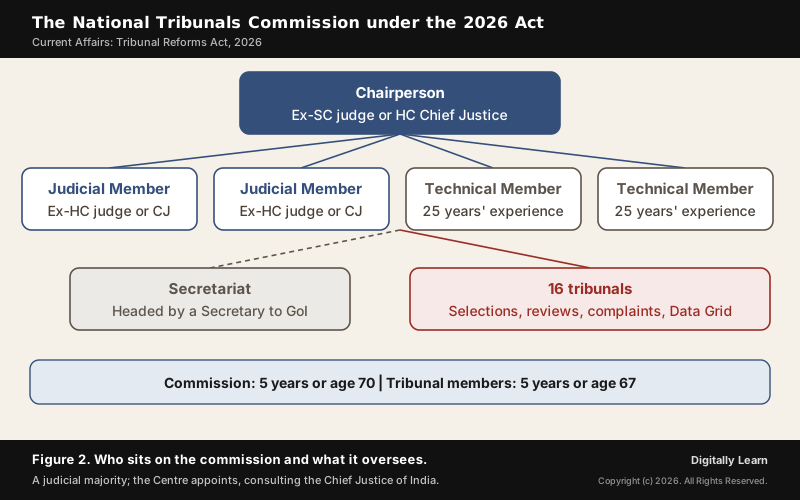
The Tribunal Reforms Act of 2026 sets up the National Tribunals Commission, a judiciary-led body that selects the chairpersons and members of 16 tribunals, reviews their performance and oversees complaints against them. Parliament passed it on 10 and 11 August 2026 to replace the Tribunals Reforms Act, 2021, parts of which the Supreme Court had struck down.
Tribunal Reforms Act 2026: Why It Is in the News
Passage in August 2026 and the Rules of September
The Lok Sabha passed the Bill by voice vote without a debate, amid Opposition protests over the police action of 20 July against student protesters; the Rajya Sabha passed it after a brief debate in which the Opposition, having walked out, took no part. Law Minister Arjun Ram Meghwal said it would bring uniformity to the selection of tribunal members and improve efficiency, transparency and independence, and that it did not change the jurisdiction of any tribunal.
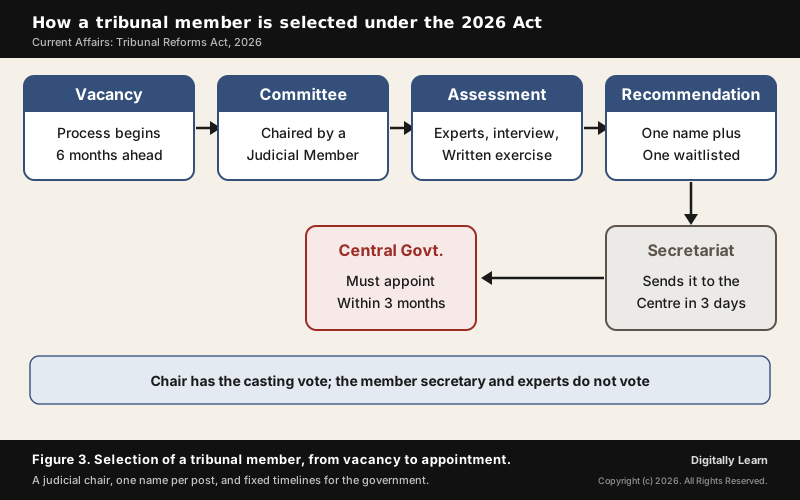
The Union Law Ministry then issued the rules that make the commission work. The National Tribunals Commission and Qualification, Selection and Conditions of Service of Chairperson and Members of Tribunals Rules, 2026, dated 30 September, fix pay at Rs 2.5 lakh a month for the commission's chairperson and Rs 2.25 lakh for its members, with the same pay for tribunal chairpersons and members. The process to fill a tribunal vacancy must begin at least six months before it arises, and selection committees will assess candidates through expert evaluation, personal interaction and, where needed, written exercises.
Supreme Court Cases That Led to the National Tribunals Commission
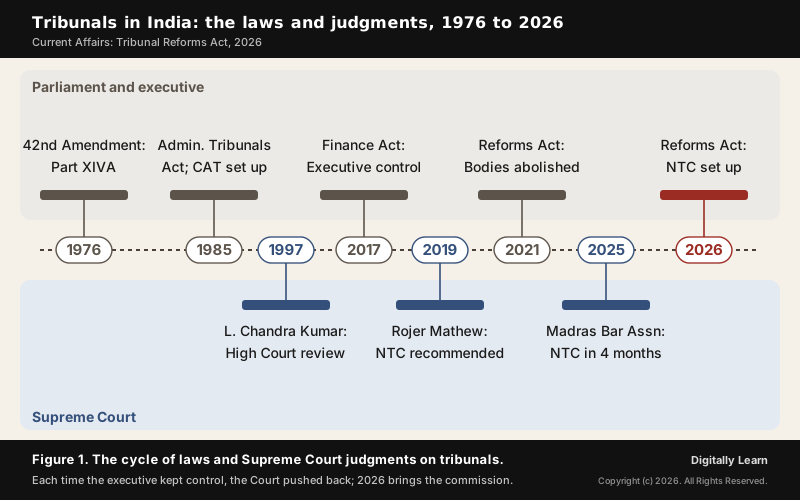
The Act is the latest round in a long exchange between Parliament and the Supreme Court over who controls tribunals. The Court has accepted that tribunals let specialists settle technical disputes faster than courts, but it has insisted that they stay independent of the Ministries whose decisions they review.
- S.P. Sampath Kumar (1987) and L. Chandra Kumar (1997): The Court held that tribunal decisions stay subject to review by High Courts, because judicial review is part of the basic structure.
- Rojer Mathew (2019): After Parliament used the Finance Act 2017 to give the executive more control over appointments, the Court recommended an independent, statutory National Tribunals Commission.
- Ordinance and Act of 2021: The Tribunals Reforms Ordinance 2021 and then the Tribunals Reforms Act 2021 brought back conditions the Court had rejected, including a four-year tenure and a minimum age of 50.
- Madras Bar Association (2025): On 19 November 2025 the Court struck down the re-enacted provisions, restored the earlier framework and gave the government four months to set up the commission.
Tribunals in India: Constitutional Basis and Rationalisation
Difference Between Article 323A and 323B: Administrative and Other Tribunals
The original Constitution had no provision on tribunals. The 42nd Amendment Act of 1976 added Part XIVA, in force from 3 January 1977, with only two articles.
| Feature | Article 323A | Article 323B |
|---|---|---|
| Subject | Administrative tribunals for recruitment and service conditions of public servants | Tribunals for other matters, such as taxation, foreign exchange, industrial and labour disputes, land reforms, urban property ceilings, elections, foodstuffs and rent |
| Who may legislate | Parliament only | Parliament and State Legislatures, each on its own subjects |
| Hierarchy | No hierarchy of tribunals | A hierarchy of tribunals may be created |
Article 323A(2)(d) let Parliament exclude the jurisdiction of all courts except the Supreme Court under Article 136. In L. Chandra Kumar the Court struck that exclusion down, and the matching clause of Article 323B, so appeals against the Central Administrative Tribunal now go first to a division bench of the High Court. Under Article 323A, Parliament passed the Administrative Tribunals Act in 1985, and the Central Administrative Tribunal (CAT) was set up that year with its principal bench in Delhi; its members are drawn from both the judicial and the administrative streams.
Tribunal Reforms Act 2021 and the Merger of Tribunals
Tribunals were meant to give specialised, faster justice, but they multiplied, and several were later folded into others: the Competition Appellate Tribunal into the National Company Law Appellate Tribunal, and the Airports Economic Regulatory Authority Appellate Tribunal and the Cyber Appellate Tribunal into the Telecom Disputes Settlement and Appellate Tribunal.
The 2021 Ordinance, later the Tribunals Reforms Act 2021, went further. It abolished the Film Certification Appellate Tribunal along with nine other appellate bodies and moved their work to High Courts and other judicial bodies; the 2021 Act also made the designations of chairpersons uniform and put appointments with a Search-cum-Selection Committee. The criticism was that already overburdened courts took on more cases, while the executive kept its hold over appointments, tenure and removal.
National Tribunals Commission under the 2026 Act
Composition, Appointment and Tenure of the Commission
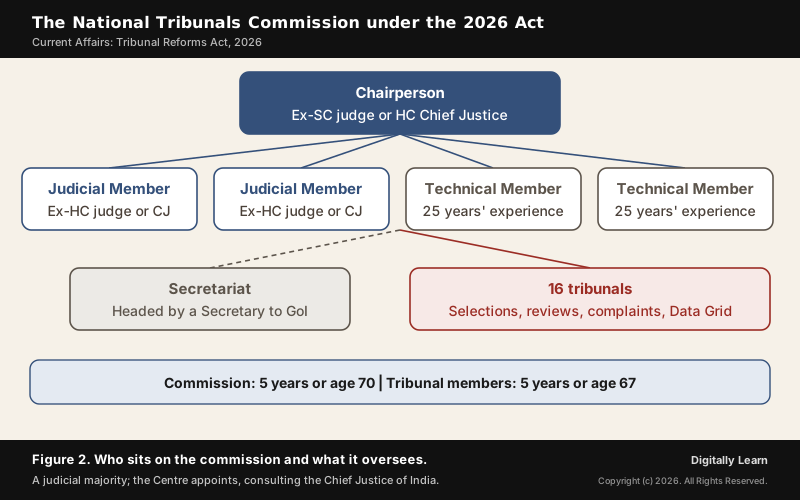
The commission, headquartered in New Delhi, has a chairperson and four members. The chairperson must have been a judge of the Supreme Court or a Chief Justice of a High Court; two Judicial Members must have been a Chief Justice or judge of a High Court; two Technical Members need at least 25 years of experience in public administration, finance, law, accountancy, banking, management or technology.
- Appointment: The Central Government appoints the chairperson and the Judicial Members after consulting the Chief Justice of India.
- Commission’s term: The chairperson and members hold office for five years or until the age of 70, whichever is earlier.
- Tribunal members’ term: Five years or until the age of 67, whichever is earlier; reappointment is allowed, with previous service and performance taken into account.
Functions, Data Grid and the List of Tribunals in India Covered
- Selections: It runs the selection of tribunal chairpersons and members through Search-cum-Selection Committees.
- Performance review: It monitors tribunals’ performance and sends annual reports to the Central Government.
- Complaints: It supervises inquiries into complaints against tribunal members.
- National Tribunals Data Grid: It builds and maintains this portal, which holds case information for all 16 tribunals.
A Secretariat headed by a Secretary to the Government of India supports the commission, empanels experts from relevant fields and prepares its annual report. On money, each tribunal states its needs for funds, staff and premises, the Secretariat consolidates them and the commission evaluates them on an objective framework; the Centre still allocates the grants after Parliament votes them, and the Comptroller and Auditor-General audits the commission, with the report laid before both Houses. In all, 16 tribunals in India come under the commission.
| Group | Tribunals covered by the Act |
|---|---|
| Service and administration | Central Administrative Tribunal; State Administrative Tribunals; Armed Forces Tribunal |
| Tax and customs | Customs, Excise and Service Tax Appellate Tribunal; Income-tax Appellate Tribunal; Appellate Tribunal under SAFEMA, 1976 |
| Finance and companies | Securities Appellate Tribunal; Debts Recovery Tribunal; Debts Recovery Appellate Tribunal; National Company Law Appellate Tribunal |
| Sectors and others | Telecom Disputes Settlement and Appellate Tribunal; Appellate Tribunal for Electricity; National Green Tribunal; National Consumer Disputes Redressal Commission; Railway Claims Tribunal; Industrial Tribunal under the Industrial Relations Code |
Search-cum-Selection Committees and Timelines
Section 13 sets out who selects. For a tribunal chairperson, the committee is chaired by the commission's chairperson, with a Technical Member, a retired High Court Chief Justice nominated by the chairperson, a Secretary to the Government of India (the State's Chief Secretary for a State Administrative Tribunal), two empanelled experts who assessed the candidates, and the commission's Secretary as member secretary. For a tribunal member, a Judicial Member of the commission chairs, and the retired judge is a High Court judge.
- Voting: The committee chair has the casting vote; the member secretary and the experts do not vote.
- One name per post: The committee recommends one candidate for each vacancy and one for a waiting list, not a panel of names.
- Timelines: The Secretariat sends recommendations to the Centre within three days, and the Centre must make the appointment within three months.
Tribunal Independence: Gains and Concerns in the 2026 Act
Gains and Concerns: Delegated Rules, Ministry Screening, Executive Control
The Act answers several of the Court's objections. It restores five-year terms for tribunal members, introduces uniform service conditions, creates the National Tribunals Data Grid and does not hold up appointments already pending. The commission has a judicial majority, its selection committees are judicially chaired, and a single recommendation per post limits the government's room to choose.
- Delegation: Section 14 leaves qualifications, selection, salaries and service conditions of tribunal members to rules made by the executive, though in Rojer Mathew Justice Deepak Gupta held that defining who may exercise judicial power is an essential legislative function.
- Ministry screening: Under Section 16 a Ministry first screens a complaint before it reaches the commission.
- Appointments to the commission: The Centre appoints the commission’s members, consulting the Chief Justice of India only for the chairperson and Judicial Members.
- Money and removal: The Centre keeps substantial influence over the commission’s finances and administration, and critics want the power to appoint or remove members at will taken away.
Experts have also flagged vague wording in Section 3. The test of the Act will be whether the rules of 30 September and the first appointments keep the commission at arm's length from the Ministries whose decisions tribunals review.
Tribunal Reforms for UPSC: GS Paper II Links
Where Tribunals Sit in the UPSC Syllabus
Tribunals belong to General Studies Paper II, under the structure, organisation and functioning of the judiciary, and statutory, regulatory and various quasi-judicial bodies. The independence of the judiciary is the thread: judges must be able to work without fear or favour, and the Constitution protects that independence partly by keeping appointments away from party politics; state PCS papers test the same articles and cases.
- Prelims facts: Part XIVA added by the 42nd Amendment (1976), in force from 3 January 1977; Article 323A only Parliament, Article 323B Parliament and States; CAT set up in 1985; L. Chandra Kumar (1997); NTC: chairperson and four members, terms of five years or age 70; tribunal members five years or age 67; 16 tribunals covered.
- Mains analysis: Tribunals against ordinary courts, separation of powers, the cycle of judgments and re-enactments, independence against accountability.
Previous Year UPSC-CSE Questions By the end you will be able to draft model answers for the following UPSC questions. Each question carries a collapsible framework showing how to approach it in the exam.
- UPSC Mains 2025 GS-IIComment on the need of administrative tribunals as compared to the court system. Assess the impact of the recent tribunal reforms through rationalization of tribunals made in 2021.
Answer outline: how to structure the answer
What the question asks, the main arguments, relevant examples and the direction of the conclusion. This is not a full model answer.
Introduction: Define tribunals as quasi-judicial bodies under Part XIVA (Articles 323A and 323B), added by the 42nd Amendment of 1976.
Body (sub-themes to develop):
- Need: specialised expertise, speed, lower cost, relief for courts in service, tax and regulatory disputes.
- 2021 reforms: Film Certification Appellate Tribunal and nine other bodies abolished, work moved to High Courts; uniform designations; Search-cum-Selection Committee.
- Impact: more load on High Courts; four-year tenure and minimum age 50 kept despite earlier rulings; provisions struck down in Madras Bar Association (2025).
- Correction: the 2026 Act and the National Tribunals Commission, five-year terms, Data Grid.
Conclusion: Conclude that tribunals are needed, but only independent ones relieve courts; the 2026 commission is the test of that independence.
- UPSC Mains 2018 GS-IIHow far do you agree with the view that tribunals curtail the jurisdiction of ordinary courts? In view of the above, discuss the constitutional validity and competency of the tribunals in India.
Answer outline: how to structure the answer
What the question asks, the main arguments, relevant examples and the direction of the conclusion. This is not a full model answer.
Introduction: Introduce tribunals as specialised adjudicatory bodies created under Part XIVA to reduce the burden on courts.
Body (sub-themes to develop):
- Curtailment: Article 323A(2)(d) and the matching clause of 323B allowed exclusion of all courts except the Supreme Court under Article 136.
- Limits: L. Chandra Kumar (1997) struck the exclusion down; appeals from the CAT lie first to a High Court division bench; tribunals supplement, not replace, courts.
- Validity: S.P. Sampath Kumar (1987), Rojer Mathew (2019) and Madras Bar Association (2025) on independence of appointments and tenure.
- Competence: technical members' expertise against concerns of executive control; the 2026 National Tribunals Commission as the response.
Conclusion: Conclude that tribunals are constitutionally valid only as long as they remain independent and subject to judicial review.
- UPSC Mains 2019 GS-II“The Central Administrative Tribunal which was established for redressal of grievances and complaints by or against central government employees, nowadays is exercising its powers as an independent judicial authority.” Explain.
Answer outline: how to structure the answer
What the question asks, the main arguments, relevant examples and the direction of the conclusion. This is not a full model answer.
Introduction: State that the CAT was set up in 1985 under Article 323A for service disputes of central government employees.
Body (sub-themes to develop):
- Judicial character: members from judicial and administrative streams; adjudication on natural justice; power over recruitment and service matters.
- Independence: L. Chandra Kumar placed it under High Court review; the 2026 Act gives members five-year terms and a judiciary-led selection.
- Limits: the government is the main litigant; delegation of service conditions to executive rules.
Conclusion: Conclude that the CAT has grown into a court-like body whose independence now rests on the National Tribunals Commission.
- UPSC Prelims 2009 Prelims-GSConsider the following statements :
- Central Administrative Tribunal (CAT) was set up during the Prime Ministership of Lal Bahadur Shastri.
- The Members for CAT are drawn from both judicial and administrative streams.
Which of the statements given above is/are correct ?
How to approach this Prelims question
Approach: Step 1: statement 1, set up under Lal Bahadur Shastri: wrong, because the CAT came in 1985, when Rajiv Gandhi was Prime Minister (1984-1989); Shastri was Prime Minister from 1964 to 1966. Step 2: statement 2, members from judicial and administrative streams: right. So only 2.
Trap to watch: The year decides statement 1; match 1985 to the Prime Minister of that time.
Key facts to recall:
- (a) 1 only: wrong. Statement 1 is wrong, as the CAT was set up in 1985.
- (b) 2 only: right. Only the mixed judicial and administrative membership is correct.
- (c) Both 1 and 2: wrong. Statement 1 is wrong.
- (d) Neither 1 nor 2: wrong. Statement 2 is correct.
Answer signal: Only statement 2 is correct: option (b), the official answer.
Sources
- PIB: Reforming India's Tribunal System, Tribunal Reforms Bill, 2026 (backgrounder, 12 August 2026)
- Legislative Department: The Constitution of India (2024 edition), Part XIVA, Articles 323A and 323B
- NCERT: Indian Constitution at Work (Class XI), Chapter 6, Judiciary
- The Hindu, Delhi, 11 August 2026: Tribunals Reforms Bill passed amid din in LS
- The Hindu, Delhi, 12 August 2026: In the way (editorial); RS passes Tribunals Reforms Bill amid Opposition walkout
- The Hindu, Delhi, 3 October 2026: rules for the National Tribunals Commission notified
- Wikipedia: Tribunals Reforms Act, 2021
- Wikipedia: Tribunals in India
- Wikipedia: Film Certification Appellate Tribunal
- UPSC: Civil Services Examination question papers
Editorial Disclaimer
This article draws on the PIB backgrounder, the Constitution and the other sources listed on this page.


