


Overview
Chemical reactions are changes in which the bonds between atoms break and new bonds form, so that new substances with new properties appear. Chemical bonding is the force that holds atoms together in those substances. Atoms transfer electrons to form ionic bonds, share them to form covalent bonds, or pool them in metals. The breaking and making of bonds also explains why iron rusts, how a catalyst works in a fertiliser plant and how sunlight produces smog over a city.
Chemical Bonding: Octet Rule, Ionic and Covalent Bonds
Octet Rule and the Kössel-Lewis Approach to Bonding
Atoms combine because the bonded arrangement is more stable than the separate atoms. In 1916 Walther Kössel and Gilbert N. Lewis independently explained why, starting from the noble gases, which hardly take part in reactions. An atom with a complete outer shell, usually eight electrons, is stable, so other atoms lose, gain or share electrons until each reaches such an arrangement. This is the octet rule. Only the outer-shell electrons, the valence electrons, take part, which is why the electron arrangement of an atom decides how it bonds.
Which way the electrons move depends on electronegativity, the tendency of an atom to attract shared electrons when it forms a bond. It increases from left to right along a period and decreases down a group of the periodic table, so fluorine is the most electronegative element. When two atoms differ greatly in electronegativity, as a metal and a non-metal do, one atom takes electrons outright and an ionic bond forms. When they are similar, as two non-metals are, they share electrons and form a covalent bond. In reality no bond is completely ionic or completely covalent, and most bonds lie between these two ends.
Ionic Bond: Formation and Properties of Ionic Compounds
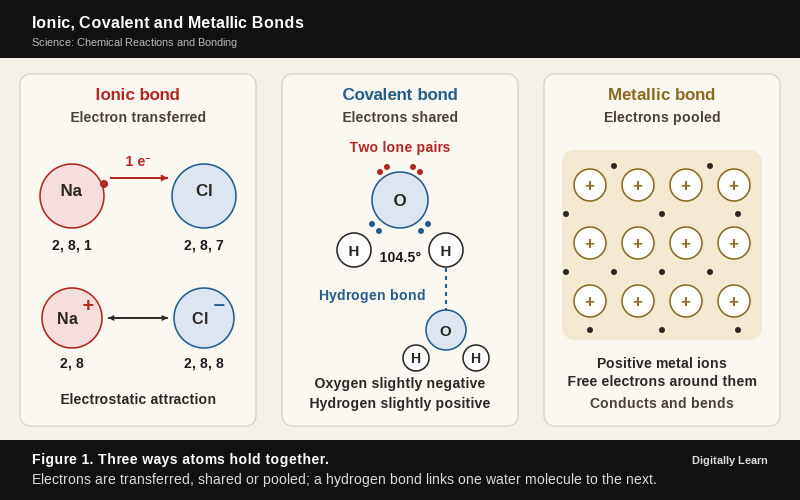
An ionic bond, also called an electrovalent bond, forms when a metal gives one or more electrons to a non-metal and the oppositely charged ions attract each other. Sodium (2, 8, 1) gives its single outer electron to chlorine (2, 8, 7). The result is a sodium ion, Na+ (2, 8), and a chloride ion, Cl− (2, 8, 8), each with a noble-gas arrangement. Sodium chloride does not exist as separate molecules; it is a lattice of oppositely charged ions held by strong electrostatic forces. The energy released when the gaseous ions pack into the crystal, the lattice energy, is about 786 kJ for every mole of sodium chloride, and it is this energy that makes the solid stable.
The properties of ionic compounds follow from the strong attraction between ions.
- Physical nature: They are solids and somewhat hard, but brittle, so they break into pieces when pressure is applied.
- Melting and boiling points: These are high, because much energy is needed to break the strong attraction between the ions.
- Solubility: They are generally soluble in water and insoluble in solvents such as kerosene and petrol. Only highly polar solvents dissolve them well. A kilogram of water dissolves 360 g of sodium chloride at 25 °C, but a kilogram of ethanol, an alcohol, dissolves only 0.65 g.
- Electrical conduction: A solution in water or the molten compound conducts electricity, because the ions are free to move. The solid does not conduct, because its ions are held rigidly in the lattice.
Covalent Bond, Coordinate Bond and Bond Polarity
A covalent bond is formed by the sharing of a pair of electrons between two atoms, so that each reaches a stable outer shell without forming ions. Two hydrogen atoms share one pair in H2, a single bond. Two oxygen atoms share two pairs in O2, a double bond, and two nitrogen atoms share three pairs in N2, a triple bond. Carbon, with four valence electrons, shares them with four hydrogen atoms to form methane, CH4, the start of the vast chemistry of carbon compounds.
Covalent compounds have strong bonds inside each molecule but weak forces between molecules, so most of them have low melting and boiling points, and because they contain no charged particles, they are generally poor conductors of electricity.
In a coordinate bond, also called a dative bond, both shared electrons come from the same atom. Ammonia, whose nitrogen atom carries a lone pair, donates that pair to boron trifluoride, whose boron atom has an incomplete octet. Once formed, a coordinate bond is a covalent bond like any other; the name records only where the electrons came from. The bonds between metal ions and the molecules around them in metal complexes are of this kind.
A bond between two identical atoms, as in H2 or Cl2, holds the shared pair exactly between them, which makes the bond a nonpolar covalent bond. In hydrogen fluoride the pair is pulled towards fluorine, the more electronegative atom, so the bond is a polar covalent bond with a partial negative charge on fluorine and a partial positive charge on hydrogen. Water shows why shape matters too. Its two lone pairs push the two O‑H bonds to an angle of 104.5°, less than the 109.5° of a regular tetrahedron, so the molecule is bent and its bond dipoles do not cancel. Water is therefore a polar molecule, which is why it dissolves ionic compounds so well.
Metallic Bond, Hydrogen Bond and Van der Waals Forces
A metallic bond holds the atoms of a metal together. Each atom gives up its valence electrons to a cloud of delocalised electrons spread through the whole crystal, and the positive metal ions are held in a lattice by their attraction to this cloud. Because the electrons are free to move, metals conduct heat and electricity, and because the bonding is not fixed between particular pairs of atoms, metal layers can slide, which makes metals malleable and ductile.
A hydrogen bond is the attractive force that binds the hydrogen atom of one molecule to an electronegative atom, fluorine, oxygen or nitrogen, of another molecule. It forms because a hydrogen atom bonded to such an atom is left with a partial positive charge. It is weaker than a covalent bond, yet it is responsible for the unusually high boiling point of water, holds together the paired bases of DNA and stabilises the structure of proteins. A hydrogen bond between two molecules, as in water or alcohol, is intermolecular; one between two parts of the same molecule is intramolecular.
Van der Waals forces are weak attractions between atoms and molecules that do not come from a chemical bond at all. They include the attraction between permanent dipoles and the London dispersion forces between momentary dipoles that arise in any atom. They fade quickly with distance, yet they underlie many properties of organic compounds and molecular solids.
| Bond or force | What the electrons do | Example | Typical result |
|---|---|---|---|
| Ionic bond | Transferred from metal to non-metal | Sodium chloride | Hard, brittle, high melting point; conducts when molten or dissolved |
| Covalent bond | Shared in pairs between non-metals | Methane, water | Mostly low melting point; does not conduct |
| Coordinate bond | Both shared electrons from one atom | Ammonia with boron trifluoride | A covalent bond once formed |
| Metallic bond | Pooled in a delocalised cloud | Copper, iron | Conducts heat and electricity; malleable |
| Hydrogen bond | Partial charges attract between molecules | Water, DNA base pairs | Raises boiling point; holds large molecules in shape |
| Van der Waals forces | Momentary or permanent dipoles attract | Organic compounds, molecular solids | Very weak; easily broken |
Chemical Reactions and Chemical Equations
Chemical Change and Balancing Chemical Equations
Milk left at room temperature in summer, an iron pan left in humid air, grapes fermenting and food being digested all change the identity of a substance. Each is a chemical change, and wherever a chemical change occurs, a chemical reaction has taken place. A reaction shows itself through a change in state, a change in colour, the evolution of a gas or a change in temperature.
A chemical equation writes a reaction in symbols, with the reactants on the left, the products on the right and an arrow pointing towards the products. Burning magnesium, which gives a dazzling white flame and a white powder, is written 2Mg + O2 → 2MgO. An equation must be balanced, because of the law of conservation of mass. Mass is neither created nor destroyed in a reaction, so the number of atoms of each element must be the same on both sides. The usual method is to balance by trial, as the reaction of iron with steam shows.
- Write the skeletal equation: Fe + H2O → Fe3O4 + H2 has unequal numbers of atoms on the two sides.
- Balance the largest formula first: Four molecules of water supply the four oxygen atoms of Fe3O4, and only the coefficient is changed, never the formula, so 4H2O is written and never H2O4.
- Balance the remaining elements: Four molecules of hydrogen and three atoms of iron complete the equation, 3Fe + 4H2O → Fe3O4 + 4H2.
- Add state symbols and conditions: The symbols (s), (l), (g) and (aq) mark a solid, a liquid, a gas and a solution in water, as in 3Fe(s) + 4H2O(g) → Fe3O4(s) + 4H2(g), where (g) shows that the water is steam. Temperature, pressure or a catalyst is written above or below the arrow.
Combination and Decomposition Reactions: Thermal, Electrolytic and Photolytic
In a combination reaction, two or more reactants form a single product. Calcium oxide, or quicklime, reacts vigorously with water to give slaked lime and a large amount of heat: CaO(s) + H2O(l) → Ca(OH)2(aq). A solution of slaked lime is used to whitewash walls. It reacts slowly with carbon dioxide in the air and, after two to three days, leaves a thin, shiny layer of calcium carbonate, the same compound, CaCO3, as marble. Burning coal (C + O2 → CO2) and the formation of water from hydrogen and oxygen are also combination reactions.
A decomposition reaction is the opposite, in which a single reactant breaks down into simpler products. Breaking bonds needs energy, and the reaction is named by the form in which that energy is supplied.
- Thermal decomposition: Heat breaks the compound. Limestone gives quicklime and carbon dioxide, CaCO3(s) → CaO(s) + CO2(g), a reaction used in making cement. Heating lead nitrate gives lead oxide, oxygen and brown fumes of nitrogen dioxide, 2Pb(NO3)2(s) → 2PbO(s) + 4NO2(g) + O2(g).
- Electrolytic decomposition: An electric current splits the compound. Passing current through water with a little dilute sulphuric acid gives hydrogen and oxygen.
- Photolytic decomposition: Light splits the compound. White silver chloride turns grey in sunlight as it breaks into silver and chlorine, 2AgCl(s) → 2Ag(s) + Cl2(g), and silver bromide behaves the same way. These reactions are used in black and white photography.
Displacement, Double Displacement, Precipitation and Neutralisation
In a displacement reaction, a more reactive element pushes a less reactive one out of its compound. An iron nail dipped in blue copper sulphate solution turns brown as copper is deposited on it, and the blue colour fades: Fe(s) + CuSO4(aq) → FeSO4(aq) + Cu(s). Zinc and lead, also more reactive than copper, displace it in the same way. The order in which metals displace one another is the reactivity series.
In a double displacement reaction, two compounds exchange ions. Solutions of sodium sulphate and barium chloride give a white solid, barium sulphate, and sodium chloride: Na2SO4(aq) + BaCl2(aq) → BaSO4(s) + 2NaCl(aq). An insoluble solid formed in a solution is a precipitate, and any reaction that produces one is a precipitation reaction.
The reaction of an acid with a base to give a salt and water is a neutralisation reaction, as in NaOH(aq) + HCl(aq) → NaCl(aq) + H2O(l). It too is an exchange of ions, and it lies behind antacids, toothpaste and the liming of acid soil.
Exothermic and Endothermic Reactions
Every reaction also moves energy. Reactions in which heat is released along with the products are exothermic reactions; reactions in which energy is absorbed are endothermic reactions. Many combination reactions, such as quicklime with water, are exothermic, while decomposition reactions are endothermic, since they need heat, light or electricity to break the reactants apart. Burning natural gas, CH4(g) + 2O2(g) → CO2(g) + 2H2O(g), is exothermic, and so is the slow decay of vegetable matter into compost.
| Reaction | Exothermic or endothermic | Energy involved |
|---|---|---|
| Quicklime with water | Exothermic | A large amount of heat released |
| Burning of natural gas (methane) | Exothermic | Heat released |
| Respiration of glucose in body cells | Exothermic | Energy released for the body |
| Vegetable matter decaying into compost | Exothermic | Heat released |
| Heating limestone to quicklime | Endothermic | Heat absorbed |
| Silver chloride splitting in sunlight | Endothermic | Light absorbed |
| Electrolysis of water | Endothermic | Electrical energy absorbed |
Respiration is an exothermic reaction too. The glucose formed from the carbohydrates in rice, potatoes and bread combines with oxygen in the body's cells, C6H12O6(aq) + 6O2(aq) → 6CO2(aq) + 6H2O(l) + energy, and the energy released keeps the body alive.
Oxidation and Reduction: Redox Reactions
Redox Reaction: Oxygen, Hydrogen and Electron Transfer
When copper powder is heated in air, its surface gains oxygen and turns into black copper(II) oxide. When hydrogen is passed over the hot oxide, the black coating turns brown again as the oxide loses its oxygen: CuO + H2 → Cu + H2O. A substance that gains oxygen is oxidised and one that loses oxygen is reduced. In this reaction copper oxide is reduced while hydrogen, gaining the oxygen, is oxidised. One reactant is oxidised as the other is reduced, so the two processes always occur together, and such a reaction is an oxidation-reduction reaction, or redox reaction.
Chemists define the two processes in three ways, each wider than the one before.
- Oxygen and hydrogen: Oxidation is the gain of oxygen or the loss of hydrogen, and reduction is the loss of oxygen or the gain of hydrogen.
- Electrons: Oxidation is the loss of electrons by any species, and reduction is the gain of electrons.
- Oxidation number: Oxidation is an increase in the oxidation number of an element, and reduction is a decrease.
The substance that causes oxidation is the oxidising agent. It accepts electrons and is itself reduced. The reducing agent donates electrons and is itself oxidised. In ZnO + C → Zn + CO, carbon is oxidised to carbon monoxide and zinc oxide is reduced to zinc, so carbon is the reducing agent. In MnO2 + 4HCl → MnCl2 + 2H2O + Cl2, hydrochloric acid is oxidised to chlorine and manganese dioxide is reduced, so manganese dioxide is the oxidising agent.
All combustion reactions that use oxygen are redox reactions, and so are many combination, decomposition and displacement reactions. In a disproportionation reaction, one element in a single substance is oxidised and reduced at the same time, as oxygen is when hydrogen peroxide decomposes into water and oxygen.
Oxidation Number: Rules and Worked Examples
Many reactions involve no obvious gain or loss of oxygen, so chemists track the oxidation number, a charge assigned to each atom as a form of bookkeeping for electrons. A few fixed rules assign these numbers, and the last of them lets an unknown number be worked out from the others.
| Rule | Worked example |
|---|---|
| An element on its own is 0 | H2, O2 and sodium metal: 0 |
| Alkali metals are +1 and alkaline earth metals +2 in their compounds | Calcium in calcium peroxide, CaO2: +2 |
| Aluminium is +3 in all its compounds | Aluminium in NaAlH4: +3, since sodium (+1) and four hydride ions (−1 each) must balance it |
| Oxygen is −2, but −1 in peroxides such as H2O2 and +2 in OF2 | Manganese in MnO2: +4, since two oxygens give −4 |
| Hydrogen is +1, but −1 in metal hydrides such as NaH and CaH2 | Sulphur in H2S2O7: +6, since 2(+1) + 2S + 7(−2) = 0 |
| The numbers in a compound add up to zero, and in an ion to its charge | Carbon in the carbonate ion CO32−: +4 |
Everyday Redox: Corrosion, Rancidity, Combustion and the Blast Furnace
Redox reactions go on all around us, often slowly. Corrosion is the slow attack on a metal by moisture, air, acids or other substances around it. Iron in moist air gains a brown, flaky coat of rust, silver turns black as it forms silver sulphide with sulphur in the air, and copper gains a green coat of basic copper carbonate. Rusting needs both air and water, and it is prevented by painting, oiling, greasing, galvanising, chrome plating, anodising or making alloys.
Rancidity is the spoiling of fats and oils exposed to air, light, moisture or bacteria. The fats break down, by oxidation in air or by hydrolysis, into short-chain aldehydes, ketones and free fatty acids, which give the food an unpleasant smell and taste, and the reaction can also destroy vitamins sensitive to oxidation. It is slowed in three ways.
- Antioxidants: Substances such as vitamin C, vitamin E and synthetic antioxidants are added to fat-containing foods to delay oxidation.
- Cool, dark storage: Heat and light speed up the reaction of fats with oxygen, so fats and oils keep longer in a cool, dark place.
- Little exposure to oxygen: Air-tight packing keeps oxygen away from the food.
Combustion is a fast redox reaction. Magnesium burns to magnesium oxide, and fuels burn to carbon dioxide and water. Redox reactions are also used to extract metals from their ores. In a blast furnace, coke burns in a blast of hot air to give carbon monoxide and heat, 2C + O2 → 2CO, and the hot carbon monoxide is the reducing agent that turns iron oxide into molten iron: Fe2O3 + 3CO → 2Fe + 3CO2. Coke thus serves as both fuel and reducing agent. The silica in the ore is removed by a different substance, limestone, which breaks down into calcium oxide that combines with the silica to form a slag of calcium silicate.
Rate of Reaction and Catalysts
Rate of Reaction: Concentration, Temperature and Activation Energy
Some reactions, such as the precipitation of barium sulphate, happen almost at once, while others, such as the rusting of iron, are slow. The rate of a reaction depends on the concentration of the reactants (the pressure, for gases), the temperature and the presence of a catalyst. Collision theory explains why. Molecules must collide to react, but only collisions in which the molecules have enough kinetic energy, the threshold energy, and the proper orientation break the old bonds and form new ones. These are the effective collisions.
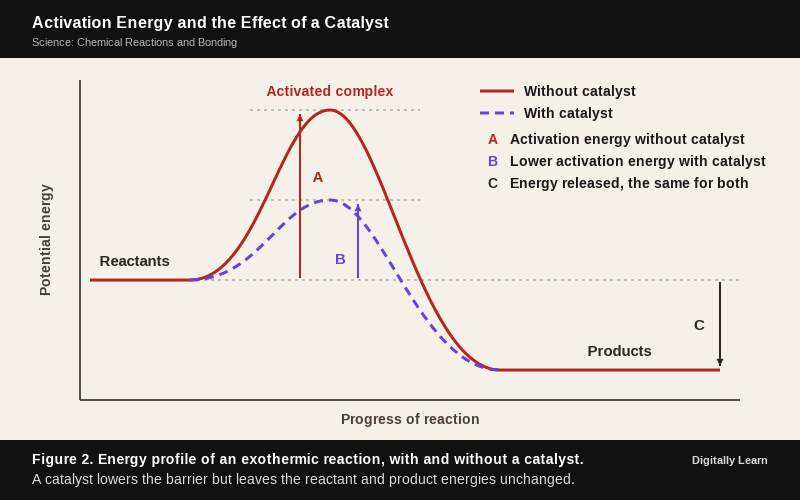
The extra energy reactants need to reach the short-lived activated complex between reactants and products is the activation energy. Raising the temperature makes molecules move faster and increases the fraction that collide with energies greater than the activation energy. For a chemical reaction, a rise of 10 °C in temperature nearly doubles the rate constant. The Arrhenius equation describes this dependence of rate on temperature. It was first proposed by the Dutch chemist J. H. van 't Hoff, and the Swedish chemist Svante Arrhenius gave its physical justification.
Catalyst and Catalysis: Homogeneous, Heterogeneous and Enzymes
A catalyst is a substance that increases the rate of a reaction without itself undergoing any permanent chemical change, and the process is catalysis. Manganese dioxide, for example, greatly speeds the decomposition of potassium chlorate: 2KClO3 → 2KCl + 3O2, with MnO2 written over the arrow. A catalyst forms temporary bonds with the reactants, giving a short-lived intermediate complex that breaks down into the products and the catalyst. In doing so it provides an alternative pathway with a lower activation energy. A substance that slows a reaction is not called a catalyst but an inhibitor.
A catalyst has three characteristic features.
- Small amounts suffice: A small amount of catalyst can act on a large amount of reactants, because it is regenerated at the end.
- Equilibrium unchanged: A catalyst does not change the equilibrium constant of a reaction. It speeds the forward and backward reactions to the same extent, so equilibrium is reached sooner, but its position does not change.
- Only possible reactions: A catalyst speeds reactions that can occur on their own and cannot make a non-spontaneous reaction happen.
Catalysis is classified by the phase of the catalyst. In homogeneous catalysis, the catalyst is in the same phase as the reactants, usually all gases or all in solution. In heterogeneous catalysis, the catalyst is in a different phase, usually a solid acting on gases or liquids. A solid catalyst holds the reactant molecules on its surface by forming bonds with them, which raises their concentration at the surface and weakens their bonds. Transition metals and their compounds make good catalysts of this kind, because they can change their oxidation states and form complexes.
Enzymes are the catalysts of living things. They are mostly proteins that bind particular molecules and speed the reactions of life, often by factors of millions, by lowering the activation energy. Most enzymes are highly specific, acting only on the molecules whose shape fits their binding pocket. Their activity rises with temperature up to an optimum, beyond which the protein unfolds, or denatures, and the enzyme stops working.
Industrial Catalysts: Haber Process, Contact Process and Catalytic Converter
Many reactions of industrial importance would be too slow to be worth running without a solid catalyst. The Haber process, developed by the German chemists Fritz Haber and Carl Bosch in the first decade of the twentieth century, combines nitrogen from the air with hydrogen to make ammonia, N2 + 3H2 ⇌ 2NH3, the raw material of nitrogen fertilisers. The reaction is highly exothermic and reduces the number of gas molecules.
A low temperature would favour a high yield but give a very slow rate, while a high temperature gives a satisfactory rate but a poor yield. An iron catalyst lets the reaction run at a satisfactory rate at temperatures where the yield is still reasonable, and a high pressure raises the yield further. The optimum conditions are around 500 °C and 200 atm.
The contact process makes sulphuric acid. Sulphur dioxide is oxidised with excess oxygen to sulphur trioxide, 2SO2 + O2 ⇌ 2SO3, over a vanadium pentoxide catalyst at about 450 °C and 1 to 2 atm. The sulphur trioxide is dissolved in concentrated sulphuric acid to give oleum, which is then added to water to give very concentrated sulphuric acid.
| Process | Product | Catalyst |
|---|---|---|
| Haber process | Ammonia | Finely divided iron, with promoters such as aluminium oxide and potassium oxide |
| Contact process | Sulphuric acid | Vanadium pentoxide (V2O5) |
| Ostwald process | Nitric acid | Platinum gauze alloyed with rhodium |
| Hydrogenation of vegetable oils | Hydrogenated (saturated) fats | Nickel |
| Polymerisation of ethene | Polythene | Titanium tetrachloride with trimethylaluminium (Ziegler catalyst) |
A catalytic converter is a device in a vehicle's exhaust that converts toxic gases into less harmful ones by catalysing redox reactions. A two-way converter combines oxygen with carbon monoxide and unburnt hydrocarbons to give carbon dioxide and water. A three-way converter also reduces oxides of nitrogen to nitrogen. The catalysts are precious metals, mainly platinum, palladium and rhodium.
Cleaner fuel lets these devices do more. India decided on 6 January 2016 to leapfrog from Bharat Stage IV (BS‑IV) to Bharat Stage VI (BS‑VI) emission norms by 1 April 2020, skipping BS‑V because of rising pollution. BS‑VI fuel carries at most 10 ppm of sulphur against 50 ppm under BS‑IV, and this has enabled diesel particulate filters, which cut particulate matter, and selective catalytic reduction systems, which cut nitrogen oxides, in BS‑VI vehicles.
Classical and Photochemical Smog: Formation, Effects and Control
Winter Smog and Summer Smog: Season, Sources and Pollutants
Smog, a word made from smoke and fog, is an intense form of air pollution, and it comes in two chemically different kinds. Classical smog, also called winter smog or London smog, forms in cold, damp weather when smoke from burning coal and sulphur dioxide mix with fog, often trapped near the ground by a temperature inversion. The Great Smog of London in December 1952 is its best-known case. Government medical reports in the following weeks put its deaths at up to 4,000, and later research estimates between 10,000 and 12,000.
Photochemical smog, also called summer smog, forms in warm, sunny weather when sunlight acts on nitrogen oxides and volatile organic compounds such as hydrocarbons from vehicle exhausts and industry. Its products, ozone, peroxyacetyl nitrate (PAN) and aldehydes, are highly reactive and oxidising. Los Angeles, a flat basin ringed by mountains, became the best-known city for this smog, and ozone was first identified there as a component of it.
| Feature | Classical smog | Photochemical smog |
|---|---|---|
| Season and weather | Winter; cold, damp, foggy | Summer; warm and sunny |
| Main sources | Burning coal for heat and power | Vehicle exhausts and industrial fumes |
| Key pollutants | Smoke particles and sulphur dioxide | Nitrogen oxides and hydrocarbons, turned into ozone, PAN and aldehydes |
| Role of sunlight | Not needed | Drives the reactions |
| Character | Smoky and sulphurous | Highly reactive and oxidising |
| Classic example | London | Los Angeles |
Formation of Photochemical Smog: The Sunlight-Driven Reaction Chain
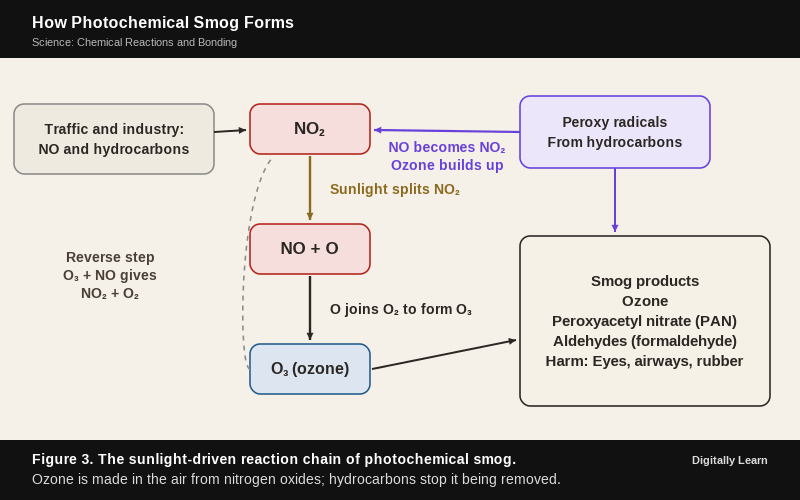
Photochemical smog builds up through a chain of reactions that starts in the morning rush hour and needs sunlight to continue. Ground-level ozone, one of its major constituents, is a secondary pollutant. No vehicle emits it; it forms in the air from the primary pollutants.
- Emission: Traffic and industry release nitric oxide (NO) and unburnt hydrocarbons, and in the air the nitric oxide is converted into nitrogen dioxide (NO2).
- Photolysis of nitrogen dioxide: Nitrogen dioxide absorbs sunlight and splits into nitric oxide and a free oxygen atom, NO2 + sunlight → NO + O.
- Ozone formation: The oxygen atom joins a molecule of oxygen to form ozone, O + O2 → O3.
- Build-up of ozone: Left alone, ozone would react with nitric oxide to give back nitrogen dioxide and oxygen, O3 + NO → NO2 + O2, and the three steps would form a cycle with no net gain. Hydrocarbons, oxidised into peroxy radicals, convert nitric oxide into nitrogen dioxide instead, so ozone is not removed and builds up through the day.
- Secondary oxidants: Oxidation of the hydrocarbons also gives aldehydes such as formaldehyde, and peroxy radicals react with nitrogen dioxide to form peroxyacetyl nitrate.
Effects and Control of Smog and the 1999 Gothenburg Protocol
The oxidants of photochemical smog harm people and materials. Ozone, PAN and aldehydes irritate the eyes and the airways and reduce lung function, and ground-level ozone is especially harmful for senior citizens, children and people with heart and lung conditions. PAN is also a lachrymatory substance, one that makes the eyes water. Ozone also attacks rubber, which develops the cracks known as ozone cracking. Classical smog harms through smoke and sulphur dioxide. Deaths in London in 1952 rose with the levels of both.
Because the ozone of photochemical smog is not emitted directly, it is controlled by cutting what it is made from. Removing the primary pollutants, nitrogen oxides and hydrocarbons, removes the secondary ones, ozone and PAN.
- Catalytic converters: They convert nitrogen oxides, carbon monoxide and hydrocarbons in vehicle exhaust before these reach the air.
- Cleaner fuel and vehicles: India's direct move to BS‑VI norms in 2020 lowered fuel sulphur to 10 ppm and brought in systems that cut nitrogen oxides and particulate matter.
- Air quality law and monitoring: The Air (Prevention and Control of Pollution) Act, 1981, amended in 1987, provides for the prevention, control and abatement of air pollution in India, and India has notified National Ambient Air Quality Standards for 12 pollutants.
- National Clean Air Programme: Launched in 2019, it covers 130 cities. In 2025‑26, 108 of them recorded lower levels of particulate matter (PM10) than in 2017‑18, and 26 of these cut them by more than 40 per cent.
Air pollution crosses borders, so the precursors of ozone are controlled by treaty as well. The Gothenburg Protocol, formally the Protocol to Abate Acidification, Eutrophication and Ground-level Ozone, was concluded at Gothenburg, Sweden, on 30 November 1999 under the 1979 Convention on Long-range Transboundary Air Pollution of the UN Economic Commission for Europe. It set national emission ceilings, to be met by 2010, for sulphur dioxide, nitrogen oxides, volatile organic compounds and ammonia, and entered into force on 17 May 2005.
In May 2012 its Parties agreed to revise it with further reduction commitments for 2020, including targets for particulate matter, which bind each Party once it ratifies the amendment. In November 2026 the UN treaty record listed 33 Parties, the European Union among them; India is not a Party.
Previous Year UPSC‑CSE Questions
Each Prelims question is explained option by option, and each Mains question comes with an answer outline.
- UPSC Prelims 2013Photochemical smog is a resultant of the reaction among
How to approach this Prelims question
Approach: Start from what photochemical smog needs, sunlight and nitrogen oxides, and remove any option that lacks either. Options (c) and (d) set the reaction at low temperature or in the evening, without sunlight, so both go. Option (b) has no nitrogen oxide, although the photolysis of nitrogen dioxide starts the whole chain. Option (a) names nitrogen dioxide with ozone and peroxyacetyl nitrate in sunlight. The last two form inside the smog from nitrogen oxides and hydrocarbons and then take part in its further reactions, so the three together describe the reacting mixture that is the smog.
Trap to watch: Carbon monoxide appears in three options, and students who link smog with exhaust gases in general choose (b); the smog chain begins with nitrogen dioxide, not carbon monoxide.
Why each option is right or wrong:
- (a) NO₂, O₃ and peroxyacetyl nitrate in the presence of sunlight: Correct. Sunlight splits nitrogen dioxide, and the ozone and PAN formed from it react further within the smog.
- (b) CO, O₂ and peroxyacetyl nitrate in the presence of sunlight: Wrong. It leaves out nitrogen dioxide, whose photolysis starts the chain.
- (c) CO, CO₂ and NO₂ at low temperature: Wrong. Photochemical smog forms in warm, sunny weather.
- (d) high concentration of NO₂, O₃ and CO in the evening: Wrong. Without sunlight the photochemical reactions do not run.
Answer: (a) NO₂, O₃ and peroxyacetyl nitrate in the presence of sunlight. Photochemical smog is the sunlit mixture in which nitrogen dioxide reacts and the ozone and peroxyacetyl nitrate formed from it react further.
- UPSC Prelims 2003With reference to ionic compounds, consider the following statements:
- Ionic compounds are insoluble in alcohol.
- Ionic compounds in the solid state are good conductors of electricity.
Which of these statements is/are correct?
How to approach this Prelims question
Approach: Judge each statement from what holds an ionic solid together, the strong attraction between ions fixed in a lattice.
- Statement 1: Only a highly polar solvent such as water pulls the ions apart; a kilogram of ethanol dissolves only 0.65 g of sodium chloride, against 360 g for water, so for practical purposes ionic compounds are insoluble in alcohol, and the statement is correct.
- Statement 2: Conduction needs moving charged particles; in the solid the ions are held rigidly in the lattice, so the solid does not conduct, and the statement is wrong.
Trap to watch: Students who remember that ionic compounds conduct electricity choose (c); they conduct only when molten or in solution, never as solids.
Why each option is right or wrong:
- (a) Only 1: Correct. Ionic compounds dissolve only slightly in alcohol, and their solid does not conduct.
- (b) Only 2: Wrong. The solid cannot conduct, because its ions cannot move.
- (c) Both 1 and 2: Wrong. Statement 2 is false, since only the molten compound or its solution conducts.
- (d) Neither 1 nor 2: Wrong. Statement 1 is true, because ionic compounds dissolve well only in a highly polar solvent such as water.
Answer: (a) Only 1. Ionic compounds hardly dissolve in alcohol, and their solid conducts no current because its ions are fixed in the lattice.
- UPSC Prelims 2003Which one of following is produced during the formation of photochemical smog?
How to approach this Prelims question
Approach: Separate the pollutants that go into the smog from the substances the reactions produce. Hydrocarbons and nitrogen oxides are released by vehicles and industry, so they are inputs. Sunlight splits nitrogen dioxide into nitric oxide and an oxygen atom, and the oxygen atom joins a molecule of oxygen to form ozone, so ozone is produced. Methane is not a product of the smog reactions.
Trap to watch: Nitrogen oxides are central to the smog, so students choose (b); they are the starting pollutants, while ozone is what forms from them.
Why each option is right or wrong:
- (a) Hydrocarbons: Wrong. Hydrocarbons are emitted pollutants that feed the smog.
- (b) Nitrogen Oxides: Wrong. Nitrogen oxides are the starting pollutants, whose photolysis begins the chain.
- (c) Ozone: Correct. The oxygen atom from split nitrogen dioxide joins oxygen to form ozone.
- (d) Methane: Wrong. Methane is not formed in the smog reactions.
Answer: (c) Ozone. Ozone forms when the oxygen atom released by the photolysis of nitrogen dioxide joins a molecule of oxygen.
- UPSC Prelims 2002Match List I (Oxidation number) with List II (The element) and select the correct answer using the codes given below the lists:List I (Oxidation number)
- A. 2
- B. 3
- C. 4
- D. 6
List II (The element)
- 1. Oxidation number of Mn in MnO₂
- 2. Oxidation number of S in H₂S₂O₇
- 3. Oxidation number of Ca in CaO₂
- 4. Oxidation number of Al in NaAlH₄
Codes:
How to approach this Prelims question
Approach: Work out each oxidation number from the rule that the numbers in a neutral compound add up to zero.
- Calcium: In CaO2 calcium, an alkaline earth metal, is +2 and each oxygen of the peroxide is −1, so the value is 2; pair A‑3 is correct.
- Aluminium: In NaAlH4 sodium is +1 and each of the four hydride ions is −1, so aluminium is +3; pair B‑4 is correct.
- Manganese: In MnO2 two oxygens at −2 give −4, so manganese is +4; pair C‑1 is correct.
- Sulphur: In H2S2O7 two hydrogens give +2 and seven oxygens give −14, so the two sulphurs share +12 and each is +6; pair D‑2 is correct.
Only option (a) carries all four pairs.
Trap to watch: Students who take oxygen as −2 in CaO2 give calcium +4 and so reject option (a); oxygen is −1 in a peroxide.
Why each option is right or wrong:
- (a) A‑3, B‑4, C‑1, D‑2: Correct. Calcium is +2, aluminium +3, manganese +4 and sulphur +6.
- (b) A‑4, B‑3, C‑1, D‑2: Wrong. It gives aluminium +2 and calcium +3, but calcium is +2 and aluminium +3 in these compounds.
- (c) A‑3, B‑4, C‑2, D‑1: Wrong. It gives sulphur +4 and manganese +6, swapping their values.
- (d) A‑4, B‑3, C‑2, D‑1: Wrong. It makes both errors, swapping calcium with aluminium and manganese with sulphur.
Answer: (a) A‑3, B‑4, C‑1, D‑2. Calcium in CaO2 is +2, aluminium in NaAlH4 +3, manganese in MnO2 +4 and sulphur in H2S2O7 +6.
- UPSC Prelims 2001Assertion and Reason:
- Assertion (A): A chemical reaction becomes faster at higher temperatures.
- Reason (R): At higher temperatures, molecular motion becomes more rapid.
Which of the following is correct?
How to approach this Prelims question
Approach: Test A and R separately, then ask whether R is the cause of A. A: A rise of 10 °C nearly doubles the rate constant of a chemical reaction; true. R: Heated molecules have more kinetic energy and move faster; true. Faster molecules collide with more energy, and a larger fraction of them has energy above the activation energy, so more collisions are effective. Faster molecular motion is therefore the reason the reaction speeds up, and R explains A.
Trap to watch: Some students pick (b), thinking the real reason is the activation energy rather than molecular motion; the larger share of molecules with the activation energy is itself a result of faster motion.
Why each option is right or wrong:
- (a) Both A and R are individually true and R is the correct explanation of A: Correct. Faster molecules carry more energy, so more of their collisions reach the activation energy.
- (b) Both A and R are individually true but R is NOT a correct explanation of A: Wrong. Faster molecular motion is the very reason the rate rises.
- (c) A is true but R is false: Wrong. Molecules do move faster at higher temperatures.
- (d) A is false but R is true: Wrong. Reactions do speed up when heated; a 10 °C rise nearly doubles the rate constant.
Answer: (a) Both A and R are individually true and R is the correct explanation of A. Heating makes molecules move faster, so more of their collisions carry the activation energy, which is why the reaction speeds up.
- UPSC Prelims 1998Consider the following statements:Coke is one of the materials of the charge added to blast furnace for the production of steel/iron. Its function is to
- I. Act as a reducing agent.
- II. Remove silica associated with the iron ore.
- III. Function as fuel, to supply heat.
- IV. Act as an oxidizing agent.
Of these statements:
How to approach this Prelims question
Approach: Follow what happens to coke in the furnace and test each statement against it.
- Statement I: Coke burns to carbon monoxide, and the hot carbon monoxide reduces iron oxide to iron, so coke acts as a reducing agent; correct.
- Statement II: Silica is removed by calcium oxide from the limestone flux, which forms a slag of calcium silicate, not by coke; wrong.
- Statement III: The burning of coke in the hot air blast supplies the heat of the furnace; correct.
- Statement IV: Coke takes oxygen away from the ore rather than giving oxygen to anything, so it is not an oxidising agent; wrong.
Trap to watch: Statement II tempts students who know coke is part of the charge; removing silica is the job of the limestone flux.
Why each option is right or wrong:
- (a) I and II are correct: Wrong. Silica is removed by the limestone flux, not by coke.
- (b) II and IV are correct: Wrong. Coke neither removes silica nor acts as an oxidising agent.
- (c) I and III are correct: Correct. Coke burns to supply heat and gives the carbon monoxide that reduces iron oxide.
- (d) III and IV are correct: Wrong. Coke is a reducing agent, the opposite of an oxidising agent.
Answer: (c) I and III are correct. Coke is the fuel of the blast furnace and, through the carbon monoxide it forms, the reducing agent that turns iron oxide into iron.
- UPSC Mains 2022 GS‑IIIDiscuss in detail the photochemical smog emphasizing its formation, effects and mitigation. Explain the 1999 Gothenburg Protocol.
Answer outline
The outline sets out what the question asks, the main arguments, relevant examples and the direction of the conclusion; it is not a full model answer.
Introduction: Photochemical smog is an oxidising summer smog that forms when sunlight acts on nitrogen oxides and volatile organic compounds from vehicles and industry, unlike the coal-smoke and sulphur dioxide smog of cold, damp winters.
Body (sub-themes to develop):
- Formation: Sunlight splits nitrogen dioxide into nitric oxide and an oxygen atom, the oxygen atom forms ozone with oxygen, and hydrocarbons keep nitric oxide from destroying the ozone, while their oxidation gives aldehydes and peroxyacetyl nitrate.
- Effects: Ozone, PAN and aldehydes irritate the eyes and airways and reduce lung function, most of all in children, senior citizens and people with heart and lung conditions; ozone also cracks rubber.
- Mitigation: Since ozone is a secondary pollutant, control cuts its precursors through catalytic converters, cleaner fuel such as India's BS‑VI fuel with 10 ppm sulphur from 2020, the Air (Prevention and Control of Pollution) Act, 1981, and the National Clean Air Programme of 2019.
- Gothenburg Protocol: Concluded on 30 November 1999 under the 1979 Convention on Long-range Transboundary Air Pollution, it set emission ceilings for 2010 for sulphur dioxide, nitrogen oxides, volatile organic compounds and ammonia, entered into force in 2005 and was revised in 2012 with commitments for 2020.
Conclusion: Because ozone forms in the air rather than coming out of an exhaust, lasting control lies in cutting nitrogen oxides and hydrocarbons at source, the approach the Gothenburg Protocol itself takes.
Sources
- NCERT: Class 10 Science, Chapter 1
- NCERT: Class 10 Science, Chapter 2
- NCERT: Class 10 Science, Chapter 3
- NCERT: Class 10 Science, Chapter 4
- NCERT: Class 11 Chemistry Book 1, Chapter 4
- NCERT: Class 11 Chemistry Book 1, Chapter 6
- NCERT: Class 11 Chemistry Book 2, Chapter 1
- NCERT: Class 12 Chemistry Book 1, Chapter 3
- NCERT: Class 12 Chemistry Book 1, Chapter 4
- PIB, Ministry of Road Transport and Highways: Government Decides to Directly Shift from BS‑IV to BS‑VI Emission Norms
- PIB, Ministry of Petroleum and Natural Gas: Fuel Quality Improved from BS‑IV to BS‑VI Norms
- PIB Backgrounder: India's Path to Blue Skies, from Awareness to Action for Cleaner Air
- PIB, Ministry of Environment, Forest and Climate Change: Impact of National Clean Air Programme on PM2.5 Levels
- Central Pollution Control Board: Air Pollution
- United Nations Treaty Collection: Protocol to Abate Acidification, Eutrophication and Ground-level Ozone
- World Health Organization: Ambient (Outdoor) Air Quality and Health
- Wikipedia: Chemical bond
- Wikipedia: Octet rule
- Wikipedia: Electronegativity
- Wikipedia: Lattice energy
- Wikipedia: Sodium chloride
- Wikipedia: Coordinate covalent bond
- Wikipedia: Chemical polarity
- Wikipedia: VSEPR theory
- Wikipedia: Metallic bonding
- Wikipedia: Hydrogen bond
- Wikipedia: Van der Waals force
- Wikipedia: Rancidification
- Wikipedia: Blast furnace
- Wikipedia: Catalysis
- Wikipedia: Enzyme
- Wikipedia: Haber process
- Wikipedia: Contact process
- Wikipedia: Ostwald process
- Wikipedia: Catalytic converter
- Wikipedia: Smog
- Wikipedia: Great Smog of London
- Wikipedia: Peroxyacetyl nitrate
- Wikipedia: Ozone cracking
- Wikipedia: Gothenburg Protocol
- UPSC: Civil Services Examination question papers
Editorial Disclaimer
This article draws on the current NCERT textbooks and the other sources listed above.
See more of our UPSC articles in Google Search
Add to Preferred Sources

