


Overview
pH scale, indicators, acid rain and everyday salts
The pH scale tells you how acidic or basic a solution is. It runs from 0 for a strongly acidic solution, through 7 for a neutral one, to 14 for a strongly basic one, and a lower number always means more hydrogen ions. Acids release hydrogen ions, bases release hydroxide ions, the two cancel each other to leave a salt and water, and indicators and the pH scale are the tools for reading the balance. The same ideas explain a stomach remedy, a ruined lake, a sour soil and a plaster cast on a broken arm.
Acids, Bases and Salts: Definition and Everyday Signs
Hydrogen Ions, Hydroxide Ions and Salts: Definitions
An acid is a substance that gives hydrogen ions, H+, when it dissolves in water. Sour taste is the everyday sign of one, and lemon, curd, tamarind and vinegar all taste sour because they contain acids. A base is a substance that gives hydroxide ions, OH−, in water, and its everyday signs are a bitter taste and a soapy, slippery feel. A salt is what forms when an acid and a base react and cancel each other, and sodium chloride, the salt on the table, is the best-known example.
Acids and bases also reach into environmental science through acid rain and ocean acidification, into agriculture through soil acidity and liming, and into human biology through blood pH, digestion and tooth decay.
Properties of Acids and Bases
Taste, Feel and Litmus Response of Acids and Bases
Acids taste sour and turn blue litmus paper red. Bases taste bitter, feel soapy or slippery, and turn red litmus paper blue. Substances that do neither, such as tap water, sugar solution and salt solution, are called neutral. Tasting is never a safe test in a laboratory, which is why indicators exist.
Taste alone can mislead. Bitter gourd (karela) tastes bitter but is not basic, so a bitter taste does not prove a base.
Bases that dissolve in water are called alkalis. Sodium hydroxide dissolves in water to give Na+ and OH− ions, so it is an alkali. Alkalis feel soapy and taste bitter, but they are corrosive, so they must never be tasted or touched.
Arrhenius, Brønsted-Lowry and Lewis Concepts of Acids and Bases
Chemists have defined acids and bases in three steps, each wider than the one before.
- Arrhenius concept: An acid gives H+ ions in water and a base gives OH− ions. A bare H+ cannot exist alone in water, so it joins a water molecule to form the hydronium ion, H3O+; the two forms are used interchangeably. Svante Arrhenius proposed the definition of a base in 1884, and he received the 1903 Nobel Prize in Chemistry for his theory of electrolytic dissociation. The limit of the concept is that it works only in water and cannot explain why ammonia, which has no hydroxyl group, is a base.
- Brønsted-Lowry concept (1923): An acid is a proton donor and a base is a proton acceptor. Two species that differ by a single proton, such as NH4+ and NH3, form a conjugate acid-base pair. A strong acid has a weak conjugate base and the reverse.
- Lewis concept (1923): An acid accepts a pair of electrons and a base donates one. Boron trifluoride, BF3, has no proton, yet it acts as an acid by accepting the lone pair of ammonia. Electron-deficient species such as AlCl3 are Lewis acids, and H2O, NH3 and OH− are Lewis bases.
Each later concept includes the earlier ones. For school-level work and most UPSC questions the Arrhenius picture is enough. Acids make H+ (as H3O+) and bases make OH−.
Reactions of Acids and Bases: Metals, Carbonates and Oxides
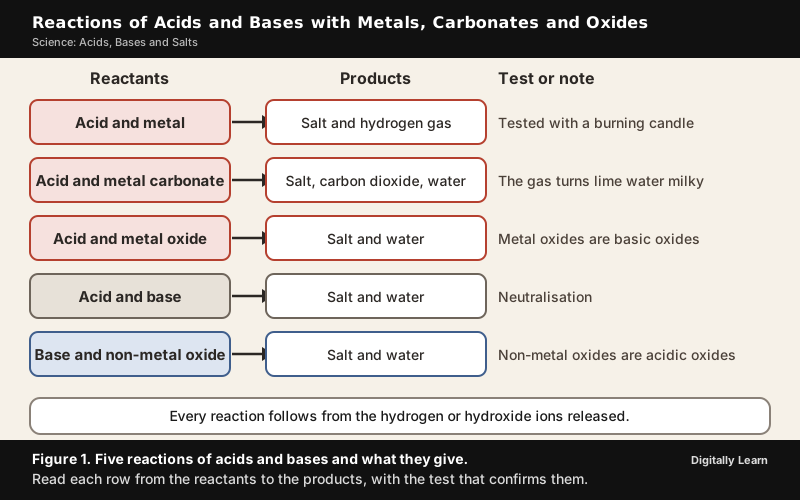
Acids and bases react in a small number of predictable ways, and all of them follow from the ions the acid or base releases.
- Acid with a metal: The metal displaces hydrogen from the acid, giving a salt and hydrogen gas. Zinc granules in dilute sulphuric acid fizz, and when a burning candle is brought near a soap bubble filled with the gas, the gas burns, which shows that it is hydrogen.
- Base with a metal: Zinc also reacts with sodium hydroxide, giving hydrogen and a salt called sodium zincate. Such reactions are not possible with every metal.
- Acid with a metal carbonate or hydrogencarbonate: The products are a salt, carbon dioxide and water. The gas turns lime water milky, because it forms a white precipitate of calcium carbonate. Limestone, chalk and marble are all forms of calcium carbonate, which is why an acid makes limestone and marble fizz.
- Acid with a metal oxide: The products are a salt and water, so metal oxides behave like bases and are called basic oxides. Copper oxide dissolves in dilute hydrochloric acid to give a blue-green copper chloride solution.
- Base with a non-metal oxide: Carbon dioxide reacts with calcium hydroxide to give a salt and water, so non-metal oxides behave like acids and are called acidic oxides.
Acid solutions conduct electricity because their ions carry the current. Glucose and alcohol also contain hydrogen but do not release it as ions, so their solutions do not conduct and they are not acids. Dry hydrogen chloride gas does not change dry litmus paper at all, and only with water does it release H+, so acidic behaviour needs water.
Strong and Weak Acids, Alkalis and Safe Dilution
The strength of an acid depends on how many hydrogen ions it releases, not on how much of it is present. At the same concentration, hydrochloric acid releases far more H+ than acetic acid does, so hydrochloric acid is a strong acid and acetic acid is a weak one. Strong and weak bases differ in the same way in the OH− ions they produce.
Being organic does not make an acid weak or strong. Formic acid (methanoic acid) and acetic acid are both organic acids, yet formic acid is about ten times stronger, since its ionisation constant is 1.8 × 10⁻⁴ against 1.74 × 10⁻⁵ for acetic acid.
Dissolving an acid or a base in water is strongly exothermic. A concentrated acid must therefore always be added slowly to water, with constant stirring. Water poured into concentrated acid can make the mixture splash out and cause burns, and the glass container may crack from the local heating. Water's large specific heat is what absorbs the heat released when the acid goes into a large amount of water.
Adding water also lowers the concentration of H3O+ or OH− ions per unit volume, a process called dilution.
Acid-Base Indicators
Natural Indicators: Litmus, Turmeric, Red Rose and Red Cabbage
An indicator is a dye, or a mixture of dyes, that shows by a change of colour whether a solution is acidic or basic. Many are natural.
Litmus is a purple dye extracted from lichen. A lichen is a partnership of a fungus and an alga. Litmus is purple when the solution is neutral, red in acid and blue in base, and the colour change happens over roughly the pH range 4.5 to 8.3. It is sold as a solution and as red and blue paper strips.
Turmeric paper behaves differently. Yellow turmeric turns reddish-brown in a base but stays yellow in acidic and neutral solutions, so it can detect a base but cannot tell an acid from a neutral liquid. That is why a curry stain on a white shirt turns reddish-brown when soap is rubbed on it and yellow again when the shirt is rinsed with plenty of water.
Red rose petal extract is red in acid and green in base. Red cabbage, beetroot, jamun, red hibiscus and the petals of Petunia and Geranium also work, because many coloured plant pigments (the anthocyanins) are red in acidic solutions and blue in basic ones. Hydrangea flowers change colour with the soil for a different reason. On acidic soil the plant can take up aluminium, which turns the flowers blue, while on basic soil it cannot, and the flowers stay pink.
| Indicator | In acid | In base | In neutral solution |
|---|---|---|---|
| Litmus | Red | Blue | Purple |
| Turmeric | Yellow | Reddish-brown | Yellow |
| Red rose extract | Red | Green | No change |
| Phenolphthalein | Colourless | Pink | Colourless |
| Methyl orange | Red | Yellow | Yellow |
Synthetic, Olfactory and Universal Indicators
Laboratories use synthetic indicators because their colour changes are sharp. Phenolphthalein is colourless in acid and pink in base. Methyl orange is red in acid and yellow in base, with orange in between. In an acid-base titration, an acid is added to a base drop by drop until the indicator changes colour at the point of neutralisation; phenolphthalein is often chosen for this work.
Some substances change odour rather than colour, and these are called olfactory indicators. Onion, vanilla essence and clove oil are tested in this way. Strips of cloth kept overnight with finely chopped onion take up its smell, and the smell is checked again after a few drops of a dilute acid go on one strip and a dilute base on the other; a substance whose smell changes in an acidic or a basic medium is an olfactory indicator.
A universal indicator is a mixture of several indicators that shows a different colour at each hydrogen ion concentration. Yellow to red colours show an acid, blue to violet an alkali and green a neutral solution. Paper impregnated with it is the pH paper used in schools. The universal indicator turns "acidic or basic" into a number on the pH scale.
The pH Scale
pH Scale: Meaning, Formula and the 0 to 14 Range
pH is a number that tells how acidic or basic a solution is by its hydrogen ion concentration. The p stands for potenz, German for power. Danish chemist Søren Sørensen introduced the idea in 1909 at the Carlsberg Laboratory. The modern definition is the negative logarithm to base 10 of the hydrogen ion concentration, written pH = −log[H+].
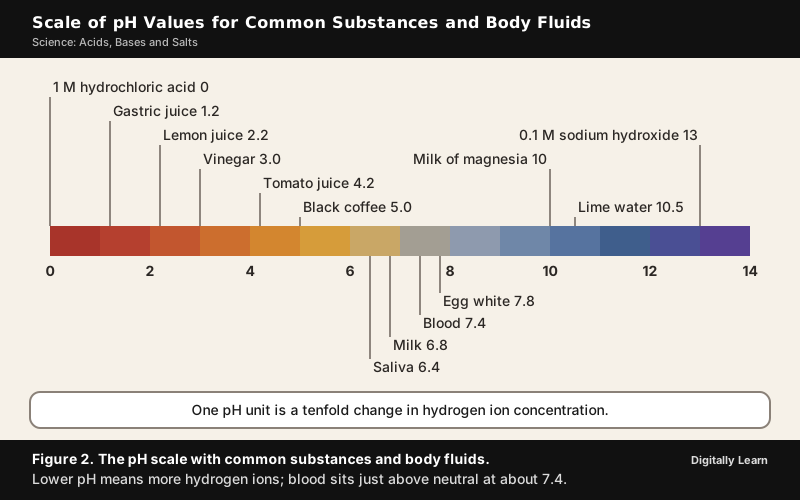
On the usual scale, 0 is very acidic, 7 is neutral and 14 is very alkaline. A solution with a pH below 7 is acidic, and a solution with a pH above 7 is basic. The higher the hydronium ion concentration, the lower the pH. Pure water at 25 °C has [H+] = 10−7 M, so its pH is 7. A 0.01 M (10−2 M) solution of hydrochloric acid has a pH of 2. A sodium hydroxide solution with [OH−] = 10−4 M has [H3O+] = 10−10 M and a pH of 10.
The range 0 to 14 is a convenience, not a physical limit. Very concentrated solutions go beyond it. A saturated sodium hydroxide solution is about 15, and concentrated hydrochloric acid is about −1.
Ionic Product of Water and the Relation of pH and pOH
Water ionises very slightly. One molecule gives up a proton to another, so pure water holds equal, tiny amounts of H3O+ and OH−, each being 1.0 × 10⁻⁷ M at 25 °C. Their product is called the ionic product of water, Kw = [H3O+][OH−] = 1 × 10⁻¹⁴ at 25 °C. Taking negative logarithms gives pH + pOH = 14. That relation is why the common scale ends at 14. In a solution where H+ is 10−14 M, OH− is 1 M.
The balance of the two ions decides the nature of a solution. In an acidic solution [H3O+] is greater than [OH−]; in a neutral solution the two are equal; in a basic solution [H3O+] is less than [OH−]. Kw rises with temperature, so the pH of a neutral solution falls below 7 in hot water; the values given here are for 25 °C.
Two checks make the idea concrete. If solution A has a pH of 6 and solution B a pH of 8, A has the higher hydrogen ion concentration and is acidic while B is basic. Basic solutions do contain H+ ions too; they simply contain far more OH− ions, so the solution is basic overall.
Measuring pH and the pH of Common Substances
pH is measured in two ways. Universal indicator solution or pH paper gives a colour that is matched by eye against a printed chart, so it reads only to about half a pH unit across the range 1 to 14. A pH meter measures the pH-dependent electrical potential of the solution through a glass electrode, which is calibrated against buffer solutions of known pH, and it reads to 0.001.
Gastric juice, at pH 1.2, holds more than a million times the hydrogen ions of blood at pH 7.4, because the two differ by more than six pH units. Milk of magnesia, at pH 10, is the mild base used as an antacid.
Why pH Matters for Life and the Environment
pH of Blood, Buffers, Digestion and Tooth Decay
Living organisms survive only within a narrow pH range, and the human body works between 7.0 and 7.8. Blood is slightly alkaline, at about 7.4, and the body holds it there with great precision. The pH of the blood plasma is regulated by chemical buffers, by the respiratory system and by the kidneys, and its normal range is narrow, about 7.35 to 7.45.
A buffer solution resists a change in pH when it is diluted or when a little acid or alkali is added. A mixture of acetic acid and sodium acetate buffers around pH 4.75, and a mixture of ammonium chloride and ammonium hydroxide buffers around pH 9.25. One buffer behind blood pH is the carbonic acid and bicarbonate pair, and when the pH is 7.4, the ratio of carbonic acid to bicarbonate is 1 to 20.
The stomach, by contrast, is meant to be strongly acidic. It produces hydrochloric acid, which helps digest food without harming the stomach. During indigestion the stomach makes too much acid, and the pain and irritation are relieved by antacids, which are bases that neutralise the excess acid. Marketed antacids contain salts of aluminium, calcium, magnesium or sodium, with milk of magnesia (magnesium hydroxide) and baking soda as familiar examples.
Tooth decay starts when the pH of the mouth falls below 5.5. Tooth enamel, made of calcium hydroxyapatite (a crystalline form of calcium phosphate), is the hardest substance in the body. It does not dissolve in water, but acid corrodes it once the mouth pH drops below 5.5. Bacteria in the mouth make acids by breaking down sugar and food particles left after eating, and those acids lower the pH. Toothpastes are generally basic, so cleaning the teeth after eating neutralises the excess acid and slows decay.
Acid Rain: Causes, Effects and the pH Limit
Rain is called acid rain when its pH falls below 5.6. Clean rain is already slightly acidic because of the carbonic acid formed from dissolved carbon dioxide, so the pH line for "acid rain" is set below the pH of clean rain, not at 7.
The current NCERT textbook puts the acid rain limit at pH 5.6, while some other accounts draw it at pH 5.
The chief acid-forming gases are sulphur dioxide and oxides of nitrogen, and they react with water in the air to form sulphuric and nitric acids. They come largely from burning fossil fuels in coal-fired power stations and motor vehicles. Volcanoes and lightning are natural sources, since lightning produces nitric acid. Tall smokestacks carry the gases far from their source, so the acid often falls a considerable distance downwind.
Acid rain does its harm in three places.
- Water bodies: When acid rain flows into rivers it lowers their pH and makes the survival of aquatic life difficult. Below pH 5 most fish eggs do not hatch, and below pH 4 adult fish die.
- Soil and forests: Acid rain washes away nutrients such as calcium and magnesium and releases toxic aluminium from soil.
- Buildings and monuments: It corrodes limestone and marble, and in India the marble of the Taj Mahal has been damaged in this way.
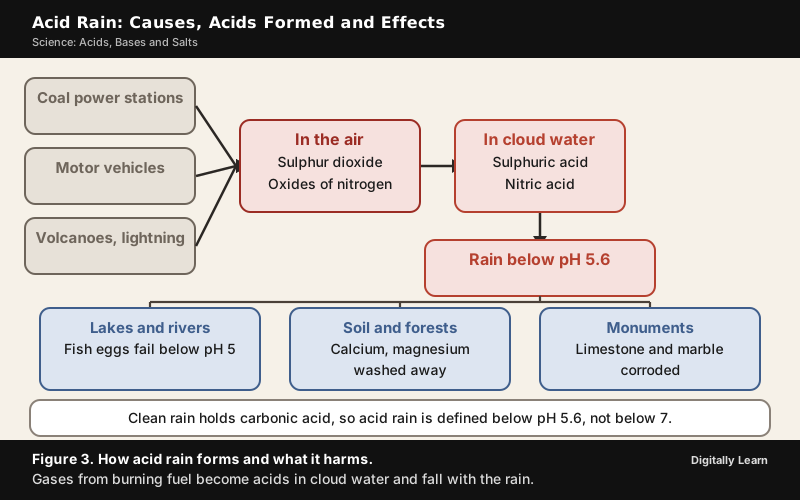
Controls act on the source. Flue-gas desulphurisation in coal power stations removes sulphur dioxide with lime or limestone, and emission control on vehicles cuts oxides of nitrogen.
India shows a different picture. Measurements published in 1984 showed that rain over unpolluted parts of India may have a pH between 6 and 7, and that a fall to acidic values may be restricted to highly industrialised cities such as Bombay (now Mumbai), where the rain pH was 4.5. The reason is that basic dust in the air neutralises the acid, since Indian soils are normally basic and the dust load is high.
Soil pH, Acid Soils and Liming
Soil pH is a master variable of the soil. It controls which forms of plant nutrients are available, and the best pH range for most plants is 5.5 to 7.5. Soils normally fall between pH 3 and 10, and a soil under warm, humid conditions turns acidic with time as water leaches the products of weathering out of it, while soils in dry climates are often neutral or alkaline. Ammonium fertilisers also acidify soil, because they release H+ as they are converted to nitrate.
To treat an acidic soil a farmer adds quicklime (calcium oxide), slaked lime (calcium hydroxide) or chalk (calcium carbonate), all bases. A basic soil is treated by adding organic matter such as manure and composted leaves, which release acids.
In India, about 25 million hectares of cultivated land have a pH below 5.5, and these are classed as critically degraded acid lands with low productivity. Liming acid soils raises the efficiency with which crops use fertiliser, saving about 50 per cent of chemical fertilisers, particularly in oilseeds and pulses.
The Soil Health Card scheme records pH. It was introduced on 19 February 2015 at Suratgarh, Rajasthan, and each card reports the soil status on 12 parameters, namely nitrogen, phosphorus, potassium, sulphur, zinc, iron, copper, manganese, boron, pH, electrical conductivity and organic carbon.
Ocean Acidification and Marine Life
Ocean acidification is the ongoing fall in the pH of the ocean as it absorbs carbon dioxide. Dissolved CO2 forms carbonic acid, which releases hydrogen ions. Between 1950 and 2020 the average pH of the ocean surface is estimated to have fallen from about 8.15 to 8.05. The sea is still alkaline, but the change is large in hydrogen ion terms, since a fall of 0.1 pH unit is a 26 per cent increase in hydrogen ion concentration.
The organisms hit hardest are those that build shells and skeletons of calcium carbonate, such as corals, molluscs and coccolithophores, a phytoplankton. Acid water makes it harder for these organisms to build a shell or skeleton, so calcification is reduced. Pteropod shells dissolve as acidity rises, and brittle stars lose muscle mass when they regrow appendages.
Larvae are affected too. In experiments at pH 7.6, orange clownfish larvae showed no reaction to the smell cues that they normally use to find reefs. Many of these organisms sit at the base of the food web, so the effect can run up to fish and to the one billion people who depend wholly or partly on coral reefs for fishing, tourism and coastal management.
Salts and Their Uses
Neutralisation Reaction and Salt Formation
A neutralisation reaction is the reaction of an acid with a base to give a salt and water, with heat released. In the standard example, sodium hydroxide and hydrochloric acid give sodium chloride and water: NaOH + HCl → NaCl + H2O. At heart, H+ joins OH− to make water.
Neutralisation happens in many everyday settings. A drop of lemon juice in water turns blue litmus red, and lime water added slowly turns it blue again, because the base has used up the acid. A red ant bite leaves formic acid in the skin, and moist baking soda, a base, relieves the pain. Factory waste that is acidic can be neutralised with a base before it is released into a lake, so the fish are not harmed.
Families of Salts and the pH of Salt Solutions
Salts with the same positive or negative part belong to a family. NaCl and Na2SO4 are sodium salts, and NaCl and KCl are chloride salts.
A salt solution need not be neutral. The ions of some salts react with water, a process called hydrolysis, and this changes the pH. The result depends on which parent was strong.
| Salt made from | Example | pH of solution |
|---|---|---|
| Strong acid and strong base | Sodium chloride | 7, neutral |
| Strong acid and weak base | Ammonium chloride | Below 7, acidic |
| Weak acid and strong base | Sodium acetate, sodium hydrogencarbonate | Above 7, basic |
The ions of a strong acid or strong base simply become hydrated and do not hydrolyse, which is why the salt of a strong acid with a strong base gives a neutral solution.
Sodium acetate is made from the weak acetic acid and the strong sodium hydroxide. Its acetate ion reacts with water to give acetic acid and OH− ions, and because acetic acid is weak the OH− ions build up and the solution is basic. Ammonium chloride is made from the weak base ammonium hydroxide and the strong hydrochloric acid. Its ammonium ion reacts with water to form NH4OH and H+ ions, and because ammonium hydroxide is a weak base the H+ ions build up and the solution is acidic.
Hydrolysis is different from three processes with similar names. Electrolysis uses a direct electric current to drive a reaction, as in the chlor-alkali process; dialysis separates molecules in solution by their different rates of diffusion through a semipermeable membrane; and photolysis breaks molecules down by the absorption of light.
Common Salt and the Chlor-Alkali Process
Common salt is sodium chloride. It is separated from sea water, which contains many dissolved salts, or mined as rock salt, which occurs in large crystals that are often brown from impurities. Beds of rock salt formed where seas of past ages dried up, and the salt is mined like coal.
Common salt is the raw material for sodium hydroxide, baking soda, washing soda and bleaching powder. When electricity is passed through brine, a solution of sodium chloride, it decomposes. The process is called the chlor-alkali process, after chlorine and the alkali sodium hydroxide that it gives. The reaction is 2NaCl + 2H2O → 2NaOH + Cl2 + H2.
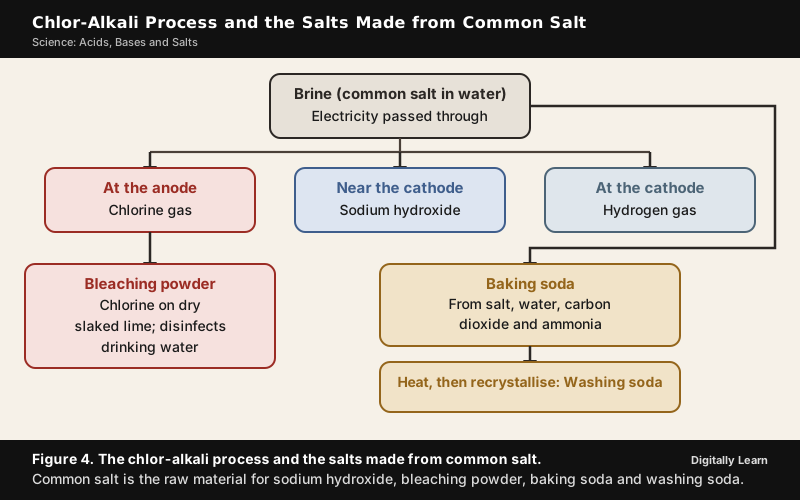
Chlorine gas is given off at the anode, hydrogen at the cathode, and sodium hydroxide solution forms near the cathode. All three products are useful, and the chlorine, for instance, goes to make bleaching powder.
The process became the principal source of chlorine during the twentieth century. The older diaphragm and mercury cells were environmentally unfriendly because they used asbestos and mercury, and the newer membrane cell is more energy efficient and avoids those materials.
Baking Soda, Baking Powder and Washing Soda
Baking soda is sodium hydrogencarbonate, NaHCO3, also called sodium bicarbonate. It is made from sodium chloride, water, carbon dioxide and ammonia. It is a mild, non-corrosive basic salt, and heated during cooking it gives sodium carbonate, water and carbon dioxide, which is why it makes pakoras crisp and speeds cooking.
Its uses follow from its two properties, mild basicity and the carbon dioxide it releases with an acid:
- It is an ingredient in antacids, where being alkaline it neutralises excess acid in the stomach.
- It is used in soda-acid fire extinguishers, where an acid releases carbon dioxide from it.
- It eases a bee sting or ant bite, since the sting leaves an acid.
Baking soda is often confused with baking powder, which is a mixture of baking soda and a mild edible acid.
| Feature | Baking soda | Baking powder |
|---|---|---|
| What it is | A single compound, NaHCO3 | A mixture of baking soda and a mild edible acid such as tartaric acid |
| How it releases carbon dioxide | Needs an acid from the food, or heat | Carries its own acid, so water or heat releases CO2 |
| Main uses | Antacid, fire extinguisher, crisp fried food | Makes bread and cake rise, soft and spongy |
Washing soda is sodium carbonate decahydrate, Na2CO3·10H2O. Heating baking soda gives sodium carbonate (soda ash), and recrystallising it from water gives washing soda, which is also a basic salt. Washing soda is used in the glass, soap and paper industries. In glass-making, sodium carbonate goes in with quicklime (calcium oxide), which makes the glass more durable. Washing soda is also used to make sodium compounds such as borax, as a household cleaning agent, and to remove the permanent hardness of water.
Bleaching Powder and Water Disinfection
Bleaching powder is made by the action of chlorine on dry slaked lime, Ca(OH)2, and the chlorine comes from the chlor-alkali process. It is written as Ca(ClO)2, the formula of calcium hypochlorite, its main active ingredient, although the real composition is quite complex. The reaction is 2Ca(OH)2 + 2Cl2 → Ca(ClO)2 + CaCl2 + 2H2O.
Bleaching powder has three main uses.
- Bleaching: It bleaches cotton and linen in the textile industry, wood pulp in paper factories and washed clothes in laundries.
- Oxidising agent: It acts as an oxidising agent in many chemical industries.
- Disinfection: It makes drinking water free from germs, which is the commonest use of calcium hypochlorite.
Water of Crystallisation, Gypsum and Plaster of Paris
Water of crystallisation is the fixed number of water molecules present in one formula unit of a salt. Blue copper sulphate crystals look dry but contain it, with five water molecules per formula unit, written CuSO4·5H2O. On heating, the water is removed and the salt turns white; moisten it with a few drops of water and the blue colour comes back. Washing soda, Na2CO3·10H2O, is also a hydrated salt, so a crystal of it is not "wet" even though it has ten water molecules in the formula.
| Common name | Chemical name | Formula |
|---|---|---|
| Baking soda | Sodium hydrogencarbonate | NaHCO3 |
| Washing soda | Sodium carbonate decahydrate | Na2CO3·10H2O |
| Caustic soda | Sodium hydroxide | NaOH |
| Bleaching powder | Calcium hypochlorite (composition complex) | Ca(ClO)2 |
| Plaster of Paris | Calcium sulphate hemihydrate | CaSO4·½H2O |
| Gypsum | Calcium sulphate dihydrate | CaSO4·2H2O |
| Blue vitriol | Copper sulphate pentahydrate | CuSO4·5H2O |
| Epsom salt | Magnesium sulphate heptahydrate | MgSO4·7H2O |
| Quicklime | Calcium oxide | CaO |
| Slaked lime | Calcium hydroxide | Ca(OH)2 |
| Limestone, chalk, marble | Calcium carbonate | CaCO3 |
Gypsum is another salt with water of crystallisation, two molecules of it, written CaSO4·2H2O. Heating gypsum drives off water and gives calcium sulphate hemihydrate, CaSO4·½H2O, which is Plaster of Paris. It is a white powder that sets into a hard solid mass as gypsum again when mixed with water, which is why doctors use it to hold a fractured bone in position and why it must be stored in a moisture-proof container. It is also used for making toys, decorative materials and smooth surfaces. The half in the formula arises because two formula units of CaSO4 share one water molecule.
The current NCERT textbook gives 100 °C (373 K) for heating gypsum, while industrial kilns work at about 120 to 180 °C.
The name comes from the large gypsum deposit at Montmartre, a hill in the north of Paris, from which the material was first made.
Acids and Bases in Everyday Life
Natural Acids in Food, Stings and Plants
Many foods owe their sour taste to natural acids, and ant and nettle stings carry one too.
| Natural source | Acid |
|---|---|
| Vinegar | Acetic acid |
| Curd (sour milk) | Lactic acid |
| Orange and lemon | Citric acid |
| Tamarind | Tartaric acid |
| Tomato | Oxalic acid |
| Ant sting and nettle sting | Methanoic (formic) acid |
Stinging hairs on nettle leaves inject methanoic acid and cause burning pain; a traditional remedy is to rub the spot with the leaf of the dock plant, which often grows beside the nettle.
Previous Year UPSC‑CSE Questions
Each question is explained option by option.
- UPSC Prelims 2022Consider the following:
- Carbon monoxide
- Nitrogen oxide
- Ozone
- Sulphur dioxide
Excess of which of the above in the environment is/are cause(s) of acid rain?
How to approach this Prelims question
Approach: Keep only the acid-forming gases. Sulphur dioxide and oxides of nitrogen react with water in the air to form acids. Carbon monoxide and ozone are pollutants but are not the gases that acidify rain.
Trap to watch: Including carbon monoxide or ozone because they are pollutants is the mistake; they do not acidify rain.
Why each option is right or wrong:
- (a) 1, 2 and 3: Wrong. Carbon monoxide and ozone are not among the acid-forming gases.
- (b) 2 and 4 only: Correct. Nitrogen oxide and sulphur dioxide give nitric and sulphuric acids.
- (c) 4 only: Wrong. Nitrogen oxide also causes acid rain.
- (d) 1, 3 and 4: Wrong. It includes carbon monoxide and ozone and leaves out nitrogen oxide.
Answer: (b) 2 and 4 only. Nitrogen oxide and sulphur dioxide.
- UPSC Prelims 2012The acidification of oceans is increasing. Why is this phenomenon a cause of concern?
- The growth and survival of calcareous phytoplankton will be adversely affected.
- The growth and survival of coral reefs will be adversely affected.
- The survival of some animals that have phytoplanktonic larvae will be adversely affected.
- The cloud seeding and formation of clouds will be adversely affected.
Which of the statements given above is/are correct?
How to approach this Prelims question
Approach: Ask which life forms depend on calcium carbonate or have delicate early stages. A more acidic ocean makes it harder to build calcium carbonate shells and skeletons, which hurts calcareous plankton such as coccolithophores and the corals that build reefs, and some animals' larvae survive poorly in acid water. Cloud seeding is the artificial triggering of rain from clouds and has nothing to do with the pH of the sea.
Trap to watch: Adding cloud seeding because the ocean affects weather is the mistake; it has no link to ocean pH.
Why each option is right or wrong:
- (a) 1, 2 and 3 only: Correct. Calcareous phytoplankton, coral reefs and animals with planktonic larvae are all harmed by a more acidic ocean.
- (b) 2 only: Wrong. It leaves out the calcareous phytoplankton and the larvae, which are harmed as well.
- (c) 1 and 3 only: Wrong. It leaves out coral reefs, which build calcium carbonate skeletons.
- (d) 1, 2, 3 and 4: Wrong. Cloud seeding is not linked to the pH of the ocean.
Answer: (a) 1, 2 and 3 only. The organisms that build calcium carbonate and the larvae are hurt.
- UPSC Prelims 2010Consider the following:
- Oxides of Hydrogen
- Oxides of Nitrogen
- Oxides of Sulphur
Which of the above causes/cause acid rain?
How to approach this Prelims question
Approach: Acid rain comes from sulphur dioxide and the oxides of nitrogen, which react with water in the air to give sulphuric and nitric acids. The oxide of hydrogen is water, H2O, which is not acidic.
Trap to watch: Accepting oxides of hydrogen because they sound like the acid gases is the mistake; the oxide of hydrogen is water.
Why each option is right or wrong:
- (a) 1 and 2 only: Wrong. The oxide of hydrogen is water, which does not cause acid rain.
- (b) 3 only: Wrong. Oxides of nitrogen form nitric acid and also cause acid rain.
- (c) 2 and 3 only: Correct. Oxides of sulphur and nitrogen give sulphuric and nitric acids in rain.
- (d) 1, 2 and 3: Wrong. Statement 1 is a distractor, since oxides of hydrogen means water.
Answer: (c) 2 and 3 only. Oxides of sulphur and nitrogen.
- UPSC Prelims 2008What is the pH level of blood of a normal person?
How to approach this Prelims question
Approach: Blood is slightly alkaline, so its pH lies just above 7. Buffers, the respiratory system and the kidneys hold it in a very narrow band near 7.4, and only one option brackets that value.
Trap to watch: Choosing a band below 7 because blood carries carbon dioxide is the mistake; blood is slightly alkaline.
Why each option is right or wrong:
- (a) 4·5 – 4·6: Wrong. That is strongly acidic, far below the body's working range of 7.0 to 7.8.
- (b) 6·45 – 6·55: Wrong. That is acidic, while blood is slightly alkaline at about 7.4.
- (c) 7·35 – 7·45: Correct. Blood is slightly alkaline at about 7.4, and this band brackets that value.
- (d) 8·25 – 8·35: Wrong. That is far more alkaline than blood and outside the body's working range of 7.0 to 7.8.
Answer: (c) 7·35 – 7·45. Blood is slightly alkaline, at about 7.4.
- UPSC Prelims 2004Consider the following statements:
- Banking soda is used in fire extinguishers.
- Quicklime is used in the manufacture of glass.
- Gypsum is used in the manufacture of Plaster of Paris.
Which of the statements given above is/are correct?
How to approach this Prelims question
Approach: Check each use. Statement 1 misspells baking soda; read as baking soda, it is used in soda-acid fire extinguishers, where an acid releases carbon dioxide from it. Lime, calcium oxide, is added to glass to make it more durable. Gypsum, heated, gives Plaster of Paris. All three are correct.
Trap to watch: Rejecting statement 1 for its misprint 'Banking soda' is the mistake; baking soda is meant.
Why each option is right or wrong:
- (a) 1 and 2: Wrong. Statement 3 is also correct, because heating gypsum gives Plaster of Paris.
- (b) 2 and 3: Wrong. Statement 1 is also correct, because baking soda is used in soda-acid fire extinguishers.
- (c) 1 only: Wrong. Quicklime goes into glass, and gypsum makes Plaster of Paris.
- (d) 1, 2 and 3: Correct. All three uses are correct.
Answer: (d) 1, 2 and 3. Fire extinguishers, glass and Plaster of Paris.
- UPSC Prelims 2001An aqueous solution of copper sulphate is acidic in nature because the salt undergoes
How to approach this Prelims question
Approach: A salt solution is acidic or basic when the ions of the salt react with water and change the balance of H+ and OH−. That reaction is hydrolysis. The other three terms name processes that do not involve the salt's ions reacting with water.
Trap to watch: Choosing electrolysis because a solution of ions is involved is the mistake; no current is passed.
Why each option is right or wrong:
- (a) dialysis: Wrong. Dialysis separates small particles from large ones through a membrane and does not change the pH of a solution.
- (b) electrolysis: Wrong. Electrolysis needs an electric current passed through a solution, as in the chlor-alkali process.
- (c) hydrolysis: Correct. The ions of the salt react with water, and this changes the pH of the solution.
- (d) photolysis: Wrong. Photolysis is the breakdown of a compound by light.
Answer: (c) hydrolysis. The ions of the salt react with water and shift the pH.
- UPSC Prelims 1999Assertion and Reason:
- Assertion (A): To dilute sulphuric acid, acid is added to water and not water to acid.
- Reason (R): Specific heat of water is quite large.
How to approach this Prelims question
Approach: Dissolving concentrated acid in water releases a great deal of heat. If the acid goes slowly into a large amount of water, the water absorbs that heat. Water's large specific heat is exactly why this method is safe, so both statements are true and R explains A.
Trap to watch: Treating R as a separate true fact is the mistake; water's large specific heat is why the method is safe.
Why each option is right or wrong:
- (a) Both A and R are true, and R is the correct explanation of A: Correct. Water's large specific heat absorbs the heat released, which is why acid is added to water.
- (b) Both A and R are true, but R is not a correct explanation of A: Wrong. The large specific heat of water is the reason the method is safe.
- (c) A is true, but R is false: Wrong. Water's specific heat is indeed large.
- (d) A is false, but R is true: Wrong. A is the standard laboratory rule, since water added to concentrated acid can splash out and cause burns.
Answer: (a) Both A and R are true, and R is the correct explanation of A. Water absorbs the heat of the acid.
- UPSC Prelims 1999When ants bite, they inject
How to approach this Prelims question
Approach: An ant bite leaves an acid in the skin, and moist baking soda, a base, relieves it by neutralisation. The acid is formic acid, also called methanoic acid, which is why the same acid is found in nettle stings.
Trap to watch: Choosing acetic acid because it is the best-known organic acid is the mistake; ants inject formic acid.
Why each option is right or wrong:
- (a) glacial acetic acid: Wrong. Acetic acid is the acid of vinegar, not the acid ants inject.
- (b) methanol: Wrong. Methanol is an alcohol, not an acid, while ants inject formic (methanoic) acid.
- (c) formic acid: Correct. Ants inject formic acid, which a mild base such as baking soda neutralises.
- (d) stearic acid: Wrong. The acid ants inject is formic acid, not stearic acid.
Answer: (c) formic acid. The ant's sting is methanoic acid.
- UPSC Prelims 1998Assertion and Reason:
- Assertion (A): Formic acid is a stronger acid than acetic acid.
- Reason (R): Formic acid is an organic acid.
How to approach this Prelims question
Approach: Test each statement, then the link. Formic acid has the larger ionisation constant, 1.8 × 10⁻⁴ against 1.74 × 10⁻⁵ for acetic acid, so it is about ten times stronger and A is true. Formic acid is an organic acid, so R is true. But acetic acid is organic too, so being organic cannot be the reason one is stronger.
Trap to watch: Taking 'organic' as the reason is the mistake; acetic acid is organic too and weaker.
Why each option is right or wrong:
- (a) Both A and R are true, and R is the correct explanation of A: Wrong. Acetic acid is also organic and weaker, so being organic cannot explain why formic acid is stronger.
- (b) Both A and R are true, but R is NOT a correct explanation of A: Correct. A and R are each true, but strength depends on how many H+ ions the acid releases, not on being organic.
- (c) A is true, but R is false: Wrong. Formic acid is an organic acid (methanoic acid), so R is true.
- (d) A is false, but R is true: Wrong. Formic acid is about ten times stronger than acetic acid, so A is true.
Answer: (b) Both A and R are true, but R is NOT a correct explanation of A. Strength depends on ionisation, not on being organic.
- UPSC Prelims 1998Match List I with List II and select the correct answer using the codes given below the lists:List I
- I. Blue vitriol
- II. Epsom salt
- III. Baking soda
- IV. Caustic soda
List II
- A) Sodium bicarbonate
- B) Sodium hydroxide
- C) Magnesium sulphate
- D) Copper sulphate
Codes:
How to approach this Prelims question
Approach: Recall each common name. Blue vitriol is copper sulphate pentahydrate, CuSO4·5H2O; Epsom salt is magnesium sulphate heptahydrate, MgSO4·7H2O; baking soda is sodium hydrogencarbonate (sodium bicarbonate), NaHCO3; caustic soda is sodium hydroxide, NaOH. So I matches D, II matches C, III matches A and IV matches B.
Trap to watch: Swapping blue vitriol and Epsom salt, both sulphates, is the mistake.
Why each option is right or wrong:
- (a) I‑C, II‑D, III‑B, IV‑A: Wrong. Blue vitriol is copper sulphate (D), not magnesium sulphate, and baking soda is sodium bicarbonate (A), not sodium hydroxide.
- (b) I‑D, II‑C, III‑A, IV‑B: Correct. Blue vitriol is copper sulphate, Epsom salt is magnesium sulphate, baking soda is sodium bicarbonate and caustic soda is sodium hydroxide.
- (c) I‑C, II‑D, III‑A, IV‑B: Wrong. It swaps blue vitriol and Epsom salt.
- (d) I‑D, II‑A, III‑B, IV‑A: Wrong. Epsom salt is magnesium sulphate, not sodium bicarbonate, and the code uses sodium bicarbonate twice.
Answer: (b) I‑D, II‑C, III‑A, IV‑B. Blue vitriol is copper sulphate, Epsom salt magnesium sulphate, baking soda sodium bicarbonate and caustic soda sodium hydroxide.
Sources
- NCERT: Class 10 Science, Chapter 2
- NCERT: Class 7 Curiosity (Science), Chapter 2
- NCERT: Class 11 Chemistry Book 1, Chapter 6
- PIB: Celebrating a Decade of Soil Health Cards
- ICAR: Natural Resource Management, Annual Report 2005‑06
- India Meteorological Department (MAUSAM): Prospects of acid rain over India
- India Meteorological Department (MAUSAM): Natural dust and the acidity of rain over India
- Wikipedia: Acid-base homeostasis
- Wikipedia: Acid rain
- Wikipedia: Antacid
- Wikipedia: Base (chemistry)
- Wikipedia: Calcium hypochlorite
- Wikipedia: Chloralkali process
- Wikipedia: Cloud seeding
- Wikipedia: Coccolithophore
- Wikipedia: Copper(II) sulfate
- Wikipedia: Dialysis (biochemistry)
- Wikipedia: Dialysis (chemistry)
- Wikipedia: Electrolysis
- Wikipedia: Formic acid
- Wikipedia: Glass
- Wikipedia: Litmus
- Wikipedia: Magnesium sulfate
- Wikipedia: Methyl orange
- Wikipedia: Ocean acidification
- Wikipedia: pH
- Wikipedia: pH indicator
- Wikipedia: Phenolphthalein
- Wikipedia: Photodissociation
- Wikipedia: Plaster of Paris
- Wikipedia: Sodium bicarbonate
- Wikipedia: Sodium carbonate
- Wikipedia: Sodium hydroxide
- Wikipedia: Soil pH
- Wikipedia: Universal indicator
- Wikipedia: Water
- UPSC: Civil Services Examination question papers
Editorial Disclaimer
Facts are drawn from the current NCERT science and chemistry textbooks and from official and reference sources; where they give different values, NCERT's are used.


