

Overview
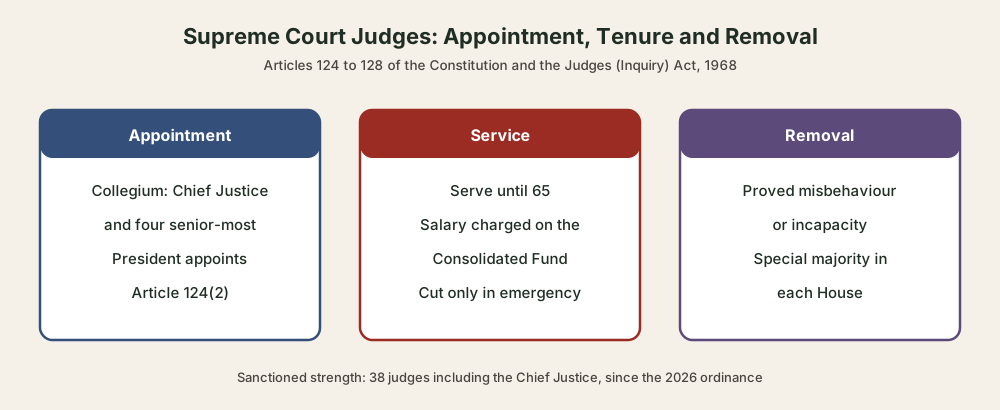
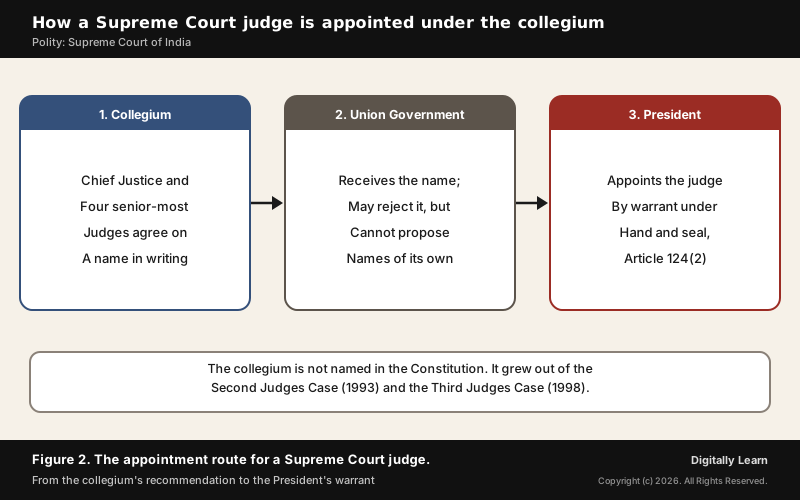
The collegium system is the method by which judges of the Supreme Court are chosen: the Chief Justice of India and the four senior-most judges recommend a name, and the President appoints by warrant under Article 124(2). The Constitution does not mention the collegium; the Court created it through the Three Judges Cases of 1981, 1993 and 1998, and restored it in 2015 after striking down the National Judicial Appointments Commission.
Supreme Court of India: Constitutional Basis and Establishment
Articles 124 to 147: The Union Judiciary in Part V
India has one integrated judicial system: the Supreme Court at the top, the High Courts below it and the subordinate courts below them. Unlike the United States, which runs separate federal and state courts, this single system enforces Central and State laws alike, a structure carried over from the Government of India Act, 1935. The federal features of the Constitution explain why a federal country still chose a unified judiciary.
Chapter IV of Part V, titled The Union Judiciary, runs from Article 124 to Article 147. It deals with the Court's organisation and independence, its jurisdiction, powers and procedure, and Parliament is authorised to regulate several of these matters by law. The table lists the provisions on how the Court is organised; its jurisdiction begins at Article 131.
| Article | What it provides |
|---|---|
| 124 | Establishment and composition; appointment, qualifications, oath, tenure and removal of judges |
| 125 | Salaries, allowances, leave and pension of judges |
| 126 | Acting Chief Justice of India |
| 127 and 128 | Ad hoc judges; retired judges sitting again |
| 129 and 130 | Court of record; seat of the Court |
| 145 and 146 | Rules of the Court; officers, servants and expenses |
From Federal Court to Supreme Court: Establishment in 1950
The Supreme Court came into existence on 26 January 1950, when the Constitution came into force, and was inaugurated two days later, on 28 January 1950. The ceremony took place in the Chamber of Princes in the old Parliament building, where the Federal Court of India had sat from 1937 to 1950. The first Chief Justice of India was Harilal J. Kania, and the proceedings began at 9:45 am.
The new Court succeeded the Federal Court, but its jurisdiction is wider, because it also replaced the British Privy Council as the highest court of appeal. It sat in part of the old Parliament House until 1958, when it moved to its present building on Tilak Marg in New Delhi. President Rajendra Prasad inaugurated that building on 4 August 1958; it is shaped to project the image of the scales of justice.
Number of Judges in the Supreme Court: 8 in 1950, 38 Today
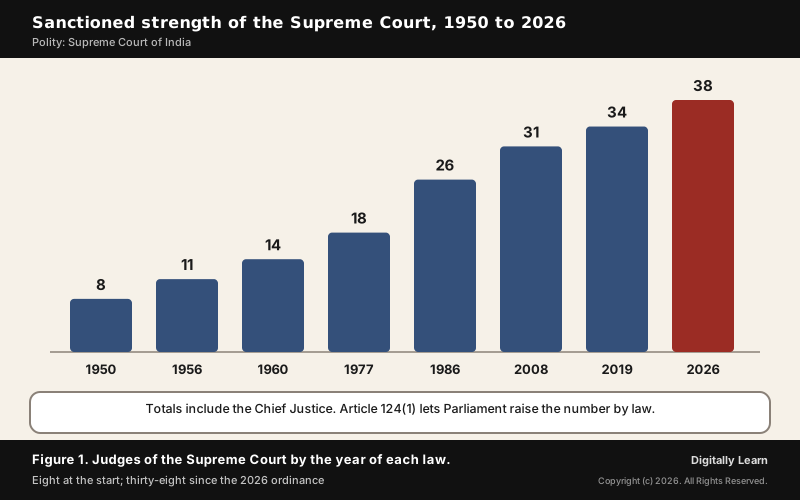
Article 124(1) created a Court of a Chief Justice and not more than seven other judges, "until Parliament by law prescribes a larger number". The number of judges is therefore set by an ordinary law of Parliament, the Supreme Court (Number of Judges) Act, 1956, and not by amending the Constitution. In the early years all the judges sat together to hear cases; today they sit in benches of two and three.
- 1956: The Act fixed the judges other than the Chief Justice at 10.
- 1960 and 1977: Amending Acts raised the number to 13 and then to 17. The Cabinet held the working strength at 15 until the end of 1979, when the restriction was withdrawn at the Chief Justice’s request.
- 1986 and 2008: The number rose to 25 and then to 30.
- 2019: The Supreme Court (Number of Judges) Amendment Act raised it to 33.
- 2026: An ordinance of 16 May 2026 raised it to 37, so the Court now has a sanctioned strength of 38 including the Chief Justice.
Qualifications, Oath, Tenure and Salary of Supreme Court Judges
Qualifications for Appointment Under Article 124(3)
A person is qualified to be a judge of the Supreme Court only if he or she is a citizen of India and meets one of three conditions in Article 124(3). The Constitution sets no minimum age, and no maximum either, beyond the retirement age of 65.
- A judge of a High Court, or of two or more High Courts in succession, for at least five years.
- An advocate of a High Court, or of two or more High Courts in succession, for at least ten years.
- A distinguished jurist in the opinion of the President.
An explanation to the clause counts, towards the ten years of practice, any period in which an advocate held judicial office not inferior to that of a district judge. In practice most judges come from the High Courts; only a small number have been appointed straight from the Bar. The appointments of 1 June 2026 show both routes: four High Court Chief Justices and one senior advocate, V. Mohana, were appointed together under Article 124(2).
Oath, Tenure, Retirement at 65 and Resignation
Before taking office, a judge makes an oath or affirmation before the President, or a person the President appoints, in the form set out in the Third Schedule. The judge swears to bear true faith and allegiance to the Constitution, to uphold the sovereignty and integrity of India, to perform the duties of office without fear or favour, affection or ill-will, and to uphold the Constitution and the laws.
The Constitution does not give a judge a fixed term. Instead, a judge holds office until the age of 65, and Article 124(2A), added by the Fifteenth Amendment of 1963, lets Parliament decide by law the authority and manner for settling any question about a judge's age. Office ends earlier in only two ways: resignation, by writing addressed to the President, or removal under Article 124(4). A judge does not hold office at the pleasure of the President, even though the President makes the appointment.
Salaries and the Consolidated Fund of India (Article 125)
Under Article 125, Parliament fixes the salaries of judges by law, and, until it does, the Second Schedule applies. Their privileges, allowances, leave and pension may also be set by Parliament, but a proviso bars any change to a judge's disadvantage after appointment. The one exception is a financial emergency: Article 360(4) lets the President direct a cut in the salaries of Union servants, including the judges of the Supreme Court and the High Courts.
The salaries, allowances and pensions of the judges are charged on the Consolidated Fund of India by Article 112(3), and Article 146(3) charges the Court's administrative expenses as well. Charged expenditure is not put to the vote in Parliament, though it can be discussed, so the judges' pay never depends on a majority in the Lok Sabha. The Chief Justice draws a basic salary of Rs 2,80,000 a month and a judge Rs 2,50,000.
Appointment of Supreme Court Judges: The Collegium System
Appointment of the Chief Justice of India and the Seniority Convention
Every judge of the Supreme Court, including the Chief Justice, is appointed by the President by warrant under his hand and seal under Article 124(2). For the Chief Justice, a convention filled the gap the text left: from 1950 to 1973 the senior-most judge of the Court was always appointed. The convention was broken in 1973, when A.N. Ray was appointed over three senior judges, J.M. Shelat, A.N. Grover and K.S. Hegde, and again when M.H. Beg was appointed over H.R. Khanna.
In the Second Judges Case of 1993 the Court ruled that the senior-most judge alone should be appointed Chief Justice, which closed the government's discretion. The process now runs in a fixed order: as the incumbent approaches retirement, the Ministry of Law and Justice asks for a recommendation, the outgoing Chief Justice names a successor, and the Prime Minister advises the President. The Chief Justice is also the master of the roster, allocating cases and forming Constitution Benches.
The Three Judges Cases (1981, 1993, 1998) and the Birth of the Collegium
The original Article 124(2) required the President to appoint judges "after consultation" with such judges of the Supreme Court and the High Courts as he thought necessary, and to consult the Chief Justice in every appointment other than his own. What "consultation" meant was settled by the Court in three decisions known together as the Three Judges Cases.
| Case | What the Court held |
|---|---|
| First Judges Case: S.P. Gupta v. Union of India (1981) | Consultation does not mean concurrence; it is only an exchange of views, so the executive had the final say |
| Second Judges Case: Supreme Court Advocates-on-Record Association (judgment of 6 October 1993) | Consultation means concurrence; the Chief Justice's advice binds the President, given after consulting his two senior-most colleagues |
| Third Judges Case: advisory opinion of 28 October 1998 | The Chief Justice must consult a collegium of the four senior-most judges; if two of them disagree, the name should not be sent |
The Third Judges Case was not a dispute between parties. It was the Court's advisory opinion on a question of law referred by President K.R. Narayanan in July 1998. Its insistence on a plurality of judges, recorded in writing, is the origin of the collegium as it works today.
How the Collegium System Works: Composition and Memorandum of Procedure
The collegium system is the method by which judges of the higher judiciary are chosen. For the Supreme Court, the collegium is the Chief Justice of India and the four senior-most judges, who also take the views of the senior-most judge of the Court from the candidate's High Court. There is no mention of the collegium in the Constitution; it rests entirely on the Second and Third Judges Cases.
The procedure is written down in a Memorandum of Procedure prepared in 1998 on the basis of those two judgments. Under it, the power to initiate a proposal for the Supreme Court lies with the Chief Justice of India. The recommendation then goes to the Union Government. The executive cannot propose names of its own, though it may reject a recommended name, and the President appoints only from the names the collegium recommends. The Ministry of Law and Justice describes the whole exercise as a continuous, integrated and collaborative process between the executive and the judiciary.
NJAC and the 99th Amendment: Why the Court Struck It Down in 2015
In August 2014 Parliament tried to replace the collegium. The Constitution (Ninety-ninth Amendment) Act, 2014 inserted Articles 124A to 124C, and the National Judicial Appointments Commission Act, 2014 set out its procedure. The Lok Sabha passed the Bills on 13 August and the Rajya Sabha on 14 August 2014; sixteen State legislatures ratified the amendment, and the President assented on 31 December 2014. The amendment came into force on 13 April 2015.
| NJAC member | Who |
|---|---|
| Chairperson | Chief Justice of India |
| Two judges | The two senior-most judges of the Supreme Court after the Chief Justice |
| Law Minister | Union Minister in charge of Law and Justice |
| Two eminent persons | Chosen by the Prime Minister, the Chief Justice and the Leader of Opposition in the Lok Sabha for three years; one from the SC, ST, OBC, minority communities or women |
On 16 October 2015 a five-judge Constitution Bench struck down both laws by a 4:1 majority, Justice J. Chelameswar dissenting, in Supreme Court Advocates-on-Record Association v. Union of India. The majority held that giving the executive a role in appointments would undermine the independence of the judiciary, which is part of the basic structure. The collegium was restored, but the Court accepted that it lacked transparency and asked the government and the collegium to finalise a revised Memorandum of Procedure.
Collegium System: Advantages, Criticism and Reform Proposals
The case for the collegium rests on judicial independence: judges chosen by judges owe nothing to the government of the day, and the 2015 judgment treated that insulation as part of the basic structure. The case against it rests on accountability and transparency: a small group of serving judges chooses its successors, with no role for anyone outside the judiciary.
- Opacity: The 2015 judgment itself accepted that the system lacked transparency and credibility.
- Delay: The Memorandum of Procedure asks High Courts to recommend names at least six months before a vacancy, but the Law Ministry has told Parliament this time limit is rarely observed.
- Diversity: The first woman judge, Fathima Beevi, was sworn in only in 1989, and the Court now has two women judges, B.V. Nagarathna and V. Mohana.
- Reform proposals: Eligibility criteria, a permanent secretariat to assess candidates, more transparency and a grievance mechanism, the four heads on which the Court invited suggestions in 2015.
Greater representation of women in the higher judiciary is argued for on grounds of equity and of better judging: a bench drawn from one narrow group is less able to see how a law bears on everyone. The government has asked High Court Chief Justices to give due consideration to candidates from the Scheduled Castes, Scheduled Tribes, Other Backward Classes, minorities and women, and says more women judges and lawyers will add to the social diversity of the justice system.
Acting, Ad Hoc and Retired Judges (Articles 126 to 128)
Acting Chief Justice and Ad Hoc Judges
Under Article 126, when the office of Chief Justice is vacant, or the Chief Justice is absent or otherwise unable to perform the duties of the office, the President appoints one of the other judges to perform them as acting Chief Justice.
Article 127 deals with a shortage of judges. If there is no quorum to hold or continue a session of the Court, the Chief Justice of India may, with the previous consent of the President and after consulting the Chief Justice of the High Court concerned, request a High Court judge qualified for appointment to the Supreme Court to attend as an ad hoc judge. Attending the Supreme Court then takes priority over the judge's other duties, and while attending, the judge has all the jurisdiction, powers and privileges of a Supreme Court judge.
Retired Judges Recalled to Sit, and the Bar on Practice After Retirement
Article 128 lets the Chief Justice of India, with the previous consent of the President, request a retired judge of the Supreme Court or the Federal Court to sit and act as a judge of the Supreme Court. Since the Fifteenth Amendment of 1963, a retired High Court judge qualified for appointment to the Supreme Court may be asked as well. The person must consent, draws the allowances the President fixes, and has all a judge's powers, but is not otherwise deemed a judge of the Court.
Once a judge retires, Article 124(7) bars him or her from pleading or acting in any court or before any authority in India. The bar is meant to stop a sitting judge from favouring anyone in the hope of future work. Retired judges can still be appointed to tribunals and commissions, a practice criticised on the ground that the hope of such posts may itself affect independence.
Removal of Supreme Court Judges: The Impeachment Procedure
Grounds and the Special Majority Under Article 124(4)
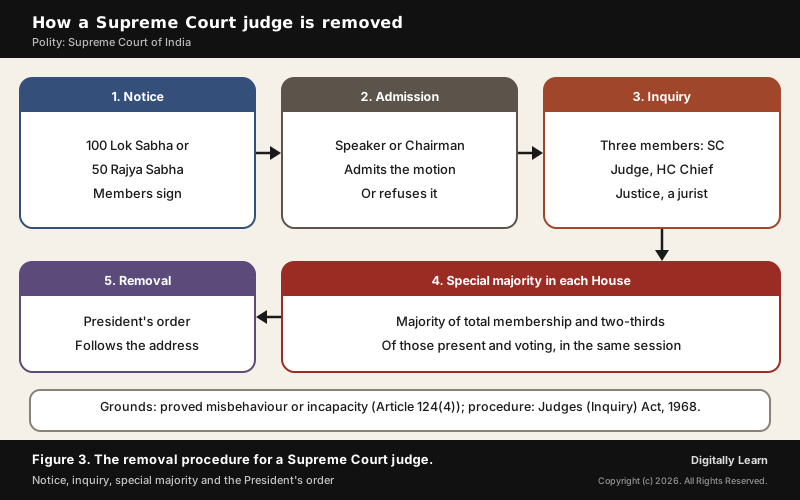
A judge of the Supreme Court can be removed only by an order of the President, passed after an address by each House of Parliament has been presented in the same session. Each House must support the address by a special majority: a majority of its total membership and a majority of not less than two-thirds of the members present and voting.
There are only two grounds, proved misbehaviour or incapacity. Article 124(4) names them but does not define either, and Article 124(5) leaves the procedure for investigating and proving them to Parliament. The procedure is in the Judges (Inquiry) Act, 1968, and the same method of removal applies to a High Court judge. While a removal motion is not before it, Parliament may not even discuss a judge's conduct in the discharge of duties: Article 121 forbids it.
Judges (Inquiry) Act 1968: Motion, Inquiry Committee and Vote
- A removal motion is signed by 100 members of the Lok Sabha or 50 members of the Rajya Sabha and given to the Speaker or the Chairman.
- The Speaker or Chairman may admit the motion or refuse to admit it.
- If it is admitted, a three-member committee is formed: the Chief Justice or a judge of the Supreme Court, a Chief Justice of a High Court, and a distinguished jurist.
- If the committee finds the judge guilty of misbehaviour or suffering from incapacity, the House takes up the motion.
- Each House passes the address by the special majority, and the President orders removal.
No judge of the Supreme Court has ever been removed. The only case to reach a vote was that of Justice V. Ramaswami: a motion signed by 108 members was moved in 1991, and in 1992 an inquiry committee of judges found him guilty of wilful and gross misuse of office as Chief Justice of the Punjab and Haryana High Court. Put to the vote, the motion won two-thirds of those present and voting, but the Congress party abstained, so it fell short of a majority of the total membership and he was not removed.
Independence of the Judiciary: Constitutional Safeguards
How the Constitution Protects Judicial Independence
An independent judiciary means that the executive and the legislature do not restrain the courts or interfere with their decisions, and that judges can decide without fear or favour. It does not mean a judiciary free of accountability: judges remain answerable to the Constitution, to democratic traditions and to the people. The Constitution secures independence through a set of connected provisions.
- Appointment: The legislature has no part in choosing judges, and the judiciary itself now leads the process.
- Security of tenure: Judges serve until 65 and can be removed only by the difficult procedure of Article 124(4).
- Fixed service conditions: Pay and privileges cannot be cut after appointment, except in a financial emergency.
- Charged expenditure: Salaries and the Court’s expenses are charged on the Consolidated Fund.
- No discussion of conduct: Article 121 bars Parliament, and Article 211 the State legislatures, from discussing a judge’s conduct except on a removal motion.
- Contempt power: As a court of record under Article 129, the Court can punish contempt of itself.
- Control of its staff: Under Article 146 the Chief Justice appoints the Court’s officers and servants.
- Separation from the executive: Article 50, a Directive Principle, asks the State to separate the judiciary from the executive in the public services.
Parliament may extend the Court's jurisdiction but cannot curtail what the Constitution guarantees. Together, these safeguards explain why the NJAC judgment treated independence as untouchable: it is part of the basic structure of the Constitution, and Article 50 shows that the framers wanted the separation built into the State itself.
Seat of the Court, Benches and Constitution Benches
Under Article 130 the Supreme Court sits in Delhi, or in any other place the Chief Justice appoints with the approval of the President. The provision is optional: no court can direct the President or the Chief Justice to set up another seat. Under Article 145 the Court frames its own rules of practice and procedure, again with the President's approval.
Most cases are heard by benches of two or three judges. Article 145(3) requires at least five judges for any case involving a substantial question of law as to the interpretation of the Constitution, and for a presidential reference under Article 143; such a bench is called a Constitution Bench. The largest bench ever formed, of 13 judges, heard Kesavananda Bharati v. State of Kerala in 1973. Judgments are by majority, and a judge who does not agree may deliver a dissent.
Previous Year UPSC-CSE Questions
Previous Year UPSC-CSE Questions By the end you will be able to draft model answers for the following UPSC questions. Each question carries a collapsible framework showing how to approach it in the exam.
- UPSC Mains 2025 GS-IIDiscuss the evolution of collegium system in India. Critically examine the advantages and disadvantages of the system of appointment of the Judges of the Supreme Court of India and that of the USA.
How to structure the answer in the exam
Introduction: Article 124(2) makes the President the appointing authority, but since 1993 the collegium of the Chief Justice and four senior-most judges decides whom the President appoints.
Body (sub-themes to develop):
- Evolution: First Judges Case 1981 (consultation is not concurrence), Second 1993 (concurrence), Third 1998 (collegium of five); NJAC 2014 struck down in 2015.
- India, advantages: insulation from the executive; judges assess judicial ability.
- India, disadvantages: opacity, no written criteria, delays, thin diversity.
- USA: presidential nomination and Senate confirmation; open hearings and democratic legitimacy, but partisan appointments.
Conclusion: Conclude that India needs the independence of the collegium with the transparency of a public, criteria-based process.
- UPSC Mains 2017 GS-IICritically examine the Supreme Court’s judgement on ‘National Judicial Appointments Commission Act, 2014’ with reference to appointment of judges of higher judiciary in India.
How to structure the answer in the exam
Introduction: The 99th Amendment and the NJAC Act of 2014 sought to replace the collegium with a six-member commission.
Body (sub-themes to develop):
- The Commission: Chief Justice, two senior judges, Law Minister, two eminent persons.
- The judgment: 4:1, executive role and the eminent persons' veto held to threaten independence, a basic feature.
- Criticism: judges alone choosing judges; the dissent; the Court's own admission of opacity.
Conclusion: Conclude that the judgment protected independence but left the transparency problem to a revised Memorandum of Procedure.
- UPSC Mains 2021 GS-IIDiscuss the desirability of greater representation to women in the higher judiciary to ensure diversity, equity and inclusiveness.
How to structure the answer in the exam
Introduction: The first woman judge of the Supreme Court was sworn in only in 1989, and the Court now has two women judges.
Body (sub-themes to develop):
- Diversity: a varied bench understands how laws affect different groups.
- Equity and inclusiveness: public confidence in courts that reflect society.
- Measures: consideration of women in collegium proposals; wider appointment from the Bar and the subordinate judiciary.
Conclusion: Conclude that representation strengthens both the legitimacy and the quality of justice.
- UPSC Prelims 2014 Prelims-GSThe power to increase the number of judges in the Supreme Court of India is vested in
How to approach this Prelims question
Approach: Recall the words of Article 124(1).
Trap to watch: The President appoints judges, which makes option (a) tempting.
Key facts to recall:
- Article 124(1): until Parliament by law prescribes a larger number.
- Supreme Court (Number of Judges) Act, 1956.
Answer signal: Parliament, option (b).
- UPSC Prelims 2012 Prelims-GSWhat is the provision to safeguard the autonomy of the Supreme Court of India?
- While appointing the Supreme Court Judges, the President of India has to consult the Chief Justice of India.
- The Supreme Court Judges can be removed by the Chief Justice of India only.
- The salaries of the Judges are charged on the Consolidated Fund of India to which the legislature does not have to vote.
- All appointments of officers and staffs of the Supreme Court of India are made by the Government only after consulting the Chief Justice of India.
Which of the statements given above is/are correct?
How to approach this Prelims question
Approach: Test each statement against the relevant article.
Trap to watch: Statement 4 sounds like consultation but reverses Article 146.
Key facts to recall:
- Article 124(4): removal by the President after Parliament's address.
- Article 112(3): salaries charged.
- Article 146: the Chief Justice appoints staff.
Answer signal: Statements 1 and 3 are correct, option (a).
- UPSC Prelims 2021 Prelims-GSWith reference to Indian judiciary, consider the following statements:
- Any retired judge of the Supreme Court of India can be called back to sit and act as a Supreme Court judge by the Chief Justice of India with prior permission of the President of India.
- A High Court in India has the power to review its own judgement as the Supreme Court does.
Which of the statements given above is/are correct?
How to approach this Prelims question
Approach: Check statement 1 against Article 128.
Trap to watch: Statement 2 relies on a general idea of courts reviewing judgments.
Key facts to recall:
- Article 128: retired judges, previous consent of the President.
- Article 137: review by the Supreme Court.
Answer signal: Only statement 1 is correct, option (a).
- UPSC Prelims 2019 Prelims-GSConsider the following statements:
- The motion to impeach a Judge of the Supreme Court of India cannot be rejected by the Speaker of the Lok Sabha as per the Judges (Inquiry) Act, 1968.
- The Constitution of India defines and gives details of what constitutes 'incapacity and proved misbehaviour' of the Judges of the Supreme Court of India.
- The details of the process of impeachment of the Judges of the Supreme Court of India are given in the Judges (Inquiry) Act, 1968.
- If the motion for the impeachment of a Judge is taken up for voting, the law requires the motion to be backed by each House of the Parliament and supported by a majority of total membership of that House and by not less than two-thirds of total members of that House present and voting.
Which of the statements given above is/are correct?
How to approach this Prelims question
Approach: Separate what the Constitution says from what the Act says.
Trap to watch: Statement 1 inverts the Speaker's discretion.
Key facts to recall:
- The Speaker or Chairman may admit or refuse.
- Grounds are not defined in Article 124(4).
- Special majority in each House.
Answer signal: Statements 3 and 4 are correct, option (c).
Sources and Further Reading
- Legislative Department, Ministry of Law and Justice: The Constitution of India
- Legislative Department: The Supreme Court (Number of Judges) Amendment Ordinance, 2026 (16 May 2026)
- Press Information Bureau: Cabinet approves increase in the judge strength of the Supreme Court (5 May 2026)
- Press Information Bureau: Supreme Court gets five new judges (1 June 2026)
- Press Information Bureau: Appointment of judges and the Memorandum of Procedure (Ministry of Law and Justice)
- Press Information Bureau: Social diversity in the appointment of judges (Ministry of Law and Justice)
- Lok Sabha: Unstarred Question 2144, Collegium recommendation on judicial appointments (31 July 2026)
- Supreme Court of India: History
- Supreme Court of India: Constitution
- NCERT: Indian Constitution at Work, Class 11, Chapter 6, Judiciary
- Wikipedia: Supreme Court of India
- Wikipedia: Chief Justice of India
- Wikipedia: Collegium system
- Wikipedia: National Judicial Appointments Commission
- Wikipedia: Supreme Court of the United States
Editorial Disclaimer
This article explains the appointment and removal of Supreme Court judges from the text of the Constitution, official releases and the other sources listed. It is not legal advice.


