

Overview
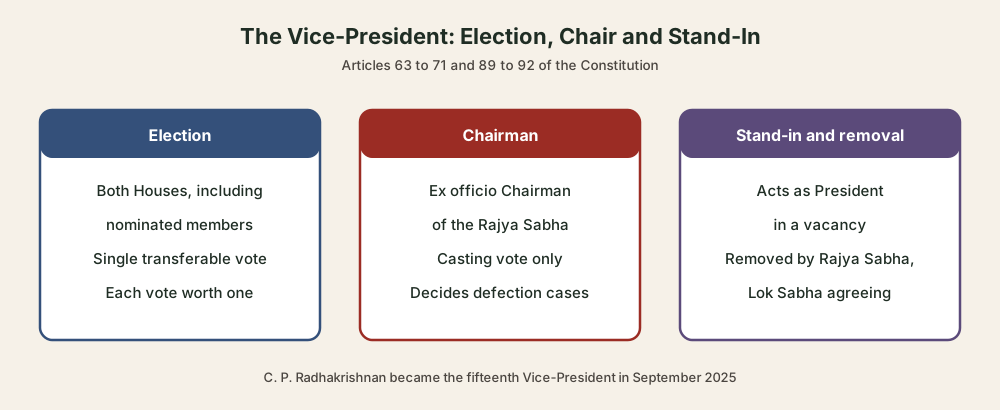
The Vice-President of India is elected by the members of both Houses of Parliament and serves as the ex officio Chairman of the Rajya Sabha. The Vice-President acts as President in a vacancy and discharges the President's functions during absence or illness, and may be removed by a Rajya Sabha resolution agreed to by the Lok Sabha.
Vice-President of India: Office and Constitutional Position
The Second Office of the Republic and Ex Officio Chairman
The Vice-President of India holds the office created by Article 63 and, under Article 64, is the ex officio Chairman of the Council of States, the Rajya Sabha. The Vice-President may hold no other office of profit and, when the presidency falls vacant or the President cannot act, discharges the President's functions under Article 65.
The office matters because it joins Parliament and the executive. As Chairman, the Vice-President conducts the Rajya Sabha and decides questions that shape its work, and as a stand-in the office keeps the presidency from ever being empty.
The significance of the Vice-President lies in three functions:
- Presiding officer: The Vice-President chairs the Rajya Sabha, keeps order and interprets its rules.
- Continuity: The Vice-President acts as President in a vacancy and discharges the President’s functions during absence or illness.
- Neutral authority: The Chairman decides defection cases and certain procedural questions for members of the Rajya Sabha.
An earlier introduction on this site, Vice President of India: Everything You Need to Know, gives a short overview. This article is the detailed treatment, and the President's own election and powers are covered in President of India: Election, Qualifications, Term and Impeachment.
India and the United States: Similar Title, Different Design
The American Vice President is also the presiding officer of the upper House: as president of the Senate, the Vice President presides but votes only to break a tie. The Indian Chairman likewise has only a casting vote.
The two offices differ in how they are filled and what happens to the presidency. The American Vice President is elected with the President, as a running mate, and ranks first in the line of succession, while the Indian Vice-President is elected separately by Parliament and only acts as President until a new President is elected.
| Feature | India | United States |
|---|---|---|
| Election | Separately, by members of both Houses of Parliament | With the President, as a running mate |
| Role in the legislature | Ex officio Chairman of the Rajya Sabha; casting vote only | President of the Senate; tie-breaking vote only |
| If the presidency falls vacant | Acts as President until a new President is elected | First in the line of succession |
| Term | Five years, re-election allowed | Four years, elected at the same time as the President |
Election of the Vice-President Under Article 66
Electoral College of Both Houses, Including Nominated Members
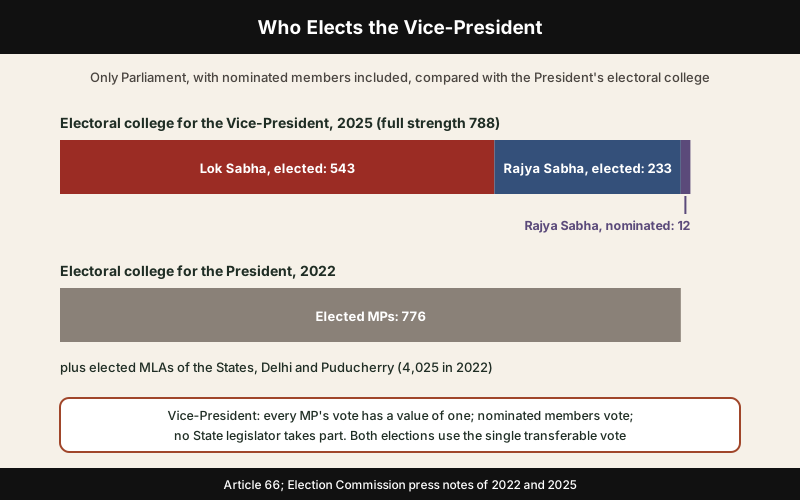
Under Article 66(1), the Vice-President is elected by an electoral college of the members of both Houses of Parliament, by proportional representation through the single transferable vote and by secret ballot. The Eleventh Amendment of 1961 introduced this electoral college in place of the original joint meeting of the two Houses.
The change reflected practice. When Sarvepalli Radhakrishnan was elected unopposed in 1952 and 1957, no joint sitting was held, and the requirement was dropped because it seemed totally unnecessary and was likely to cause practical difficulties.
Unlike the President's college, this one includes nominated members and excludes State legislators. For the 2025 election it comprised 233 elected and 12 nominated members of the Rajya Sabha and 543 elected members of the Lok Sabha, 788 in all, and because every elector is a member of Parliament each vote had a value of one.
Qualifications, Nomination, Oath and Disputes
Under Article 66(3), a candidate must be a citizen of India, must have completed thirty-five years, and must be qualified for election to the Council of States, not the House of the People as for the President. No person holding an office of profit is eligible, with the same exemptions as for the President, and a legislator elected Vice-President vacates the seat.
The nomination rules are lighter than for the President:
- Proposers and seconders: At least twenty electors must propose and twenty others second each nomination.
- Papers and deposit: A candidate may file at most four papers and must deposit Rs 15,000.
- Poll and whip: The poll is held in Parliament House, and parties cannot issue a whip to their MPs.
Before entering office, the Vice-President swears before the President, or a person the President appoints, to bear true faith and allegiance to the Constitution. Disputes about the election are decided by the Supreme Court under Article 71.
| Feature | President | Vice-President |
|---|---|---|
| Electoral college | Elected MPs and elected MLAs | All members of both Houses, nominated included |
| Value of votes | Weighted by population | One vote each |
| Qualified for | Election to the Lok Sabha | Election to the Rajya Sabha |
| Proposers and seconders | Fifty and fifty | Twenty and twenty |
| Oath before | The Chief Justice of India | The President or a person appointed by the President |
| Mid-term vacancy | Election within six months | Election as soon as possible |
| Removal | Impeachment for violation of the Constitution | Rajya Sabha resolution agreed to by the Lok Sabha |
Election Procedure: Timetable, Returning Officer and Election Petitions
The Election Commission notifies each stage in the Official Gazette. For a vacancy on expiry of the term, the notification issues on or after the sixtieth day before the term ends, so that the new Vice-President can take office the day after; for any other vacancy it issues as soon as may be. The statutory timetable runs:
- Nominations: The last date is the fourteenth day after the notification.
- Scrutiny: The day immediately after the last date for nominations.
- Withdrawal: The second day after scrutiny.
- Poll: Not earlier than the fifteenth day after the last date for withdrawal.
By practice the Secretary-General of the Lok Sabha or the Rajya Sabha is appointed Returning Officer by rotation; the eleventh election was the one departure, when a Secretary of the Ministry of Parliamentary Affairs served. Until 1974 a single proposer and seconder sufficed and no deposit was required.
An election petition may be presented to the Supreme Court by any candidate, or by ten or more electors together, within thirty days of the declaration of the result. The grounds include bribery or undue influence by the returned candidate, and a result materially affected by improper reception or refusal of votes, non-compliance with the law, or wrongful acceptance or rejection of a nomination.
The Vice-Presidential Election of 2025
Jagdeep Dhankhar, in office from 11 August 2022, resigned on 21 July 2025 citing health. The Home Ministry notified the vacancy on 22 July 2025, and on 1 August the Election Commission announced the schedule for the seventeenth vice-presidential election, the first early election for the office since 1987.
The Commission notified the election on 7 August, nominations closed on 21 August, and the poll and count took place on 9 September 2025. Of 781 eligible electors, 767 voted and 15 ballots were invalid. C. P. Radhakrishnan was declared elected with 452 votes against 300 for B. Sudershan Reddy, a margin of 152.
Radhakrishnan became the fifteenth Vice-President on 12 September 2025. Because Article 68 allows the person elected to a mid-term vacancy a full five-year term, his term runs from that date, not from the end of his predecessor's.
Term, Vacancy and Removal of the Vice-President (Articles 67 and 68)
Five-Year Term, Resignation and Filling a Vacancy
Under Article 67, the Vice-President holds office for five years, may resign by writing to the President, and continues in office until a successor enters upon it. Re-election is allowed; Sarvepalli Radhakrishnan and Mohammad Hamid Ansari each served two terms.
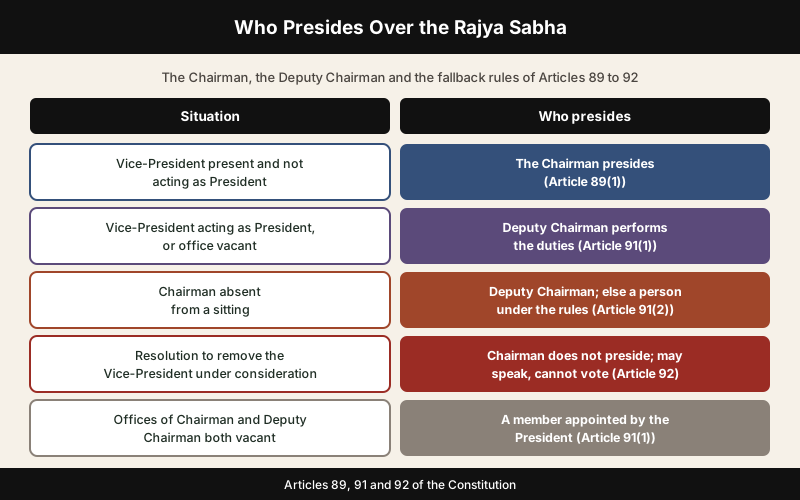
Article 68 requires an election before a term expires, and for a mid-term vacancy an election as soon as possible. Unlike Article 62 for the President, it sets no six-month limit; meanwhile the Deputy Chairman performs the Chairman's duties under Article 91(1). Krishan Kant is the only Vice-President to have died in office, in 2002.
Removal by the Rajya Sabha With the Lok Sabha's Agreement
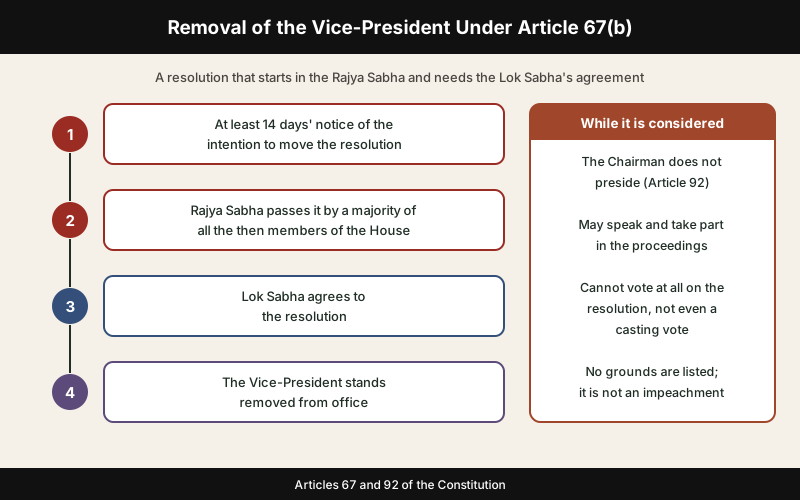
Under Article 67(b), the Vice-President may be removed by a resolution of the Council of States passed by a majority of all the then members and agreed to by the House of the People, after at least fourteen days' notice. The resolution can be moved only in the Rajya Sabha.
The Constitution lists no grounds for removal, and the procedure is not an impeachment. While the resolution is under consideration, the Chairman does not preside, may speak and take part, but under Article 92 cannot vote at all, not even a casting vote.
No Vice-President has been removed. On 10 December 2024 opposition members gave notice of a resolution against Jagdeep Dhankhar, accusing him of partisanship as Chairman, but it was never taken up because the session ended during the fourteen-day notice period.
Salary, Residence and Emoluments of the Vice-President
The Vice-President draws no salary as Vice-President. The salary is paid for the office of Chairman of the Rajya Sabha, under the Salaries and Allowances of Officers of Parliament Act, 1953, and is charged on the Consolidated Fund of India; Article 97 lets Parliament fix it by law.
The Chairman also receives a furnished residence free of charge during the term and for a month after it, free medical facilities, and travelling allowances on the scale of a Cabinet Minister. While acting as President, the Vice-President instead receives the President's emoluments and draws no salary as Chairman.
Chairman of the Rajya Sabha: Powers and Role
Casting Vote, Defection Cases and Other Constitutional Duties
Under Article 89(1), the Vice-President is the ex officio Chairman of the Council of States, but is not a member of it. The Deputy Chairman, by contrast, must be a member, chosen by the House under Article 89(2), and can be removed by a resolution of a majority of all the then members.
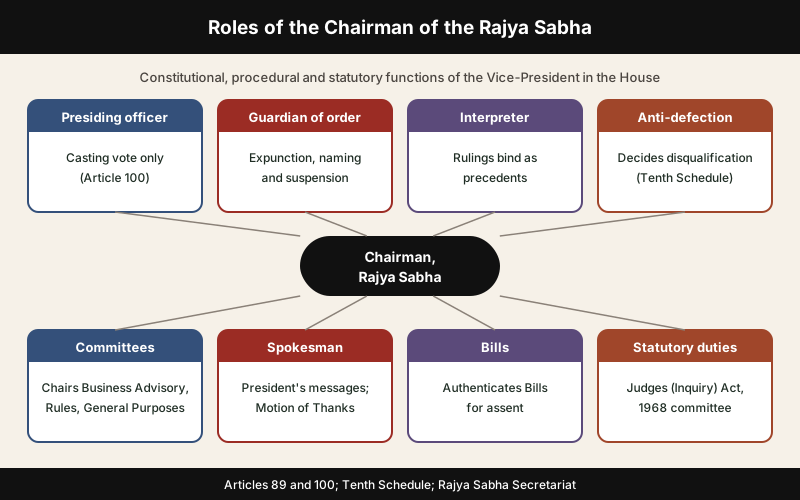
The Chairman does not vote in the first instance but has a casting vote when votes are equal. Under the Tenth Schedule, the Chairman decides whether a member of the Rajya Sabha has incurred disqualification for defection, and that decision is final.
The Rajya Sabha Secretariat lists further constitutional duties:
- Quorum: The Chairman adjourns or suspends a sitting when there is no quorum.
- Resignations: The Chairman must not accept a member’s resignation found not to be voluntary or genuine.
- Language: The Chairman may let a member unable to speak Hindi or English address the House in the mother tongue.
Guardian of the House: Order, Rulings and Committees
The Chairman is the guardian of the prestige and dignity of the House. The Chairman's rulings are binding precedents, need no reasons, and cannot be questioned; protesting against them is a contempt of the House. In practice the Chairman presides during Question Hour and during important debates.
Maintaining order is a fundamental duty, and the rules give the Chairman the disciplinary powers to do it:
- Checking irrelevance or repetition in a member’s speech, and ordering expunction of unparliamentary words.
- Directing a disorderly member to withdraw, and naming a member for suspension.
- Adjourning or suspending the sitting in case of grave disorder.
The Chairman's consent is also needed to raise a question of privilege in the House, and the Chairman may refer such a question to the Committee of Privileges.
The Chairman also guides the House's committees, appointing their chairpersons and nominating members, and personally heads three of them: Business Advisory, Rules and General Purposes. The Chairman authenticates Bills in the Rajya Sabha's possession before they go to the President for assent.
As principal spokesman, the Chairman receives the President's messages and conveys the Motion of Thanks on the President's Address. Statutes add duties, such as constituting a committee under the Judges (Inquiry) Act, 1968. On 20 April 1987, Chairman R. Venkataraman, who had been Defence Minister from 1982 to 1984, declined to preside over a debate on defence deals and left the Chair to the Deputy Chairman, a mark of impartiality.
Deputy Chairman and the Panel of Vice-Chairmen
Under Article 91(1), while the office of Chairman is vacant or the Vice-President is acting as President, the Deputy Chairman performs the Chairman's duties; if that office is also vacant, a member appointed by the President does so. During the Chairman's absence from a sitting, the Deputy Chairman presides.
A panel of six Vice-Chairmen is constituted every year, and one of them presides in the absence of both the Chairman and the Deputy Chairman. A Secretariat headed by the Secretary-General assists the Chairman.
Vice-President as Acting President (Article 65)
Vacancy and Absence: Two Different Situations
Article 65 separates two cases. When the presidency falls vacant through death, resignation or removal, the Vice-President acts as President until a new President enters office. When the President is unable to discharge the functions owing to absence or illness, the Vice-President discharges the functions until the President resumes.
In either case the Vice-President has all the powers and immunities of the President and the President's emoluments. Under the proviso to Article 64, the Vice-President then does not act as Chairman and draws no Chairman's salary; the Deputy Chairman presides instead.
Vice-Presidents Who Acted as President or Became President
Two Vice-Presidents have acted as President in a vacancy: V. V. Giri after Zakir Husain's death, from 3 May until 19 July 1969, and B. D. Jatti after Fakhruddin Ali Ahmed's death, from 11 February until 24 July 1977. Jatti, as acting President, delivered the address to Parliament on 28 March 1977 and appointed a Chairman pro tem for the Rajya Sabha.
Vice-Presidents have more often discharged the functions of an absent or ill President:
- Sarvepalli Radhakrishnan: From 20 June to 5 July 1960, during Rajendra Prasad’s State visit to the Soviet Union, and from 25 July to 19 December 1961, during his illness.
- Zakir Husain: In February 1964 and from 16 March to 18 April 1965, when President Radhakrishnan underwent eye operations; he delivered the address to Parliament on 10 February 1964.
- Mohammad Hidayatullah: From 6 to 31 October 1982, during President Zail Singh’s medical treatment abroad, when he also conveyed recommendations on Bills under Article 117(3).
Six of the fifteen Vice-Presidents later became President: Sarvepalli Radhakrishnan, Zakir Husain, V. V. Giri, R. Venkataraman, Shankar Dayal Sharma and K. R. Narayanan. Hidayatullah is unusual in another way: he acted as President twice, once as Chief Justice in 1969 and once as Vice-President in 1982. Fakhruddin Ali Ahmed and Neelam Sanjiva Reddy, by contrast, became President without having been Vice-President.
| No. | Vice-President | Term | Later President? |
|---|---|---|---|
| 1 | Sarvepalli Radhakrishnan | 1952 to 1962 (two terms) | Yes |
| 2 | Zakir Husain | 1962 to 1967 | Yes |
| 3 | V. V. Giri | 1967 to 1969 (resigned) | Yes |
| 4 | Gopal Swarup Pathak | 1969 to 1974 | No |
| 5 | B. D. Jatti | 1974 to 1979 | No |
| 6 | Mohammad Hidayatullah | 1979 to 1984 | No |
| 7 | R. Venkataraman | 1984 to 1987 (resigned) | Yes |
| 8 | Shankar Dayal Sharma | 1987 to 1992 (resigned) | Yes |
| 9 | K. R. Narayanan | 1992 to 1997 (resigned) | Yes |
| 10 | Krishan Kant | 1997 to 2002 (died in office) | No |
| 11 | Bhairon Singh Shekhawat | 2002 to 2007 (resigned) | No |
| 12 | Mohammad Hamid Ansari | 2007 to 2017 (two terms) | No |
| 13 | Venkaiah Naidu | 2017 to 2022 | No |
| 14 | Jagdeep Dhankhar | 2022 to 2025 (resigned) | No |
| 15 | C. P. Radhakrishnan | Since 12 September 2025 | Incumbent |
Assessment of the Vice-President's Office
Distinguishing Features, Outcomes and Current Debates
Three features distinguish the office from that of the President:
- A parliamentary base: Only members of Parliament elect the Vice-President, nominated members included.
- A presiding role: Most of the Vice-President’s work is done as Chairman of the Rajya Sabha, not in the executive.
- A simpler removal: A resolution with no stated grounds, rather than impeachment for violation of the Constitution.
Three observable outcomes follow:
- Continuity: Acting arrangements in 1969, 1977 and 1982 kept the presidency filled.
- A path to the presidency: Six of fifteen Vice-Presidents later became President.
- Contested neutrality: The 2024 notice against the Chairman shows how the chair’s impartiality can become a political question.
The current debate concerns the Chairman's neutrality and the absence of grounds for removal. Because the Vice-President is chosen by the parliamentary majority, the office depends on convention, such as a Chairman stepping aside from debates touching his own record, to keep the trust of all sides.
UPSC Relevance and Previous-Year Questions on the Vice-President
Where the Vice-President Fits in the UPSC-CSE Syllabus
This topic belongs to General Studies Paper II, under the Executive and Parliament. The linked questions from the preliminary examination test precise textual points:
- Membership: The Chairman is not a member of the Rajya Sabha, while the Deputy Chairman is.
- Electoral college: Nominated members vote in the Vice-President’s election but not in the President’s.
- Removal: The resolution can be moved only in the Rajya Sabha.
- Office-holders: Which public figures served as Vice-President.
The linked question from the main examination asks for the role of the Vice-President as Chairman of the Rajya Sabha. The section on the Chairman's powers, with the Secretariat's account of order, rulings, committees and statutory duties, supplies the material for that answer.
Previous Year UPSC-CSE Questions By the end you will be able to draft model answers for the following UPSC questions. Each question carries a collapsible framework showing how to approach it in the exam.
- UPSC Prelims 2013 GS-IConsider the following statements:
- The Chairman and the Deputy Chairman of the Rajya Sabha are not the members of that House.
- While the nominated members of the two Houses of the Parliament have no voting right in the presidential election, they have the right to vote in the election of the Vice President.
Which of the statements given above is/are correct?
How to approach this Prelims question
Approach: Split statement 1: the Chairman is the Vice-President, an outsider; the Deputy Chairman is chosen from among members.
Trap to watch: Pairing the two officers makes statement 1 sound uniformly true.
Key facts to recall:
- Article 89(2): Deputy Chairman is a member.
- Article 66(1): members of both Houses elect the Vice-President.
- Article 54: only elected members elect the President.
Answer signal: Only statement 2 is correct, so option (b) is the answer.
- UPSC Prelims 2004 GSThe resolution for removing the Vice-President of India can be moved in the
How to approach this Prelims question
Approach: Recall that the Rajya Sabha passes the resolution and the Lok Sabha only agrees to it.
Trap to watch: Impeachment of the President can start in either House, which makes option (b) tempting.
Key facts to recall:
- Rajya Sabha: majority of all the then members.
- Lok Sabha: agrees.
- Fourteen days' notice.
Answer signal: The resolution can be moved only in the Rajya Sabha, so option (d) is the answer.
- UPSC Prelims 2008 GSWho among the following have held the office of the Vice-President of India?
- Mohammad Hidayatullah
- Fakhruddin Ali Ahmed
- Neelam Sanjiva Reddy
- Shankar Dayal Sharma
Select the correct answer using the code given below:
How to approach this Prelims question
Approach: Check each name against the list of Vice-Presidents, not the list of Presidents.
Trap to watch: All four names are associated with the presidency; two became President directly.
Key facts to recall:
- Hidayatullah: Vice-President 1979 to 1984.
- Shankar Dayal Sharma: Vice-President 1987 to 1992.
- Ahmed and Reddy: Presidents only.
Answer signal: Only Hidayatullah and Sharma held the office, so option (b) is the answer.
- UPSC Mains 2022 GS-IIDiscuss the role of the Vice-President of India as the Chairman of Rajya Sabha.
How to structure the answer in the exam
Introduction: Under Article 89(1) the Vice-President is ex officio Chairman of the Rajya Sabha, presiding over a House of which he is not a member.
Body (sub-themes to develop):
- Constitutional powers: casting vote only (Article 100), disqualification for defection (Tenth Schedule), quorum, resignations.
- Presiding officer: binding rulings, maintenance of order, privilege, Question Hour.
- Committees and Bills: chairs the Business Advisory, Rules and General Purposes Committees; authenticates Bills for assent.
- Spokesman and statutory roles: President's messages, Motion of Thanks, Judges (Inquiry) Act committees.
- Neutrality: recusal precedent of 1987; the 2024 notice; no grounds for removal under Article 67(b).
Conclusion: The Chairman's authority rests on constitutional powers but its legitimacy depends on visible impartiality towards all sides of the House.
Prelims MCQ practice
Each question below tests one specific concept on the topic. Click to reveal the answer and a full option-wise explanation.
Q1. With reference to the election of the Vice-President, consider the following statements:
- Members of State Legislative Assemblies are part of the electoral college.
- Nominated members of the Rajya Sabha are part of the electoral college.
- The value of each elector's vote is the same.
Which of the statements given above are correct?
- 1 and 2 only
- 2 and 3 only
- 1 and 3 only
- 1, 2 and 3
Show answer and explanation
Answer: 2 and 3 only
Explanation.
Correct: b (2 and 3 only). Statement 1 is incorrect: only members of both Houses of Parliament elect the Vice-President. Statements 2 and 3 are correct: nominated members vote, and in 2025 every vote had a value of one.
Q2. With reference to the Vice-President, consider the following statements:
- A candidate must be qualified for election as a member of the Lok Sabha.
- A nomination must be subscribed by at least twenty proposers and twenty seconders.
- The oath is made before the Chief Justice of India.
How many of the statements given above are correct?
- Only one
- Only two
- All three
- None
Show answer and explanation
Answer: Only one
Explanation.
Correct: a (Only one). Statement 1 is incorrect: Article 66(3)(c) requires qualification for the Council of States. Statement 2 is correct. Statement 3 is incorrect: under Article 69 the oath is made before the President or a person appointed by the President.
Q3. With reference to the removal of the Vice-President, consider the following statements:
- The Rajya Sabha must pass the resolution by a majority of all its then members.
- The Lok Sabha must pass the resolution by a special majority of two-thirds.
- The Chairman may cast a vote on the resolution only if the votes are equal.
Which of the statements given above is/are correct?
- 1 only
- 1 and 2 only
- 2 and 3 only
- 1, 2 and 3
Show answer and explanation
Answer: 1 only
Explanation.
Correct: a (1 only). Statement 1 is correct under Article 67(b). Statement 2 is incorrect: the Lok Sabha only has to agree to the resolution. Statement 3 is incorrect: under Article 92(2) the Chairman cannot vote at all on the resolution, notwithstanding Article 100.
Q4. With reference to the Vice-President acting as President, consider the following statements:
- The Vice-President continues to preside over the Rajya Sabha while acting as President.
- The Vice-President has all the powers and immunities of the President during that period.
- The Deputy Chairman performs the duties of Chairman during that period.
Which of the statements given above are correct?
- 1 and 2 only
- 2 and 3 only
- 1 and 3 only
- 1, 2 and 3
Show answer and explanation
Answer: 2 and 3 only
Explanation.
Correct: b (2 and 3 only). Statement 1 is incorrect under the proviso to Article 64. Statement 2 is correct under Article 65(3). Statement 3 is correct under Article 91(1).
Q5. Consider the following pairs relating to the Chairman of the Rajya Sabha:
- Casting vote : Only when votes are equal
- Disqualification for defection : Decided by the Chairman for members of the Rajya Sabha
- Business Advisory Committee : Chaired by the Deputy Chairman
- Authentication of Bills : Done by the Chairman for Bills in the Rajya Sabha's possession
How many of the pairs given above are correctly matched?
- Only one pair
- Only two pairs
- Only three pairs
- All four pairs
Show answer and explanation
Answer: Only three pairs
Explanation.
Correct: c (Only three pairs). Pairs 1, 2 and 4 are correct. Pair 3 is incorrect: the Chairman personally heads three committees of the House: Business Advisory, Rules and General Purposes.
Q6. With reference to vacancies in high offices, consider the following statements:
- An election to fill a mid-term vacancy in the office of Vice-President must be held within six months.
- A person elected to a mid-term vacancy in the office of Vice-President holds office for a full five-year term.
- If the offices of Chairman and Deputy Chairman are both vacant, a member appointed by the President performs the Chairman's duties.
Which of the statements given above are correct?
- 1 and 2 only
- 2 and 3 only
- 1 and 3 only
- 1, 2 and 3
Show answer and explanation
Answer: 2 and 3 only
Explanation.
Correct: b (2 and 3 only). Statement 1 is incorrect: the six-month limit applies to the President (Article 62); for the Vice-President, Article 68 says as soon as possible. Statements 2 and 3 are correct under Articles 68(2) and 91(1).
Sources and Further Reading
- Legislative Department, Ministry of Law and Justice: The Constitution of India
- Press Information Bureau: Election to the Office of the Vice-President of India, 2025 (1 August 2025)
- Press Information Bureau: Vice-Presidential Election 2025, result (10 September 2025)
- Rajya Sabha Secretariat: Rajya Sabha at Work, Chapter 4, Presiding Officers
- Rajya Sabha Secretariat: Powers and Functions as Chairman
- NCERT: Indian Constitution at Work, Class 11, Chapter 4, Executive
- Election Commission of India: Press note on the election to the office of President, 2022 (9 June 2022)
- Wikipedia: Vice President of India
- Wikipedia: List of vice presidents of India
- Wikipedia: 2025 Indian vice presidential election
- Wikipedia: Jagdeep Dhankhar
- Wikipedia: C. P. Radhakrishnan
- Wikipedia: Mohammad Hidayatullah
- Wikipedia: Eleventh Amendment of the Constitution of India
- Wikipedia: Vice President of the United States
Editorial Disclaimer
This article is for UPSC preparation and explains the office of the Vice-President. Election figures are those published by the Election Commission and in published results, and the official text of the Constitution governs any question of law.


