


Overview
The President of India is the head of the Indian State and the formal head of the Union executive. Articles 52 to 62 of the Constitution create the office and settle how the President is elected, who may stand, what conditions the office carries, how long it lasts, how its holder may be removed and how a vacancy is filled. Droupadi Murmu, the 15th President, has held the office since 25 July 2022.
President of India Under Articles 52 and 53: Head of the Union
Executive Power and Supreme Command Under Article 53
Article 53(1) vests the executive power of the Union in the President. Under Article 53(2), the supreme command of the Defence Forces of the Union also vests in the President, and its exercise is regulated by law. Clause (3) sets two limits. It does not transfer to the President any function that an existing law gives to a State government or another authority, and it does not prevent Parliament from conferring functions by law on authorities other than the President.
The President is also part of the legislature. Under Article 79, Parliament consists of the President and two Houses, the Council of States and the House of the People, although Article 59(1) bars the President from being a member of either House. The office therefore joins three parts of the constitutional system:
- Head of State: The executive power of the Union is vested in the President, and the Union acts in the President's name.
- Part of Parliament: A Bill passed by both Houses becomes law only when the President assents to it.
- Federal link: State legislators help elect the President, so the office rests on a base wider than Parliament.
Article 111 prescribes no time limit within which the President must give assent to a Bill or withhold it. In its opinion of 20 November 2025 on a Presidential Reference, the Supreme Court held that the President cannot be bound by judicially prescribed timelines when deciding on State Bills reserved under Article 201.
Nominal Head in a Parliamentary System: The Framers' Design
The framers chose a parliamentary system rather than the American presidential one. Introducing the Draft Constitution on 4 November 1948, B. R. Ambedkar said that the President "occupies the same position as the King under the English Constitution" and is "the head of the State but not of the Executive". The President, he added, "represents the Nation but does not rule the Nation" and would be "generally bound by the advice of his Ministers".
Jawaharlal Nehru described the same balance in the Constituent Assembly: "We did not give him any real power but we have made his position one of authority and dignity." The real executive is the Prime Minister and the Council of Ministers, who have the support of the majority in the Lok Sabha. Under Article 74, the President acts on the aid and advice of the Council of Ministers in exercising the functions of the office, the ordinance, pardoning and emergency powers among them.
Election of the President: The Electoral College Under Article 54
Members of the Electoral College: Elected MPs and Elected MLAs
Under Article 54, the President is elected by the members of an electoral college consisting of the elected members of both Houses of Parliament and the elected members of the Legislative Assemblies of the States. An Explanation inserted by the Constitution (Seventieth Amendment) Act, 1992, in force from 1 June 1995, provides that "State" in Articles 54 and 55 includes the National Capital Territory of Delhi and the Union Territory of Puducherry. The elected members of the Legislative Assembly of the Union Territory of Jammu and Kashmir are electors as well.
Membership of a legislature is not enough, because only elected members vote. Four groups therefore stay outside the college:
- Nominated members of Parliament: Members nominated to either House have no vote.
- Nominated members of the Assemblies: Members nominated to a Legislative Assembly, including those of Delhi and Puducherry, have no vote.
- Legislative Councils: Members of the State Legislative Councils, elected or nominated, are not electors.
- Dissolved Assemblies: When an Assembly is dissolved, its former members cease to be electors, even if fresh elections have not been held before the presidential election.
The Election Commission of India keeps the list of electors under Rule 40 of the Presidential and Vice-Presidential Elections Rules, 1974. For the election of 2022, the list held 4,796 electors (771 MPs and 4,025 MLAs), fewer than the full strength of the college, because five seats in the Rajya Sabha and six in the Assemblies were vacant and two MLAs were disqualified.
| Part of the college | Value of one vote | Total value of votes (all elected seats) | Electors in the 2022 list | Electors who voted |
|---|---|---|---|---|
| Elected MPs | 700 | 5,43,200 | 771 | 763 |
| Elected MLAs | 7 to 208 by State | 5,43,231 | 4,025 | 3,991 |
| Whole college | Not uniform | 10,86,431 | 4,796 | 4,754 |
Why the President Is Elected Indirectly
Some members of the Constituent Assembly criticised indirect election as undemocratic and proposed a direct election by the people. The framers kept the indirect method for two reasons:
- Fit with the parliamentary system: The President is only a nominal executive, and it would have been anomalous to elect the President directly by the people and then give the office no real power.
- Cost and scale: A direct election by so vast an electorate would have been costly and time-consuming for an office that is symbolic.
The framers also rejected election by the two Houses of Parliament alone. A Parliament dominated by one party would always have chosen that party's candidate, and such a President could not have represented the States. Including the elected MLAs makes the President a representative of the Union and the States alike, and Article 55 gives the two sides nearly equal weight.
Amending the Election Provisions: Ratification Under Article 368(2)
Changing the method of electing the President needs a special procedure. Under the proviso to Article 368(2), an amendment that makes any change in the following must also be ratified by the legislatures of not less than one-half of the States, by resolutions passed before the Bill is presented to the President for assent:
- Named Articles: 54, 55, 73, 162, 241 and 279A.
- Chapters: Chapter IV of Part V on the Union judiciary, Chapter V of Part VI on the High Courts, and Chapter I of Part XI on legislative relations.
- Lists: Any of the Lists in the Seventh Schedule.
- Representation: The representation of States in Parliament.
- Article 368: The provisions of Article 368 itself.
A law that abolishes or creates a State Legislative Council works differently. Under Article 169(3), such a law is not deemed an amendment of the Constitution for the purposes of Article 368, so it needs no ratification by the States. The election of the President, by contrast, is a federal matter that the States must approve before it can be changed.
Value of Votes Under Article 55: Uniformity and Parity
Value of an MLA's Vote: The Article 55(2) Formula
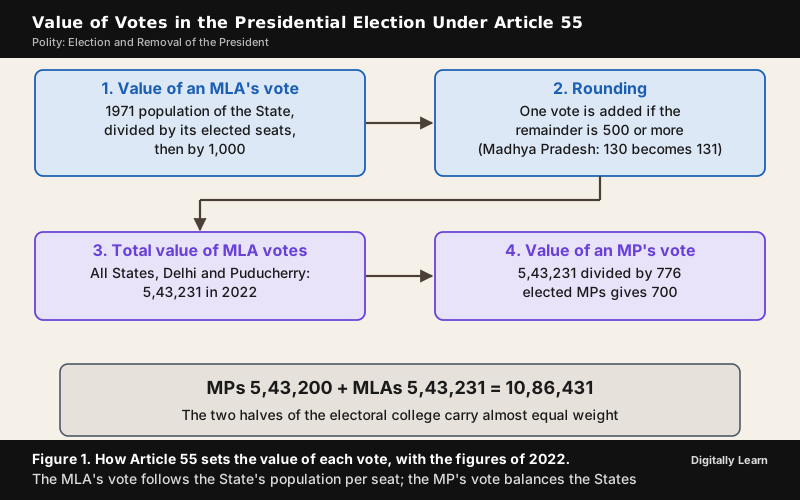
Article 55(1) requires, as far as practicable, uniformity in the scale of representation of the different States. Under clause (2)(a), every elected MLA has as many votes as there are multiples of one thousand in the quotient obtained by dividing the population of the State by the total number of elected members of its Assembly. Clause (2)(b) adds one vote when the remainder left after taking those multiples is not less than five hundred. The value is worked out in three steps:
- Population per seat: The State's population is divided by the number of elected seats in its Assembly.
- Thousands: The quotient is divided by 1,000, and the whole number is kept.
- Rounding: One vote is added if the remainder is 500 or more.
Uttar Pradesh had a population of 8,38,49,905 at the 1971 census and has 403 elected seats, so each seat stands for about 2,08,064 people and each MLA's vote is worth 208, the highest of any State. Madhya Pradesh shows the rounding step at work. Its 1971 population of 3,00,16,625, divided among 230 seats, gives about 1,30,507, and the remainder of 507 raises the value from 130 to 131.
| State or Union Territory | Assembly seats | Population at the 1971 census | Value of each MLA's vote |
|---|---|---|---|
| Uttar Pradesh | 403 | 8,38,49,905 | 208 |
| Kerala | 140 | 2,13,47,375 | 152 |
| Madhya Pradesh | 230 | 3,00,16,625 | 131 |
| Puducherry | 30 | 4,71,707 | 16 |
| Arunachal Pradesh | 60 | 4,67,511 | 8 |
| Sikkim | 32 | 2,09,843 | 7 |
The value therefore depends on how many people each MLA represents on average, not on the size of the Assembly. Kerala, with 140 seats, gives each MLA a heavier vote than Madhya Pradesh, with 230. Puducherry and Arunachal Pradesh had almost the same population in 1971, but Puducherry's 30 seats against Arunachal Pradesh's 60 make each Puducherry MLA's vote worth twice as much. Multiplied across the Assembly, the arrangement keeps each State's total weight roughly in line with its population.
Population Base Frozen at the 1971 Census
The Explanation to Article 55 defines "population" as the population ascertained at the last preceding census whose relevant figures have been published. The Constitution (Forty-second Amendment) Act, 1976, in force from 3 January 1977, substituted the Explanation, and its proviso read this as the 1971 census until the figures of the first census after 2000 were published. The Constitution (Eighty-fourth Amendment) Act, 2001, in force from 21 February 2002, replaced 2000 with 2026.
The freeze was meant to encourage family planning, so that States which slowed their population growth would not lose weight in the election. As a result, the vote values used in 2022 still rested on 1971 populations. Until the relevant figures of the first census taken after 2026 are published, the relative weight of each State stays where it was in 1971.
Value of an MP's Vote and Parity With the States
Clause (2)(c) secures parity between the States as a whole and the Union. The total value of all MLAs' votes is divided by the total number of elected members of both Houses of Parliament, fractions exceeding one-half being counted as one and other fractions being disregarded. Every elected MP, of either House, therefore casts a vote of the same value.
In 2022 the MLAs' votes were worth 5,43,231 in all. Dividing this by 776 elected MPs, 543 of the Lok Sabha and 233 of the Rajya Sabha, gives 700 for each MP, so the MPs' votes totalled 5,43,200 and the whole college 10,86,431. The two halves of the college carried almost equal weight.
Jammu and Kashmir had no Legislative Assembly in 2022, so its seats added nothing to the MLA total, and the value of each MP's vote was lower as a result.
Single Transferable Vote and Secret Ballot in the Presidential Election
Preferences, Quota and the Transfer of Votes
Article 55(3) requires the election to be held in accordance with the system of proportional representation by means of the single transferable vote, and the voting to be by secret ballot. Each elector receives one ballot paper and marks preferences in figures against the names of the candidates, up to as many preferences as there are candidates. The first preference is compulsory for the ballot to be valid, and the other preferences are optional.
To win, a candidate must secure a quota, which is the total value of valid votes divided by two, with one added to the quotient. The count then proceeds in rounds:
- First count: The first preferences are counted, and a candidate who reaches the quota is declared elected.
- Exclusion: If no candidate reaches it, the candidate with the fewest first-preference votes is excluded.
- Transfer: The excluded candidate's ballots pass to the next preferences marked on them.
- Repeat: Exclusion and transfer continue until one candidate reaches the quota.
It was pointed out in the Constituent Assembly that the name is a misnomer. Proportional representation applies where two or more seats are filled, while this election fills one, so it works as a preferential or alternative vote. Nor does any elector hold a single vote, since each casts several votes by value.
Secret Ballot, the Special Pen and No Party Whip
The Constitution requires a secret ballot, so the election has no open voting, and showing the ballot to anyone is prohibited. After marking it, the elector folds the ballot paper and puts it in the ballot box, and any breach of the voting procedure leads the Presiding Officer to cancel the ballot paper. Preferences may be marked only with the pen the Election Commission supplies. In 2022 these were serially numbered pens with violet ink, supplied centrally, and a vote marked with any other pen is invalid at the count.
Political parties cannot issue a whip to their MPs and MLAs on how to vote. The law also guards the electors against pressure. Under Section 18 of the Presidential and Vice-Presidential Elections Act, 1952, bribery or undue influence by the returned candidate, or by another person with the candidate's consent, is among the grounds on which the Supreme Court can declare the election void on an election petition.
The 1969 Election: A Contest Decided by Transfers
The election of 1969 shows the transfer of votes at work. After President Zakir Husain died in office on 3 May 1969, V. V. Giri, then Vice-President and acting President, resigned both offices to contest as an independent candidate against Neelam Sanjiva Reddy, the official Congress candidate. Prime Minister Indira Gandhi did not issue a whip to Congress MPs, and on the night before the poll she called on her party to cast a conscience vote.
No candidate reached the quota on first preferences. Giri led with 4,01,515 votes by value, followed by Reddy with 3,13,548 and C. D. Deshmukh with 1,12,769. After Deshmukh and the other candidates were excluded and their ballots transferred, Giri won with 4,20,077 against Reddy's 4,05,427. Large-scale defections within the Congress showed how a secret ballot without a whip lets electors depart from their party's choice.
Conduct of the Presidential Election: Nomination, Schedule and Disputes
Election Commission, Returning Officer and Nomination Rules
Article 324, read with the Presidential and Vice-Presidential Elections Act, 1952, and the Presidential and Vice-Presidential Elections Rules, 1974, vests the superintendence, direction and control of the election in the Election Commission of India. Under Section 4(3) of the Act, the notification calling the election is issued on or after the sixtieth day before the outgoing President's term expires. The Commission, in consultation with the Central Government, appoints the Secretary-General of the Lok Sabha or of the Rajya Sabha, by rotation, as Returning Officer, with Assistant Returning Officers in the State capitals. The nomination rules are strict:
- Proposers and seconders: At least 50 electors must propose the candidate and at least 50 others must second, and an elector may subscribe to only one nomination paper.
- Nomination papers: A candidate may file at most four nomination papers, delivered to the Returning Officer in New Delhi.
- Security deposit: A deposit of ₹15,000 accompanies the nomination and is forfeited if the candidate fails to secure one-sixth of the votes polled.
These thresholds were raised in 1997. Before then, 10 proposers, 10 seconders and a deposit of ₹2,500 were enough, and the increase was meant to discourage candidates who were not serious. Scrutiny of nominations can settle an election before any vote is cast. In 1977, 37 candidates filed nominations and 36 of them were rejected, so Neelam Sanjiva Reddy was elected unopposed.
The 2022 Presidential Election: Schedule, Turnout and Result
The 16th presidential election filled the vacancy caused by the end of Ram Nath Kovind's term on 24 July 2022, and Article 62(1) required it to be completed before that date. The Election Commission announced the schedule on 9 June 2022:
- Notification calling the election: 15 June 2022.
- Last date for nominations: 29 June 2022.
- Scrutiny of nominations: 30 June 2022.
- Last date for withdrawal: 2 July 2022.
- Poll: 18 July 2022.
- Counting: 21 July 2022.
Polling took place in Room No. 63 of Parliament House and at 30 places in the State Legislative Assemblies, 31 locations in all. Of 4,796 electors, 4,754 voted, 763 of the 771 MPs and 3,991 of the 4,025 MLAs. The Returning Officer, the Secretary-General of the Rajya Sabha, declared Droupadi Murmu elected on 21 July 2022. She polled 6,76,803 votes by value against 3,80,177 for Yashwant Sinha.
Murmu was born on 20 June 1958 into a Santali family in Odisha. She is the first person from a tribal community, and the second woman, after Pratibha Patil, to hold the office. She had been a member of the Odisha Legislative Assembly from Rairangpur from 2000 to 2009 and Governor of Jharkhand from 2015 to 2021.
Election Disputes Under Article 71
Under Article 71(1), all doubts and disputes arising out of or in connection with the election of a President or Vice-President are inquired into and decided by the Supreme Court, whose decision is final. Clause (3) lets Parliament regulate by law any other matter connected with the election, which it has done through the 1952 Act and the 1974 Rules.
Two clauses protect the office from disruption. Clause (2) provides that if the Supreme Court declares an election void, acts done by the President in office on or before the date of the decision are not invalidated. Clause (4) bars any challenge to the election on the ground of a vacancy, for whatever reason, among the members of the electoral college. The Constitution (Eleventh Amendment) Act, 1961, first inserted clause (4), and Article 71 in its present form comes from the Constitution (Forty-fourth Amendment) Act, 1978, in force from 20 June 1979.
Together, Article 62(1), which requires the election to be completed before the outgoing President's term expires, and Article 71(4) explain why the poll of 2022 went ahead on schedule although Jammu and Kashmir had no Legislative Assembly to take part.
Qualifications, Conditions of Office, Oath and Immunities of the President
Eligibility for Election as President Under Articles 57 and 58
Article 58(1) sets three conditions. A candidate must be a citizen of India, must have completed the age of 35 years, and must be qualified for election as a member of the House of the People. Article 58(2) makes a person ineligible who holds an office of profit under the Government of India, the government of any State, or any local or other authority controlled by either government.
The Explanation to Article 58 exempts certain offices. A person is not treated as holding an office of profit merely because he or she is the President or Vice-President of the Union, the Governor of a State, or a Minister of the Union or of a State. A sitting Vice-President, Governor or Minister can therefore stand for election without first resigning that office.
Article 57 makes a person who holds or has held the office eligible for re-election, with no limit on the number of terms. Rajendra Prasad, the first President, is the only person to have held the office for two terms. In the United States, by contrast, no person can be elected President more than twice.
Conditions of Office and Salary of the President Under Article 59
Article 59 sets four conditions of the office:
- No seat in a legislature: The President cannot be a member of either House of Parliament or of a State Legislature, and a member elected President is deemed to have vacated the seat on the date of entering office.
- No other office of profit: The President cannot hold any other office of profit.
- Residence and emoluments: The President is entitled to official residences without payment of rent, and to the emoluments, allowances and privileges that Parliament fixes by law, or until then those in the Second Schedule.
- Protection of emoluments: The emoluments and allowances cannot be reduced during the term of office.
The Second Schedule fixed the President's emoluments at ₹10,000 a month. Parliament raised the salary to ₹1.5 lakh a month in 2008, and the Union Budget of 2018 raised it to ₹5 lakh a month. The President's official residence in New Delhi is Rashtrapati Bhavan.
Oath or Affirmation by the President Under Article 60
Under Article 60, every President, and every person acting as President or discharging the President's functions, makes and subscribes an oath or affirmation before entering office. It is made in the presence of the Chief Justice of India or, in the Chief Justice's absence, the senior-most judge of the Supreme Court available. The President swears or solemnly affirms three things:
- Office: To faithfully execute the office of President, or discharge its functions.
- Constitution: To preserve, protect and defend the Constitution and the law, to the best of the President's ability.
- People: To devote himself or herself to the service and well-being of the people of India.
The Vice-President's oath under Article 69 is different. It is made before the President or a person the President appoints, and it promises to bear true faith and allegiance to the Constitution and to discharge the duties of the office faithfully. The duty to preserve, protect and defend the Constitution appears in the President's oath, not in the Vice-President's.
Immunities of the President Under Article 361
Article 361(1) provides that the President is not answerable to any court for the exercise and performance of the powers and duties of the office, or for any act done or purporting to be done in that exercise. The first proviso keeps one route open. The President's conduct may be reviewed by any court, tribunal or body appointed or designated by either House to investigate a charge under Article 61. The second proviso preserves the right of any person to bring proceedings against the Government of India, so the immunity protects the office-holder, not the government.
The personal protections last for the term of office:
- Criminal proceedings: No criminal proceedings may be instituted or continued against the President in any court.
- Arrest: No court may issue process for the President's arrest or imprisonment.
- Civil proceedings: Proceedings seeking relief for an act done in a personal capacity may be instituted only after two months' written notice has been delivered to the President or left at the President's office.
Term of Office, Resignation and Vacancy (Articles 56, 62, 65 and 70)
Five-Year Term, Resignation and Continuance Under Article 56
Under Article 56(1), the President holds office for a term of five years from the date of entering office. Its proviso adds three rules:
- Resignation: The President may resign by writing under his or her hand addressed to the Vice-President, who under clause (2) must forthwith communicate the resignation to the Speaker of the Lok Sabha.
- Removal: The President may be removed from office for violation of the Constitution by impeachment under Article 61.
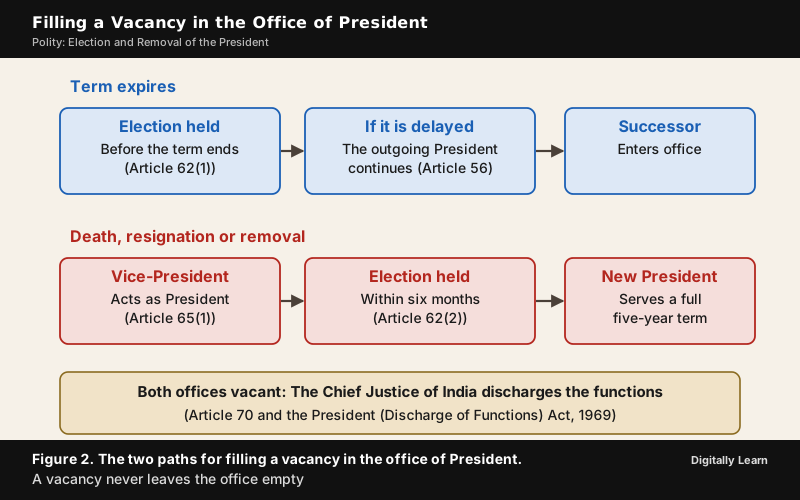
- Continuance: The President continues in office after the term expires until the successor enters office.
The third rule prevents an interregnum. If the election to replace an outgoing President is delayed for any reason, the outgoing President stays in office beyond five years, and the Vice-President does not act as President in that case. The present President's five-year term, which began in July 2022, runs to July 2027.
Filling a Vacancy Under Article 62 and Acting Presidents
Article 62 sets two deadlines. An election to fill a vacancy caused by the expiration of the term must be completed before the term expires. An election to fill a vacancy caused by death, resignation, removal or otherwise must be held as soon as possible and in no case later than six months from the date of the vacancy. The person so elected holds office for a full term of five years from the date of entering office, not for the rest of the predecessor's term.
Until then, under Article 65(1), the Vice-President acts as President. Article 65(2) also lets the Vice-President discharge the President's functions when the President is unable to do so owing to absence, illness or any other cause. While acting, the Vice-President has all the powers and immunities of the President and does not perform the duties of Chairman of the Rajya Sabha.
Article 70 lets Parliament provide for any contingency the Chapter does not cover. Under the President (Discharge of Functions) Act, 1969, when the offices of President and Vice-President are both vacant, the Chief Justice of India, or in the Chief Justice's absence the senior-most judge of the Supreme Court available, discharges the President's functions. This arrangement lasts until a newly elected President enters office or a newly elected Vice-President begins to act as President, whichever comes first.
| Year | Event | Who acted, and for how long | What followed |
|---|---|---|---|
| 1969 (May) | Zakir Husain died in office on 3 May 1969 | V. V. Giri, Vice-President, from 3 May to 20 July 1969 | Giri resigned both offices on 20 July 1969 to contest the election |
| 1969 (July) | Both offices vacant after Giri resigned | Mohammad Hidayatullah, Chief Justice of India, from 20 July to 24 August 1969 | V. V. Giri took office as President on 24 August 1969 |
| 1977 (February) | Fakhruddin Ali Ahmed died in office on 11 February 1977 | B. D. Jatti, Vice-President, from 11 February to 25 July 1977 | Neelam Sanjiva Reddy, elected unopposed, took office on 25 July 1977 |
Impeachment of the President Under Article 61
Procedure Under Article 61: From Notice to Removal
Impeachment is the only procedure for removing a President from office, and its only ground is violation of the Constitution, a phrase the Constitution does not define. The charge may be preferred by either House of Parliament. Impeachment of the President is one of the features the framers borrowed from the Constitution of the United States. The procedure has four stages:
- Notice: A resolution proposing the charge may be moved only after at least 14 days' notice in writing, signed by not less than one-fourth of the total number of members of the House.
- Charge preferred: The House prefers the charge by passing the resolution with a majority of not less than two-thirds of its total membership.
- Investigation: The other House investigates the charge or causes it to be investigated, and the President has the right to appear and to be represented.
- Removal: If the investigating House resolves, by a majority of not less than two-thirds of its total membership, that the charge is sustained, the President stands removed from the date the resolution is passed.
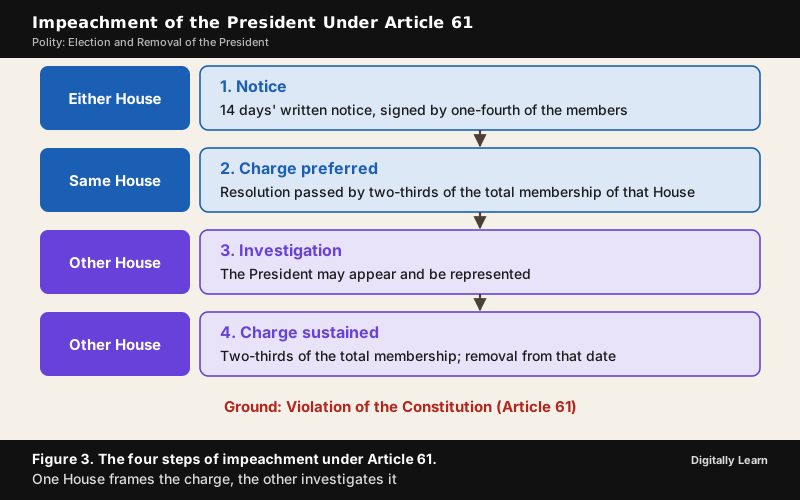
Both resolutions need two-thirds of the total membership of the House, not two-thirds of the members present and voting. Members who are absent or abstain therefore count against the resolution, which sets a high bar for removal.
Quasi-Judicial Character and Who Takes Part
Impeachment is a quasi-judicial procedure in Parliament. One House frames the charge and the other investigates it, the President may appear and be represented, and Article 361 allows the investigating body to review the President's conduct. No President has been impeached so far.
The bodies that elect the President and the bodies that can remove the President are not the same. Nominated MPs have no vote in the election, but as members of their House they count in its total membership and vote on an impeachment resolution. Elected MLAs vote in the election but have no part in impeachment, which is confined to Parliament, and members of the State Legislative Councils have no part in either.
| Legislators | Impeachment | President's election | Vice-President's election |
|---|---|---|---|
| Elected MPs | Yes | Yes | Yes |
| Nominated MPs | Yes | No | Yes |
| Elected MLAs | No | Yes | No |
| Legislative Council members | No | No | No |
President and Vice-President of India Compared
Election, Qualifications, Oath and Removal of the Two Offices
The Vice-President is elected by the members of both Houses of Parliament under Article 66, nominated members included, and every member's vote has the same value of one. The State legislators have no part.
B. R. Ambedkar explained the difference in the Constituent Assembly. The President's power, he said, "extends both to the administration by the Centre as well as to the states", so in the President's election "the members of the state legislatures should have a voice". The Vice-President, by contrast, normally presides over the Council of States and only rarely assumes the President's duties. Both elections use the single transferable vote and a secret ballot, and disputes about both go to the Supreme Court under Article 71.
| Feature | President | Vice-President |
|---|---|---|
| Electoral college | Elected MPs and elected MLAs of the States, Delhi, Puducherry and Jammu and Kashmir (Article 54) | All members of both Houses, elected and nominated (Article 66) |
| Value of a vote | Weighted by the 1971 census (Article 55) | One for every member |
| Qualified for election to | The Lok Sabha | The Rajya Sabha |
| Proposers and seconders | 50 and 50 | 20 and 20 |
| Security deposit | ₹15,000 | ₹15,000 |
| Oath taken before | The Chief Justice of India or the senior-most judge available | The President or a person the President appoints |
| Resignation addressed to | The Vice-President | The President |
| Removal | Impeachment for violation of the Constitution, by two-thirds of the total membership of each House | Rajya Sabha resolution passed by a majority of all its then members and agreed to by the Lok Sabha, after 14 days' notice |
| Mid-term vacancy | Election within six months | Election as soon as possible, with no outer limit |
Presidential Election in India and France: A Critical Comparison
Direct Election in France and Indirect Election in India
France offers the sharpest contrast with India. The Constitution of the Fifth Republic, adopted in 1958, created an electoral college to choose the President, and a referendum in 1962 replaced it with direct election by universal suffrage. The election uses run-off voting. If no candidate wins a majority in the first round, the two highest-scoring candidates go to a second round, so the winner always has a majority.
A referendum in 2000 shortened the French term from seven years to five, and the constitutional law of 2008 bars a President from serving more than two consecutive terms. To stand, a candidate needs signed nominations from more than 500 elected local officials, mostly mayors, drawn from at least 30 departments or overseas collectivities. When the office falls vacant, the President of the Senate acts, and the first round of the new election is held between 20 and 35 days after the vacancy.
The two methods follow from the two offices. France is a semi-presidential system, in which the President appoints the Prime Minister, presides over the Council of Ministers and may dissolve the National Assembly, so a personal popular mandate fits the office. The President of India is a nominal head in a parliamentary system and acts on the advice of ministers who answer to the Lok Sabha.
| Feature | India | France |
|---|---|---|
| Method | Indirect, by elected MPs and MLAs | Direct, by universal suffrage since 1962 |
| Voting system | Single transferable vote, with a quota of half the valid votes plus one | Two-round run-off voting |
| Weight of votes | Weighted by the 1971 census | Equal for every voter |
| Term | Five years | Five years since the 2000 referendum |
| Limit on terms | None | Two consecutive terms since 2008 |
| Nomination | 50 proposers and 50 seconders from the electoral college | More than 500 sponsoring elected officials from at least 30 departments or overseas collectivities |
| Vacancy | Vice-President acts; election within six months | President of the Senate acts; first round within 20 to 35 days |
| Role of the office | Nominal head in a parliamentary system | Head of a semi-presidential system who appoints the Prime Minister |
Merits and Weaknesses of the Indian Method
The Indian method has clear strengths:
- Federal parity: MLAs and MPs carry nearly equal total weight, so neither Parliament alone nor the Assemblies alone can choose the President.
- Majority support: The quota of more than half the valid votes, reached through transfers where needed, gives the winner majority backing.
- Fit with the office: A head of State who acts on ministerial advice draws authority from the people's elected representatives, which suits an office without real executive power.
The method also has weaknesses:
- Party arithmetic: Because the electors are legislators, the result tends to follow the strength of parties in Parliament and the Assemblies. In 2022 Murmu won 64.03 per cent of the valid vote value.
- Old population base: Vote values still rest on the 1971 census, so they do not reflect the population change of the decades since.
- Gaps in the college: A dissolved Assembly leaves its people without a voice in the election, and Articles 62(1) and 71(4) let the poll proceed regardless.
Previous Year UPSC‑CSE Questions
Each Prelims question is explained option by option, and each Mains question comes with an answer outline.
- UPSC Prelims 2023Consider the following statements:
- If the election of the President of India is declared void by the Supreme Court of India, all acts done by him/her in the performance of duties of his/her office of President before the date of decision become invalid.
- Election for the post of the President of India can be postponed on the ground that some Legislative Assemblies have been dissolved and elections are yet to take place.
- When a Bill is presented to the President of India, the Constitution prescribes time limits within which he/she has to declare his/her assent.
How many of the above statements are correct?
How to approach this Prelims question
Approach: Each statement is tested against the text of Articles 71 and 111.
- Statement 1: Article 71(2) says acts done before the Supreme Court's decision are not invalidated, so the statement is incorrect.
- Statement 2: Article 62(1) requires the election to be completed before the term expires, Article 71(4) bars any challenge on the ground of a vacancy in the electoral college, and the 2022 election went ahead with the Jammu and Kashmir seats vacant, so a dissolved Assembly cannot postpone the election; the statement is incorrect.
- Statement 3: Article 111 lets the President assent, withhold assent or return a Bill but fixes no time limit, so the statement is incorrect.
With no statement correct, the count is none.
Trap to watch: Statement 2 looks reasonable because a dissolved Assembly leaves some electors without a vote, and students who expect a complete college choose (a), but Article 71(4) makes such vacancies irrelevant.
Why each option is right or wrong:
- (a) Only one: Wrong. Each of the three statements contradicts Article 71(2), Article 71(4) or Article 111.
- (b) Only two: Wrong. No two statements hold, because acts done before the decision survive and vacancies cannot delay the election.
- (c) All three: Wrong. Article 111 prescribes no time limit for assent, so statement 3 alone already fails.
- (d) None: Correct. Article 71(2) protects past acts, Articles 62(1) and 71(4) keep the poll on time despite vacancies in the electoral college, and Article 111 sets no time limit for assent.
Answer: (d) None. Acts done before an election is declared void remain valid, vacancies in the electoral college cannot postpone the election, and the Constitution fixes no time limit for assent.
- UPSC Prelims 2023Consider the following statements in respect of election to the President of India :
- The members nominated to either House of the Parliament or the Legislative Assemblies of States are also eligible to be included in the Electoral College.
- Higher the number of elective Assembly seats, higher is the value of vote of each MLA of that State.
- The value of vote of each MLA of Madhya Pradesh is greater than that of Kerala.
- The value of vote of each MLA of Puducherry is higher than that of Arunachal Pradesh because the ratio of total population to total number of elective seats in Puducherry is greater as compared to Arunachal Pradesh.
How many of the above statements are correct?
How to approach this Prelims question
Approach: Each statement is tested against Articles 54 and 55 and the 1971 census values.
- Statement 1: Article 54 admits only elected members, so nominated members are excluded; incorrect.
- Statement 2: The value is the 1971 population divided by the elected seats and then by 1,000, so more seats with the same population lower the value; incorrect.
- Statement 3: Madhya Pradesh's 3,00,16,625 people over 230 seats give 131, while Kerala's 2,13,47,375 over 140 seats give 152; incorrect.
- Statement 4: Puducherry's 4,71,707 people over 30 seats give 16, while Arunachal Pradesh's 4,67,511 over 60 seats give 8, and the reason given is the ratio of population to seats; correct.
Only statement 4 holds.
Trap to watch: Students who think a bigger State always has heavier votes pick Madhya Pradesh over Kerala, and those who link value to the number of seats accept statement 2, but the value follows population per seat.
Why each option is right or wrong:
- (a) Only one: Correct. Statement 4 alone holds, because Puducherry has more people per elected seat than Arunachal Pradesh.
- (b) Only two: Wrong. Statement 2 reverses the formula, and statement 3 fails because Kerala's MLAs carry 152 votes against Madhya Pradesh's 131.
- (c) Only three: Wrong. Nominated members are outside the electoral college, so statement 1 fails along with statements 2 and 3.
- (d) All four: Wrong. Article 54 admits only elected members, so statement 1 fails at once.
Answer: (a) Only one. Only the Puducherry statement holds, because each of its MLAs represents more people than an Arunachal Pradesh MLA, giving a vote value of 16 against 8.
- UPSC Prelims 2018With reference to the election of the President of India, consider the following statements:
- The value of the vote of each MLA varies from State to State.
- The value of the vote of MPs of the Lok Sabha is more than the value of the vote of MPs of the Rajya Sabha.
Which of the statements given above is/are correct?
How to approach this Prelims question
Approach: The two statements are tested against the two formulas of Article 55(2).
- Statement 1: An MLA's value is the State's 1971 population per elected seat divided by 1,000, so it differs from State to State, from 208 in Uttar Pradesh to 7 in Sikkim; correct.
- Statement 2: Clause (2)(c) divides the MLAs' total equally among all elected members of both Houses, so a Lok Sabha member and a Rajya Sabha member each cast 700, as in 2022; incorrect.
Trap to watch: The Lok Sabha is directly elected and larger, so students who assume its members carry more weight pick (c), but Article 55(2)(c) gives every elected MP the same value.
Why each option is right or wrong:
- (a) 1 only: Correct. MLA values vary with each State's population per seat, while every elected MP has the same value.
- (b) 2 only: Wrong. Lok Sabha and Rajya Sabha members cast votes of equal value, and statement 1 is true.
- (c) Both 1 and 2: Wrong. Statement 2 fails because Article 55(2)(c) makes every MP's vote equal.
- (d) Neither 1 nor 2: Wrong. Statement 1 is true, since the value of an MLA's vote varies between States.
Answer: (a) 1 only. An MLA's vote varies with the population per seat of the State, while every elected MP, of either House, casts a vote of the same value.
- UPSC Prelims 1997In the Presidential election in India, every elected member of the Legislative Assembly of a State shall have as many votes as there are multiples of one thousand in the quotient obtained by dividing the population of the State by the total number of the elected members of the Assembly. As at present (1997) the expression "population" here means the population as ascertained by the
How to approach this Prelims question
Approach: The question turns on the Explanation to Article 55 as it stood in 1997. The Forty-second Amendment, in force from 3 January 1977, read "population" as the population at the 1971 census until the figures of the first census after 2000 were published, and that rule was in force in 1997. The Eighty-fourth Amendment of 2001 later extended the same 1971 base until the first census after 2026.
Trap to watch: Students who expect the latest census to be used pick 1991, the census whose figures were available in 1997, but the Forty-second Amendment had frozen the base at 1971.
Why each option is right or wrong:
- (a) 1991 Census: Wrong. The 1991 figures were not used, because the Forty-second Amendment had frozen the base at 1971.
- (b) 1981 Census: Wrong. The 1981 census was also set aside by the freeze.
- (c) 1971 Census: Correct. The proviso added by the Forty-second Amendment read "population" as the 1971 census.
- (d) 1961 Census: Wrong. The freeze fixed the base at 1971, not at an earlier census.
Answer: (c) 1971 Census. The Forty-second Amendment froze the population base for the presidential election at the 1971 census, and the Eighty-fourth Amendment kept it there until the first census after 2026.
- UPSC Prelims 1997Which one of the following are/is stated in the Constitution of India?
- I. The President shall not be a member of either House of Parliament.
- II. The Parliament shall consist of the President and two Houses.
Choose the correct answer from the codes given below:
How to approach this Prelims question
Approach: Each statement is matched with the Article that contains it.
- Statement I: Article 59(1) provides that the President shall not be a member of either House of Parliament or of a House of a State Legislature; stated.
- Statement II: Article 79 provides that Parliament shall consist of the President and two Houses; stated.
Both statements are in the Constitution.
Trap to watch: The two statements look contradictory, so students pick (c) or (d), but being part of Parliament does not require membership of either House.
Why each option is right or wrong:
- (a) Neither I nor II: Wrong. Both rules are written into the Constitution, in Articles 59(1) and 79.
- (b) Both I and II: Correct. Article 59(1) keeps the President out of both Houses, and Article 79 makes the President part of Parliament.
- (c) I alone: Wrong. Article 79 also states statement II.
- (d) II alone: Wrong. Article 59(1) also states statement I.
Answer: (b) Both I and II. Article 59(1) bars the President from membership of either House, while Article 79 makes the President one of the three parts of Parliament.
- UPSC Prelims 1996Which one of the following is part of the electoral college for the election of the President of India but does not form part of the forum for his impeachment?
How to approach this Prelims question
Approach: The question compares two lists. Electoral college: Article 54 includes the elected members of both Houses of Parliament and of the State Legislative Assemblies. Impeachment: Article 61 gives the charge and the investigation only to the two Houses of Parliament. Only the State Legislative Assemblies are in the first list and not in the second.
Trap to watch: State Legislative Councils have no part in impeachment, so students pick (c), but they have no part in the election either.
Why each option is right or wrong:
- (a) Lok Sabha: Wrong. Its elected members vote in the election, and the House can prefer or investigate an impeachment charge.
- (b) Rajya Sabha: Wrong. Its elected members vote in the election, and it also takes part in impeachment.
- (c) State Legislative Councils: Wrong. Their members are outside the electoral college as well as the impeachment process.
- (d) State Legislative Assemblies: Correct. Their elected members vote in the election, while impeachment is confined to Parliament.
Answer: (d) State Legislative Assemblies. The elected members of the State Legislative Assemblies help elect the President, but only the two Houses of Parliament can impeach.
- UPSC Prelims 1995Which of the following are matters on which a constitutional amendment is possible only with the ratification of the legislatures of not less than one-half of the States?
- I. Election of the President
- II. Representation of States in Parliament
- III. Any of the Lists in the 7th Schedule
- IV. Abolition of the Legislative Council of a State
Choose the correct answer from the codes given below:
How to approach this Prelims question
Approach: Each item is checked against the proviso to Article 368(2).
- Item I: Articles 54 and 55 on the election of the President are in the proviso, so ratification is needed; correct.
- Item II: The representation of States in Parliament is in the proviso, so ratification is needed; correct.
- Item III: Any of the Lists in the Seventh Schedule is in the proviso, so ratification is needed; correct.
- Item IV: Article 169(3) says a law abolishing a Legislative Council is not an amendment for the purposes of Article 368, so no ratification is needed; wrong.
Trap to watch: Abolishing a Legislative Council changes the Constitution's text, so students include item IV, but Article 169(3) takes such a law outside Article 368.
Why each option is right or wrong:
- (a) I, II and III: Correct. All three items are listed in the proviso to Article 368(2), and item IV is not.
- (b) I, II and IV: Wrong. Item IV needs no ratification, and item III does.
- (c) I, III and IV: Wrong. Item IV needs no ratification, and item II does.
- (d) II, III and IV: Wrong. Item IV needs no ratification, and item I does.
Answer: (a) I, II and III. The election of the President, the representation of States in Parliament and the Seventh Schedule Lists are in the ratification proviso, while a law on Legislative Councils under Article 169 is not deemed an amendment.
- UPSC Mains 2022 GS‑IICritically examine the procedures through which the Presidents of India and France are elected.
Answer outline
The outline sets out what the question asks, the main arguments, relevant examples and the direction of the conclusion; it is not a full model answer.
Introduction: The President of India is elected indirectly by an electoral college of elected MPs and MLAs under Articles 54 and 55, while the President of France has been elected directly by universal suffrage since the referendum of 1962.
Body (sub-themes to develop):
- Indian procedure: An electoral college of elected MPs and MLAs, votes weighted by the 1971 census under Article 55(2), the single transferable vote with a quota, a secret ballot with no party whip, 50 proposers and 50 seconders, and disputes decided by the Supreme Court.
- French procedure: Direct election by two-round run-off voting, sponsorship by more than 500 elected officials from at least 30 departments, a five-year term since 2000 and a limit of two consecutive terms since 2008.
- Merits of the Indian method: Parity between the States and the Union, majority support through transfers, and a mandate suited to a head of State who acts on ministerial advice.
- Weaknesses of the Indian method: Results that follow party strength, as in 2022, vote values resting on 1971 populations, and gaps such as Jammu and Kashmir's vacant seats in 2022.
- Fit with the system of government: A semi-presidential President who appoints the Prime Minister needs a popular mandate, while a nominal head in a parliamentary system does not.
Conclusion: Each procedure suits its system, since indirect and federally weighted election fits India's nominal head of State, while direct election fits the executive role of the French President.
Sources
- Legislative Department, Ministry of Law and Justice: The Constitution of India (2024 edition)
- Lok Sabha Secretariat: Constituent Assembly Debates, Volume VII, 4 November 1948
- NCERT: Indian Constitution at Work, Class XI, Chapter 4, Executive
- Election Commission of India: Press note on the election to the office of President of India, 2022 (9 June 2022)
- Press Information Bureau: Polling for Presidential Elections 2022 held peacefully today (18 July 2022)
- Press Information Bureau: Shrimati Droupadi Murmu elected as the President of India (22 July 2022)
- Press Information Bureau: Election to the Office of the Vice-President of India, 2025 (1 August 2025)
- Press Information Bureau: Population Census-2027 to be conducted in two phases along with enumeration of castes (4 June 2025)
- Supreme Court of India: Special Reference No. 1 of 2025, opinion of 20 November 2025 (2025 INSC 1333)
- Wikipedia: President of India
- Wikipedia: Electoral College (India)
- Wikipedia: List of presidents of India
- Wikipedia: 2022 Indian presidential election
- Wikipedia: 1969 Indian presidential election
- Wikipedia: 1977 Indian presidential election
- Wikipedia: Eleventh Amendment of the Constitution of India
- Wikipedia: Mohammad Hidayatullah
- Wikipedia: Droupadi Murmu
- Wikipedia: President of France
- UPSC: Civil Services Examination question papers
Editorial Disclaimer
This article draws on the text of the Constitution, the Election Commission's and the Government's releases, the current NCERT textbook and the other sources listed above. Constitutional provisions are given as currently in force.
See more of our UPSC articles in Google Search
Add to Preferred Sources

