


Overview
A guaranteed monthly pension of Rs 1,000 to Rs 5,000 for the informal worker
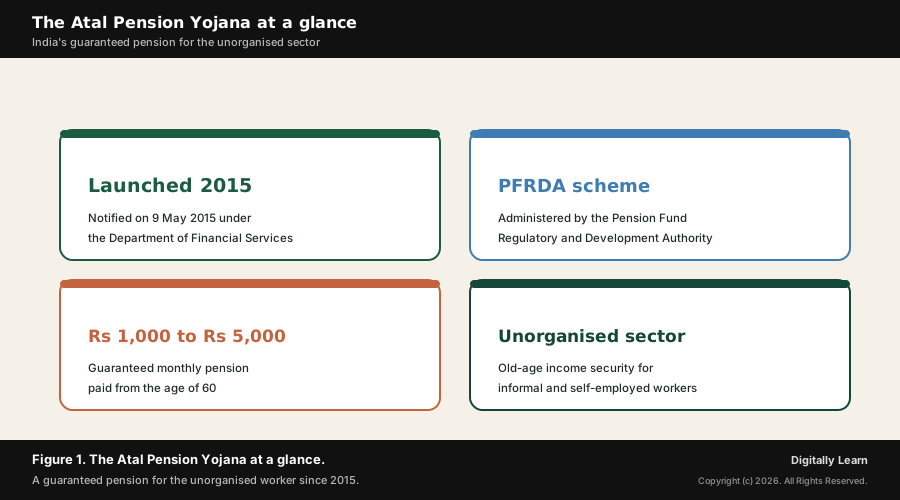
Launched on 9 May 2015 and run by the PFRDA, the Atal Pension Yojana gives workers in the unorganised sector a guaranteed monthly pension of Rs 1,000 to Rs 5,000 from the age of 60, with the same pension continuing for the spouse.
The Atal Pension Yojana, branded APY, is a guaranteed-pension scheme of the Government of India launched on 9 May 2015 and administered by the Pension Fund Regulatory and Development Authority (PFRDA) under the Department of Financial Services, Ministry of Finance. Aimed at workers in the unorganised sector, it gives a subscriber who joins between the ages of 18 and 40 a guaranteed monthly pension of Rs 1,000 to Rs 5,000 from the age of 60, with the same pension continuing for the spouse and the accumulated corpus returning to the nominee, backed by a government guarantee of the promised amount.
What the Atal Pension Yojana Is: The 9 May 2015 Launch, PFRDA Administration and the Guaranteed-Pension Mandate for the Unorganised Sector
The 9 May 2015 launch, the administration by the Pension Fund Regulatory and Development Authority under the Department of Financial Services, and the guaranteed monthly pension for the unorganised worker
The Atal Pension Yojana, known as APY, is a guaranteed-pension scheme of the Government of India launched on 9 May 2015 and administered by the Pension Fund Regulatory and Development Authority (PFRDA) under the Department of Financial Services in the Ministry of Finance. It gives a subscriber a fixed monthly pension from the age of 60, and is aimed above all at workers in the unorganised sector who have no formal pension of their own.
The scheme is deliberately simple. A worker between 18 and 40 years opens an account, chooses a pension level, and pays a small monthly amount by auto-debit until the age of 60, after which a guaranteed pension of Rs 1,000 to Rs 5,000 a month is paid for life. The same pension continues to the spouse after the subscriber, and the accumulated corpus returns to the nominee, so the household is protected across the whole of old age.
Why it matters is that most Indians work in the unorganised sector, as farm labour, street vendors, domestic workers, drivers and the self-employed, and they retire with no pension, no provident fund and no employer behind them. As people live longer, this leaves a vast population exposed to poverty in old age. By offering a small, affordable and government-guaranteed pension, APY treats old-age income security as a basic right rather than a privilege of formal employees. The figure below sets out APY at a glance.
Why India Needs a Pension for the Unorganised Sector: The Missing Pillar of Old-Age Income Security and an Ageing Population
The absence of any formal pension for informal workers, the longevity and old-age poverty risk, the weakening of family support and the demographic transition toward an ageing India
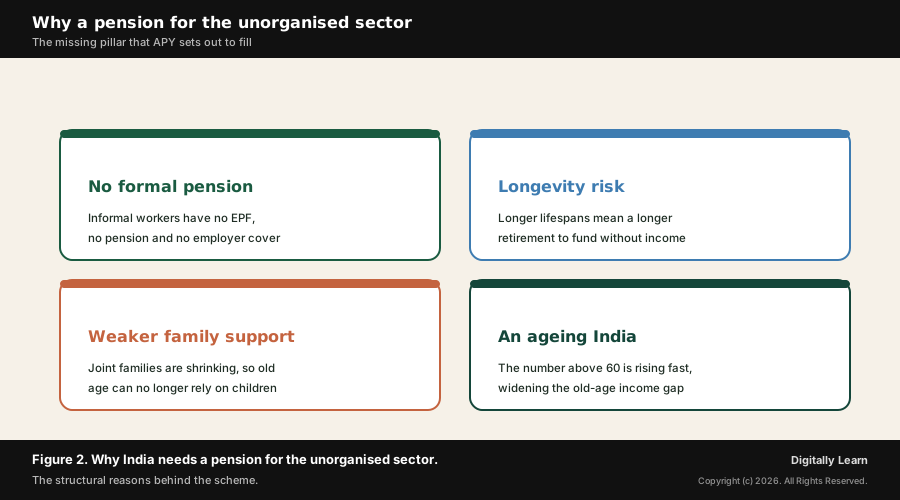
India's social security has long had a missing pillar. Organised-sector employees are covered by the Employees Provident Fund and its pension scheme, and government servants have their own pensions, but the unorganised sector, which is the overwhelming majority of the workforce, has historically had none. These workers earn irregular incomes, change jobs often and rarely save in a formal pension product, so they reach old age dependent on family support or on falling back into work.
The need is sharpened by a demographic transition. India is ageing, and the number of people above 60 is rising quickly, even as joint-family support weakens and lifespans lengthen. Without a pension, a longer life becomes a longer period of old-age poverty, falling hardest on those who worked the hardest for the least. A contributory pension that a poor worker can actually afford, topped by a state guarantee, is the instrument designed to close this gap.
What is the significance of this gap is that it explains the whole design of APY. The scheme does not wait for the informal worker to find a complex market product; it offers a fixed, predictable pension for a fixed, predictable contribution, and the government guarantees the promised amount. By converting a small monthly saving into a lifelong pension, APY turns longevity from a threat into a planned, secure retirement for the unorganised worker. The figure below maps why the scheme exists.
Who Can Join the Atal Pension Yojana: Eligibility, the 18 to 40 Age Band and the Exclusion of Income-Tax Payers
The eligibility of any Indian citizen aged 18 to 40 with a savings bank or post office account, the minimum 20-year contribution period, the exclusion of income-tax payers since 1 October 2022, and the individual-account design
Eligibility is broad but precise. Any Indian citizen aged between 18 and 40 years can join, provided they have a savings bank account or a post office savings account, to which the contribution is linked and through which the pension and any government benefit are paid. Because the minimum entry age is 18 and the pension begins at 60, every subscriber contributes for at least 20 years, which is what makes a small monthly amount grow into a meaningful pension.
Two limits matter for the examination. First, since 1 October 2022 any person who is or has been an income-tax payer is not eligible to join, so the scheme is squarely targeted at low-income, non-taxpaying workers. Second, APY is an individual account, not a family one, so there is no rule that only one member of a family may join; a husband and a wife, for instance, can each open a separate account and each draw a separate pension.
The Guaranteed Pension Structure: Five Slabs of Rs 1,000 to Rs 5,000 and the Age-Linked Contribution
The five guaranteed pension slabs from the age of 60, the contribution that rises with entry age and chosen slab, the auto-debit collection, and the government guarantee that funds any return shortfall
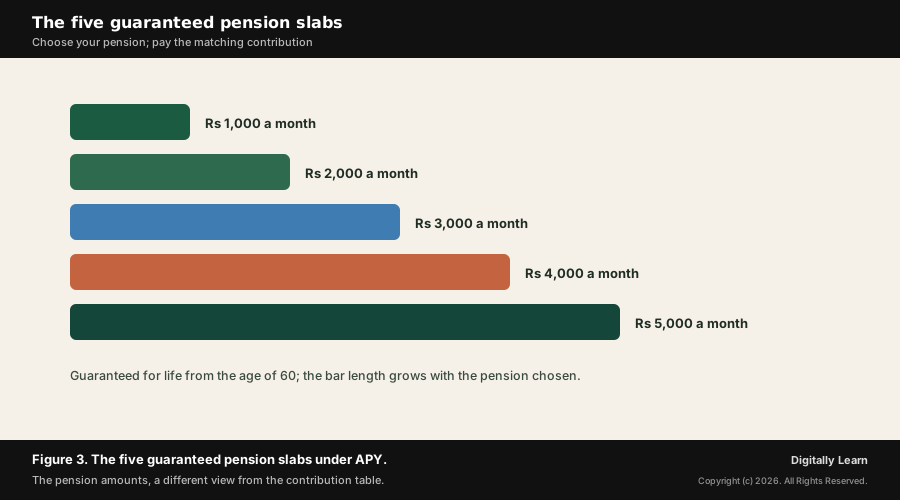
The heart of APY is a guaranteed pension in five fixed slabs, of Rs 1,000, Rs 2,000, Rs 3,000, Rs 4,000 or Rs 5,000 a month, paid from the age of 60 for the rest of the subscriber's life. The subscriber chooses the slab at the start, and may later move up or down once a year. Because the amount is fixed and assured, the worker knows exactly what the pension will be, which is the scheme's central promise.
The contribution rises with the entry age and the chosen slab. A person who joins at 18 pays as little as Rs 42 a month for the Rs 1,000 pension and about Rs 210 a month for the Rs 5,000 pension; a person who joins at 40 pays about Rs 291 and Rs 1,454 a month for the same two slabs. The contribution is collected by auto-debit from the linked account on a monthly, quarterly or half-yearly basis, so saving is automatic.
A crucial feature is the government guarantee. If the actual returns earned on the pooled contributions fall short of the return assumed for the promised pension, the shortfall is met by the Government of India, so the subscriber bears no market risk on the guaranteed amount. This makes APY a genuine defined-benefit promise to the poor, unlike a pure market-linked product. The table and figure below set out the contribution required and the pension slabs it buys.
| Age at joining | Monthly contribution for the Rs 1,000 pension | Monthly contribution for the Rs 5,000 pension |
|---|---|---|
| 18 years | About Rs 42 | About Rs 210 |
| 40 years | About Rs 291 | About Rs 1,454 |
The Government Co-Contribution and the Spouse and Nominee Provisions: How the Scheme Protects the Early Subscriber and the Family
The government co-contribution of 50 per cent or Rs 1,000 for eligible early subscribers, the spouse continuation of the same pension, the return of the corpus to the nominee on the death of both, and the exit rules
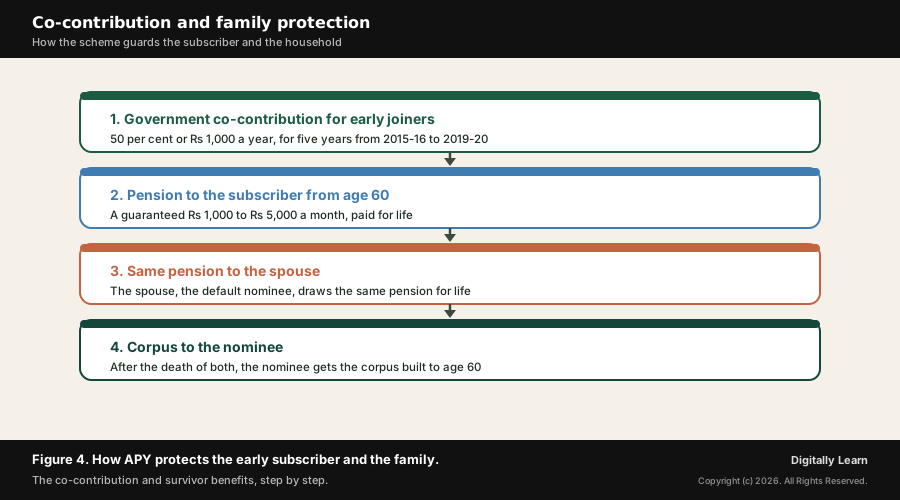
To pull in the poorest early, the scheme offered a government co-contribution. For eligible subscribers who joined between 1 June 2015 and 31 March 2016, who were not income-tax payers and not covered by any statutory social security scheme, the government paid 50 per cent of the contribution or Rs 1,000 a year, whichever is lower, for five years from 2015-16 to 2019-20. This first push rewarded the early adopter and lowered the cost of joining for those who could least afford it.
The scheme protects the family across old age. The default nominee is the spouse, who receives the same monthly pension for life after the subscriber's death. If the subscriber dies before 60, the spouse may either exit with the corpus or continue the account in the subscriber's name to the original date and then draw the pension. After the death of both the subscriber and the spouse, the nominee receives the accumulated pension wealth as built up to the age of 60.
What is the significance of these provisions is that they make the pension a household security, not merely an individual one. Premature exit before 60 is allowed only in limited cases, such as death or terminal illness, which keeps the saving locked for its purpose, while the spouse and nominee rules ensure the money is never lost to the family. Together the co-contribution and the survivor benefits answer the two fears of the poor saver: that joining is costly, and that the saving might be lost. The figure below traces these protections.
Institutional Architecture: PFRDA, the National Pension System Trust, Banks and Post Offices, and the Jan Suraksha Family
The PFRDA as regulator and administrator, the National Pension System Trust and pension fund managers, banks and post offices as the points of presence, and the place of APY within the Jan Suraksha schemes alongside PMJJBY and PMSBY
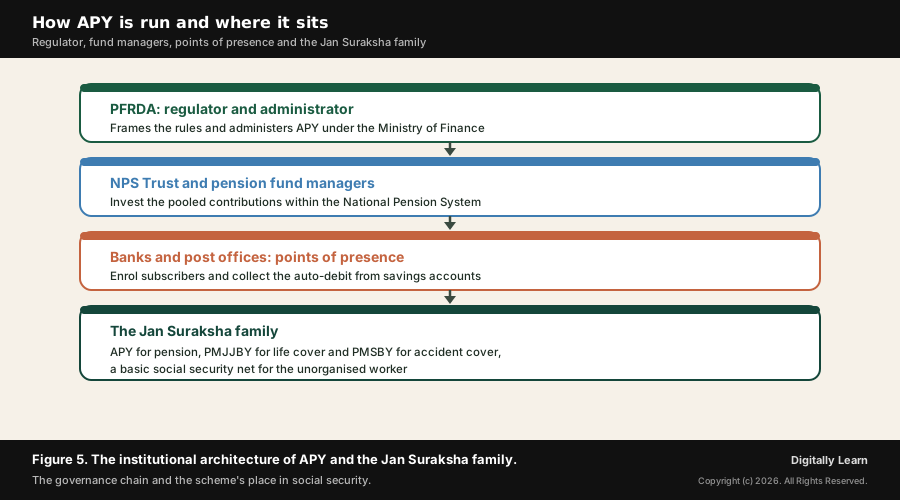
APY runs on an existing pensions architecture. The Pension Fund Regulatory and Development Authority, the statutory regulator for pensions in India, administers the scheme, and the contributions are managed within the National Pension System framework through the National Pension System Trust and professional pension fund managers. The subscriber, however, never deals with this machinery directly, which is what keeps the scheme simple for an unlettered worker.
The scheme reaches people through banks and post offices. Every bank branch and post office that holds the worker's savings account acts as the point of enrolment and the channel for auto-debit, so a worker opens an APY account where they already bank. This piggybacking on the banking network, built up by the financial-inclusion drive, is what lets APY scale to crores of subscribers without a separate field force on the ground.
APY is one of the three Jan Suraksha schemes announced together in 2015, alongside the Pradhan Mantri Jeevan Jyoti Bima Yojana for life insurance and the Pradhan Mantri Suraksha Bima Yojana for accident insurance. Where the two insurance schemes cover death and disability, APY covers the risk of outliving one's savings, so the three together build a basic safety net of life cover, accident cover and pension for the unorganised worker. The figure below sets out this architecture.
Scale and Progress of the Atal Pension Yojana: Enrolments, Women's Share and Assets Under Management
The gross enrolments crossing 8.34 crore, the high share of women subscribers, the growth of assets under management within the National Pension System, and what the figures show against the unorganised workforce
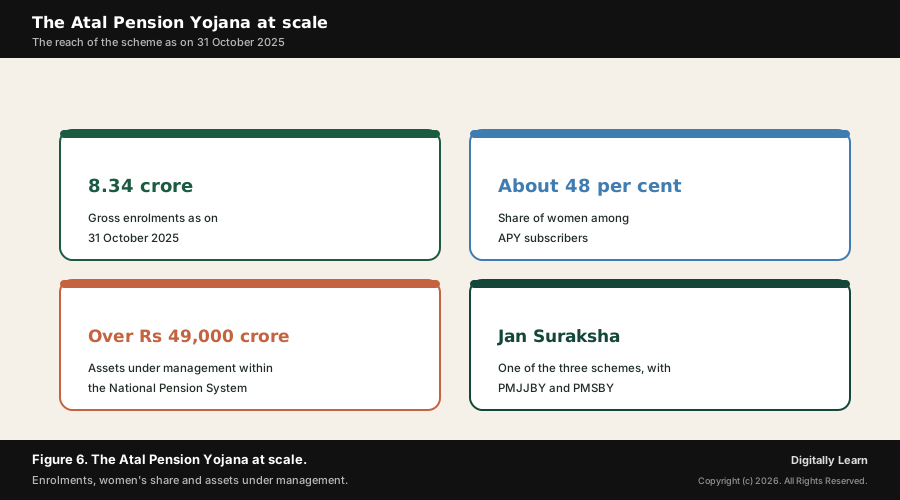
APY has grown into one of India's largest pension schemes. As on 31 October 2025, gross enrolments had crossed 8.34 crore subscribers, drawn overwhelmingly from the unorganised sector, a reach that few contributory pension schemes anywhere achieve in a decade. The steady year-on-year additions show that a small, guaranteed pension, sold through the banking network, can attract the informal worker who never bought a pension product before.
Two features of the base stand out. Women make up about 48 per cent of subscribers, a high share for any financial product in India and a sign that the scheme reaches female workers who are often outside formal finance. The pooled savings have grown to assets under management of more than Rs 49,000 crore, invested within the National Pension System framework, which both funds the future pensions and adds to long-term domestic savings.
Read together, these numbers show real success against a hard target. APY has converted the idea of a pension for the poor into a mass, women-heavy, growing scheme, yet the base still covers only a part of an unorganised workforce numbered in the hundreds of millions, and the adequacy of a fixed pension over a long retirement remains an open question, as the next section sets out. The figure below presents APY at scale.
Significance for Social Security and Financial Inclusion: Old-Age Income Security, Women's Empowerment and the Fiscal-Prudence Debate
How APY extends social protection to the informal many, deepens financial inclusion and women's economic security, and balances fiscal prudence against the open question of pension adequacy
The deeper significance of APY is as a pillar of social security. By guaranteeing income in old age to the worker the formal system never reached, it extends the idea of social protection from the organised few to the informal many, and it does so as a right backed by a state guarantee rather than as charity. In a country without a universal contributory pension, this is a foundational step toward old-age security for all.
APY also advances financial inclusion. Because it rides on a savings account and auto-debit, it deepens the use of the bank accounts opened under the financial-inclusion drive and gives the poor a long-term savings habit. The high women's participation means the scheme strengthens the economic security of women in particular, giving a homemaker or a domestic worker a pension in her own name, which is empowerment in a concrete, lifelong form.
What is the significance of this for policy is that APY balances reach against cost. The fixed slabs and the contributory design keep the fiscal burden modest, since subscribers fund most of their own pensions and the state mainly guarantees the floor, which makes the scheme sustainable as it scales. The open question is adequacy: whether a pension fixed at up to Rs 5,000 will be enough decades from now, a tension this scheme will have to manage. The table below contrasts the unorganised worker without and with APY.
| Aspect | Unorganised worker without APY | Worker under APY |
|---|---|---|
| Old-age income | No pension; dependent on family or continued work | Guaranteed Rs 1,000 to Rs 5,000 a month from age 60 |
| Market risk | Bears the full risk on any savings | Government guarantees the promised pension |
| The family | No assured survivor benefit | Spouse gets the same pension; nominee gets the corpus |
| Cost of joining | Formal pension products costly or out of reach | A small monthly contribution by auto-debit from age 18 |
| Financial inclusion | Often outside formal finance | A bank account, savings habit and a pension in own name |
Challenges Before the Atal Pension Yojana: Pension Adequacy, Coverage of the Poorest, Awareness and the Voluntary Design
The inflation risk to a fixed pension, the difficulty of reaching the poorest after the co-contribution window closed, the limits of a voluntary contributory design with penalties and dropouts, and uneven awareness
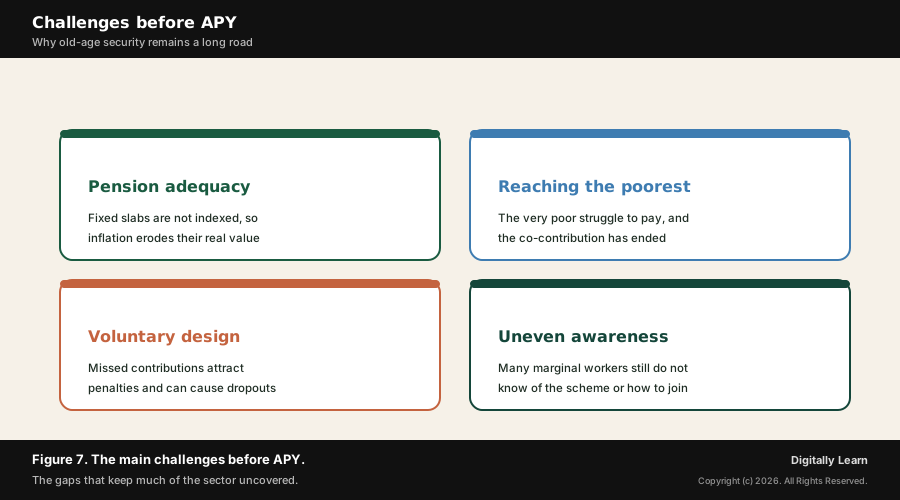
Judged honestly, APY faces real limits. The most debated is pension adequacy. The slabs are fixed in rupee terms and are not indexed to inflation, so a Rs 1,000 to Rs 5,000 pension that looks modest today may buy far less in the 2040s and 2050s when today's young subscribers retire, leaving an open question over how much real security the scheme finally delivers.
Reaching the truly poor is also hard. The very poorest may struggle to spare even a small monthly contribution, and since the co-contribution window closed in 2019-20, new joiners get no government top-up, so the scheme can miss those who most need it. Its voluntary, contributory design means a worker must choose to join and keep paying, and missed contributions attract penalties and can lead to dropouts, while awareness among the most marginal workers remains uneven.
These are reasons to strengthen the scheme, not to doubt its direction. Because old-age security for the unorganised sector touches income, awareness, banking habits and fiscal limits at once, no single measure can finish the task, and progress depends on enrolment, sustained contributions and adequate pensions together. The honest reading is that APY has built a real but partial floor under old-age income security, and that the unfinished agenda, above all adequacy and the coverage of the poorest, is large. The figure below sets out the main challenges.
The Way Forward: Deepening Old-Age Income Security for the Unorganised Sector
Widening coverage, reviving a targeted co-contribution, protecting the real value of the pension, reducing dropouts, raising awareness, linking with Jan Suraksha and financial inclusion, and tracking outcomes
The path ahead is to widen coverage and deepen adequacy, so that the guarantee of old-age income reaches more of the unorganised sector and means more in real terms. The measures below set out a balanced way to strengthen the Atal Pension Yojana.
- Widen coverage by enrolling more unorganised workers through banks, post offices, employers and self-help groups, and by making it easy to join in the local language with minimal paperwork.
- Consider reviving or redesigning a targeted government co-contribution for the poorest new subscribers, so that those who can least afford the contribution are not left out.
- Examine ways to protect the real value of the pension over time, including higher voluntary slabs and a periodic review of the guaranteed amounts against the cost of living.
- Reduce dropouts by allowing flexible contributions, gentle reminders and easy reactivation of lapsed accounts, so that a missed payment does not end a worker’s pension.
- Raise awareness among the most marginal workers, including women, migrants and the self-employed, so that those who most need a pension actually enrol and keep contributing.
- Strengthen the link with the wider Jan Suraksha and financial-inclusion drive, so that a single account can carry life cover, accident cover and a pension for the same worker.
- Track outcomes such as active contributions, dropout rates, women’s participation and the eventual pensions paid, and use the findings to refine the scheme.
Taken together, these steps point to a pension system that is both wider and deeper: wider through near-universal enrolment of unorganised workers, and deeper through slabs and a possible co-contribution that keep pace with rising prices. The central policy question is one of fiscal balance, because a richer guarantee raises the government contingent liability, so reform is likely to pair higher adequacy with stronger auto-debit discipline and sharper targeting of any subsidy toward the poorest contributors.
UPSC Relevance: GS-II and GS-III, the Prelims Pointers and the Social-Security Framing
The GS-II welfare-schemes and GS-III social-security and financial-inclusion fit, the Prelims facts on launch, regulator, age band, slabs and tax exclusion, and the current links to Jan Dhan, Jan Suraksha and the labour codes
For the examination, the Atal Pension Yojana sits across GS-II, under welfare schemes for vulnerable sections, and GS-III, under inclusive growth, financial inclusion and social security. The facts worth fixing for Prelims are the launch on 9 May 2015, the administration by the PFRDA under the Department of Financial Services, the age band of 18 to 40, the five guaranteed slabs of Rs 1,000 to Rs 5,000, and the exclusion of income-tax payers since 1 October 2022.
For Mains, APY is a ready example for any answer on social security, the unorganised sector, financial inclusion or an ageing India. It lets a student show how a contributory, guaranteed pension extends protection to the informal worker, how it advances women's economic security, and how it balances fiscal prudence against the unresolved question of pension adequacy, while naming its place within the Jan Suraksha family of schemes.
Contemporary linkages place APY within a wider push to build a social security floor. It works alongside the Pradhan Mantri Jan Dhan Yojana account base and the two Jan Suraksha insurance schemes, and it speaks to debates on the silver economy, on an ageing population and on extending the new labour codes' social security to gig and platform workers. Read this way, APY is a central instrument of India's attempt to secure income for every worker in old age.
Previous Year UPSC-CSE Questions By the end you will be able to draft model answers for the following UPSC questions. Each question carries a collapsible framework showing how to approach it in the exam.
- UPSC Prelims 2016 GS Paper IIdentify which of the three statements about the Atal Pension Yojana are correct: that it is a minimum guaranteed pension mainly for unorganised sector workers, whether only one member of a family may join, and whether the spouse gets the same pension after the subscriber's death.
How to approach this Prelims question
Approach: Read APY as a minimum guaranteed pension scheme for the unorganised sector, so statement 1 is correct. Statement 2 is wrong: APY is an individual account with no one-per-family rule, so more than one member of a family can join. Statement 3 is correct: the spouse receives the same pension for life after the subscriber's death. Hence 1 and 3 only, option (c).
Trap to watch: The trap is statement 2. Because APY is opened one account at a time for individual workers, it is tempting to assume only one member per family may join. There is no such restriction: a husband and a wife can each hold a separate APY account, so statement 2 is incorrect.
Key facts to recall:
- APY, launched on 9 May 2015 and run by the PFRDA, is a minimum guaranteed pension scheme mainly for unorganised sector workers, paying Rs 1,000 to Rs 5,000 a month from age 60.
- It is an individual scheme open to citizens aged 18 to 40 with a bank account, so more than one member of a family can join, each with a separate account.
- The spouse is the default nominee and receives the same pension for life after the subscriber's death; after both die, the nominee gets the accumulated corpus.
Answer signal: Statements 1 and 3 describe the core promise of APY, a guaranteed pension for unorganised workers and the same pension for the spouse; statement 2 invents a one-per-family limit that does not exist, so the answer is 1 and 3 only, option (c).
Sources and Further Reading
- Department of Financial Services: Atal Pension Yojana, eligibility, the five guaranteed slabs, the government guarantee and the income-tax-payer exclusion
- Department of Financial Services: Atal Pension Yojana frequently asked questions on the co-contribution, the spouse continuation and the return of the corpus
- Press Information Bureau: Atal Pension Yojana launched in May 2015, primarily targeted at the unorganised sector and informal workers
- Press Information Bureau: Atal Pension Yojana crosses 8.34 crore gross enrolments, women account for 48 per cent, with assets under management above Rs 49,000 crore
- Press Information Bureau: PMSBY, PMJJBY and APY complete ten years of providing social security cover
- Press Information Bureau: Atal Pension Yojana, securing retirement for India's unorganised sector, with the contribution chart by entry age
- NITI Aayog: Senior Care Reforms in India, reimagining the senior care paradigm for an ageing population
- Reserve Bank of India: National Strategy for Financial Inclusion 2019-2024
- World Bank: pensions and old-age income security overview
- Wikipedia: Atal Pension Yojana
Editorial Disclaimer
This briefing is for UPSC preparation. Verify the scheme features and the latest figures against the official Department of Financial Services, PFRDA and Press Information Bureau sources before relying on them.


