


Overview
India's national mission for financial inclusion
The Pradhan Mantri Jan Dhan Yojana, launched in 2014 under the Department of Financial Services, gives every unbanked adult a zero-balance bank account with a RuPay card, insurance and an overdraft, and the Jan Dhan account it created is the base of the JAM trinity that powers Direct Benefit Transfer.
PMJDY, the Pradhan Mantri Jan Dhan Yojana, is India's national mission for financial inclusion, launched on 28 August 2014 to bring every unbanked household, and later every unbanked adult, into the formal banking fold. It is run by the Department of Financial Services in the Ministry of Finance, and its core offer is a Basic Savings Bank Deposit Account that can be opened with zero balance and minimal paperwork. Each account carries a free RuPay debit card with built-in accident insurance, an overdraft facility and, for early eligible accounts, a small life cover. The accounts are opened at branches and at the doorstep through business correspondents, the Bank Mitras, and the Jan Dhan account became the base of the JAM trinity that carries Direct Benefit Transfer to the poor.
What PMJDY Is: A National Mission to Bank Every Unbanked Adult
The 2014 mission, the problem of financial exclusion and why inclusion matters
The Pradhan Mantri Jan Dhan Yojana, known as PMJDY, is the programme through which the Indian state set out to give every excluded household, and later every excluded adult, a bank account and the wider financial services that flow from it. It was launched on 28 August 2014 as a national mission for financial inclusion, run by the Department of Financial Services in the Ministry of Finance. Its scale showed at once: in the opening week the banks opened crores of accounts, a feat recorded as a Guinness World Record.
The problem PMJDY attacks is financial exclusion, the condition in which a large part of the population has no account with a formal institution and must rely on cash, moneylenders and informal savings. Before the mission, a great many Indian adults, especially the rural poor, women and migrants, were outside the banking system, left without a safe place to save, no record to build creditworthiness, and no easy way to receive a government benefit. Why it matters is that such exclusion keeps the poor exposed to high-cost informal lenders and shut out of the modern economy.
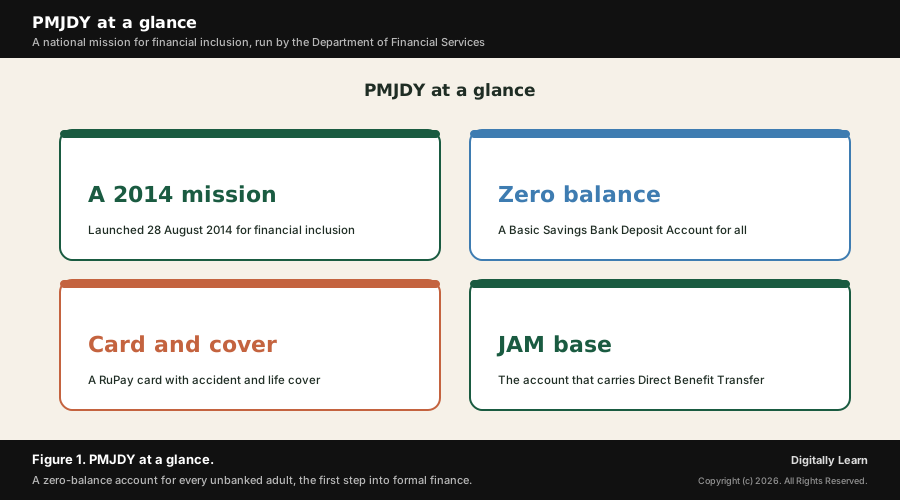
Financial inclusion, the goal PMJDY pursues, means giving the vulnerable access to a basic set of services, a savings account, a means of remittance and payment, credit, insurance and pension, in an affordable and fair manner through mainstream institutions. By making the account the first step, the mission aims to draw the poor into a system that can hold their savings safely, build a record that opens the door to credit, and serve as the channel for benefits and insurance. The figure below sets out the headline features of the mission before the detail that follows.
The Design of PMJDY: The Six Pillars and the Zero-Balance Account
The six pillars, the Basic Savings Bank Deposit Account and the two phases of the mission
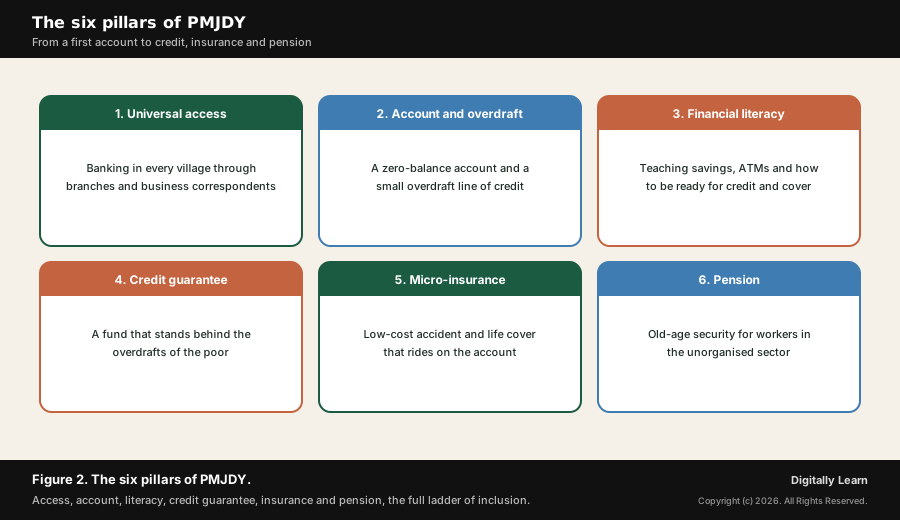
PMJDY was built on a clear architecture of six pillars that together carry the poor from a first account to a full set of services. The first is universal access to banking, reaching every village through branches and business correspondents; the second is a basic account with an overdraft, giving each adult a zero-balance account and a small line of credit; and the third is financial literacy, teaching savings, the use of ATMs and how to be ready for credit, insurance and pension. These three pillars open the door and teach the household to use what lies behind it.
The remaining three pillars deepen the offer. The fourth is a credit guarantee fund, which stands behind the overdrafts so that banks will lend to the poor without collateral; the fifth is micro-insurance, the low-cost accident and life cover that rides on the account; and the sixth is an unorganised-sector pension, a route to old-age security for workers with no employer scheme. Read together, the six pillars were meant to take a household from no account at all to a savings account, a means of payment, credit, insurance and pension, the full ladder of financial inclusion the mission set out to build.
At the foot of this design sits the Basic Savings Bank Deposit Account, the BSBDA, the account that makes inclusion possible for those with nothing to deposit. By the Reserve Bank's design, this account carries no requirement of any minimum balance, so a poor household need not keep money it does not have merely to hold an account. It allows cash deposits and withdrawals at the branch and the ATM and the receipt of money through electronic channels, and it permits a limited number of withdrawals each month. The figure below sets out the six pillars on which the mission stands.
Phase one for every household and the 2018 shift to every unbanked adult
The mission was designed to run in two phases. In its first phase, from 2014, the target was framed around the household: the aim was to ensure that every unbanked household in the country had at least one bank account, and the early drive to open accounts at scale, recorded in the opening-week record, was the visible mark of this household-first approach. The first phase concentrated on universal access and on giving each household the basic account, the RuPay card and the cover that came with it.
In 2018 the Government extended the programme and shifted its focus from every household to every unbanked adult. The second phase widened the target so that the individual, rather than the family, became the unit of inclusion, and it improved the benefits that the account carried. The overdraft ceiling was doubled and the accident cover on new RuPay cards was raised, changes the next section examines, so that the deepened mission offered not only an account but a more useful set of services to a larger body of beneficiaries.
The RuPay Card, the Accident and Life Insurance and the Overdraft Facility
The RuPay debit card, the accident cover raised to two lakh, the life cover and the ten-thousand-rupee overdraft
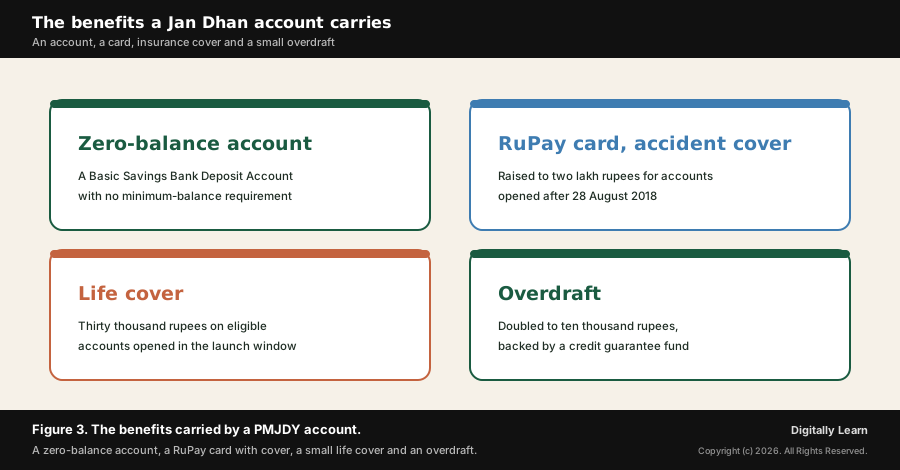
Every PMJDY account comes with a free RuPay debit card, the domestic card network that lets the holder withdraw cash at ATMs and pay at shops. The card matters for inclusion because it turns a passive account into a usable means of payment, and because it carries an insurance benefit at no separate cost. Built into the RuPay card is an accidental insurance cover that pays out if the holder dies or is disabled in an accident, a form of protection that most of the poor had never held before the mission gave it to them with their first card.
The cover was strengthened in the second phase. For accounts opened up to 28 August 2018, the built-in accidental cover stood at one lakh rupees; for accounts opened after that date, it was raised to two lakh rupees, so newer cardholders carry the higher protection. In addition, a small life cover of thirty thousand rupees was offered to eligible accounts opened in the launch window of the mission, between the middle of August 2014 and the end of January 2015, payable on the death of the beneficiary. These benefits, though modest, brought basic insurance within reach of households that the formal market had never served.
The account also carries a built-in line of credit. An eligible account holder may draw an overdraft, a small loan against the account, to meet a sudden need without turning to a moneylender, and a credit guarantee fund stands behind these overdrafts so that banks will extend them without collateral. The overdraft ceiling was doubled in the 2018 extension from five thousand to ten thousand rupees, and the upper age limit for availing it was raised, widening the pool of adults who can use the account as a first rung of institutional credit. The figure below sets out the benefits the account carries.
The Delivery Architecture: The Department of Financial Services, Banks, Bank Mitras and the RBI
The Department of Financial Services, the banks, the business correspondents and the role of the Reserve Bank
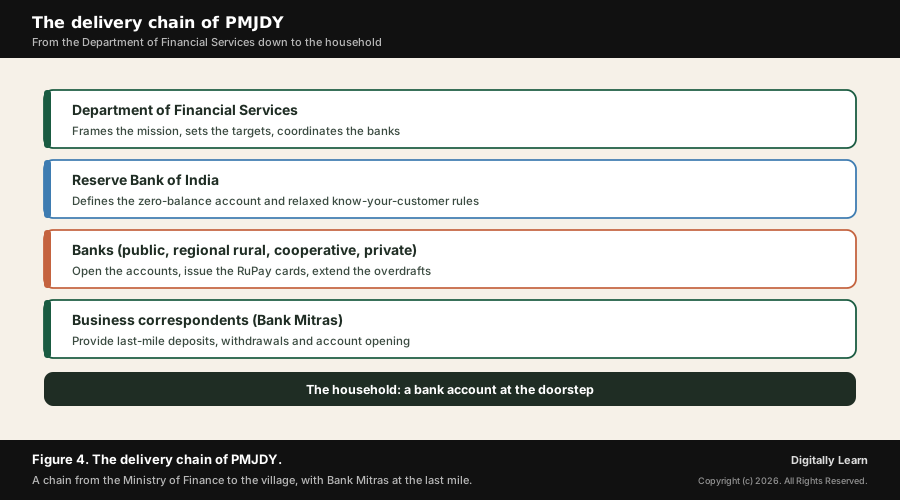
PMJDY is delivered through a chain that runs from the Ministry of Finance to the village doorstep. At the top, the Department of Financial Services, the wing of the Ministry of Finance that oversees banking, frames the scheme, sets the targets and coordinates the banks that carry it out. It is a mission rather than a single law, driven through the public-sector banks, the regional rural banks and the cooperative and private banks that actually open the accounts and issue the cards, so the Department's task is to steer a vast banking system towards a common goal of inclusion.
The reach into the village is provided by business correspondents, the agents popularly called Bank Mitras. A Bank Mitra is a retail agent engaged by a bank to offer banking services beyond the branch and the ATM, particularly in rural areas where a full branch is not viable. Working with a hand-held device, the Bank Mitra opens accounts, accepts deposits and withdrawals, and helps residents with mini-statements and other basic services, so that the account holder need not travel far to a branch. This last-mile network is what allowed PMJDY to reach households that the formal banking map had never touched.
Standing over the banking system is the Reserve Bank of India, the regulator whose rules make the mission workable. It is the Reserve Bank that defines the Basic Savings Bank Deposit Account and lays down that it shall carry no minimum-balance requirement, that frames the simplified, relaxed know-your-customer norms that let a poor person open an account with little paperwork, and that authorises banks to appoint business correspondents. PMJDY therefore rests on the Reserve Bank's prior framework for inclusion, which the mission used to drive accounts at scale. The figure below maps this delivery chain.
The JAM Trinity and Direct Benefit Transfer: How Jan Dhan Became the Base
The JAM trinity, Aadhaar seeding and how Jan Dhan carries Direct Benefit Transfer
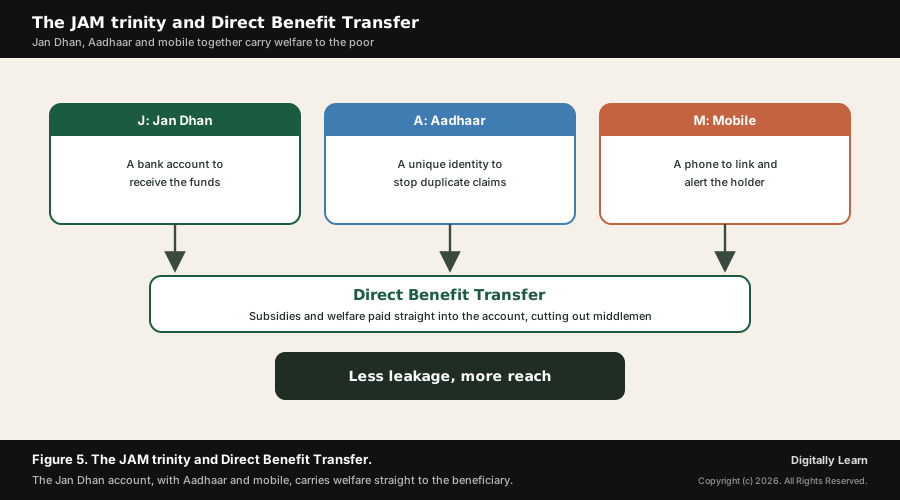
The deepest significance of PMJDY lies not in the account alone but in what the account made possible. The Jan Dhan account is the first letter of the JAM trinity, the combination of Jan Dhan accounts, Aadhaar identity numbers and mobile phones that the Government uses to send money to the poor. Each leg plays a part: Jan Dhan gives the beneficiary a bank account to receive funds, Aadhaar gives a unique identity that prevents duplicate and ghost claimants, and the mobile phone links the account and alerts the holder, so that together they form a digital pipe from the treasury to the citizen.
This pipe carries Direct Benefit Transfer, the system of paying subsidies and welfare straight into the beneficiary's bank account rather than through cash counters and middlemen. To make it work, accounts are Aadhaar-seeded, that is, linked to the holder's Aadhaar number, so that a benefit can be routed to the right person automatically. The official case is that this design plugs leakage: an Economic Survey framing describes JAM as attacking leakage at three points, identifying the right beneficiary through Aadhaar, paying into a Jan Dhan account, and reaching the holder through the mobile phone, so that money meant for the poor is less likely to be diverted on the way.
On the back of the Jan Dhan account, a layer of micro-insurance and pension schemes was built for the same account holders. The Pradhan Mantri Jeevan Jyoti Bima Yojana offers low-cost life insurance, the Pradhan Mantri Suraksha Bima Yojana offers low-cost accident insurance, and the Atal Pension Yojana offers a guaranteed pension for the unorganised sector, each bought through a bank account and drawing its contribution directly from it. By giving the poor an account first, PMJDY created the platform on which this wider social-security architecture could be delivered. The table below sets out these riding schemes, and the figure that follows maps the JAM trinity.
| Scheme | What it provides | How it rides on the account |
|---|---|---|
| Pradhan Mantri Jeevan Jyoti Bima Yojana | Low-cost life insurance cover | Bought through a bank account, premium auto-debited from it |
| Pradhan Mantri Suraksha Bima Yojana | Low-cost accidental death and disability cover | Bought through a bank account, premium auto-debited from it |
| Atal Pension Yojana | A guaranteed pension for the unorganised sector | Contribution drawn directly from the linked bank account |
The Outcomes: Account Ownership, Women's Accounts and Leakage Savings
Mass account ownership, women's participation and the savings from plugged leakage
The first and most visible outcome of PMJDY is a dramatic rise in account ownership. Hundreds of millions of accounts have been opened under the mission, drawing into the banking system households that had never held a formal account, and independent measures confirm the scale of the shift. The World Bank's Global Findex, which tracks account ownership across countries, recorded that the share of adults worldwide with an account rose sharply over the decade to 2021, with India's government-led inclusion drive among the forces behind the gain, a movement of which Jan Dhan was the centrepiece.
A second outcome lies in the reach to women. A large share of the accounts opened under PMJDY are held by women, many of them rural, and giving a woman an account in her own name has been linked to a measure of financial autonomy, a safe place to keep savings out of others' reach and a channel through which benefits meant for her can reach her directly. Because the account is the gateway to the wider services, this reach to women carries forward into their access to the insurance and pension schemes that ride on the Jan Dhan account.
A third outcome is the saving from reduced leakage through Direct Benefit Transfer. By paying subsidies and welfare straight into Aadhaar-seeded accounts, the Government has reported large cumulative savings from weeding out duplicate, fake and ineligible beneficiaries who once drew benefits they were not owed, with the gains heavily concentrated in big subsidy programmes. The precise figures move with each official report and are best read as indicative rather than exact, but the direction is clear: the account that PMJDY created is the rail on which a leaner, more targeted welfare delivery now runs.
The Critiques and Debates: Dormant Accounts, Usage Versus Access and Last-Mile Viability
Zero-balance and dormant accounts, duplicate accounts, usage versus access and Bank Mitra viability
A balanced reading sets the achievements against persistent critiques, presented here as they are argued by independent researchers, economists and audit bodies. The most common is the worry about dormant and zero-balance accounts: a large number of Jan Dhan accounts have at times lain inactive or carried no balance, which critics read as a sign that opening an account is not the same as using one, and that the headline count of accounts may overstate the real depth of inclusion the mission has achieved.
A related debate is over usage versus access and over duplicate accounts. Critics argue that the drive to open accounts at speed led some households to open more than one account, inflating the numbers, and that genuine inclusion is measured not by accounts opened but by whether the poor actively save, borrow and transact through them. Supporters reply that dormancy falls as accounts mature, that balances have grown over time, and that even a little-used account becomes valuable the moment a Direct Benefit Transfer must be paid into it, so the access itself has worth.
Further concerns cluster around last-mile delivery and the risk of over-reliance on the overdraft. The viability of the Bank Mitra network is questioned, since an agent who earns thin commissions and works with patchy connectivity may not stay in business, leaving the very villages that most need the service without it. Critics also caution that pushing overdraft credit to the poor without care can lead to over-indebtedness if incomes are unsteady. On the central question, whether PMJDY has turned mass account-opening into deep, active financial inclusion, a careful answer treats the matter as open and weighs both sides.
Understanding the Significance: Inclusion, the DBT Platform and Empowerment
A gateway to formal finance, the rail for Direct Benefit Transfer and a route to empowerment
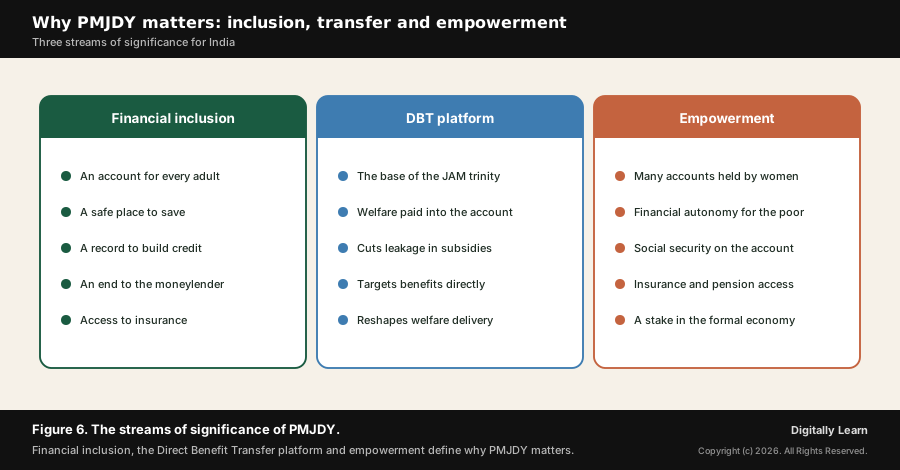
What is the significance of PMJDY lies first in its character as a gateway to formal finance. By giving almost every adult an account, the mission brought a vast excluded population into the banking system, replacing the moneylender and the cash box with a safe place to save, a record that can build creditworthiness, and access to insurance and pension. This near-universal access is its deepest contribution: it makes financial inclusion, long an aspiration, a concrete reality for hundreds of millions, and it is studied as one of the largest such drives attempted anywhere.
Its second significance is as the platform for Direct Benefit Transfer. The Jan Dhan account is the J of the JAM trinity, and without it the system of paying subsidies and welfare straight into a beneficiary's account could not function at scale. By creating the account on one side and pairing it with Aadhaar and the mobile phone, PMJDY built the rail on which a leaner, better-targeted welfare state now runs, cutting leakage and reaching the poor directly. This makes the mission far more than a banking programme; it is a piece of governance reform, reshaping how the state delivers to its citizens.
Its third significance is for empowerment and social security. Because so many of the accounts are held by women and by the rural poor, the mission has given the weakest a measure of financial autonomy and a direct stake in the formal economy. Riding on the account, the micro-insurance and pension schemes extend a layer of social security to those the formal market never served. Read together, inclusion, the DBT platform and empowerment are why PMJDY is treated as a landmark in India's development policy. The figure below maps these strands.
The Way Forward: From Access to Usage, Stronger Bank Mitras and Deeper Inclusion
Turning accounts into active usage, strengthening the last mile and deepening the credit and insurance layer
The way forward follows directly from the critiques. The first priority is to move from access to usage: to ensure that the accounts already opened are actively used for saving, borrowing and transacting, through steady financial-literacy efforts and through routing more benefits and payments into them, so that a dormant account becomes a living one and the depth of inclusion catches up with its breadth.
The second priority is to strengthen the last mile. Making the Bank Mitra network financially viable, through fair commissions and better connectivity, would keep an agent in every village that needs one, and improving the reliability of the digital plumbing would reduce the failures that leave a genuine account holder unable to transact. Alongside this, the credit and insurance layer should be deepened with care, extending the overdraft and the micro-insurance and pension schemes to more of the poor while guarding against the over-indebtedness that pushing credit carelessly can bring.
The third priority is to use the platform to deepen inclusion rather than rest on the account count. Linking the Jan Dhan account more fully to credit, savings products and digital payments, and continuing to expand the reach to women and the remaining unbanked, would turn the mission from a drive that opened accounts into one that genuinely changed financial lives. Pursued together, these measures would move PMJDY closer to its founding promise: not merely a bank account for every adult, but real, active inclusion in the formal economy.
UPSC Relevance and Exam Focus
Where PMJDY fits in the UPSC-CSE syllabus
This topic maps most directly to General Studies Paper II: government policies and interventions for development in various sectors, and issues arising out of their design and implementation; and welfare schemes for vulnerable sections, since PMJDY is a flagship inclusion mission whose design and delivery are routinely examined. It also links strongly to General Studies Paper III, inclusive growth and the mobilisation of resources, where financial inclusion, the JAM trinity and Direct Benefit Transfer are core themes, and it supplies rich material on governance reform and the targeting of subsidies.
For Prelims, hold the high-yield facts: PMJDY is a 2014 national mission for financial inclusion run by the Department of Financial Services; its account is a zero-balance Basic Savings Bank Deposit Account; it carries a free RuPay card with accident cover, an overdraft raised to ten thousand rupees, and a small life cover for early accounts; the 2018 extension shifted the focus from every household to every unbanked adult; Bank Mitras are the business correspondents; and the Jan Dhan account is the J of the JAM trinity behind Direct Benefit Transfer, with PMJJBY, PMSBY and APY riding on it.
For Mains, the recurring framing is to assess whether the mission has delivered genuine financial inclusion: how the zero-balance account and the last-mile Bank Mitra brought in the unbanked, how the Jan Dhan account became the rail for Direct Benefit Transfer, and how far dormant accounts, low usage and last-mile viability have limited its depth. A strong answer treats PMJDY as a case study in inclusion and governance reform, weighing its real gains in access and DBT against the unresolved questions of usage, viability and meaningful inclusion.
Recurring linked concepts an aspirant should keep in working memory:
- Financial inclusion: Access for the vulnerable to savings, credit, insurance and pension through formal institutions, of which PMJDY is India’s flagship instrument.
- JAM trinity: The combination of Jan Dhan, Aadhaar and mobile that carries Direct Benefit Transfer and reduces leakage in welfare.
- Basic Savings Bank Deposit Account: The zero-balance account defined by the Reserve Bank that makes inclusion possible for those with nothing to deposit.
- Business correspondents: The Bank Mitra agents who deliver banking at the doorstep where a branch is not viable.
A common Prelims trap is to confuse the bodies and the benefits; hold that PMJDY is run by the Department of Financial Services in the Ministry of Finance, that the account requires no minimum balance, that the accident cover was raised to two lakh for accounts opened after 28 August 2018, and that PMJJBY, PMSBY and APY are separate schemes that ride on the Jan Dhan account rather than parts of PMJDY itself.
A common Mains trap is to praise the account count and stop there. The exam value lies in a balanced judgment: the real achievements in access, women's accounts and the DBT platform, set honestly against the open problems of dormant accounts, usage versus access and the viability of the last mile.
Previous Year UPSC-CSE Questions By the end you will be able to draft model answers for the following UPSC questions. Each question carries a collapsible framework showing how to approach it in the exam.
- UPSC Mains 2016 GS-IIITake and defend a position on whether PMJDY is necessary for bringing the unbanked into the institutional-finance fold, and whether it achieves financial inclusion of the poor, giving arguments on both sides.
How to structure the answer in the exam
Body (sub-themes to develop):
- Why it is necessary: the zero-balance Basic Savings Bank Deposit Account, relaxed know-your-customer rules and Bank Mitra delivery reach the rural poor, women and migrants whom branch banking had left unbanked.
- How it advances inclusion of the poor: the six pillars carry the household from an account to a RuPay card, overdraft credit, micro-insurance and pension, and the Jan Dhan account becomes the rail for Direct Benefit Transfer through the JAM trinity, cutting leakage and reaching the poor directly.
- Evidence of success: a large rise in account ownership confirmed by the Global Findex, a high share of accounts held by women, and reported savings from reduced leakage in subsidies.
- Honest qualifications: dormant and zero-balance accounts, duplicate accounts, the gap between access and active usage, and the doubtful viability of the last-mile Bank Mitra network temper the claim.
- Reasoned opinion: agree that PMJDY is necessary and largely successful in bringing the unbanked into the fold, while holding that genuine inclusion of the poor requires moving from access to deep, active usage.
Sources and Further Reading
- Department of Financial Services: Pradhan Mantri Jan-Dhan Yojana scheme page
- Department of Financial Services: PMJDY overview
- Press Information Bureau: PMJDY, National Mission for Financial Inclusion, completes nine years
- Press Information Bureau: Insurance coverage to PMJDY account holders
- Reserve Bank of India: FAQs on the Basic Savings Bank Deposit Account (BSBDA)
- Press Information Bureau: JAM trinity and the digital revolution, a decade of financial inclusion
- Ministry of Finance, Economic Survey: Spreading JAM across India's economy
- World Bank: Global Findex Database, ownership of accounts
- Wikipedia: Pradhan Mantri Jan Dhan Yojana
Editorial Disclaimer
This briefing is for UPSC preparation. Verify the facts and figures against the official Department of Financial Services, PMJDY and PIB sources before relying on them.


