


Overview
Solarising agriculture for farmer energy and income security
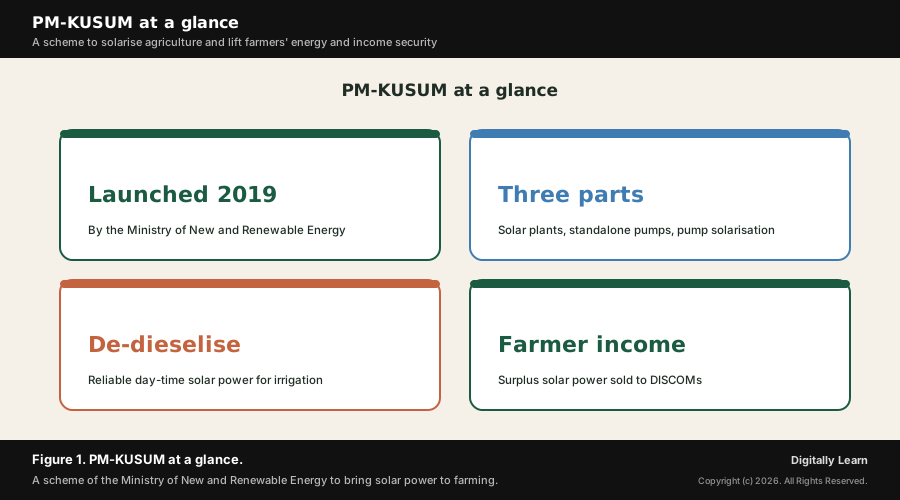
PM-KUSUM, launched in 2019 under the Ministry of New and Renewable Energy, brings solar power to agriculture through three components so farmers can replace diesel pumps, irrigate on day-time solar power and earn from surplus solar.
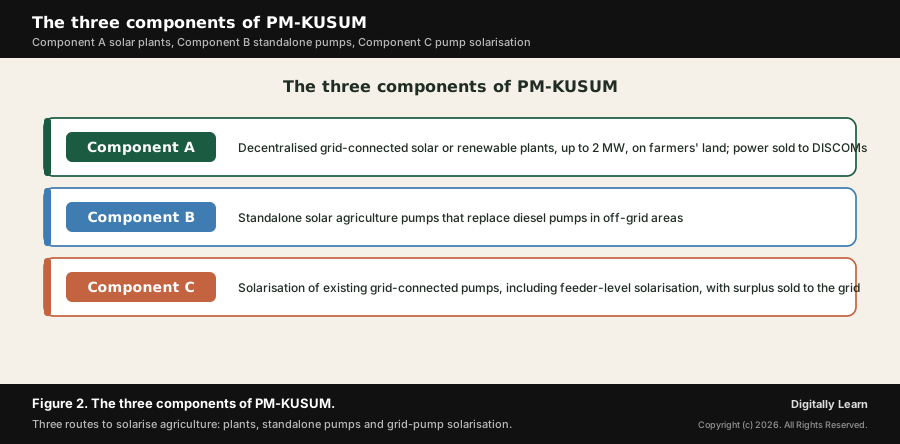
PM-KUSUM, the Pradhan Mantri Kisan Urja Suraksha evam Utthaan Mahabhiyan, is India's flagship scheme to bring solar power to agriculture. Launched in 2019 under the Ministry of New and Renewable Energy, it sets out to solarise the farm sector and improve farmers' energy and income security. It works through three components: Component A, decentralised grid-connected solar power plants of up to 2 MW set up by farmers on their land; Component B, standalone solar pumps that replace diesel pumps in off-grid areas; and Component C, the solarisation of existing grid-connected agriculture pumps, including at the feeder level. Its purpose is to de-dieselise farming, give farmers reliable day-time power for irrigation, let them earn by selling surplus solar power to the grid, ease the electricity-subsidy burden on distribution companies, and add to India's renewable-energy capacity.
What PM-KUSUM Is: A Scheme to Solarise Indian Agriculture
A renewable-energy scheme for farmer energy and income security
PM-KUSUM, the Pradhan Mantri Kisan Urja Suraksha evam Utthaan Mahabhiyan, is the Government of India's flagship scheme to bring solar power to farming. Launched in 2019 and run by the Ministry of New and Renewable Energy, it sets out to solarise the agriculture sector so that farmers draw their irrigation power from the sun rather than from diesel or the grid alone, and gain both energy security and a new source of income.
The scheme rests on a simple but powerful idea. Indian farming runs on a vast number of irrigation pumps, many of them powered by costly diesel or by subsidised, often unreliable, grid electricity. PM-KUSUM seeks to replace that arrangement with solar power, which the sun supplies free once the equipment is in place, turning the farmer's pump and even the farmer's land into a source of clean power and earnings.
To do this the scheme is built in three components, labelled A, B and C, that together cover the main ways solar power can enter the farm economy: large decentralised solar power plants on farmers' land, standalone solar pumps for areas without a grid connection, and the solarisation of pumps that are already connected to the grid. The figure below sets out the headline facts.
Why PM-KUSUM Is in Focus: Solar Energy, Farm Incomes and the Power Bill
The push to scale up farm solarisation and the questions it raises
Why it matters now is that PM-KUSUM sits at the meeting point of three pressing concerns: India's drive to expand renewable energy, the search for ways to raise farm incomes, and the heavy cost to State governments of supplying cheap or free electricity for irrigation. The scheme promises to address all three at once, which keeps it a live subject for policy and for the exam.
At the same time the scheme has drawn attention to the hard questions of putting such an idea into practice: how fast farmers and States are taking it up, how a farmer is to finance a solar pump or plant, how the distribution companies coordinate the purchase of surplus power, and whether free solar power might encourage farmers to pump even more groundwater. These debates, weighed below in neutral terms, are exactly what a strong answer on the scheme is expected to explore.
Understanding the Significance of Solar Power for Farmers and the Grid
Energy security, farmer income and relief for the distribution companies
What is the significance of PM-KUSUM lies first in energy security for the farmer. By replacing diesel pumps with solar ones and by solarising grid-connected pumps, the scheme gives farmers reliable day-time power for irrigation, exactly when they need it, free of the cost and uncertainty of diesel and the erratic supply that often marks rural grid power. Assured day-time power makes irrigation easier and more dependable.
Its second significance is the income it can give farmers. Under the scheme a farmer can sell surplus or saved solar power to the distribution company, turning sunlight and idle land into earnings. A farmer who sets up a solar plant on barren land, or who saves power after solarising a pump, is paid for what is fed to the grid, so the scheme treats the farmer not only as a consumer of power but as a small producer of clean energy.
Its third significance is relief for the distribution companies and the State budget. State governments spend large sums subsidising electricity for agriculture, a recurring drain on their finances. By shifting farm pumps to solar power, PM-KUSUM is intended to reduce this agricultural-electricity subsidy burden over time, while adding clean renewable-energy capacity and cutting diesel use and the emissions that go with it.
The Three Components: Solar Plants, Standalone Pumps and Pump Solarisation
Component A: decentralised grid-connected solar power plants up to 2 MW
Component A supports the setting up of decentralised, ground or stilt-mounted, grid-connected solar or other renewable-energy power plants. Each such plant can be of a size up to 2 MW, typically in the range of 500 kilowatts to 2 megawatts, and is set up on the farmer's own land. The plants can be built by individual farmers, by groups of farmers, by cooperatives, by panchayats, by Farmer Producer Organisations or by Water User Associations, either directly or with a developer.
The point of Component A is to put otherwise idle land to work. A plant can be raised on barren, fallow, pasture or marshy land, or even on cultivable land using stilt-mounted panels that let farming continue beneath them. The renewable power generated is bought by the distribution companies (DISCOMs) at a pre-fixed, levelised tariff, so the farmer or group earns a steady return from the land while feeding clean power into the grid.
Component B: standalone solar agriculture pumps to replace diesel
Component B covers the installation of standalone, off-grid solar agriculture pumps. These are meant for areas that are not yet connected to the electricity grid, where farmers have until now depended on diesel pumps that are expensive to run and that pollute. A solar pump installed under Component B replaces the diesel pump, drawing its power directly from solar panels at the well or borehole.
The benefit to the farmer is immediate. A standalone solar pump removes the running cost and the fumes of diesel, gives reliable day-time power for irrigation, and works in places the grid has not reached. By de-dieselising these off-grid pumps, Component B advances the scheme's twin aims of cleaner energy and lower costs for the farmer, and it is the most visible face of PM-KUSUM in remote farming areas.
Component C: solarisation of grid-connected pumps and feeder-level solarisation
Component C addresses the very large number of agriculture pumps that are already connected to the grid. Rather than replace them, it solarises them, attaching solar generation so that the pump runs on the sun during the day and the farmer draws on the grid only when needed. The farmer gets reliable day-time power for irrigation, and any solar power not used can be fed back to the grid for payment.
Component C works in two ways. Under individual pump solarisation, a solar system is added to a single farmer's grid-connected pump. Under feeder-level solarisation, an entire agricultural feeder, the line that supplies a cluster of pumps, is solarised at once, which is often cheaper and easier to manage than fitting panels pump by pump. In both cases the surplus or saved power is treated as power injected by the farmer, and the DISCOM pays for it at a pre-determined tariff. The table below compares the three components.
| Component | What it does | Who or what it serves |
|---|---|---|
| Component A | Decentralised grid-connected solar or renewable plants up to 2 MW on farmers' land | Farmers, groups, cooperatives and FPOs earning from power sold to DISCOMs |
| Component B | Standalone, off-grid solar pumps | Farmers in areas without a grid connection, replacing diesel pumps |
| Component C | Solarisation of grid-connected pumps, including feeder-level solarisation | Farmers with grid pumps, who irrigate on solar and sell surplus power |
Reading the rows together shows the design: three complementary routes that, between them, reach the farmer with land to spare, the farmer beyond the grid and the farmer already on the grid, so that solar power can enter the farm economy whatever a farmer's starting point. The figure below sets out the three components.
The Objectives: De-dieselisation, Day-Time Power, Income and Clean Energy
Five linked aims, from cleaner pumps to lower DISCOM subsidies
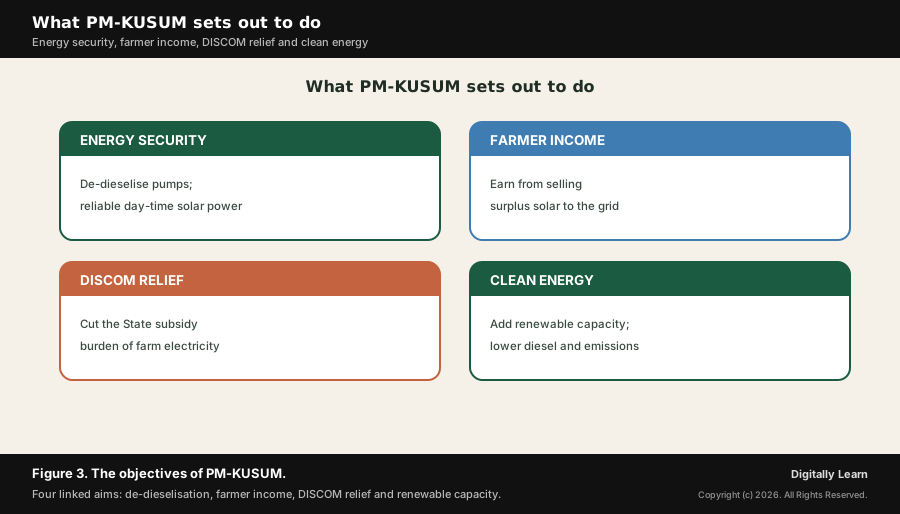
The objectives of PM-KUSUM tie its components into a single purpose. The first is de-dieselisation of the farm sector: removing the costly, polluting diesel pump and putting solar power in its place, which lowers the farmer's costs and cuts diesel use and emissions. This sits at the centre of the scheme's stated aim of giving farmers energy and water security.
The second objective is reliable day-time power for irrigation. Solar power is available precisely during daylight, when irrigation is done, so a solar pump gives the farmer assured day-time supply instead of the night-time or erratic power that grid-dependent farmers often face. The third objective is farmer income: by letting farmers sell surplus or saved solar power to the grid, the scheme turns the farm into a small source of earnings from clean energy.
The fourth objective is to ease the subsidy burden on the distribution companies and the States. Because farm electricity is heavily subsidised, every pump moved to solar power reduces the subsidy the State must pay, easing a recurring strain on State finances. The fifth objective is renewable-energy capacity: by adding solar generation across millions of farms and plots, PM-KUSUM contributes to India's wider clean-energy goals. The scheme also notes that reliable day-time solar power can help avoid the over-use of water and power. The figure below maps these aims.
The Financing and Delivery Architecture: Who Pays and Who Delivers
Central financial assistance, State and farmer shares, and the role of DISCOMs
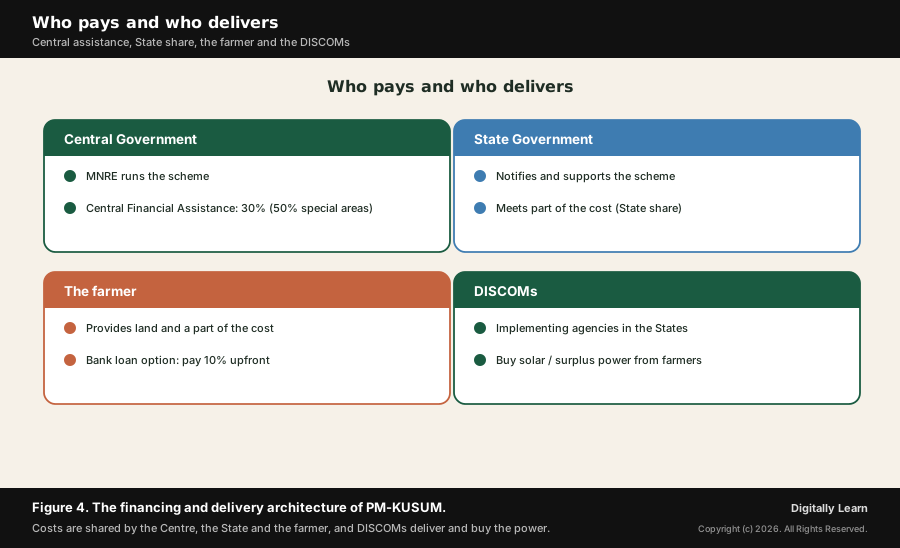
PM-KUSUM runs on a shared financing arrangement and a clear chain of delivery. At the top, the Ministry of New and Renewable Energy (MNRE) designs the scheme, issues the guidelines and provides the Central Financial Assistance (CFA). For standalone solar pumps under Component B and for the solarisation of grid-connected pumps under Component C, the Centre gives a CFA of 30 per cent of the benchmark or tender cost, whichever is lower, rising to 50 per cent in the North-Eastern States, Sikkim, Jammu and Kashmir, Himachal Pradesh, Uttarakhand, Lakshadweep and the Andaman and Nicobar Islands.
The rest of the cost is shared between the State government and the farmer. In the general design the State meets a part of the cost and the farmer the balance, and to ease the farmer's burden a bank-finance option lets the farmer pay only a small initial share, often around 10 per cent, with the remainder taken as a loan. The exact State and farmer shares have been revised over time, so the durable points to hold are the Centre's CFA of 30 per cent, the higher 50 per cent for special-category areas, and the principle of cost-sharing between the Centre, the State and the farmer.
Delivery on the ground runs through the States and their distribution companies. The DISCOMs are the implementing agencies for much of the scheme: they notify where solar plants and solarisation can take place, purchase the renewable and surplus power from farmers at the agreed tariff, and connect it to the grid. This makes the cooperation of the DISCOMs central to the scheme, since it is they who must buy the power and pay the farmer. The figure below sets out who pays and who delivers.
PM-KUSUM in Context: Renewable-Energy Targets and Farmer Welfare
How the scheme links clean-energy goals to the rural economy
PM-KUSUM is best understood as a bridge between two of India's largest policy goals. On one side stands the country's commitment to expand renewable energy and reduce its dependence on fossil fuels; the scheme aims to add a substantial block of solar capacity spread across farms, with the Ministry of New and Renewable Energy putting the target at the order of 34,800 megawatts of solar capacity by March 2026 and total central financial support of about Rs. 34,422 crore. By placing generation close to where power is used, it also reduces transmission losses.
On the other side stands the goal of farmer welfare and higher rural incomes. By cutting the farmer's energy bill, giving reliable irrigation power and creating a new stream of earnings from selling solar power, PM-KUSUM connects the clean-energy transition directly to the household economy of the farm. This is what makes the scheme distinctive: it pursues a climate and energy objective and a rural-income objective through the same instrument.
The scheme also sits within a wider family of efforts on solar energy and farm power. It complements India's broader solar mission and its push for distributed and rooftop solar, and it speaks to the long-standing problem of the energy-water-agriculture nexus, the tangled link between cheap farm power, irrigation and the use of groundwater, which the next section weighs. PM-KUSUM is thus one part of a larger attempt to make Indian agriculture both cleaner and more secure.
Challenges and Debates: Uptake, Finance, Groundwater and DISCOM Coordination
The pace of uptake, the farmer's finance, the groundwater concern and the DISCOMs
A balanced reading must weigh the debates around PM-KUSUM. The first is the pace of uptake and implementation. Translating an ambitious national target into solar plants and pumps on millions of farms is slow and uneven work, and progress on the ground has often lagged the scheme's goals, so the gap between announced targets and actual delivery is a recurring concern. Targets for the components have themselves been revised over time.
A second challenge is land and finance for farmers. A solar pump or a small solar plant is a substantial upfront cost, and even with central assistance the farmer's own share, and the need to arrange a bank loan, can be a real barrier for small and marginal farmers. The availability of low-cost finance, and the State's share of the funds, have been identified as major challenges in putting the scheme into practice, so that the poorest farmers risk being left behind.
A third, much-discussed concern is groundwater. Because solar power, once installed, costs the farmer almost nothing to run, some analysts caution that free solar power could encourage farmers to pump even more groundwater, deepening the over-extraction that decades of subsidised farm electricity have already caused in many regions. Others argue that the scheme can be designed to pull the other way: by paying farmers for surplus or saved power, it gives them a reason to use less and sell more, rewarding water-use efficiency. The balance of this risk depends on how the scheme is implemented, and it is fair to present it as an open question rather than a settled one.
A fourth challenge is DISCOM coordination. The scheme depends on the distribution companies to notify capacity, buy the solar and surplus power and pay the farmer, yet many DISCOMs are financially stressed and slow to act. Where their cooperation falters, plants go unbuilt and farmers go unpaid, so strengthening the DISCOMs and their incentives is widely seen as essential to the scheme's success.
On the central question of how far PM-KUSUM can deliver clean power, farm incomes and water security together, a careful answer presents both the promise and the unresolved difficulties rather than treating the matter as settled.
The Way Forward: From Targets to Take-Up on the Farm
Affordable finance, water-smart design and stronger distribution companies
The way forward for PM-KUSUM follows from its own challenges. The first priority is affordable finance and faster take-up: simpler procedures, assured State shares and low-cost credit so that small and marginal farmers, not only the better-off, can install solar pumps and plants, closing the gap between the national target and what is actually built on the farm.
The second priority is a water-smart design that turns the groundwater risk into an opportunity. Pairing solar power with payment for surplus or saved power, with metering, and with encouragement for efficient irrigation can reward farmers for using less water rather than more, so that cheaper energy does not become a license to over-pump. The third priority is to strengthen the distribution companies and their incentives, so they can reliably buy and pay for the power farmers generate. Pursued together, these can help PM-KUSUM deliver clean energy, higher farm incomes and water security at the same time.
UPSC Relevance and Exam Focus
Where PM-KUSUM fits in the UPSC-CSE syllabus
This topic maps most directly to General Studies Paper III: agriculture and the issues of farm irrigation and farmer incomes, energy and the development of renewable sources, and the economy. It connects the farm sector, the power sector and the clean-energy transition, and it is a strong example of a single scheme that cuts across agriculture, energy and the environment.
For Prelims, hold the high-yield facts: PM-KUSUM, the Pradhan Mantri Kisan Urja Suraksha evam Utthaan Mahabhiyan, was launched in 2019 under the Ministry of New and Renewable Energy; it has three components, Component A, decentralised grid-connected solar plants of up to 2 MW on farmers' land sold to DISCOMs; Component B, standalone solar pumps that replace diesel pumps off-grid; and Component C, the solarisation of grid-connected pumps, including feeder-level solarisation; and the Centre gives a Central Financial Assistance of 30 per cent, rising to 50 per cent for the North-Eastern and hilly States and the Islands.
For Mains, the recurring framing is to assess how PM-KUSUM advances farmer welfare and the renewable-energy transition at once, and to weigh its challenges. A strong answer treats the scheme as a case study in linking clean energy to the rural economy and in cooperative federalism, balancing the real gains in de-dieselisation, day-time irrigation power, farm income and DISCOM relief against the unresolved problems of uptake, farmer finance, the groundwater risk and DISCOM coordination.
Recurring linked concepts an aspirant should keep in working memory:
- De-dieselisation and day-time power: Replacing diesel pumps with solar power and giving farmers reliable irrigation power during daylight hours.
- The three components: Component A solar plants, Component B standalone pumps and Component C solarisation of grid-connected pumps, including feeder-level solarisation.
- Central financial assistance and cost-sharing: The Centre’s 30 per cent assistance (50 per cent in special areas), with the State and the farmer meeting the balance.
- The energy-water-agriculture nexus: The link between cheap farm power, irrigation and groundwater, and the debate over whether free solar power eases or worsens over-extraction.
A common Prelims trap is to confuse PM-KUSUM with a general solar mission or a crop-insurance or fertiliser scheme, or to misattribute it to the agriculture ministry; hold that PM-KUSUM is the solar-for-agriculture scheme of the Ministry of New and Renewable Energy, built around the three components A, B and C.
A common Mains trap is to present the scheme as an unmixed success. Its exam value lies in a balanced judgment: the genuine gains in clean energy, farm income and lower diesel and subsidy costs, set honestly against the open questions of slow uptake, the farmer's finance, the groundwater-over-extraction risk and the readiness of the distribution companies.
Previous Year UPSC-CSE Questions By the end you will be able to draft model answers for the following UPSC questions. Each question carries a collapsible framework showing how to approach it in the exam.
- UPSC Mains 2024 GS-IIISet out the major recent challenges of the Indian irrigation system and the measures the government has taken for efficient irrigation management.
How to structure the answer in the exam
Body (sub-themes to develop):
- The challenges, energy and cost: a vast number of farm pumps run on expensive, polluting diesel or on subsidised but erratic, often night-time grid power, raising the farmer's costs and the unreliability of irrigation.
- The challenges, subsidy and sustainability: the heavy agricultural-electricity subsidy is a recurring drain on State and DISCOM finances, and subsidised or free farm power has driven the over-extraction of groundwater in many regions.
- The government's measure, PM-KUSUM: de-dieselisation through standalone solar pumps, reliable day-time solar power, the solarisation of grid-connected pumps including feeder-level solarisation, and decentralised solar plants on farmers' land.
- Efficient management and incentives: paying farmers for surplus or saved solar power rewards using less water, the central financial assistance and cost-sharing that fund the scheme, and the role of the DISCOMs.
- A balanced judgment: the gains in cleaner, cheaper, more reliable irrigation power and lower subsidies, set against slow uptake, the farmer's finance, the groundwater risk and the readiness of the distribution companies, and the way forward of affordable finance, water-smart design and stronger DISCOMs.
Sources and Further Reading
- Ministry of New and Renewable Energy: Pradhan Mantri Kisan Urja Suraksha evam Utthaan Mahabhiyaan (PM-KUSUM)
- National Portal for PM-KUSUM, Ministry of New and Renewable Energy
- Press Information Bureau: Pradhan Mantri Kisan Urja Suraksha evam Utthaan Mahabhiyan (PM-KUSUM) Fact Sheet
- Press Information Bureau: MNRE expands scope of the PM-KUSUM Scheme to enable greater solar energy generation in the farm sector
- Press Information Bureau: MNRE issues Guidelines for Implementation of Feeder Level Solarisation under Component-C of PM-KUSUM
- Press Information Bureau: Availability of low-cost financing for farmers and State share of funds, a major challenge in implementation of PM-KUSUM
- NITI Aayog: Energy division, on the energy-water-agriculture nexus and groundwater
- Ministry of Finance: Economic Survey, chapter on agriculture, energy and the rural economy
- Wikipedia: PM-KUSUM
Editorial Disclaimer
This briefing is for UPSC preparation. Verify the facts and provisions against the official MNRE and PIB sources before relying on them.


