


Overview
India's Blue Revolution in fisheries and aquaculture
A flagship mission launched in 2020 under the Atmanirbhar Bharat package with an investment of about Rs 20,050 crore, PMMSY drives the Blue Revolution, raising fish production, building the aquaculture value chain and lifting the incomes and exports of fishers and fish farmers across India.
Pradhan Mantri Matsya Sampada Yojana, or PMMSY, is India's flagship fisheries and aquaculture mission, launched in 2020 as part of the Atmanirbhar Bharat package with an investment of about Rs 20,050 crore for the period 2020-21 to 2024-25. Run by the Department of Fisheries under the Ministry of Fisheries, Animal Husbandry and Dairying, it is delivered through a Central Sector Scheme and a Centrally Sponsored Scheme, and invests along the whole value chain to raise fish production toward 220 lakh tonnes, lift exports, double fishers' incomes and cut post-harvest losses, driving India's Blue Revolution.
What PMMSY Is: The 2020 Atmanirbhar Bharat Launch and the Blue Revolution Mandate
The 2020 launch under the Atmanirbhar Bharat package, the Rs 20,050 crore investment, the 2020-21 to 2024-25 period and the Department of Fisheries as the nodal body
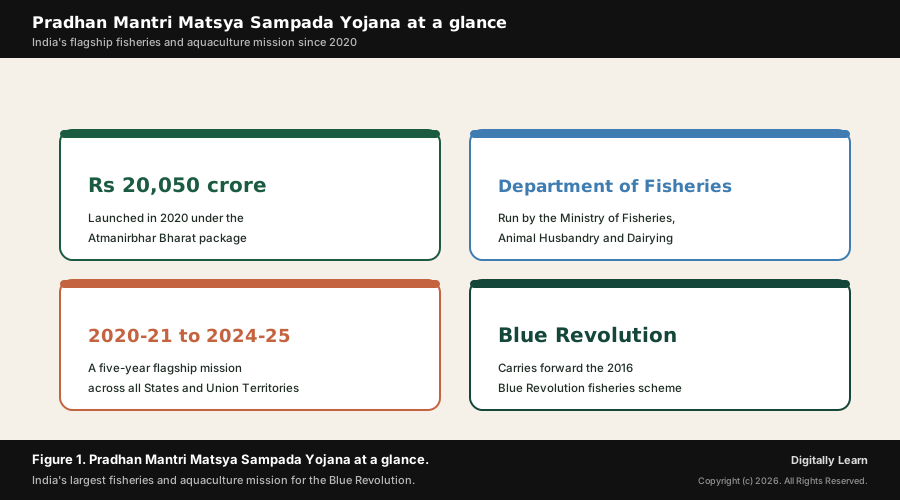
The Pradhan Mantri Matsya Sampada Yojana, almost always shortened to PMMSY, is India's flagship mission for fisheries and aquaculture. It was launched in 2020 as part of the Atmanirbhar Bharat package, with the highest ever investment in the sector, about Rs 20,050 crore, and it is run by the Department of Fisheries. Its purpose is the focused, sustainable development of fishing and fish farming so that the sector lifts incomes, food supply and exports together.
The mission runs for a fixed period, the five years from 2020-21 to 2024-25, and it operates in every State and Union Territory. It sits inside the Ministry of Fisheries, Animal Husbandry and Dairying, the dedicated ministry carved out in 2019 to give the sector its own home in government. PMMSY did not begin from a blank slate; it carries forward and enlarges an earlier Blue Revolution scheme that had funded fisheries development since 2016.
Why it matters is the scale of the bet. By bringing money, infrastructure and welfare under a single mission, PMMSY treats fisheries not as a side activity but as a sunrise sector of the rural economy, one that can grow fast, employ millions and earn foreign exchange. The figure below sets out the mission at a glance before the briefing turns to what the Blue Revolution means and why India needed a flagship scheme.
Defining the Blue Revolution: India's Fisheries Standing and the Case for a Flagship Mission
What the Blue Revolution means, India's place as a leading fish and aquaculture producer, and the gaps that a flagship mission was created to close
The Blue Revolution is to fish what the Green Revolution was to grain. It means a rapid, science-led rise in fish production through the planned development of inland and marine fisheries and, above all, aquaculture, the farming of fish and shellfish in ponds, tanks, cages and coastal waters. The idea is to move from chance capture to deliberate cultivation, raising output, incomes and nutrition while keeping the resource base healthy for the future.
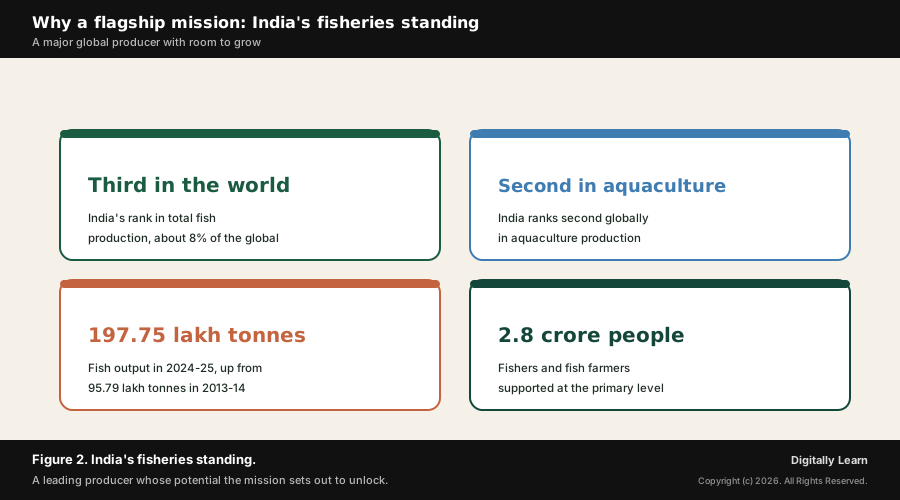
India already stands among the world's leaders. It is the third largest producer of fish, contributing about 8 per cent of global output, and ranks second in aquaculture, with recent government statements reporting a further rise. Total fish output climbed from about 95.79 lakh tonnes in 2013-14 to 197.75 lakh tonnes in 2024-25. The sector supports roughly 2.8 crore fishers and fish farmers at the primary level and is among the country's largest earners of farm export income.
What is the significance of this strength is that the potential still runs far ahead of the reality. Productivity per hectare is low, much of the catch is lost after landing, infrastructure is thin and credit reaches few, so a leading producer still farms below its capacity. PMMSY was created to close exactly these gaps, turning India's natural advantage in water and coastline into steady, well-paid livelihoods. The figure below sets out this standing that the mission builds upon.
The Two Components: Central Sector Scheme and Centrally Sponsored Scheme
The Central Sector Scheme funded fully by the centre, the Centrally Sponsored Scheme shared with the states, and the split between beneficiary-oriented and non-beneficiary activities
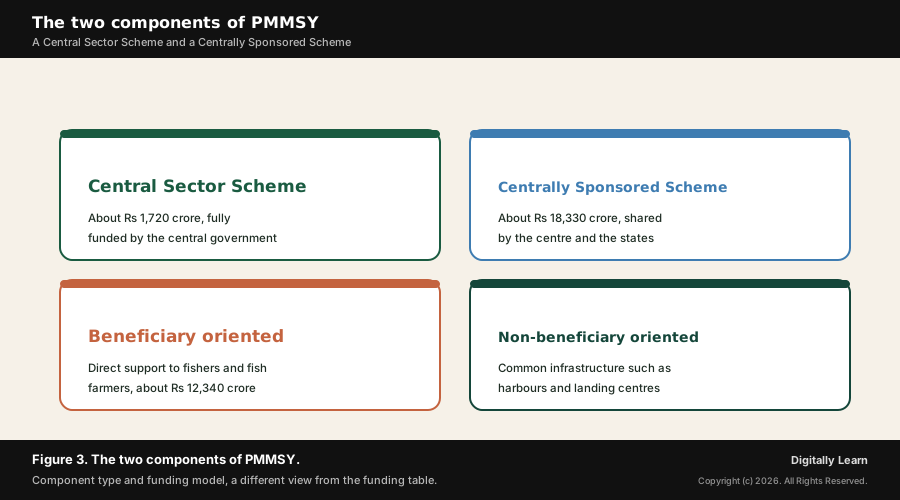
PMMSY is an umbrella mission delivered through two components. The first is the Central Sector Scheme, with an outlay of about Rs 1,720 crore, funded fully by the central government and used mainly for activities of national importance carried out by central agencies. It is the smaller of the two, the part the centre runs directly without a matching contribution from the states.
The second and far larger component is the Centrally Sponsored Scheme, with an investment of about Rs 18,330 crore, implemented by the States and Union Territories with central assistance. It is split into two kinds of work. Beneficiary-oriented activities, worth about Rs 12,340 crore, give direct support to fishers and fish farmers, while non-beneficiary-oriented activities fund common infrastructure such as harbours and landing centres that serve the whole community.
This design lets PMMSY share the cost with the states while still steering the mission from the centre. The whole investment of about Rs 20,050 crore is met from three pockets: a central share of about Rs 9,407 crore, a state share of about Rs 4,880 crore, and a beneficiaries' contribution of about Rs 5,763 crore. The figure sets out the two components and the table breaks down where the money comes from.
| Source of funds | Amount (about, Rs crore) | Note |
|---|---|---|
| Central government share | 9,407 | The largest single share of the outlay |
| State and Union Territory share | 4,880 | Through the Centrally Sponsored Scheme |
| Beneficiaries' contribution | 5,763 | Fishers and fish farmers' own stake |
The Objectives and Targets: Production, Exports, Incomes, Post-Harvest Losses and Employment
Raising fish production toward 220 lakh tonnes, lifting exports toward Rs 1,00,000 crore, doubling fishers' incomes, cutting post-harvest losses and generating employment
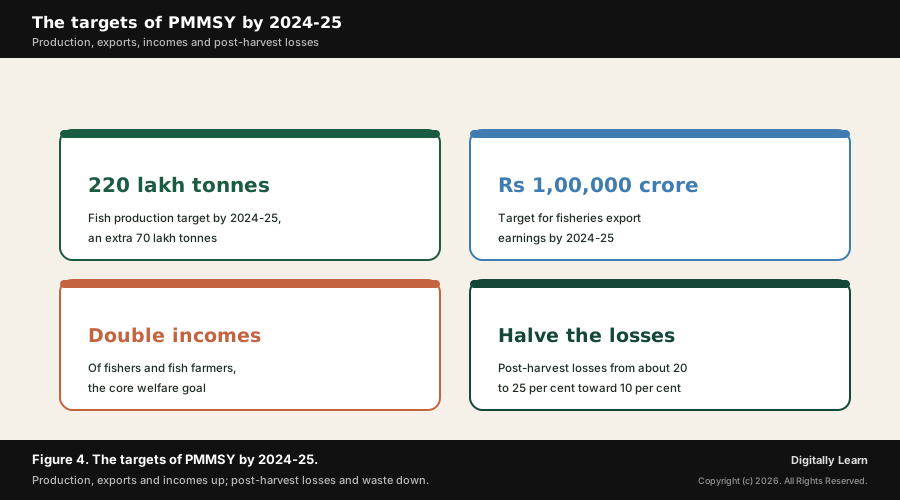
PMMSY is built around a small set of clear, measurable targets for 2024-25. The headline goal is to raise fish production by an extra 70 lakh tonnes to about 220 lakh tonnes, a steep rise from the level at launch. The second is to lift fisheries exports toward Rs 1,00,000 crore, building on India's strength in farmed shrimp, which is the single largest item in the country's seafood export basket.
The remaining goals turn output into welfare. The mission aims to double the incomes of fishers and fish farmers, the social heart of the scheme, and to cut post-harvest losses from about 20 to 25 per cent toward about 10 per cent, since a fifth of the catch is today wasted for want of ice, cold storage and quick transport. It also seeks to generate about 55 lakh direct and indirect jobs along the value chain.
These targets matter because they tie a large investment to outcomes the public can check, not just to spending. Higher production feeds a growing population and earns exports; a smaller post-harvest loss means the same catch feeds more people and fetches a better price; doubled incomes and new jobs spread the gain to the poorest fishing households. The figure below sets out the main targets the mission works toward.
The Fisheries Value Chain PMMSY Funds: From Seed and Ponds to Cold Chain and Markets
How the mission invests at every link, from hatcheries and quality seed, through grow-out ponds, recirculatory systems and cages, to landing, cold chain, transport and markets
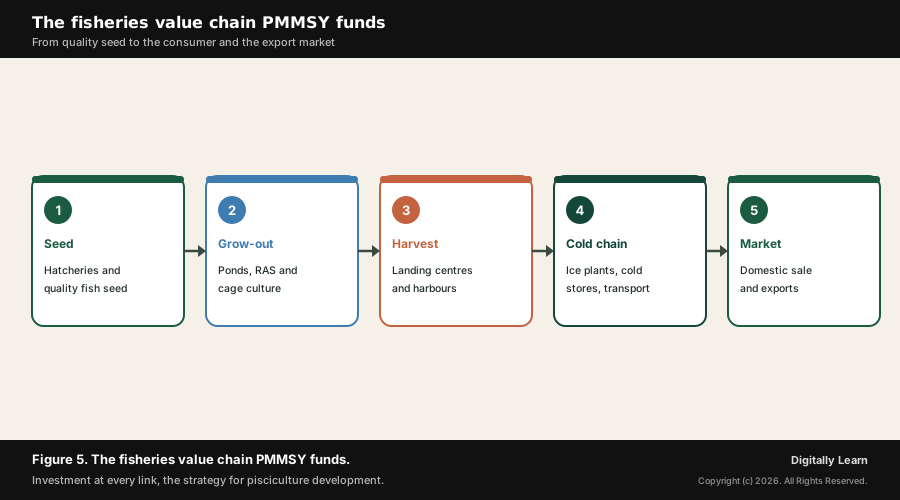
The strategy of PMMSY is to invest at every link of the fisheries chain rather than at one point alone. It begins with the seed, funding hatcheries and brood banks so that farmers get healthy, fast-growing young fish, because poor seed is one of the deepest weaknesses of Indian pisciculture. From there the money moves to grow-out, the ponds and systems where the fish are raised to market size.
In the grow-out stage the mission supports a wide range of methods. It funds new and renovated ponds, Recirculatory Aquaculture Systems that reuse and clean water to raise fish in a small footprint, and cage culture in reservoirs and the open sea, along with brackish-water shrimp farming and even seaweed and ornamental fish. The aim is to spread risk across many products and to raise the yield from each unit of water and land.
The chain does not end at harvest. PMMSY pays for fishing harbours and landing centres where the catch comes ashore, for the cold chain of ice plants, cold stores and insulated transport that keeps fish fresh, and for markets at home and the processing that feeds exports. By funding the whole chain, the mission attacks the heavy post-harvest loss that has long eaten into the value of Indian fish. The figure below traces this value chain step by step.
The Institutional and Financial Architecture: Department of Fisheries, FIDF, Kisan Credit Card and Insurance
The Department of Fisheries under its own ministry, the Fisheries and Aquaculture Infrastructure Development Fund, the Kisan Credit Card for fishers, insurance and Fish Farmers Producer Organisations
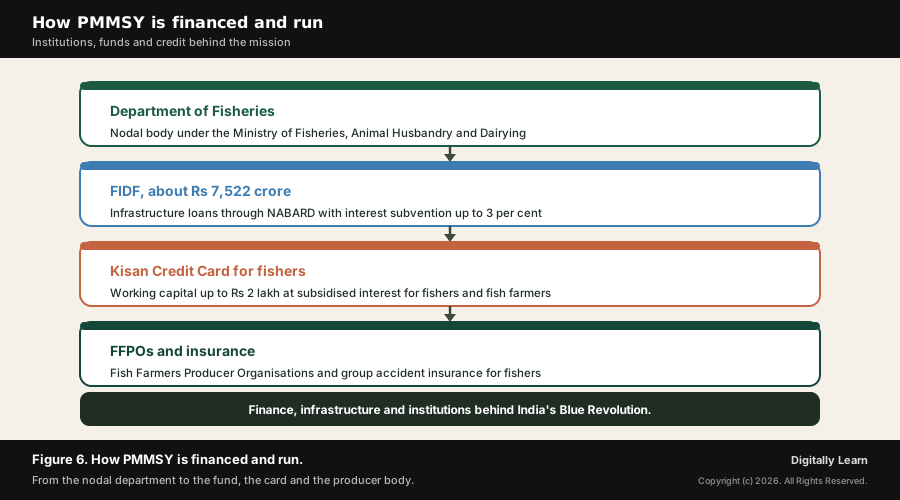
PMMSY is run by the Department of Fisheries within the Ministry of Fisheries, Animal Husbandry and Dairying, the dedicated ministry created in 2019. Having a department and ministry of its own gives the sector a clear nodal authority that frames the scheme, releases funds and monitors progress, in place of the divided attention it once received as a small part of the agriculture ministry.
Money for big infrastructure comes through a dedicated fund. The Fisheries and Aquaculture Infrastructure Development Fund, set up in the 2018-19 Budget with a corpus of about Rs 7,522 crore, lends for harbours, cold chains and other large assets through NABARD, the National Cooperative Development Corporation and scheduled banks, with the government meeting an interest subvention of up to 3 per cent a year. It works alongside PMMSY rather than within it, financing the heavy assets the mission needs.
Credit and security for individuals come through other tools. The Kisan Credit Card was extended to fishers and fish farmers, offering working capital of up to about Rs 2 lakh at a subsidised rate to buy feed, seed and fuel. The mission also supports group accident insurance for fishers and the formation of Fish Farmers Producer Organisations, which pool small producers so they can buy inputs and sell their catch on better terms. The figure below sets out this architecture.
The Geography of Indian Fisheries: Inland, Marine and Aquaculture, the EEZ and Leading States
The three arms of inland, marine and aquaculture fisheries, the Exclusive Economic Zone and deep-sea fishing, and the leading states such as Andhra Pradesh
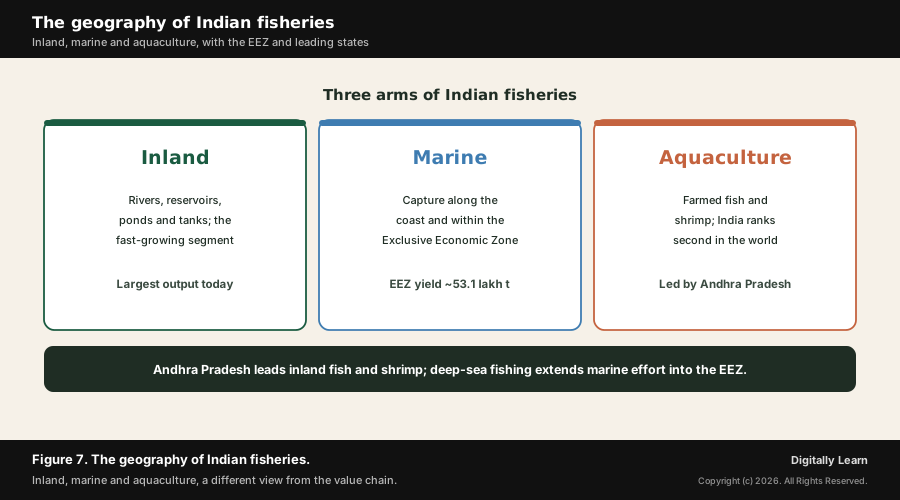
Indian fisheries rest on three arms. Inland fisheries, in rivers, reservoirs, ponds and tanks, are now the fast-growing and largest source of fish, driven above all by freshwater aquaculture. Marine fisheries work the long coastline and the seas beyond it, while aquaculture, the farming rather than catching of fish and shrimp, is the segment in which India ranks second in the world and where most of the recent growth has come.
The sea offers room to grow. India's Exclusive Economic Zone, the belt of ocean up to 200 nautical miles offshore, has an estimated potential yield of about 53.1 lakh tonnes, much of it in deeper waters that small traditional boats cannot reach. PMMSY therefore supports deep-sea fishing vessels and the modernisation of craft, so that marine effort can move beyond the crowded inshore zone where stocks are already under heavy pressure.
Production is concentrated in a few leading states. Andhra Pradesh is the largest producer of fish and the country's top seafood exporter, the hub of its inland and brackish-water shrimp aquaculture, followed in inland output by West Bengal, Uttar Pradesh, Bihar and Odisha. Coastal states such as Gujarat, Tamil Nadu and Kerala anchor the marine catch, while seaweed farming is being promoted through a dedicated park in Tamil Nadu. The figure below sets out this geography.
The Problems of Pisciculture: Quality Seed, Disease, Post-Harvest Loss, Credit Gaps and Sustainability
The shortage of quality seed and brood, disease in aquaculture, heavy post-harvest losses, gaps in credit and insurance, weak infrastructure, and the pressures of overfishing and climate
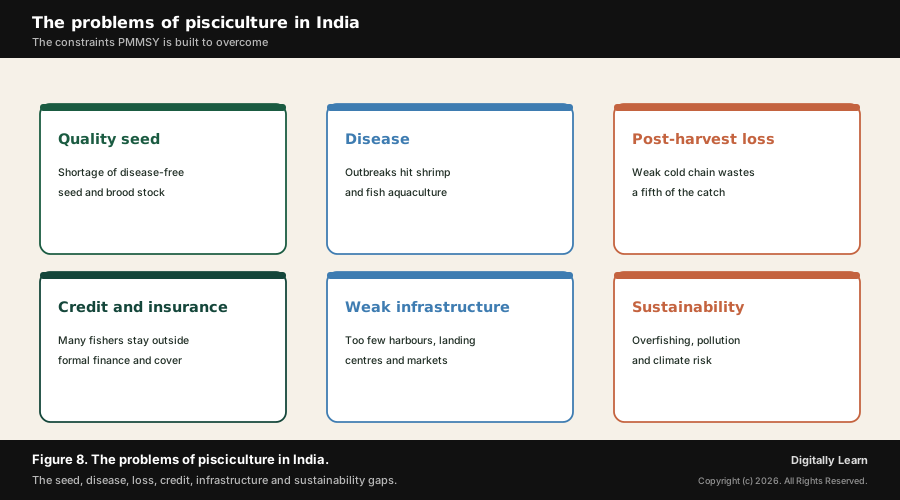
For all its promise, pisciculture in India is held back by a chain of problems. The first lies at the very start, in the seed. Farmers often cannot get enough disease-free, fast-growing fish seed and good brood stock, so yields stay low and uneven. Close behind comes disease, which can sweep through crowded shrimp and fish ponds and wipe out a season's investment, a risk that grows as farming intensifies.
The next problems lie downstream. Post-harvest losses are heavy, with about a fifth of the catch spoiled for want of ice, cold storage and quick transport, so value is lost between the pond and the plate. Many fishers also remain outside formal credit and insurance, depending on traders and moneylenders, while infrastructure is thin: too few modern harbours, landing centres, cold chains and markets to handle a fast-growing output.
A final set of problems concerns sustainability. Inshore marine stocks are under pressure from overfishing, pollution and the use of destructive gear, and climate change brings warmer, more acidic seas and fiercer cyclones that threaten both the catch and coastal farms. These weaknesses, in seed, disease, losses, credit, infrastructure and sustainability, are the very problems of pisciculture that a Blue Revolution strategy must solve. The figure below sets them out together.
The Way Forward: Strategies for Sustainable Pisciculture Development
Strengthening quality seed and disease control, completing the cold chain, deepening credit and insurance, diversifying products and securing sustainability
The strategy that follows from these problems is to strengthen every weak link at once, which is the logic of PMMSY itself. That means better seed and brood from certified hatcheries, firm control of disease through biosecurity and surveillance, and a complete cold chain so that less of the catch is lost. It also means carrying formal credit and insurance to the ordinary fisher and producer organisation, not only to the large farm.
Growth must also be made to last. India should diversify into mariculture, seaweed and ornamental fish, move marine effort from the crowded inshore zone toward the deep sea under proper rules, and protect breeding stocks through closed seasons and responsible gear. Above all the gains must reach the small fisher, with traceability and quality standards opening export markets. The measures below set out a balanced path for sustainable pisciculture development.
- Expand certified hatcheries and brood banks so that farmers get healthy, fast-growing and disease-free fish seed.
- Control disease through biosecurity, surveillance and better pond and water management in aquaculture.
- Complete the cold chain of ice plants, cold stores and insulated transport to cut post-harvest losses toward 10 per cent.
- Deepen formal credit and insurance for fishers through the Kisan Credit Card, group insurance and producer organisations.
- Diversify into mariculture, seaweed, bivalves and ornamental fish to spread risk and raise rural incomes.
- Move marine effort toward the deep sea under sustainable rules, with closed seasons and responsible gear to protect stocks.
- Strengthen traceability and quality standards to open export markets and to ensure the small fisher shares the gain.
UPSC Relevance: Prelims Pointers, the Mains Framing and Linked Schemes
The GS-III economy and allied agriculture fit with a GS-I geography crossover, the facts to remember, the Blue Revolution and pisciculture framing, and the related schemes to distinguish
For the examination, PMMSY sits mainly in GS-III, under the economy, allied agriculture and inclusive growth, with a clear crossover into GS-I geography on fisheries resources and the Blue Revolution. The facts worth fixing for Prelims are the 2020 launch under Atmanirbhar Bharat, the Rs 20,050 crore investment, the Department of Fisheries as the nodal body, the two components, and the supporting tools of FIDF, the Kisan Credit Card and Fish Farmers Producer Organisations.
For Mains, PMMSY is the worked example for answers on the Blue Revolution and on the problems and strategies of pisciculture. It lets a student define the Blue Revolution, set out the real problems of Indian fish farming, in seed, disease, losses, credit and sustainability, and then show how a value-chain strategy answers them. It also serves answers on doubling farmers' incomes, the blue economy, food and nutrition security, and rural employment.
PMMSY should be distinguished from the schemes it works beside. It carries forward the earlier Blue Revolution scheme of 2016 and is supported by the FIDF for infrastructure, while the later Pradhan Mantri Matsya Kisan Samridhi Sah-Yojana adds a focus on small enterprises and formalisation. Read together, these show PMMSY as the central instrument of India's Blue Revolution, the form in which it is most useful in the examination.
Previous Year UPSC-CSE Questions By the end you will be able to draft model answers for the following UPSC questions. Each question carries a collapsible framework showing how to approach it in the exam.
- UPSC Mains 2018 GS-IDefining Blue Revolution, explain the problems and strategies for pisciculture development in India.
How to structure the answer in the exam
Body (sub-themes to develop):
- Define and frame: the Blue Revolution mirrors the Green Revolution, shifting from chance capture to deliberate cultivation, with inland aquaculture as the engine and PMMSY (2020, about Rs 20,050 crore) as the flagship scheme.
- Problems of pisciculture, part one: shortage of quality, disease-free fish seed and brood stock, disease outbreaks in intensive shrimp and fish farming, and low productivity per hectare.
- Problems of pisciculture, part two: heavy post-harvest losses of about 20 to 25 per cent from a weak cold chain, gaps in formal credit and insurance for ordinary fishers, thin infrastructure of harbours and markets, and unsustainable pressure on inshore marine stocks.
- Strategies, part one: invest along the whole value chain as under PMMSY, from hatcheries and grow-out ponds, recirculatory systems and cage culture, to landing centres, cold chain and markets, backed by the FIDF for infrastructure and the Kisan Credit Card for working capital.
- Strategies, part two: diversify into mariculture, seaweed and ornamental fisheries, move marine effort to the deep sea under sustainable rules, strengthen Fish Farmers Producer Organisations, traceability and quality standards, with examples such as Andhra Pradesh shrimp and the Tamil Nadu seaweed park.
Relevance to this topic. The article defines the Blue Revolution, teaches the problems of pisciculture (seed, disease, post-harvest loss, credit and sustainability) and the value-chain strategies, with examples such as Andhra Pradesh shrimp aquaculture and the Tamil Nadu seaweed park, so a student who reads only this article can attempt the question.
Sources and Further Reading
- Department of Fisheries: Pradhan Mantri Matsya Sampada Yojana, framework and guidelines
- Press Information Bureau: Cabinet approves PMMSY for boosting the fisheries sector
- Press Information Bureau: PMMSY targets and the Blue Revolution
- NABARD: financing of rural and fisheries infrastructure as a Nodal Loaning Entity for the FIDF
- Department of Fisheries: Kisan Credit Card for fishers and fish farmers
- MPEDA: state-wise aquaculture and seafood exports
- FAO: The State of World Fisheries and Aquaculture (SOFIA), India's global standing
- Wikipedia: Pradhan Mantri Matsya Sampada Yojana
Editorial Disclaimer
This briefing is for UPSC preparation. Verify the figures against the official PMMSY, Department of Fisheries and Press Information Bureau sources before relying on them.


