


Overview
India's legal guarantee of 100 days of rural wage work, 2006 to 2026
MGNREGA, the Mahatma Gandhi National Rural Employment Guarantee Act of 2005, gave every rural household a legal right to up to 100 days of unskilled wage work a year, delivered on demand through the Gram Panchayat. It was repealed on 1 July 2026 and replaced by the VB-G RAM G Act, 2025.
MGNREGA, the Mahatma Gandhi National Rural Employment Guarantee Act of 2005, gave every rural household a legal right to up to 100 days of unskilled manual wage employment in a financial year, on demand. It was run by the Ministry of Rural Development and delivered through the States and their Gram Panchayats, with the Gram Sabha planning and auditing the works. What set it apart is that the work was a justiciable entitlement: if it was not given within 15 days of a demand, the worker was owed an unemployment allowance. The Act tied the wages to durable rural assets, fixed a 60:40 wage-material ratio so that most of the money reached labour, and reserved at least a third of the work for women.
What MGNREGA Was: India's First Justiciable Right to Rural Wage Employment
The 2005 Act, the shift from schemes to a legal guarantee of work
The Mahatma Gandhi National Rural Employment Guarantee Act, known as MGNREGA, was the law through which the Indian state promised every rural household up to 100 days of guaranteed wage employment in a financial year, in return for unskilled manual labour. The Act was passed in 2005 and its implementation began on 2 February 2006, first in 200 of the poorest districts, before it was extended in phases to cover all the rural districts of the country by 1 April 2008. It was run by the Ministry of Rural Development and it remained in force for just over twenty years, until 30 June 2026.
The defining feature of MGNREGA was that work was a legal right rather than a discretionary favour. Earlier wage-employment programmes, such as the National Rural Employment Programme and the later Sampoorna Grameen Rozgar Yojana, gave the rural poor work where funds and political will allowed, but no household could claim it. MGNREGA reversed that logic: the entitlement was justiciable, so a household that demanded work and was denied it could seek the law's protection, and the State had either to supply the work or pay an allowance for failing to.
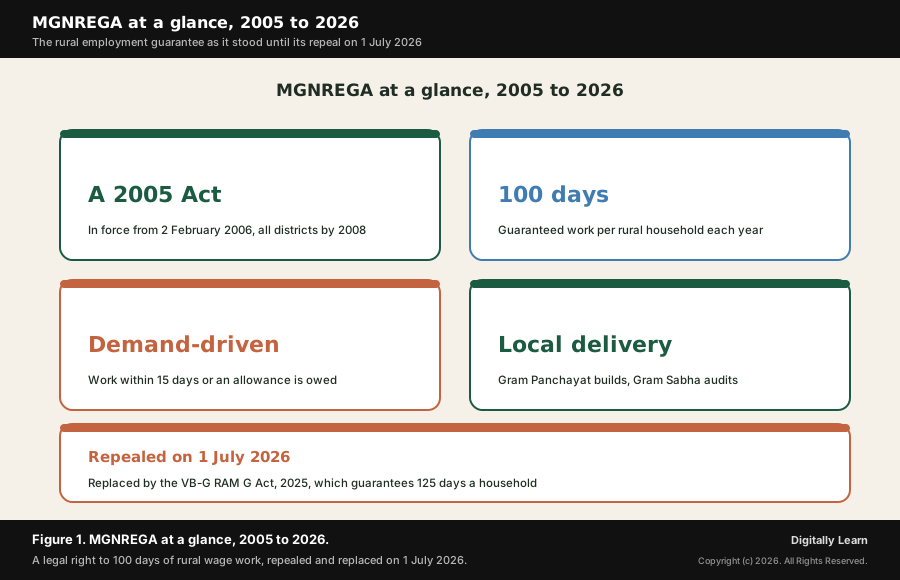
Why it matters is that this rights-based design made MGNREGA the world's largest such guarantee of work and a recurring subject of debate for two decades, and that the statute which replaced it was written against that record. The Act was renamed in 2009 in honour of Mahatma Gandhi, signalling its place in the tradition of self-reliant village development. The figure below sets out its headline features, the facts an aspirant should hold before the detail that follows.
The Repeal of 2026: How the VB-G RAM G Act Replaced MGNREGA
The statute that repealed MGNREGA, what changed and what carried over
The replacement moved quickly. The Viksit Bharat, Guarantee for Rozgar and Ajeevika Mission (Gramin) Bill was introduced in the Lok Sabha on 16 December 2025, passed by the Rajya Sabha in the early hours of 19 December 2025 and received presidential assent on 21 December 2025. The Ministry of Rural Development then notified its commencement across all rural areas from 1 July 2026, and MGNREGA stood repealed from the same date. For twenty years and five months, from February 2006 to June 2026, the 2005 Act was the operative law of rural employment in India.
The successor keeps the shape of the guarantee and changes its terms. The statutory entitlement rises from 100 to 125 days a household a financial year; an interim base wage of Rs 300 a day replaces notified rates that ran as low as Rs 241; the job card gives way to a Gramin Rozgar Guarantee Card, with existing verified cards valid until the new ones are issued; and the cost is shared 60:40 between the Centre and the States, and 90:10 for the north-eastern States and the Union Territories. Permissible work is organised around four declared domains: water security, rural infrastructure, livelihood infrastructure and the mitigation of extreme weather events.
Two changes go to the character of the right, and they are where the contest lies. Funding moves from the open-ended, demand-driven model of the 2005 Act to annual normative allocations, with expenditure beyond the allocation falling on the State government, a shift opposition members criticised as converting a guarantee into a budgeted scheme. States may also notify up to 60 days a year, during sowing or harvesting, when employment may be suspended. What carries over is the architecture MGNREGA built: the Gram Panchayat as the implementing unit, the Gram Sabha choosing the works, social audit and public disclosure, and payment by direct transfer. The full treatment of the new law is in the briefing on the VB-G RAM G Act, 2025; the sections that follow return to MGNREGA as it stood.
The Core Entitlements: 100 Days, Demand-Driven Work and the Unemployment Allowance
The hundred-day guarantee, the job card and the 15-day rule
At the heart of the Act lay a simple promise. Every rural household whose adult members were willing to do unskilled manual work was entitled to at least 100 days of wage employment in a financial year, with the option of more days in areas hit by drought or notified calamity. The unit of the guarantee was the household, not the individual, so the hundred days were shared among the adults of a family who chose to work, and the right belonged to every household, not only to those officially counted as poor.
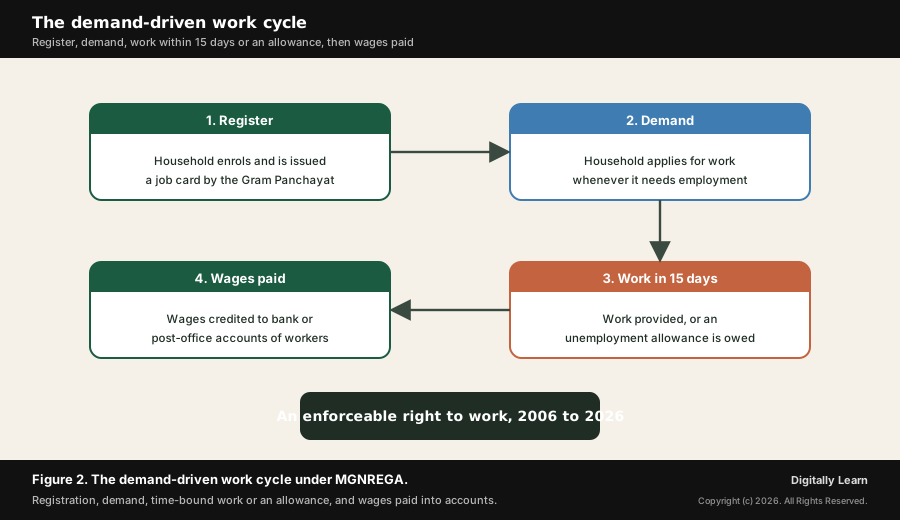
The right was exercised through a job card. A household registered with its Gram Panchayat, was verified and was issued a job card that listed its adult members and recorded the days of work and wages it received. The card was both the proof of entitlement and a check against fraud, because the days worked and the wages paid were written on it and could be matched against the muster rolls. Holding a job card, the household could then demand work whenever it needed it, which is the feature that made the programme demand-driven rather than supply-led.
The demand triggered a time-bound duty on the State. Once a household applied for work, employment had to be provided within 15 days, ordinarily within five kilometres of the home; if it was farther, an extra allowance was due. Should the administration fail to provide work within that window, the household became entitled to an unemployment allowance paid by the State Government, the legal teeth that turned the guarantee from a promise into an enforceable claim. The figure below traces this demand-to-work cycle.
The MGNREGA wage rate, Section 6 and indexation to rural prices
The wage a worker earned was set not by the open market but by a notified MGNREGA wage rate, fixed separately for each State. Under Section 6 of the Act, the Central Government had the power to notify these wage rates, and from January 2009 it used that power to fix the programme's wages independently of the State Minimum Wages Act. The wage was to be paid for a day's measured task, and payment had to reach the worker promptly, ordinarily within fifteen days of the work being done.
To protect the wage against inflation, the Ministry of Rural Development revised it every year using the Consumer Price Index for Agricultural Labour, the price measure most relevant to the rural poor. Indexing the wage in this way was meant to keep its real value from being eaten away by rising prices, though, as a later section explains, whether the indexed MGNREGA wage kept pace with the statutory minimum wage for farm labour was one of the programme's most contested questions and a central argument in the case for replacing it.
The Institutional Architecture: From the Ministry of Rural Development to the Gram Sabha
The Ministry of Rural Development, the States, the District Programme Coordinator and the Programme Officer
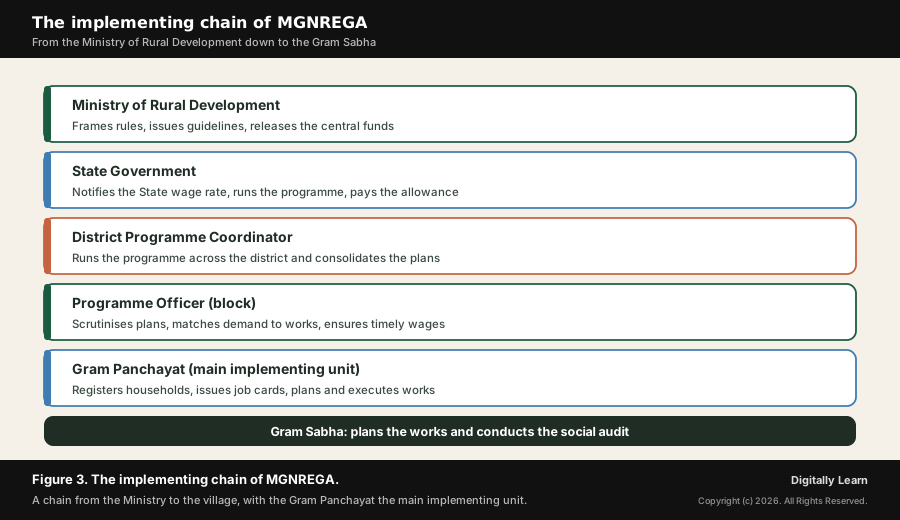
MGNREGA was delivered through a chain of authorities that ran from New Delhi down to the village. At the top, the Ministry of Rural Development framed the rules, issued guidelines and released the central share of the funds, and a Central Employment Guarantee Council advised it. Below the Ministry, each State Government, advised by its own State Employment Guarantee Council, set the State wage rate within the law, ran the programme and bore a share of the cost, most visibly the unemployment allowance, which was a State liability.
At the district and block levels sat the officers who made the guarantee operational. The District Programme Coordinator, usually the head of the district administration, was responsible for the programme across the district, consolidating the plans and overseeing the works. Under that officer, the Programme Officer at the block level scrutinised the village plans, matched the demand for work to the works available, and ensured that wages were paid on time. These officers formed the administrative spine that connected the Ministry's funds to the villager's job card.
The base of the structure, and its most distinctive feature, was the Gram Panchayat. The Act made the Gram Panchayat the main implementing unit: it registered households, issued job cards, received the demand for work, prepared the shelf of projects and executed a large part of the works itself. By placing the bulk of delivery in the elected village council, MGNREGA was a deliberate exercise in decentralisation, an attempt to make the constitutional vision of self-governing villages real through a concrete programme of work and wages, and that placement is the design choice the successor statute keeps. The figure below maps this chain.
Permissible Works, the 60:40 Wage-Material Ratio and Durable Asset Creation
The permissible works, the wage-material ratio and the assets MGNREGA builds
MGNREGA was not make-work for its own sake; the labour it paid for was meant to build durable rural assets. The Act listed the permissible categories of work, weighted towards the land and water that rural livelihoods depend on: water conservation and water harvesting; drought-proofing, including afforestation and tree planting; minor irrigation works and the restoration of traditional water bodies; land development; flood control and protection; and rural connectivity such as all-weather village roads, alongside works that helped individual poor households improve their own land and livelihoods.
A defining financial rule governed how the money was split. The Act fixed a 60:40 wage-material ratio, meaning that across the works of a Gram Panchayat at least sixty per cent of the cost had to go on wages and no more than forty per cent on materials, machinery and skilled labour. This rule kept MGNREGA labour-intensive, ensuring that the bulk of the spending reached the poor as wages rather than being absorbed by contractors and equipment, and it was reinforced by the Act's general bar on the use of contractors and labour-displacing machinery.
Read together, the permissible works and the wage rule gave the programme a dual purpose. In the short run it put cash into the hands of rural households in the lean season, cushioning them against hunger and distress migration; in the longer run it left behind productive assets, ponds, wells, bunds, roads and plantations, that can raise farm output and strengthen the rural economy. Where the works were well chosen and well built, the wage spending and the asset creation reinforced each other; where they were not, the assets were the first casualty, which is why their quality was a recurring concern.
Transparency and Accountability: The Gram Sabha, Social Audit and the Ombudsman
The Gram Sabha, the social audit, the Ombudsman and the management information system
MGNREGA was as notable for how it was watched as for what it built. Its central accountability tool was the social audit, a public examination of the programme's works and spending by the very people it was meant to serve. The Act gave the Gram Sabha, the assembly of all adult villagers, the right and the duty to scrutinise every work and every rupee spent in the village, comparing the muster rolls and accounts against what was actually done on the ground, in open meetings where officials had to answer.
To make the audit more than a formality, the law and the rules made under it required independent machinery. States were to set up independent Social Audit Units that trained village resource persons, facilitated the audits and followed up on the findings, and the records were to be proactively disclosed, read out in the Gram Sabha and written on village walls so that the illiterate were not shut out. Where wrongdoing was found, the Act also provided for a district-level Ombudsman to receive and decide complaints, giving the worker a forum beyond the officials being audited.
Underpinning all of this was a vast public management information system. Job cards, the demand for work, the muster rolls, the works sanctioned and the wages paid were recorded online and placed in the public domain, so that a worker, a researcher or a journalist could trace where the money went. By combining the face-to-face scrutiny of the social audit with the data transparency of the management information system, MGNREGA built one of India's most ambitious accountability designs, even if its practice fell short of its promise in many States. The table below sets out these tools.
| Accountability tool | Who acts | What it does |
|---|---|---|
| Social audit | The Gram Sabha and village resource persons | Publicly examines works and spending against records |
| Social Audit Units | Independent State bodies | Train auditors, facilitate audits and track follow-up |
| Ombudsman | A district-level grievance authority | Receives and decides complaints against the programme |
| Management information system | The Ministry and the States | Puts job cards, muster rolls and wages online for all to see |
The Payments Reform: Aadhaar-Based Payment and Mobile Attendance, and Its Controversy
Aadhaar-Based Payment, the National Mobile Monitoring System and the exclusion debate
In its final years the most consequential changes to MGNREGA came not in the law but in the plumbing of how work was recorded and wages were paid. Wages, once paid in cash, were credited directly into the worker's bank or post-office account, and the Government pushed the Aadhaar-Based Payment System, in which the wage was routed using the worker's Aadhaar number as the financial address. The official case for it was that it sped payment and curbed leakage, weeding out duplicate and fake job cards so that genuine workers were paid.
Attendance was digitised in parallel. Through the National Mobile Monitoring System, a mobile application introduced in 2021, attendance at worksites with several workers was captured on a phone with a geo-tagged, time-stamped photograph of the labourers, replacing the paper muster roll for many works. The stated aim was to make attendance verifiable in real time and to make it harder to record ghost workers who never came, tightening the link between the wage paid and the work actually done.
These reforms were genuinely contested, and a fair account presents both sides. Supporters pointed to faster payments and fewer fake muster rolls; critics, including independent researchers and worker organisations, argued that mandatory Aadhaar-based payment and app-based attendance could exclude the very poor when records did not match, a phone had no signal, or a name was wrongly deleted, so that a genuine worker was left unpaid. The Government clarified that a job card could not be deleted merely because a worker was not yet ready for Aadhaar-based payment, but whether the reforms cut leakage without cutting out the poor was never settled before the Act was repealed.
Women's Participation, Inclusion and the Outcomes for Rural Livelihoods
The one-third reservation for women, inclusion and what MGNREGA achieves
Gender was built into the design. The Act required that at least one-third of the workers be women, and in practice women's participation often ran well above that floor, in many years close to half. The work was offered near the home, the wage was paid into an account the woman could hold, and the rate was the same for women and men, so MGNREGA became, for many rural women, a rare route to independent earnings and a measure of bargaining power within the household and the village labour market.
The same inclusive logic reached other disadvantaged groups. Because the right belonged to every rural household rather than to an officially poor category, and because the works were sited in the village, the programme was taken up heavily by Scheduled Castes and Scheduled Tribes and by small and marginal farmers, the groups most exposed to seasonal joblessness. The provision of crèches, drinking water and shade at worksites, and of works that improved a poor family's own land, was meant to lower the barriers that would otherwise keep the weakest from claiming the work.
On outcomes, the evidence is real though best stated with care. Independent studies and government assessments credit MGNREGA with providing employment to vast numbers of rural households, raising the floor under rural wages by giving workers an alternative to exploitative local employers, and acting as a safety net in years of drought and during the pandemic, when demand for its work surged. It has also been linked to gains in household consumption and to better child nutrition where it worked well, though the exact magnitudes are debated and the programme's reach and quality varied sharply across States.
The Critiques and Debates: Payment Delays, Wage Adequacy and the Budget-as-Cap Problem
Payment delays, the wage rate against the minimum wage, the budget cap and leakage
A balanced reading must set the achievements against persistent critiques, presented here as they are argued by independent researchers, worker organisations and official audit bodies, and as they were taken up in the official case for replacing the Act. The first and most documented was payment delays: wages that were meant to reach the worker within fifteen days often arrived weeks or months late, because of staffing gaps, slow data entry and delays in the fund-transfer chain, which hit households that demanded the work precisely because they had no other income to fall back on.
A second debate was the adequacy of the wage. Critics argued that since the MGNREGA wage had been delinked from the State minimum wage, the notified rate had in several States fallen below the statutory minimum wage for agricultural labour, so that a worker on a public programme could earn less than the law guaranteed a farm labourer. A related concern was that the budget functioned as a de facto cap: because the central allocation was fixed each year while the right was demand-driven, a shortfall of funds could in practice ration the work, blunting the legal guarantee when demand was highest. The successor Act answers the first concern with an interim base wage of Rs 300 a day, and converts the second into a statutory normative allocation.
Further concerns clustered around leakage, exclusion and asset quality. Audit and research flagged the diversion of funds, fudged muster rolls and the recording of ghost workers; the later worry, noted above, was that Aadhaar-based payment and app-based attendance could exclude genuine workers when records failed to match. Critics also questioned whether the assets built were durable and well maintained, and whether weak Gram Panchayats and patchy social audit allowed money to leak. On the central question, whether MGNREGA turned a legal right into reliable, timely, well-paid work for all who demanded it, a careful answer weighs both sides rather than settling it.
Understanding the Significance: Social Security, Rural Wages and Decentralised Governance
A rights-based safety net, a floor under rural wages and a test of local governance
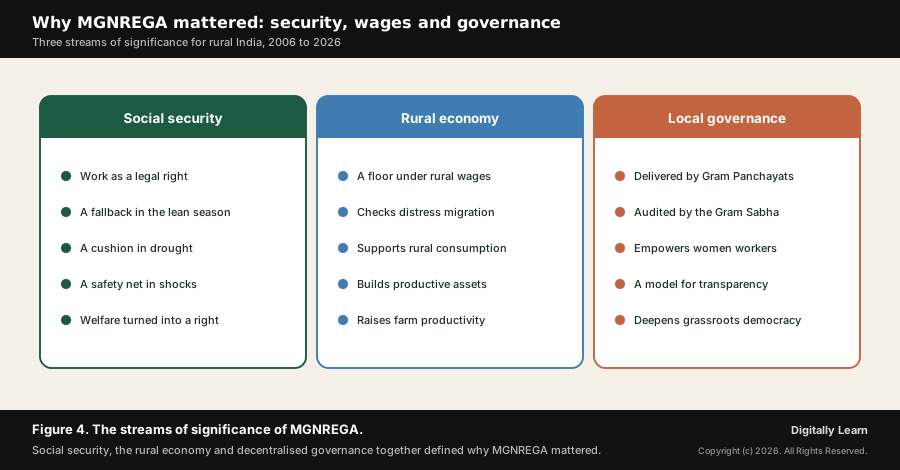
What is the significance of MGNREGA lies first in its character as a rights-based safety net. By making employment a legal entitlement rather than a discretionary handout, the Act gave rural households a guaranteed fallback in the lean season, in drought and in shocks such as the pandemic, so that the poorest were not left wholly at the mercy of the local labour market. This shift from welfare to right is its deepest contribution to India's social-security architecture, the reason it is studied as a landmark in welfare law, and the reason its repeal is itself an examinable event.
Its second significance is economic. By offering work at a notified wage, MGNREGA put a floor under rural wages, strengthening the bargaining power of labour against exploitative employers and helping to check distress migration from the village in the off-season. The wages it paid supported household consumption in the countryside, and the assets it built, water bodies, land works and roads, can raise the productivity of farming, so the programme worked on both the demand and the supply sides of the rural economy when it was run well.
Its third significance is for governance and empowerment. Because the programme ran through the Gram Panchayat and was audited by the Gram Sabha, it strengthened grassroots democracy and gave ordinary villagers, including women and the Scheduled Castes and Tribes, a direct stake in planning and policing public spending. Its transparency tools, the social audit and the public management information system, became a model for accountability well beyond rural employment, which is why MGNREGA is read as a study in decentralised, participatory governance. The figure below maps these strands.
The Unfinished Agenda: Timely Wages, an Adequate Wage Rate and Stronger Social Audit
The reform agenda MGNREGA left to its successor
The unfinished agenda follows directly from the critiques, and it is the agenda the new statute inherits. The first item is timely payment: to close the staffing and data-entry gaps and to fix the fund-transfer chain so that wages reliably reach the worker within the promised fifteen days, with the delay compensation that the rules provide actually paid when they do not, since a guarantee of work means little if the wage for it comes late.
The second item is the wage question and the protection of the budget. Aligning the wage with a fair benchmark, so that it does not lag the statutory minimum wage, and funding the guarantee as a right rather than letting a fixed allocation ration the work, were the two demands MGNREGA never fully met. Alongside this, the payment reforms have to be made inclusion-safe, so that Aadhaar-based payment and app-based attendance cut leakage without leaving genuine workers unpaid when a record or a signal fails.
The third item is accountability and asset quality. Reviving the independent social audit where it has weakened, strengthening Gram Panchayats so that they can plan and maintain good works, and choosing and building durable assets that genuinely raise rural productivity would let the wage spending and the asset creation reinforce each other. Pursued together, these measures were what would have moved MGNREGA closer to its founding promise, a reliable, well-paid, well-audited right to work for every rural household that demanded it, and they are the test by which its successor will be judged.
UPSC Relevance and Exam Focus
Where MGNREGA fits in the UPSC-CSE syllabus after the repeal
This topic maps most directly to General Studies Paper II: government policies and interventions for development in various sectors, and issues arising out of their design and implementation; welfare schemes for vulnerable sections; and the functioning of local self-government, since MGNREGA was a rights-based welfare law delivered through Panchayati Raj institutions, and since its repeal and replacement are themselves a question on policy design. It also links to General Studies Paper III, inclusive growth and the rural economy, and supplies rich material on transparency, accountability and social audit for both governance and ethics answers.
For Prelims, hold the high-yield facts: MGNREGA was a 2005 Act run by the Ministry of Rural Development, in force from 2006 and nationwide by 2008; it guaranteed up to 100 days of unskilled manual wage work per rural household; work had to come within 15 days of a demand or an unemployment allowance was owed; the wage-material ratio was 60:40; at least one-third of workers had to be women; the Gram Panchayat was the main implementing unit and the Gram Sabha conducted the social audit; its late reforms were the Aadhaar-Based Payment System and the National Mobile Monitoring System; and the Act was repealed on 1 July 2026 by the VB-G RAM G Act, 2025, which guarantees 125 days.
For Mains, the recurring framing is to assess the Act's design against its delivery, and now against its replacement: how a demand-driven legal right worked through local government, how its social audit advanced accountability, and how far payment delays, the wage rate and the budget blunted the guarantee. A strong answer treats MGNREGA as the case study in rights-based welfare and decentralised governance, weighs its genuine gains in social security and rural wages against the unresolved questions of timeliness, wage adequacy and inclusion, and asks whether the 2025 Act answers them.
Recurring linked concepts an aspirant should keep in working memory:
- Rights-based welfare: The shift from discretionary schemes to a justiciable legal entitlement, of which MGNREGA, alongside the right to food and to education, was the leading example.
- Social audit: The public scrutiny of works and spending by the Gram Sabha and independent Social Audit Units, MGNREGA’s signature accountability tool, carried forward into the 2025 Act.
- Wage-material ratio: The 60:40 rule that kept the programme labour-intensive by ensuring most spending reached workers as wages.
- Aadhaar-Based Payment System: The routing of wages through the worker’s Aadhaar number, central to the leakage-versus-exclusion debate.
A common Prelims trap is to confuse the unit and the scope of the guarantee; hold that the 100 days were per household, not per person, that the right belonged to every rural household rather than only to those below the poverty line, that the wage was set under the Act and not by the State Minimum Wages Act, and that the guarantee is now 125 days under the 2025 Act.
A common Mains trap is to praise the law and stop there, or to write about it as though it were still in force. The exam value lies in a balanced judgment: the real achievements in social security, rural wages and grassroots accountability, set honestly against the open problems of payment delays, wage adequacy, the budget-as-cap and the exclusion risks of the payment systems, every one of which the successor Act inherits.
Previous Year UPSC-CSE Questions By the end you will be able to draft model answers for the following UPSC questions. Each question carries a collapsible framework showing how to approach it in the exam.
- UPSC Mains 2021 GS-IVArgue why an independent, empowered social audit mechanism is essential across every sphere of public service to secure performance, accountability and ethical conduct, illustrating with a working example.
How to structure the answer in the exam
Body (sub-themes to develop):
- Why it is an absolute must: in any sphere of public service, only outside, public scrutiny reliably exposes whether money was spent as claimed and whether the service reached the people, as the Gram Sabha audit does for rural works.
- Independence and empowerment: independent Social Audit Units, proactive disclosure of records, reading out in the Gram Sabha and a district Ombudsman make the audit free of the officials it scrutinises, the features without which an audit becomes a formality.
- Performance: the audit checks works and spending against records and the work actually done on the ground, tying the audit to measurable outcomes.
- Accountability and ethical conduct: open meetings where officials must answer, grievance redress through the Ombudsman, and the exposure of diversion, fudged muster rolls and ghost workers protect probity.
- Extending the principle: the same independent-audit design can be carried to other spheres of public service, including the judiciary, as the question invites, while guarding against the capture and neglect that weakened MGNREGA's audit in practice and that its successor statute, which carries social audit and public disclosure forward, must still answer.
Sources and Further Reading
- Ministry of Rural Development: Mahatma Gandhi NREGA portal
- Ministry of Rural Development: Mahatma Gandhi NREGA Operational Guidelines
- Ministry of Rural Development: Higher work demand and greater timely payment of wages in MGNREGA
- Press Information Bureau: MGNREGA is a demand-driven wage employment programme
- Press Information Bureau: Change of mode of attendance of MGNREGA workers (NMMS)
- Press Information Bureau: Mahatma Gandhi NREGA, Frequently Asked Questions
- NITI Aayog: Report of the Sub-Group of Chief Ministers on coordination of agriculture and MGNREGS
- World Bank: The political economy of social security, a study of MGNREGA
- Wikipedia: Mahatma Gandhi National Rural Employment Guarantee Act, 2005
- Press Information Bureau: Commencement of the Viksit Bharat G RAM G Act across rural India from 1 July 2026
- Press Information Bureau: Reforming Mahatma Gandhi NREGA for Viksit Bharat
Editorial Disclaimer
This briefing is for UPSC preparation. MGNREGA stands repealed with effect from 1 July 2026, and the rural employment guarantee now runs under the VB-G RAM G Act, 2025. Verify the provisions against the official Ministry of Rural Development and PIB sources before relying on them.


