


Overview
Behaviour change as a tool of climate action
Mission LiFE, or Lifestyle for Environment, is India's people-centred movement that asks individuals to shift from wasteful to mindful consumption, turning everyday choices into a contribution to climate action.
Mission LiFE, which stands for Lifestyle for Environment, is India's people-centred movement to make environmental protection a matter of everyday individual choices. Its core idea is a shift from mindless and wasteful consumption toward mindful and deliberate consumption, so that the way ordinary people live becomes part of the answer to climate change. The Prime Minister first called for such a movement, under the one word LIFE, at the COP26 climate conference in Glasgow in 2021, and Mission LiFE was formally launched by India together with the United Nations on 20 October 2022. It organises simple, repeatable actions into seven themes and 75 individual actions, asks people to become Pro-Planet People, and is built into India's updated climate commitments under the Paris Agreement. It is best understood as demand-side climate action, complementing the supply-side work of clean energy and policy.
What Mission LiFE Is: Behaviour Change as a Tool of Climate Action
A people-centred movement for mindful, not wasteful, consumption
Mission LiFE, short for Lifestyle for Environment, is India's movement to bring the individual to the centre of the fight against climate change. Its central claim is simple but powerful: the daily choices of ordinary people, about how they use energy, water, food and materials, add up to a large environmental footprint, and changing those choices at scale is a real contribution to climate action.
The heart of the idea is a contrast between two ways of living. Mission LiFE asks people to move away from mindless and wasteful consumption, the habit of using and discarding without thought, and toward mindful and deliberate consumption, in which each use of a resource is weighed. Those who adopt such a lifestyle are described as Pro-Planet People, sometimes shortened to P3.
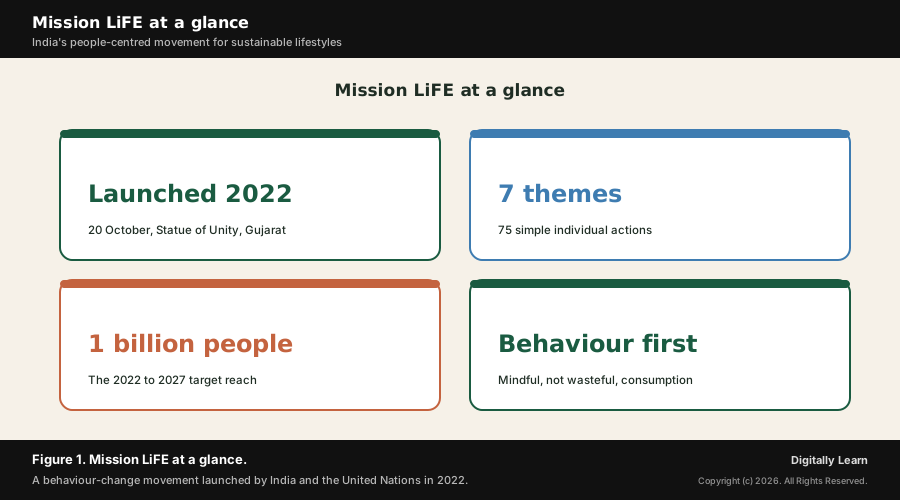
It is important to be precise about what Mission LiFE is and is not. It is a behaviour-change movement, a mass campaign of nudges and awareness rather than a single regulation or a spending scheme. It does not replace clean-energy building or environmental law; instead it works on the demand side, shaping what people ask for, so that changed demand reshapes markets. The figure below sets out the headline facts.
Why Mission LiFE Is in the News: From a Glasgow Call to a Global Movement
The COP26 call, the 2022 launch and India's continued push
Why it matters now is that Mission LiFE has moved from an idea announced on a global stage to a working programme. The story began at COP26, the twenty-sixth session of the Conference of the Parties to the United Nations climate convention, held in Glasgow in November 2021. To place Mission LiFE in its birth setting, it helps to recall what that conference achieved before turning to India's commitments.
The headline outcome was the Glasgow Climate Pact, agreed by nearly 200 parties. For the first time a climate decision named coal, calling on countries to accelerate the phase-down of unabated coal power and the phase-out of inefficient fossil-fuel subsidies and to strengthen their 2030 targets. The pact promised more finance to help developing countries adapt, while noting that the 100-billion-dollar-a-year climate-finance pledge remained unmet.
| COP26 outcome | What it agreed |
|---|---|
| Glasgow Climate Pact | Phase-down of unabated coal power and phase-out of inefficient fossil-fuel subsidies; stronger 2030 targets |
| Global Methane Pledge | More than 80 countries to cut methane emissions by about 30 percent by 2030 |
| Declaration on Forests | More than 100 countries to halt and reverse deforestation by 2030 |
| Article 6 rulebook | The Paris Agreement carbon-market rules, its last unfinished part, finally settled |
| Climate finance | More adaptation finance promised; the 100-billion-dollar-a-year pledge still unmet |
Several outcomes sat alongside the pact. More than 80 countries joined a Global Methane Pledge to cut methane by about 30 percent by 2030; over 100 countries, in the Glasgow Leaders' Declaration on Forests, agreed to halt and reverse deforestation by 2030; and negotiators settled the Article 6 carbon-market rulebook, the last unfinished part of the Paris Agreement, making Glasgow a consequential if incomplete conference.
On this stage India set out its own contribution. It announced enhanced targets, the Panchamrit commitments, and the Prime Minister called on the world to embrace LIFE, Lifestyle for Environment, a one-word movement for mindful rather than wasteful living. India then formally launched Mission LiFE on 20 October 2022, alongside the United Nations, turning that Glasgow call into a working programme.
Since the launch India has carried the LiFE message into its wider diplomacy. It wrote LiFE into its updated climate pledge, advanced the idea during its G20 Presidency under the theme of one Earth, one family and one future, and saw the concept reflected in the outcome text of the COP27 conference. Mission LiFE stays a live examination subject because it joins India's environmental policy and its climate diplomacy.
Understanding the Significance of Mission LiFE for Climate Action
Demand-side action, the citizen-to-policy link and India's leadership
What is the significance of Mission LiFE lies first in its focus on demand-side climate action. Most climate policy works on the supply side, building renewable power or setting industrial standards, but Mission LiFE works on the demand side, on what people consume. By shifting demand toward less wasteful choices, it aims to cut emissions and resource use at their everyday source, a dimension of climate action that large infrastructure programmes alone cannot reach.
Its second significance is that it builds a bridge from the individual to national and global goals. A single household switching off an unused light or refusing a single-use plastic bag seems small, but Mission LiFE connects that act to India's commitments under the Paris Agreement and to the Sustainable Development Goals. It gives the ordinary citizen a concrete, visible stake in targets that are otherwise abstract, which can deepen public ownership of climate policy.
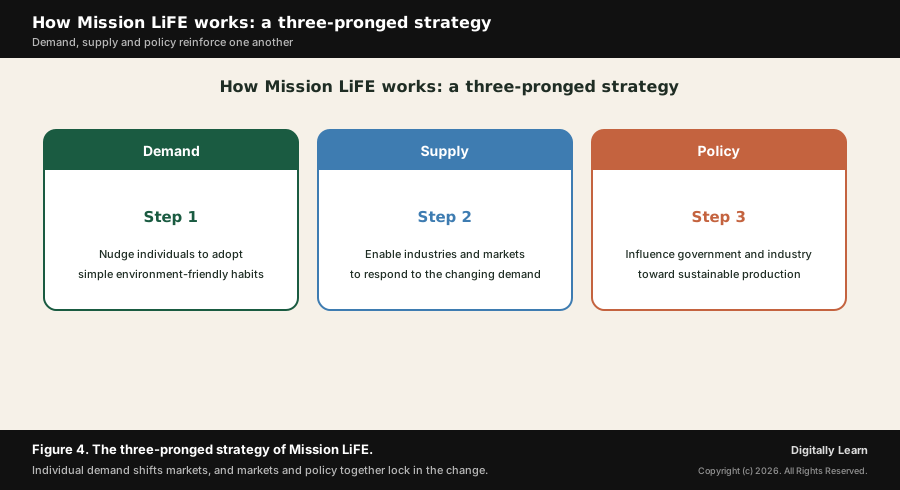
Its third significance is one of leadership and framing. By placing individual behaviour at the centre of the climate narrative, India has offered the world a distinctive, low-cost idea rooted in a tradition of moderation. Mission LiFE positions India as a source of ideas in climate diplomacy, not only a recipient of finance, and it reframes climate action as something every person can join. The figure below sets out how the mission turns demand into wider change.
The Origin and Philosophy of Mission LiFE, from COP26 to Pro-Planet People
The COP26 Glasgow call and India's Panchamrit commitments
Mission LiFE traces its origin to a single speech. At COP26 in Glasgow in November 2021, the Prime Minister set out India's climate plan and, within it, called on the world to adopt LIFE, Lifestyle for Environment, as a mass movement for mindful and deliberate utilization in place of mindless and destructive consumption. He framed it as a one-word campaign that every individual could join, drawing on long-standing traditions of conservation and moderation.
That same Glasgow statement carried India's headline pledges, the Panchamrit or five nectar elements. India committed to reach 500 gigawatts of non-fossil capacity by 2030, to meet half of its energy needs from renewable energy by 2030, to cut projected carbon emissions by one billion tonnes by 2030, to lower the carbon intensity of its economy by 45 percent by 2030, and to reach net-zero by 2070.
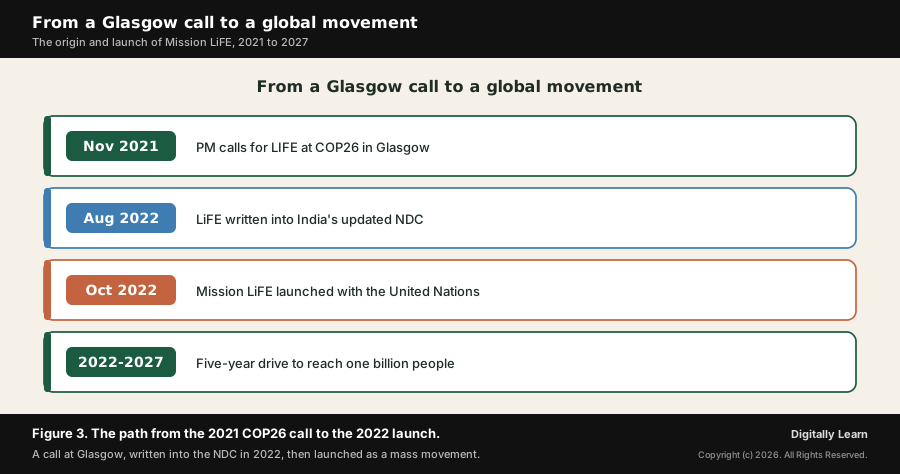
The link between the two is deliberate. The Panchamrit commitments work on how energy is produced and the economy is run, while LiFE works on how energy and resources are consumed. Read together, they show India treating climate action as a problem of both production and consumption, with Mission LiFE supplying the part that depends on citizens. The timeline below traces how the Glasgow call became a mission.
Pro-Planet People, mindful versus wasteful consumption and the LiFE Global Movement
The philosophy of Mission LiFE rests on a clear moral contrast. On one side is the throw-away habit, the use-and-dispose pattern that the mission calls mindless and wasteful consumption; on the other is mindful consumption, the deliberate, weighed use of resources. The mission argues that this second way of living is not a sacrifice but a return to values of moderation, and that practised at scale it can lighten humanity's pressure on the planet.
At the centre of this philosophy is the figure of the Pro-Planet Person. Rather than appealing to fear, Mission LiFE appeals to identity, inviting individuals to see themselves as part of a worldwide community, P3, committed to environment-friendly living. The aim is to build a network whose shared norms make sustainable behaviour self-reinforcing, so good habits spread through example rather than only through rules.
This vision is carried beyond India through the LiFE Global Movement. Mission LiFE was launched not only as an Indian programme but as a global call, presented alongside the United Nations and welcomed by international bodies, and India has used platforms such as the G20 to spread it. The philosophy thus scales from the single household to a global community of pro-planet citizens, all sharing the same simple discipline of mindful use.
The Seven Themes and the 75 Individual Actions
Save energy, save water, cut plastic and e-waste, and sustainable food
Mission LiFE turns its philosophy into practice through a structured menu of actions. It identifies 75 individual actions, simple steps an ordinary person can take, and groups them under seven themes. The themes are wide enough to touch most parts of daily life, from the home to the marketplace, and they make the abstract goal of mindful living concrete and doable.
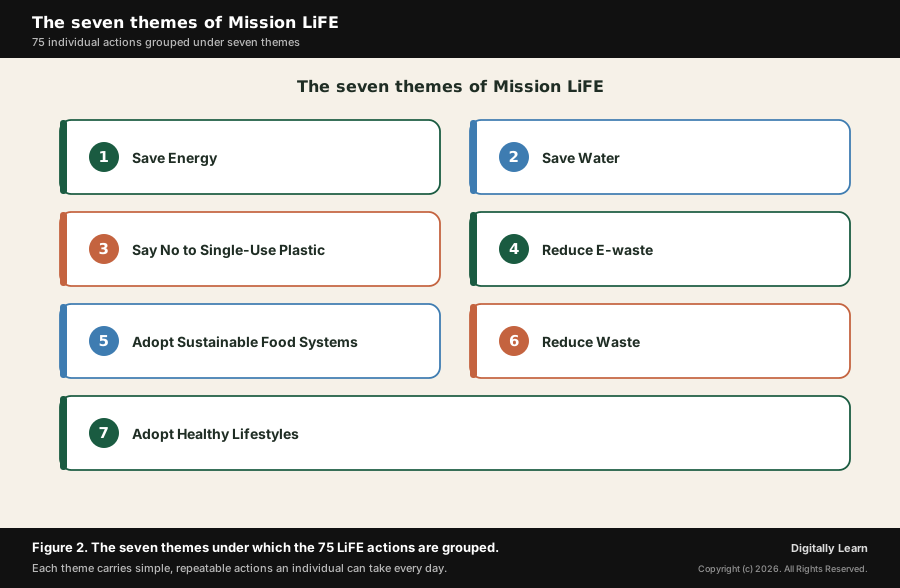
The seven themes are Save Energy, Save Water, Say No to Single-Use Plastic, Reduce E-waste, Adopt Sustainable Food Systems, Reduce Waste and Adopt Healthy Lifestyles. Each carries concrete steps: switching off unused appliances, fixing leaks, carrying a cloth bag, repairing and recycling electronics, eating local and seasonal food, composting and segregating waste, and making choices that are good for both body and planet.
The design has a clear logic. Each action is meant to be low-cost, repeatable and visible, so it can become a habit and be copied by others, and together the actions span the everyday decisions that shape a household's footprint. The government describes the list as comprehensive but not exhaustive, so it can grow as new habits are identified. The figure below sets out the seven themes.
The Institutional Architecture: Who Runs Mission LiFE and How
MoEFCC, NITI Aayog, states and local bodies, and the role of the United Nations
Mission LiFE is run through a clear, if light, institutional architecture. The nodal ministry is the Ministry of Environment, Forest and Climate Change, which carries forward the mission's implementation after its launch. At the start, NITI Aayog, the government's policy think-tank, helped curate and incubate the mission and frame its actions, so that the design drew on both environmental and economic-policy expertise.
Because Mission LiFE is about everyday behaviour, it must reach people where they live, so it leans heavily on states, districts and urban local bodies and on schools, colleges and community groups to spread its message. The mission set itself the goal of making a large share of villages and urban local bodies environment-friendly within a few years, which makes local institutions the real front line of delivery rather than the central ministry alone.
The mission also has an international dimension. It was launched together with the United Nations, and UN bodies have welcomed and supported the LiFE idea, helping carry it into global forums. One concrete instrument is the notification of Ecomark rules, which certify environment-friendly products so the demand Mission LiFE encourages can find trustworthy goods. The architecture thus joins a nodal ministry, a policy incubator, local bodies and international partners.
Mission LiFE and India's Climate Commitments, the SDGs and the Circular Economy
LiFE in the updated NDC, the link to SDG-12 and the circular economy
Mission LiFE is not a stand-alone campaign; it is woven into India's formal climate commitments. India became the first country to write a lifestyle movement into its Nationally Determined Contribution, the national pledge under the Paris Agreement. India's updated NDC, communicated in 2022, undertakes to spread a healthy and sustainable way of living based on conservation and moderation, naming the LIFE movement as a key to combating climate change.
The mission also maps directly onto the Sustainable Development Goals, and most clearly onto SDG-12, which calls for responsible, sustainable consumption and production. By asking individuals to consume less wastefully and by pushing markets toward sustainable products, Mission LiFE works on exactly the demand-and-supply patterns that SDG-12 targets, and it touches other goals on water, energy and climate as well. It gives a behavioural route to goals that are usually pursued through policy and investment.
A third linkage is to the circular economy. Mission LiFE seeks to replace the linear use-and-dispose economy, governed by wasteful consumption, with a circular one in which products are reused, repaired and recycled and resources kept in use longer. By nudging demand for durable, repairable goods, the mission aims to pull the economy toward circular patterns, joining individual habit to a systemic shift. The table below sets out these linkages.
| Linkage | What Mission LiFE connects to | How |
|---|---|---|
| Climate commitments | India's updated NDC under the Paris Agreement | LiFE named in the NDC as a key to combating climate change |
| Panchamrit | India's COP26 climate targets | The demand-side companion to supply-side energy targets |
| SDG-12 | Responsible consumption and production | Shifts individual demand and market supply toward sustainability |
| Circular economy | Reuse, repair and recycling of materials | Replaces the use-and-dispose pattern with mindful use |
Reading the rows together shows the pattern: Mission LiFE is the thread that ties the single citizen's habits to India's treaty pledges, the global development goals and the wider shift toward a circular economy. That web of connections is what makes a behaviour-change movement a serious instrument of climate policy rather than mere exhortation.
Challenges, Debates and the Road Ahead for Mission LiFE
Measuring behaviour, the individual-versus-systemic debate, equity and greenwashing
A balanced reading must weigh the challenges Mission LiFE faces. The first is measurement. Behaviour change is hard to track and harder to verify; unlike megawatts of clean power, the climate effect of millions of small daily choices is difficult to quantify, so demonstrating that the mission delivers real, lasting emission cuts rather than one-off gestures is a genuine analytical problem.
The second is a wider debate over individual versus systemic responsibility, presented in measured terms. Supporters argue that individual action and structural change are complementary, that changed demand pushes systems to change. Critics caution that stressing personal habits can shift the burden onto consumers and away from large emitters. The fair reading is that the two are not rivals: Mission LiFE is designed to use individual demand to move markets and policy, so a candidate should hold both sides.
Further challenges concern equity and credibility. Consumption patterns differ sharply by income, so a movement about consumption must ensure its asks are fair and that the heaviest consumers, not only the poor, change their ways. There is also the risk of greenwashing, where actors claim a pro-planet image without real change. Guarding against tokenism and keeping the focus on substance rather than slogans will decide whether Mission LiFE endures.
Mission LiFE in Context: India's Wider Environmental and Climate Architecture
How Mission LiFE sits among India's other climate and environment initiatives
Contemporary linkages place Mission LiFE within a dense web of India's environmental policy. It sits alongside supply-side climate efforts such as the renewable-energy and solar push and the broader net-zero by 2070 goal, beside material-and-waste measures such as the rules on single-use plastic, e-waste and solid-waste management, and beside India-led international platforms on climate. Mission LiFE is the demand-side, behaviour-facing pillar of this wider effort.
It also connects to India's diplomatic initiatives. The LiFE idea has travelled through India's G20 Presidency and its climate statements at the United Nations, and it complements India-led coalitions on solar power and resilient infrastructure. The movement reinforces, and is reinforced by, India's standing as a voice for developing nations in climate negotiations, where it argues for action that respects both growth and equity.
Finally, Mission LiFE sits at the meeting point of environment, economy and ethics in India's policy. It links the environmental aim of a lighter footprint, the economic aim of a circular economy and resource efficiency, and the ethical aim of moderation and responsibility, into one movement. The following initiatives are worth holding together in working memory:
- The Panchamrit and net-zero by 2070: India’s supply-side climate targets, to which Mission LiFE adds the demand side.
- Single-use plastic, e-waste and waste rules: The regulatory measures that Mission LiFE’s themes mirror in everyday behaviour.
- SDG-12 and the circular economy: The global goal and the economic model that Mission LiFE works to advance.
- India’s climate diplomacy: The G20 Presidency and United Nations forums through which the LiFE idea has been carried abroad.
Taken together, these linkages show that Mission LiFE is not a stand-alone slogan but a node in India's evolving climate architecture, joining the citizen's daily habits to the country's treaty commitments, its development goals and its environmental diplomacy.
UPSC Relevance and Exam Focus
Where Mission LiFE fits in the UPSC-CSE syllabus
This topic maps most directly to General Studies Paper III: conservation, environmental pollution and degradation, and climate change, and to the part of the syllabus on government policies and interventions in the environment sector. Because it turns on individual behaviour and values, it also carries a clear General Studies Paper IV angle on attitude, moral responsibility and the ethics of consumption, and a society dimension on how norms spread.
For Prelims, hold the high-yield facts: Mission LiFE stands for Lifestyle for Environment; it was called for by the Prime Minister at COP26 in Glasgow in 2021 and launched on 20 October 2022 with the United Nations; the nodal ministry is the Ministry of Environment, Forest and Climate Change; it has seven themes and 75 individual actions; it promotes Pro-Planet People and mindful over wasteful consumption; and India was the first country to include LiFE in its NDC.
For Mains, the recurring framing is to assess Mission LiFE as demand-side climate action and to discuss how far behaviour change can complement structural and policy change. A strong answer explains the COP26 origin and the Panchamrit, the seven themes, and the links to the NDC, the SDGs and the circular economy, and then weighs the debates over measurement, individual versus systemic responsibility, equity and greenwashing in measured, attributed terms rather than taking sides.
Recurring linked concepts an aspirant should keep in working memory:
- Panchamrit and net-zero by 2070: India’s five COP26 climate commitments and its long-term net-zero target.
- Sustainable consumption and production: SDG-12 and the circular economy, which Mission LiFE works to advance.
- Nationally Determined Contribution: India’s climate pledge under the Paris Agreement, into which LiFE is written.
- Demand-side and behaviour change: The idea that nudging individual choices can complement supply-side climate policy.
A common Prelims trap is to confuse the dates or the lead body, for example to place the launch at COP26 itself or to assign the mission to a different ministry; hold the 2021 Glasgow call and the 20 October 2022 launch, and the Ministry of Environment, Forest and Climate Change as nodal, precisely.
A common Mains trap is to treat Mission LiFE either as a cure-all or as mere tokenism. Its exam value lies in a balanced judgment: the genuine promise of demand-side action and the citizen-to-policy link, set against the real difficulties of measurement, equity and the individual-versus-systemic debate, which a strong answer presents without partisanship.
Previous Year UPSC-CSE Questions By the end you will be able to draft model answers for the following UPSC questions. Each question carries a collapsible framework showing how to approach it in the exam.
- UPSC Mains 2021 GS-IIIDescribe the major outcomes of COP26 (UNFCCC) and the commitments India made at that conference.
How to structure the answer in the exam
Body (sub-themes to develop):
- The conference-wide outcomes of COP26: the Glasgow Climate Pact, which named coal for the first time by calling for the phase-down of unabated coal power and the phase-out of inefficient fossil-fuel subsidies and urged stronger 2030 targets; the Global Methane Pledge to cut methane by about 30 percent by 2030; the Glasgow Leaders' Declaration on Forests to halt and reverse deforestation by 2030; the settling of the Article 6 carbon-market rulebook; and the climate-finance question, including the promise of more adaptation finance and the unmet 100-billion-dollar-a-year commitment.
- India's Panchamrit commitments announced at Glasgow: 500 GW of non-fossil capacity by 2030, 50 percent of energy from renewables by 2030, a one-billion-tonne cut in projected emissions by 2030, a 45 percent cut in carbon intensity by 2030, and net-zero by 2070.
- The LIFE call: India's proposal at COP26 for Lifestyle for Environment, mindful rather than wasteful consumption, which became Mission LiFE and a distinctive Indian contribution to the climate narrative.
- How these commitments were operationalised: the translation of the Panchamrit and LiFE into India's updated Nationally Determined Contribution communicated in 2022.
- The significance of India's COP26 stance: balancing growth and equity, demand-side and supply-side action, and offering a low-cost behavioural idea to the world.
Sources and Further Reading
- Press Information Bureau: PM launches Mission LiFE at Statue of Unity in Ekta Nagar, Kevadia, Gujarat
- Press Information Bureau: PM and UN Secretary-General launch Mission LiFE at the Statue of Unity
- Ministry of External Affairs: National Statement by the Prime Minister at the COP26 Summit in Glasgow
- Press Information Bureau: National Statement by the Prime Minister at the COP26 Summit in Glasgow
- Press Information Bureau: Cabinet approves India's Updated Nationally Determined Contribution
- UNFCCC: India's Updated First Nationally Determined Contribution Under the Paris Agreement
- NITI Aayog: Mission LiFE Brochure
- NITI Aayog: Goal 12, Ensure sustainable consumption and production patterns
- Ministry of Environment, Forest and Climate Change: Official website of Mission LiFE
- Ministry of Environment, Forest and Climate Change: Mission LiFE and India's climate action
- Press Information Bureau: MoEFCC notifies Ecomark Rules under the Lifestyle for Environment initiative
- Press Information Bureau: India's G20 Presidency and the LiFE theme
- Wikipedia: 2021 United Nations Climate Change Conference (COP26)
- Wikipedia: Glasgow Climate Pact
Editorial Disclaimer
This briefing is for UPSC preparation. Verify the facts and figures against the official MoEFCC, PIB and UNFCCC sources before relying on them.


