


Overview
The Global Forest Goals Report is the United Nations assessment of progress towards the UN Strategic Plan for Forests 2017 to 2030 and its six Global Forest Goals. The 2026 edition was launched on 11 May 2026 at the opening of the UN Forum on Forests in New York. Based on national reports from 48 countries, it finds that the world's forest area has fallen to about 4.14 billion hectares and that finance for forests remains far below need. Its verdict is that progress is real but off track to meet the goals by 2030.
Why the Global Forest Goals Report is in focus
A UN report card on the world's forests
The United Nations launched the Global Forest Goals Report 2026 on 11 May 2026, at the opening of the twenty-first session of the UN Forum on Forests in New York.
The report measures progress towards the UN Strategic Plan for Forests 2017 to 2030 and its six Global Forest Goals. It draws on voluntary national reports from 48 countries that hold 51 per cent of the world's forests.
The central finding is sobering. With fewer than five years left to 2030, progress is real but too slow, leaving the world off track to halt deforestation and meet the forest goals on time.
The headline findings of the report are:
- Off track: the six Global Forest Goals will be missed at current rates.
- Shrinking cover: world forest area fell by over 40 million hectares from 2015 to 2025.
- Primary loss: nearly 16 million hectares of irreplaceable primary forest were lost.
- Finance gap: forest funding is far below the level the goals require.
Why the report matters
A shrinking forest base
Forests cover about 32 per cent of the world's land and anchor the climate, water cycles and biodiversity. When forests shrink, carbon is released and the services that billions of people depend on are weakened.
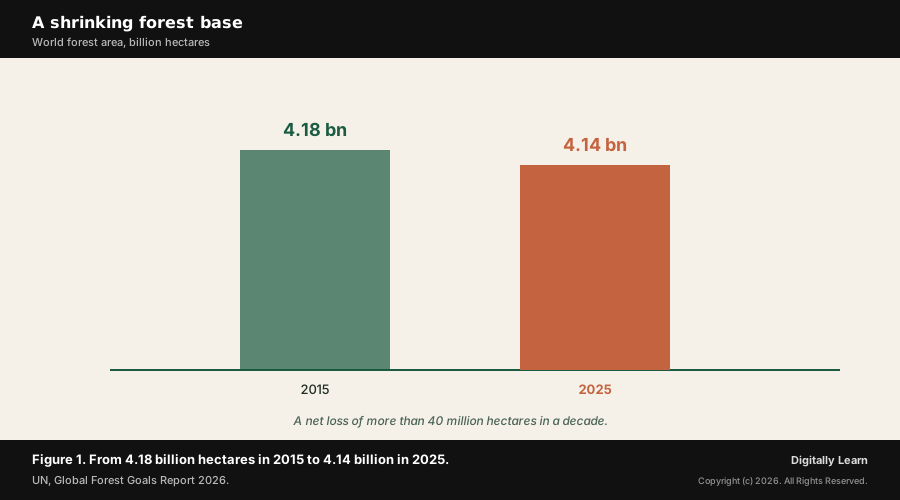
Global forest area fell from about 4.18 billion hectares in 2015 to about 4.14 billion hectares in 2025, a net loss of more than 40 million hectares in a decade.
Worse, much of the loss is of primary forest, the oldest and most biodiverse type. Nearly 16 million hectares of it were lost, and such forest cannot be quickly replaced once cleared.
What the report signifies
Regional hotspots, the finance gap, and slow goals
Three threads carry the weight: where the loss is concentrated, the finance gap, and the slow pace against the goals.
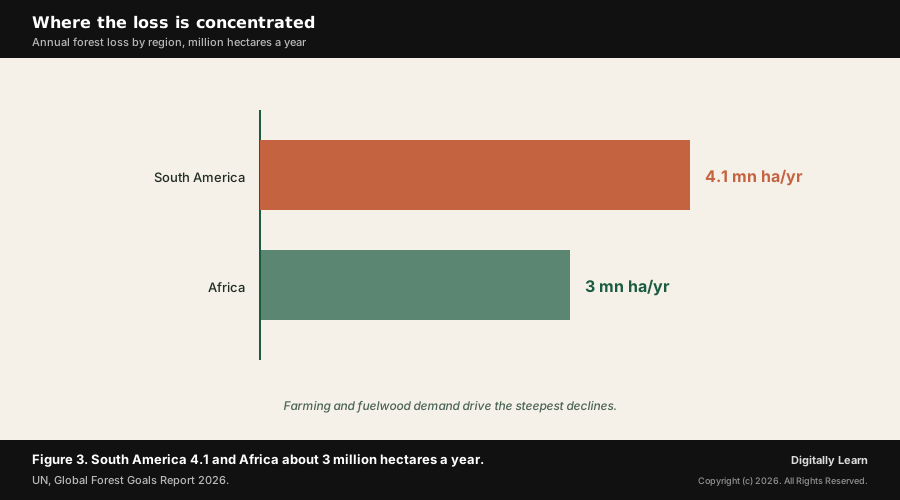
First, the regional hotspots. South America saw the steepest decline, losing about 4.1 million hectares a year, while Africa lost nearly 3 million hectares a year, driven by farming and fuelwood demand.
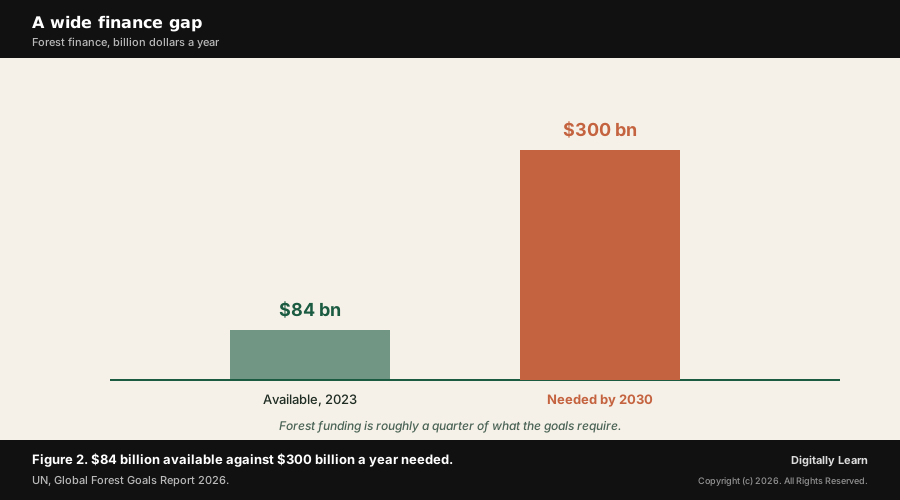
Second, the finance gap. Funding for sustainable forest management reached about 84 billion dollars in 2023, far short of the nearly 300 billion dollars a year the goals are estimated to need by 2030.
Third, the slow pace. Some goals show gains, such as protected areas and national forest plans, but the headline trends on cover and finance mean the overall target set for 2030 is slipping.
Distinguishing features of the report
The report at a glance
The table sets out the key facts, so the scope and headline figures of the report are visible at a glance.
| Indicator | Finding |
|---|---|
| Forest area, 2025 | About 4.14 billion hectares (about 32% of land) |
| Change, 2015 to 2025 | Loss of over 40 million hectares |
| Primary forest lost | Nearly 16 million hectares |
| Forest finance, 2023 | About 84 billion dollars |
| Finance needed by 2030 | About 300 billion dollars a year |
Three features that define the report
Three elements set this report apart from a single dataset:
- (i) A goal-by-goal scorecard. It tracks the six Global Forest Goals and their 26 targets, not just total forest cover.
- (ii) Country-reported evidence. It is built from voluntary national reports, giving an on-the-ground picture.
- (iii) A finance focus. It pairs the loss data with the funding gap, naming money as a binding constraint.
Observable outcomes
Three trackable outcomes
The report translates into three developments to watch in global and national forest policy.
- (a) A push on finance. The funding gap strengthens calls for more public and private money for forests.
- (b) Stronger restoration drives. The loss of primary forest sharpens the case for protection and restoration.
- (c) Better national reporting. Wider and more frequent country reports are needed to track the goals to 2030.
A report names the gap; closing it needs money and enforcement. Whether forest loss actually slows by 2030 is the real test of the goals.
Forests, the SDGs and India
SDG 15, REDD-plus and India's forest effort
Forest health underpins Sustainable Development Goal 15 on life on land, which seeks to protect forests, halt land degradation and stop biodiversity loss.
It connects to global tools such as REDD-plus, which rewards developing countries for reducing emissions from deforestation and forest degradation, linking forests to climate finance.
For India, the findings echo its own effort to expand tree and forest cover, its forest survey reporting, and its pledge to create a large additional carbon sink through forests by 2030.
UPSC relevance and exam focus
Where this fits in the UPSC-CSE syllabus
This topic maps to General Studies Paper III: conservation, environmental pollution and degradation, and to General Studies Paper II: important international institutions and global groupings.
For Prelims, hold the high-yield facts: the UN Forum on Forests as the report's host, the six Global Forest Goals, the headline forest-area figure and the finance gap.
For Mains, two framings recur: the drivers and remedies of deforestation, and the role of finance in meeting global environmental goals.
Recurring linked concepts an aspirant should keep in working memory:
- UN Forum on Forests: the UN body for forest policy.
- SDG 15: life on land, including forests.
- REDD-plus: rewarding cuts in deforestation emissions.
- Primary forest: old-growth forest of high ecological value.
The Global Forest Goals sit under the UN Strategic Plan for Forests, not under the Paris Agreement. Mixing up the parent framework is an easy error.
Do not treat forest loss as only an environmental issue. Its drivers are economic, in farming and energy, so the remedy must address those too.
Previous Year UPSC-CSE Questions By the end you will be able to draft model answers for the following UPSC questions. Each question carries a collapsible framework showing how to approach it in the exam.
- UPSC Mains 2020 GS-IExamine the status of forest resources of India and its resultant impact on climate change.
How to structure the answer in the exam
Introduction: Open with forests as both a carbon sink and a climate buffer.
Body (sub-themes to develop):
- Status: forest and tree cover trends from national forest surveys.
- Drivers of loss: encroachment, diversion and degradation.
- Climate impact: forests as carbon sinks and their loss as emissions.
- Policy: afforestation, the carbon-sink pledge and forest conservation law.
- Global frame: the Global Forest Goals and finance gap.
Conclusion: Conclude that protecting and expanding forests is central to India's climate strategy.
- UPSC Prelims 2016Proper design and effective implementation of the UN-REDD-plus Programme can significantly contribute to which of the following?
- Protection of biodiversity
- Resilience of forest ecosystems
- Poverty reduction
Select the correct answer using the code given below.
How to approach this Prelims question
Approach: Test whether REDD-plus can deliver each of the listed benefits.
Trap to watch: All three are genuine co-benefits of well-designed REDD+, so the answer is 1, 2 and 3, not a narrower subset.
Key facts to recall:
- REDD-plus rewards reduced deforestation and forest degradation.
- Well-designed schemes protect biodiversity and ecosystems.
- They can also support local livelihoods and cut poverty.
Answer signal: All three benefits hold. Correct answer: 1, 2 and 3.
Sources and Further Reading
- United Nations: Latest Global Forest Goals Report 2026 reveals progress, but not at scale needed
- UN Forum on Forests: Global Forest Goals Report 2026
- UN Forum on Forests: UN Strategic Plan for Forests 2017-2030
- FAO: Global Forest Resources Assessment
- United Nations: Sustainable Development Goal 15
- Wikipedia: United Nations Forum on Forests
Editorial Disclaimer
This article is compiled from the reference materials listed in the Sources section. It is an explainer for UPSC preparation and is not a substitute for primary documents (NCERTs, GoI ministry releases, IMD bulletins, RBI / CEA / MoEFCC publications, and Standing-Committee reports).


