


Overview
The power-line crisis and India's conservation response
The Great Indian Bustard, Ardeotis nigriceps, is a critically endangered grassland bird and the state bird of Rajasthan, whose survival now turns on power-line mitigation and conservation breeding.
The Great Indian Bustard (Ardeotis nigriceps) is one of the heaviest flying birds in the world and a flagship of India's open grasslands. It is the state bird of Rajasthan and is listed as Critically Endangered on the IUCN Red List, with as few as about 150 individuals estimated to survive as of 2018. Once spread across the dry grasslands of the subcontinent, it now clings to a handful of pockets, the largest in the Thar of Rajasthan in and around Desert National Park, with smaller groups in Kutch and elsewhere. Its sharpest threat is collision with overhead power transmission lines, compounded by habitat loss, a very low reproductive rate and predation. India's response combines a Supreme Court directive on power lines, a conservation breeding programme and habitat protection.
What the Great Indian Bustard Is: Taxonomy, Size and Protection Status
A heavy grassland bird, the state bird of Rajasthan and a grassland indicator
The Great Indian Bustard, scientific name Ardeotis nigriceps, is a large ground bird of the bustard family Otididae and is among the heaviest of all flying birds. Standing about a metre tall, with a horizontal body, long bare legs and a distinctive black cap, it walks the open country in search of insects, seeds and small animals, and takes to the air with slow, heavy wingbeats. It is the state bird of Rajasthan, where it is known locally as the godawan, and it has become a symbol of India's neglected grassland habitats.
As a creature of open grasslands, scrub and rain-fed farmland, the bustard is what ecologists call a grassland indicator, or flagship, species. Its presence signals a healthy, intact grassland; its disappearance signals one that has been broken up or degraded. Protecting the bird therefore means protecting a whole ecosystem and the other wildlife that shares it, from the chinkara and the blackbuck to the Indian wolf and the spiny-tailed lizard, animals that depend on the same arid grasslands of the Thar.
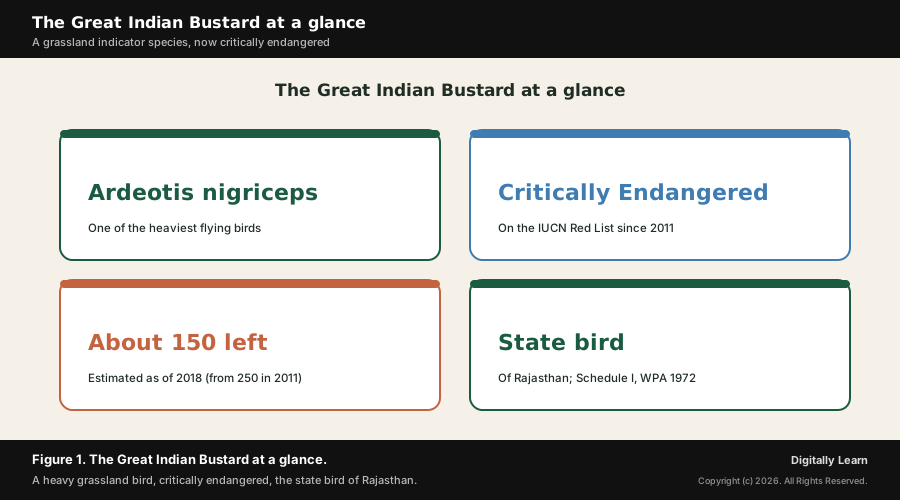
The species carries the highest levels of legal protection. It is listed as Critically Endangered on the IUCN Red List, placed on Schedule I of the Wild Life (Protection) Act, 1972, the schedule that grants absolute protection and the heaviest penalties, and included in Appendix I of CITES, which bars international commercial trade. Yet, as the table and figure below show, this paper protection has not been enough to halt its slide toward extinction.
| Attribute | Detail |
|---|---|
| Scientific name | Ardeotis nigriceps, family Otididae |
| IUCN Red List status | Critically Endangered (since 2011) |
| National protection | Schedule I, Wild Life (Protection) Act, 1972 |
| International protection | CITES Appendix I |
| State bird | Rajasthan |
| Main stronghold | The Thar, Desert National Park, Rajasthan |
Read together, the rows above show a bird that is protected at every level, nationally and internationally, yet still critically endangered, a gap between the law on paper and the bird's survival on the ground that the rest of this account explains. The figure below sets out the same headline facts.
Why the Great Indian Bustard Is in Focus: A Race Against Extinction
A collapsing population and a clash between power lines and conservation
Why it matters now is that the Great Indian Bustard has become one of the most closely watched conservation stories in India, because the population has fallen so far that every bird counts. From an estimated 250 individuals in 2011, the count had dropped to as few as about 150 by 2018 on the IUCN assessment, almost all of them in India, and the species is now described as facing an imminent risk of extinction unless decisive action is taken. The numbers are small enough that the loss of a single breeding female matters.
The bird is also in focus because it sits at the centre of a hard policy clash. Its last strongholds in the Thar overlap with some of India's best solar and wind resources, so the very deserts where it survives are being threaded with the overhead power lines that kill it. That has forced the courts, the conservation agencies and the energy sector into a debate about how to expand renewable energy without driving the bustard extinct, which is exactly why the species has become a live subject for the exam.
Habitat and Range: The Thar, Desert National Park and the Last Pockets
The grassland and desert habitat and the five surviving populations
The Great Indian Bustard is a bird of arid and semi-arid grasslands, open thorn scrub and rain-fed cultivation, not of forest or wetland. It needs wide, undisturbed expanses of short grass where it can see far, forage on the ground and perform its courtship display, and it avoids tall vegetation and clutter. This makes it acutely sensitive to anything that fragments the open landscape, whether ploughing, fencing, roads, wind turbines or transmission towers, because each intrusion shrinks the open country the bird requires.
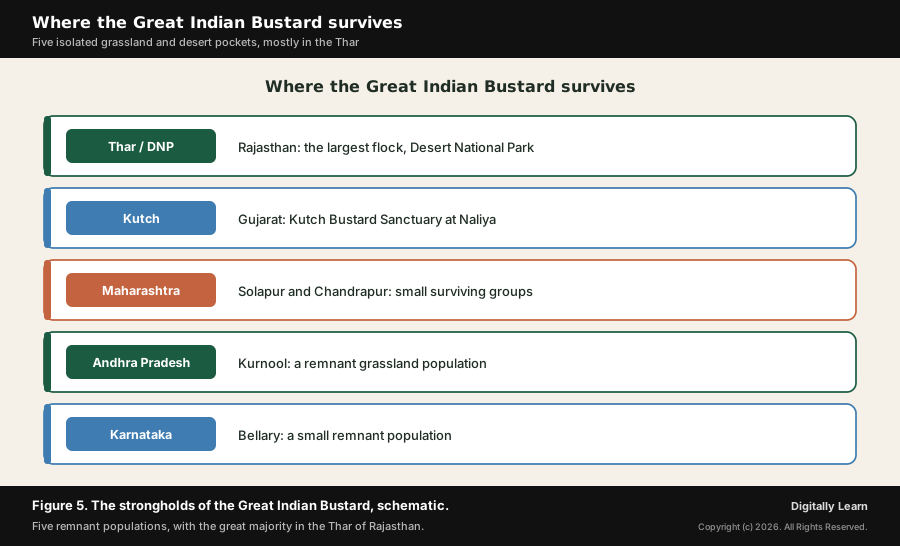
Its surviving range is now reduced to a few isolated pockets. The largest population, the great majority of all the birds left, lives in the Thar desert of Rajasthan, in and around Desert National Park near Jaisalmer. Far smaller groups cling on in Kutch in Gujarat, around the Kutch Bustard Sanctuary at Naliya, and in pockets of Maharashtra, Andhra Pradesh and Karnataka. The contrast is stark: one substantial flock in the Thar and a scatter of tiny, vulnerable remnants elsewhere.
This pattern of distribution carries a clear lesson for conservation. Because so much of the species now depends on the Thar, the fate of the bird is tied to the fate of one landscape, and a single catastrophe there, a disease outbreak, a run of power-line deaths or a failed breeding season, could be decisive. Securing the Thar grasslands and Desert National Park is therefore the first priority, while the smaller pockets need their own urgent protection. The figure below maps the strongholds.
The Threats: Why the Power Line Is the Foremost Killer
Power-line collisions, the chief cause of unnatural death
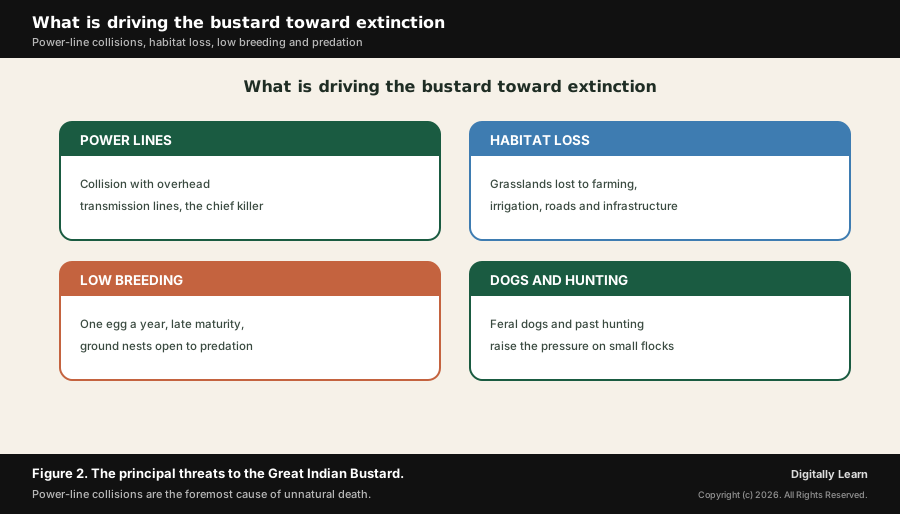
The single most important threat to the Great Indian Bustard today is collision with overhead power transmission lines. The bird is heavy, flies low and fast, and has poor frontal vision, with its eyes set to the sides of its head, so it sees wires straight ahead only at the last moment and cannot manoeuvre its bulky body out of the way in time. When its grassland is crossed by high-tension lines, birds strike the wires and are killed, and studies in the Thar identify these collisions as the critical cause of the rapid decline.
The problem is made worse by the geography of the energy transition. The Thar and Kutch carry some of the country's strongest solar and wind potential, so the bustard's last open habitat is being filled with the evacuation lines that carry that power to the grid. Every new line through the grassland adds another lethal obstacle in the airspace of a bird that already numbers only in the low hundreds, which is why the power-line question has come to dominate the conservation debate.
Habitat loss, a very low reproductive rate, predation and hunting
Beyond power lines, the bustard faces a familiar set of pressures, starting with habitat loss. Its open grasslands have been steadily converted to intensive agriculture, opened up by canal irrigation, broken by roads and infrastructure and invaded by unsuitable vegetation, so the undisturbed short-grass country it needs has shrunk drastically. India's grasslands have long been treated as wasteland rather than as ecosystems worth protecting, and that neglect has cost the bustard dearly.
The species is also held back by a very low reproductive rate. A female typically lays only a single egg in a year, matures late and nests on the open ground, where the egg and chick are exposed to predation by foxes, free-ranging and feral dogs and other animals, whose numbers have risen around human settlements. A bird that breeds so slowly cannot quickly replace its losses, so even a modest rate of unnatural death, from wires or predators, pushes the small population downward.
Historically, hunting also took a heavy toll, and although the bird is now legally protected, the legacy of past hunting helped reduce it to today's fragile numbers. Taken together, these pressures, power lines, habitat loss, slow breeding and predation, form a reinforcing trap: a slow-breeding bird, in a shrinking habitat, exposed to lethal wires and predators. The figure below sets out the main threats.
The Supreme Court Case: Power Lines, Bird Diverters and the Renewable-Energy Balance
The directive to underground lines and fit bird diverters
The power-line crisis reached the Supreme Court of India through public-interest litigation brought by conservationists, including the veteran wildlife expert M.K. Ranjitsinh, who sought protection for the bustard from the spread of transmission lines across its habitat. The case turned the bird's plight into a question of law, asking whether the State must act to stop a protected, critically endangered species from being killed by the country's own energy infrastructure.
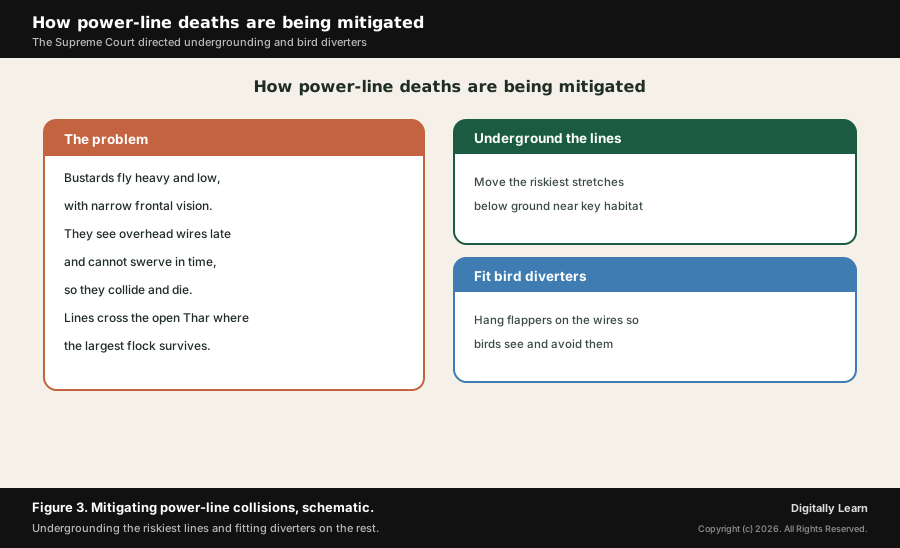
In response, the Court directed two practical mitigation measures. First, the riskiest overhead lines passing through key bustard habitat were to be undergrounded, that is, laid below the surface so that no wires hang in the bird's airspace. Second, on lines that could not be put underground, power agencies were to install bird diverters, the flapper-like devices that hang from the wires and make them far more visible to birds, reducing the chance of a fatal strike. Power lines have since been marked with diverters in the Thar in line with the Court's directions.
Carrying out the order has proved difficult, because undergrounding high-voltage lines over long distances is costly and technically demanding, and the power and renewable-energy sector argued that a blanket requirement would be impractical and would hold back the clean-energy build-out. The dispute thus became a direct test of how to weigh two public goods against each other, the survival of a critically endangered species and the rapid expansion of solar and wind power, both of which the country has committed to pursue.
Balancing renewable energy and conservation in the later proceedings
Faced with this tension, the Court later recalibrated its approach to balance the two objectives rather than treat them as irreconcilable. Recognising that an unqualified undergrounding mandate across vast areas could impede India's renewable-energy goals and its climate commitments, the proceedings moved toward a more targeted approach: concentrating the strictest protection, including undergrounding, on the priority stretches that matter most for the bustard, while relying on diverters and expert assessment elsewhere, and constituting a committee to examine the feasibility of measures.
This shift reflects a wider principle of sustainable development: that conservation and development are not always opposed and must, where they conflict, be reconciled through evidence and proportionate measures. The bustard case has become a landmark illustration of the conservation-versus-development dilemma, showing both the duty of the State to protect endangered species and the need to do so in a way that does not needlessly obstruct the transition to clean energy. The figure below sets out the two mitigation measures at the heart of the case.
The Conservation Breeding Programme and Project Great Indian Bustard
Conservation breeding by the WII at Sam and Ramdevra
Because the wild population is so small and slow to recover, India has built a conservation breeding programme as an insurance against extinction. Run as the project titled Habitat Improvement and Conservation Breeding of the Great Indian Bustard, an integrated approach, it is carried out by the Wildlife Institute of India in Dehradun together with the Rajasthan, Gujarat and Maharashtra Forest Departments, with central support, and an outlay of about Rs 33.85 crore sanctioned over five years for the first phase.
The method is to collect eggs from the wild, hatch them artificially and rear the chicks in protected breeding centres, building a captive population that can later supply birds for release into the wild. A satellite breeding facility, with incubator, hatcher and chick-rearing units, was set up at Sam near Jaisalmer, run by WII scientists and the Rajasthan Forest Department with technical assistance from the International Fund for Houbara Conservation and Reneco of Abu Dhabi, partners with deep experience of breeding the related houbara bustard, and a second centre operates at Ramdevra.
The programme has begun to show results. Project Great Indian Bustard entered its fourth year of captive breeding with the hatching of new chicks, taking the captive tally to around seventy birds, and a trans-state effort produced the first hatching in Gujarat in a decade. The long-term aim is head-starting and reintroduction, raising chicks safely and returning them to a wild that has been made less dangerous, which is why breeding and habitat work, including power-line mitigation, have to advance together rather than in isolation.
Project Great Indian Bustard and the wider package of measures
Alongside breeding, Project Great Indian Bustard provides the in-situ, on-the-ground arm of the effort. Launched by the State of Rajasthan on World Environment Day in 2013, it works by identifying and fencing off bustard breeding grounds within protected areas such as Desert National Park, and by creating secure breeding enclosures outside them, so that nesting birds, eggs and chicks are shielded from disturbance and predators in the open Thar.
The package is reinforced by national funding and planning. The Compensatory Afforestation Fund authority, CAMPA, sanctioned about Rs 77.05 crore over five years in 2024 for a Conservation Action Plan covering the Great Indian Bustard and the Lesser Florican, another threatened grassland bird, signalling that the bustard is being treated as part of a wider grassland recovery rather than a single-species rescue. Habitat management, predator and feral-dog control around Desert National Park, and community engagement round out the in-situ work.
Understanding the Significance of the Great Indian Bustard for Grassland Conservation
An indicator species, a test of the development balance and a grassland flagship
What is the significance of the Great Indian Bustard lies first in its role as an indicator species. Because it needs large, intact grasslands, its decline is a direct measure of how badly India's open habitats have been degraded. Saving the bird is impossible without restoring those grasslands, so the species acts as a flagship whose protection pulls along the whole ecosystem and the many other animals, from the chinkara to the Indian wolf, that depend on the same land.
Its second significance is as a test of the development balance. The clash between transmission lines and the bustard is a textbook case of the conservation-versus-development dilemma, and how India resolves it, by undergrounding, diverters and targeted protection rather than by abandoning either the bird or its clean-energy goals, will set a precedent for reconciling renewable energy with biodiversity. The bustard has thus become a symbol of whether growth and conservation can be pursued together.
Its third significance is what it reveals about India's neglected grasslands. Grasslands have long been classed as wasteland and left out of the protected-area network that favours forests and tigers, and the bustard's crisis has forced a rethink, drawing attention and funding, as in the joint plan for the bustard and the Lesser Florican, to grassland conservation as a category in its own right. The bird's fate is, in this sense, the fate of an entire, overlooked biome.
Challenges and the Way Forward for the Great Indian Bustard
Reconciling power lines, breeding and habitat in an integrated recovery
The way forward must begin with the power lines. The priority is to complete undergrounding on the most lethal stretches near the core bustard habitat, fit bird diverters comprehensively on the rest, and route new transmission and wind projects away from the surviving grasslands through careful, evidence-based siting, so that the energy transition expands without adding new killers to the bird's airspace. This is the single change that would most quickly reduce unnatural deaths.
Read more widely, the bustard crisis is a case study in how to mitigate the controversial environmental impact of a major developmental project. The overhead transmission lines that carry solar and wind power out of the Thar are the major project, and the collision deaths they cause in a critically endangered species are the contested impact, exactly the kind of conflict that surrounds large projects. The measures the case suggests form a layered mitigation template that addresses the impact at four points rather than at one:
- Mitigate at source: Underground the riskiest overhead lines passing through key habitat and fit bird diverters on the lines that cannot be buried, removing or reducing the collision risk directly.
- Mitigate through siting: Route new transmission lines and wind projects away from the surviving grasslands and screen proposals on the best available evidence, so the impact is avoided before it is created.
- Mitigate through institutions: Refer the feasibility of measures and the priority stretches to an expert committee, concentrating the strictest protection where it matters most.
- Offset the residual impact: Pair the engineering measures with habitat protection, conservation breeding and a funded conservation action plan, so the affected ecosystem is restored rather than merely fenced off.
The lesson is that a major project's environmental impact is reconciled with its benefits not by halting the project, but by mitigating the impact at source, in the siting and in compensatory restoration, the proportionate, evidence-based approach the bustard case has come to stand for.
At the same time, the breeding and habitat effort has to be sustained and scaled. The conservation breeding centres need to keep raising chicks and move toward successful reintroduction, while in the wild the Thar grasslands and Desert National Park must be secured, predators and feral dogs controlled around nesting areas, and local communities made partners in protection, since the bird shares its land with people and livestock. Captive breeding buys time, but only a safe wild habitat can save the species for good.
Above all, the response must remain integrated. No single measure, neither breeding nor undergrounding nor habitat work alone, can rescue the Great Indian Bustard; the threats reinforce one another and so must the remedies. The lesson the bird teaches, that protecting a flagship species means protecting its whole ecosystem and reconciling conservation with development, is the lesson India must apply if the godawan is to remain part of the living landscape of the Thar.
UPSC Relevance and Exam Focus
Where the Great Indian Bustard fits in the UPSC-CSE syllabus
This topic maps most directly to General Studies Paper III: conservation, environmental pollution and degradation, and specifically to species conservation, biodiversity and the protection of endangered species and their habitats. It also connects to the conservation-versus-development debate, environmental impact and the governance of renewable energy, themes that recur across the environment and ecology part of the syllabus.
For Prelims, hold the high-yield facts: the Great Indian Bustard is Ardeotis nigriceps, the state bird of Rajasthan, Critically Endangered on the IUCN Red List, on Schedule I of the Wild Life (Protection) Act, 1972 and in CITES Appendix I; its main population is in the Thar in and around Desert National Park, with smaller groups in Kutch and elsewhere; its chief threat is collision with overhead power lines; and the response includes a conservation breeding programme by the Wildlife Institute of India and Project Great Indian Bustard.
For Mains, the recurring framing is to assess the threats to the bustard and the measures to conserve it, and to use the species as a case study in reconciling conservation with development, above all the power-line-versus-renewable-energy tension. A strong answer treats the bird as a grassland indicator species, sets out the integrated response of breeding, habitat protection and power-line mitigation, presents the Supreme Court's role and the development balance fairly, and links the case to grassland conservation and sustainable development.
Recurring linked concepts an aspirant should keep in working memory:
- Indicator and flagship species: A species whose health reflects that of its ecosystem and whose protection benefits many others, as the bustard does for grasslands.
- Conservation breeding and head-starting: Raising animals in captivity, here by the Wildlife Institute of India, to build a population for release into the wild.
- Conservation versus development: The need to reconcile species protection with infrastructure and renewable energy, the central tension of the bustard case.
- Grassland conservation: The protection of India’s open grassland and desert ecosystems, long neglected in favour of forests, of which the bustard is the flagship.
A common Prelims trap is to confuse the bustard's protection status; hold it precisely as Critically Endangered on the IUCN Red List, on Schedule I of the Wild Life (Protection) Act, 1972, and in CITES Appendix I, and remember it is the state bird of Rajasthan, not a forest species.
A common Mains trap is to treat the case as conservation against energy. Its exam value lies in a balanced judgment: the genuine threat power lines pose, the duty to protect a critically endangered species, the practical difficulty and cost of undergrounding, and the targeted, evidence-based reconciliation of conservation with the renewable-energy transition.
Previous Year UPSC-CSE Questions By the end you will be able to draft model answers for the following UPSC questions. Each question carries a collapsible framework showing how to approach it in the exam.
- UPSC Mains 2016 GS-IIIDiscuss the measures suggested for mitigating the controversial environmental impact of major developmental projects, taking the project-versus-habitat impact and its mitigation as the case.
How to structure the answer in the exam
Body (sub-themes to develop):
- The impact and the controversy: how a major project, here the power transmission lines that evacuate the Thar's solar and wind energy, cuts through the last grassland habitat of a critically endangered species and kills it on collision, pitting a developmental goal against an environmental value.
- Engineering mitigation at source: undergrounding the riskiest overhead lines passing through key habitat so no wires hang in the airspace, and fitting bird diverters on the lines that cannot be buried so they become visible to birds and reduce collision risk, as directed by the Supreme Court.
- Planning and siting mitigation: routing new transmission and wind projects away from the surviving grasslands through careful, evidence-based siting, and constituting an expert committee to assess the feasibility of measures and concentrate the strictest protection on the priority stretches.
- Compensatory and habitat mitigation: pairing the engineering measures with habitat protection, conservation breeding and a funded conservation action plan, so the impact is offset and the affected ecosystem is restored rather than merely fenced off.
- Reconciling development and environment: how the cost and difficulty of undergrounding are weighed against the duty to protect a critically endangered species, so mitigation is targeted, proportionate and evidence-based, the principle of sustainable development applied to a real major-project impact.
Sources and Further Reading
- Wikipedia: Great Indian bustard
- Wikipedia: List of Indian state birds
- Wikipedia: Kutch Bustard Sanctuary
- IUCN: Big birds lose out in a crowded world
- IUCN Red List: Ardeotis nigriceps (Great Indian Bustard)
- Wildlife Institute of India: Habitat improvement and conservation breeding of the Great Indian Bustard
- Wildlife Institute of India: GIB Publications and power-line mitigation
- Press Information Bureau: Conservation Plan for Great Indian Bustards
- Press Information Bureau: Protection of Great Indian Bustards
- Press Information Bureau: Project Great Indian Bustard Captive Breeding Programme enters 4th year
- Ministry of Environment, Forest and Climate Change: National Board for Wildlife and species conservation
Editorial Disclaimer
This briefing is for UPSC preparation. Verify the facts and provisions against the official PIB, WII and IUCN sources before relying on them.


