


Overview
Tuberculosis (TB) is an infectious disease caused by the bacterium Mycobacterium tuberculosis, spread through the air and most often affecting the lungs; it is both preventable and curable. The National Tuberculosis Elimination Programme (NTEP) is India's programme to control and end TB, run by the Central TB Division under the Ministry of Health and Family Welfare. Renamed in 2020 from the Revised National TB Control Programme, it reflects a sharper goal: India set a target to eliminate TB by 2025, five years ahead of the global Sustainable Development Goal target of 2030. It works through the National Strategic Plan 2017-2025 on four pillars, Detect, Treat, Prevent and Build, alongside the Pradhan Mantri TB Mukt Bharat Abhiyaan, which brings community support to patients. India carries the heaviest TB burden of any country.
What Tuberculosis and the NTEP Are: India's 2025 Elimination Target
Tuberculosis: a preventable, curable airborne disease
Tuberculosis, or TB, is an infectious disease caused by the bacterium Mycobacterium tuberculosis. It spreads through the air when a person with active lung TB coughs or sneezes, and it most often attacks the lungs, a form called pulmonary TB, though it can affect other organs too. Despite its long history, TB is both preventable and curable with the right diagnosis and a full course of drugs.
TB is closely tied to poverty and under-nutrition. It spreads most easily in crowded, poorly ventilated homes, and a weak immune system, often from poor nutrition or other illness, makes infection more likely to turn into disease. This is why TB is as much a development and social challenge as a purely medical one, and why a public response must reach the poorest.
The NTEP and the goal to eliminate TB by 2025
The National Tuberculosis Elimination Programme, or NTEP, is India's national programme to control and end TB. It is run by the Central TB Division under the Ministry of Health and Family Welfare, and is delivered through the states down to the district and sub-district level, offering free diagnosis and treatment in the public system.
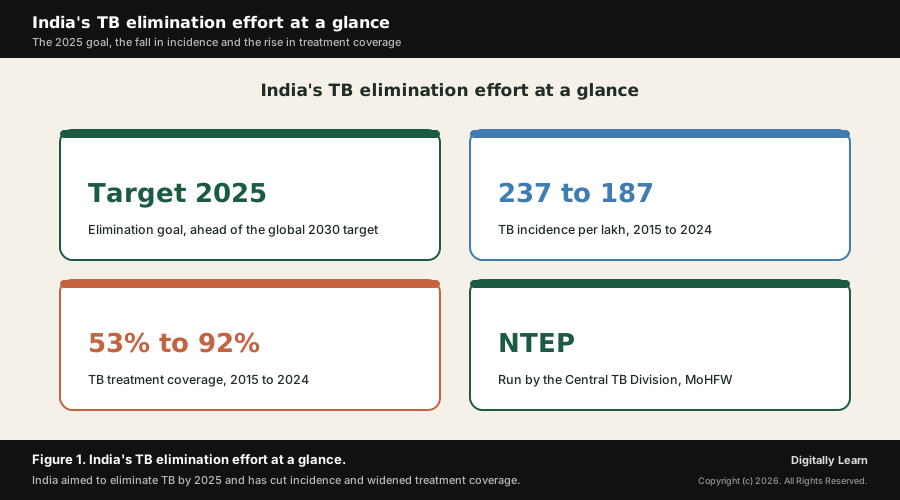
The programme was renamed in 2020, from the Revised National TB Control Programme to the National TB Elimination Programme, a change of word that signalled a change of ambition: from controlling TB to ending it. India set a target to eliminate TB by 2025, five years ahead of the global Sustainable Development Goal target of 2030, one of the most ambitious national health goals anywhere. The figure below sets out the effort at a glance.
Why TB Elimination Is in the News: A Sharp Fall in Incidence
A 21 percent fall in incidence and wider treatment coverage
Why it matters now is the scale of the progress reported as India reviews the 2025 target. Per the WHO Global TB Report, India's TB incidence fell by about 21 percent, from 237 cases per lakh population in 2015 to 187 per lakh in 2024, almost double the pace of the decline seen globally over the same years.
At the same time, treatment coverage, the share of estimated TB cases that the programme actually finds and treats, rose from about 53 percent in 2015 to about 92 percent in 2024. The number of missing cases, people with TB who were never reported to the programme, fell from an estimated 15 lakh in 2015 to under one lakh in 2024, a sign that case-finding has improved sharply.
These gains are why the programme is closely watched. They show that a large, poor and densely populated country can bend the TB curve faster than the world as a whole, even though the absolute burden remains very heavy and the 2025 elimination target, on the latest reporting, has not been fully met.
Understanding the Significance of TB Elimination for India
Why ending TB is a test of public health at the grassroots
What is the significance of the TB elimination drive lies first in the sheer size of the problem. TB is the world's deadliest infectious disease, and India carries the largest burden of any country, with a major share of all cases worldwide. Cutting TB therefore saves more lives, and prevents more impoverishing illness, than almost any other single health intervention India can make.
Its second significance is what it shows about public health itself. TB falls hardest on the poor, so reaching every patient is a test of whether the State can deliver care at the grassroots, free at the point of use, rather than leaving the sick to a costly private market. The NTEP offers free testing, free drugs and cash for nutrition, a deliberate counter to the out-of-pocket costs that push families into debt.
Third, the programme is a model of mission-mode government, joining the health system with community participation through TB Mukt Bharat. It links directly to nutrition, to poverty reduction and to the goal of Universal Health Coverage, making TB a lens through which the wider strength of Indian public health can be judged.
How the NTEP Works: The NSP 2017-2025 Pillars, Diagnosis and Treatment
The National Strategic Plan 2017-2025 and its four pillars
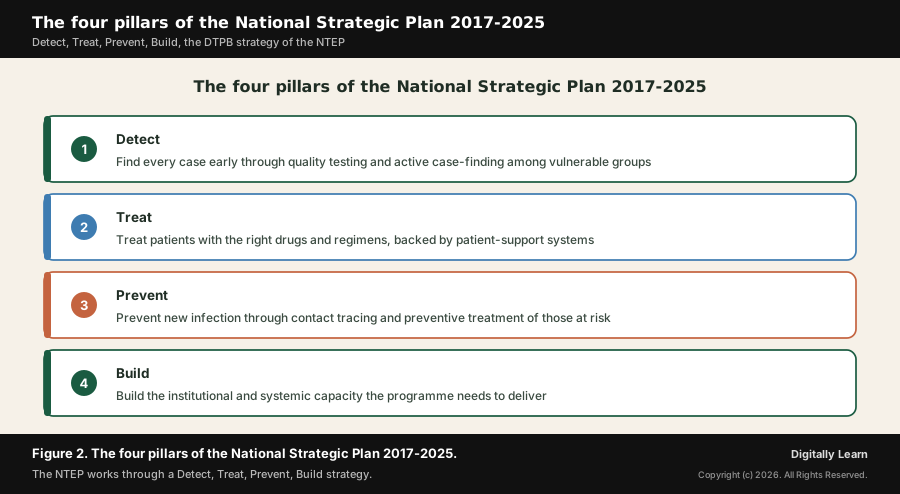
The NTEP is guided by the National Strategic Plan (NSP) 2017-2025, the road map that frames how India means to end TB. It organises the work around four pillars, summed up as Detect, Treat, Prevent and Build, the DTPB strategy, each addressing a different stage of the response.
| Pillar | What it means | Core actions |
|---|---|---|
| Detect | Find every case, early | Quality testing and active case-finding among vulnerable groups |
| Treat | Cure those who have TB | Right drugs and regimens, with patient-support systems |
| Prevent | Stop new infection | Contact tracing and preventive treatment for those at risk |
| Build | Strengthen the system | Institutional and systemic capacity to deliver the plan |
Read together, the four pillars show the design: a strategy that does not stop at treating the sick but reaches out to find hidden cases, protects those around them, and builds the system that has to carry it all. The figure below sets out the pillars.
Diagnosis, treatment and the Ni-kshay digital portal
On diagnosis, the programme has shifted from old, slow methods to rapid molecular tests, known as nucleic-acid amplification tests, which confirm TB and detect drug resistance within hours rather than weeks. Wider use of these tools, alongside active case-finding drives, is a main reason missing cases have fallen so far.
On treatment, patients receive a free, full course of standard anti-TB drugs through the public system, with support to help them complete it, since stopping early is what breeds resistance. For drug-resistant TB, India has adopted shorter, more effective regimens, discussed in the next section.
Holding the system together is the Ni-kshay portal, a web-based patient-management and surveillance platform built by the Central TB Division. Every notified case, from both the public and the private sector, is recorded on it, so the programme can track tests, treatment and outcomes patient by patient. Mandatory notification of TB by private doctors and laboratories is what lets the portal capture cases the public system once missed.
Key Initiatives: Pradhan Mantri TB Mukt Bharat, Ni-kshay Schemes and the 100-Day Campaign
Pradhan Mantri TB Mukt Bharat Abhiyaan and the Ni-kshay Mitra
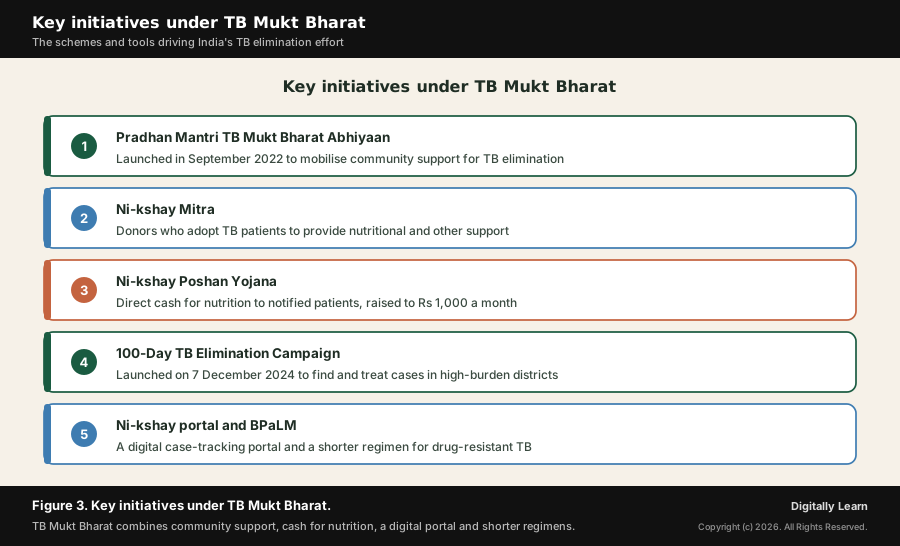
The flagship community effort is the Pradhan Mantri TB Mukt Bharat Abhiyaan (PMTBMBA), launched in September 2022 by the President of India to mobilise society behind TB elimination. Its idea is simple: ending TB is not the work of the health system alone, so the public is invited to support patients directly.
The heart of the scheme is the Ni-kshay Mitra, a donor, an individual, an organisation or an institution, who adopts one or more TB patients and provides nutritional and other support during treatment, such as monthly food baskets. Because under-nutrition both raises the risk of TB and slows recovery, this community adoption directly addresses a key driver of the disease and builds a sense of shared responsibility.
Ni-kshay Poshan Yojana: direct cash for nutrition
Running alongside community support is the Ni-kshay Poshan Yojana (NPY), a Direct Benefit Transfer scheme launched on 1 April 2018. It pays cash directly into the bank account of every notified TB patient to help them afford a better diet through treatment, on the evidence that good nutrition improves the chance of a cure.
The support was raised in 2024, from Rs 500 a month to Rs 1,000 a month for the full duration of treatment, and its scope was widened to reach household contacts of patients. This is a clear instance of the State using a cash transfer to tackle a social determinant of disease, nutrition, rather than treating the illness in isolation.
The 100-Day Campaign and shorter drug-resistant-TB regimens
To accelerate case-finding, the Government launched the 100-Day TB Elimination Campaign on 7 December 2024, a focused drive to screen vulnerable people and quickly detect and treat TB across hundreds of the worst-affected districts. Such time-bound campaigns concentrate effort and attention on finding the cases the routine system can miss.
The campaign also marked a step forward in treating drug-resistant TB. India adopted the BPaLM regimen, a combination of bedaquiline, pretomanid, linezolid and moxifloxacin, which can cure many drug-resistant cases in about six months, far shorter and better tolerated than the long, gruelling regimens it replaces. The figure below lists the main initiatives.
Progress and Challenges: Gains in Coverage, Drug Resistance and Missing Cases
The measurable gains in incidence and coverage
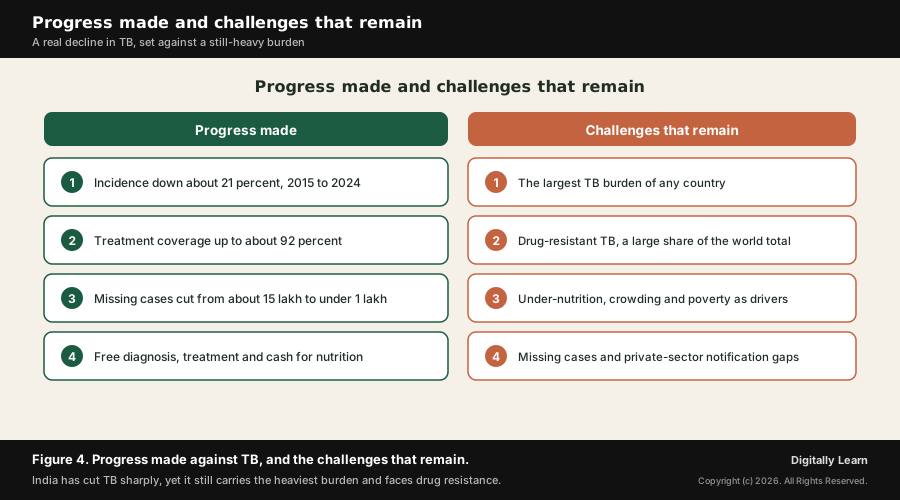
The gains are real and measurable. The fall in incidence from 237 to 187 per lakh between 2015 and 2024, the rise in treatment coverage to about 92 percent, and the collapse in missing cases together show that wider testing, free treatment and nutrition support are bending the TB curve faster than the global average.
These improvements rest on concrete system changes: rapid molecular diagnostics, mandatory notification that brings private-sector cases onto the Ni-kshay portal, cash for nutrition, community adoption of patients and shorter regimens for resistant TB. Together they have widened the reach of public health to groups the system once failed to reach.
Drug-resistant TB, missing cases and social determinants
Yet the challenges remain formidable, and an honest assessment must weigh them. India still carries the largest absolute TB burden of any country, so even a falling rate leaves a very large number of people ill each year, and the 2025 elimination target, on the latest reporting, has not been fully met.
Drug-resistant TB, including multidrug-resistant and extensively drug-resistant forms, is a serious threat, with India accounting for a large share of the world's drug-resistant cases; it is harder, longer and costlier to treat. Beneath it lie the social determinants, under-nutrition, crowding and poverty, that keep generating new infection and that no drug alone can fix.
- (a) A heavy absolute burden. A falling rate still leaves India with the largest number of TB cases of any country.
- (b) Drug-resistant TB. Multidrug-resistant and extensively drug-resistant TB are harder to cure and a major share is in India.
- (c) Missing and undiagnosed cases. People with TB who never reach or are never recorded by the system continue to spread it.
- (d) Social determinants. Under-nutrition, crowding and poverty keep driving new infection beyond the reach of medicine alone.
- (e) Private-sector gaps. Incomplete notification and uneven treatment quality in the large private sector weaken the response.
Reading the gains and the gaps together gives the fair verdict: India has made genuine progress against TB, faster than the world, yet the burden, drug resistance and the social roots of the disease mean the work is far from finished. The figure below pairs the progress with the challenges.
TB Elimination in Context: SDG 3, the End TB Strategy and Social Determinants
How the effort connects to global health goals and Indian welfare
Contemporary linkages tie India's TB drive to wider goals. It is part of Sustainable Development Goal 3, good health and well-being, which calls for ending the TB epidemic by 2030, and of the WHO End TB Strategy, the global framework of targets for cutting TB deaths and cases that India has tried to outpace.
The effort connects, too, to the idea of social determinants of health. By pairing free treatment with cash for nutrition and community support, the NTEP treats TB not only as a medical condition but as a problem rooted in poverty, hunger and housing, the conditions that decide who falls ill.
It also sits within India's wider push for Universal Health Coverage and the architecture of welfare around it. The same digital and Direct Benefit Transfer tools that run the Ni-kshay schemes connect TB to Ayushman Bharat and to the broader effort to make essential health care free and reachable for all.
Finally, drug-resistant TB ties the programme to the global fight against antimicrobial resistance, one of the gravest long-term health threats, where the misuse of antibiotics breeds resistant disease. Completing treatment and using the right regimens, the heart of the NTEP, is also how that wider danger is held back.
UPSC Relevance and Exam Focus
Where this fits in the UPSC-CSE syllabus
This topic maps most directly to General Studies Paper II: issues relating to health, and government policies and interventions for development in the health sector, with strong links to governance and to welfare schemes for vulnerable sections. It also reaches into General Studies Paper III, where drug-resistant disease and antimicrobial resistance sit within the science-and-technology and biotechnology syllabus.
For Prelims, hold the high-yield facts: TB is caused by Mycobacterium tuberculosis; the NTEP, renamed in 2020, is run by the Central TB Division; India targeted TB elimination by 2025, ahead of the global 2030 goal; the National Strategic Plan 2017-2025 has four pillars, Detect, Treat, Prevent and Build; and the Ni-kshay Poshan Yojana and the Ni-kshay portal are central tools.
For Mains, the recurring framing is the State's role in public health: how a national programme can deliver free care, counter the marketisation of health, and reach the poorest at the grassroots through community participation. NTEP is a ready example of mission-mode public health to use in any health or governance answer.
Recurring linked concepts an aspirant should keep in working memory:
- Universal Health Coverage: Ensuring all people can use the health services they need without financial hardship, the wider goal NTEP serves.
- Social determinants of health: The conditions, such as nutrition, housing and poverty, that shape who falls ill, which the Ni-kshay schemes target.
- Antimicrobial resistance: The rise of drug-resistant disease from the misuse of antibiotics, of which drug-resistant TB is a leading example.
- Direct Benefit Transfer: The cash-transfer mechanism used by the Ni-kshay Poshan Yojana to deliver nutrition support directly to patients.
A common Prelims trap is to confuse the NTEP with the older RNTCP or to mistake the 2025 target for the global one. The programme was renamed the NTEP in 2020, and India's 2025 elimination target was set five years ahead of the global Sustainable Development Goal target of 2030.
A common Mains trap is to praise the programme without testing it. Its exam value lies in a balanced judgment: the genuine fall in incidence and the model of community public health, set honestly against the heavy burden, drug resistance, missing cases and the social roots of the disease.
Previous Year UPSC-CSE Questions By the end you will be able to draft model answers for the following UPSC questions. Each question carries a collapsible framework showing how to approach it in the exam.
- UPSC Mains 2024 GS-IIIn a crucial domain like the public healthcare system the Indian State should play a vital role to contain the adverse impact of marketisation of the system. Suggest some measures through which the State can enhance the reach of public healthcare at the grassroots level.
How to structure the answer in the exam
Body (sub-themes to develop):
- Why the State must lead and contain marketisation: health spending is a leading cause of impoverishment, the poor cannot afford private care, and communicable diseases such as TB carry externalities that the market under-treats, so free, State-provided care is essential.
- Strengthen primary and grassroots delivery: free diagnosis and treatment through the public system down to the sub-district level, as the NTEP provides, with Health and Wellness Centres and frontline workers extending reach.
- Use technology and active outreach to reach the unreached: rapid molecular diagnostics, active case-finding drives and a digital tracking portal (Ni-kshay) with mandatory notification bring hidden and private-sector cases into the public system.
- Tackle the social determinants directly: Direct Benefit Transfer of cash for nutrition (Ni-kshay Poshan Yojana) addresses under-nutrition, a driver of disease that medical care alone cannot fix.
- Mobilise the community and partnerships: schemes such as the Pradhan Mantri TB Mukt Bharat Abhiyaan, with Ni-kshay Mitras adopting patients, harness community participation and convergence to extend the State's reach at the grassroots.
Sources and Further Reading
- Ministry of Health and Family Welfare: TB incidence in India drops by 21% (237 to 187 per lakh, 2015 to 2024)
- World Health Organization: Global Tuberculosis Report 2025
- Directorate General of Health Services: National Tuberculosis Elimination Programme
- Central TB Division: National Strategic Plan 2017-2025 for TB Elimination in India
- Press Information Bureau: President launches Pradhan Mantri TB Mukt Bharat Abhiyaan
- Press Information Bureau: World Tuberculosis (TB) Day 2025
- Press Information Bureau: Nutritional Support to TB Patients (Ni-kshay Poshan Yojana revision)
- Press Information Bureau: India's 100-Day TB Elimination Campaign
- Wikipedia: Tuberculosis
- Wikipedia: Tuberculosis management
Editorial Disclaimer
This briefing is for UPSC preparation. Verify the figures and programme details against the official MoHFW, Central TB Division, PIB and WHO sources before relying on them.


