


Overview
ABHA, the registries and consent-based health records
The Ayushman Bharat Digital Mission (ABDM) is the digital-health-infrastructure pillar of Ayushman Bharat, building the digital backbone of the health system so citizens hold a consent-based set of their own health records.
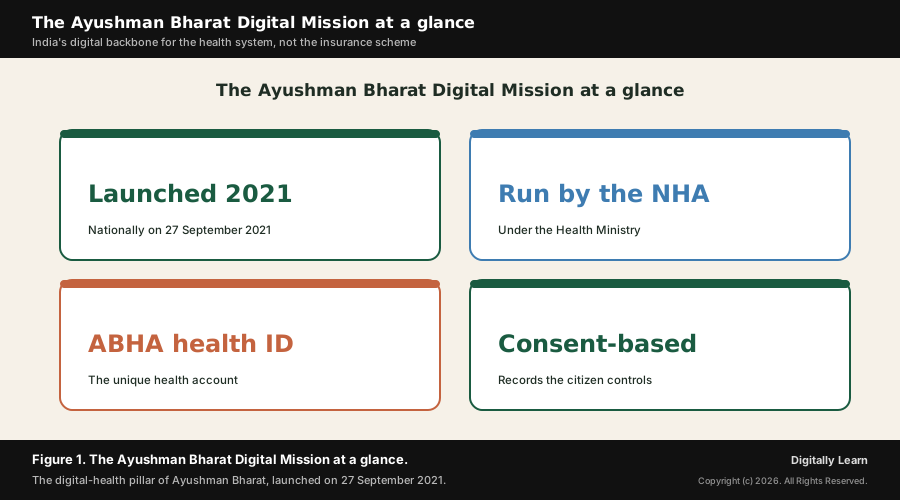
The Ayushman Bharat Digital Mission (ABDM) is the programme through which India is building the digital backbone of its health system. It is the digital-health-infrastructure pillar of Ayushman Bharat, and it must be kept apart from the insurance pillar, the Pradhan Mantri Jan Arogya Yojana, which pays for hospital treatment; ABDM is about health data and records, not insurance cover. Launched nationally on 27 September 2021 and run by the National Health Authority under the Ministry of Health and Family Welfare, it gives every citizen an ABHA health account, builds registries of health professionals and facilities, and lets a person's longitudinal health records be accessed and shared, with the citizen's consent, across public and private providers. Its design is deliberately federated and consent-based, so records stay with the providers that hold them and move only when the citizen agrees.
What ABDM Is: India's Digital Health Backbone and Why It Is in the News
The digital-health pillar of Ayushman Bharat, distinct from the insurance scheme
The Ayushman Bharat Digital Mission (ABDM) is the Government of India's programme to build the digital backbone of the country's health system. It connects the scattered parts of healthcare, patients, doctors, hospitals, clinics and laboratories, through common digital rails, so a person's health information can follow them rather than sit locked in one provider's files. The stated aim is a national digital health ecosystem that supports universal health coverage.
A first point must be made clearly to avoid a common confusion. Ayushman Bharat rests on two distinct pillars. The other pillar, the Pradhan Mantri Jan Arogya Yojana (PM-JAY), is the health-insurance scheme that pays for hospital treatment up to a fixed cover. ABDM is the digital-infrastructure pillar; it does not pay any medical bill. It builds the identity, the registries and the consent-driven plumbing through which health records are created, stored and shared.
The mission is run by the National Health Authority (NHA), the same agency that runs PM-JAY, working under the Ministry of Health and Family Welfare. It links practitioners and patients digitally and is meant to give them access to a person's longitudinal health records, the running history of a patient's care over time, with that person's consent. The figure below sets out the headline facts before the building blocks are taken one by one.
Why ABDM is in the news: the mission's multi-year journey and steady expansion
ABDM is in the news because it has moved from launch into a phase of scale. The mission was first announced as a pilot by the Prime Minister from the Red Fort on 15 August 2020, and ran in pilot form in six Union Territories before the national rollout. The national launch followed on 27 September 2021, and since then the government has reported a steady expansion of the accounts created and of the providers joining its registries.
The reason this matters for current affairs is that ABDM is now treated as a working example of India's digital public infrastructure, alongside digital identity and digital payments. As more providers join and more records become shareable, the questions that follow scale, on privacy, on the digital divide and on adoption, move to the centre of policy debate, which is exactly why a careful, balanced understanding of the mission is useful for the exam.
Understanding the Significance of ABDM as Digital Public Infrastructure for Health
Why a digital health backbone matters for patients, providers and the system
What is the significance of ABDM lies first in what it does for the patient. Today a person's records are scattered across the hospitals and labs that happen to hold them, so each new visit often starts from a blank slate. By giving every citizen an ABHA account and a way to link records to it, ABDM lets a patient carry a portable history between providers, which supports better and faster care and reduces repeated, avoidable tests.
Its second significance is for the health system as a whole. By building shared registries and common standards, ABDM lets public and private providers, primary clinics and tertiary hospitals work from one interoperable framework rather than a patchwork of disconnected software. This is the logic of digital public infrastructure: a common, open set of digital rails that many actors can build on, the same idea that underpins India's digital identity and digital-payments systems, now applied to health.
Its third significance is for governance and public health. A digital, consent-based record system can, over time, support telemedicine, continuity of care and, in anonymised and aggregated form, better planning and research, while keeping the citizen in control of who sees their data. ABDM thus matters not only as a health programme but as a test of how India delivers e-governance that is efficient and inclusive at the same time.
The Building Blocks of ABDM: ABHA, the Registries, the Health Interface and the Consent Manager
ABHA: the Ayushman Bharat Health Account and the citizen's health ID
The foundation of ABDM is the Ayushman Bharat Health Account (ABHA), the unique health ID for each individual, earlier called the Health ID. ABHA establishes a trustworthy digital identity for a person within the health system, so that records created at different hospitals, clinics and laboratories can be linked to a single account and accessed and shared in one place. It is the key that ties a scattered medical history together.
ABHA is created voluntarily by the citizen, and it comes with an easy-to-remember address through which a person can receive and manage their records on a personal-health-record application. The government has reported very large numbers of ABHA accounts created since launch; as of 6 February 2025 the Health Ministry reported about 73.98 crore ABHA created. Such totals move continually, so the precise figure should always be read as a dated, official snapshot rather than a fixed number.
The Healthcare Professionals Registry: a verified directory of practitioners
The Healthcare Professionals Registry (HPR) is a comprehensive, verified directory of healthcare professionals involved in delivering care across both modern and traditional systems of medicine. By enrolling doctors and other practitioners in a single, checkable register, the HPR lets patients and institutions confirm that a professional is genuine, and it gives each practitioner a verified identity within the ABDM network.
This registry matters because trust is the precondition for sharing sensitive records. A record is only as safe as the assurance that the person on the other side is a real, qualified professional. As of 6 February 2025 the Health Ministry reported 5,64,851 healthcare professionals registered on the HPR, a figure that, like the others, continues to grow as enrolment proceeds.
The Health Facility Registry: a single register of hospitals, clinics and labs
The Health Facility Registry (HFR) is the matching, comprehensive register of health facilities across the country, again spanning both modern and traditional systems of medicine and covering both public and private facilities. It includes hospitals, clinics, diagnostic laboratories and imaging centres, so that every place where care is delivered can be uniquely identified within the system.
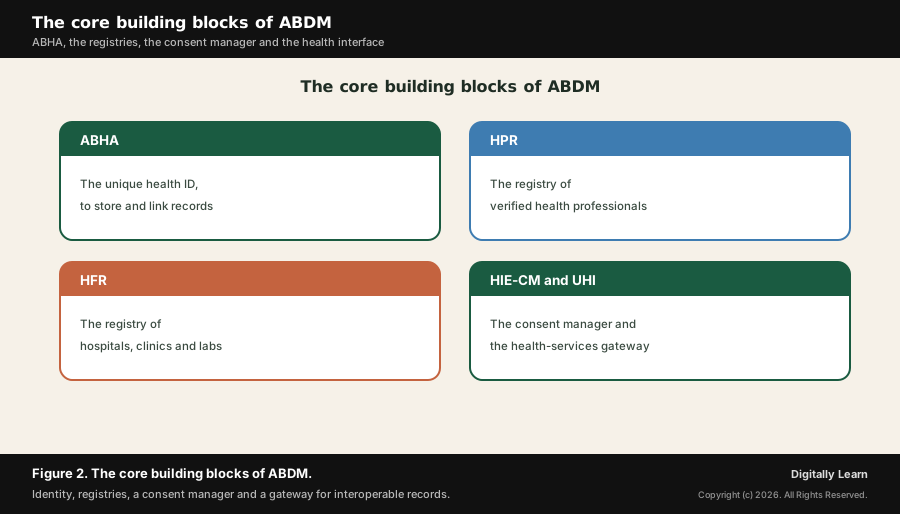
Together the HPR and HFR form the verified backbone of identities on which the rest of ABDM rests: a registered patient (through ABHA), a registered professional (through HPR) and a registered facility (through HFR). As of 6 February 2025 the Health Ministry reported 3,63,520 health facilities registered on the HFR. The table below summarises the building blocks and their functions, and the figure that follows sets them side by side.
| Building block | What it is | Function in the system |
|---|---|---|
| ABHA | The Ayushman Bharat Health Account, the unique health ID | Gives the citizen a verified identity to store and link records |
| HPR | The Healthcare Professionals Registry | A verified directory of doctors and other practitioners |
| HFR | The Health Facility Registry | A register of hospitals, clinics, laboratories and imaging centres |
| UHI | The Unified Health Interface | An open, standards-based gateway for digital health services |
| HIE-CM | The Health Information Exchange and Consent Manager | Lets the citizen grant, view and withdraw consent to share records |
The Unified Health Interface: an open gateway for digital health services
The Unified Health Interface (UHI) is a gateway with a standards-based protocol for the digital health services built on ABDM. It lets many different applications connect to one another through common rules, much as a payments interface lets many apps move money between many banks. A patient using one application can then discover and use a service, such as booking a teleconsultation, offered through a different application.
This open-gateway design is central to the mission's promise of interoperability. Rather than locking patients into a single provider's software, the UHI is meant to create a competitive, connected market of health-service applications that all speak the same digital language. It is the part of ABDM that turns a set of records into a usable ecosystem of services a patient can actually reach.
Personal Health Records and the consent manager that keeps the citizen in control
The final building block is the layer that makes ABDM consent-based: the Personal Health Record and the Health Information Exchange and Consent Manager (HIE-CM). A personal-health-record application lets a citizen view, link and manage their own records in one place. The consent manager is the tool through which that citizen grants, sees and can withdraw permission for any specific record to be shared with any specific provider.
This is the decisive design choice of the whole mission. Records are stored with the providers that created them and are shared over the ABDM network, with encryption, only after the citizen gives express consent through the consent manager. The citizen, not any central authority, decides who sees what and for how long. This consent layer is what distinguishes ABDM from a simple government database and is the safeguard on which its claim to protect privacy rests.
The Federated, Consent-Based and Interoperable Architecture, Explained
A federated design with no central data store, records moving only on consent
The single most important idea in ABDM is that its architecture is federated. A federated system has no centralised repository of health data; the government does not gather every citizen's medical records into one giant database. Instead, records remain physically with the providers that generated them, the hospital, clinic or laboratory, and ABDM supplies only the common standards and the secure channels through which those records can be found and shared when, and only when, the citizen agrees.
The mission is built, in the government's phrase, on a privacy by design principle, and ABDM itself does not store the health data flowing across it. A request to view a patient's records becomes a consent ask that reaches the citizen; on approval, the records are pulled from the holding provider and shared, encrypted, with the requester. Because there is no single store to break into, the design aims to limit the damage any one breach could cause.
The same architecture delivers interoperability. By prescribing common data standards through the consent-manager and gateway layers, ABDM lets records created in one provider's software be read in another's, so a patient's history becomes genuinely portable across the system. The figure below traces how a single consent-based exchange works, step by step.
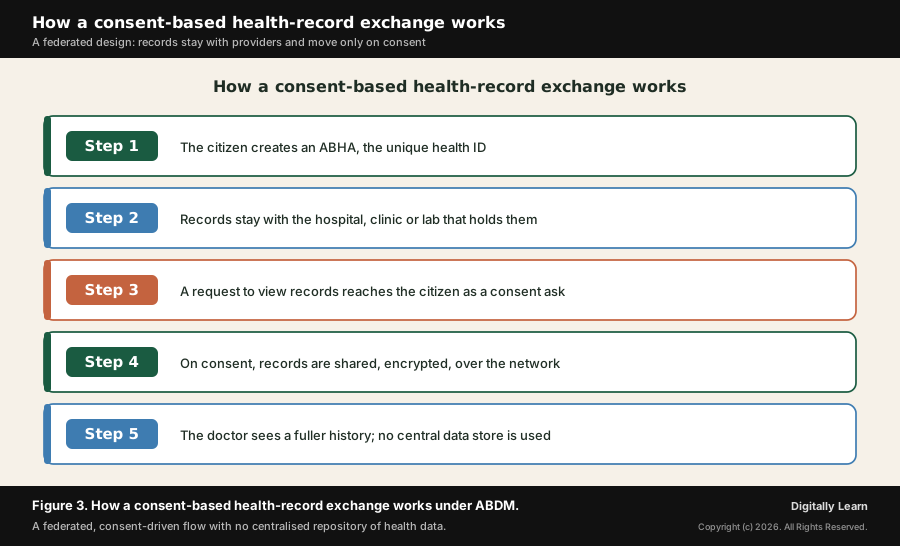
Reading the steps together shows the logic of the federated model: identity first through ABHA, records left where they are created, a consent ask to the citizen, an encrypted share on approval and no central pool of data at any stage. The architecture is the policy: privacy and citizen control are built into how the system is wired, not bolted on afterwards.
The Institutional Architecture: the NHA, the Health Ministry, States and Private Providers
Who runs ABDM, under what ministry, and how the states and private sector fit in
ABDM is implemented by the National Health Authority (NHA), an agency of the Government of India that also administers the PM-JAY insurance scheme. The NHA was given the responsibility of taking the mission forward, and it owns the core digital building blocks, the registries and the standards. It sits under the Ministry of Health and Family Welfare, which provides the policy and budgetary frame within which the mission operates.
Because health is largely a State subject in India, ABDM is necessarily a cooperative effort. The NHA builds the shared national rails, but it is the states and union territories, through their public hospitals, primary health centres and health-management systems, that connect their facilities and create records on the ground. The pilot itself ran in six Union Territories, underlining that adoption depends on the sub-national level as much as on the centre.
The mission is also designed to bring in the private sector, which delivers a large share of Indian healthcare. Private hospitals, clinics, laboratories and digital-health applications integrate with ABDM through its registries and gateways after meeting its standards. The institutional model is therefore a layered one: the centre sets the standards, the states deliver public-sector adoption, and private providers build on the open rails.
The Benefits of ABDM: Portability, Less Duplication, Telemedicine and Research
For patients: portable records, fewer repeated tests and continuity of care
For the individual patient, the clearest benefit is the portability of records. A person who can carry their history between a primary clinic, a specialist and a hospital no longer has to reconstruct their medical past at each visit. This continuity helps a doctor make a better-informed decision, and it directly reduces the duplication of laboratory tests and imaging that occurs when earlier results are simply unavailable, saving the patient both money and time.
ABDM also widens access, particularly through telemedicine. The Health Ministry's free telemedicine service, eSanjeevani, has been integrated with ABDM, so its users can create an ABHA, link and manage records such as prescriptions and laboratory reports, and share them with a doctor in a remote consultation. For patients in remote and rural areas, joining a distant consultation to a portable record is a real gain in continuity of care.
For the system: efficiency, public-health planning and the scope for research
For the health system, a connected digital record reduces friction and waste. Shared registries and interoperable records cut the administrative cost of finding and re-entering information, and they make referrals between providers smoother. Over time, a system in which records and facilities are digitally identified can support better monitoring of where care is delivered and where the gaps lie.
In anonymised and aggregated form, and subject to consent and the law, the digital health ecosystem also creates scope for better public-health planning and research. Patterns of disease, treatment and access that are invisible in scattered paper records can become visible once data is standardised, helping the state allocate resources. This potential is real, but the safeguards below matter, since the same data that enables research is what the privacy debate is about.
The Debates: Data Privacy, Security, the Digital Divide and Exclusion
Data privacy and security: the DPDP Act, consent and the federated safeguard
The first and largest concern is data privacy and security. Health information is among the most sensitive data a person holds, and a system built to make it shareable raises the question of who can see it. The government's answer rests on the federated design: ABDM stores no health data centrally, records move only on express consent, and exchanges are encrypted, so there is no single pool of records to be stolen at once.
The governing law is the Digital Personal Data Protection Act, 2023 (DPDP Act), which sets a consent-based framework for processing personal data, with principles of purpose limitation, data minimisation and security safeguards. ABDM states that its federated architecture is aligned with this Act, alongside its own Health Data Management Policy.
Commentators have noted, however, that the DPDP Act, unlike some other data-protection laws, does not create a separate, higher class of sensitive personal data, so health data is protected under the same general framework as other personal data. Whether that general protection is sufficient for data this sensitive is a question raised in the debate, presented here as an open issue rather than a settled one.
Alongside the legal frame, ABDM describes operational security measures: applications are validated in a sandbox and undergo security audits before integration, the system is hosted on an empanelled cloud, and a Chief Information Security Officer and a Data Protection Officer review safeguards. Critics nonetheless caution that no system is immune to breaches and that strong enforcement, oversight and grievance redress matter as much as the design.
The digital divide, consent in practice and the risk of exclusion
A second concern is the digital divide. A health system built on digital identity, smartphones and connectivity risks leaving behind those who lack them: the elderly, the poor, people in remote areas with weak networks, and those with low digital literacy. If digital records become the default route to care, the very groups who most need public health services may find them harder to reach, the opposite of the inclusion the mission promises.
The government notes that inclusion is a stated principle of ABDM and that it provides for an assisted mode where connectivity is poor. Even so, ensuring that no one is left out as services move online remains a real design challenge rather than a solved problem, and it is one the debate keeps in view.
Closely linked is the question of consent in practice. Consent is meaningful only if it is genuinely informed and freely given, and a patient seeking urgent care, or one unfamiliar with digital systems, may consent without fully understanding what is shared. The risk that participation comes to feel effectively compulsory, even where it is formally voluntary, is one careful implementation must guard against, so that no one is denied care for declining a digital record.
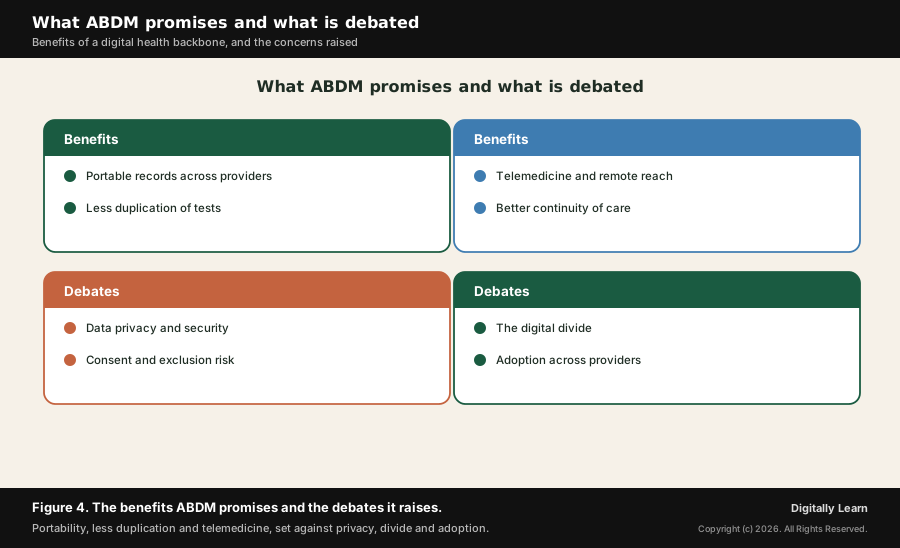
A third, more practical concern is adoption. The mission's value grows only as more providers join and records are actually linked and used, and uneven uptake across states and between the public and private sectors can limit the benefits. Building genuine interoperability and persuading busy providers to adopt digital workflows are continuing challenges. The figure below sets the benefits and the debates side by side, as a balanced reading requires.
ABDM in Context: Digital Public Infrastructure for Health and the Way Forward
How ABDM fits India's digital public infrastructure and what would strengthen it
Seen in context, ABDM is the health application of India's wider model of digital public infrastructure. The same approach behind a digital identity used by hundreds of millions and a digital-payments system for everyday transactions is now applied to health: an open, standards-based, interoperable layer that public and private actors can build on. This places ABDM within a broader story about delivering public services digitally and at scale.
The way forward, on a balanced reading, lies in matching the technical build with the safeguards. Closing the digital divide through assisted modes, ensuring consent is genuinely informed, strengthening data-protection enforcement under the DPDP Act, and deepening adoption are the tasks that would let the mission deliver without its risks. The aim is a health system that is at once more efficient and more inclusive, and the test of ABDM is whether it achieves both together.
UPSC Relevance and Exam Focus
Where ABDM fits in the UPSC-CSE syllabus
This topic maps most directly to General Studies Paper II: government policies and interventions in the health sector, welfare schemes and their design, and e-governance as a tool of service delivery. It also reaches into General Studies Paper III, on developments in science and technology and on the digital economy, since ABDM is a leading instance of digital public infrastructure.
For Prelims, hold the high-yield facts: ABDM is the digital-health pillar of Ayushman Bharat, distinct from the PM-JAY insurance scheme; it was launched nationally on 27 September 2021 and is run by the National Health Authority; its building blocks are ABHA, the professional and facility registries, the Unified Health Interface and the consent manager; and its architecture is federated, sharing records only on consent.
For Mains, the recurring framing is to assess ABDM as e-governance and digital public infrastructure: its promise of efficiency, transparency and inclusion set against the inadequacies that can hamper it, the data-privacy and security questions under the DPDP Act, the digital divide and the risk of exclusion. A strong answer treats the mission in balanced terms, crediting the genuine gains in portability, telemedicine and continuity of care while taking the privacy and equity concerns seriously.
Recurring linked concepts an aspirant should keep in working memory:
- Digital public infrastructure: Open, interoperable digital rails that many actors build on, of which ABDM is the health example alongside digital identity and payments.
- Federated architecture and consent: Records kept with providers and shared only on the citizen’s consent, with no centralised data store.
- The DPDP Act, 2023: India’s data-protection law, the consent-based frame within which health data under ABDM is governed.
- The digital divide: Unequal access to devices, connectivity and digital skills, the central equity risk for any digital-first public service.
A common Prelims trap is to confuse ABDM with PM-JAY; remember that ABDM is the digital-records pillar and PM-JAY is the insurance pillar, and that ABDM does not pay any medical bill. A common Mains trap is to praise the technology without weighing the risks; the exam value lies in a balanced judgment that holds the benefits of a digital health backbone together with the privacy, security and digital-divide concerns it must answer.
Previous Year UPSC-CSE Questions By the end you will be able to draft model answers for the following UPSC questions. Each question carries a collapsible framework showing how to approach it in the exam.
- UPSC Mains 2023 GS-IIDiscuss how e-governance brings effectiveness, transparency and accountability, and the inadequacies that hamper the enhancement of these features.
How to structure the answer in the exam
Body (sub-themes to develop):
- How e-governance brings effectiveness: portable, interoperable records that cut duplication and administrative friction and speed up service delivery, as in ABDM's portable health records and telemedicine reach.
- How it brings transparency and accountability: verified registries and digital identities that let citizens confirm genuine providers, and consent-based access that gives the citizen a clear, auditable say over their own data.
- The inadequacies, part one: the digital divide, unequal access to devices, connectivity and digital literacy, which can exclude the elderly, the poor and remote populations from digital-first services.
- The inadequacies, part two: data privacy and security risks and the limits of the legal frame (the DPDP Act 2023 does not create a separate class of sensitive health data), and the question of whether consent is genuinely informed and free.
- The inadequacies, part three: uneven adoption and interoperability gaps across states and between the public and private sectors, plus the need for stronger enforcement, oversight and grievance redress.
Sources and Further Reading
- Press Information Bureau: PM to launch Ayushman Bharat Digital Mission on 27th September
- National Health Authority: Ayushman Bharat Digital Mission official website
- Ministry of Health and Family Welfare: Update on the implementation of Ayushman Bharat Digital Mission
- Ministry of Health and Family Welfare: ABDM marks a Transformative Three-Year Journey towards enabling Digital Health
- Press Information Bureau: Steps taken for cyber security under ABDM
- Press Information Bureau: eSanjeevani telemedicine service integrated with ABDM
- Ministry of Electronics and Information Technology: The Digital Personal Data Protection Act, 2023
- India Code: The Digital Personal Data Protection Act, 2023 (Act 22 of 2023)
- NITI Aayog: Frontier Technologies and digital health in India
- Wikipedia: Ayushman Bharat Digital Mission
- Wikipedia: Digital Personal Data Protection Act, 2023
Editorial Disclaimer
This briefing is for UPSC preparation. Verify the facts and provisions against the official National Health Authority, Health Ministry and PIB sources before relying on them.


