


Overview
The National Health Accounts (NHA) are the official accounting of how much India spends on health and where the money comes from. They are prepared for the Ministry of Health and Family Welfare by the National Health Systems Resource Centre. The 2022-23 estimates, released in May 2026, show that out-of-pocket expenditure fell to 43.4 per cent of total health spending, while government health expenditure rose to 1.43 per cent of GDP. The figures point to a steady shift from household payments towards public funding of health.
Why the National Health Accounts are in focus
A fresh reading of how India funds health
The Ministry of Health and Family Welfare released the National Health Accounts Estimates for India 2022-23 in May 2026. The accounts are compiled by the National Health Systems Resource Centre, the ministry's technical body.
The National Health Accounts measure the country's total spending on health in a year and trace where the money comes from, whether the government, households, employers or external funders. They follow a standard global framework so the numbers can be compared across years and countries.
The headline of the 2022-23 round is a clear shift in who pays. The government's share of health spending has risen, while the direct burden on households has fallen to its lowest level in the decade the accounts cover.
The key findings of the 2022-23 estimates are:
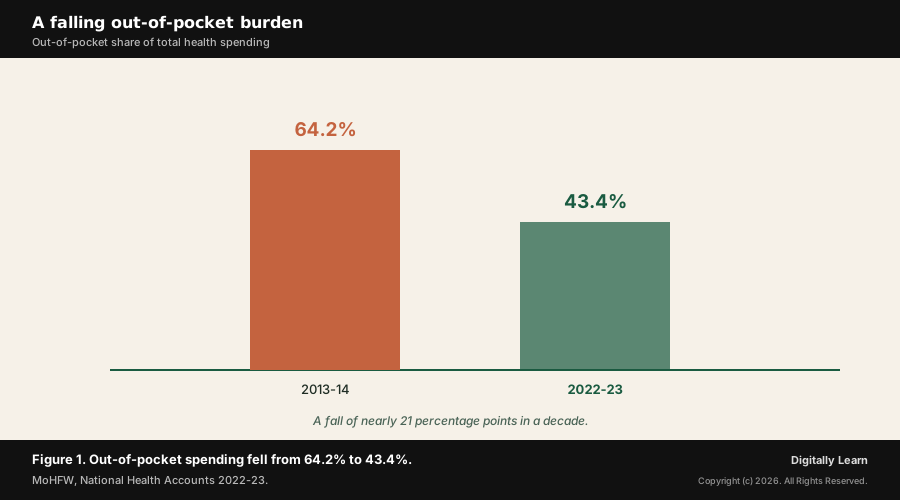
- Out-of-pocket spending fell to 43.4% of total health expenditure, from 64.2% in 2013-14.
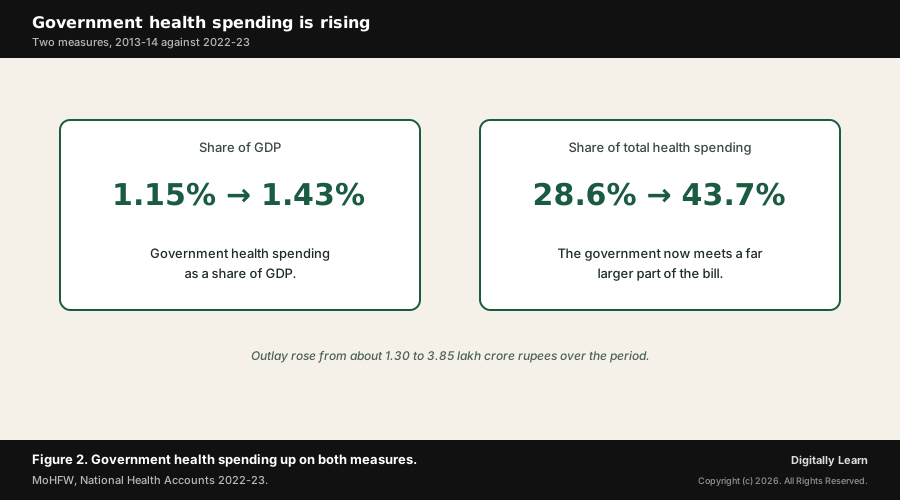
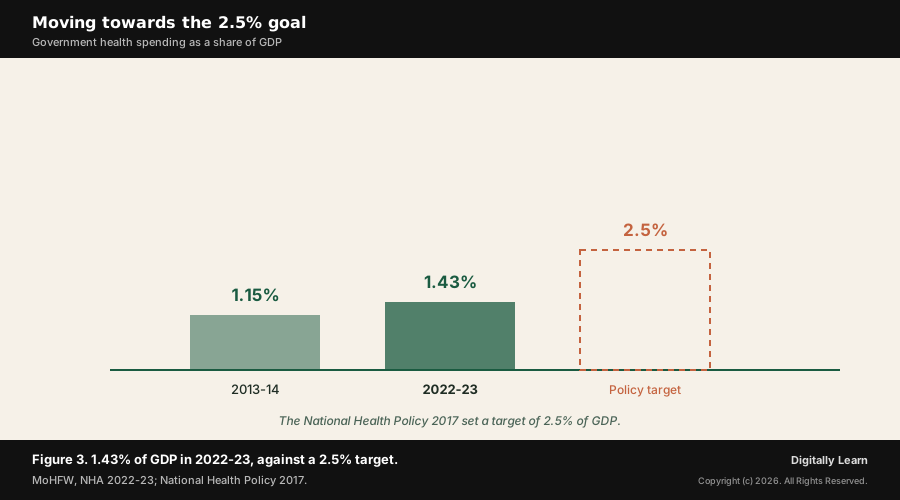
- Government health expenditure rose to 1.43% of GDP, from 1.15% in 2013-14.
- Government’s share of total health spending climbed to 43.7%, from 28.6%.
- Social security spending on health rose to 9.9% of the total, from 6%.
Why the estimates matter
Out-of-pocket spending and financial protection
A high out-of-pocket expenditure means families pay directly at the point of care, which can push the poor into debt or distress. When this share falls, households enjoy better financial protection, a core aim of universal health coverage.
The decline from 64.2% to 43.4% over a decade is therefore a meaningful gain. It signals that more health costs are now borne by the state and by insurance, and fewer are met from a family's own pocket during illness.
It also matters for policy direction. The numbers give evidence that public funding and government insurance are reshaping how India pays for health, which supports the case for sustaining and expanding those programmes.
What the estimates signify
Rising public funding, a tripling outlay, and insurance
Three threads carry the weight: the rise in the government's share, the near-tripling of public outlay, and the growing role of social health insurance.
First, the government's share. Public spending now accounts for 43.7% of total health expenditure, up from 28.6% in 2013-14, an increase of about fifteen percentage points that mirrors the fall on the household side.
Second, the scale of outlay. Government health expenditure rose from about 1.30 lakh crore rupees in 2013-14 to roughly 3.85 lakh crore in 2022-23, close to a threefold rise in absolute terms.
Third, the insurance shift. Social security spending on health, which includes government-funded insurance such as Ayushman Bharat and reimbursements to public employees, rose to 9.9% of the total, from 6%.
Distinguishing features of the estimates
The estimates at a glance
The table sets the headline indicators side by side, so the decade-long shift in how India pays for health is visible at a glance.
| Indicator | 2013-14 | 2022-23 |
|---|---|---|
| Out-of-pocket share of total health spending | 64.2% | 43.4% |
| Government health spending as share of GDP | 1.15% | 1.43% |
| Government share of total health spending | 28.6% | 43.7% |
| Social security share of total health spending | 6.0% | 9.9% |
Three features that define the release
Three elements set the National Health Accounts apart from a routine budget figure:
- (i) A full-system view. The accounts capture all health spending, public and private, not only the government’s own budget.
- (ii) A standard global method. They follow an internationally agreed framework, so India’s numbers are comparable across years and countries.
- (iii) A focus on who pays. They separate government, household and insurance spending, which reveals the financial-protection story.
Observable outcomes
Three trackable outcomes
The estimates translate into three developments worth watching in health policy.
- (a) Lower household distress. A falling out-of-pocket share should reduce the risk of families being pushed into poverty by medical bills.
- (b) Stronger case for insurance. The rising social-security share supports the expansion of government-funded health insurance.
- (c) A higher public-spending target. The data keeps pressure on the goal of raising government health spending towards the long-stated benchmark.
The numbers are an average. Out-of-pocket spending remains high for many households, especially for medicines and long illnesses, so the headline fall does not reach every family equally.
Health financing, schemes and the policy goal
Ayushman Bharat, the spending target and universal health coverage
The shift in spending is closely tied to Ayushman Bharat, which combines a large government-funded insurance scheme with a network of health and wellness centres for primary care.
It connects to the National Health Policy 2017, which set the goal of raising government health spending to 2.5% of GDP. At 1.43%, the country is moving towards that target but has not yet reached it.
The trend also advances universal health coverage, the principle that everyone should get the care they need without financial hardship, which links to Sustainable Development Goal 3 on health and well-being.
UPSC relevance and exam focus
Where this fits in the UPSC-CSE syllabus
This topic maps to General Studies Paper II: issues relating to development and management of social sectors, health, and to General Studies Paper III: government budgeting and inclusive growth.
For Prelims, hold the high-yield facts: the National Health Accounts are prepared by the NHSRC for the health ministry, and the 2022-23 figures for out-of-pocket spending and government health expenditure.
For Mains, two framings recur: whether public funding can deliver universal health coverage, and how to reduce the out-of-pocket burden on poor households.
Recurring linked concepts an aspirant should keep in working memory:
- Out-of-pocket expenditure: direct payments by households at the point of care.
- Ayushman Bharat: the government-funded health insurance and primary-care programme.
- National Health Policy 2017: set the 2.5% of GDP public-spending goal.
- Universal health coverage: care for all without financial hardship.
The National Health Accounts are compiled by the NHSRC for the health ministry, not by the Reserve Bank or the statistics ministry. Mixing up the compiling body is an easy error.
Do not equate higher government spending with solved access. A lower out-of-pocket share is an average, and gaps remain for medicines, rural areas and chronic illness.
Previous Year UPSC-CSE Questions By the end you will be able to draft model answers for the following UPSC questions. Each question carries a collapsible framework showing how to approach it in the exam.
- UPSC Mains 2015 GS-IIPublic health system has limitations in providing universal health coverage. Do you think that the private sector could help in bridging the gap? What other viable alternatives would you suggest?
How to structure the answer in the exam
Introduction: Open with the gap between health needs and public capacity that the accounts make visible.
Body (sub-themes to develop):
- Limits of the public system: underfunding, shortages and uneven reach.
- Private sector: can add capacity but may raise costs and out-of-pocket spending.
- Government-funded insurance such as Ayushman Bharat as a bridge.
- Raising public health spending towards the policy target.
- Strengthening primary care to cut downstream costs.
Conclusion: Conclude that a mix of higher public funding, insurance and regulated private provision best advances universal health coverage.
- UPSC Prelims 2022With reference to Ayushman Bharat Digital Mission, consider the following statements:
- Private and public hospitals must adopt it.
- As it aims to achieve universal health coverage, every citizen of India should be part of it ultimately.
- It has seamless portability across the country.
Which of the statements given above is/are correct?
How to approach this Prelims question
Approach: Test each statement about the Ayushman Bharat Digital Mission against its actual design.
Trap to watch: Adoption is voluntary, not compulsory, and it is not mandatory for every citizen; only seamless portability is correct, giving '3 only'.
Key facts to recall:
- The mission is voluntary for hospitals, not compulsory.
- It does not require every citizen to enrol.
- It offers seamless portability of health records across the country.
Answer signal: Only the portability statement holds. Correct answer: 3 only.
Sources and Further Reading
- Press Information Bureau: Union Health Ministry releases the National Health Accounts Estimates for India 2022-23
- National Health Systems Resource Centre: National Health Accounts records
- Ministry of Health and Family Welfare, Government of India
- Ministry of Health and Family Welfare: National Health Policy 2017
- United Nations: Sustainable Development Goal 3
- Wikipedia: Healthcare in India
Editorial Disclaimer
This article is compiled from the reference materials listed in the Sources section. It is an explainer for UPSC preparation and is not a substitute for primary documents (NCERTs, GoI ministry releases, IMD bulletins, RBI / CEA / MoEFCC publications, and Standing-Committee reports).


