

Overview
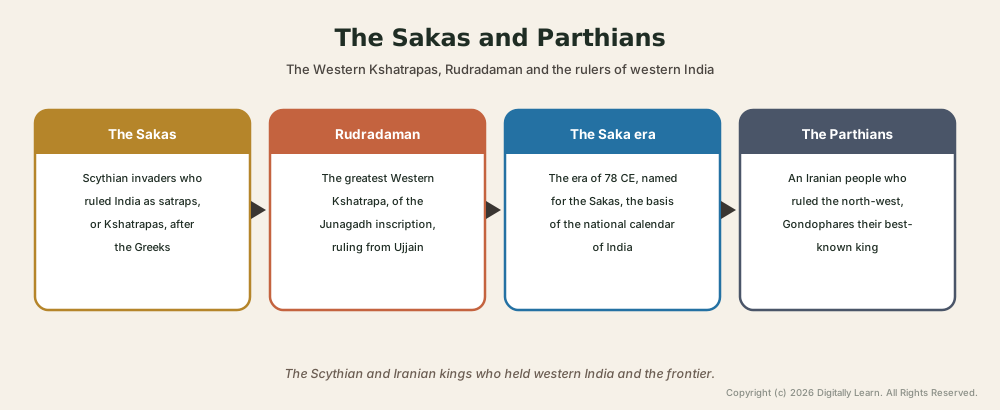
The Sakas, or Scythians, and the Parthians were two peoples from the Iranian and Central Asian world who followed the Indo-Greeks into the Indian north-west. The Sakas, driven from their homeland by the Yuezhi, ruled as satraps, or Kshatrapas, and their greatest branch, the Western Kshatrapas, held Gujarat, Malwa and parts of the Deccan from their seat at Ujjain. Their most famous king, Rudradaman, left the Junagadh rock inscription, the first long record in chaste Sanskrit. It is from the Sakas that the Saka era of 78 CE, the basis of the Indian national calendar, takes its name. The Parthians, an Iranian people, ruled the north-west briefly, the best known of them being Gondophares. This part covers the Sakas and the satrap system, the Western Kshatrapas and Rudradaman, the Saka era and the Parthians.
The Sakas: Scythian Invaders of India
Who the Sakas Were and the Satrap System
What is the significance of the Sakas: they were the second of the foreign peoples to rule in India, and they held the west for far longer than the Greeks held the north-west.
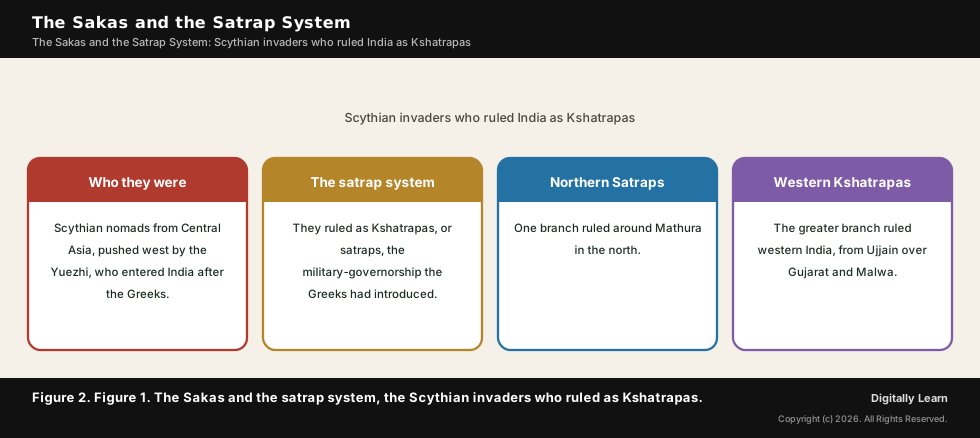
The Sakas, whom the Greeks called Scythians, were nomads of Central Asia. Driven from their lands by another people, the Yuezhi, they moved south and west and, in the first century BCE, entered India through the same north-western passes the Greeks had used. They ruled their lands as satraps, or in the Indian form Kshatrapas, the system of military governorship that the Greeks had first introduced into India.
The Northern Satraps and the Western Kshatrapas
Distinguishing the two branches: the Saka power in India fell into two main branches, of which the western was by far the more important.
One branch, the Northern Satraps, ruled around Mathura in the north. The greater branch, the Western Kshatrapas, ruled western India, Gujarat, Malwa and parts of the western Deccan, from their seat at Ujjain. It is the Western Kshatrapas, who lasted for nearly four centuries, from the first to the early fifth century CE, that the student must know best, for theirs is the longer and better-recorded story.
The Western Kshatrapas: Rulers of Western India
The Kshaharatas and Kardamakas: Nahapana and Chastana
What is the significance of the Western Kshatrapas: they ruled the rich lands and ports of western India for nearly four hundred years and left a fine coinage and famous inscriptions.
The Western Kshatrapas ruled in two successive houses. The first was the Kshaharata house, whose great king was Nahapana, a powerful ruler of western India and the Deccan in the early second century CE. The second was the Kardamaka house, founded by Chastana at Ujjain, from which came the most famous of all the Western Kshatrapas, Rudradaman.
| House | Leading kings | Note |
|---|---|---|
| Kshaharata | Bhumaka; Nahapana | Powerful in western India and the Deccan; ended by Gautamiputra Satakarni |
| Kardamaka | Chastana; Rudradaman I | Ruled from Ujjain; Rudradaman the greatest, of the Junagadh inscription |
Rudradaman I and the Junagadh Inscription
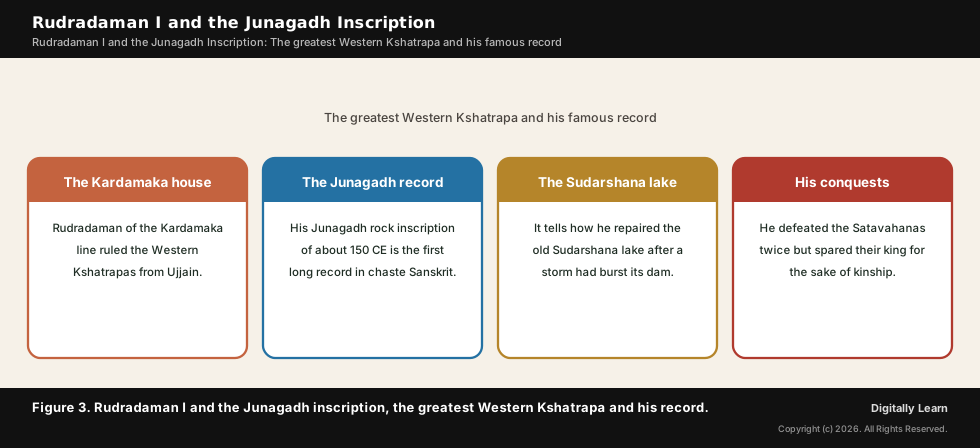
Distinguishing Rudradaman: of all the Saka kings, Rudradaman is the one whose name and deeds are most fully known, thanks to a single great inscription.
Rudradaman I, of the Kardamaka house, reigned about the middle of the second century CE. His Junagadh rock inscription, of about 150 CE, is celebrated as the first long inscription written in chaste, literary Sanskrit. It records that he repaired the old Sudarshana lake after a storm had burst its dam, and it lists his conquests, including two victories over the Satavahanas, though he spared their king because of a close kinship between the two houses.
The Saka-Satavahana Struggle and the Saka Era
Nahapana and Gautamiputra Satakarni
What is the significance of the struggle: the history of the western Deccan in this age is the long see-saw struggle between the Saka Kshatrapas and the Satavahanas.
The Saka king Nahapana pushed his power deep into the western Deccan, until he was defeated by the Satavahana king Gautamiputra Satakarni. The Nasik inscription of Gautamiputra's mother boasts that he destroyed the Kshaharata line, and large hoards of Nahapana's silver coins have been found restruck in Gautamiputra's name, sure proof of the Satavahana victory. The two powers would contest these lands for generations.
The Saka Era of 78 CE and the National Calendar
Distinguishing the Saka era: the Sakas left their name on the very calendar of modern India, in the Saka era.
The Western Kshatrapas dated their coins and records in an era that began in 78 CE, the era that came to be called the Saka era after them. This era is the most important in the dating of ancient India.
It was chosen as the basis of the national calendar of the Republic of India; in it the first day of the year, Chaitra 1, falls on the 22nd of March in a normal year, and on the 21st in a leap year.
The Parthians (Pahlavas) in the North-West
Gondophares and the Indo-Parthian Kingdom
What is the significance of the Parthians: between the Sakas and the Kushanas, a third foreign people, the Parthians, held the north-west for a time.
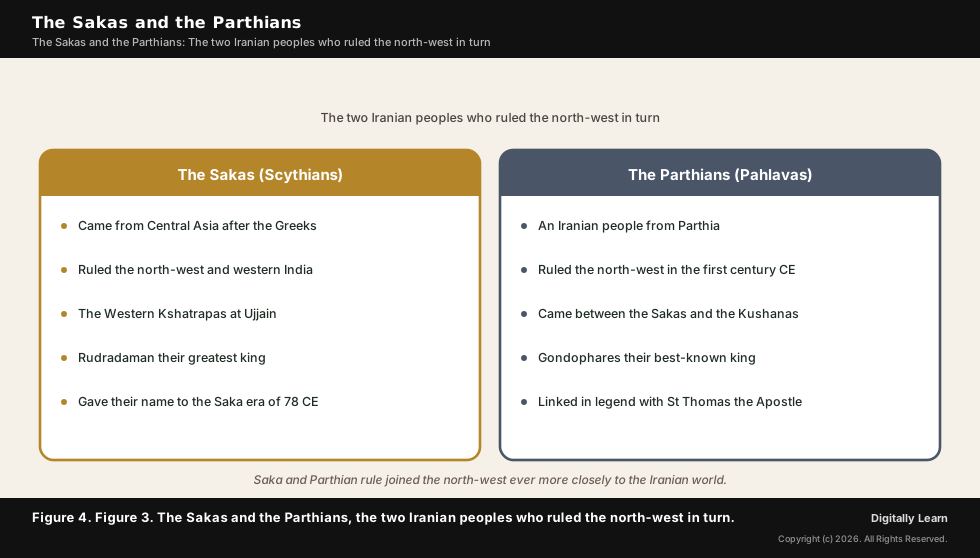
The Parthians, whom the Indians called Pahlavas, were an Iranian people from Parthia, to the west of Bactria. In the first century CE they ruled the Indian north-west, coming between the Saka and the Kushana power. The best known of them was Gondophares, whose kingdom is remembered in Christian tradition because the Apostle St Thomas is said to have visited his court. Their rule was brief, and the Kushanas soon swept it away.
Mapping the Western Kshatrapas and the Satavahanas
Distinguishing the western lands: the geography of western India shows how the Saka Kshatrapas and the Satavahanas faced each other across the Deccan.
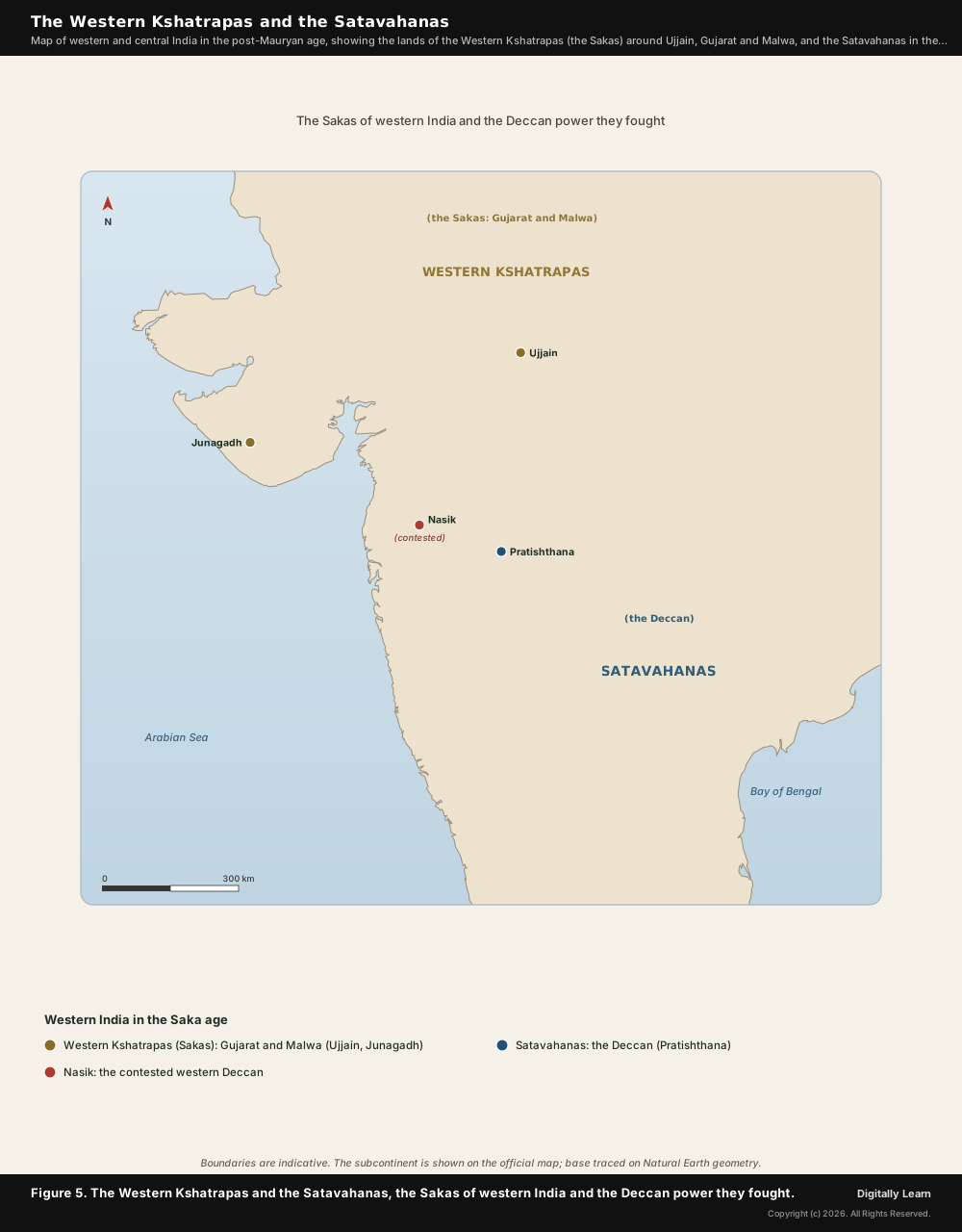
The map sets out the lands of the age in the west. The Western Kshatrapas held Gujarat and Malwa, with their seat at Ujjain and the Junagadh inscription of Rudradaman in the Kathiawar peninsula. To the south lay the Satavahanas of the Deccan, with their capital at Pratishthana, and between the two powers lay the contested western Deccan around Nasik, won and lost again and again.
UPSC Relevance and Exam Focus
Where the Sakas and Parthians Fit in the UPSC-CSE Syllabus
This topic belongs to General Studies Paper I: ancient Indian history and culture, and the Sakas, with the Saka era and the Junagadh inscription, are a recurring source of questions.
For Prelims, hold the firm facts: the Sakas ruled as satraps, or Kshatrapas, the military governorship the Greeks had introduced; the Western Kshatrapas ruled western India from Ujjain; Rudradaman's Junagadh inscription is the first long chaste-Sanskrit record; the Saka era of 78 CE is the basis of the national calendar; and the Parthian Gondophares ruled the north-west.
For Mains, the age is valuable for the absorption of the foreigners into Indian life and for the long Saka-Satavahana contest over the west.
Recurring linked concepts an aspirant should keep in working memory:
- Kshatrapa: A satrap; the Greek system the Sakas adopted.
- Western Kshatrapas: Sakas of Gujarat and Malwa, seat at Ujjain.
- Rudradaman: The Junagadh inscription; first long Sanskrit record.
- Nahapana: Defeated by the Satavahana Gautamiputra Satakarni.
- Saka era: 78 CE; the basis of the national calendar.
A common Prelims trap is to credit the satrap (Kshatrapa) system to the Sakas; it was first introduced by the Greeks, and the Sakas adopted it. Another is to forget that the Saka era of 78 CE, not the Vikrama era, is the one used in the national calendar.
Previous Year UPSC-CSE Questions By the end you will be able to draft model answers for the following UPSC questions. Each question carries a collapsible framework showing how to approach it in the exam.
- UPSC Prelims 2000 GS-IThe practice of military governorship was first introduced in India by the
How to approach this Prelims question
Approach: Recall that the satrap (military-governor) system came from the Greeks and was taken up by the Sakas.
Trap to watch: The Greeks introduced the satrap system; the Sakas (Shakas) adopted it and ruled as Kshatrapas, so the answer is the Greeks, not the Shakas.
Key facts to recall:
- The satrap (military governorship) system was introduced by the Greeks.
- The Sakas adopted it and ruled as Kshatrapas (satraps).
Answer signal: Greeks.
- UPSC Prelims 2014 GS-IChaitra 1 of the national calendar based on the Saka Era corresponds to which one of the following dates of the Gregorian calendar in a normal year of 365 days?
How to approach this Prelims question
Approach: Recall that the national calendar is based on the Saka era and begins, at Chaitra 1, on 22 March (21 March in a leap year).
Trap to watch: Chaitra 1 of the Saka-based national calendar is 22 March in a normal year (21 March in a leap year), not the other dates.
Key facts to recall:
- The Indian national calendar is based on the Saka era.
- Chaitra 1 falls on 22 March (21 March in a leap year).
Answer signal: 22nd March (or 21st March).
Prelims MCQ practice
Each question below tests one specific concept on the topic. Click to reveal the answer and a full option-wise explanation.
Q1. The Sakas, who entered India after the Indo-Greeks, were driven from their Central Asian homeland by the:
- Huns
- Yuezhi
- Mongols
- Parthians
Show answer and explanation
Answer: Yuezhi
Explanation.
Option (b) is correct. The Sakas (Scythians) were driven south and west by the Yuezhi, and so entered India. Hence option (b).
Q2. The Western Kshatrapas, the greatest Saka branch in India, ruled western India from their seat at:
- Mathura
- Taxila
- Ujjain
- Pataliputra
Show answer and explanation
Answer: Ujjain
Explanation.
Option (c) is correct. The Western Kshatrapas ruled Gujarat and Malwa from Ujjain; the Northern Satraps ruled around Mathura. Hence option (c).
Q3. The Junagadh rock inscription, famous as the first long inscription in chaste Sanskrit, was issued by the Saka ruler:
- Nahapana
- Chastana
- Rudradaman
- Gondophares
Show answer and explanation
Answer: Rudradaman
Explanation.
Option (c) is correct. Rudradaman I issued the Junagadh inscription (c. 150 CE), the first long record in chaste Sanskrit. Hence option (c).
Q4. With reference to the Saka-Satavahana conflict, consider the following statements:
- The Saka king Nahapana was defeated by the Satavahana Gautamiputra Satakarni.
- Nahapana's silver coins have been found restruck in the name of the Satavahana king.
Which of the statements given above is/are correct?
- 1 only
- 2 only
- Both 1 and 2
- Neither 1 nor 2
Show answer and explanation
Answer: Both 1 and 2
Explanation.
Both statements are correct. Gautamiputra Satakarni defeated Nahapana, and large numbers of Nahapana's coins have been found restruck by the Satavahanas. Hence option (c).
Q5. The Saka era, used as the basis of the national calendar of India, begins in:
- 58 BCE
- 78 CE
- 248 CE
- 320 CE
Show answer and explanation
Answer: 78 CE
Explanation.
Option (b) is correct. The Saka era begins in 78 CE and is the basis of the Indian national calendar; the Vikrama era begins in 58 BCE. Hence option (b).
Q6. The best-known Indo-Parthian (Pahlava) king of the north-west, linked in legend with St Thomas the Apostle, was:
- Nahapana
- Gondophares
- Rudradaman
- Azes
Show answer and explanation
Answer: Gondophares
Explanation.
Option (b) is correct. Gondophares was the best-known Indo-Parthian king, associated with the legend of St Thomas. Hence option (b).
Sources and Further Reading
Editorial Disclaimer
This article is for UPSC preparation. The dates and the order of the Saka and Parthian kings rest largely on coins and inscriptions and are reconstructed by historians, so some details remain debated.


