


Overview
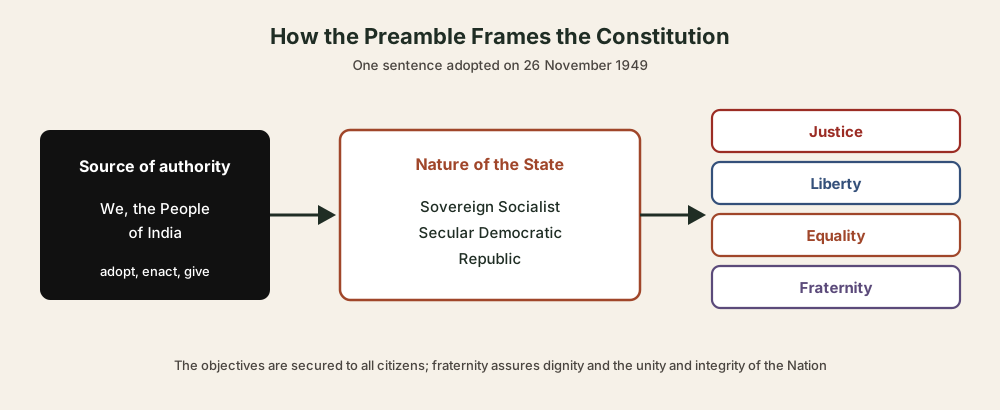
The Preamble is the opening sentence of the Constitution of India. It names the people of India as the source of the Constitution's authority, describes India as a sovereign, socialist, secular, democratic republic, sets the objectives of justice, liberty, equality and fraternity, and records adoption on 26 November 1949. It is part of the Constitution and guides the reading of its other provisions.
The Preamble to the Indian Constitution: Meaning and Place
Preamble as the Constitution's Statement of Purpose
The Preamble to the Indian Constitution is the introductory sentence of the Constitution that states who made the Constitution, what kind of State it creates and which objectives that State must pursue. In its present text, the people of India resolve to constitute India into a Sovereign Socialist Secular Democratic Republic and to secure justice, liberty, equality and fraternity to all its citizens.
The Preamble matters because it records the purpose behind every provision that follows. It is widely read as the best summary of the philosophy of the Constitution, and the Supreme Court has held that Parliament's amending power under Article 368 extends to it, so its words carry both political meaning and legal consequence.
The significance of the Preamble lies in four elements that together describe the constitutional order:
- Source of authority: The people of India, who adopt, enact and give the Constitution to themselves.
- Nature of the State: Sovereign, socialist, secular, democratic and a republic.
- Objectives: Justice, liberty, equality and fraternity, secured to all citizens.
- Date of adoption: The twenty-sixth day of November, 1949, in the Constituent Assembly.
Text of the Preamble and Its Four Components
The official text published by the Legislative Department gives the Preamble as a single sentence. Two footnotes record the only change ever made to it: section 2 of the Constitution (Forty-second Amendment) Act, 1976 substituted two phrases with effect from 3 January 1977.
| Component | Words in the official text | What it establishes |
|---|---|---|
| Source of authority | WE, THE PEOPLE OF INDIA … do HEREBY ADOPT, ENACT AND GIVE TO OURSELVES THIS CONSTITUTION | Authority flows from the people, not from an external power |
| Nature of the State | SOVEREIGN SOCIALIST SECULAR DEMOCRATIC REPUBLIC | Five features of the Indian State |
| Objectives | JUSTICE, social, economic and political; LIBERTY of thought, expression, belief, faith and worship; EQUALITY of status and of opportunity; FRATERNITY assuring the dignity of the individual and the unity and integrity of the Nation | Four ideals the State must secure to all citizens |
| Date of adoption | IN OUR CONSTITUENT ASSEMBLY this twenty-sixth day of November, 1949 | The day the Constitution was adopted |
The footnotes show exactly what changed. The words SOVEREIGN DEMOCRATIC REPUBLIC became SOVEREIGN SOCIALIST SECULAR DEMOCRATIC REPUBLIC, and the words unity of the Nation became unity and integrity of the Nation.
We, the People: Popular Sovereignty as the Source of Authority
The opening words place the source of the Constitution's authority in the people of India. The Constitution does not claim to be given by a body of great men; it is prepared and adopted by the people themselves, who thereby become the makers of their own destiny through democratic government.
The same words appeared in the Supreme Court's ruling of 25 November 2024. The Court observed that the terms socialist and secular had achieved widespread acceptance, with their meanings understood by We, the people of India without any semblance of doubt.
Origins of the Preamble: The Objectives Resolution of 1946
Nehru's Objectives Resolution: Moved 1946, Accepted 1947
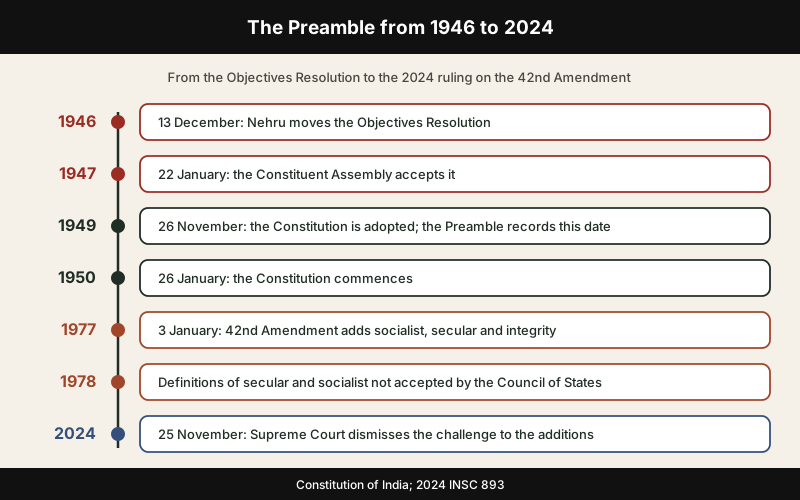
The Preamble grew out of the Objectives Resolution, which Jawaharlal Nehru moved in the Constituent Assembly on 13 December 1946 and which the Assembly accepted on 22 January 1947. The resolution defined the aims of the Assembly and carried the values the national movement brought to the making of the Constitution.
The resolution had eight main points, and together they set the direction that the Preamble and the rest of the Constitution later took:
- India is an independent, sovereign republic.
- India shall be a Union of the former British Indian territories, the Indian States and other parts willing to join the Union.
- The territories forming the Union shall be autonomous units exercising all powers not assigned to or vested in the Union.
- All powers and authority of sovereign and independent India and its constitution shall flow from the people.
- All the people shall be guaranteed social, economic and political justice, equality of status and opportunities, equality before law, and fundamental freedoms of speech, expression, belief, faith, worship, vocation, association and action, subject to law and public morality.
- Minorities, backward and tribal areas, and depressed and other backward classes shall be provided adequate safeguards.
- The territorial integrity of the Republic and its sovereign rights on land, sea and air shall be maintained according to justice and the law of civilised nations.
- India would make a full and willing contribution to world peace and the welfare of mankind.
The table shows how the resolution's points were carried into the Preamble or into specific parts of the Constitution. The Preamble kept the core ideals, while detailed freedoms and safeguards moved into the provisions that enforce them.
| Objectives Resolution | Where it appears in the Constitution |
|---|---|
| Independent, sovereign republic | Preamble: Sovereign … Democratic Republic |
| Power flows from the people | Preamble: WE, THE PEOPLE OF INDIA … give to ourselves this Constitution |
| Social, economic and political justice; equality of status and opportunities | Preamble: JUSTICE and EQUALITY; Articles 14 to 16 |
| Freedoms of speech, expression, belief, faith and worship | Preamble: LIBERTY of thought, expression, belief, faith and worship |
| Freedoms of vocation, association and action | Article 19(1): association in clause (c), profession, occupation, trade or business in clause (g) |
| Safeguards for minorities and backward classes | Articles 29 and 30, and special provisions for backward classes |
| Contribution to world peace | Article 51: promotion of international peace and security |
The Constituent Assembly held its first sitting on 9 December 1946 and adopted the Constitution on 26 November 1949, the date the Preamble records. Under Article 394, a small group of provisions came into force at once and the rest on 26 January 1950, the day the Constitution calls its commencement.
Socialist and Secular: Words the Assembly Left Out in 1949
The Constituent Assembly did not agree to include the words socialist and secular in the Preamble, and both were added only in 1976. The reasons shaped how the Supreme Court later read the two words.
On the first word, the Supreme Court's 2024 order recorded that in 1949 the term secular was considered imprecise, because some scholars and jurists interpreted it as being opposed to religion. India later developed its own meaning of the term, explained in the section on the nature of the State.
Published accounts also record that Dr B. R. Ambedkar opposed writing the word socialist into the Preamble. He argued that the Constitution should not prescribe a particular social and economic system for future generations, and that the Directive Principles already contained provisions socialist in nature.
Constituent Assembly Debates on the Preamble: God, Gandhi and a Name
The debates on the Preamble produced several proposals that the Assembly did not accept. Published accounts of the debates record three of them, each of which tested what kind of document the Constitution should be:
- A proposal to rename India the Union of Indian Socialistic Republics, which other members did not accept.
- A proposal to invoke God in the Preamble, defeated when 68 members voted against it; H. V. Kamath called it a black day in the Assembly’s annals.
- A suggestion to include Gandhi’s name, which Brajeshwar Prasad opposed and which was not adopted.
The outcome was a Preamble that names neither a deity nor a leader and draws its authority only from We, the People of India. That choice matches the secular and democratic character the text describes, with religion left to the freedoms of Articles 25 to 28.
The Original Preamble Page: Illumination and Calligraphy
The Preamble page of the original Constitution is also a work of art. According to published accounts, it was designed and decorated by the painter Beohar Rammanohar Sinha of Jabalpur, then at Shantiniketan with Acharya Nandalal Bose, who endorsed the artwork without any alteration.
The page carries Sinha's short signature, Ram, in Devanagari in the lower right corner. The calligraphy of the text was done by Prem Behari Narain Raizada, and 284 members signed the Constitution as finally passed on 24 January 1950.
Nature of the Indian State: Sovereign, Socialist, Secular, Democratic, Republic
Sovereign: Independent Authority, Internal and External
The word sovereign means the independent authority of a State: it can legislate on any subject and is not subject to the control of any other State or external power. External sovereignty is independence in dealing with other States, which includes the power to acquire foreign territory or cede Indian territory within constitutional limits.
Internal sovereignty is the State's supreme authority over its own territory and the people in it. The same idea runs through the Fundamental Duties, since Article 51A(c) asks every citizen to uphold and protect the sovereignty, unity and integrity of India.
Socialist: A Welfare State Within a Mixed Economy
The Supreme Court explained in 2024 that the word socialist does not restrict the economic policies of an elected government. Neither the Constitution nor the Preamble mandates a specific economic policy or structure, whether left or right.
In the Court's words, socialist denotes the State's commitment to be a welfare State and to ensure equality of opportunity. India has embraced a mixed economy in which the private sector has grown, and socialism embodies economic and social justice so that no citizen is disadvantaged by economic or social circumstances.
The word also does not restrict private entrepreneurship or the right to carry on business and trade, which is a Fundamental Right under Article 19(1)(g). The Court relied on the nine-judge ruling in Property Owners Association (2024), which held that the Constitution lets an elected government choose its structure of economic governance.
Secular: Equal Respect for All Religions and Principled Distance
India developed its own meaning of secularism, in which the State neither supports any religion nor penalises the profession and practice of any faith. The Supreme Court located this principle in Articles 14, 15 and 16, which prohibit religious discrimination, and in the freedoms of Articles 25, 26, 29 and 30.
The Indian model departs from the western idea of strict separation of State and religion in two ways. It grants rights to religious communities as well as individuals, and it allows the State to intervene in religious practices such as untouchability that deny people basic dignity. This is described as principled distance.
Under principled distance, the State keeps a distance from all religions so that it can intervene or abstain, depending on which better promotes liberty, equality and social justice. The Court added that secularism is one facet of the right to equality, woven into the basic fabric of the constitutional scheme.
The Constitution gives this secular character effect through specific Fundamental Rights:
- Articles 15 and 16(2): No discrimination by the State, and no ineligibility for public employment, on grounds only of religion.
- Article 25(1): All persons are equally entitled to freedom of conscience and the right freely to profess, practise and propagate religion.
- Article 26: Every religious denomination may manage its own religious affairs and its institutions.
- Article 27: No person shall be compelled to pay taxes whose proceeds are appropriated for promoting any particular religion.
- Article 28(1): No religious instruction shall be provided in any educational institution wholly maintained out of State funds.
- Articles 29 and 30: Protection of the culture of every section of citizens and the right of minorities to run educational institutions.
Democratic: Universal Adult Franchise and Accountable Government
The word democratic means that government rests on the will of the people, expressed through regular elections. Article 326 provides that elections to the House of the People and to State Legislative Assemblies shall be on the basis of adult suffrage, open to every citizen not less than eighteen years of age who is not otherwise disqualified.
The commitment to universal franchise was notable at a time when the vote had only recently been extended to women and the working class in stable western democracies. The idea had deep roots in the national movement: the Motilal Nehru Report of 1928 had proposed that every person of either sex aged twenty-one should vote.
Republic: An Elected Head of State
A republic has a head of State who is elected rather than hereditary. Article 52 provides that there shall be a President of India, and under Article 54 the President is elected by an electoral college consisting of the elected members of both Houses of Parliament and the elected members of the Legislative Assemblies of the States.
The office is held for a fixed term, not for life. Under Article 56(1), the President holds office for a term of five years from the date of entering upon office, which keeps the head of State answerable to a periodic electoral process.
The five words describe distinct features, and the table sets out what each means and where the Constitution gives it effect.
| Word | Meaning | Where the Constitution gives it effect |
|---|---|---|
| Sovereign | Independent authority, free of external control | Article 51A(c); power to acquire or cede territory within constitutional limits |
| Socialist (added 1977) | Welfare State committed to equality of opportunity; no fixed economic model | Directive Principles; Article 19(1)(g) protects private trade |
| Secular (added 1977) | State neither supports nor penalises any religion; principled distance | Articles 14, 15, 16, 25, 26, 29 and 30 |
| Democratic | Government based on the people's will through elections | Article 326, adult suffrage |
| Republic | Elected head of State | Article 54, election of the President |
Objectives of the Preamble: Justice, Liberty, Equality and Fraternity
Justice: Social, Economic and Political
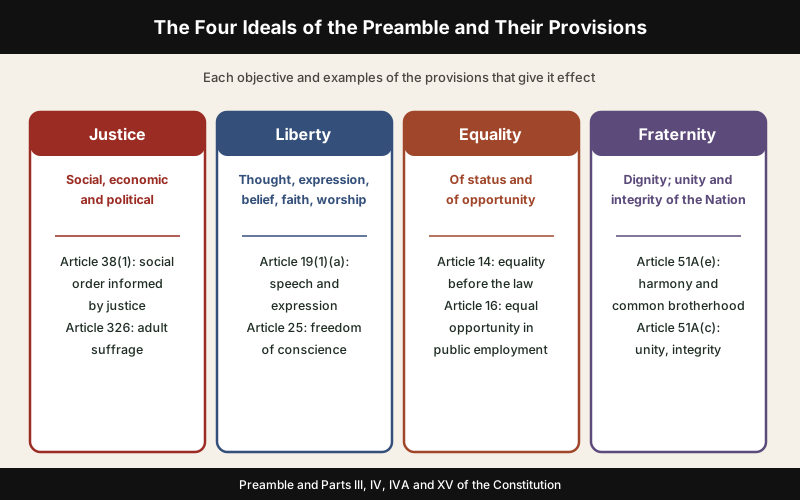
The Preamble seeks justice in three forms: social, economic and political. The same phrase appears in Article 38(1), under which the State shall strive to promote the welfare of the people by securing a social order in which justice, social, economic and political, shall inform all the institutions of national life.
Political justice is given effect through adult suffrage under Article 326, while social and economic justice run through the Directive Principles of State Policy. The four ideals and the provisions that carry them are set out in the figure.
Liberty of Thought, Expression, Belief, Faith and Worship
The Preamble names five liberties: thought, expression, belief, faith and worship. Freedom of speech and expression is guaranteed by Article 19(1)(a), and Article 25(1) entitles all persons equally to freedom of conscience and the right freely to profess, practise and propagate religion, subject to public order, morality and health.
The list is precise, and it does not include economic liberty. Economic activity is protected elsewhere, for example by the right to practise any profession or carry on any trade under Article 19(1)(g), but it is not one of the liberties named in the Preamble.
Equality of Status and of Opportunity
The Preamble promises equality of status and of opportunity. Article 14 guarantees equality before the law and the equal protection of the laws, Article 15 prohibits discrimination on grounds such as religion, race, caste, sex or place of birth, and Article 17 abolishes untouchability.
Equality of opportunity has a specific guarantee in public employment. Article 16(1) provides that there shall be equality of opportunity for all citizens in matters relating to employment or appointment to any office under the State.
Equality of status is protected by removing marks of rank. Under Article 18, the State shall confer no title other than a military or academic distinction, and no citizen of India shall accept any title from a foreign State.
Fraternity: Dignity of the Individual and Unity of the Nation
Fraternity is a sense of common brotherhood among the people, and the Preamble ties it to two things: the dignity of the individual and the unity and integrity of the Nation. The 42nd Amendment added the word integrity to this phrase.
The Fundamental Duties carry the same ideal. Article 51A(e) asks every citizen to promote harmony and the spirit of common brotherhood transcending religious, linguistic and regional or sectional diversities, as explained in the article on Fundamental Duties.
Published accounts quote Dr B. R. Ambedkar's view that liberty, equality and fraternity are principles of life that cannot be divorced from each other: without equality, liberty would produce the supremacy of the few over the many, and equality without liberty would kill individual initiative.
The Preamble and the Universal Declaration of Human Rights
The Preamble's ideals run parallel to the Universal Declaration of Human Rights, adopted by the United Nations General Assembly in 1948. The Directive Principles and the Fundamental Duties also echo the Declaration, so the Fundamental Rights are not the only part of the Constitution that reflects it.
| Part of the Constitution | Provision | Parallel in the Universal Declaration |
|---|---|---|
| Preamble | Dignity of the individual; fraternity | Article 1: all human beings are born free and equal in dignity and rights and should act in a spirit of brotherhood |
| Preamble | Liberty of thought, belief, faith and worship | Article 18: freedom of thought, conscience and religion |
| Preamble | Liberty of expression | Article 19: freedom of opinion and expression |
| Directive Principles | Article 41: right to work, to education and to public assistance | Articles 23 and 26: right to work and right to education |
| Fundamental Duties | Article 51A: duties of every citizen | Article 29(1): everyone has duties to the community |
The Declaration was proclaimed by the United Nations General Assembly in Paris on 10 December 1948, by resolution 217 A, as a common standard of achievement for all peoples and nations. The Constitution was adopted less than a year later, on 26 November 1949.
The parallels therefore run through several Parts of the Constitution, not only the Fundamental Rights. The Preamble states the ideals of dignity and liberty, the Directive Principles take up work and education, and the Fundamental Duties added in 1976 echo the Declaration's statement of duties to the community.
The 42nd Amendment, 1976: Socialist, Secular and Integrity
What Section 2 of the 42nd Amendment Changed
Section 2 of the Constitution (Forty-second Amendment) Act, 1976 made the only amendment the Preamble has received. It took effect on 3 January 1977 and inserted two words in the description of the State and one word in the phrase on fraternity.
| Phrase | Original text of 1949 | Text in force from 3 January 1977 |
|---|---|---|
| Description of the State | SOVEREIGN DEMOCRATIC REPUBLIC | SOVEREIGN SOCIALIST SECULAR DEMOCRATIC REPUBLIC |
| Phrase on fraternity | unity of the Nation | unity and integrity of the Nation |
The additions did not create a new direction on their own. The principles they name were already present: secularism in the freedoms of religion, and social and economic justice in the Directive Principles, which is why the Court said in 2024 that the Preamble's original tenets reflect a secular ethos.
The 1978 Attempt to Define Secular and Socialist
Parliament returned to the two words during the Constitution (Forty-fifth Amendment) Bill, 1978, which was renumbered and enacted as the Constitution (Forty-fourth Amendment) Act, 1978. The Bill proposed to define both words in Article 366, the definitions clause.
- Secular was to denote a republic that upholds equal respect for all religions.
- Socialist was to denote a republic dedicated to eliminating all forms of exploitation, whether social, political or economic.
- The proposed amendment to Article 366 was not accepted by the Council of States, so the words remain undefined in the Constitution.
Because no definition was adopted, the meaning of the two words has come from the Supreme Court. The 2024 order drew on the 1978 debate itself, noting that secular had been explained as equal respect for all religions and socialist as the elimination of all forms of exploitation.
Balram Singh v Union of India, 2024: The Challenge Dismissed
In Dr Balram Singh v Union of India, decided on 25 November 2024 and reported as 2024 INSC 893, writ petitions challenged the insertion of the words socialist and secular. A bench of Chief Justice Sanjiv Khanna and Justice Sanjay Kumar dismissed them.
The petitioners raised four grounds of challenge:
- Retrospectivity: The Constitution was adopted on 26 November 1949, so inserting words in 1976 made the recorded date false.
- The Constituent Assembly had deliberately left out the word secular.
- The word socialist fetters the economic policy choices of elected governments.
- The amendment was passed during the Emergency on 2 November 1976, after the normal tenure of the Lok Sabha had ended on 18 March 1976.
The Court rejected each ground and set out its reasons:
- Article 368 permits amendment of the Constitution, and the amending power extends to the Preamble; the date of adoption does not curtail that power.
- The Constitution is a living document, even though the Constituent Assembly had not agreed to include the two words.
- Neither word restricts legislation or policy, provided fundamental and constitutional rights and the basic structure are respected.
- The objection that the amendment was passed during the Emergency had already been deliberated by Parliament in 1978, when the Bill that became the Forty-fourth Amendment was considered.
- The petitions were filed in 2020, forty-four years after the words became part of the Preamble, and no justification existed for a challenge after so long.
Is the Preamble Part of the Constitution? Supreme Court Rulings
Berubari Union Reference, 1960: Preamble Not an Integral Part
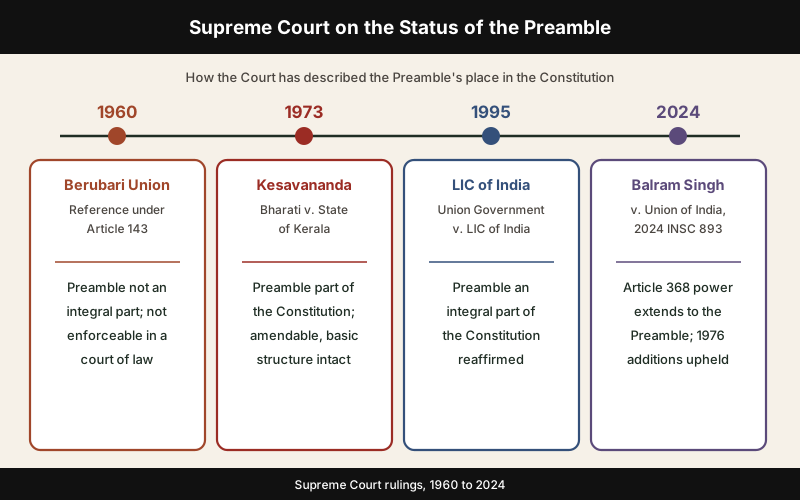
The question came before the Supreme Court in the Berubari Union presidential reference of 1960, which asked whether Parliament could cede Indian territory to a foreign country. In that opinion, the Court stated that the Preamble is not an integral part of the Constitution and is therefore not enforceable in a court of law.
The reference turned on Article 3, which lets Parliament diminish the area of a State by ordinary law. The Court held that this power does not cover ceding Indian territory to a foreign country, which needs an amendment under Article 368, and the 9th Amendment Act, 1960 was enacted to transfer the Berubari Union to East Pakistan, now Bangladesh.
Kesavananda Bharati, 1973: Preamble Part of the Constitution
In Kesavananda Bharati v. State of Kerala (1973), the Court overruled the earlier view. It held that the Preamble is part of the Constitution and is subject to Parliament's amending power like any other provision, provided the basic structure is not destroyed.
The same case recognised that the Preamble may be used to interpret ambiguous areas of the Constitution where different interpretations are possible. The Court has also observed, in Kesavananda Bharati, S. R. Bommai and other cases, that secularism is a basic feature of the Constitution.
LIC of India, 1995: The Integral Part Reaffirmed
In Union Government v. LIC of India (1995), the Supreme Court again held that the Preamble is an integral part of the Constitution. The 2024 order in Balram Singh went a step further in practice, applying Article 368 directly to the Preamble when it upheld the 1976 additions.
Taken in sequence, the three rulings moved the Preamble from an aid outside the text to an integral part of it. That shift matters because a part of the Constitution can be amended under Article 368, but only within the limit of the basic structure.
Legal Effect: A Guide to Interpreting the Other Provisions
Read together, the rulings give the Preamble a precise legal status. It is part of the Constitution, but it works through the other provisions rather than on its own: courts use it to interpret ambiguous text rather than enforcing it as a free-standing provision.
This is why the Preamble's ideals are enforced through the provisions that carry them, such as the Fundamental Rights, while its own words guide how those provisions are read. The figure traces how the Court's view developed.
The Preamble and the Basic Structure of the Constitution
Amending Power Under Article 368 and Its Limit
Article 368 gives Parliament the power to amend the Constitution, and the 2024 ruling confirmed that this power extends to the Preamble. Amendments can still be challenged on several grounds, including violation of the basic structure of the Constitution.
The basic structure therefore marks the limit. Parliament may amend the Preamble's words, as it did in 1976, but it may not use that power to destroy the features the Court has identified as basic, of which secularism is one.
Secularism as a Basic Feature: Kesavananda to Ismail Faruqui
The Supreme Court has repeatedly placed secularism among the basic features of the Constitution. The 2024 order summarised this line of decisions:
- Kesavananda Bharati v. State of Kerala (1973), a bench of thirteen judges, and S. R. Bommai v. Union of India (1994), a bench of nine judges, observed that secularism is a basic feature of the Constitution.
- R. C. Poudyal v. Union of India (1994) explained that secularism represents the nation’s commitment to treat persons of all faiths equally, although the word was not in the Constitution before 1976.
- M. Ismail Faruqui v. Union of India (1994) held that secularism in the Indian context has the widest possible scope: the State has no religion of its own and all persons are equally entitled to freedom of conscience.
Secularism in this sense is not neutral towards harmful practice. The 2024 order added that the secular nature of the State does not prevent the elimination of attitudes and practices derived from or connected with religion when, in the larger public interest, they impede development and the right to equality.
Significance of the Preamble and Recent Developments
Observable Outcomes of the Preamble in Constitutional Practice
The design of the Preamble has produced three observable outcomes:
- It guides interpretation: Courts read ambiguous provisions in the light of its objectives, while enforcing those objectives through the provisions that carry them.
- Its ideals recur across the Constitution, from the justice of Article 38(1) to the sovereignty, unity and integrity that Article 51A(c) asks citizens to protect.
- Its 1976 additions have stood for decades: The Supreme Court declined to reopen them in 2024, forty-four years after they took effect.
Its promise also frames the law of membership. The rules on who is a citizen, set out in the article on Citizenship in India, determine who belongs to the people in whose name the Preamble speaks.
Criticism and Defence of the Preamble
The Preamble has drawn criticism on three questions, and the constitutional record supplies an answer to each:
- Legal force, the criticism: A statement of ideals that cannot be enforced adds little, as the Berubari opinion of 1960 suggested when it treated the Preamble as outside the Constitution.
- Legal force, the reply: Kesavananda Bharati held it part of the Constitution and a guide to interpreting ambiguous provisions, and its ideals are enforced through the provisions that carry them.
- The 1976 additions, the criticism: The words socialist and secular were inserted during the Emergency and against the Constituent Assembly’s choice, as the 2024 petitioners argued.
- The 1976 additions, the reply: Article 368 extends to the Preamble, the words neither restrict elected governments nor fix an economic model, and they had stood unchallenged for forty-four years.
- Economic choice, the criticism: Ambedkar opposed writing socialist into the Preamble so as not to bind future generations to one economic system.
- Economic choice, the reply: The Supreme Court read socialist in 2024 as a welfare commitment that leaves the structure of economic governance to the elected government.
The debate has therefore moved from whether the Preamble matters to how its words should be read, and the Supreme Court has answered that question by reading them broadly enough to leave policy choices to elected governments.
Recent Developments: The 2024 Ruling and Constitution Day
Two recent developments connect the Preamble to current affairs:
- 25 November 2024: The Supreme Court dismissed the challenge to the words socialist and secular, holding that Parliament’s amending power extends to the Preamble.
- November 2015: The Government decided to observe 26 November, the day the Constitution was adopted in 1949, as Constitution Day.
Both developments return to the date of adoption the Preamble itself records. The adoption of 26 November 1949 is now marked as Constitution Day, and the 2024 ruling confirmed that the date of adoption does not freeze the Preamble's words.
UPSC Relevance and Previous-Year Questions
Where the Preamble Fits in the UPSC-CSE Syllabus
This topic belongs to General Studies Paper II, under the Indian Constitution, its historical underpinnings and significant provisions, and to the polity section of the preliminary examination. The linked questions from that examination test precise points:
- The legal status of the Preamble: Part of the Constitution but without legal effect independently of other parts.
- The exact list of liberties, which does not include economic liberty.
- The date of adoption recorded in the Preamble, 26 November 1949.
- Which parts of the Constitution reflect the Universal Declaration of Human Rights.
The Mains question linked with this article asks about each adjective attached to the word Republic and whether it can be defended today. The sections above teach every point these questions require.
Previous Year UPSC-CSE Questions
Previous Year UPSC-CSE Questions By the end you will be able to draft model answers for the following UPSC questions. Each question carries a collapsible framework showing how to approach it in the exam.
- UPSC Prelims 2020 GS-IThe Preamble to the Constitution of India is
How to approach this Prelims question
Approach: Separate two questions: whether the Preamble is part of the Constitution, and whether it has legal effect on its own.
Trap to watch: Option (a) says it has no legal effect at all, but the Preamble guides interpretation and the amending power applies to it, so its effect is real though not independent.
Key facts to recall:
- Kesavananda Bharati (1973): the Preamble is part of the Constitution.
- LIC of India (1995): the Preamble is an integral part.
- The Preamble guides interpretation but is not a separate source of power.
Answer signal: Part of the Constitution, but no legal effect independently of other parts, so option (d) is the answer.
- UPSC Prelims 2017 GS-IWhich one of the following objectives is not embodied in the Preamble to the Constitution of India?
How to approach this Prelims question
Approach: Recall the five liberties in the text and find the option outside that list.
Trap to watch: Economic justice is in the Preamble, which can make economic liberty look familiar; the liberties listed are only thought, expression, belief, faith and worship.
Key facts to recall:
- LIBERTY of thought, expression, belief, faith and worship.
- JUSTICE is social, economic and political.
- EQUALITY is of status and of opportunity.
Answer signal: Economic liberty is not named, so option (b) is the answer.
- UPSC Prelims 1997 GSIn the following quotation, “WE, THE PEOPLE OF INDIA, having solemnly resolved to constitute India into a Sovereign Socialist Secular Democratic Republic and to secure to all its citizens: JUSTICE, social, economic and political; LIBERTY of thought, expression, belief, faith and worship; EQUALITY of status and of opportunity; and to promote among them all; FRATERNITY assuring the dignity of the individual and the unity and integrity of the Nation; In our Constituent Assembly this ‘X’ ………. do hereby adopt, enact and give to ourselves this Constitution.” ‘X’ stands for
How to approach this Prelims question
Approach: Distinguish the date of adoption, which the Preamble records, from the date of commencement.
Trap to watch: 26 January 1950 is the commencement under Article 394, not the date of adoption in the Preamble.
Key facts to recall:
- Adoption: 26 November 1949.
- Commencement: 26 January 1950 under Article 394.
- The Preamble records the date of adoption.
Answer signal: The Preamble records the twenty-sixth day of November, 1949, so option (b) is the answer.
- UPSC Prelims 2020 GS-IOther than the Fundamental Rights, which of the following parts of the Constitution of India reflect/reflects the principles and provisions of the Universal Declaration of Human Rights (1948)?
- Preamble
- Directive Principles of State Policy
- Fundamental Duties
Select the correct answer using the code given below:
How to approach this Prelims question
Approach: Test each part against a specific article of the Declaration rather than relying on a general impression.
Trap to watch: The Fundamental Duties can seem unrelated to a declaration of rights, but Article 29(1) of the Declaration speaks of duties to the community.
Key facts to recall:
- Preamble: dignity and liberty of thought and expression, as in Articles 1, 18 and 19.
- Directive Principles: work and education, as in Articles 23 and 26.
- Fundamental Duties: duties to the community, as in Article 29(1).
Answer signal: All three parts reflect the Declaration, so option (d) is the answer.
- UPSC Mains 2016 GS-IIDiscuss each adjective attached to the word ‘Republic’ in the ‘Preamble’. Are they defendable in the present circumstances?
How to structure the answer in the exam
Introduction: The Preamble describes India as a Sovereign Socialist Secular Democratic Republic; the words socialist and secular were added by the 42nd Amendment with effect from 3 January 1977.
Body (sub-themes to develop):
- Sovereign: independent authority, internal and external, and the citizen's duty under Article 51A(c).
- Socialist: a welfare State committed to equality of opportunity without a fixed economic model, as the Supreme Court explained in 2024.
- Secular: the State neither supports nor penalises any religion; principled distance; secularism a basic feature from Kesavananda to Ismail Faruqui.
- Democratic: adult suffrage under Article 326 and accountable government.
- Defensibility today: the 2024 ruling found the words widely accepted and not restrictive of elected governments' policies, subject to rights and the basic structure.
Conclusion: Each adjective remains defensible because it rests on specific provisions and has been read by the Supreme Court in a way that leaves policy choices to elected governments.
Sources and Further Reading
- Legislative Department, Ministry of Law and Justice: The Constitution of India
- Supreme Court of India: Dr Balram Singh v Union of India, order of 25 November 2024 (2024 INSC 893)
- NCERT: Indian Constitution at Work, Class 11, Chapter 1, Constitution: Why and How?
- NCERT: Indian Constitution at Work, Class 11, Chapter 10, The Philosophy of the Constitution
- United Nations: Universal Declaration of Human Rights
- Press Information Bureau: 26th November to be observed as Constitution Day (23 November 2015)
- Wikipedia: Preamble to the Constitution of India
- Wikipedia: Objectives Resolution
- Wikipedia: Forty-second Amendment of the Constitution of India
Editorial Disclaimer
This article is for UPSC preparation and explains the constitutional position on the Preamble. Constitutional amendments and court rulings can change that position, so the current official text governs any question of law.


