


Overview
India's drone-launched precision missile
DRDO finished final trials of the 12.5 kg, 10 km ULPGM-V3 on 19 May 2026 at Kurnool, in air-to-ground and air-to-air modes.
An Unmanned Aerial Vehicle Launched Precision Guided Missile is an air-to-surface guided munition designed for launch from an unmanned aerial vehicle against a designated target with sub-metre accuracy. The ULPGM family developed by the Defence Research and Development Organisation through its Research Centre Imarat at the Dr. A. P. J. Abdul Kalam Missile Complex in Hyderabad runs across three variants. The ULPGM-V3 is the third-generation, longer-range, fire-and-forget configuration whose final developmental trials were completed on 19 May 2026.
What DRDO completed on 19 May 2026
The Kurnool trials and the headline outcome
On Tuesday, 19 May 2026, the Defence Research and Development Organisation completed the final developmental trials of the Unmanned Aerial Vehicle Launched Precision Guided Missile, version three, at the National Open Area Range in Kurnool, Andhra Pradesh. The trials covered both air-to-ground and air-to-air modes from an integrated Ground Control System. The missile was launched from a UAV developed by NewSpace Research and Technologies, the Bengaluru-based private partner integrating the aerial vehicle and the munition into a single weapon system.
The trials concluded an iterative development cycle that started in 2022 and moved through anti-armour configuration tests in July 2025 to the present full-spectrum trial set. The Defence Minister framed the outcome as a strategic milestone for the Aatmanirbhar Bharat initiative and the indigenous loitering-munition class. The missile system is cleared for the next stage of induction and emergency procurement now that developmental-trial closure has been reported.
Definition: An Unmanned Aerial Vehicle Launched Precision Guided Missile is an air-to-surface guided munition launched from an unmanned aerial vehicle against a designated target with sub-metre accuracy. The ULPGM family was developed by the Defence Research and Development Organisation through its Research Centre Imarat at the Dr. A. P. J. Abdul Kalam Missile Complex in Hyderabad, in collaboration with the Defence Electronics Research Laboratory, the Terminal Ballistics Research Laboratory, the High Energy Materials Research Laboratory, and the Defence Research and Development Laboratory. The supporting industrial base includes more than thirty Indian small and medium enterprises and startups.
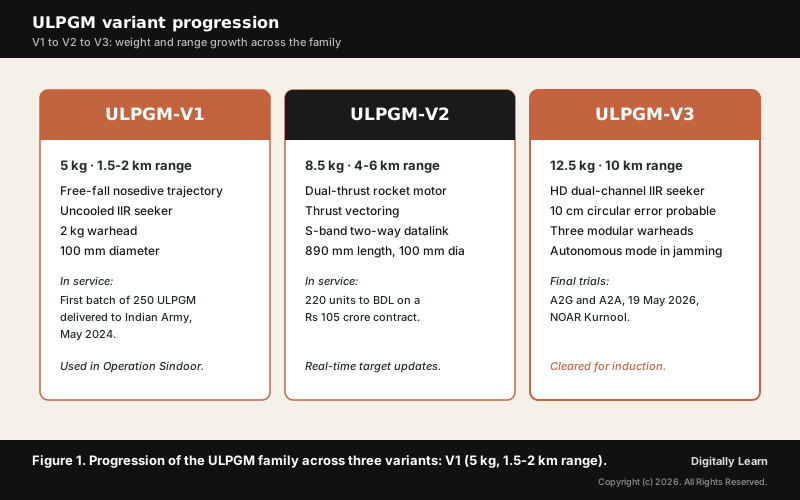
Variant progression V1 to V3
Why this matters for India's drone-warfare architecture
The loitering-munition class as a doctrinal shift
Why it matters: The ULPGM family populates a doctrinal class that India did not have indigenously until recently. The class is the UAV-launched precision munition, sometimes described as a loitering munition when the UAV itself orbits over the target area before release. The category sits between an artillery shell and a cruise missile in cost, between a tactical drone and a strategic missile in reach, and it has become decisive in twenty-first-century conflicts where contested electromagnetic environments and dispersed-target sets dominate.
Indigenous capacity in the class affects three things. The first is the operational autonomy of formations that previously depended on imported equivalents such as the American AGM-176 Griffin or the Israeli Desert Sting. The second is the cost-economics of precision strike, where a domestically manufactured 4.77 million rupees per unit acquisition price for the V2 variant brings the per-shot cost within reach for mass deployment. The third is the industrial spillover into the seeker electronics, propulsion, and warhead-design supply chains, where the thirty-plus participating MSMEs are building dual-use capability.
Significance for India's defence-technology posture
The significance of this issue
What is the significance of this issue: The ULPGM-V3 trial closure marks the operational maturation of a weapon class in which India was a buyer five years ago and is now a developer-producer. The shift maps directly to three strategic policy threads. The first is the Aatmanirbhar Bharat in Defence framework, which set a domestic-content target across major capital acquisitions; ULPGM hits the target. The second is the Defence Industrial Corridor programme, where the Hyderabad-Bengaluru axis carrying RCI, NRT, Adani Defence, and Bharat Dynamics Limited becomes a credible export-ready cluster. The third is the positive indigenisation list approach, where the Ministry of Defence has progressively restricted import of categories the domestic base can supply.
Structural reading: The Operation Sindoor deployment of ULPGM-V1 in 2025 demonstrated the family in active service before V3 even completed development trials. That sequencing tells the wider story: India's defence-procurement loop from laboratory to combat use has shortened, with emergency procurement orders bridging the gap between developmental closure and conventional induction. The model contrasts with the older path where weapon systems took a decade from trial completion to first deployment.
Distinguishing features of the V3 configuration
How ULPGM-V3 differs from its V1 and V2 predecessors
Distinguishing features: Three configuration upgrades define what the V3 brings over its predecessors, and each addresses a specific operational gap.
- (i) Range and altitude envelope. The V3 extends the engagement range to 10 kilometres in extended-range mode, more than doubling V1 and nearly doubling V2. Its base engagement range is about 4 kilometres by day and 2.5 kilometres at night, and the system can be fired in both plain and high-altitude areas. The dual-thrust solid motor inherited from V2 is retained as the propulsion baseline.
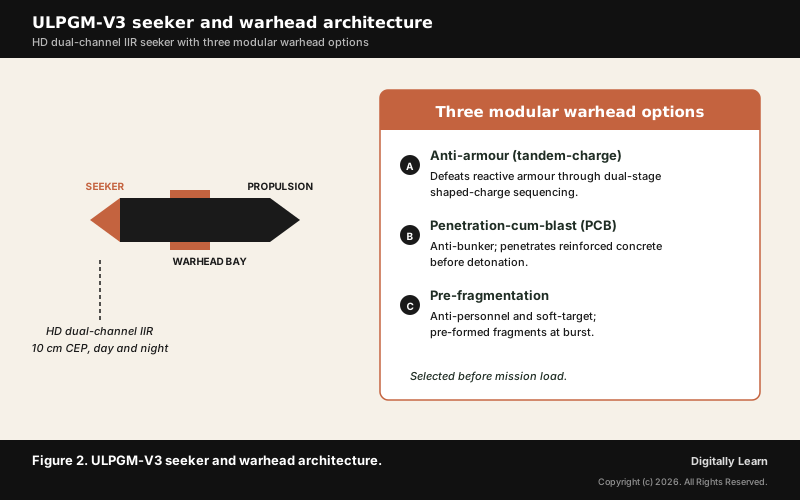
- (ii) Seeker and accuracy. The V3 carries a high-definition dual-channel imaging infrared seeker with day-and-night capability, delivering a circular error probable of about 10 centimetres. The seeker pairs with a two-way data link that supports post-launch target or aim-point updates, retaining the V2 datalink architecture for course corrections.
- (iii) Warhead modularity and autonomous mode. The V3 offers three modular warhead options: an anti-armour tandem-charge head for armoured vehicles, a penetration-cum-blast head for fortified bunkers, and a pre-fragmentation head for soft and anti-personnel targets. An autonomous mode allows the missile to engage when real-time control and communication links are jammed or denied, addressing the electronic-warfare environment characteristic of contemporary conflicts.
Seeker and warhead architecture
Side-by-side specifications
The three variants are best compared in a single side-by-side table covering weight, range, propulsion, seeker, and warhead architecture.
| Specification | ULPGM-V1 | ULPGM-V2 | ULPGM-V3 |
|---|---|---|---|
| Weight | 5 kg | 8.5 kg | 12.5 kg |
| Range | 1.5-2 km | 4-6 km | 10 km |
| Length | 680-690 mm | 890 mm | Not yet released |
| Diameter | 100 mm | 100 mm | Not yet released |
| Propulsion | Free-fall nosedive | Dual-thrust rocket motor with thrust vectoring | Dual-thrust solid motor |
| Seeker | Uncooled imaging infrared | Advanced navigation suite | HD dual-channel imaging infrared |
| Warhead | Pre-fragmented / EFP / bunker-buster | EFP for soft enclosed targets | Anti-armour / PCB / pre-fragmentation (modular) |
| Datalink | Open-loop | S-band two-way | Two-way with post-launch update |
| Status | In service since May 2024 | In service (220 units to BDL) | Trials completed 19 May 2026 |
Observable outcomes and induction pathway
What to watch on the V3 induction path
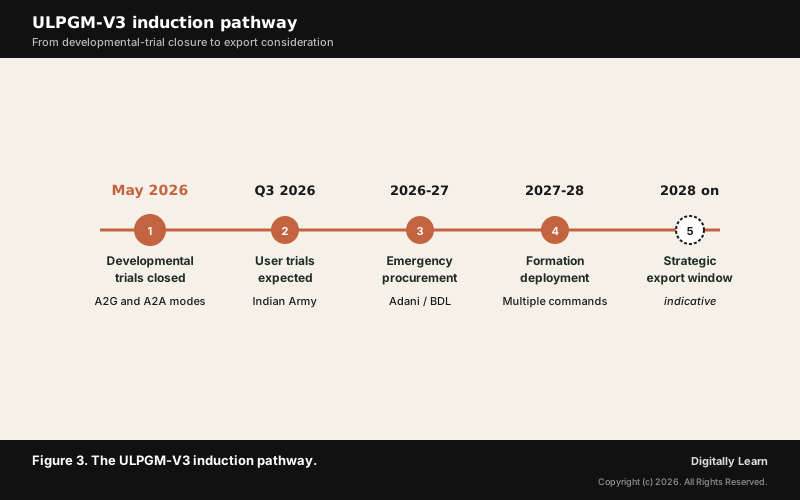
Observable outcomes: Six outcomes connect the laboratory closure on 19 May to operational deployment over the next eighteen months.
- (a) Emergency-procurement closure. Earlier ULPGM-V1 deliveries to the Indian Army began in May 2024 under an emergency-procurement order placed in August 2023. A similar order pathway is the most likely first induction channel for V3 once user-trial certification is achieved.
- (b) Industry production ramp. Adani Defence and Aerospace serves as the primary production partner; Bharat Dynamics Limited, Hyderabad, holds the V2 production contract for two hundred and twenty units at a per-unit price of approximately forty-seven lakh seventy thousand rupees.
- (c) UAV-platform integration. The V3 was trial-integrated with a NewSpace Research and Technologies UAV at Kurnool. Earlier variants flew on Raphe mPhibr MR-10 and MR-20 high-endurance drones and on a DRDO hexacopter, indicating a multi-platform launcher base.
- (d) Operation Sindoor deployment of V1. The Indian Armed Forces deployed the ULPGM-V1 during Operation Sindoor in 2025, the first combat use of an indigenous UAV-launched precision munition.
- (e) Western Command sixth-tranche delivery. Adani Defence delivered a sixth emergency-procurement tranche of ULPGM and the Agnikaa VTOL-1 kamikaze drone to Western Command on 12 May 2026, indicating recurring formation-level demand.
- (f) Export readiness. The Defence Acquisition Council’s positive list and the Strategic Partnership policy permit Indian production of the ULPGM-V3 to be considered for friendly foreign-country export windows. The strategic-export window is the next stage policy lever to watch.
Contemporary linkages
Drone warfare, foreign comparables, and the Make in India track
Contemporary linkages: Three threads connect the ULPGM-V3 trials to wider Indian defence-policy currents. The first is the drone-warfare track: contemporary conflicts in West Asia and Eastern Europe have demonstrated that loitering munitions and UAV-launched precision missiles can dislodge armoured vehicles, defended structures, and personnel concentrations at a fraction of the cost of stand-off cruise systems. India's domestic capability now offers the same outcome without the import-dependency cost. The second is the foreign-comparable thread: the AGM-176 Griffin (United States), the Desert Sting (Israel), and Mini Akıllı Mühimmat (Turkey) populate the same class, and India is now a participant rather than a buyer in this category. The third is the Make in India defence track, where the Hyderabad-Bengaluru cluster of RCI, Adani Defence, Bharat Dynamics Limited, and NewSpace Research and Technologies has emerged as a functional ecosystem with measurable outputs.
UPSC Relevance
Where the ULPGM-V3 trial sits in the UPSC syllabus
UPSC context: The ULPGM-V3 development falls within General Studies Paper III under two syllabus heads: science and technology, developments and their applications and effects in everyday life, particularly the indigenisation-of-technology dimension; and various security forces and agencies and their mandate, particularly defence research and development. The topic also touches General Studies Paper II on government policies and interventions through the Aatmanirbhar Bharat in Defence framework.
Prelims relevance: The factual surface that Prelims tests here includes the Research Centre Imarat as the developer, sitting at the Dr. A. P. J. Abdul Kalam Missile Complex in Hyderabad; the V3 weight of 12.5 kilograms and engagement range of 10 kilometres; the National Open Area Range at Kurnool as the trial site; the modular-warhead options (anti-armour, penetration-cum-blast, pre-fragmentation); the industry partnership of Adani Defence and Aerospace, Bharat Dynamics Limited, and NewSpace Research and Technologies; and the integration with Raphe mPhibr MR-10 and MR-20 UAV platforms.
Mains relevance: The strongest Mains framing is the indigenisation question: how does India translate developmental closure of a weapon system into formation-level induction at scale, and what role do emergency-procurement orders, positive indigenisation lists, and the Strategic Partnership policy play in compressing the laboratory-to-combat timeline. A second framing is the drone-warfare doctrine question: how do contemporary conflicts reshape the cost-economics of precision strike, and where do UAV-launched precision missiles fit in India's escalation ladder. A third framing is the defence-industrial-corridor question: what does the Hyderabad-Bengaluru cluster of RCI, Adani Defence, BDL, and NRT demonstrate about the operational viability of the Make in India defence model.
Mains practice question: A focused fifteen-mark question on this topic would read: Examine the significance of the ULPGM-V3 trials of May 2026 for India's defence-technology indigenisation. How does the laboratory-to-combat compression demonstrated by the ULPGM family relate to the Aatmanirbhar Bharat in Defence framework and the Strategic Partnership policy? The answer should treat the variant-progression evidence, the emergency-procurement pathway, the industry-cluster maturation, and the comparison with foreign loitering-munition systems as the four spokes.
- Past Mains linkage. 2018 GS-III: What do you understand by ‘Standard Positive Profile Management (SPPM)’ in defence procurement? Discuss its significance. The positive indigenisation list under which ULPGM categories are restricted from import is the direct successor mechanism.
- Past Mains linkage. 2022 GS-III: Discuss different types of cyber crimes and measures required to be taken to fight the menace. The autonomous mode of the V3, designed to operate when communications are jammed, sits in the same electronic-warfare frame.
- Adjacent linkage. Operation Sindoor (2025) deployed the V1 variant; the operational lessons feed the V3 specification.
Previous Year UPSC-CSE Questions By the end you will be able to draft model answers for the following UPSC questions. Each question carries a collapsible framework showing how to approach it in the exam.
- UPSC Mains 2018 GS-IIIWhat do you understand by 'Standard Positive Profile Management (SPPM)' in defence procurement? Discuss its significance.
How to structure the answer in the exam
Introduction: Open with the Make in India in Defence framework introduced under the Defence Procurement Procedure 2016 and the Defence Acquisition Procedure 2020, name Standard Positive Profile Management as the mechanism that classifies acquisitions by indigenous-content priority, and signal that the framework was the precursor to the Positive Indigenisation Lists notified from 2020 onwards.
Body (sub-themes to develop):
- Definition: a procurement-prioritisation framework that classifies categories by indigenous content, with the higher tiers (Buy Indian Indigenously Designed Developed and Manufactured, Buy Indian, Buy and Make Indian) carrying first-priority status and Buy Global as last resort.
- Institutional embedding: the Defence Acquisition Council; the Department of Defence Production within the Ministry of Defence; the Strategic Partnership model that permits Indian private companies to lead major platform integration.
- Significance for industrial policy: domestic-supplier development; Defence Industrial Corridors in Tamil Nadu and Uttar Pradesh; the over-thirty Micro, Small, and Medium Enterprise base behind systems like the ULPGM.
- Significance for fiscal allocation: capital-acquisition budget steering; the 75 per cent capital-acquisition outlay earmarked for domestic suppliers in recent Union Budgets.
- Significance for strategic autonomy: reduced import dependency under sanctions or supply-chain disruption; freedom of operational customisation; export readiness through the Strategic Partnership policy.
Conclusion: Conclude that Standard Positive Profile Management was the institutional precursor to the Positive Indigenisation Lists, that the framework has matured into a credible domestic-content discipline across categories from small arms to missile systems, and that the ULPGM-V3 trials of May 2026 demonstrate the framework's operational outcomes.
The ULPGM family is a flagship outcome of Standard Positive Profile Management and the Positive Indigenisation Lists that succeeded it. The article's industrial-ecosystem coverage (Adani Defence as primary production partner, Bharat Dynamics Limited holding the Rs 105 crore V2 contract, over thirty Micro, Small, and Medium Enterprises in the supplier base) supplies the core evidence for the body sub-theme on industrial-policy significance. The body sub-theme on strategic-autonomy connects to the article's discussion of replacing imported equivalents such as the AGM-176 Griffin.
- UPSC Mains 2020 GS-IIIExplain the significance of Defence Research and Development Organisation (DRDO) for indigenous defence production in India.
How to structure the answer in the exam
Introduction: Open with the establishment of the Defence Research and Development Organisation in 1958, its present structure of over fifty laboratories grouped under technology clusters, and frame the significance of indigenous defence production as a combination of laboratory innovation, technology transfer, and partnership with the Defence Public Sector Undertakings and private-sector integrators.
Body (sub-themes to develop):
- Institutional structure: the Defence Research and Development Organisation under the Department of Defence Research and Development, Ministry of Defence; technology clusters spanning aeronautics, armament, combat vehicles, electronics, life sciences, materials, missiles, and naval systems; the Director-General as chair of the Defence Research and Development Council.
- Flagship indigenous platforms: the Integrated Guided Missile Development Programme (Prithvi, Agni, Akash, Trishul, Nag); the Light Combat Aircraft Tejas; the Arjun main battle tank; the Akash surface-to-air missile; the BrahMos cruise missile joint venture; the ULPGM family from Research Centre Imarat.
- Industry partnership architecture: technology-transfer agreements with Defence Public Sector Undertakings (Hindustan Aeronautics Limited, Bharat Dynamics Limited, Bharat Electronics Limited); private-sector integrators (Tata Advanced Systems, Larsen and Toubro, Adani Defence); the Defence Innovation Organisation start-up ecosystem.
- Aatmanirbhar Bharat in Defence: the over-three-hundred items on the Positive Indigenisation Lists notified between 2020 and 2024; the percentage of capital-acquisition budget earmarked for domestic suppliers (75 per cent target); the Strategic Partnership policy for major platform integration.
- Ongoing modernisation: hypersonic vehicles (Hypersonic Technology Demonstrator Vehicle programme); the Indian Multi-Role Helicopter; the Advanced Medium Combat Aircraft programme; quantum and artificial-intelligence research centres.
Conclusion: Conclude that the Defence Research and Development Organisation has evolved from a single-laboratory research body to a multi-cluster integrator that drives India's transition from defence importer to defence developer-producer, with the ULPGM-V3 trials of May 2026 illustrating the operational outcome of the Research Centre Imarat lead working with private-sector integrators and over thirty Micro, Small, and Medium Enterprises.
The article's coverage of Research Centre Imarat as the Defence Research and Development Organisation laboratory leading ULPGM development directly supplies the body sub-theme on institutional structure. The collaboration with the Defence Electronics Research Laboratory, the Terminal Ballistics Research Laboratory, the High Energy Materials Research Laboratory, and the Defence Research and Development Laboratory illustrates the technology-cluster architecture in operation. The body sub-theme on industry partnership architecture is supported by the article's evidence on Adani Defence, Bharat Dynamics Limited, and NewSpace Research and Technologies as the integrator network.
Sources
- Major boost to Aatmanirbhar Bharat: DRDO completes development trials of Unmanned Aerial Vehicle Launched Precision Guided Missile-V3 in Air-to-Ground & Air-to-Air modes
- DRDO conducts successful flight-trials of Advanced Unmanned Aerial Vehicle Launched Precision Guided Missile-V3
- Defence Research and Development Organisation
- ULPGM (Unmanned Aerial Vehicle Launched Precision Guided Missile)
- DRDO successfully completes final trials of ULPGM-V3 missile
- DRDO completes final trials of UAV-launched precision guided missile
- Office of the Principal Scientific Adviser: Aatmanirbhar Bharat in Defence
Editorial Disclaimer
This article is compiled from the reference materials listed in the Sources section. It is an explainer for UPSC preparation and is not a substitute for primary documents (NCERTs, GoI ministry releases, IMD bulletins, RBI / CEA / MoEFCC publications, and Standing-Committee reports).


