


Overview
The Defence Research and Development Organisation and the Indian Air Force successfully flight-tested the indigenous RudraM-II air-to-surface missile in June 2026. The missile was launched from a Su-30 MKI fighter off the coast of Odisha and guided to its target, with all critical systems performing as planned. RudraM-II belongs to a home-built family of missiles designed to strike ground targets and to destroy enemy radars, advancing India's push for self-reliance in defence.
DRDO and the Air Force Test the RudraM-II Missile
An indigenous strike missile is flight-tested
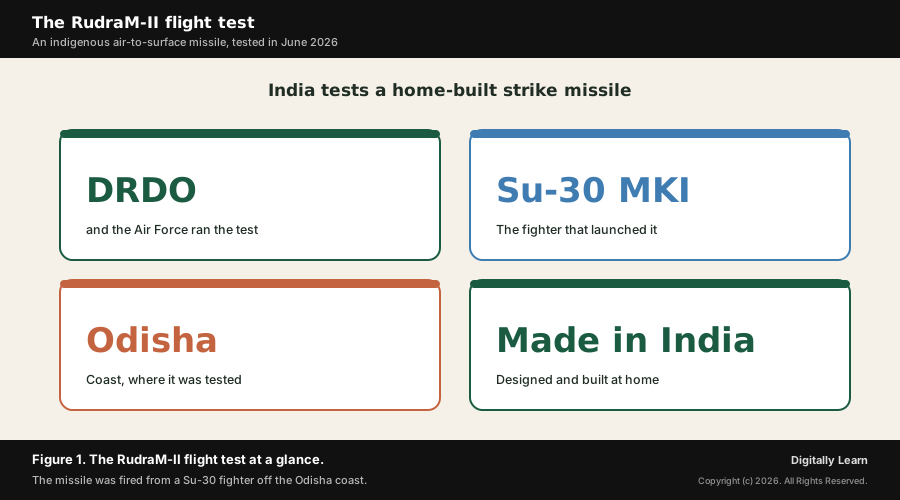
In June 2026, the Defence Research and Development Organisation and the Indian Air Force successfully flight-tested the RudraM-II missile. It was launched from a Su-30 MKI fighter off the coast of Odisha and guided to a predefined target.
All critical systems of the missile performed as planned during the test, which was tracked by range instruments of the Integrated Test Range at Chandipur. The missile was designed and built by the Research Centre Imarat in Hyderabad, a laboratory of the DRDO.
RudraM-II is an air-to-surface missile, meaning it is fired from an aircraft at targets on the ground. It belongs to the RudraM family of home-built missiles, a step in India's drive to build advanced weapons within the country rather than importing them.
Why an Indigenous Strike Missile Matters
Self-reliance and the suppression of enemy defences
Why it matters is that India has long been one of the world's largest arms importers. A successful home-built missile reduces that dependence and keeps critical technology and supply chains within the country.
The RudraM family also fills a specific military need. Its missiles are designed to destroy enemy radars and air-defence systems, clearing the way for India's own aircraft to operate, a task armed forces call the suppression of enemy air defences.
What the Test Signifies for India's Air Power
From a single test to a fielded weapon
What is the significance of this test lies in the progress it marks. A successful flight test validates the missile's design and its critical systems, an essential step before a weapon can be produced in numbers and inducted into service.
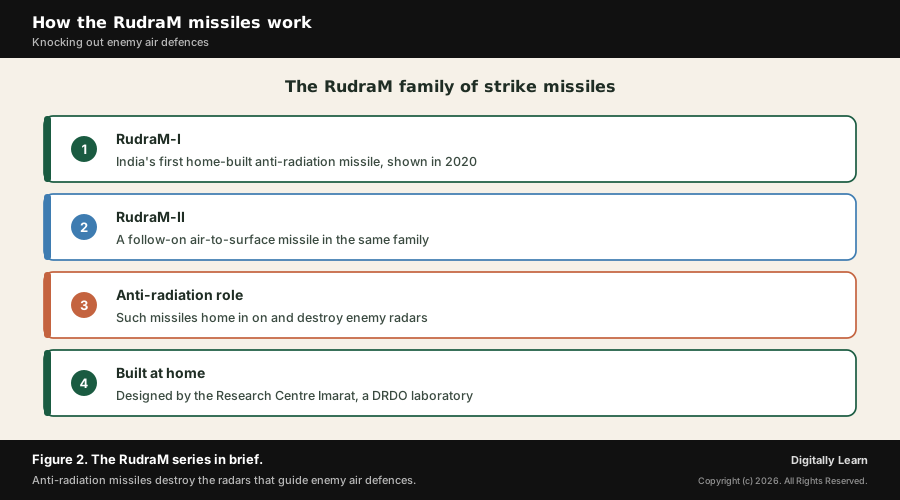
It also builds on the earlier RudraM-I, India's first indigenous anti-radiation missile. Each test in the series moves the country closer to a reliable, home-grown capability to strike ground targets and to blind an adversary's air defences.
The RudraM Series and How Anti-Radiation Missiles Work
The RudraM-II flight test at a glance
The table sets out the key features of the test and what each one means. Together they show an indigenous missile, fired from a frontline fighter and tracked by India's own test range.
| Feature | Detail |
|---|---|
| Missile | RudraM-II, an indigenous air-to-surface missile |
| Tested by | The Defence Research and Development Organisation and the Indian Air Force |
| Platform | Launched from a Su-30 MKI fighter aircraft |
| Location | Off the coast of Odisha, tracked by the Integrated Test Range, Chandipur |
| Developed by | The Research Centre Imarat, Hyderabad, a DRDO laboratory |
| Series role | A follow-on in the RudraM family of strike missiles |
Read together, the rows show a missile that is both home-built and integrated with the air force's frontline fighter, a marker of growing self-reliance.
Anti-Radiation Missiles and the SEAD Mission
An anti-radiation missile is a weapon that homes in on the radio signals emitted by an enemy radar and destroys it. Because air-defence systems rely on radars to find and target aircraft, knocking out those radars blinds the defence.
This mission is called the suppression of enemy air defences. By clearing radars and missile batteries, anti-radiation missiles let a country's own aircraft fly and strike more safely, which is why the RudraM family is important for the air force.
What to Watch in the RudraM Programme
Three things to track from here
The test points to three developments worth following, since a successful trial is a step towards, not the same as, a fielded weapon.
- (a) Induction. Whether the missile completes its trials and enters service with the air force.
- (b) Production. Whether it is manufactured in numbers within India, deepening the home supply chain.
- (c) The family. Whether further variants extend the range and roles of the RudraM series.
The real test is whether the programme delivers a dependable weapon in regular service, produced at home in useful numbers, not only a successful single trial under test conditions.
India's Push for Self-Reliance in Defence
Atmanirbhar Bharat in the defence sector
Contemporary linkages tie the RudraM-II test to India's wider drive for self-reliance in defence, often summed up as Atmanirbhar Bharat. The aim is to design and build more weapons at home and to cut a long-standing dependence on imports.
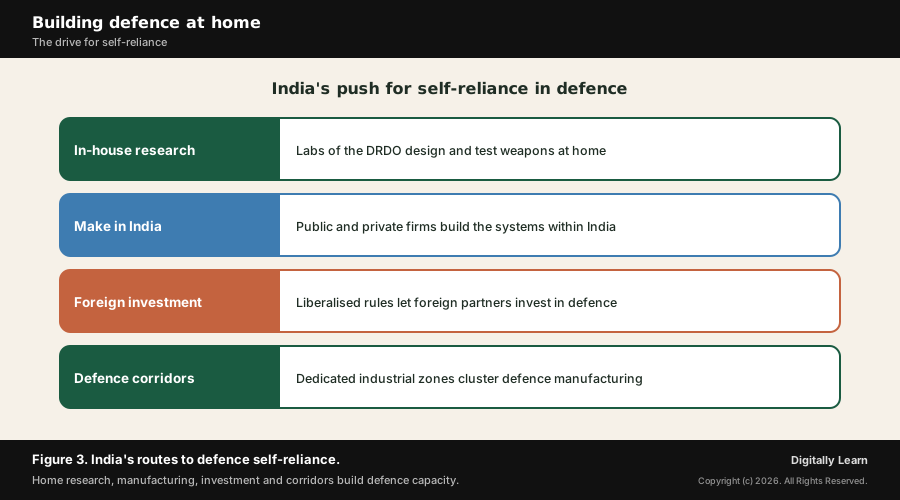
This effort runs along several tracks. The DRDO designs systems in its laboratories, public and private firms manufacture them under Make in India, and dedicated defence corridors cluster the industry in particular states.
Policy has also opened the sector to investment. Rules on foreign direct investment in defence have been liberalised so that foreign partners can invest and bring technology, while production stays within India and strengthens the domestic base.
These efforts sit within global rules on missile technology. India is a member of the Missile Technology Control Regime, the group that governs the spread of missile technology, which shapes both what India can import and what it can export.
UPSC Relevance and Exam Focus
Where this fits in the UPSC-CSE syllabus
This topic maps to General Studies Paper III: developments in science and technology, and defence and security, with links to the indigenisation of technology and the economy.
For Prelims, hold the high-yield facts: RudraM as India's indigenous anti-radiation missile, the meaning of an air-to-surface and an anti-radiation missile, the difference between ballistic and cruise missiles, and India's membership of the Missile Technology Control Regime.
For Mains, two framings recur: how policy steps such as opening defence to investment affect the sector and the economy, and how indigenous capability strengthens India's security.
Recurring linked concepts an aspirant should keep in working memory:
- Anti-radiation missile: a missile that destroys enemy radars to suppress air defences.
- Air-to-surface missile: a missile fired from an aircraft at targets on the ground.
- DRDO: India’s defence research and development organisation.
- Missile Technology Control Regime: the regime governing the spread of missile technology, which India joined.
A common Prelims trap is to confuse missile types; a ballistic missile follows a high arching path, while a cruise missile flies like a powered aircraft for most of its flight.
A common Mains trap is to treat a single test as a finished capability. A weapon must still complete trials, be produced and be inducted before it counts as fielded strength.
Previous Year UPSC-CSE Questions By the end you will be able to draft model answers for the following UPSC questions. Each question carries a collapsible framework showing how to approach it in the exam.
- UPSC Mains 2014 GS-IIIForeign Direct Investment (FDI) in the defence sector is now set to be liberalized: What influence is this expected to have on Indian defence and economy in the short and long-run?
How to structure the answer in the exam
Introduction: Open with India's reliance on defence imports and the case for opening the sector.
Body (sub-themes to develop):
- Short-run: inflow of capital, technology and modern production know-how.
- Long-run: a stronger domestic defence industrial base and fewer imports.
- Economy: jobs, exports and a boost to allied industries.
- Risks: safeguards over control, technology and strategic autonomy.
Conclusion: Conclude that liberalised investment, used with safeguards, can deepen self-reliance and aid the economy.
- UPSC Prelims 2023 GS-IConsider the following statements:
- Ballistic missiles are jet-propelled at subsonic speeds throughout their flights, while cruise missiles are rocket-powered only in the initial phase of flight.
- Agni-V is a medium-range supersonic cruise missile, while BrahMos is a solid-fuelled intercontinental ballistic missile.
Which of the statements given above is/are correct?
How to approach this Prelims question
Approach: Test each statement against the real definitions of ballistic and cruise missiles.
Trap to watch: Statement 1 reverses the propulsion; statement 2 swaps the categories of Agni and BrahMos.
Key facts to recall:
- A cruise missile flies like a powered aircraft; a ballistic missile follows a high arching path. So statement 1 is reversed.
- Agni-V is a long-range ballistic missile and BrahMos is a cruise missile, so statement 2 is wrong too.
Answer signal: Both statements are wrong, so the answer is Neither 1 nor 2.
- UPSC Prelims 2022 GS-IIndia is a member of which of the following?
- Asian Infrastructure Investment Bank
- Missile Technology Control Regime
- Shanghai Cooperation Organisation
Select the correct answer using the code given below.
How to approach this Prelims question
Approach: Check India's membership of each listed body.
Trap to watch: All three are real memberships; do not drop the Missile Technology Control Regime, which India joined in 2016.
Key facts to recall:
- India is a member of the Asian Infrastructure Investment Bank, the Missile Technology Control Regime and the Shanghai Cooperation Organisation.
- India joined the Missile Technology Control Regime in 2016.
Answer signal: India is a member of all three, so the answer is 1, 2 and 3.
Sources and Further Reading
- Press Information Bureau: DRDO and IAF conduct successful flight-tests of RudraM-II Air-to-Surface Missile
- Defence Research and Development Organisation: RudraM-II flight test
- DD News: DRDO, IAF successfully flight-test RudraM-II air-to-surface missile
- Press Information Bureau: DRDO successfully flight tests indigenously developed Anti Radiation Missile (RUDRAM)
Editorial Disclaimer
This briefing is for UPSC preparation. Verify the missile's details against the official government and DRDO sources before relying on them.


