


Overview
A convergence mission to end child and maternal malnutrition
POSHAN Abhiyaan, the National Nutrition Mission launched on 8 March 2018, is India's flagship programme to reduce stunting, under-nutrition, anaemia and low birth weight, run by the Ministry of Women and Child Development through convergence, technology and a people's movement, and now realigned under Mission Poshan 2.0.
POSHAN Abhiyaan, the National Nutrition Mission, is India's flagship programme to improve the nutritional status of children, adolescent girls, pregnant women and lactating mothers. It was launched by the Prime Minister on 8 March 2018 from Jhunjhunu in Rajasthan and is run by the Ministry of Women and Child Development. Its declared goals are to reduce stunting, under-nutrition, anaemia and low birth weight in a time-bound way. What sets it apart is its method: it relies not on a single new benefit but on convergence across ministries, on technology through the Poshan Tracker, and on a Jan Andolan, a people's movement, to change behaviour. From 2021-22 the mission was realigned under Mission Saksham Anganwadi and Poshan 2.0, bringing the Anganwadi network and supplementary nutrition into one nutrition support programme.
The Malnutrition Burden in India: Stunting, Wasting, Anaemia and the First 1,000 Days
Stunting, wasting, anaemia and the window of the first 1,000 days
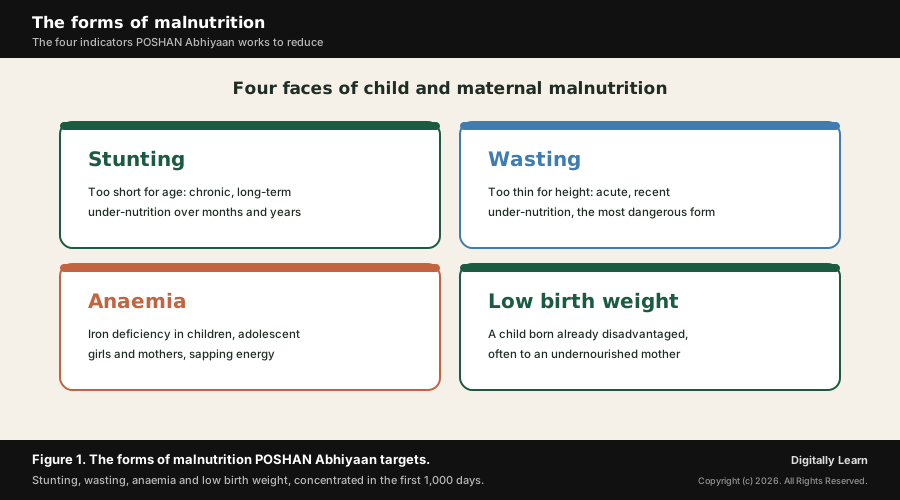
Malnutrition in India is not one condition but a cluster of them, and the mission that addresses it begins by naming each. Stunting, a child being too short for its age, is the mark of chronic under-nutrition that has set in over months and years; wasting, a child being too thin for its height, is the sign of acute, recent under-nutrition; and being underweight combines the two. Alongside these, anaemia, a deficiency of iron in the blood, saps the energy of children, adolescent girls and mothers, while low birth weight marks a child who began life already disadvantaged in the womb.
These measures follow the internationally agreed standards of child nutrition. The World Health Organization defines stunting as low height-for-age and wasting as low weight-for-height, judged against its Child Growth Standards, and the mission's goals run parallel to the WHO Global Nutrition Targets: a forty per cent cut in stunted under-fives, a fifty per cent cut in anaemia among women of reproductive age, a thirty per cent cut in low birth weight, and childhood wasting held below five per cent.
Why it matters is that these conditions are not merely a health problem but a brake on the nation's human capital. A stunted child suffers irreversible harm to brain development, learns less in school and earns less as an adult, so the loss compounds across a lifetime and across generations. Because poverty causes malnutrition and malnutrition deepens poverty, the two lock into a vicious cycle: an undernourished, anaemic mother is more likely to bear a low-birth-weight child, who is more likely to be stunted, to do poorly at school and to remain poor, closing the loop. Breaking that cycle is the central purpose of the mission.
The science points to a narrow window where action pays off most. The first 1,000 days, from conception to a child's second birthday, are the period of fastest physical growth and brain development, and damage done in this window is largely irreversible later. This is why the mission concentrates on pregnant women, lactating mothers and children under two, and why nutrition during pregnancy, exclusive breastfeeding for the first six months and timely complementary feeding thereafter sit at the heart of its strategy. The figure below sets out the forms of malnutrition the mission seeks to reduce.
The Design of POSHAN Abhiyaan: The Four Indicators and Time-Bound Reduction Targets
The 2018 launch, the four target indicators and the annual reduction goals
POSHAN Abhiyaan, where POSHAN stands for the Prime Minister's Overarching Scheme for Holistic Nourishment, was launched by the Prime Minister on 8 March 2018 from Jhunjhunu in Rajasthan, the programme having been set up by the Government a few months earlier. Earlier called the National Nutrition Mission, it was conceived not as one more feeding scheme but as an overarching mission to place nutrition at the centre of the development agenda. It is run by the Ministry of Women and Child Development as a centrally sponsored scheme, with the States and Union Territories carrying out the work on the ground.
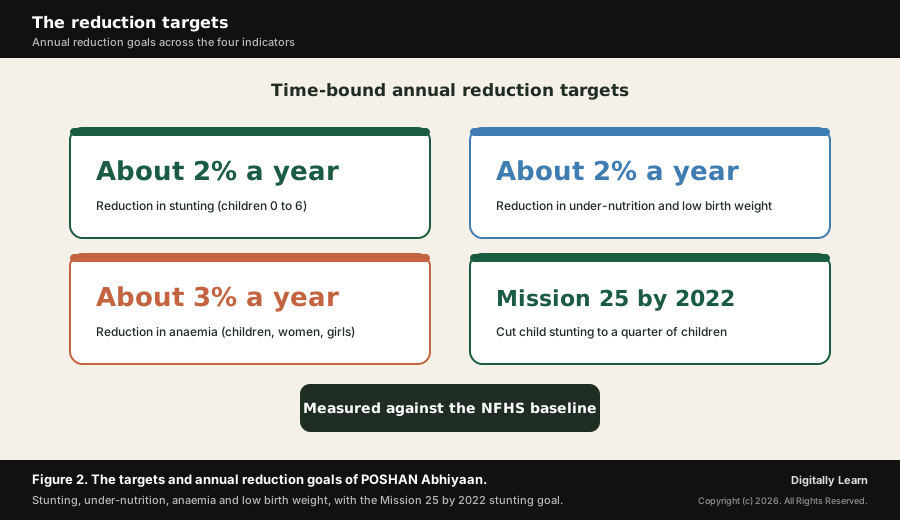
The mission fixed itself on four indicators. It works to reduce the level of stunting and under-nutrition, that is underweight, in children aged nought to six; anaemia among young children, women and adolescent girls; and low birth weight in newborns. The targeted groups follow from these indicators: children up to six years, adolescent girls, pregnant women and lactating mothers, the people whose nutrition decides whether the next generation grows healthy. By naming measurable indicators and the groups that carry them, the mission made nutrition a problem that could be tracked rather than merely talked about.
To give the goals teeth, the mission set time-bound numerical targets. It aimed to reduce stunting, under-nutrition and low birth weight each by about two per cent a year, and to bring down anaemia by about three per cent a year, across the country. A headline ambition, often cited as Mission 25 by 2022, was to cut stunting among young children to a quarter of the child population, measured against the level recorded in the fourth round of the National Family Health Survey. The figure below summarises the design, the indicators and the reduction targets together.
The Convergence and Delivery Architecture: From the Ministry to the Anganwadi Worker
The Ministry of Women and Child Development, ICDS, the Anganwadi worker and convergence across ministries
The most distinctive feature of POSHAN Abhiyaan is that it is built on convergence rather than on a single new benefit. Its premise is that malnutrition cannot be solved by the food or health sector alone, because a child's nutrition depends at once on what it eats, on whether it falls ill, on whether the water is clean and on how its mother is cared for. The mission therefore knits together the work of many ministries and departments, more than a couple of dozen in all, so that nutrition becomes a shared goal pursued through a single, coordinated effort instead of scattered schemes that never meet.
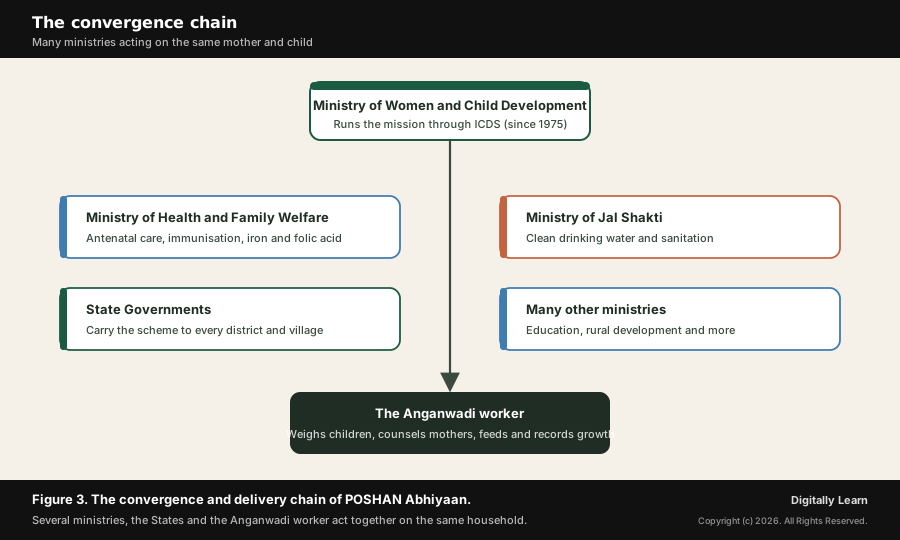
At the centre of this effort is the Ministry of Women and Child Development, which runs the mission, and its Integrated Child Development Services, the network first set up in 1975 that delivers nutrition and early-childhood services on the ground. The frontline of this network is the Anganwadi worker, a woman of the village who weighs and measures the children, counsels mothers on feeding, distributes supplementary food, and records each child's growth. Working alongside her are the auxiliary nurse midwife from the health system and the accredited social health activist, so that the three frontline workers reach the same mother and child together rather than apart.
Three partners make the convergence real beyond the Ministry itself. The Ministry of Health and Family Welfare supplies antenatal care, immunisation, iron and folic acid supplements and the treatment of severe malnutrition; the Ministry of Jal Shakti brings clean drinking water and sanitation, since a child that keeps falling ill from dirty water cannot absorb the food it eats; and the State Governments carry the scheme to every district and village. By aligning the Anganwadi, the health worker, water and sanitation, and the State machinery on the same households, the mission tries to act on every cause of malnutrition at once. The figure below maps this delivery chain.
| Partner | Role in the convergence | Nutrition contribution |
|---|---|---|
| Ministry of Women and Child Development | Runs the mission through ICDS and the Anganwadi | Supplementary nutrition, growth monitoring and counselling |
| Ministry of Health and Family Welfare | Provides the health services for mother and child | Antenatal care, immunisation, iron and folic acid, treatment |
| Ministry of Jal Shakti | Supplies clean water and sanitation | Cuts the illness that drains a child's nutrition away |
| State Governments | Carry the scheme to every district and village | Local delivery, staffing and supplementary nutrition supply |
Technology and Accountability: The Poshan Tracker and Real-Time Growth Monitoring
The Poshan Tracker, growth monitoring and near real-time data
The second pillar of the mission is technology, used to replace slow paper registers with live data. Its main instrument is the Poshan Tracker, a software application rolled out from 1 March 2021 through which the Anganwadi worker records each child and beneficiary on a phone or tablet. The application captures registration, attendance, the food given and, above all, the regular weighing and measuring of children, so that growth is tracked digitally rather than guessed. Because the data flows up at once, supervisors at the block, district, State and national level can see progress in near real time.
The promise of this design is better targeting. When a child's weight and height are entered, the system can flag a child who is faltering, prompting the worker to act before mild under-nutrition becomes severe, and it can identify which villages and districts are lagging so that effort and food are steered there. The Poshan Tracker has been made available in many regional languages and lets a child's record follow it when a family migrates, so that a moving household does not fall out of the net, and it has been linked with the health system's own portals so that nutrition and health data speak to each other.
Yet technology is a tool, not a cure, and the mission's own logic insists that data must drive decisions rather than sit on a dashboard. The aim is that a worker who sees a stunted child counsels the mother and refers the child, that a supervisor who sees a weak Anganwadi sends help, and that a State that sees a district falling behind reallocates resources. Used in this way, the Poshan Tracker turns the everyday weighing of children into a steady stream of evidence on which nutrition action can be planned, monitored and corrected, the modern accountability core of the mission.
Jan Andolan and Rashtriya Poshan Maah: Nutrition as a People's Movement
The Jan Andolan strategy, Poshan Maah, Poshan Pakhwada and the Poshan ke Panch Sutra
The third pillar of the mission is the Jan Andolan, a people's movement, built on the recognition that nutrition is decided as much in the home as in the clinic. Much of malnutrition stems from behaviour: whether a newborn is breastfed at once and exclusively for six months, whether complementary feeding begins on time, whether the family eats a diverse diet, whether hands are washed and water is clean. Because no official can sit in every kitchen, the mission seeks to make better feeding and care a social norm, owned by families and communities rather than imposed from above, so that good practice spreads from neighbour to neighbour.
This movement is carried by two great annual campaigns. Rashtriya Poshan Maah, the national nutrition month, is observed every September, and Poshan Pakhwada, a nutrition fortnight, is held around March and April, between them filling the calendar with community events, rallies, counselling sessions and the planting of Poshan Vatikas, the nutri-gardens that grow fruit and vegetables for local diets. These campaigns reach millions of women and families and pull in the staff and beneficiaries of many ministries at once, turning a government target into a visible public effort.
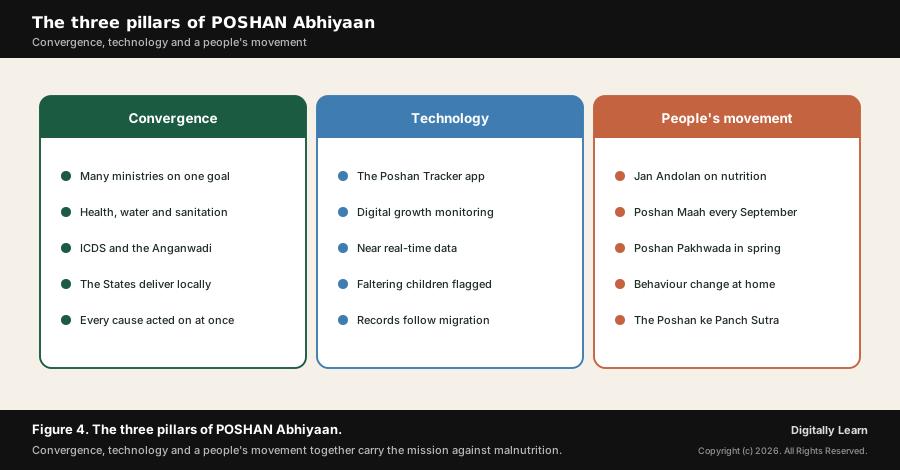
The messages of the movement are gathered into a simple, memorable code, the Poshan ke Panch Sutra, the five threads of nutrition: the care of the first 1,000 days; nutritious food and dietary diversity; the prevention and treatment of anaemia; the management of diarrhoea; and hygiene and sanitation. By reducing a complex science to five clear actions a mother can take, the campaign makes nutrition both teachable and doable, and it joins the work of the Anganwadi, the health worker and the water and sanitation drive into one understandable message. The figure below sets out the three pillars on which the mission stands.
Saksham Anganwadi and Mission Poshan 2.0: The Realignment and Supplementary Nutrition
What Mission Poshan 2.0 merged, the supplementary nutrition programme and growth monitoring
From the financial year 2021-22, the Government realigned its nutrition schemes under a single umbrella, Mission Saksham Anganwadi and Poshan 2.0, usually shortened to Mission Poshan 2.0. The realignment brought together three programmes that had run separately: the Anganwadi Services, that is the Integrated Child Development Services network; POSHAN Abhiyaan itself; and the Scheme for Adolescent Girls. By merging them, the Government sought a single nutrition support programme with one set of guidelines and one delivery system, so that the same Anganwadi could serve every group through a common framework rather than running three overlapping schemes.
The merger came with a shift of emphasis. Poshan 2.0 stresses not only the quantity of food but the quality and content of nutrition, encouraging the use of millets and locally grown, nutrient-rich foods, the fortification of food, and the spread of nutri-gardens. It carries forward the Poshan Tracker and the Jan Andolan, and folds them into a wider drive to upgrade the Anganwadi itself into a Saksham Anganwadi, a better-equipped centre with improved infrastructure and learning material for early-childhood care, so that the place where nutrition is delivered is itself strengthened.
The everyday core of the scheme remains the supplementary nutrition programme, through which the Anganwadi provides take-home rations and hot cooked meals to children of six months to six years, pregnant women and lactating mothers, with extra provision for adolescent girls in chosen districts. Alongside the food, the Anganwadi continues the regular growth monitoring of children, weighing and measuring them and using the Poshan Tracker to spot a child who is failing to grow. In this way Mission Poshan 2.0 carries the original goals of POSHAN Abhiyaan into a consolidated, better-resourced structure.
Outcomes and Evidence: What the Survey Data Show on Stunting and Anaemia
The National Family Health Survey trends and the gains and gaps in nutrition
The chief measure of progress is the National Family Health Survey, the large household survey that records the nutrition of children and women across the country. Its fourth round, for 2015-16, recorded that a little over a third of young children were stunted and around a fifth were wasted, with more than a third underweight, the baseline against which the mission set its goals. These figures established just how widespread chronic and acute under-nutrition were when POSHAN Abhiyaan began, and they framed the headline ambition to bring child stunting down to a quarter of children.
The survey's later round points to real but uneven progress. Stunting and underweight among young children show a measurable decline over the years across which the mission has run, a genuine gain in a country of this scale, even if the pace has fallen short of the steep annual targets the mission set itself. The improvement, where it has come, is best read with care, because nutrition is shaped by incomes, food prices, sanitation and many programmes at once, so it cannot be credited to a single scheme; the mission is one important force among several, not the sole cause of change.
The sterner picture is anaemia. Far from the steady fall the mission sought, anaemia among children and among women of reproductive age has remained stubbornly high, and on some measures has worsened, which is why a dedicated drive against it runs alongside the nutrition mission. The honest summary, then, is mixed: stunting and underweight have improved while anaemia has not, the gains are real but slower than promised, and the precise numbers are best taken from the latest survey rather than asserted, since the figures move with each round.
Linked Programmes: Anaemia Mukt Bharat and the Wider Nutrition Ecosystem
Anaemia Mukt Bharat, the wider nutrition schemes and the convergent ecosystem
Because anaemia has proved the hardest of the four indicators to move, it has its own dedicated drive, Anaemia Mukt Bharat, run by the Ministry of Health and Family Welfare. It works through a small set of interventions repeated for every age group: iron and folic acid supplements for children, adolescents and mothers, deworming, the testing and treatment of anaemia, and counselling on iron-rich diets. POSHAN Abhiyaan and its Jan Andolan campaigns carry the same message into the community, so that the nutrition mission and the anaemia drive reinforce one another rather than work in isolation.
The nutrition mission also sits within a wider ecosystem of programmes that touch the same households. The maternity benefit scheme supports pregnant and lactating mothers with cash for better nutrition and rest; the school meal programme feeds older children at school; the public distribution system supplies subsidised foodgrains to poor families; and the drinking water and sanitation missions cut the illness that drains nutrition away. The premise of convergence is that these efforts, pulled onto the same family, do together what none can do alone, which is why the mission insists on coordination rather than competition between schemes.
Set in this ecosystem, POSHAN Abhiyaan is best understood not as a feeding scheme but as the coordinating spine of India's nutrition effort. It supplies the targets, the Anganwadi network, the Poshan Tracker data and the people's movement, while the health system, the food and water programmes and the States supply the rest. The strength of this design is that it attacks every cause of malnutrition at once; its weakness, as the next section sets out, is that a mission depending on so many actors is only as strong as the coordination, the staffing and the resources that hold the actors together.
The Critiques and Debates: Data Concerns, Anganwadi Capacity and the Anaemia Measurement Question
Poshan Tracker data concerns, supplementary nutrition quality, Anganwadi capacity, anaemia measurement and funding
A balanced reading sets the mission's design against the critiques made of it by independent researchers, evaluators and audit bodies, presented here as an open debate rather than a verdict. A first concern is about data and the Poshan Tracker. Observers caution that a dashboard is only as good as what is entered, that overburdened Anganwadi workers may struggle to record every child accurately, and that real-time numbers, however impressive, are not the same as real-time nutrition unless the data actually triggers action on the ground for the child who is faltering.
A second cluster of concerns is about delivery and capacity. Evaluators have questioned the quality and regularity of the supplementary nutrition that reaches children, the adequacy of its calorie and protein content, and the leakage and irregular supply that can blunt it. They point too at the Anganwadi worker, asked to weigh and counsel and feed and now to enter data on a phone, often for modest honoraria and with weak infrastructure, and they note that the network's reach into the poorest and most remote homes remains uneven, so that those who most need it can still be missed.
A third debate is technical but important, over the measurement of anaemia. Some experts argue that the survey method used to estimate anaemia, based on a finger-prick blood sample, may overstate its true extent, and that India needs a more accurate national measurement before the scale of the problem and the success of the response can be judged fairly. Alongside this run questions of funding and staffing, on whether the budget keeps pace with ambition. Taken together, the critiques do not deny the mission's gains; they argue that data, delivery, capacity, measurement and money must all improve for the design to deliver on its promise, and the issue is fairly treated as open.
Understanding the Significance: Human Capital, the Demographic Dividend and Convergent Governance
Why nutrition is a human-capital investment, a condition for the demographic dividend and a model of convergence
What is the significance of POSHAN Abhiyaan lies first in its treatment of nutrition as an investment in human capital. By concentrating on the first 1,000 days, the mission tries to prevent the irreversible damage of early under-nutrition, protecting a child's brain, its schooling and its future earnings. Because a well-nourished child becomes a more productive adult, spending on nutrition is among the highest-return public investments a developing country can make, and the mission reframes nutrition from a welfare cost into a foundation of national development.
Its second significance is for the demographic dividend. India's advantage of a young population can only be realised if that population is healthy and able to learn and work, and a generation stunted in childhood would convert the dividend into a burden. By striking at malnutrition in the early years and at anaemia among adolescent girls and mothers, the mission works to keep the dividend intact, which is why nutrition is treated not as a side issue but as a precondition for the country's economic promise being fulfilled.
Its third significance is for governance. POSHAN Abhiyaan is studied as a model of convergent, technology-led and participatory administration: many ministries pulled onto one goal, a digital system carrying live data, and a people's movement enlisting families in their own welfare. Its design shows both the power and the difficulty of governing across departmental walls, and it offers lessons for every problem that no single ministry can solve alone. The figure earlier in this article maps these strands; together they explain why a nutrition mission is read as a study in development, demography and the craft of government.
The Way Forward: Quality Nutrition, Stronger Anganwadis and Honest Measurement
Improving supplementary nutrition, supporting the Anganwadi worker, fixing measurement and sustaining funding
The way forward follows from the critiques. The first priority is the quality of nutrition the child actually receives: ensuring that the supplementary food is regular, adequate in calories and protein, diverse and locally appropriate, with millets, fortified foods and nutri-gardens widening the diet, so that the meal on the plate matches the ambition on the dashboard. A guarantee of food means little if what reaches the child is thin or irregular, so closing that gap is the most direct route to better growth.
The second priority is to strengthen the Anganwadi and the worker at its heart. Better infrastructure, fair and timely honoraria, lighter paperwork, proper training and enough staff would let the Anganwadi worker do the counselling, feeding and growth monitoring that the mission depends on, rather than being stretched thin across too many tasks. Alongside this, the Poshan Tracker should be used to drive action and not merely to display numbers, so that a faltering child flagged by the system is followed up in the home.
The third priority is honest measurement and steady resources. Settling the dispute over how anaemia is measured, so that the true scale of the problem is known, and sustaining the funding and staffing of the nutrition system across years rather than in bursts, would let the mission be judged and improved on solid ground. Pursued together, better food, stronger Anganwadis, action-driven data, accurate measurement and dependable funding would move POSHAN Abhiyaan closer to its founding promise: to break the poverty-malnutrition cycle in the first 1,000 days of every child's life.
UPSC Relevance and Exam Focus
Where POSHAN Abhiyaan fits in the UPSC-CSE syllabus
This topic maps most directly to General Studies Paper II: government policies and interventions for development in various sectors and issues arising out of their design and implementation; welfare schemes for vulnerable sections; and issues relating to the development and management of the social sector relating to health and human resources, since POSHAN Abhiyaan is a welfare mission for children and mothers delivered through the Anganwadi network. It also links to General Studies Paper I, on poverty and developmental issues, and to General Studies Paper III, on inclusive growth and human capital, supplying rich material on convergence and the demographic dividend.
For Prelims, hold the high-yield facts: POSHAN Abhiyaan, the National Nutrition Mission, was launched on 8 March 2018 from Jhunjhunu and is run by the Ministry of Women and Child Development; it targets stunting, under-nutrition, anaemia and low birth weight; it works through convergence, technology and a Jan Andolan; its data tool is the Poshan Tracker; Rashtriya Poshan Maah falls in September; and from 2021-22 it was realigned under Mission Saksham Anganwadi and Poshan 2.0, which merged the Anganwadi Services, POSHAN Abhiyaan and the Scheme for Adolescent Girls.
For Mains, the recurring framing is to assess the mission's design against its delivery and to connect malnutrition to development: how convergence, data and a people's movement attack malnutrition, why the first 1,000 days matter for human capital, and how the poverty-malnutrition cycle hurts the demographic dividend. A strong answer treats nutrition as a human-capital investment, weighs the genuine decline in stunting against the stubborn persistence of anaemia, and proposes balanced reforms in food quality, Anganwadi capacity, measurement and funding.
Recurring linked concepts an aspirant should keep in working memory:
- The first 1,000 days: The window from conception to a child’s second birthday when growth and brain development are fastest and damage is largely irreversible.
- Convergence: The pulling of many ministries, including health and water and sanitation, onto the single goal of better nutrition for the same household.
- The Poshan Tracker: The software application for digital growth monitoring and near real-time data, the technology core of the mission.
- Mission Poshan 2.0: The 2021-22 realignment that merged the Anganwadi Services, POSHAN Abhiyaan and the Scheme for Adolescent Girls into one nutrition support programme.
A common Prelims trap is to confuse the mission with the school meal programme; hold that POSHAN Abhiyaan is the National Nutrition Mission under the Ministry of Women and Child Development for the under-six, adolescent girls and mothers, whereas the school meal is a separate scheme for older school children, and that the Anganwadi, not the school, is the delivery point of the nutrition mission.
A common Mains trap is to describe the scheme and stop there. The exam value lies in a balanced judgment that links nutrition to human capital and the demographic dividend, credits the real decline in stunting, faces the stubborn persistence of anaemia honestly, and grounds reform in food quality, Anganwadi capacity, accurate measurement and sustained funding.
Previous Year UPSC-CSE Questions By the end you will be able to draft model answers for the following UPSC questions. Each question carries a collapsible framework showing how to approach it in the exam.
- UPSC Mains 2024 GS-IIExplain how poverty and malnutrition reinforce each other in a vicious cycle that damages human capital formation, and set out the steps that can break the cycle, illustrating with a concrete programme.
How to structure the answer in the exam
Body (sub-themes to develop):
- The cycle and human capital: an undernourished mother bears a low-birth-weight child who is stunted, learns less, earns less and stays poor, so early under-nutrition causes irreversible harm to the brain, schooling and lifetime productivity that drives the demographic dividend.
- Steps in the critical window: concentrate on the first 1,000 days through antenatal care, exclusive breastfeeding, timely complementary feeding and the maternity benefit, since this is where action is most cost-effective.
- Convergent delivery: pull health, water and sanitation, food security and the States onto the same household, as POSHAN Abhiyaan does, because no single sector can break the cycle alone.
- Direct nutrition and anaemia: provide quality supplementary nutrition and growth monitoring through a strengthened Anganwadi, and run Anaemia Mukt Bharat with iron and folic acid, deworming and testing for adolescent girls and mothers.
- Behaviour and accountability: use the Jan Andolan to change feeding and hygiene practice and the Poshan Tracker to drive data-led action, while improving food quality, worker capacity, honest measurement and sustained funding.
Sources and Further Reading
- Ministry of Women and Child Development: Mission Saksham Anganwadi and Poshan 2.0
- Ministry of Women and Child Development: Poshan Tracker
- Press Information Bureau: POSHAN Abhiyaan to address malnutrition through convergence, technology and a targeted approach
- Press Information Bureau: POSHAN Abhiyaan (National Nutrition Mission)
- Press Information Bureau: Mission Poshan 2.0, strengthening India's nutrition ecosystem
- Press Information Bureau: Guidelines of Saksham Anganwadi and Poshan 2.0
- Press Information Bureau: POSHAN Abhiyaan FAQ (frequently asked questions)
- NITI Aayog: POSHAN Abhiyaan, preserving progress on nutrition in India
- Ministry of Health and Family Welfare: Anaemia Mukt Bharat
- Wikipedia: National Family Health Survey (India)
- World Health Organization: Global Nutrition Targets 2025 (stunting, wasting, anaemia and low birth weight)
Editorial Disclaimer
This briefing is for UPSC preparation. Verify the facts and provisions against the official Ministry of Women and Child Development, POSHAN Abhiyaan and Press Information Bureau sources before relying on them.


