


Overview
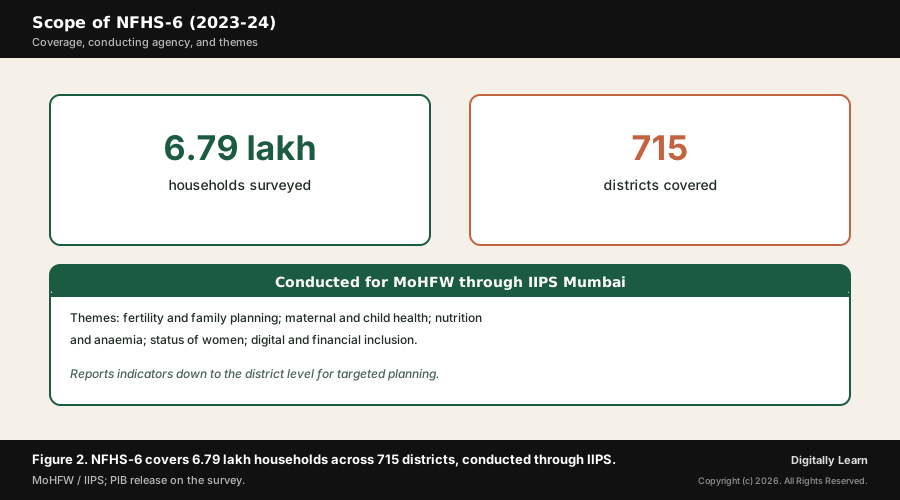
The National Family Health Survey (NFHS) is a large-scale household survey that measures India's population, health, nutrition and family-welfare indicators. On 29 May 2026, the Ministry of Health and Family Welfare released NFHS-6 (2023-24), conducted through the International Institute for Population Sciences (IIPS), Mumbai, covering nearly 6.79 lakh households across 715 districts.
Why NFHS-6 is in the news in May 2026
The release and what the survey is
On 29 May 2026, the Union Ministry of Health and Family Welfare released the sixth National Family Health Survey, covering the reference period 2023-24. The survey is the largest of its kind in India.
The National Family Health Survey is a household sample survey that measures fertility, family planning, maternal and child health, nutrition and the status of women. It is conducted through the International Institute for Population Sciences (IIPS), Mumbai, the nodal agency, with the Ministry as the coordinating body.
NFHS-6 covered nearly 6.79 lakh households across 715 districts, which lets it report indicators down to the district level. That granularity is what makes the survey a planning tool rather than a headline-only dataset.
The headline findings cluster in four areas:
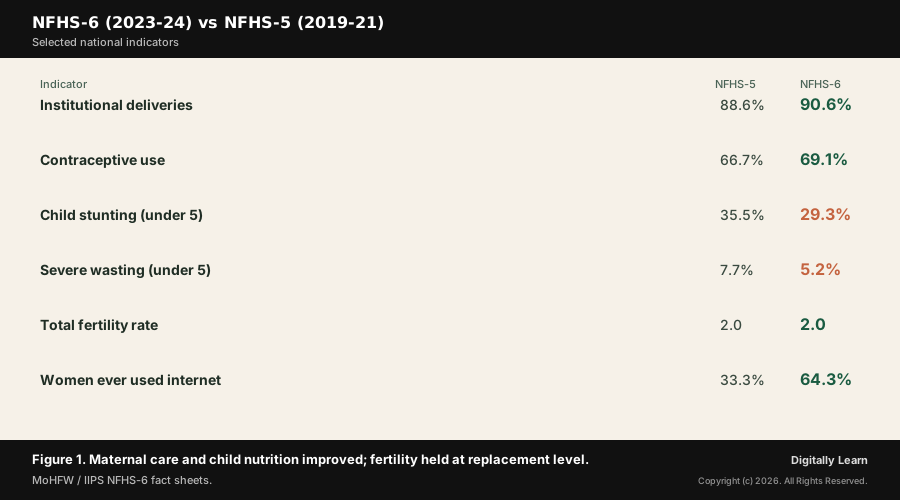
- Fertility: the total fertility rate stayed at 2.0, at the replacement level, while contraceptive use rose to 69.1 per cent.
- Maternal care: institutional deliveries reached 90.6 per cent and births attended by skilled personnel rose to 91.3 per cent.
- Child nutrition: stunting fell from 35.5 to 29.3 per cent and severe wasting fell from 7.7 to 5.2 per cent.
- Women’s status: women who had ever used the internet nearly doubled, from 33.3 to 64.3 per cent.
Why the survey matters for policy and planning
A district-level evidence base for welfare programmes
NFHS data is the backbone of India's health and welfare planning. Programme budgets, scheme targets and district rankings are calibrated against its indicators, so a fresh round resets the evidence base for the whole social sector.
The 2023-24 round matters because it measures progress since NFHS-5 (2019-21), a period that included the pandemic recovery. Gains in institutional delivery and child nutrition show whether maternal and nutrition programmes held up through that shock.
District-level reporting lets the Ministry target laggard districts directly, rather than averaging away local gaps. This is the logic of the Aspirational Districts approach, where granular data steers resources to where outcomes are weakest.
What the 2023-24 findings signify
Replacement fertility, nutrition gains and women's status
Three findings carry the most weight for the syllabus: stable replacement-level fertility, measurable nutrition gains, and a sharp rise in women's digital access.
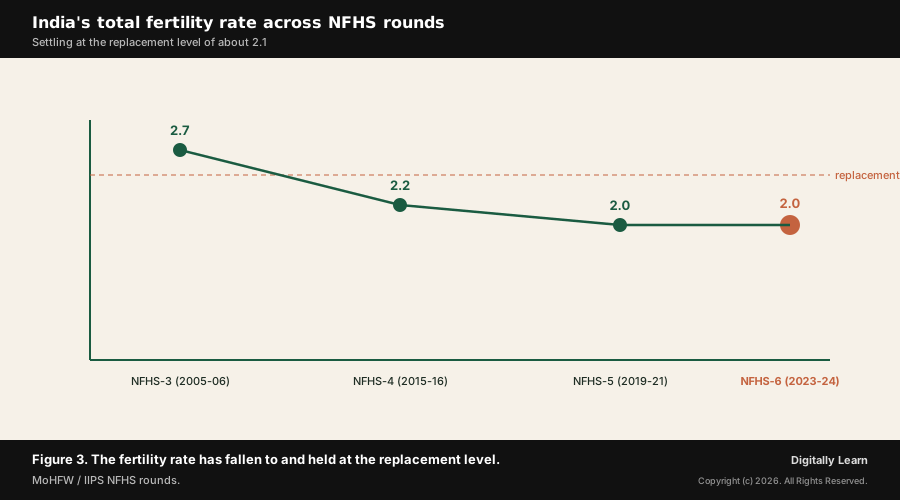
A total fertility rate of 2.0 confirms that India remains at, and just below, the replacement level of about 2.1. This means the population will keep growing for some decades through momentum, then stabilise, which reframes the policy debate from controlling numbers to managing an ageing transition.
The nutrition gains matter because stunting and wasting are lead indicators of long-term human capital. A fall in stunting from 35.5 to 29.3 per cent signals real progress, even as underweight prevalence barely moved, showing the work is unfinished.
The jump in women's internet use, from 33.3 to 64.3 per cent, is a marker of agency and access. It links health outcomes to digital and financial inclusion, since informed, connected women tend to use health services more.
What sets the NFHS apart as a data source
NFHS-6 against the previous round
The table sets selected NFHS-6 figures against the NFHS-5 baseline so the direction of change is visible at a glance, which is how UPSC tends to test survey data.
| Indicator | NFHS-5 (2019-21) | NFHS-6 (2023-24) |
|---|---|---|
| Total fertility rate | 2.0 | 2.0 (replacement level) |
| Contraceptive use (any method) | 66.7% | 69.1% |
| Institutional deliveries | 88.6% | 90.6% |
| Child stunting (under 5) | 35.5% | 29.3% |
| Severe wasting (under 5) | 7.7% | 5.2% |
| Women who ever used the internet | 33.3% | 64.3% |
Three features that make NFHS distinctive
Three design choices set the survey apart from other data sources:
- (i) District-level granularity. By covering 6.79 lakh households across 715 districts, NFHS reports indicators for every district, not just states, enabling targeted programme design.
- (ii) Broad thematic scope. One survey captures fertility, family planning, maternal and child health, nutrition, anaemia and the status of women, allowing cross-cutting analysis.
- (iii) Digital and financial inclusion data. Recent rounds added indicators on women’s internet use, bank-account ownership and mobile access, linking health to wider empowerment.
Observable outcomes the data will inform
Three trackable uses of the findings
The survey feeds directly into three streams of policy action over the coming years.
- (a) Programme targeting. Nutrition and maternal-health schemes such as POSHAN Abhiyaan, Anaemia Mukt Bharat and Janani Suraksha Yojana will be re-targeted using the new district figures.
- (b) Demographic planning. Replacement-level fertility shifts attention towards the ageing transition, the demographic dividend window and the future labour force.
- (c) District health rankings. The granular data updates district performance benchmarks, steering resources towards laggard districts under outcome-based frameworks.
Several indicators, including anaemia among women and children and the sex ratio at birth, must be read from the detailed fact sheets rather than the summary, since prevalence can shift between rounds even when headline numbers improve.
Population transition, ageing, and the data calendar
Fertility transition, ageing and the data calendar
NFHS-6 sits within a wider population-and-health policy arc. With the total fertility rate at replacement level, the debate is moving from population control to managing the demographic transition and the eventual rise in the elderly share.
It connects to the demographic dividend question: a young workforce yields gains only if it is healthy, educated and employable. NFHS health and nutrition indicators are the human-capital side of that equation.
The survey also links to the data calendar ahead. It complements the Sample Registration System and feeds into planning for the upcoming Census, while its district indicators map onto the Sustainable Development Goal health targets that India reports against.
UPSC relevance and exam focus
Where this fits in the UPSC-CSE syllabus
This topic maps to General Studies Paper I: population and associated issues and to General Studies Paper II: issues relating to the development and management of the social sector and services relating to health.
For Prelims, hold the high-yield facts: the release (29 May 2026), the nodal agency (IIPS Mumbai), the coverage (6.79 lakh households, 715 districts), the total fertility rate (2.0, at replacement), institutional deliveries (90.6 per cent), contraceptive use (69.1 per cent), and the stunting fall (35.5 to 29.3 per cent).
For Mains, two framings recur: how replacement-level fertility reshapes population policy towards the ageing transition, and how women's empowerment and education drive both fertility decline and better health outcomes.
Recurring linked concepts an aspirant should keep in working memory:
- Replacement-level fertility: a total fertility rate of about 2.1, at which a population replaces itself over the long run.
- Demographic dividend: the growth potential of a large working-age population, realised only with health, education and jobs.
- Key programmes: POSHAN Abhiyaan, Anaemia Mukt Bharat, Janani Suraksha Yojana, the National Population Policy 2000.
- Data system: NFHS, the Sample Registration System and the Census together form India’s population-and-health evidence base.
NFHS is conducted through the IIPS, Mumbai, not the National Sample Survey Office or the Registrar General of India. Mixing up the conducting agencies is a frequent error.
Do not read a replacement-level fertility rate as an immediate end to population growth. Population momentum means India's numbers will keep rising for some decades before stabilising.
Previous Year UPSC-CSE Questions By the end you will be able to draft model answers for the following UPSC questions. Each question carries a collapsible framework showing how to approach it in the exam.
- UPSC Prelims 2005Consider the following statements about India's population policy and fertility:
- India is the second country in the world to adopt a National Family Planning Programme.
- The National Population Policy, 2000 seeks to achieve replacement level of fertility by 2010 with a population of 111 crores.
- Kerala is the first State in India to achieve replacement level of fertility.
Which of the statements given above is/are correct?
How to approach this Prelims question
Approach: Validate each statement against the population-policy record.
Trap to watch: Statement 1 inverts the order: India was the FIRST country in the world to launch a national family planning programme, in 1952, not the second.
Key facts to recall:
- India launched the world's first national family planning programme in 1952.
- The National Population Policy 2000 targeted replacement-level fertility by 2010.
- Kerala (and Tamil Nadu) were among the first States to reach replacement-level fertility.
Answer signal: Statement 1 is false; statements 2 and 3 are correct. Correct answer: 2 and 3.
- UPSC Mains 2019 GS-I“Empowering women is the key to control population growth.” Discuss.
How to structure the answer in the exam
Introduction: Open with the established link: female education, autonomy and health access lower desired family size and raise contraceptive use.
Body (sub-themes to develop):
- Education and age at marriage: educated women marry later and have fewer children.
- Contraceptive access and agency: NFHS-6 shows contraceptive use rising to 69.1 per cent.
- Health and child survival: better maternal and child health lowers the felt need for more births.
- Digital and financial inclusion: NFHS-6 records women's internet use nearly doubling, widening access to information.
- Caveat: incomes, social norms and son-preference also shape fertility, so empowerment is necessary but not sufficient.
Conclusion: Conclude that empowering women is the most durable lever for stabilising population, complementing rather than replacing direct family-welfare services.
Sources and Further Reading
- Press Information Bureau: Union Health Ministry releases National Family Health Survey-6
- International Institute for Population Sciences: NFHS-6 (2023-24) portal
- IIPS: NFHS-6 (2023-24) National and State Fact Sheets
- Ministry of Health and Family Welfare: NFHS overview
- Press Information Bureau: Role of the National Family Health Survey
- Wikipedia: National Family Health Survey
Editorial Disclaimer
This article is compiled from the reference materials listed in the Sources section. It is an explainer for UPSC preparation and is not a substitute for primary documents (NCERTs, GoI ministry releases, IMD bulletins, RBI / CEA / MoEFCC publications, and Standing-Committee reports).


