


Overview
The Kovind committee and the 129th Amendment Bill
One Nation One Election proposes holding elections to the Lok Sabha and all State Legislative Assemblies together, an electoral reform weighed for cost and governance against concerns for federalism and accountability.
One Nation One Election (ONOE) is the proposal to hold elections to the Lok Sabha and all State Legislative Assemblies at the same time, rather than in the near-continuous cycle of separate state and national polls India now follows. The term covers a single, synchronised electoral calendar for the two tiers, and in its fuller form the eventual synchronisation of Municipality and Panchayat elections as well. India in fact held such simultaneous elections from the first general election of 1951-52 until 1967, after which premature dissolutions broke the cycle. The idea returned to the centre of debate with the High Level Committee chaired by former President Ram Nath Kovind, whose 2024 report led to the Constitution (129th Amendment) Bill, 2024, now before a Joint Parliamentary Committee.
What One Nation One Election Means: Synchronised Polls Across Tiers
Simultaneous elections to the Lok Sabha and the State Assemblies
One Nation One Election, often shortened to ONOE, is the proposal to hold elections to the Lok Sabha and to every State Legislative Assembly at the same time, on a single synchronised calendar. In its fuller design it would, in a second stage, also bring the Municipalities and Panchayats into the same cycle. The aim is to replace the present pattern, in which some election is almost always under way, with a single, periodic national exercise.
It helps to be precise about what the proposal is and is not. It does not mean a single ballot or a single all-India counting; voters would still cast separate votes for the Lok Sabha and for their state representative. Nor does it abolish state governments or merge the two tiers. It is a change to the timing of elections, so the country votes for both tiers together rather than in a rolling series of contests.
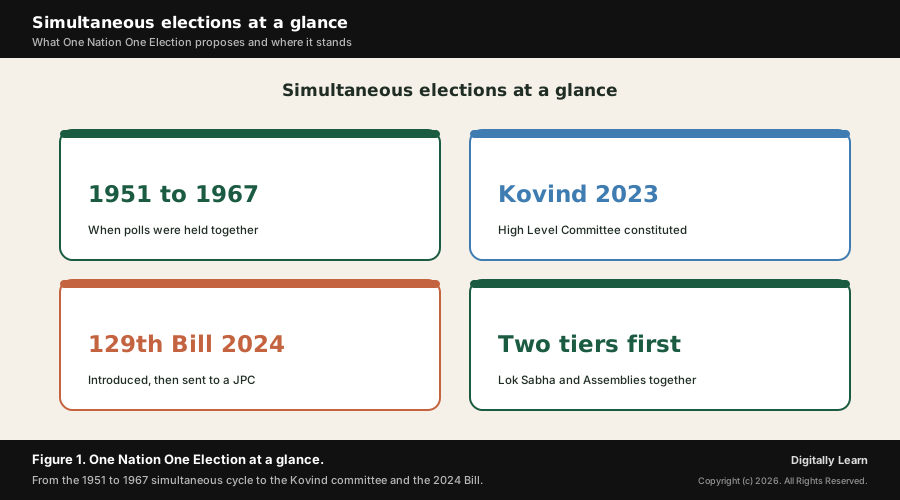
The reform therefore sits squarely within electoral reforms and the working of federal democracy. Because the duration of a House and the early dissolution of a legislature are fixed by the Constitution, synchronising the two tiers cannot be done by ordinary administrative order. It requires amendments to the Constitution and the careful handling of cases where a government falls before its term ends. The figure below sets out the headline facts.
Why One Nation One Election Is in the News: The Committee and the Bill
The Kovind committee report and the Constitution 129th Amendment Bill
Why it matters now is that the proposal has moved from idea to draft law. The Government constituted a High Level Committee on Simultaneous Elections under former President Ram Nath Kovind on 2 September 2023, and the committee submitted its report on 14 March 2024 after 191 days of work, a document running to 18,626 pages. The Union Cabinet accepted the committee's recommendations on 18 September 2024, giving the proposal formal political backing.
The reform then took legislative shape. The Constitution (129th Amendment) Bill, 2024 and an accompanying Union Territories Laws (Amendment) Bill, 2024 were introduced in the Lok Sabha on 17 December 2024 by the Minister of Law and Justice. On a recorded division the House voted 269 in favour of taking up the Bill and 198 against, short of the two-thirds support an amendment ultimately needs. The Bills were then referred to a Joint Parliamentary Committee for detailed examination.
The History: Why India Once Held Simultaneous Polls and How the Cycle Broke
Simultaneous elections from 1951-52 to 1967 and the break in the cycle
Simultaneous elections are not a new idea in India; they are how the country began. From the first general election of 1951-52, voters chose the Lok Sabha and their State Legislative Assemblies together, and this pattern held through the general elections of 1957, 1962 and 1967. For roughly a decade and a half, a single national vote renewed both tiers of the legislature at once, an arrangement that flowed naturally from terms that then ran in step.
The cycle broke later in the 1960s. Several State Legislative Assemblies were dissolved prematurely in 1968 and 1969, before their terms were complete, and the Lok Sabha itself was dissolved early in 1970. Once a legislature is dissolved ahead of time, its fresh election falls out of step and the synchrony is lost. The repeated use of Article 356, which allows the Union to place a state under President's Rule, deepened this drift over later decades.
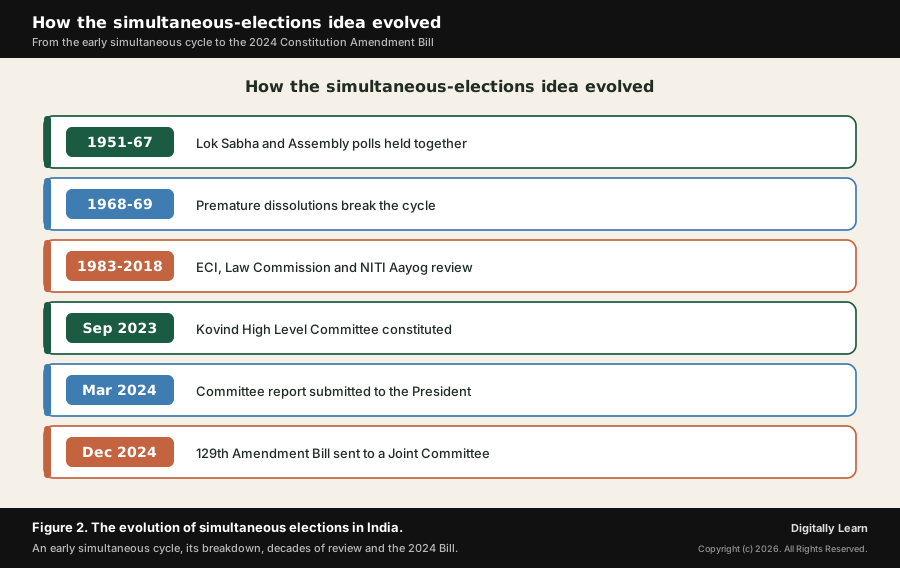
The result is the present pattern of near-continuous elections. With state terms no longer aligned, some Assembly election is almost always in progress somewhere, and the Lok Sabha and the states go to the polls on their own separate clocks. It is this drift away from the original simultaneous arrangement that the One Nation One Election proposal seeks to reverse. The timeline below traces the evolution of the idea.
| Period | What happened | Effect on the cycle |
|---|---|---|
| 1951-52 to 1967 | Lok Sabha and Assembly polls held together | A single simultaneous national cycle |
| 1968-69 | Several Assemblies dissolved before term | The synchronised cycle is broken |
| 1970 onward | Early Lok Sabha and Assembly elections recur | Polls fall out of step across states |
| 1983 to 2018 | ECI, Law Commission and NITI Aayog review | Repeated calls to return to simultaneity |
| 2023 to 2024 | Kovind committee and the 129th Amendment Bill | A concrete plan placed before Parliament |
Reading the rows together shows the arc: a synchronised start, a break caused by early dissolutions, decades of drift and review, and a recent effort to return to a single cycle through a constitutional amendment.
Earlier reviews by the Election Commission, the Law Commission and NITI Aayog
The proposal carries a long record of official review. The Election Commission of India raised the idea of returning to simultaneous polls as early as its First Annual Report of 1983. The Law Commission's 170th Report of 1999, on electoral reforms, recommended one election to the Lok Sabha and all Legislative Assemblies every five years, restoring the original rhythm. These early endorsements gave the idea a settled place in the reform debate.
The review continued into the present century. A Parliamentary Standing Committee, in its 79th Report of 2015, examined the feasibility of holding simultaneous elections and suggested a phased approach. NITI Aayog published a working paper on the subject in 2017, and the Law Commission returned to it with a draft report in 2018. This long chain of study, rather than any single proposal, is the institutional background against which the Kovind committee was set up.
The Kovind Committee and Its Recommendations on a Two-Step Rollout
The High Level Committee, the two-step plan and a single electoral roll
The High Level Committee on Simultaneous Elections, chaired by former President Ram Nath Kovind, was the most detailed examination of the question. Constituted in September 2023, it consulted political parties, experts and the public, received tens of thousands of responses, and submitted a report of 18,626 pages in March 2024. Of the political parties that responded, a majority supported a return to simultaneous elections, while several opposed it.
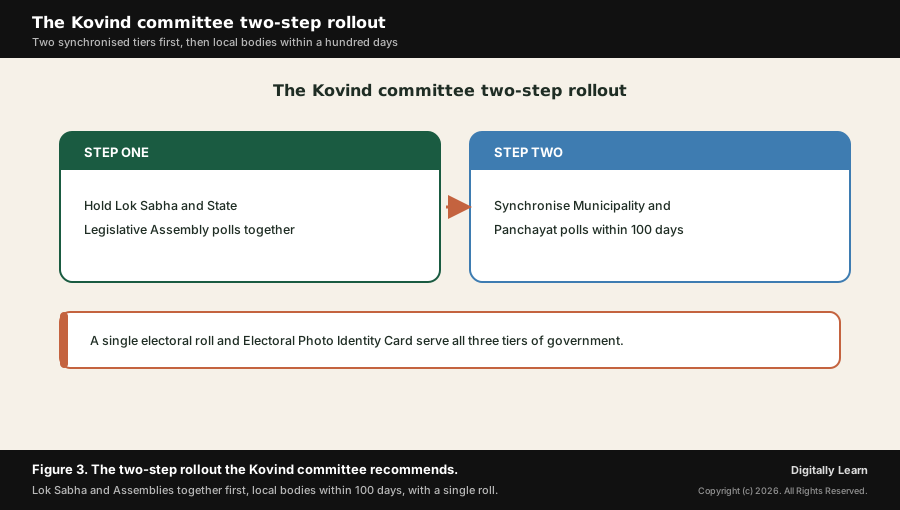
Its central proposal is a two-step rollout. In the first step, elections to the House of the People and the State Legislative Assemblies would be held together. In the second step, elections to the Municipalities and the Panchayats would be synchronised with them, so that the local-body polls are held within 100 days of the Lok Sabha and Assembly elections. The aim is to bring all three tiers onto one calendar in a sequenced way.
The committee added two supporting recommendations. It proposed a single electoral roll and a single Electoral Photo Identity Card for use across all three tiers, prepared by the Election Commission with state authorities, to end the duplication of separate rolls. To begin the new cycle, it suggested fixing an appointed date after a general election and aligning Assembly terms to it, with later mid-term polls running only for the remainder. The figure below sets out the plan.
The Constitutional Route: Articles, the Amendment Bills and Ratification
Articles 83, 85, 172, 174 and 356 and the new Article 82A
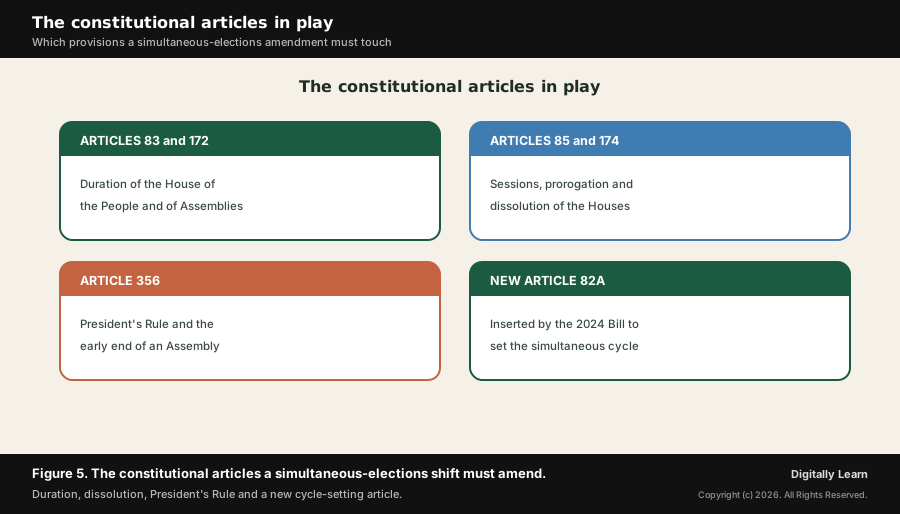
Synchronising the two tiers requires amending the Constitution, because the life of a legislature is fixed there. Articles 83 and 172 set the duration of the House of the People and of the State Legislative Assemblies at five years. Articles 85 and 174 govern the summoning, prorogation and dissolution of those Houses. Any plan that fixes a common election date, or shortens or extends a term to align it, must work through these provisions.
Article 356, which allows the Union to impose President's Rule and can trigger an early Assembly election, also has to be reconciled with a fixed cycle, since a government may fall mid-term. To address this, the Bill proposes to insert a new Article 82A to set the simultaneous cycle and the appointed date, and to adjust the duration and dissolution provisions so that an Assembly elected at a mid-term poll serves only the unexpired part of the cycle.
The local-body stage and the rolls add further requirements. Bringing Panchayats and Municipalities into the cycle and providing a single roll engage the parts of the Constitution on local government and elections, and the committee identified a new Article 324A and changes around Article 325 for these. Crucially, these amendments need ratification by the states, which makes the consent of state legislatures central to the whole exercise. The figure below sets out the articles in play.
Who decides: Parliament, the states, the Joint Committee and the Election Commission
The reform runs through a clear institutional architecture. Parliament is the prime mover: a constitutional amendment of this kind must pass each House by a special majority, that is a majority of the total membership and two-thirds of those present and voting, which is why the December 2024 division mattered. The Ministry of Law and Justice piloted the Bills, and the Joint Parliamentary Committee now examining them will hear views and report before the Houses take a final decision.
Two further actors are central. The states hold an effective veto over the local-body and single-roll changes, because those amendments require ratification by the legislatures of at least half the states, so the proposal cannot be completed by the Union alone. The Election Commission of India, the constitutional body that conducts elections, would carry the operational burden of a synchronised poll, from preparing a single roll to deploying the machines, staff and security a vast single-window election demands.
The Case in Favour: Cost, Continuity and Lighter Administrative Load
Lower cost, governance continuity and shorter Model Code periods
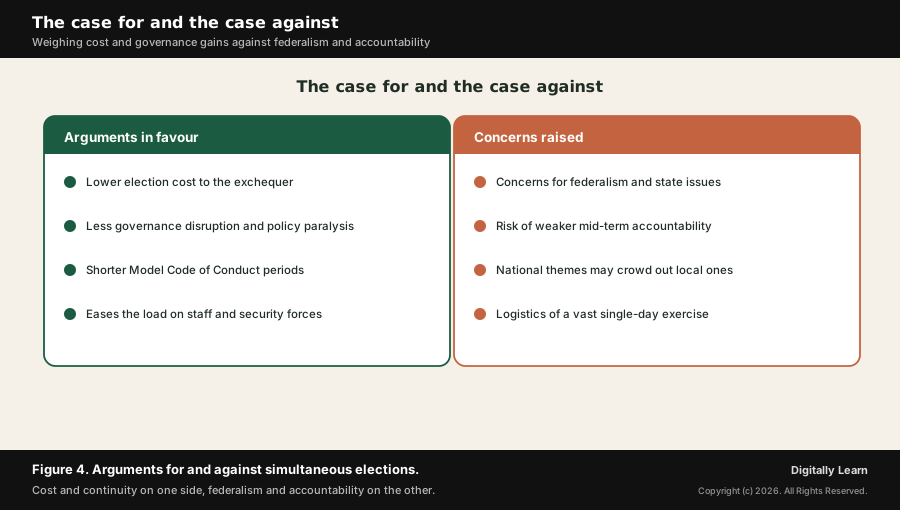
The first argument for simultaneous elections is cost. Holding a single combined election, rather than a long series of separate state and national polls, is expected to lower the recurring expense to the public exchequer and to the parties that contest. The committee treated the saving of the time and money now spent on near-continuous electioneering as one of the proposal's principal gains, a saving that recurs at every cycle.
The second argument is governance continuity. Whenever an election is announced, the Model Code of Conduct comes into force and remains until the count is complete, and during this period governments cannot launch new schemes. Because some election is almost always under way, this enforcement is frequent and prolonged, which critics say causes policy paralysis. Synchronising polls would confine the code to a single window, freeing the rest of the cycle for administration and welfare work.
A third set of arguments concerns the administrative load. Repeated elections tie up large numbers of government staff, teachers and security forces on election duty, and divert officials from regular work each time. A single combined poll would concentrate this effort, easing the strain on the administrative machinery. Supporters also argue that one well-publicised national election day could lift voter participation and reduce voter fatigue. The figure below sets the case for against the case against.
The Case Against: Federalism, Accountability and the Hung-House Problem
Concerns for federalism and the salience of state and local issues
The first concern is federalism. India's federal design gives states their own electoral mandate and their own five-year terms, and critics argue that forcing state polls onto the Union's calendar weakens that autonomy. There is also a worry about issue salience: when national and state elections are held together, the louder national campaign and national leaders may overshadow state and local questions, so that voters decide state contests on Union-level themes. This could blur the distinct accountability of state governments.
A second concern is the practical accountability a frequent election cycle provides. Regular state polls act as a steady check, letting voters pass verdict on their state government at many points across the national term. Critics fear that compressing all of this into one event every five years would reduce the moments at which a government must answer to the people, and so weaken the day-to-day accountability that India's staggered calendar now supplies.
There is also a structural objection on the working of the system. Smaller and regional parties worry that a single combined campaign, dominated by resources and national messaging, could disadvantage them against larger national parties. Together these arguments form the heart of the case against, and they are the reason the proposal is debated as a question of democratic design, not merely of administrative convenience.
The hung-house and mid-term dissolution problem
The hardest design problem is what happens when a government falls in the middle of the cycle. If a Lok Sabha or an Assembly is dissolved early, through a hung verdict, a successful no-confidence motion or a withdrawal of support, the simple model of one election every five years breaks down, because that House now needs a fresh poll out of turn. A workable scheme must answer this without quietly suspending democracy in the interim.
The proposed answer is that any mid-term election would fill only the unexpired portion of the cycle, so the new House serves the remainder and the country returns to a common date at the next full election. Critics question how often such short-term polls would occur and whether they undercut the savings the reform promises. The handling of hung houses, caretaker arrangements and frequent mid-term contests is central to whether the reform can work in practice.
Comparative Practice: How Other Democracies Hold Elections Together
Simultaneous and fixed-term elections in South Africa and Sweden
Several democracies hold elections for different tiers together, which the committee studied as comparative practice. In South Africa, voters elect the National Assembly and the legislatures of the nine provinces on the same day in a general election held at least every five years, using party-list proportional representation. The national and provincial mandates are renewed in a single exercise, a clear example of synchronised polls across two tiers.
Sweden offers a second model. Elections to the national Riksdag, to the county councils and to the municipal assemblies are held concurrently, on the second Sunday of September, on a fixed-term cycle. Holding all three levels together on a fixed date is close to the synchronised, calendar-based design the Indian proposal envisages.
Such comparisons must be read with care. Both countries use proportional systems and parliamentary forms that differ from India's first-past-the-post arrangement, yet they show that synchronised elections across tiers are workable. The way forward, in any case, turns less on foreign precedent than on resolving the federal and mid-term questions at home.
One Nation One Election in Context: Electoral Reforms and Federalism
How the proposal sits among India's wider electoral-reform debates
Contemporary linkages place One Nation One Election within a broader agenda of electoral reforms. It connects to the long-running push for a single electoral roll and shared voter identity, which the committee folded into its plan, and to debates on the cost of elections and the regulation of campaign finance. It also touches the role and independence of the Election Commission, the body that would have to deliver a synchronised national poll.
The proposal sits, above all, at the meeting point of federalism and the design of representative government. It engages the basic structure reasoning that protects free and fair elections and the federal character of the Constitution, and it raises the question of how far the Union may shape the electoral calendar of the states. These are the threads an aspirant should hold together when reading the topic:
- Electoral reforms: The wider agenda of cleaner, cheaper and better-run elections, of which simultaneous polls and a single roll are one strand.
- Federalism and Centre-state relations: The autonomy of states over their own electoral mandate, and the need for state ratification of key amendments.
- Model Code of Conduct: The Election Commission’s code that pauses new policy during polls, and the governance argument built on shortening it.
- Article 356 and President’s Rule: The provision whose use helped break the old cycle and which a fixed calendar must accommodate.
Taken together, these linkages show that One Nation One Election is not a narrow administrative change but a constitutional question that reaches into federalism, accountability and the everyday conduct of Indian democracy.
UPSC Relevance and Exam Focus
Where One Nation One Election fits in the UPSC-CSE syllabus
This topic maps most directly to General Studies Paper II: the Indian Constitution, its features and amendments, the structure and functioning of the Union and the states, and electoral reforms in the salient features of the Representation of the People framework. It also draws on federalism, Centre-state relations and the role of constitutional bodies such as the Election Commission.
For Prelims, hold the high-yield facts: India held simultaneous elections from 1951-52 to 1967; the cycle broke through premature dissolutions and the use of Article 356; the High Level Committee was chaired by Ram Nath Kovind and reported in 2024; the two-step rollout brings local bodies in within 100 days; and the key provisions are Articles 83, 85, 172, 174 and 356, with a new Article 82A proposed by the 129th Amendment Bill.
For Mains, the recurring framing is to weigh the arguments: the gains in cost, governance continuity and administrative load against the concerns for federalism, accountability and the salience of state issues, with the hung-house problem as the central design test. A strong answer treats the reform as a question of democratic design rather than convenience, uses the constitutional and comparative material, and reaches a balanced judgment.
Recurring linked concepts an aspirant should keep in working memory:
- Simultaneous elections and the appointed date: The mechanism of one synchronised cycle for the Lok Sabha and the Assemblies, begun from a fixed date.
- Federalism and state ratification: The requirement that states ratify key amendments, and the autonomy questions the reform raises.
- Model Code of Conduct and policy paralysis: The governance argument that frequent, prolonged code periods disrupt administration.
- Article 356 and mid-term polls: The handling of President’s Rule, hung houses and elections for the unexpired part of a term.
A common Prelims trap is to assume simultaneous elections mean a single ballot or a single counting day; hold instead that voters cast separate votes for the two tiers and that the reform changes the timing, and remember the original 1951 to 1967 cycle.
A common Mains trap is to treat the topic as a one-sided efficiency gain. Its exam value lies in a balanced judgment: the genuine savings in cost and governance time set honestly against the federalism and accountability concerns, the design problem of mid-term dissolutions, and the need for state consent through ratification.
Previous Year UPSC-CSE Questions By the end you will be able to draft model answers for the following UPSC questions. Each question carries a collapsible framework showing how to approach it in the exam.
- UPSC Mains 2017 GS-IIDiscuss how simultaneous elections would limit the time and money spent on electioneering while also reducing the government's accountability to the people.
How to structure the answer in the exam
Body (sub-themes to develop):
- The savings case: lower recurring cost to the exchequer and to parties, less time lost to near-continuous electioneering, shorter Model Code of Conduct periods that reduce policy paralysis, and a lighter load on staff and security forces.
- The accountability concern: fewer moments at which voters can pass verdict on a government across the national term, and the risk that one combined event every five years weakens the day-to-day responsiveness that staggered state polls now provide.
- The federalism dimension: the autonomy of states over their own electoral mandate, the need for state ratification of key amendments, and the worry that national themes and leaders overshadow state and local issues.
- The design problem: how hung houses and mid-term dissolutions are handled, with elections for the unexpired part of a term, and whether this preserves both synchrony and democratic choice.
- A managed middle path: phased rollout, a single electoral roll, clear caretaker rules and safeguards for state and local issue salience, so the savings are captured without hollowing out accountability.
Sources and Further Reading
- Press Information Bureau: High Level Committee submits its report on One Nation, One Election
- Press Information Bureau: Cabinet accepts recommendations of the High-Level Committee on Simultaneous Elections
- One Nation One Election: Report of the High Level Committee on Simultaneous Elections
- Ministry of Law and Justice, Legislative Department: Annual Report 2023-2024
- Law Commission of India: Electoral Reforms and the 170th Report on simultaneous elections
- Election Commission of India: Model Code of Conduct
- Press Information Bureau: One Nation, One Election overview note
- Wikipedia: One Nation, One Election
Editorial Disclaimer
This briefing is for UPSC preparation. Verify the facts and provisions against the official PIB, the Election Commission and the report of the High Level Committee on Simultaneous Elections before relying on them.
