


Overview
NCRB 2024 and Section 80 BNS
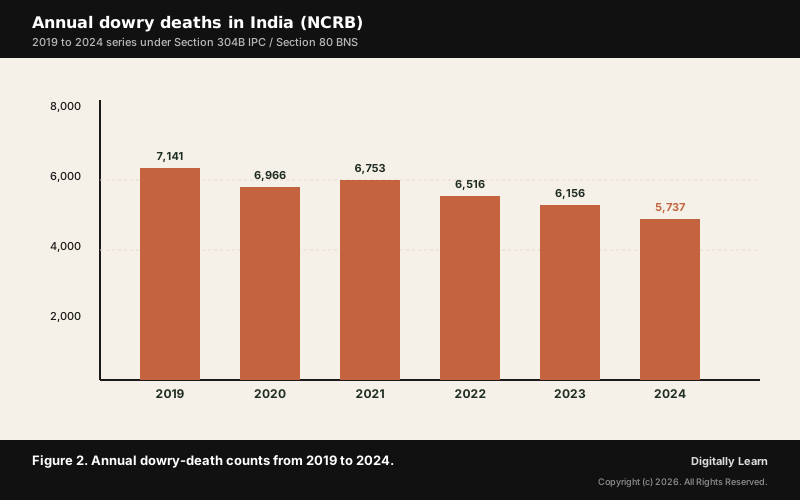
NCRB Crime in India 2024 records 5,737 dowry deaths while convictions stay near one in six; Section 80 BNS continues Section 304B.
A dowry death is defined in Section 80 of the Bharatiya Nyaya Sanhita, 2023 (which replaced Section 304B of the Indian Penal Code, 1860) as the death of a woman caused by burns, bodily injury, or otherwise than under normal circumstances within seven years of her marriage, where it is shown that soon before her death she was subjected to cruelty or harassment by her husband or any relative of her husband for, or in connection with, any demand for dowry.
Why this is in the news on 21 May 2026
The NCRB Crime-in-India 2024 release and the Greater Noida case
On 20 May 2026, the latest National Crime Records Bureau (NCRB) Crime in India 2024 report (released on 6 May 2026) and the Accidental Deaths and Suicides in India (ADSI) 2024 report returned to public attention after a fresh dowry-death case from Greater Noida. The 2024 data set is the first published under the post-Bharatiya Nyaya Sanhita reporting framework.
The Greater Noida case is that of Deepika Nagar, a 24-year-old woman married on 11 December 2024 who died on 17 May 2026 after falling from the roof of her matrimonial home. The family alleges roughly 17 months of cumulative dowry harassment, including demands for a vehicle and cash, by her husband and in-laws. Four accused, including the husband, his parents, and an uncle, were arrested over 18 to 20 May 2026.
Definition: A dowry death is defined in Section 80 of the Bharatiya Nyaya Sanhita, 2023 (which replaced Section 304B of the Indian Penal Code, 1860) as the death of a woman caused by burns, bodily injury, or otherwise than under normal circumstances within seven years of her marriage, where it is shown that soon before her death she was subjected to cruelty or harassment for, or in connection with, any demand for dowry.
Three headline data points define the 2024 release:
- (i) 5,737 dowry deaths registered under Section 304B IPC (now Section 80 BNS) in 2024, an average of 15-16 deaths per day.
- (ii) 1,693 dowry-related suicides recorded in the ADSI 2024 dataset, a 6.7 per cent rise over the 1,587 cases reported in 2023.
- (iii) Persistent under-reporting documented in field studies that reclassify accidental burns and kitchen-stove deaths as accidental rather than dowry-linked, suggesting the headline figure understates the real magnitude.
Why dowry deaths remain a structural problem six decades after the 1961 Act
Why the 5,500-7,000 dowry-death band has held since the 1961 Act
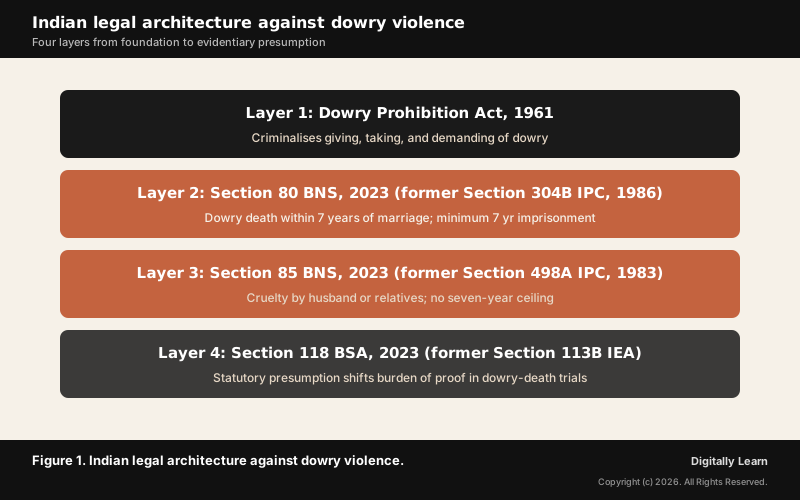
Why it matters: The headline of 5,737 dowry deaths in 2024 sits against a legal architecture that has been progressively tightened over six decades, from the Dowry Prohibition Act, 1961 through the 1983 introduction of Section 498A IPC (cruelty) and the 1986 introduction of Section 304B IPC (dowry death), to the 2023 BNS recodification.
Despite the layered architecture, the annual death count has not fallen below the 5,500-7,000 band since the early 2000s, indicating a structural ceiling that legislation alone has not broken. The persistence is driven by patrilocal residence after marriage, kin-network protection of perpetrators, and weak conviction rates that erode deterrence.
The 2024 release also matters because it is the first NCRB report under the new Bharatiya Nyaya Sanhita 2023 reporting architecture. The cross-walk between Section 304B IPC and Section 80 BNS is reported alongside cumulative IPC totals so the time series remains comparable.
Significance of the data for the women-safety policy frame
What the NCRB 2024 release means for the women-safety policy frame
What is the significance of this issue: The 2024 NCRB release carries three significances for the women-safety policy frame:
- (i) Legislative-recodification significance. The transition from Section 304B IPC to Section 80 BNS preserves the seven-year-of-marriage trigger and the presumption-of-dowry-death rule under Section 113B of the Indian Evidence Act (now Section 118 of the Bharatiya Sakshya Adhiniyam, 2023). The 2023 codes are continuity, not rupture.
- (ii) Conviction-rate significance. The conviction rate in dowry-death cases has hovered in the 11 to 17 per cent band in the NCRB series, roughly one conviction in six, far below the all-crime average. Conviction-rate weakness rather than reporting weakness is the binding constraint on deterrence.
- (iii) Reporting-architecture significance. Dowry-related suicides (ADSI 1,693 cases) and Section 498A cruelty cases (running above 130,000 annually) frame the broader continuum of dowry violence within which the 5,737 deaths sit. Dowry death is the visible tip of a much larger structural violence.
Structural reading: Field studies show that dowry violence intensifies in the first 18-24 months of marriage, peaking around the third dowry demand cycle. The Greater Noida case at 17 months after marriage sits inside this empirical window, making the case-event timing diagnostic rather than anecdotal.
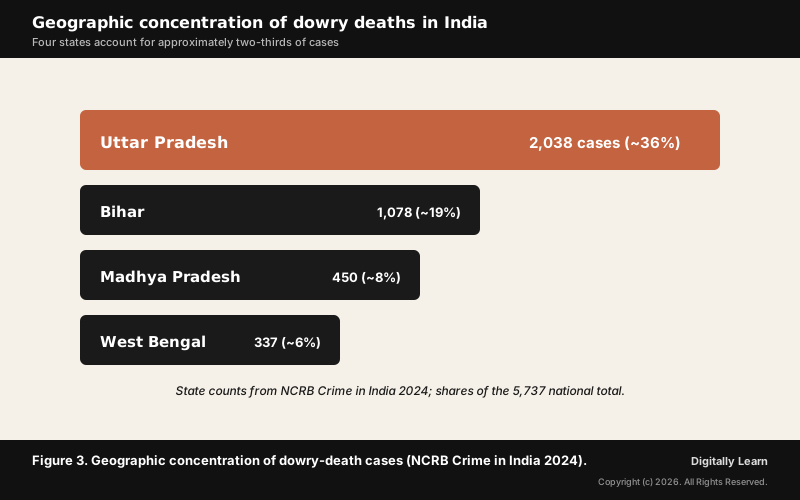
Cross-state variance is wide. In the 2024 data, Uttar Pradesh reported about 2,038 cases and Bihar about 1,078 cases, so the two states alone account for over half the national total. Adding Madhya Pradesh (about 450) and West Bengal (about 337) takes the share toward two-thirds, with the Hindi heartland and eastern states over-represented relative to their share of the female population.
Distinguishing features of the legal architecture
The three statutory and evidentiary pillars against dowry violence
Distinguishing features: The Indian legal architecture against dowry violence rests on three statutory and evidentiary pillars:
- (i) Dowry Prohibition Act, 1961 (DPA): criminalises the giving and taking of dowry under Section 3 (minimum five years imprisonment plus fine of fifteen thousand rupees or value of dowry, whichever is higher) and the demanding of dowry under Section 4 (six months to two years imprisonment plus fine up to ten thousand rupees). Defines dowry as property or valuable security given or agreed to be given in connection with marriage.
- (ii) Section 80 BNS, 2023 (formerly Section 304B IPC): dowry death within seven years of marriage; triggers the statutory presumption of culpability under Section 118 of the Bharatiya Sakshya Adhiniyam, 2023 (formerly Section 113B Indian Evidence Act).
- (iii) Section 85 BNS, 2023 (formerly Section 498A IPC): cruelty by husband or relatives of husband, including cruelty for dowry. Companion provision with no seven-year ceiling, and it is the most-invoked provision of the cluster.
Dowry death data and the legal architecture in numbers
| Dowry data indicator | Detail | Significance |
|---|---|---|
| Reporting authority | National Crime Records Bureau, Ministry of Home Affairs | Custodian of crime and ADSI statistics |
| Headline figure 2024 | 5,737 dowry deaths under Section 304B IPC / Section 80 BNS | Approximately 15-16 per day |
| Suicide-related | 1,693 dowry-related suicides in ADSI 2024 | Up 6.7 per cent from 1,587 in 2023 |
| Statutory trigger window | Within 7 years of marriage | Beyond 7 years: only Section 85 BNS (cruelty) and DPA apply |
| Evidentiary presumption | Section 118 Bharatiya Sakshya Adhiniyam, 2023 (former Section 113B IEA) | Shifts burden of proof to the accused on dowry death |
| Foundational statute | Dowry Prohibition Act, 1961 | Criminalises giving, taking, and demanding of dowry |
| Cruelty companion | Section 85 BNS, 2023 (former Section 498A IPC) | No seven-year ceiling; most-invoked provision |
| Conviction rate | Approximately 11 to 17 per cent (NCRB series) | Roughly one conviction in six; weak deterrence |
| Geographic concentration | Uttar Pradesh (2,038), Bihar (1,078), Madhya Pradesh (450), West Bengal (337) in 2024 | Top two states alone exceed half the national total |
Observable outcomes to track over the next four reporting cycles
What to watch on conviction rates and the Section 80 BNS rollout
Observable outcomes: Six outcomes frame the trajectory of dowry-death prevalence and deterrence between 2024 and 2030:
- (a) Annual NCRB count under Section 80 BNS. Whether the 5,500-7,000 band that has held since the early 2000s breaks below 5,000 over the next four reporting cycles.
- (b) Conviction-rate trajectory. Whether the 11 to 17 per cent conviction rate (roughly one in six) improves with the Bharatiya Nagarik Suraksha Sanhita, 2023 timeline reforms (mandatory framing of charges within 60 days, judgment within 30 days of trial completion).
- (c) Section 85 BNS / 498A invocation patterns. Trends in case load, withdrawal rates, and conviction rates under the cruelty companion provision.
- (d) State-level variance. Whether the Hindi heartland and eastern-state over-representation persists or compresses under state-level women-safety interventions.
- (e) Reporting accuracy. Whether the gap between NCRB headline figures and field-study estimates of misclassified accidental deaths narrows under the Sample Registration System and Crime Multipurpose Statistical System upgrades.
- (f) Dowry-prevalence surveys. Whether National Family Health Survey rounds NFHS-6 onwards include direct dowry-prevalence questions to triangulate the NCRB death series.
Three threads connecting the data to wider women-safety policy
Suicide-rise, gender-justice constitutionalism, and reporting-accuracy
Contemporary linkages: Three threads connect the NCRB 2024 release to the wider women-safety policy frame.
The first is the rising-suicide-among-young-women linkage. The ADSI 2024 rise of dowry-related suicides (1,587 to 1,693, up 6.7 per cent year-on-year) sits within the broader National Mental Health Survey finding of elevated suicide risk among married women aged 18-29. The 2023 GS-I Mains question on this theme is now testably current.
The second is the gender-justice constitutionalism linkage. Article 15(3) permits special provisions for women, Article 39(a) directs equal right to means of livelihood, and the Vishaka guidelines (1997) extended judicial reach into workplace harassment. The 2023 GS-II Mains question on constitutional perspectives of gender justice is the direct examination surface.
The third is the reporting-architecture linkage. The transition from Indian Penal Code 1860 to Bharatiya Nyaya Sanhita 2023 required a cross-walk between Section 304B and Section 80 for the time series to remain comparable. The cross-walk is the basis for any policy claim of progress or regress over 2023-2024.
UPSC Relevance
Where dowry deaths sit in the UPSC syllabus
UPSC context: Dowry deaths fall principally under General Studies Paper I on role of women and women's organization and issues related to women. The legislative-architecture dimension brings General Studies Paper II on welfare schemes for vulnerable sections, and the policy-effectiveness dimension touches the National Commission for Women mandate.
Prelims relevance: The Prelims surface includes the Dowry Prohibition Act, 1961, the Section 304B insertion of 1986 (now Section 80 BNS), the Section 498A insertion of 1983 (now Section 85 BNS), the Section 113B IEA evidentiary presumption (now Section 118 BSA), and the NCRB Crime in India and ADSI annual datasets.
Mains relevance: Three framings dominate the Mains-paper surface:
- (i) Why-suicide-among-young-women-is-rising framing. The ADSI 2024 rise in dowry-related suicides (6.7 per cent year-on-year) is direct empirical material for the 2023 GS-I question on rising suicide among young women.
- (ii) Constitutional-perspectives-of-gender-justice framing. Article 15(3), Article 39(a), Vishaka guidelines (1997), the National Commission for Women, and the BNS-recodification together compose the constitutional-and-statutory architecture the 2023 GS-II question asks for.
- (iii) Patriarchy-interventions-beyond-education framing. Conviction-rate weakness, kin-network protection of perpetrators, and the post-7-year visibility cliff are the structural interventions the 2021 GS-II question on patriarchy asks for.
Mains practice question: A focused fifteen-mark question would read: Six decades after the Dowry Prohibition Act, 1961 and four decades after Section 498A of the Indian Penal Code, the annual dowry-death count in India has not fallen below 5,500. Examine the structural reasons for the legislative ceiling and discuss policy interventions beyond statute.
A well-constructed answer would treat the statutory layering (1961, 1983, 1986, 2023), the conviction-rate weakness (11 to 17 per cent), and the kin-network and patrilocality structural drivers as three failure-mode pillars. The intervention list can cover witness protection, fast-track courts, dowry-prevalence surveys, and the National Commission for Women constitutionalisation question.
- Past Mains linkage. 2023 GS-I: Explain why suicide among young women is increasing in Indian society. The ADSI 2024 rise in dowry-related suicides (1,587 to 1,693 cases, up 6.7 per cent year-on-year) is direct empirical material for any answer to this question.
- Past Mains linkage. 2021 GS-II: “Though women in post-Independent India have excelled in various fields, the social attitude towards women and feminist movement has been patriarchal.” Apart from women education and women empowerment schemes, what interventions can help change this milieu? Conviction-rate weakness, patrilocality, and post-7-year visibility cliff are the structural intervention surface the question asks for.
- Related linkage. 2023 GS-II Q12 on constitutional perspectives of gender justice and Articles 15(3) and 39(a) frames the statute discussion.
Previous Year UPSC-CSE Questions By the end you will be able to draft model answers for the following UPSC questions. Each question carries a collapsible framework showing how to approach it in the exam.
- UPSC Mains 2023 GS-IExplain why suicide among young women is increasing in Indian society.
How to structure the answer in the exam
Introduction: Open with the ADSI 2024 dowry-related-suicide figure of 1,693 cases (6.7 per cent rise over 2023), name the National Mental Health Survey finding of elevated suicide risk among married women aged 18-29, and frame the explanation through four structural drivers.
Body (sub-themes to develop):
- Post-marriage and dowry-related stress: the patrilocal-residence trap, kin-network harassment cycles in the first 18-24 months of marriage, the 1,693 ADSI 2024 dowry-related suicide figure, the 5,737 NCRB 2024 dowry-death figure as the visible-tip indicator.
- Economic-stress drivers: gender-wage-gap and the lower female labour-force participation rate; the dowry-system itself as an economic-stress driver on the bride's natal family and a status-threat driver on the marital family.
- Mental-health-services gap: under-recognition of perinatal and post-partum depression; the gap between the Mental Healthcare Act, 2017 framework and on-the-ground availability of district mental-hospital capacity.
- Aspirational-pressure dimension: social-media exposure, education-employment mismatch, the rising-expectation-falling-realisation gap that the National Mental Health Survey identifies.
- Policy intervention surface: National Commission for Women, Beti Bachao Beti Padhao, One Stop Centres for women, fast-track courts, the Bharatiya Nagarik Suraksha Sanhita 2023 timeline reforms, district mental-hospital capacity additions.
Conclusion: Conclude that the rising-trend explanation runs through four structural channels (dowry-related and patrilocal stress, economic stress, mental-health-services gap, aspirational pressure), that the ADSI 2024 dowry-related-suicide figure of 1,693 cases makes the trend testably current, and that policy interventions need a four-pillar combined response.
The ADSI 2024 dowry-related-suicide figure of 1,693 cases (a 6.7 per cent rise over 2023) is direct empirical material for the rising-trend claim the 2023 GS-I question asks examinees to explain. The body sub-theme on post-marriage and dowry-related stress supplies the leading structural channel.
- UPSC Mains 2021 GS-II“Though women in post-Independent India have excelled in various fields, the social attitude towards women and feminist movement has been patriarchal.” Apart from women education and women empowerment schemes, what interventions can help change this milieu?
How to structure the answer in the exam
Introduction: Open with the 5,737 dowry-death figure of 2024 and the 11 to 17 per cent conviction-rate floor (roughly one in six) as the empirical evidence of persistent patriarchy, and frame the answer through four intervention buckets beyond the education-and-empowerment-scheme surface.
Body (sub-themes to develop):
- Statutory-deterrence intervention: Bharatiya Nagarik Suraksha Sanhita 2023 timeline reforms (charge-framing within 60 days, judgment within 30 days of trial completion); fast-track courts under Section 304B / Section 80 BNS; witness-protection scheme for dowry-death prosecution witnesses.
- Reporting-architecture intervention: NCRB cross-walk between Section 304B IPC and Section 80 BNS for time-series comparability; National Family Health Survey rounds adding direct dowry-prevalence questions; Sample Registration System upgrades to capture cause-of-death misclassification.
- Male-engagement and behaviour-change communication: targeted programmes engaging fathers and brothers of the dowry-receiving family; school-curriculum interventions on equal-rights education; the Beti Bachao Beti Padhao messaging extension to dowry-rejection.
- Financial and economic agency: independent bank accounts for married women under Jan Dhan Yojana extensions; property co-titling under the Hindu Succession (Amendment) Act, 2005; female-headed enterprise credit lines under Mudra and Stand-Up India.
- Constitutional basis: Article 15(3) on special provisions for women; Article 39(a) on equal right to means of livelihood; National Commission for Women constitutionalisation question (2020 GS-II linkage).
Conclusion: Conclude that intervention beyond education and empowerment schemes runs through four pillars (statutory deterrence, reporting architecture, male engagement, and financial-economic agency), that the 5,737 dowry-death figure of 2024 and the 11 to 17 per cent conviction rate are the binding evidence of persistent patriarchy, and that constitutional grounding through Article 15(3) and Article 39(a) frames the intervention design.
The 5,737 dowry-death figure of 2024 and the 11 to 17 per cent conviction rate (roughly one in six) are the binding empirical evidence the 2021 GS-II question asks examinees to translate into intervention buckets beyond the education-and-empowerment surface. The body sub-theme on statutory deterrence (BNS / BNSS reform) is the leading intervention pillar.
Sources
- National Crime Records Bureau: Crime in India 2024 report
- National Crime Records Bureau: Accidental Deaths and Suicides in India (ADSI) 2024
- Bharatiya Nyaya Sanhita, 2023 (gazette text)
- Dowry Prohibition Act, 1961 (consolidated text)
- Bharatiya Sakshya Adhiniyam, 2023 (gazette text)
- Lok Sabha unstarred question on dowry deaths: state-wise breakdown 2019-2023
- Wikipedia: Dowry death
- Press Information Bureau: NCRB Crime in India release
- Ministry of Women and Child Development: dowry-prevention programmes
- National Commission for Women: statutory mandate
Editorial Disclaimer
This article is compiled from the reference materials listed in the Sources section. It is an explainer for UPSC preparation and is not a substitute for primary documents (NCERTs, GoI ministry releases, IMD bulletins, RBI / CEA / MoEFCC publications, and Standing-Committee reports).


