


Overview
Forest cover in India
Forest cover in India is about 7,15,343 sq km, 21.76 per cent of the country's area, according to the India State of Forest Report 2023 (ISFR 2023) of the Forest Survey of India, released on 21 December 2024. With tree cover of 3.41 per cent, forest and tree cover together reach 25.17 per cent. The report, published every two years since 1987, also measures mangroves, bamboo, growing stock, forest fires and the carbon stored in India's forests.
ISFR 2023 Report: What the India State of Forest Report Measures
India State of Forest Report 2023: Who Prepares It and How
The India State of Forest Report is prepared every two years by the Forest Survey of India (FSI), a body under the Ministry of Environment, Forest and Climate Change. The first report came out in 1987, and ISFR 2023, the 18th, was released by Union Minister Bhupender Yadav at the Forest Research Institute, Dehradun, on 21 December 2024.
- Satellite mapping: Forest cover is mapped wall to wall from the LISS‑III sensor of ISRO's Resourcesat satellites, at 23.5 m resolution and a scale of 1:50,000, using images from October to December 2021 (with extra images to April 2022 for the north-east, the coast and the Andaman and Nicobar Islands).
- Field inventory: The National Forest Inventory lays about 6,000 sample plots in forests and 10,000 outside them every year on a 5 km grid, and gives growing stock, tree cover and carbon.
- Two volumes: Volume I gives the national picture; Volume II gives each State and UT down to district and forest division, for 751 districts against 636 in 2021.
The data feed India's reports on its climate targets, its greenhouse gas inventory for forest land to the United Nations Framework Convention on Climate Change (UNFCCC), and India's figures in the Global Forest Resources Assessment of the Food and Agriculture Organization (FAO). The 2023 report added burnt-area mapping for the whole country, fire data for 705 protected areas, trees of 5 to 10 cm in tree cover, and bamboo in tree cover for the first time.
Forest Cover, Tree Cover and Recorded Forest Area Defined
Forest cover is all land of one hectare or more with a tree canopy density of 10 per cent or more, whatever its ownership, legal status or land use. It need not be a recorded forest, and it includes orchards, bamboo and palm. Satellites cannot tell the legal status of a tree-covered patch, so the report counts what it sees. Forest cover is divided by canopy density into very dense, moderately dense and open forest, while scrub, with a canopy below 10 per cent, is not counted. Tree cover is made up of tree patches under one hectare and isolated trees outside recorded forest areas.
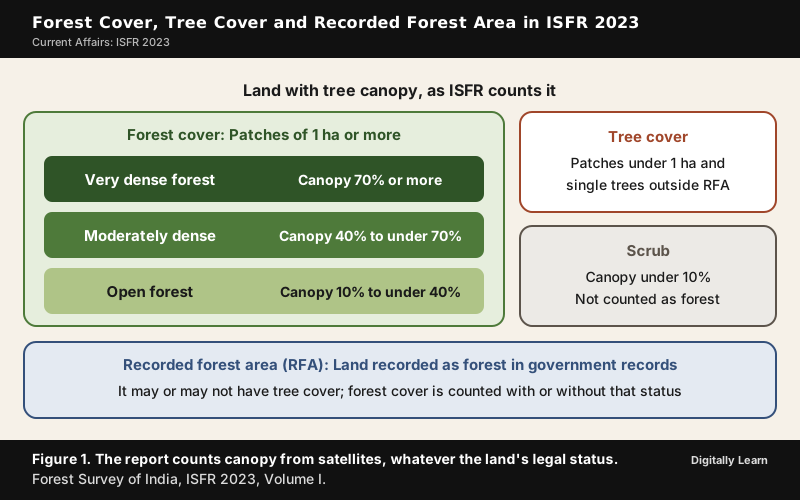
Recorded forest area is land recorded as forest in government records, mainly Reserved and Protected Forests under the Indian Forest Act, 1927, plus unclassed and village forests. It may or may not have trees, and can include pastures, deserts, rivers and snow-clad land. India's recorded forest area is 7,75,377 sq km, 23.59 per cent of its geographical area.
Forest Cover in India: The ISFR 2023 Numbers
Total Forest Cover in India and the Change Since 2021
India's forest cover in ISFR 2023 is about 7,15,343 sq km, 21.76 per cent of its geographical area, and its tree cover about 1,12,014 sq km, 3.41 per cent. Together, forest and tree cover is about 8,27,357 sq km, or 25.17 per cent of the country. Scrub covers another 43,623 sq km, 1.33 per cent.
| Measure | 2021 | 2023 | Change |
|---|---|---|---|
| Forest cover inside recorded forests (sq km) | 5,20,358.04 | 5,20,365.32 | +7.28 |
| Forest cover outside recorded forests (sq km) | 1,94,828.16 | 1,94,977.29 | +149.13 |
| Total forest cover (sq km) | 7,15,186.20 | 7,15,342.61 | +156.41 |
| Tree cover (sq km) | 1,10,724.94 | 1,12,014.34 | +1,289.40 |
| Forest and tree cover (sq km) | 8,25,911.14 | 8,27,356.95 | +1,445.81 |
Most of the gain since 2021 was tree cover. Of about 1,446 sq km added, only about 156 sq km was forest cover, and almost all of that lay outside recorded forests. Over the decade from 2013, forest cover grew by about 16,630 sq km, of which only about 440 sq km was inside recorded forests, and tree cover grew by about 20,747 sq km.
Forest Cover in India State-Wise: Largest, Highest Share and Losses
By area, Madhya Pradesh has the largest forest cover, 77,073 sq km, followed by Arunachal Pradesh (65,882 sq km) and Chhattisgarh (55,812 sq km). By share of area, Lakshadweep leads with 91.33 per cent forest cover, followed by Mizoram (85.34 per cent) and the Andaman and Nicobar Islands (81.62 per cent).
- Above one-third: Forest cover exceeds 33 per cent of the area in 19 States and UTs, and in eight of them, Mizoram, Lakshadweep, the Andaman and Nicobar Islands, Arunachal Pradesh, Nagaland, Meghalaya, Tripura and Manipur, it exceeds 75 per cent.
- Largest forest and tree cover: Madhya Pradesh (85,724 sq km), Arunachal Pradesh (67,083 sq km) and Maharashtra (65,383 sq km).
- Biggest gains in forest and tree cover: Chhattisgarh (683.62 sq km), Uttar Pradesh (559.19 sq km), Odisha (558.57 sq km) and Rajasthan (394.46 sq km).
- Biggest gains in forest cover alone: Mizoram (241.73 sq km), Gujarat (180.07 sq km) and Odisha (151.89 sq km).
- Biggest losses in forest and tree cover: Madhya Pradesh (612.41 sq km), Karnataka (459.36 sq km), Ladakh (159.26 sq km) and Nagaland (125.22 sq km).
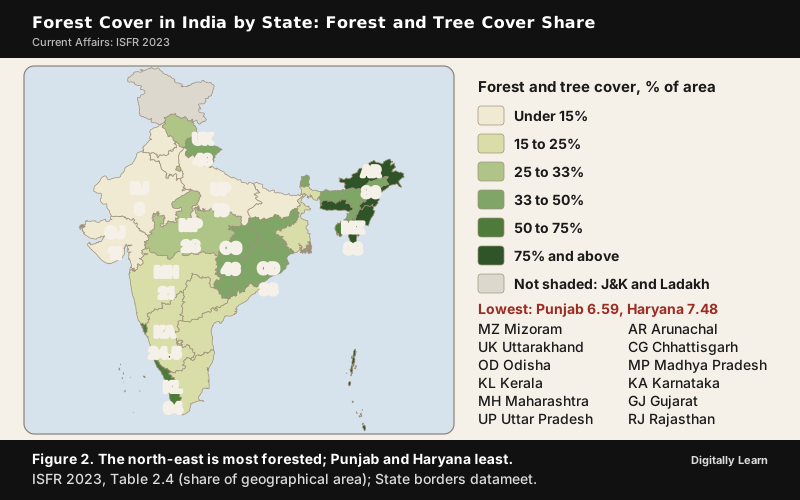
The north-eastern States have forest and tree cover on 67 per cent of their area, but they lost 327.30 sq km of forest cover since 2021. Hill districts have 40 per cent of their area under forest cover and gained 234.14 sq km. In the Western Ghats Eco-Sensitive Area, forest cover fell by 58.22 sq km over ten years, even as very dense forest grew by 3,465.12 sq km.
Mangrove Cover, Bamboo, Growing Stock and Forest Fires in ISFR 2023
Mangroves, Bamboo, Wood Stock and Forest Fire Hotspots
India's mangrove cover is 4,991.68 sq km, 0.15 per cent of its area. Very dense mangroves make up 1,463.97 sq km (29.33 per cent), moderately dense 1,500.84 sq km (30.07 per cent) and open mangroves 2,026.87 sq km (40.60 per cent). The total fell by 7.43 sq km since 2021, with Gujarat losing 36.39 sq km and Andhra Pradesh (13.01 sq km) and Maharashtra (12.39 sq km) gaining most.
- Bamboo: 1,54,670 sq km of bamboo-bearing area, up 5,227 sq km; Madhya Pradesh has the most (20,421 sq km), and Arunachal Pradesh gained most (2,685 sq km).
- Growing stock: 6,429.64 million cubic metres of wood, 4,478.89 inside forests and 1,950.75 outside, up 262.32 million (4.25 per cent); 86.10 cubic metres per hectare in forests. Sal (Shorea robusta) makes up the largest share of growing stock inside forests, and mango outside them.
- Agroforestry: Tree cover on farms of 1,27,590.05 sq km, up 21,286.57 sq km (20.02 per cent) since 2013.
- Timber from trees outside forests: A potential 91.51 million cubic metres of industrial wood a year.
The Visible Infrared Imaging Radiometer Suite (VIIRS) sensor on the Suomi National Polar-orbiting Partnership (SNPP) satellite detected 2,03,544 forest fire hotspots in the 2023‑24 fire season, against 2,23,333 in 2021‑22 and 2,12,249 in 2022‑23. Uttarakhand, Odisha and Chhattisgarh had the most fires in 2023‑24.
FSI's Forest Fire Alert System sends pre-fire alerts, using weather forecasts from the Indian Institute of Tropical Meteorology, and near-real-time alerts once fires are detected. The 2023 report mapped burnt area across the whole country for the first time, which can support course correction by policy makers.
Carbon Stock in India's Forests and the NDC Forest Sink Target
Forest Carbon Stock and the 2.5 to 3 Billion Tonne Target
India's forests held 7,285.5 million tonnes of carbon in 2023, 81.5 million tonnes more than in 2021. The yearly increase of 40.75 million tonnes equals 149.42 million tonnes of carbon dioxide. Soil organic carbon is the largest pool (55.06 per cent), followed by above-ground biomass (32.69 per cent), below-ground biomass (10.09 per cent), litter and dead wood.
Arunachal Pradesh holds the most carbon (1,021 million tonnes), and Jammu and Kashmir the most per hectare (174.10 tonnes). FSI's analysis of degradation from 2011 to 2021 found about 93,000 sq km where denser canopy could be restored, which could store a further 636 million tonnes of carbon.
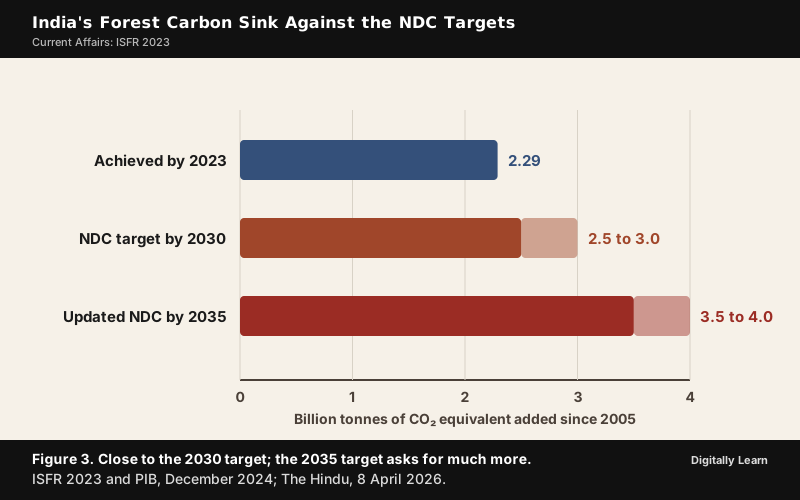
Under the Paris Agreement, India's Nationally Determined Contribution (NDC) promised an additional carbon sink of 2.5 to 3 billion tonnes of carbon dioxide equivalent through forest and tree cover by 2030. Measured as carbon dioxide equivalent, the forest and tree carbon stock was 30.43 billion tonnes in 2023, 2.29 billion tonnes more than in 2005. India's updated NDC, approved by the Union Cabinet, raises the target to 3.5 to 4 billion tonnes above 2005 levels by 2035. Modelling published in 2026 found that future forest carbon could differ in important ways from these estimates, with the largest rises in dry regions rather than the Western Ghats and the Himalaya.
Debates on Forest Cover in India: Definitions and the Green India Mission
Plantations, Tree Cover and the Counting Debate
Critics say the definition flatters the numbers. Any land over one hectare with 10 per cent canopy counts as forest cover, so eucalyptus monocultures and plantations of mango, tea and roadside trees count alongside natural forest. The recent gains lie mostly in tree cover outside recorded forests, while within recorded forests dense canopy is thinning into scrub.
The national goal is far off. The National Forest Policy of 1952, revised in 1988, aims to bring 33 per cent of the geographical area under forest cover, and two-thirds in hills and mountains to prevent erosion, against 21.76 per cent forest cover today.
- For the official view: Forest and tree cover and growing stock have risen over the decade and carbon stock since 2021, and soil health, grass cover and undergrowth inside forests have improved since 2013.
- For the critics: Plantations are counted as forest, gains are mostly outside forests, and canopy inside recorded forests is thinning.
Green India Mission and the 2026 CAG Audit
The Green India Mission, launched in February 2014, is one of the eight missions of the National Action Plan on Climate Change. It aims to protect, restore and enhance forest cover, to raise forest and tree cover over 5 million hectares and improve its quality over another 5 million, and to improve ecosystem services such as biodiversity, water and carbon sequestration. It is central to India's forest sink target.
A Comptroller and Auditor General (CAG) audit, reported in August 2026, found that the mission had largely failed. Across 16 States and UTs from 2015‑16 to 2024‑25, it found the following shortfalls.
- Quality: Forest quality improved over about 0.11 million hectares against a target of 1.4 million, a shortfall of 91.87 per cent.
- Cover: Forest cover increased over about 0.03 million hectares against 1.4 million, a shortfall of 97.57 per cent.
- Budgetary support: Only ₹1,149.14 crore, 47.88 per cent of what was approved, came through budgetary support, and planned convergence with the Compensatory Afforestation Fund Management and Planning Authority (CAMPA) and the rural employment scheme did not happen.
A revised Green India Mission was launched in June 2025 to regenerate 5 million hectares in the Aravallis, the Western Ghats and the Himalaya. Other programmes include the Nagar Van Yojana for urban forests, the MISHTI scheme for mangroves and the Ek Ped Maa Ke Naam planting campaign of 2024. Forest cover also counts in how taxes are shared, since the 16th Finance Commission gives it a 10 per cent weight in dividing central taxes among the States.
ISFR 2023 UPSC Relevance: Environment and Geography
ISFR 2023 in the UPSC and PCS Syllabus
The report belongs to General Studies Paper I (the distribution of natural resources) and Paper III (conservation and climate change). State PCS papers also ask about each State's own figures, which Volume II of the report gives district by district.
- Prelims facts: FSI, biennial since 1987, 18th report; forest cover 21.76 per cent, tree cover 3.41 per cent, together 25.17 per cent; canopy classes at 70, 40 and 10 per cent; Madhya Pradesh largest by area, Lakshadweep and Mizoram highest by share; mangroves 4,991.68 sq km; carbon sink 2.29 billion tonnes since 2005.
- Concepts: Forest cover against recorded forest area, tree cover, trees outside forests, growing stock, carbon pools, the NDC sink.
- Mains analysis: The state of forest resources, the quality of the gains, and their part in India's climate targets.
Previous Year UPSC‑CSE Questions
Each Prelims question is explained option by option, and each Mains question comes with an answer outline.
- UPSC Prelims 2016Which of the following best describes/describe the aim of 'Green India Mission' of the Government of India?
- Incorporating environmental benefits and costs into the Union and State Budgets thereby implementing the 'green accounting'
- Launching the second green revolution to enhance agricultural output so as to ensure food security to one and all in the future
- Restoring and enhancing forest cover and responding to climate change by a combination of adaptation and mitigation measures
Select the correct answer using the code given below.
How to approach this Prelims question
Approach: Test each statement against what the mission is. The Green India Mission is one of the eight climate missions of the National Action Plan on Climate Change and aims to restore and enhance forest cover, so statement 3 is correct. It is neither a green accounting scheme for budgets nor an agricultural programme, so statements 1 and 2 are wrong, which leaves statement 3 alone.
Trap to watch: The word 'green' in the name tempts a link to the green revolution or green accounting.
Why each option is right or wrong:
- (a) 1 only: Wrong. Green accounting in budgets is not the mission's aim.
- (b) 2 and 3 only: Wrong. A second green revolution in farming is not its aim.
- (c) 3 only: Correct. It restores and enhances forest cover as part of India's climate response.
- (d) 1, 2 and 3: Wrong. Statements 1 and 2 do not describe the mission.
Answer: (c) 3 only. The Green India Mission aims to restore and enhance forest cover as part of India's response to climate change.
- UPSC Prelims 1999The minimum land area recommended for forest cover to maintain proper ecological balance in India is
How to approach this Prelims question
Approach: Recall the goal of the National Forest Policy for the whole country. The policy aims to bring one-third of the geographical area under forest or tree cover, and one-third is 33 per cent.
Trap to watch: Two-thirds is the goal for hills and mountains, not for the whole country.
Why each option is right or wrong:
- (a) 25%: Wrong. That is close to today's forest and tree cover, not the policy goal.
- (b) 33%: Correct. The policy aims at one-third of the geographical area.
- (c) 43%: Wrong. No policy sets this figure.
- (d) 53%: Wrong. No policy sets this figure; hills aim at two-thirds.
Answer: (b) 33%. The National Forest Policy aims to bring one-third of India's area under forest or tree cover.
- UPSC Mains 2020 GS‑IExamine the status of forest resources of India and its resultant impact on climate change.
Answer outline
The outline sets out what the question asks, the main arguments, relevant examples and the direction of the conclusion; it is not a full model answer.
Introduction: Forest and tree cover in ISFR 2023 is about 8,27,357 sq km, 25.17 per cent of India, against the National Forest Policy goal of one-third.
Body (sub-themes to develop):
- Status: Forest cover 21.76 per cent in three density classes; tree cover 3.41 per cent; gains since 2021 mostly outside recorded forests; Madhya Pradesh largest, the north-east most forested but losing cover.
- Other resources: Mangroves 4,991.68 sq km, slightly down; bamboo and growing stock up; fire hotspots down to 2,03,544 in 2023‑24.
- Climate link: Carbon stock 7,285.5 million tonnes; a sink of 2.29 billion tonnes since 2005 against 2.5 to 3 by 2030 and 3.5 to 4 by 2035; fires and degradation release carbon.
- Quality: Plantations counted as forest, dense canopy thinning, the Green India Mission's shortfalls in the 2026 audit.
Conclusion: India's forests are growing in area but not enough in quality, and its climate targets depend on restoring natural forest, not only on planting trees.
Sources
- Forest Survey of India: India State of Forest Report 2023, Volume I
- Press Information Bureau: Union Minister releases India State of Forest Report 2023, 21 December 2024
- Press Information Bureau: India's Green Recovery, 27 December 2024
- NCERT: India, Physical Environment (Class 11), Chapter 5, Natural Vegetation
- Wikipedia: Forest Survey of India
- Wikipedia: Forest cover by state in India
- The Hindu (Delhi): Forests and the climate targets, 8 January 2026
- The Hindu (Delhi): The Sixteenth Finance Commission devolution formula, 2 February 2026
- The Hindu (Delhi): The Union Cabinet approves India's updated NDC, 29 March 2026
- The Hindu (Delhi): India's updated NDC and its three enhancements, 8 April 2026
- The Hindu (Delhi): Modelling of future forest carbon in India, 21 April 2026
- The Hindu: CAG audit flags major gaps in Green India Mission implementation, 16 August 2026
- The Hindu (Delhi): Editorial on the CAG audit of the Green India Mission, 18 August 2026
- UPSC: Civil Services Examination question papers
Editorial Disclaimer
This article draws on the India State of Forest Report of the Forest Survey of India and official releases.
See more of our UPSC articles in Google Search
Add to Preferred Sources

