


Overview
And an all-time high of 270.8 GW
A May 2026 heatwave pushed India's grid to record loads and exposed the evening-peak gap as solar fades after sunset.
India's all-India peak power demand reached 265.4 gigawatts on 20 May 2026 and an all-time high of 270.8 gigawatts on 21 May 2026 amid a 40 to 47 degree Celsius heatwave, met by a coal-dominant generation mix with a residual near 247 gigawatts at the post-sunset night peak.
Why this is in the news in May 2026
The 265 GW peak and the energy mix that met it
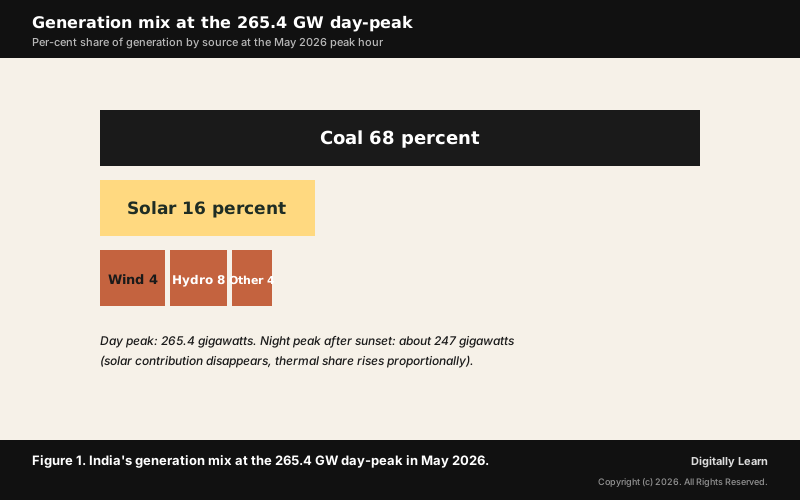
On 20 May 2026, India's electricity grid recorded a peak instantaneous demand of 265.4 gigawatts at 3:45 pm, the third consecutive daily record after 260.4 gigawatts on 19 May and 257.3 gigawatts on 18 May. The figure was surpassed the next day, when the grid met an all-time high of 270.8 gigawatts on 21 May 2026, well above the previous milestone of 257.1 gigawatts set on 25 April 2026. The peak occurred in solar hours and was met with a generation mix in which coal stations supplied about 68 per cent, wind and solar together supplied about 20 per cent, hydro supplied about 8 per cent, and nuclear plus other sources made up the balance. The driver of the demand spike was a heatwave with temperatures ranging from 40 to 47 degrees Celsius across multiple states, sharply elevating cooling-load from air-conditioners and desert coolers in domestic and commercial premises.
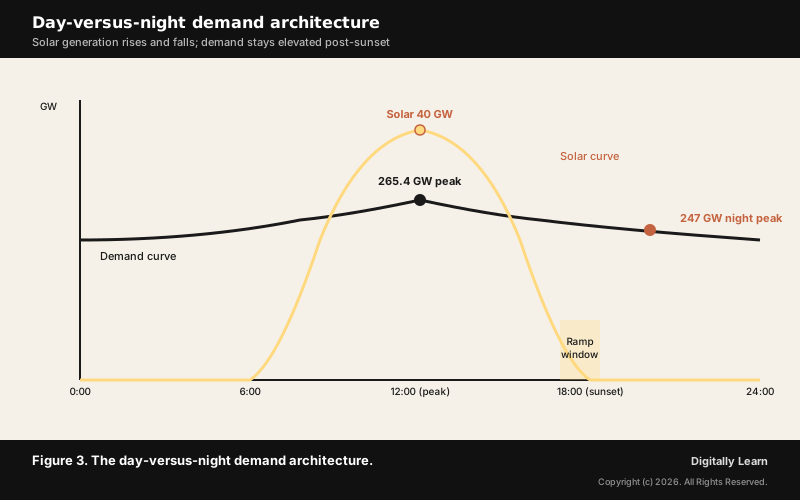
After solar generation tailed off at sunset, the non-solar peak through this heatwave week settled near 247 gigawatts; on 24 May 2026 the daily maximum of 247.9 gigawatts itself fell after dark, at 22:36. The night peak is the operationally harder figure for grid managers because it must be met without the solar contribution that helps carry the day peak. Spot-market electricity prices spiked in the post-sunset hours, and short-duration supply gaps appeared in several state networks.
Definition: Peak power demand in an electricity grid is the maximum instantaneous load that the grid is called upon to supply over a defined period, measured in gigawatts. In the Indian context the Grid Controller of India Limited (Grid-India, the successor entity to the Power System Operation Corporation Limited or POSOCO) records the all-India peak through its national load-despatch centre at the Central Electricity Regulatory Commission's directions.
Generation mix at the day-peak
Why the 2026 peak matters for grid policy
The day-peak versus night-peak architecture
Why it matters: The May 2026 peak is not a one-off heatwave artefact; it is the recurring summer pattern that India's grid now faces every year as cooling-load and renewable share both grow. The day-peak in solar hours is the easier figure to meet, because solar covers roughly a sixth of the load at noon and wind adds a further slice. The harder figure is the night-peak after sunset, when solar generation collapses and coal plus storage must carry the demand. The narrow gap between the 265.4 day-peak and the night-peak near 247 masks a much larger composition shift, because the solar contribution rises from zero in the morning to about 40 gigawatts at noon and back to zero by evening.
Three operational stresses fall on the grid manager at the post-sunset hour. The first is the solar ramp-down from peak generation to zero over the two-hour sunset window, demanding fast-ramping thermal or gas units to substitute. The second is the simultaneous cooling-load persistence in cities, where ambient temperature lags solar irradiance and air-conditioner demand remains elevated for hours after sunset. The third is the spot-market price spike, where bid prices in the post-sunset window have repeatedly cleared above 10 rupees per kilowatt-hour during the May 2026 heatwave.
Significance for India's energy transition
The significance of this issue
What is the significance of this issue: The May 2026 peak is significant for three reasons that together define the next decade of India's energy transition. The first is the cost-economics reason: meeting the night-peak with marginal thermal capacity raises the system-wide cost of supply, even as solar tariffs at noon clear at sub-three rupees per kilowatt-hour. The second is the climate-and-emissions reason: every gigawatt-hour of night-peak demand met from coal directly raises the transport-and-electricity-sector emissions bundle that India's NDC commitments target. The third is the industrial-policy reason: the demand for grid-scale storage, demand-response services, and fast-ramping flexible-fuel capacity creates a procurement window that the Production Linked Incentive Schemes for advanced chemistry cell battery storage are designed to absorb.
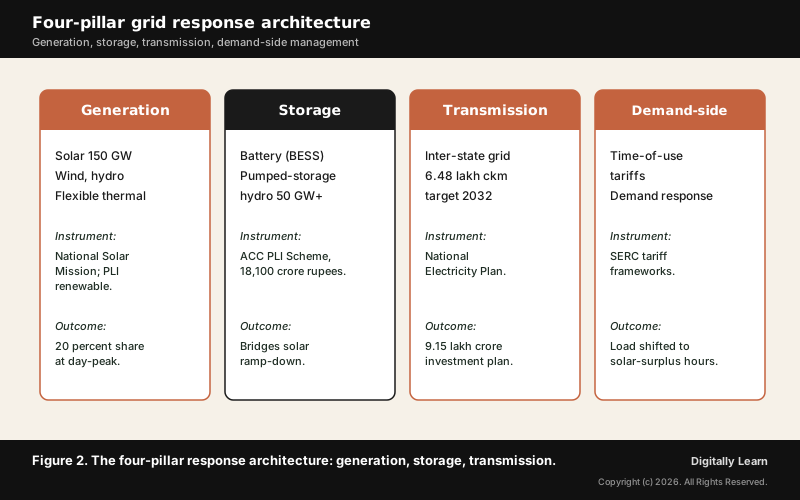
Structural reading: The grid challenge is not a renewable-versus-thermal binary; it is a day-versus-night shape mismatch between intermittent generation and continuous demand. The policy frame must therefore address generation, storage, transmission, and demand-side management together. Single-pillar solutions (build more solar, build more thermal, build more transmission) fail because each pillar leaves a residual stress on at least one other pillar.
Distinguishing features of the May 2026 peak event
What set the May 2026 peak apart from prior peaks
Distinguishing features: Three features distinguish the May 2026 peak event from prior summer maxima and shape the policy response.
- (i) Renewable share at the day-peak. Wind and solar together supplied about 20 per cent at the noon peak, and renewables including hydro reached 34 per cent on the 270.8 gigawatt record day, among the highest summer-day shares in India’s grid history. The figure reflects the cumulative effect of about 150 gigawatts of installed solar capacity and the rooftop and ground-mounted distributed-generation segments under the PM Surya Ghar Muft Bijli Yojana and predecessor schemes.
- (ii) The narrow day-night gap. The gap between the day-peak (265.4 gigawatts) and the night-peak (near 247 gigawatts) is narrow in absolute terms but conceals a sharp composition shift. The night-peak is met by a coal share well above its daytime level, with hydro and battery storage filling the marginal hour. The narrowness of the absolute gap suggests that India is now demand-bound at all hours, not just at noon.
- (iii) Heatwave-driven cooling load. The 40-to-47-degree-Celsius temperature band across northern, central, and western India elevated air-conditioner and desert-cooler load above prior-year baselines. The India Meteorological Department’s heatwave bulletins through May 2026 record multi-day temperature departures above normal that align directly with the demand-curve elevation.
The May 2026 peak-demand episode in numbers
| Grid metric | Figure | Source |
|---|---|---|
| Day-peak demand, 20 May 2026 | 265.4 gigawatts | Ministry of Power; Grid-India load-despatch data |
| All-time peak demand, 21 May 2026 | 270.8 gigawatts | Ministry of Power; Grid-India load-despatch data |
| Night and non-solar peak, May 2026 | Near 247 gigawatts | Grid-India load-despatch data |
| Coal share at day-peak | About 68 per cent | Generation-mix composition |
| Wind and solar share at day-peak | About 20 per cent | Utility plus distributed renewable generation |
| Renewables including hydro, record day | 34 per cent | Generation-mix composition, 21 May 2026 |
| Hydro share at day-peak | About 8 per cent | All-India hydro generation |
| Heatwave temperature band | 40 to 47 degrees Celsius | India Meteorological Department bulletins |
| Spot-market price spike, post-sunset | Above 10 rupees per kilowatt-hour | Indian Energy Exchange day-ahead-market clearing |
| Operational stress points | Solar ramp-down, cooling-load persistence, spot-price spike | Grid-management operational record |
Observable outcomes the policy response must deliver
What to watch through summer 2026
Observable outcomes: Six outcomes frame the policy response to the May 2026 peak and the recurring summer pattern it represents.
- (a) Grid-scale battery energy storage deployment. The Bharat Battery Energy Storage Systems rollout and the Production Linked Incentive Scheme for Advanced Chemistry Cell manufacturing together create the supply-side response to the night-peak stress.
- (b) Pumped-storage hydro pipeline. The Central Electricity Authority has identified over 100 gigawatts of pumped-storage hydro potential; the active project pipeline now stands above 50 gigawatts in various stages of clearance and construction.
- (c) Time-of-use tariff adoption. State electricity regulatory commissions are framing time-differentiated tariffs that price the night-peak hours higher and the solar-surplus noon hours lower, shifting flexible load to the renewable-surplus window.
- (d) National Electricity Plan transmission expansion. The Central Electricity Authority’s transmission plan targets inter-state transmission expansion to 6.48 lakh circuit kilometres by 2032 with an investment of about 9.15 lakh crore rupees, addressing the inter-regional renewable-power evacuation bottleneck.
- (e) Demand-response programmes. Discom-led demand-response pilots in Karnataka, Tamil Nadu, and Maharashtra offer commercial-and-industrial consumers a tariff rebate for load reduction during the night-peak window.
- (f) Heatwave preparedness coordination. The Ministry of Power and the Ministry of Earth Sciences coordinate through the India Meteorological Department on day-ahead heatwave forecasts that drive grid-side capacity prepositioning.
Contemporary linkages
Climate, electric vehicles, and the wider transition
Contemporary linkages: Three threads connect the May 2026 peak event to the wider Indian energy-transition debate. The first is the climate track: every gigawatt-hour of night-peak demand met from coal directly counters the emissions-intensity improvement that India's Nationally Determined Contributions under the Paris Agreement target. The second is the electric-vehicle track: the EV transition, governed by the PM-E-DRIVE Scheme with its 10,900 crore rupee outlay, adds an additional cooling-correlated demand spike at the early-evening commuter-return hour, intensifying the night-peak architecture. The third is the industrial-policy track, where the Production Linked Incentive Scheme for advanced chemistry cell battery storage and the National Green Hydrogen Mission together build the storage-and-flexible-fuel response that the grid-side strategy needs.
UPSC Relevance
Where the May 2026 peak sits in the UPSC syllabus
UPSC context: The May 2026 peak power demand event falls within General Studies Paper III under the syllabus heads on infrastructure, including energy; conservation, environmental pollution and degradation; and indigenisation of technology and developing new technology. The topic also touches General Studies Paper I on climatology through the heatwave-driven cooling-load dimension.
Prelims relevance: The Prelims surface includes the Grid Controller of India Limited (successor to POSOCO) as the all-India load-despatch authority, the National Electricity Plan transmission target of 6.48 lakh circuit kilometres by 2032 with 9.15 lakh crore rupees investment, the Production Linked Incentive Scheme for Advanced Chemistry Cell battery storage at 18,100 crore rupees targeting 50 gigawatt-hours of manufacturing capacity, the PM Surya Ghar Muft Bijli Yojana for rooftop solar, and the Indian Energy Exchange as the day-ahead and real-time market operator.
Mains relevance: The strongest Mains framing is the day-versus-night shape-mismatch question: how does India coordinate generation, storage, transmission, and demand-side management so that the night-peak architecture is met without recourse to additional coal capacity. A second framing is the climate-and-NDC question: what is the carbon-emission consequence of meeting the night-peak with thermal generation, and how do the Nationally Determined Contributions targets shape the response. A third framing is the industrial-policy question: how do the PLI for advanced chemistry cells, the pumped-storage-hydro pipeline, and the Bharat Battery Energy Storage Systems rollout combine to capture the domestic-value-addition opportunity.
Mains practice question: A focused fifteen-mark question would read: Examine the May 2026 peak power demand event, when India met 265.4 gigawatts on 20 May and an all-time high of 270.8 gigawatts on 21 May against a night peak near 247 gigawatts. How does the day-versus-night shape mismatch shape the policy response across generation, storage, transmission, and demand-side management? A well-constructed answer would treat the four-pillar response architecture, the National Electricity Plan transmission expansion, the ACC PLI Scheme, and the time-of-use tariff framework as the spokes.
- Past Mains linkage. 2014 GS-III: Should the pursuit of carbon credits and clean development mechanisms set up under UNFCCC be maintained even though there has been a massive slide in the value of a carbon credit? Discuss with respect to India’s energy needs for economic growth. The night-peak thermal-substitution question maps directly onto this carbon-credit framing.
- Past Mains linkage. 2013 GS-III: With growing scarcity of fossil fuels, the atomic energy is gaining more and more significance in India. Discuss the availability of raw material required for the generation of atomic energy in India and in the world. The flexible-baseload dimension that nuclear power offers to the night-peak architecture is the contemporary application of this 2013 framing.
- Adjacent linkage. 2018 Prelims tested on India’s renewable-energy target of 175 gigawatts by 2022; the 2030 target of 500 gigawatts of non-fossil capacity is the contemporary successor.
Previous Year UPSC-CSE Questions By the end you will be able to draft model answers for the following UPSC questions. Each question carries a collapsible framework showing how to approach it in the exam.
- UPSC Mains 2014 GS-IIIShould the pursuit of carbon credits and clean development mechanisms set up under UNFCCC be maintained even though there has been a massive slide in the value of a carbon credit? Discuss with respect to India's energy needs for economic growth.
How to structure the answer in the exam
Introduction: Open with the UNFCCC framework, define the Clean Development Mechanism and carbon credits, name the post-2012 value collapse, and frame the question through the lens of India's energy-growth and climate-commitment trade-off.
Body (sub-themes to develop):
- CDM architecture and Indian participation: Article 12 of the Kyoto Protocol; Designated National Authority under the Ministry of Environment, Forest and Climate Change; over 1,600 Indian CDM projects in the registry.
- Reasons for the carbon-credit value slide post-2012: oversupply of credits; weakness of compliance demand in Europe; the EU Emissions Trading System reform.
- India's energy-growth trade-off: rising peak demand (265.4 gigawatts on 20 May 2026 and an all-time high of 270.8 gigawatts on 21 May 2026); the day-versus-night shape mismatch; the cost of meeting the night-peak with marginal coal capacity.
- Successor mechanisms: Article 6 of the Paris Agreement; the Internationally Transferred Mitigation Outcomes (ITMOs); the Carbon Credit Trading Scheme notified by India in 2023.
- Strategic posture: continued CDM participation strengthens emissions-accounting capacity; new instruments under Article 6 align better with the post-2020 Paris architecture.
Conclusion: Conclude that the carbon-credit instrument's value has indeed collapsed but the underlying CDM accounting and project-development capacity remains valuable, that Article 6 of the Paris Agreement and India's domestic Carbon Credit Trading Scheme offer the next-generation framework, and that the May 2026 peak demand event provides empirical evidence for why the carbon-pricing question now sits at the centre of India's energy-growth debate.
The May 2026 peak directly illuminates the carbon-credit-versus-energy-growth trade-off the 2014 question raised. Meeting the 247 gigawatt night-peak with thermal generation directly raises the carbon-emissions intensity that the carbon-credit and Paris Agreement frameworks attempt to manage. The cost-economics, climate-and-emissions, and industrial-policy reasons named earlier supply the body sub-themes on the policy trade-off. The Production Linked Incentive Scheme for ACC battery storage and the National Green Hydrogen Mission are the contemporary instruments that the carbon-credit framework's successor regime is meant to support.
- UPSC Mains 2013 GS-IIIWith growing scarcity of fossil fuels, the atomic energy is gaining more and more significance in India. Discuss the availability of raw material required for the generation of atomic energy in India and in the world.
How to structure the answer in the exam
Introduction: Open with India's three-stage nuclear-power programme designed by Homi Bhabha, name the operating capacity at about 7.5 gigawatts, and frame the question through the raw-material logic of uranium-fed pressurised heavy-water reactors transitioning to thorium-based advanced reactors.
Body (sub-themes to develop):
- Three-stage nuclear-power programme: Stage 1 pressurised heavy water reactors using natural uranium; Stage 2 fast breeder reactors using plutonium plus uranium-238; Stage 3 advanced thorium reactors.
- Indian uranium availability: deposits in Jaduguda (Jharkhand), Tummalapalle (Andhra Pradesh), Domiasiat (Meghalaya); annual production approximately 600 to 700 tonnes against requirement of 1,500 to 2,000 tonnes; the gap met by imports under the IAEA-safeguards regime after the 2008 Indo-US 123 Agreement.
- Indian thorium availability: largest reserves in the world (over 21 per cent of global thorium); Kerala monazite sands and Tamil Nadu beach sands; long-term Stage 3 advanced-heavy-water-reactor target.
- Global uranium availability: Australia, Kazakhstan, Canada hold over 60 per cent of global resources; geopolitical risk in supply.
- Role in the May 2026 grid context: nuclear flexible-baseload at the night-peak architecture; the small-modular-reactor (SMR) programme of 2024 onwards; nuclear is one of the most credible non-coal night-peak instruments.
Conclusion: Conclude that India's uranium reserves are limited but supply is secure under the post-2008 safeguards regime, that the thorium reserves are world-leading and position India for the Stage 3 transition, and that the May 2026 peak power demand event surfaces nuclear as the most credible non-coal flexible-baseload instrument for the night-peak architecture.
The May 2026 night-peak architecture is exactly the gap that nuclear flexible-baseload generation is best positioned to fill. The four-pillar response architecture covered earlier treats generation expansion as the first pillar, and within generation nuclear sits as the non-emitting baseload alternative to coal. The 2013 question's emphasis on uranium and thorium availability supplies the long-run resource-security framing that the night-peak demand growth makes operationally urgent.
Sources
- Grid Controller of India Limited (Grid-India): all-India load-despatch reporting
- Central Electricity Authority: Daily Power Supply Position Report
- Ministry of Power, Government of India
- Indian Energy Exchange (IEX): day-ahead and real-time market clearing
- India Meteorological Department: heatwave bulletins
- Production Linked Incentive Scheme for Advanced Chemistry Cell (ACC) Battery Storage
- Wikipedia: Electricity sector in India
Editorial Disclaimer
This article is compiled from the reference materials listed in the Sources section. It is an explainer for UPSC preparation and is not a substitute for primary documents (NCERTs, GoI ministry releases, IMD bulletins, RBI / CEA / MoEFCC publications, and Standing-Committee reports).


