


Overview
India's catalogue of genetic variation
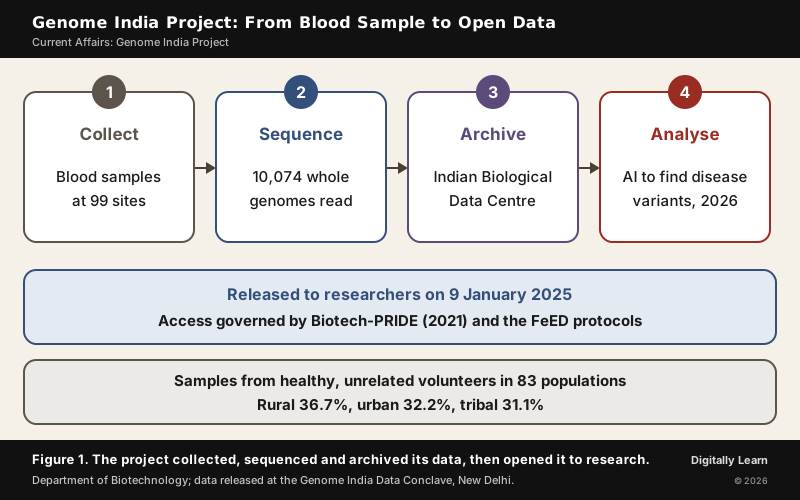
The Genome India Project (GenomeIndia) is India's national programme to catalogue the genetic variation of its people. Funded by the Department of Biotechnology under the Ministry of Science and Technology and launched on 3 January 2020, it has sequenced the whole genomes of 10,074 healthy Indians from 83 populations, and the data have been open to researchers at the Indian Biological Data Centre since 9 January 2025.
Genome India Project: India's National Catalogue of Genetic Variation
GenomeIndia Launch, Funding and the 10,000-Genome Milestone
The Centre for Brain Research at the Indian Institute of Science (IISc), Bengaluru, leads the project. More than 20 research institutions take part, among them IISc, the Indian Institutes of Technology (IITs), laboratories of the Council of Scientific and Industrial Research (CSIR) and institutes of the Biotechnology Research and Innovation Council (BRIC).
| Kind of institution | Examples in the consortium |
|---|---|
| Genomics and molecular biology | Centre for Cellular and Molecular Biology, Institute of Genomics and Integrative Biology, National Institute of Biomedical Genomics, Centre for DNA Fingerprinting and Diagnostics |
| Medical institutes | AIIMS Jodhpur, NIMHANS, Sher-i-Kashmir Institute of Medical Sciences |
| Technology and data | IIT Delhi, IIT Madras, IIT Jodhpur, IIIT Allahabad, IISER Pune |
| Regional institutes | Institute of Bioresources and Sustainable Development, Institute of Life Sciences, Rajiv Gandhi Centre for Biotechnology, Gujarat Biotechnology Research Centre, Mizoram University |
The first phase set out to sequence at least 10,000 Indian genomes. The whole genomes of 10,074 healthy individuals from 83 populations, sampled at 99 sites, have been sequenced. On 9 January 2025, at the Genome India Data Conclave in New Delhi, the data set was opened to researchers in India and abroad through the Indian Biological Data Centre (IBDC), and the government announced a future target of sequencing 10 million genomes. A second phase is to collect samples from patients with three kinds of disease, namely cardiovascular disease, mental illness and cancer.
Sampling India's Diversity: Rural, Urban and Tribal Populations
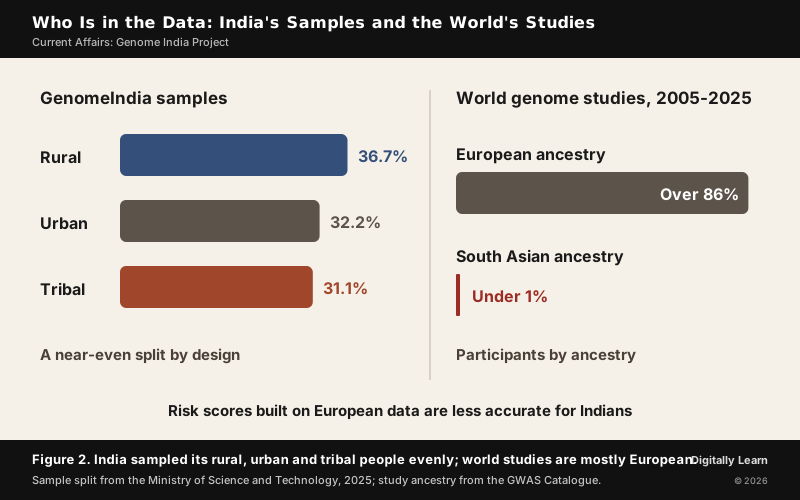
A reference for India has to include all of India, so the samples were spread on purpose. About 36.7 per cent came from rural, 32.2 per cent from urban and 31.1 per cent from tribal populations, with sampling spread across linguistic, social and regional groups throughout the country.
Reaching these groups was the hardest part of the work, and the teams had to overcome five obstacles:
- Remote places: Tribal regions were hard to reach, so nearby logistics hubs were set up to move samples.
- Trust: Local leaders and community representatives took part in the meetings with rural and tribal people.
- Awareness: Outreach programmes explained the purpose of genetic research and assured people that their data would stay confidential.
- Bias: Urban people were easier to reach, so campaigns kept each group in its proper proportion.
- Laboratories: Partnerships with local health institutions and advance preparation of laboratories handled the larger number of samples.
What Is Genome Sequencing: Variants and the Human Genome Project
Whole-Genome Sequencing and the Catalogue of Variation
The genome is the full set of DNA in a cell, and the human genome has about 3 × 10⁹ base pairs. Less than 2 per cent of the genome codes for proteins. Almost all of it, 99.9 per cent of the bases, is the same in every person; the 0.1 per cent that differs makes one person's biology unlike another's, including about 1.4 million places where a single base differs, the single nucleotide polymorphisms (SNPs).
Whole-genome sequencing reads nearly the entire sequence of a person's DNA. A narrow genetic test reads only chosen positions, so it finds only the variants it looks for; reading the whole genome also finds rare variants nobody knew to look for.
| Feature | Narrow genetic test | Whole-genome sequencing |
|---|---|---|
| What is read | A few chosen positions | Nearly the whole genome |
| Variants found | Only those already looked for | Common and rare variants across the genome |
| Best use | Checking one known condition | Building a reference catalogue for a population |
From thousands of sequences, a project builds a catalogue of variation, a record of which variants occur in a population and how common each one is. Later studies use it to ask whether a variant found in a patient is common and harmless or rare and linked to disease.
Human Genome Project and Other National Genome Programmes
The Human Genome Project (HGP), launched in 1990, set out to sequence the 3 billion base pairs of human DNA and identify its 20,000 to 25,000 genes. It ran for 13 years under the US Department of Energy and the National Institutes of Health, with the Wellcome Trust of the United Kingdom as a major partner and contributions from Japan, France, Germany, China and others, and it was declared complete in April 2003.
- Scale: At the starting estimate of US $3 per base pair, sequencing would cost about US $9 billion, and printing one cell's sequence would fill some 3,300 books of 1,000 pages each, which is why it was called a mega project.
- Bioinformatics: Storing and analysing the data needed high-speed computers, and this need gave rise to bioinformatics.
- Ethical, legal and social issues: The project also set out to address the ethical, legal and social questions that its findings might raise.
Other countries have since built national programmes. The United Kingdom's 100,000 Genomes Project (2013 to 2018) sequenced whole genomes of National Health Service patients, focusing on rare diseases and some common cancers, with consent to link each genome to the patient's health records. GenomeIndia's distinction is its spread: 83 populations sampled at 99 sites, nearly a third of the samples from tribal groups.
What the GenomeIndia Data Show About Indian Populations
Genetic Variants Unique to Indians, Endogamy and Founder Effects
The project has already identified more than 40 million genetic variants unique to the Indian population, and it documented extraordinary genetic diversity among the 83 sampled groups. India's populations have been shaped by thousands of years of migration, cultural diversity and marriage within communities, so geneticists stress that India cannot be treated as one genetic block and that distinct endogamous and tribal groups must be studied, not only a few urban groups.
Two terms explain why. Endogamy is the practice of marrying only within one's own social group, caste or community. The founder effect is the loss of genetic variation when a new population begins from a very small number of people. When a group founded by a few people also marries within itself for generations, a harmful variant that one founder happened to carry can stay common, so a disease rare elsewhere becomes frequent in that community; many harmful variants found in Indian groups are seen nowhere else.
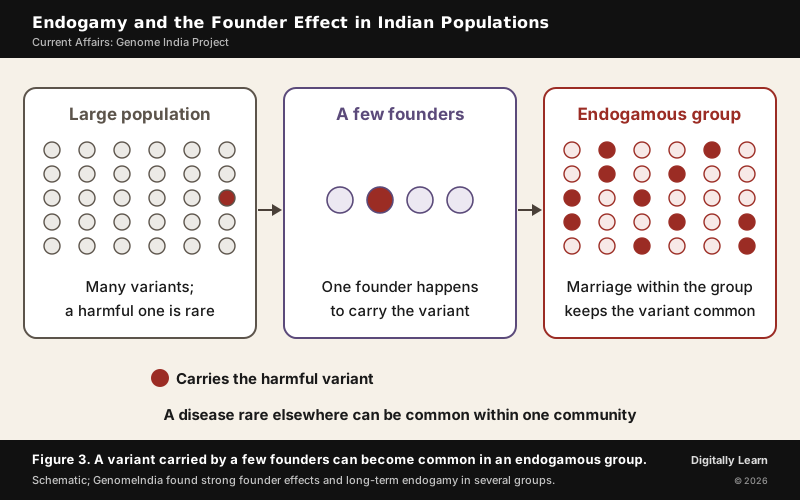
Disease patterns follow the same logic. Sickle cell anaemia is a major problem in tribal society, yet the problem found in one region may be absent in another, which is why a national study of genetic differences matters for health policy and planning.
Why European Genomic Data Fail Indian Patients
Most genetic research has studied people of European descent. Between 2005 and 2025, more than 86 per cent of the participants in genome-wide association studies were of European ancestry and less than 1 per cent were South Asian.
A genome-wide association study (GWAS) compares millions of common variants across large groups of people with and without a condition, to see which variants are more frequent in one group. For common diseases the risk is polygenic, the combined effect of thousands of variants with environment and chance, so researchers add these small effects into a single polygenic risk score.
Such scores are less accurate in other populations, because the frequencies of variants differ by ancestry. South Asians face higher rates of type 2 diabetes, heart disease and asthma than people of European ancestry, and the number of people with diabetes in India is projected to reach 12.5 crore by 2045, so tools that fit Indians poorly fail the people who need them most. Even a single Indian ancestry label is too broad, since GenomeIndia alone sampled 83 distinct groups. As of August 2026, polygenic risk scores for schizophrenia, bipolar disorder and depression were not yet accurate enough for routine clinical prediction.
Uses of GenomeIndia: Precision Medicine and Genetic Medicine
Precision Medicine, Drug Response and Indian Diagnostics
The catalogue is reference data for later research. The Department of Biotechnology funds translational research on it in four main directions:
- Indigenous chips and diagnostics: Genomic chips tailored to the Indian population, which make genetic studies more precise, and diagnostics and therapeutics built on Indian data.
- Genetic disorders: Finding the variants behind inherited diseases, including those that cluster in endogamous and tribal groups, to counter genetic and hereditary diseases.
- Drug response: Pharmacogenomics, the study of the role of the genome in drug response, aims to optimise drug therapy for a patient's genotype, identify the best dose and move away from a one-dose-fits-all approach.
- New products: Research on mRNA-based vaccines, protein manufacturing and treatments for genetic disorders.
Precision medicine brings these uses together. It fits prevention and treatment to a person's own genetic make-up rather than to an average patient. For families in a community with a known inherited disease, tests built on Indian data can guide screening and counselling.
Genetic Medicine and Gene Therapy
Genetic medicine goes one step further and treats the gene itself. Gene therapy is a set of methods for correcting a gene defect by inserting genes into a person's cells and tissues. A normal gene is delivered into the person's cells to take over from, and compensate for, the faulty one. The most common form delivers DNA carrying a working gene to replace a mutated one; it does not rewrite the whole genome.
The first clinical gene therapy was given in 1990 to a four-year-old girl with adenosine deaminase (ADA) deficiency, an immune disorder caused by the deletion of one gene. In this therapy the patient's lymphocytes are grown outside the body, given a working ADA gene through a retroviral vector and returned; because these cells are not immortal, the infusions have to be repeated.
Two kinds of carrier take the working gene into cells:
- Viral vectors: Engineered viruses carry the gene into cells; Zolgensma, for spinal muscular atrophy, uses an adeno-associated virus.
- Lipid nanoparticles: Tiny fat-based carriers, first approved for drug delivery in 2018 and used to carry the fragile mRNA of some COVID‑19 vaccines.
Genomic Data Governance, Ethics and India's Bioeconomy
Biotech-PRIDE Guidelines, FeED Protocols and Data Privacy
Genomic data are deeply personal, so access is governed rather than free. The data are shared under the Biotech-PRIDE Guidelines of 2021, where PRIDE stands for Promotion of Research and Innovation through Data Exchange, and under the Framework for Exchange of Data (FeED) protocols launched with the release, which govern how researchers gain access to the data and use them.
- Anonymised data: The released data are anonymised to protect individual identities, and researchers must follow the access rules.
- Open questions: Fair sharing of benefits with the communities that gave samples, data security, and keeping commercial enthusiasm from running ahead of the science.
The project is also part of a wider government push on biotechnology. India's bioeconomy was valued at over US $130 billion in 2024, up from US $10 billion in 2014, with a target of US $300 billion by 2030; biotech start-ups rose from 50 in 2014 to over 8,500 in 2023.
Previous Year UPSC‑CSE Questions
Each Prelims question is explained option by option, and each Mains question comes with an answer outline.
- UPSC Prelims 2026Which of the following statements with regard to GenomeIndia Project is/are correct?
- It is a part of the Human Genome Project.
- The project is funded by the Department of Biotechnology (DBT), Government of India.
- Its primary aim is to build a catalogue of genetic diversity of the Indian population.
Select the answer using the code given below:
How to approach this Prelims question
Approach: Test each statement against what GenomeIndia is and who runs it.
- Statement 1: GenomeIndia is India's own programme, begun in 2020, while the Human Genome Project was an international project completed in 2003, so the statement is wrong.
- Statement 2: The Department of Biotechnology funds the project, so the statement is correct.
- Statement 3: Its aim is a catalogue of genetic variation across India's population, so the statement is correct.
Trap to watch: The similar names tempt you to link GenomeIndia to the Human Genome Project.
Why each option is right or wrong:
- (a) 1 only: Wrong. Statement 1 is false, and statements 2 and 3 are true.
- (b) 2 and 3 only: Correct. The DBT funds it, and it builds a catalogue of Indian genetic variation.
- (c) 1 and 2 only: Wrong. GenomeIndia is not part of the Human Genome Project.
- (d) 1, 2 and 3: Wrong. Statement 1 is false.
Answer: (b) 2 and 3 only. GenomeIndia is funded by the Department of Biotechnology to catalogue Indian genetic variation and is not part of the Human Genome Project.
- UPSC Prelims 2026Which of the following statements with regard to genetic medicine is/are correct?
- Genetic medicines correct/compensate for the faulty genes responsible for disease.
- Engineered viruses and lipid nanoparticles are used as carriers of the genetic medicine.
- Genetic medicines alter the entire DNA sequence.
Select the answer using the code given below:
How to approach this Prelims question
Approach: Test each statement against what gene therapy does and how it is delivered.
- Statement 1: Gene therapy delivers a normal gene to take over from and compensate for the faulty one, so the statement is correct.
- Statement 2: Engineered viruses and lipid nanoparticles carry the gene into cells, so the statement is correct.
- Statement 3: The therapy adds or replaces one gene and does not alter the entire DNA sequence, so the statement is wrong.
Trap to watch: Words such as 'entire' make a statement too wide; gene therapy acts on one faulty gene.
Why each option is right or wrong:
- (a) 1 only: Wrong. Statement 2 is also true; viruses and lipid nanoparticles carry the medicine.
- (b) 2 and 3 only: Wrong. Statement 3 is false and statement 1 is true.
- (c) 1 and 2 only: Correct. Genetic medicines compensate for faulty genes and use viral and lipid carriers.
- (d) 1, 2 and 3: Wrong. Genetic medicines do not alter the entire DNA sequence.
Answer: (c) 1 and 2 only. Genetic medicines act on the faulty gene, carried by viruses or lipid nanoparticles, and do not alter the entire DNA sequence.
- UPSC Mains 2021 GS‑IIIWhat are the research and developmental achievements in applied biotechnology? How will these achievements help to uplift the poorer sections of the society?
Answer outline
The outline sets out what the question asks, the main arguments, relevant examples and the direction of the conclusion; it is not a full model answer.
Introduction: Applied biotechnology is the use of living systems and genetic knowledge for health, food and industry; GenomeIndia's 10,074 Indian genomes are one of its recent achievements.
Body (sub-themes to develop):
- Genomics: GenomeIndia's 10,074 genomes from 83 populations, with more than 40 million variants unique to Indians, open at the Indian Biological Data Centre; Indian genomic chips and diagnostics.
- Health for the poor: Diagnosis of inherited diseases common in endogamous and tribal groups, carrier screening, drug response suited to Indians; tribal people were 31.1 per cent of the samples.
- Genetic medicine: Gene therapy, first given in 1990 for ADA deficiency, and delivery by viral vectors and lipid nanoparticles.
- Enablers and limits: Biotech-PRIDE and FeED data rules, consent and privacy, the cost of tests, and whether benefits reach public hospitals; a bioeconomy of over US $130 billion in 2024.
Conclusion: Biotechnology uplifts the poor only when Indian data, affordable tests and public health systems carry its results beyond research laboratories.
Sources
- Press Information Bureau: Launch of Indian Genomic Data Set and IBDC Portals, 9 January 2025
- Press Information Bureau: Prime Minister's remarks on the GenomeIndia Project, 9 January 2025
- Press Information Bureau: GenomeIndia ensures equitable representation in sample collection, 6 February 2025
- Press Information Bureau: Parliament question, Indian Biological Data Centre, 19 March 2025
- Press Information Bureau: DBT's genomics platforms and AI, 19 February 2026
- India Science and Technology portal: Genome India Project publishes genomic data of 10,000 Indians
- NCERT: Biology (Class XII), Chapter 5, Molecular Basis of Inheritance
- NCERT: Biology (Class XII), Chapter 10, Biotechnology and its Applications
- Wikipedia: Genome India Project
- Wikipedia: Human Genome Project
- Wikipedia: 100,000 Genomes Project
- Wikipedia: Gene therapy
- Wikipedia: Lipid nanoparticle
- Wikipedia: Pharmacogenomics
- Wikipedia: Founder effect
- Wikipedia: Endogamy
- The Hindu: Psychiatric genetics and polygenic risk scores, Delhi, 13 August 2026
- The Hindu: South Asians missing from genomic data, Delhi, 21 August 2026
- UPSC: Civil Services Examination previous question papers
Editorial Disclaimer
This article draws on releases of the Press Information Bureau, NCERT textbooks, The Hindu and the other listed sources.
See more of our UPSC articles in Google Search
Add to Preferred Sources

