


Overview
Organised crime is serious crime committed again and again by a lasting group that uses violence, intimidation or corruption to make money. In India it ranges from extortion, contract killing and land grabbing to the trafficking of drugs, arms and people, smuggling, cyber fraud and hawala. For decades the general criminal law had no offence of organised crime, so Maharashtra and other States passed special laws such as the Maharashtra Control of Organised Crime Act, 1999 (MCOCA). Since 1 July 2024, Section 111 of the Bharatiya Nyaya Sanhita, 2023 (BNS) has made organised crime an offence across India. It is also an internal-security threat, because syndicates control the smuggling routes, weapons, safe houses and money channels that terrorist groups lack.
Organised Crime: Meaning and Features
Continuing Unlawful Activity, Hierarchy and Profit Motive
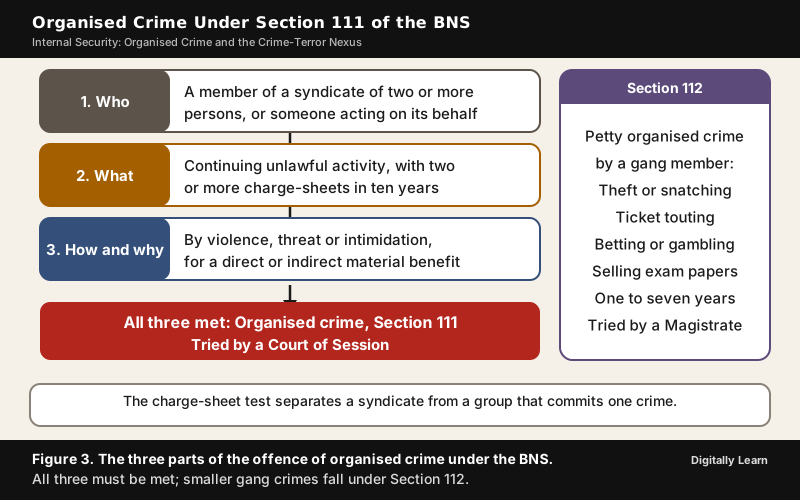
Indian law identifies organised crime by three ingredients. An organised crime syndicate is a group of two or more persons who, singly or jointly, as a syndicate or gang, carry on a continuing unlawful activity. A continuing unlawful activity is a cognizable offence punishable with three years or more, in respect of which more than one charge-sheet has been filed before a competent court within the preceding ten years and the court has taken cognizance. The third ingredient joins the means to the aim: The syndicate uses violence, threats, intimidation or coercion to obtain a direct or indirect material benefit, including a financial one.
The charge-sheet test is what separates a syndicate from a group that commits a single crime. One robbery by three friends is serious, but it is not organised crime; a gang that has faced charge-sheets for extortion and kidnapping year after year, and keeps operating, is.
Organised crime groups share a set of features:
- Continuity: The group outlives any single crime or member and recruits to replace those it loses.
- Structure: A few leaders direct many operatives, and discipline is enforced inside the group.
- Profit: The motive is money or material advantage, not ideology.
- Violence and intimidation: Force, or the threat of it, keeps victims, rivals and witnesses silent.
- Corruption and protection: The group seeks influence over politics, administration and policing.
- Laundering: Criminal earnings are moved into real estate, business and the formal economy.
- Reach: Larger groups work across State and national borders.
The corruption feature was documented officially in India by the Vohra Committee, whose report of October 1993 studied the nexus among criminals, politicians and bureaucrats. Its report recorded that crime syndicates had developed money and muscle power and linkages with government functionaries and political leaders, enough to operate with impunity, and that the criminal justice system, designed for individual offences, was unable to deal with the activities of the mafia.
UN Convention Against Transnational Organized Crime 2000
The United Nations Convention against Transnational Organized Crime (UNTOC), also called the Palermo Convention, is the main international treaty against organised crime. The UN General Assembly adopted it by resolution 55/25 on 15 November 2000; it was opened for signature at Palermo, Italy, from 12 to 15 December 2000 and came into force on 29 September 2003. It had 195 parties in November 2026.
The Convention defines an organised criminal group as a structured group of three or more persons that commits one or more serious crimes to obtain a financial or other material benefit. A serious crime is an offence punishable by at least four years in prison, and a structured group is one not formed at random, though it need not have a formal structure. The Indian definition in Section 111 is wider in two respects: Two persons can form a syndicate, and the underlying offences need carry only three years or more.
Three protocols supplement the Convention:
- Trafficking in persons: The Protocol to Prevent, Suppress and Punish Trafficking in Persons, Especially Women and Children.
- Migrant smuggling: The Protocol against the Smuggling of Migrants by Land, Sea and Air.
- Firearms: The Protocol against the Illicit Manufacturing of and Trafficking in Firearms.
The United Nations Office on Drugs and Crime (UNODC) is the custodian of the Convention and its protocols. India signed the Convention on 12 December 2002 and ratified it on 5 May 2011. India's declarations do three things. They make the Convention the legal basis for extradition with other States Parties. They provide mutual legal assistance through bilateral agreements, or under the Convention on a reciprocal basis where no agreement exists. They also name the Secretary, Ministry of Home Affairs, as India's Central Authority for such assistance.
The UNTOC has a companion treaty against corruption, the United Nations Convention against Corruption (UNCAC), adopted in October 2003 and in force since December 2005. The UNCAC is the only legally binding international anti-corruption treaty, and its Chapter V on asset recovery provides for tracing, freezing and returning funds obtained through corruption. The UNODC serves as the secretariat of the UNCAC, so one UN office supports both conventions.
Types of Organised Crime
Drug, Arms and Human Trafficking
Trafficking is the trade in goods or people that the law forbids. Section 111 of the BNS names the trafficking of persons, drugs, weapons and illicit goods or services among the activities that can make up organised crime.
- Drug trafficking: India's neighbours include Pakistan, part of the Golden Crescent (Afghanistan, Pakistan and eastern Iran), and Myanmar, part of the Golden Triangle (Myanmar, Thailand and Laos), two of Asia's main areas of illicit opium production. Drug syndicates operate across these borders, and drug money can finance armed groups. The Narcotic Drugs and Psychotropic Substances Act, 1985 (NDPS Act), enforced by the NCB, is the main law.
- Arms trafficking: Smuggled firearms and explosives arm both criminal gangs and terrorist groups.
- Human trafficking: Traffickers recruit, transport or harbour people by threats, force, fraud, deception or inducement, for exploitation that includes sexual exploitation, slavery, servitude, beggary and the forced removal of organs. The consent of the victim does not matter. The BNS punishes trafficking of a person in Section 143 and exploitation of a trafficked person in Section 144.
Extortion, Contract Killing and Land Mafia
Extortion is one of the oldest businesses of urban crime syndicates; between the 1940s and the 1980s the gangs of the Bombay docks ran protection rackets and extortion alongside smuggling. A gang demands money from traders or builders and enforces payment by threats or violence. Extortion is punished under Section 308 of the BNS, and gang leaders have directed such crime even from inside prison.
Contract killing, a murder carried out for payment, is the enforcement arm of the same business, and kidnapping for ransom is closely allied to it. Extortion, kidnapping and contract killing are all named in Section 111.
Land grabbing, the work of the land mafia, has long been a major source of criminal income in Indian cities. The Vohra Committee recorded in 1993 that in the bigger cities the main source of income of crime syndicates was real estate. Syndicates forcibly occupied land and buildings and bought property cheaply by forcing out the occupants. The money power so acquired was used to build contacts with bureaucrats and politicians and a network of muscle power, which politicians also used at election time. Section 111 names land grabbing as one of the activities of organised crime.
Smuggling, Wildlife Crime and Cyber-Enabled Organised Crime
Smuggling is the movement of goods across a border in breach of customs law, and it created Bombay's first large crime syndicates. Haji Mastan, who began as a porter in the Bombay docks, had grown rich by the 1960s by smuggling gold, silver and electronic goods, and the D-Company of Dawood Ibrahim grew out of smuggling operations in the 1970s. The Directorate of Revenue Intelligence (DRI), formed on 4 December 1957, is India's apex anti-smuggling agency. It works against the smuggling of firearms, gold, narcotics, fake Indian currency notes, antiques and wildlife, and against trade-based money laundering.
Wildlife crime is the poaching of protected animals and plants and the illegal trade in them and their parts, and wildlife is among the goods that the DRI watches at the border. The Wild Life (Protection) Act, 1972, is the main law, and the Wildlife Crime Control Bureau (WCCB), a statutory body under the Ministry of Environment, Forest and Climate Change, was created by the amendment of 2006 to combat organised wildlife crime.
Cyber-enabled organised crime uses computers and the internet to defraud many victims at once. Section 111 names cyber-crimes, and its definition of economic offence includes mass-marketing fraud and schemes that defraud several persons. The Indian Cyber Crime Coordination Centre (I4C), under the Ministry of Home Affairs and inaugurated in January 2020, coordinates the national response.
Economic offences complete the picture. The Explanation to Section 111 lists criminal breach of trust, forgery, counterfeiting of currency notes, bank notes and Government stamps, hawala transactions and frauds on banks and financial institutions. Hawala, an informal system of transferring money outside the banking channel, is also the channel through which syndicates and terrorists move funds.
| Type of organised crime | Main law | Main agency |
|---|---|---|
| Drug trafficking | NDPS Act, 1985; BNS Section 111 | NCB; State police |
| Arms trafficking | Arms Act, 1959; BNS Section 111 | NIA; State police |
| Human trafficking | BNS Sections 143 and 144; BNS Section 111 | NIA; State police |
| Extortion and contract killing | BNS Sections 308 and 111; MCOCA and similar State laws | State police and their special units |
| Land grabbing | BNS Section 111; MCOCA and similar State laws | State police |
| Smuggling of goods | Customs Act, 1962; BNS Section 111 | DRI |
| Wildlife crime | Wild Life (Protection) Act, 1972 | WCCB; State forest departments |
| Cyber-enabled fraud | BNS Sections 111 and 112 | State police; I4C |
| Hawala and laundering of proceeds | BNS Section 111; Prevention of Money-laundering Act, 2002 (PMLA) | ED |
Linkages Between Organised Crime and Terrorism
National Level: Underworld and the 1993 Bombay Bombings
The crime-terror nexus is the cooperation between crime syndicates and terrorist groups, in which each uses the other's capabilities. Within India it takes three main forms:
- Services for hire: Syndicates supply weapons, explosives, transport, safe houses, forged documents and hawala channels to terrorists, usually for payment.
- Crime as a source of funds: Terrorist and insurgent groups raise money through extortion, kidnapping for ransom, drug trafficking and counterfeit currency, the same activities that syndicates run.
- Shared people: Gang members are recruited into terror plots, and terrorists use criminals who know the local ground and the police.
The 1993 Bombay bombings are the clearest Indian case. On 12 March 1993, a series of 12 bombs exploded across Bombay (now Mumbai), including at the Bombay Stock Exchange, the Air India Building and Zaveri Bazaar, killing 257 people and injuring 1,400. The attacks were coordinated by Dawood Ibrahim, head of the D-Company, and planned with Tiger Memon, a smuggler. The explosives came through the smuggling network. Nearly 3,000 kg of the explosive RDX, with arms and ammunition, was landed at Shekhadi in Raigad district on 3 and 7 February 1993, with officials and police bribed to let the consignments pass.
The trial took two decades. In 2006 a special court under the Terrorist and Disruptive Activities (Prevention) Act, 1987 (TADA) convicted 100 of the 129 accused, and on 21 March 2013 the Supreme Court upheld the death sentence of Yakub Memon while commuting the death sentences of 10 others to life imprisonment. Dawood Ibrahim and Tiger Memon have not been arrested or tried.
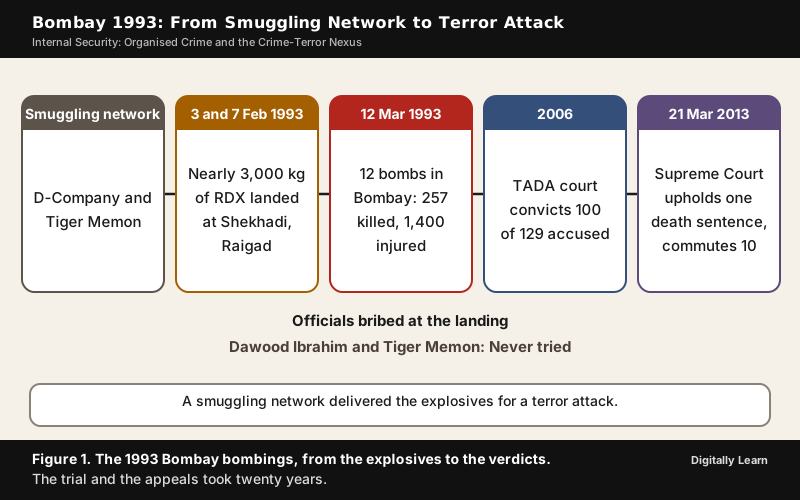
The bombings changed how the State saw the underworld. The Vohra Committee was set up after intelligence and investigation agencies reported on the activities and linkages of the Dawood Ibrahim gang following the blasts. It found that each agency dealt only with breaches of its own laws and consciously put aside information on linkages that it came across, and it called for a nodal point to which every intelligence and enforcement agency would pass information on crime syndicates. Maharashtra enacted MCOCA six years later, and its definition of organised crime includes activity aimed at "promoting insurgency".
Transnational Level: D-Company, Narco Networks and Gangster-Terror Links
At the transnational level, the nexus links Indian syndicates with groups and handlers abroad, and three patterns stand out. The D-Company shows a crime syndicate turning into an international terror facilitator. On 3 November 2003, the UN Security Council's sanctions committee on Al-Qaida listed Dawood Ibrahim Kaskar for financing and supporting acts of Al-Qaida and the Taliban. The listing records that his syndicate was involved in large-scale shipments of narcotics and shared its smuggling routes from South Asia, the Middle East and Africa with Al-Qaida, under a financial arrangement. He is wanted in India in connection with the 1993 bombings.
Narco networks are the second pattern. When the profits of drug trafficking finance terrorist or insurgent violence, the link is called narco-terrorism. India's borders with Pakistan in the west and Myanmar in the east expose it to networks from both regions.
The gangster-terror nexus of North India is the most recent pattern. In March 2023 the NIA charge-sheeted Lawrence Bishnoi and others under the Unlawful Activities (Prevention) Act, 1967 (UAPA), alleging that his syndicate worked with members of Khalistani terrorist groups to procure weapons, logistics and money for extortion and targeted killings. Babbar Khalsa International, the Khalistan Tiger Force and other Khalistani groups are banned as terrorist organisations under the UAPA. A charge-sheet states the agency's allegations, which the court tests at trial.
Prison does not always break such a network. Lawrence Bishnoi, held in jail, was found communicating with his associates through internet calls and continued to control his syndicate through illegal communications. Monitoring communications from jails is therefore part of the fight against organised crime.
Laws Against Organised Crime
MCOCA 1999 and Similar State Laws
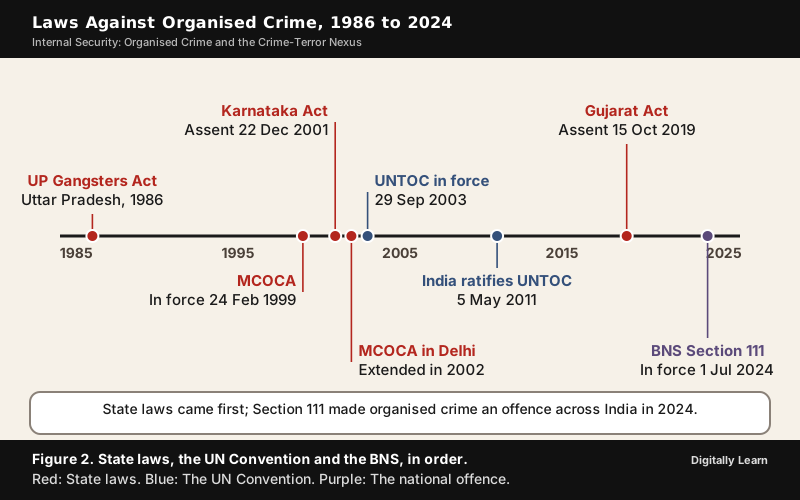
The Maharashtra Control of Organised Crime Act, 1999 (MCOCA) was the first State law in India to define organised crime and punish it as an offence in its own right. It is deemed to have come into force on 24 February 1999, when an ordinance first brought it into effect, and it was extended to the National Capital Territory of Delhi in 2002. Its Statement of Objects and Reasons links organised crime to terrorist activity and to the illegal wealth and black money that it generates.
MCOCA defines organised crime as continuing unlawful activity by a member of an organised crime syndicate, by violence, threat, intimidation, coercion or other unlawful means, with the objective of gaining pecuniary benefits, undue economic or other advantage, or promoting insurgency. Its main provisions are:
- Punishment: Death or imprisonment for life with a minimum fine of ₹1 lakh where the offence causes a death; otherwise imprisonment from five years to life with a minimum fine of ₹5 lakh.
- Unaccountable wealth: A person who holds property on behalf of a syndicate member and cannot account for it faces three to ten years in prison, and the property can be attached.
- Special Courts: Offences are tried by Special Courts with their own public prosecutors.
- Interception: A Competent Authority of at least the rank of Secretary in the State Home Department can authorise interception of wire, electronic or oral communication.
- Confessions: A confession recorded by a police officer of the rank of Superintendent of Police or above is admissible against the accused and co-accused, a departure from the ordinary rule that confessions to the police are not evidence.
- Bail: Anticipatory bail is barred, and bail is granted only if the court finds reasonable grounds to believe the accused is not guilty and not likely to offend on bail. An accused can be held in custody for up to 180 days while the investigation is completed.
- Presumption: If unlawful arms used in the crime are recovered from the accused, or the accused's fingerprints are found at the scene, the court presumes guilt unless the contrary is proved.
The Supreme Court upheld MCOCA against a challenge to its validity in State of Maharashtra v. Bharat Shanti Lal Shah (2008). The Act has also drawn criticism. Critics call its definition too vague, police have invoked it in cases that the ordinary law already covers, and convictions have been rare. In 2016 Delhi Police admitted that it had secured a conviction in only one of 57 cases in which it had invoked the Act.
Other State laws deal with gangs and organised crime:
- Uttar Pradesh: The Uttar Pradesh Gangsters and Anti-Social Activities (Prevention) Act, 1986, an older law that predates MCOCA, targets gangs that commit anti-social activities for undue advantage.
- Karnataka: The Karnataka Control of Organised Crimes Act, 2000, received the President's assent on 22 December 2001 and closely follows MCOCA.
- Gujarat: The Gujarat Control of Terrorism and Organised Crime Act, 2015, received the President's assent on 15 October 2019, after several earlier versions of the bill had failed to obtain it, and covers terrorist acts as well as organised crime.
These laws need the President's assent because criminal law and criminal procedure are in the Concurrent List. Under Article 254(2), a State law on a Concurrent List matter that conflicts with an earlier central law prevails in that State if it has been reserved for the President and has received assent, although Parliament may later amend or override it.
Section 111 of the Bharatiya Nyaya Sanhita
Section 111 of the BNS created, for the first time, an offence of organised crime in the general criminal law of India. The Indian Penal Code, 1860, which the BNS replaced, had no such offence. The BNS came into force on 1 July 2024, and Section 111 now applies in every State, alongside the State laws.
The definition follows MCOCA closely. Organised crime is any continuing unlawful activity, including kidnapping, robbery, vehicle theft, extortion, land grabbing, contract killing, economic offences, cyber-crimes and the trafficking of persons, drugs, weapons or illicit goods or services, committed by a member of an organised crime syndicate or on its behalf, by violence, threat, intimidation, coercion or other unlawful means, to obtain a direct or indirect material benefit.
Section 111 punishes the whole network, not only the person who commits the act:
- Organised crime causing death: Death or imprisonment for life, and a fine of at least ₹10 lakh.
- Organised crime in any other case: Imprisonment from five years to life, and a fine of at least ₹5 lakh.
- Abetting, attempting, conspiring or facilitating: Imprisonment from five years to life, and a fine of at least ₹5 lakh.
- Membership of a syndicate: Imprisonment from five years to life, and a fine of at least ₹5 lakh.
- Harbouring an offender: Imprisonment from three years to life, and a fine of at least ₹5 lakh; harbouring by a spouse is excluded.
- Possessing the proceeds: Imprisonment from three years to life, and a fine of at least ₹2 lakh.
- Unaccountable property held for a member: Imprisonment from three to ten years, and a fine of at least ₹1 lakh.
Section 112 of the BNS deals with smaller gang crimes. It defines petty organised crime as theft, snatching, cheating, unauthorised selling of tickets, unauthorised betting or gambling, selling of public examination question papers and similar acts committed by a member of a group or gang. For this Section, theft includes pickpocketing, card skimming, cargo theft and theft of an Automated Teller Machine.
Every offence under Section 111 is cognizable and non-bailable and is tried by a Court of Session. Petty organised crime under Section 112 is punished with imprisonment from one to seven years and a fine, and is tried by a Magistrate of the first class. Section 113 defines a terrorist act, and its Explanation leaves an officer not below the rank of Superintendent of Police to decide whether a case is registered under that Section or under the UAPA.
| Feature | MCOCA, 1999 | BNS Section 111 |
|---|---|---|
| Enacted by | Maharashtra Legislature (Delhi added in 2002) | Parliament, for the whole of India |
| In force from | 24 February 1999 | 1 July 2024 |
| Aim of the activity | Pecuniary benefit, undue economic or other advantage, or promoting insurgency | Direct or indirect material benefit, including financial benefit |
| Syndicate | Two or more persons | Two or more persons |
| Continuing unlawful activity | More than one charge-sheet in ten years, with cognizance | More than one charge-sheet in ten years, with cognizance; economic offences included |
| Offence causing death | Death or life imprisonment; fine of at least ₹1 lakh | Death or life imprisonment; fine of at least ₹10 lakh |
| Other organised crime | Five years to life; fine of at least ₹5 lakh | Five years to life; fine of at least ₹5 lakh |
| Interception of communications | Allowed with the Competent Authority's order | No special provision |
| Confession to police | Admissible if recorded by a Superintendent of Police or above | No special provision |
| Bail | Anticipatory bail barred; twin conditions for bail | Non-bailable offence under the ordinary procedure |
| Trial | Special Court | Court of Session |
Countering the Crime-Terror Nexus
Agencies: NIA, ED, NCB, DRI and State Units
Police and public order are in the State List, so State police register and investigate most organised crime, and State units such as the anti-terrorism squads take on the larger syndicates. Central agencies step in where a crime crosses State borders, touches national security or involves money, drugs or smuggling:
- National Investigation Agency: Set up under the National Investigation Agency Act, 2008, after the Mumbai attacks of 2008 and constituted on 20 January 2009, the NIA investigates scheduled offences anywhere in India. The amendment of 2019 added human trafficking, prohibited arms and cyber-terrorism to its schedule and allowed it to investigate offences against Indians and Indian interests abroad.
- Directorate of Enforcement: Established on 1 May 1956 and placed under the Department of Revenue, the ED enforces the PMLA, the Foreign Exchange Management Act, 1999, and the Fugitive Economic Offenders Act, 2018. It traces and attaches the proceeds of crime that keep syndicates alive.
- Narcotics Control Bureau: Formed on 17 March 1986 under the Ministry of Home Affairs, the NCB coordinates action against drug trafficking under the NDPS Act.
- Directorate of Revenue Intelligence: The DRI enforces the Customs Act and more than 50 other laws against smuggling, and is part of the Multi Agency Centre on national security.
- Central Bureau of Investigation: The CBI is India's National Central Bureau for the International Criminal Police Organization (INTERPOL), through which requests for international notices pass.
- Specialised bodies: The WCCB acts against organised wildlife crime, and the I4C coordinates action against cyber-crimes.
Financial Investigation, Witness Protection and International Cooperation
Financial investigation attacks the profit that drives organised crime. Section 111 punishes anyone who possesses property derived from organised crime, and MCOCA allows a Special Court to attach an accused person's property during trial and forfeit it to the State on conviction. Section 107 of the Bharatiya Nagarik Suraksha Sanhita, 2023 (BNSS) allows the police, with the approval of the Superintendent of Police, to seek a court order to attach property obtained through crime. The PMLA adds attachment of the proceeds of crime by the ED.
Witness protection is the second need, because syndicates survive by silencing those who could testify against them. The Mumbai gangster Arun Gawli escaped conviction in most cases against him because witnesses would not testify for fear, until he and 11 others were convicted of a murder in August 2012. MCOCA lets a Special Court hold proceedings at a protected place and keep the names of witnesses out of its orders. A Witness Protection Scheme has operated since 2018 following a Supreme Court ruling, and Section 398 of the BNSS now requires every State Government to prepare and notify a Witness Protection Scheme for the State.
International cooperation reaches the leaders who direct crime from abroad:
- Extradition and trial: India uses the UNTOC as a legal basis for extradition, and Section 356 of the BNSS allows a trial in absentia of a proclaimed offender who has absconded, so that a case need not wait for the accused to be brought back.
- UN sanctions: The UN Security Council's sanctions lists name individuals linked to terrorism, as with Dawood Ibrahim's listing in 2003.
- INTERPOL notices: INTERPOL circulates colour-coded notices to police forces worldwide, and each colour stands for a different kind of request.
| Notice | Purpose |
|---|---|
| Red Notice | Seeks the location and arrest of a wanted person with a view to extradition |
| Blue Notice | Obtains information on a person of interest in a criminal investigation |
| Green Notice | Warns about a person's criminal activities where that person may threaten public safety |
| Black Notice | Seeks information on unidentified bodies |
| Silver Notice | Identifies and traces criminal assets (piloted from 2025) |
Previous Year UPSC‑CSE Questions
Each Prelims question is explained option by option, and each Mains question comes with an answer outline.
- UPSC Prelims 2026Match List I (INTERPOL Notice) with List II (Description) and select the answer using the code given below the Lists:List I
- A. Silver Notice
- B. Blue Notice
- C. Black Notice
- D. Green Notice
List II
- 1. To seek information on unidentified bodies
- 2. To collect additional information about a person's identity, location, or activities in relation to a criminal investigation
- 3. To provide warning about a person's criminal activities, where the person is considered to be a possible threat to public safety
- 4. To identify and trace criminal assets
Code: A B C D
How to approach this Prelims question
Approach: Match each colour to its purpose, then find the code that carries all four matches.
- Silver Notice: It identifies and traces criminal assets, so the correct match for A is 4.
- Blue Notice: It collects information on a person's identity, location or activities in a criminal investigation, so the correct match for B is 2.
- Black Notice: It seeks information on unidentified bodies, so the correct match for C is 1.
- Green Notice: It warns about a person's criminal activities where that person is a possible threat to public safety, so the correct match for D is 3. The code 4 2 1 3 is option (c).
Trap to watch: Students who know the older notices but not the Silver Notice, piloted from 2025, may give the asset-tracing description to another colour; matching the three familiar colours first leaves 4 for Silver.
Why each option is right or wrong:
- (a) 3 1 2 4: Wrong. It gives the Silver Notice the public-safety warning, which is the Green Notice's purpose.
- (b) 3 2 1 4: Wrong. It also gives the Silver Notice the Green Notice's purpose and gives the Green Notice asset tracing.
- (c) 4 2 1 3: Correct. Silver traces criminal assets, Blue collects information on a person, Black concerns unidentified bodies and Green warns of a threat to public safety.
- (d) 4 1 2 3: Wrong. It swaps the Blue and Black Notices, giving the Blue Notice the unidentified bodies.
Answer: (c) 4 2 1 3. The Silver Notice traces criminal assets and the Black Notice concerns unidentified bodies, the two matches that set this code apart.
- UPSC Prelims 2019Consider the following statements:
- The United Nations Convention against Corruption (UNCAC) has a 'Protocol against the Smuggling of Migrants by Land, Sea and Air'.
- The UNCAC is the ever-first legally binding global anti-corruption instrument.
- A highlight of the United Nations Convention against Transnational Organized Crime (UNTOC) is the inclusion of a specific chapter aimed at returning assets to their rightful owners from whom they had been taken illicitly.
- The United Nations Office on Drugs and Crime (UNODC) is mandated by its member States to assist in the implementation of both UNCAC and UNTOC.
Which of the statements given above are correct?
How to approach this Prelims question
Approach: Test each statement by asking which of the two conventions it really describes.
- Statement 1: The Protocol against the Smuggling of Migrants by Land, Sea and Air is one of the three protocols of the UNTOC, not of the UNCAC; wrong.
- Statement 2: The UNCAC is the only legally binding international anti-corruption treaty, so it is also the first such instrument; correct.
- Statement 3: The chapter on returning stolen assets, Chapter V on asset recovery, is part of the UNCAC, not the UNTOC; wrong.
- Statement 4: The UNODC is the custodian of the UNTOC and the secretariat of the UNCAC, and it assists States with both; correct. Statements 2 and 4 are correct, which is option (c).
Trap to watch: Students who know only that the UNODC serves both conventions mix up their features, and so accept statement 1, which gives the UNTOC's migrant-smuggling protocol to the UNCAC, or statement 3, which gives the UNCAC's asset-recovery chapter to the UNTOC.
Why each option is right or wrong:
- (a) 1 and 3 only: Wrong. Both statements attach a feature to the wrong convention, since the migrant-smuggling protocol is a UNTOC instrument and asset recovery is a UNCAC chapter.
- (b) 2, 3 and 4 only: Wrong. Statement 3 is false, because the asset-recovery chapter belongs to the UNCAC.
- (c) 2 and 4 only: Correct. The UNCAC is the only legally binding international anti-corruption treaty, and the UNODC assists States with both conventions.
- (d) 1, 2, 3 and 4: Wrong. Statements 1 and 3 are false.
Answer: (c) 2 and 4 only. The migrant-smuggling protocol belongs to the UNTOC and the asset-recovery chapter to the UNCAC, so only statements 2 and 4 are correct.
- UPSC Mains 2022 GS‑IIIDiscuss the types of organised crimes. Describe the linkages between terrorists and organised crime that exist at the national and transnational levels.
Answer outline
The outline sets out what the question asks, the main arguments, relevant examples and the direction of the conclusion; it is not a full model answer.
Introduction: Organised crime is continuing unlawful activity by a syndicate that uses violence, intimidation or coercion for material benefit, and Section 111 of the BNS has made it a national offence since 1 July 2024.
Body (sub-themes to develop):
- Types: Drug, arms and human trafficking; extortion, contract killing and kidnapping for ransom; land grabbing; smuggling of gold and goods; wildlife crime; cyber-enabled fraud; economic offences such as hawala and counterfeit currency.
- National linkages: Syndicates supply arms, explosives, transport, safe houses and hawala channels; terrorists and insurgents raise money through extortion, ransom, drugs and fake currency; the 1993 Bombay bombings used RDX landed through a smuggling network.
- Transnational linkages: The D-Company shared its smuggling routes with Al-Qaida, and the UN listed Dawood Ibrahim in 2003; narco networks from the Golden Crescent and the Golden Triangle fund armed groups; the NIA's charge-sheet of March 2023 alleges links between a North Indian gang syndicate and Khalistani terrorist groups.
- Response: MCOCA and similar State laws, BNS Section 111, the NIA, ED, NCB and DRI, attachment of proceeds, witness protection, and the UNTOC and INTERPOL for cooperation.
Conclusion: Because syndicates and terrorists share money, routes and people, the same measures weaken both, chiefly financial investigation, the protection of witnesses and coordination between agencies at home and abroad.
Sources
- NCERT: Contemporary World Politics (Class XII, revised edition 2022, reprint 2026‑27), Chapter 5, Security in the Contemporary World
- India Code: Bharatiya Nyaya Sanhita, 2023 (Act 45 of 2023), Sections 111 to 113, 143, 144 and 308
- Gazette of India: Bharatiya Nagarik Suraksha Sanhita, 2023, Sections 107, 356 and 398 and the First Schedule
- India Code: The Maharashtra Control of Organised Crime Act, 1999 (Mah. Act 30 of 1999), section texts
- India Code: The Karnataka Control of Organised Crimes Act, 2000 (Karnataka Act 1 of 2002)
- India Code: The Gujarat Control of Terrorism and Organised Crime Act, 2015 (Gujarat Act 24 of 2019)
- India Code: The Uttar Pradesh Gangsters and Anti-Social Activities (Prevention) Act, 1986
- Legislative Department: The Constitution of India, Article 254 and the Seventh Schedule
- United Nations Treaty Collection: United Nations Convention against Transnational Organized Crime, status and declarations
- United Nations Security Council: Sanctions list entry, Dawood Ibrahim Kaskar (QDi.135)
- National Investigation Agency (Ministry of Home Affairs): List of terrorist organisations under the UAPA (10 March 2023)
- PIB: Union Home Minister inaugurates the BHARATPOL portal developed by CBI (7 January 2025)
- India Code: Prevention of Money-laundering Act, 2002
- Wikipedia: Organized crime
- Wikipedia: United Nations Convention against Transnational Organized Crime
- Wikipedia: United Nations Convention against Corruption
- Wikipedia: Maharashtra Control of Organised Crime Act, 1999
- Wikipedia: Gujarat Control of Terrorism and Organised Crime Act, 2015
- Wikipedia: Vohra Report
- Wikipedia: 1993 Bombay bombings
- Wikipedia: D-Company
- Wikipedia: Organised crime in India
- Wikipedia: Lawrence Bishnoi
- Wikipedia: National Investigation Agency
- Wikipedia: Enforcement Directorate
- Wikipedia: Narcotics Control Bureau
- Wikipedia: Directorate of Revenue Intelligence
- Wikipedia: Wildlife Crime Control Bureau
- Wikipedia: Indian Cyber Crime Coordination Centre
- Wikipedia: Golden Crescent
- Wikipedia: Golden Triangle (Southeast Asia)
- Wikipedia: Interpol notice
- UPSC: Civil Services Examination question papers
Editorial Disclaimer
Laws, State notifications and the status of cases change; where this article and the official text differ, the official text on India Code or in the Gazette of India prevails.
See more of our UPSC articles in Google Search
Add to Preferred Sources

