

Overview
The Scheduled Castes in India are the castes, races or tribes, or groups within them, that the President has notified under Article 341 as Scheduled Castes for the purposes of the Constitution. Scheduled Tribes are the tribes or tribal communities, or groups within them, notified in the same way under Article 342. Article 366(24) and 366(25) give these two definitions. Neither definition describes a caste or a tribe by its features; a community is a Scheduled Caste or a Scheduled Tribe only because it appears on the notified list. In the 2011 Census, Scheduled Castes formed about 16.6 per cent of India's population and Scheduled Tribes about 8.6 per cent.
Constitutional Safeguards for SCs and STs: The Five Groups
Social, Educational, Economic, Political and Administrative Safeguards
The Constitution protects these communities through safeguards of five kinds. Social safeguards remove untouchability and protect against exploitation. Educational safeguards permit special provisions, including reserved seats in admission. Economic and service safeguards promote their economic interests and permit reservation in public employment and promotion. Political safeguards reserve seats in the Lok Sabha, the State Legislative Assemblies, Panchayats and Municipalities. Administrative safeguards create institutions and give the Union a supervisory role over tribal welfare.
| Group of safeguard | Main provision | What it does |
|---|---|---|
| Social | Article 17 | Abolishes untouchability and makes its practice an offence |
| Article 46 | Directs the State to protect SCs and STs from social injustice and all forms of exploitation | |
| Educational | Article 15(4) | Permits special provisions for SCs and STs |
| Article 15(5) | Permits reservation in admission, including in private institutions other than minority institutions | |
| Economic and service | Article 46 | Directs the State to promote their educational and economic interests with special care |
| Article 16(4) | Permits reservation of posts for a backward class not adequately represented | |
| Article 16(4A) | Permits reservation in promotion, with consequential seniority, for SCs and STs | |
| Article 16(4B) | Treats unfilled reserved vacancies as a separate class outside the 50 per cent ceiling | |
| Article 335 | Requires their claims to be considered, consistently with the efficiency of administration | |
| Political | Articles 330 and 332 | Reserve seats in the Lok Sabha and the State Legislative Assemblies |
| Article 334 | Fixes the period for which these seats are reserved | |
| Articles 243D and 243T | Reserve seats and offices of Chairpersons in Panchayats and Municipalities | |
| Administrative | Articles 338 and 338A | Create the National Commissions for Scheduled Castes and for Scheduled Tribes |
| Article 339 | Gives the Union control over the administration of Scheduled Areas and the welfare of STs | |
| Article 244 | Applies the Fifth and Sixth Schedules to Scheduled Areas and Tribal Areas | |
| Article 164(1), proviso | Requires a Minister in charge of tribal welfare in four States | |
| Article 275(1), proviso | Provides grants for schemes for the welfare of Scheduled Tribes |
Scheduled Castes and Scheduled Tribes: Meaning and Identification
Articles 341 and 342: Notifying Castes and Tribes
The term "Scheduled Castes" goes back to the Government of India Act, 1935, which used it for the groups formerly known as the Depressed Classes. The Government of India (Scheduled Castes) Order, 1936, then set out the castes in a list, or Schedule, and the word "scheduled" comes from that list.
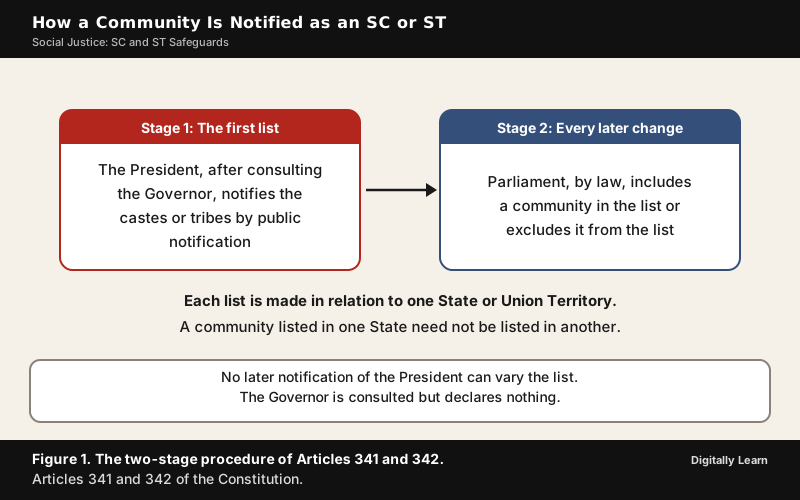
Articles 341 and 342 set out a two-stage procedure for identifying these communities. In the first stage, the President, by public notification, specifies the castes or tribes that are to be deemed Scheduled Castes or Scheduled Tribes in relation to a State or Union Territory. Where the notification concerns a State, the President acts after consultation with the Governor of that State.
In the second stage, only Parliament can change the list. Article 341(2) and Article 342(2) allow Parliament, by law, to include a community in the list or exclude it from the list; no later notification of the President can vary it.
Each list is made "in relation to" a particular State or Union Territory. A community notified as a Scheduled Tribe in one State therefore need not be a Scheduled Tribe in another. The Governor is consulted but does not declare any community a Scheduled Caste or a Scheduled Tribe.
Difference Between Scheduled Castes and Scheduled Tribes
The difference between Scheduled Castes and Scheduled Tribes lies in the basis on which each group is identified. Scheduled Castes are identified by backwardness rooted in the practice of untouchability, while Scheduled Tribes are identified by tribal characteristics such as a distinctive culture and geographical isolation. Religion also separates the two lists, and only Scheduled Tribes have special provisions for the areas where they live.
| Point of difference | Scheduled Castes | Scheduled Tribes |
|---|---|---|
| Notified under | Article 341 | Article 342 |
| Defined in | Article 366(24) | Article 366(25) |
| Basis of identification | Backwardness arising from untouchability | Tribal characteristics such as distinctive culture and geographical isolation |
| Religion condition | Only Hindus, Sikhs and Buddhists | No religion condition |
| Share of population (Census 2011) | About 16.6 per cent | About 8.6 per cent |
| Special area provisions | None | Fifth and Sixth Schedules under Article 244 |
| Constitutional commission | National Commission for Scheduled Castes (Article 338) | National Commission for Scheduled Tribes (Article 338A) |
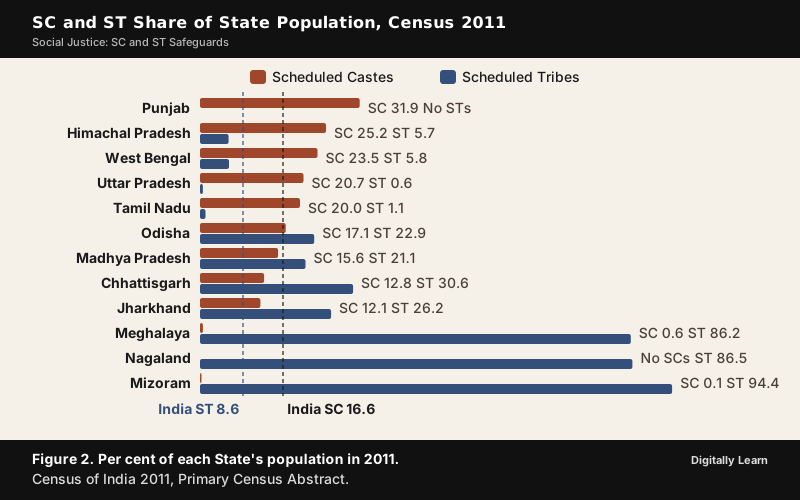
The Constitution (Scheduled Castes) Order, 1950, as amended, lists 1,108 castes across 28 States, and the Constitution (Scheduled Tribes) Order, 1950, as amended, lists 744 tribes across 22 States. The two groups are also spread differently across the country. In the 2011 Census, Scheduled Castes formed 31.94 per cent of the population of Punjab, the highest share among the States, while Arunachal Pradesh and Nagaland had no notified Scheduled Castes. Scheduled Tribes formed 94.43 per cent of the population of Mizoram and 86.48 per cent of Nagaland, while Punjab and Haryana had no notified Scheduled Tribes. In absolute numbers, Uttar Pradesh had the largest Scheduled Caste population and Madhya Pradesh the largest Scheduled Tribe population.
Inclusion and Exclusion: Lokur Committee Criteria
The Lokur Committee of 1965 laid down the criteria that are followed when a community is proposed for inclusion in, or exclusion from, the lists. For a Scheduled Caste, the test is extreme social, educational and economic backwardness arising from the practice of untouchability. For a Scheduled Tribe, the committee named five indicators:
- Primitive traits.
- A distinctive culture.
- Geographical isolation.
- Shyness of contact with the larger community.
- Backwardness.
The scheduling process also draws on the community definitions used in the colonial census and on modern anthropological study.
Social and Educational Safeguards for SCs and STs
Article 15(4), 15(5) and Special Provisions in Education
Article 15 forbids the State to discriminate against any citizen on grounds only of religion, race, caste, sex or place of birth. Two of its clauses permit special treatment of these communities. Article 15(4), added by the Constitution (First Amendment) Act, 1951, permits the State to make any special provision for the advancement of socially and educationally backward classes or of the Scheduled Castes and the Scheduled Tribes. Reserved seats and fee concessions in public educational institutions rest on this clause.
Article 15(5), inserted by the Constitution (Ninety-third Amendment) Act, 2005, goes further. It permits special provisions, made by law, for the admission of these groups to educational institutions, including private institutions, whether aided or unaided by the State. Minority educational institutions referred to in Article 30(1) are excluded from this clause.
Both clauses belong to the right to equality in Part III, so they operate as exceptions within a Fundamental Right rather than as separate guarantees.
Article 17 and the Abolition of Untouchability
Article 17 abolishes untouchability and forbids its practice in any form. The enforcement of any disability arising out of untouchability is an offence punishable in accordance with law. Neither the Constitution nor the law defines the word. The Mysore High Court held that the word refers to the practice as it developed historically in the country, that is, the social disabilities imposed on certain classes of persons because of their birth in certain castes. The right is available against private individuals as well as the State.
Parliament has enacted two laws against untouchability and caste-based crimes. The Untouchability (Offences) Act, 1955, was comprehensively amended in 1976 and renamed the Protection of Civil Rights Act, 1955. It makes offences of acts such as preventing a person from entering a place of public worship, denying access to a shop or hotel, refusing to sell goods or render services, and preaching untouchability. A person convicted of such an offence is disqualified for election to Parliament or a State Legislature.
Because the existing laws proved inadequate against atrocities on these communities, Parliament enacted the Scheduled Castes and the Scheduled Tribes (Prevention of Atrocities) Act on 11 September 1989. It came into force on 30 January 1990 and defines atrocities against members of these communities in Section 3.
Article 46 and Protection from Social Injustice
Article 46, a Directive Principle of State Policy, directs the State to promote with special care the educational and economic interests of the weaker sections of the people, and in particular of the Scheduled Castes and the Scheduled Tribes. It also directs the State to protect them from social injustice and all forms of exploitation. Like every Directive Principle, it is not enforceable by any court, but the State has a duty to apply it in making laws.
Protection of economic resources is the clearest form this duty takes in tribal areas. In a Scheduled Area, the Governor may make regulations that prohibit or restrict the transfer of land by or among members of the Scheduled Tribes, regulate the allotment of land to them, and regulate money-lending to them. These regulations protect tribal land and tribal borrowers from exploitation.
Protective rules can also have a cost. Land that cannot be freely transferred is harder to sell or to offer as security, and reservation reaches mainly public jobs and education rather than private enterprise. The State has therefore added measures that build economic capacity. The Scheduled Castes Sub-Plan of 1979 directs benefits from the annual plans of the States and Union Territories to Scheduled Castes in at least the proportion of the Scheduled Caste population, and Stand-Up India, launched on 5 April 2016, offers bank loans between Rs 10 lakh and Rs 1 crore to Scheduled Caste, Scheduled Tribe and women entrepreneurs for a new enterprise in manufacturing, trading or services.
Economic and Service Safeguards: Reservation in Public Employment
Article 16(4), 16(4A) and Reservation in Promotion
Article 16 guarantees equality of opportunity in public employment, and Article 16(4) permits the State to reserve appointments or posts for any backward class of citizens which, in the opinion of the State, is not adequately represented in the services under the State. Scheduled Castes and Scheduled Tribes are covered by this clause. Since 1982, 15 per cent of vacancies in the public sector and in government-aided educational institutions have been reserved for Scheduled Castes and 7.5 per cent for Scheduled Tribes.
In the Indra Sawhney case of 1992, the Supreme Court held that reservation should be confined to initial appointments and should not extend to promotion, and that the total reserved quota should not exceed 50 per cent except in extraordinary situations. Parliament responded with three amendments:
- Seventy-seventh Amendment, 1995: Inserted Article 16(4A), permitting reservation in promotion for Scheduled Castes and Scheduled Tribes not adequately represented in the services.
- Eighty-first Amendment, 2000: Inserted Article 16(4B), so that unfilled reserved vacancies of a year can be filled in later years as a separate class, outside the 50 per cent ceiling for those years.
- Eighty-fifth Amendment, 2001: Added "consequential seniority" to Article 16(4A), with effect from 17 June 1995.
In M. Nagaraj v. Union of India (2006), the Supreme Court upheld these amendments but treated them as enabling provisions. It held that a State wishing to reserve posts in promotion had to collect quantifiable data showing the backwardness of the class and the inadequacy of its representation, and had to keep in view overall administrative efficiency.
In Jarnail Singh v. Lachhmi Narain Gupta (2018), a five-judge bench held that the requirement to collect quantifiable data on the backwardness of the Scheduled Castes and the Scheduled Tribes was contrary to Indra Sawhney and invalid to that extent, since these groups are the most backward among the backward classes. A State must still collect quantifiable data on the inadequacy of their representation, relatable to the cadre concerned, and keep the efficiency of administration in view under Article 335.
Article 335 and the Efficiency of Administration
Article 335 states that the claims of members of the Scheduled Castes and the Scheduled Tribes shall be taken into consideration, consistently with the maintenance of efficiency of administration, in making appointments to services and posts under the Union or a State. The Article both supports these claims and limits them, since the claims must be weighed against efficiency.
The Article does not define the term "efficiency of administration". Its meaning has come from the courts, which have treated efficiency as one of the conditions that a State must satisfy before it reserves posts, especially in promotion. In this way, Article 335 acts as a limit on the reservation policies made under Article 16(4) and 16(4A).
The Constitution (Eighty-second Amendment) Act, 2000, added a proviso to Article 335. It allows the State to relax qualifying marks in an examination, or lower the standards of evaluation, for members of the Scheduled Castes and the Scheduled Tribes in matters of reservation in promotion.
Political Safeguards: Reserved Seats in Legislatures and Panchayats
Articles 330 and 332: Reserved Seats in Lok Sabha and Assemblies
Article 330 reserves seats in the Lok Sabha for the Scheduled Castes and the Scheduled Tribes, and Article 332 does the same in the Legislative Assembly of every State. The number of reserved seats in a State bears, as nearly as may be, the same proportion to the State's total seats as the State's Scheduled Caste or Scheduled Tribe population bears to its total population. Of the 543 elected seats in the Lok Sabha, 84 are reserved for Scheduled Castes and 47 for Scheduled Tribes.
The Delimitation Commission, appointed by the President, decides which constituencies are reserved. Constituencies with the highest proportion of Scheduled Tribe population are reserved for Scheduled Tribes. For Scheduled Castes, the Commission selects constituencies with a higher proportion of Scheduled Caste population but distributes them across the regions of the State, because that population is spread fairly evenly.
Reserved seats do not create separate electorates. All the voters of a reserved constituency elect its member; only the candidate must belong to the community for which the seat is reserved. A member of a Scheduled Caste or a Scheduled Tribe may also contest a general seat. For these Articles, "population" means the population at the 2001 Census until the figures of the first census taken after 2026 have been published.
Two special cases exist. Seats for the Scheduled Tribes in the autonomous districts of Assam are reserved separately, in a proportion not less than their share of the State's population. In Arunachal Pradesh, Meghalaya, Mizoram and Nagaland, Article 332(3A) sets a separate rule for reserved Scheduled Tribe seats until the seats are readjusted on the basis of the first census after 2026.
Article 334 and the Ten-Year Extensions
Article 334 fixes the period for which seats remain reserved for the Scheduled Castes and the Scheduled Tribes in the Lok Sabha and the State Assemblies. The original Constitution set this period at ten years, that is, up to 1960. Parliament has extended it by ten years at a time through seven amendments, from the Eighth Amendment of 1959 to the One Hundred and Fourth Amendment of 2019.
The One Hundred and Fourth Amendment, which came into force on 25 January 2020, made the period eighty years from the commencement of the Constitution for the Scheduled Castes and Scheduled Tribes, that is, up to 25 January 2030. It left the period for the Anglo-Indian community at seventy years, so the nomination of two Anglo-Indian members to the Lok Sabha ended in January 2020, while reservation for the Scheduled Castes and Scheduled Tribes continues.

Reservation in Panchayats and Municipalities
Articles 243D and 243T, inserted by the Seventy-third and Seventy-fourth Amendments of 1992, carry reservation down to local government. Seats are reserved for the Scheduled Castes and the Scheduled Tribes in every Panchayat and every Municipality in proportion to their share of the population of that area, and the reserved seats may be rotated among constituencies.
Three further rules apply:
- Women of these communities: Not less than one-third of the seats reserved for Scheduled Castes and Scheduled Tribes are reserved for women belonging to those communities.
- Offices of Chairpersons: The offices of Chairpersons of Panchayats at each level are reserved for Scheduled Castes and Scheduled Tribes in proportion to their population in the State; for Municipalities, the State Legislature decides the manner of reservation.
- Same end date: Reservation for the Scheduled Castes and Scheduled Tribes in these bodies, including the seats for women of those communities, ceases with the period fixed in Article 334; the general one-third reservation for women does not.
Administrative Safeguards for Scheduled Areas and Tribes
Article 339 and Union Control over Tribal Welfare
Article 339 gives the Union a supervisory role over tribal welfare in the States. Under Article 339(1), the President may at any time, and was required to at the end of ten years from the commencement of the Constitution, appoint a Commission to report on the administration of the Scheduled Areas and the welfare of the Scheduled Tribes. Under Article 339(2), the executive power of the Union extends to giving directions to a State on drawing up and carrying out schemes essential for the welfare of the Scheduled Tribes in that State.
Other administrative safeguards add to this supervision:
- Article 244 and the Fifth and Sixth Schedules: The Fifth Schedule applies to the Scheduled Areas of States other than Assam, Meghalaya, Tripura and Mizoram, and the Sixth Schedule applies to the Tribal Areas of those four States. Under the Fifth Schedule, a Tribes Advisory Council of not more than twenty members, about three-fourths of them Scheduled Tribe members of the State Assembly, advises the Governor on tribal welfare.
- Article 275(1), proviso: Grants-in-aid from the Consolidated Fund of India meet the cost of State schemes, approved by the Government of India, for the welfare of Scheduled Tribes or for raising the level of administration of Scheduled Areas.
- Article 164(1), proviso: Chhattisgarh, Jharkhand, Madhya Pradesh and Odisha must have a Minister in charge of tribal welfare, who may also look after Scheduled Castes and backward classes. The Ninety-fourth Amendment, 2006, replaced Bihar with Chhattisgarh and Jharkhand in this list.
Two constitutional commissions watch over the safeguards. The National Commission for Scheduled Castes under Article 338 and the National Commission for Scheduled Tribes under Article 338A investigate and monitor all matters relating to the safeguards, inquire into specific complaints and report to the President. Article 338A was inserted by the Eighty-ninth Amendment, 2003, which split the earlier joint commission into two.
Parliamentary Committee on the Welfare of SCs and STs
Parliament supervises the working of the safeguards through the Committee on the Welfare of Scheduled Castes and Scheduled Tribes. It has not more than 30 members: 20 elected by the Lok Sabha every year from among its members by proportional representation through the single transferable vote, and not more than 10 members of the Rajya Sabha nominated by that House to be associated with it.
The committee's composition follows three rules:
- No Ministers: A Minister cannot be elected to the committee, and a member who becomes a Minister ceases to be a member from the date of appointment.
- One-year term: The term of office of members does not exceed one year.
- Chairperson chosen by the Speaker: As for other committees of the Lok Sabha, the Speaker appoints the Chairperson from among the members.
The committee considers the reports of the National Commission for Scheduled Castes and the National Commission for Scheduled Tribes and reports on the measures the Union Government should take. It examines how far the Union secures due representation of these communities in its services and posts, including those in public sector undertakings and statutory bodies, having regard to Article 335. It also reports on welfare programmes in the Union Territories.
Safeguards in Practice: Gaps and Debates
Creamy Layer and Sub-Classification of Scheduled Castes
Benefits within a reserved category have often gone to its relatively advanced communities, and two remedies are debated. Sub-classification divides a reserved category so that its most backward communities receive a share of their own. In E. V. Chinnaiah v. State of Andhra Pradesh (2004), a five-judge bench had held that the Scheduled Castes in the President's list form a single, homogeneous group that cannot be divided.
In State of Punjab v. Davinder Singh, decided on 1 August 2024, a seven-judge bench overruled Chinnaiah by a majority of 6 to 1. The Court held that States may sub-classify Scheduled Castes and Scheduled Tribes under Articles 15 and 16, because the President's power under Article 341 only identifies the communities in the list. Any sub-classification must rest on quantifiable, empirical data showing the relative backwardness of a sub-group and its inadequate representation. Justice Bela M. Trivedi dissented.
The creamy layer is the second remedy: It excludes from reservation those members of a reserved community who have come out of backwardness. For promotion, the Supreme Court had already held in Jarnail Singh (2018) that this principle, which rests on Articles 14 and 16(1), may be applied to the Scheduled Castes and Scheduled Tribes without altering the Presidential List. The community stays on the list, and only its advanced members lose the benefit of reservation.
In Davinder Singh, Justice B. R. Gavai, in his own opinion, said the State must find a way to identify a creamy layer among the Scheduled Castes and Scheduled Tribes, even if the criteria differ from those used for the Other Backward Classes. The Union government has opposed an income-based creamy layer in the Supreme Court, arguing that the concept does not apply to these groups, and petitions on the question were pending in August 2026.
Dalit Christians and Muslims: The Religion Bar in the 1950 Order
The religion bar comes from paragraph 3 of the Constitution (Scheduled Castes) Order, 1950, issued under Article 341. Only Hindus, Sikhs and Buddhists can be members of a Scheduled Caste. The Order of 1950 covered Hindus, with an exception for certain communities in Punjab who could be either Hindu or Sikh. An amendment in 1956 extended Scheduled Caste status to Dalit converts to Sikhism nationwide, and in 1990 it was extended to Buddhists, after many people turned to Buddhism at B. R. Ambedkar's call. Scheduled Tribe status, by contrast, carries no religion condition.
Dalits who have converted to Christianity or Islam therefore lose Scheduled Caste status. A petition seeking that status for Dalit Christians and Muslims was filed in the Supreme Court in 2004 and was still being heard in 2026. The Union government has defended the Order, while the National Commission for Religious and Linguistic Minorities, chaired by Justice Ranganath Misra, recommended in 2007 that paragraph 3 be deleted. That recommendation did not change the Order.
In October 2022, the Union government set up a three-member Commission of Inquiry headed by former Chief Justice of India K. G. Balakrishnan to examine whether Scheduled Caste status can be given to Dalits who converted to religions other than those named in the 1950 Order. Its last deadline expired on 10 June 2026. As of July 2026, the commission had finished its study but had not submitted its report.
Previous Year UPSC‑CSE Questions
Each Prelims question is explained option by option, and each Mains question comes with an answer outline.
- UPSC Prelims 2026Consider the following statements about the Committee on the Welfare of Scheduled Castes and Scheduled Tribes of the Parliament of India:
- Although members of this Committee are elected from both Houses of Parliament, the Chairperson of this Committee is appointed by the Chairman of the Rajya Sabha.
- Twenty members are elected by the Rajya Sabha and ten members by the Lok Sabha.
- No Minister, except for the Union Minister of Social Justice and Empowerment, is eligible to be a member of this Committee.
- Members are elected for a fixed term of two years from the date they enter their office.
Which one of the following conclusions based on the above statements is correct?
How to approach this Prelims question
Approach: Check each statement against the Lok Sabha's Rules of Procedure.
- Statement 1 is wrong: The Speaker of the Lok Sabha appoints the Chairperson from among the members.
- Statement 2 reverses the numbers: 20 members come from the Lok Sabha and not more than 10 from the Rajya Sabha.
- Statement 3 is wrong: No Minister can be elected a member, and the rule makes no exception.
- Statement 4 is wrong: The term of members does not exceed one year.
No statement is correct.
Trap to watch: Statements that swap the two Houses or add a plausible exception for a Minister.
Why each option is right or wrong:
- (a) There are four correct statements: Wrong. Each of the four statements misstates a rule.
- (b) There is only one correct statement, that is statement 2: Wrong. The Lok Sabha elects 20 members and the Rajya Sabha nominates not more than 10, the reverse of statement 2.
- (c) There are two correct statements, that include statement 1: Wrong. The Speaker, not the Chairman of the Rajya Sabha, appoints the Chairperson.
- (d) There is no correct statement: Correct. Composition, Chairperson, Ministers and term are all misstated.
Answer: (d) There is no correct statement. The committee has 20 Lok Sabha and not more than 10 Rajya Sabha members, a Chairperson appointed by the Speaker, no Ministers and a term not exceeding one year.
- UPSC Prelims 2024Consider the following statements:
- It is the Governor of the State who recognizes and declares any community of that State as a Scheduled Tribe.
- A community declared as a Scheduled Tribe in a State need not be so in another State.
Which of the statements given above is/are correct?
How to approach this Prelims question
Approach: Under Article 342(1), the President specifies the Scheduled Tribes by public notification, after consultation with the Governor; the Governor is only consulted, so statement 1 is wrong. The list is made in relation to each State or Union Territory, so a community that is a Scheduled Tribe in one State need not be one in another; statement 2 is correct.
Trap to watch: Confusing consultation with the Governor with the power to declare.
Why each option is right or wrong:
- (a) 1 only: Wrong. The President, not the Governor, declares a community a Scheduled Tribe.
- (b) 2 only: Correct. The list is State-specific, and the Governor is only consulted.
- (c) Both 1 and 2: Wrong. Statement 1 gives the President's power to the Governor.
- (d) Neither 1 nor 2: Wrong. Statement 2 is correct because each list is made in relation to a State.
Answer: (b) 2 only. Article 342 vests the power in the President, after consultation with the Governor, and each list applies in relation to one State or Union Territory.
- UPSC Prelims 2023Consider the following statements:
- Statement‑I : The Supreme Court of India has held in some judgements that the reservation policies made under Article 16(4) of the Constitution of India would be limited by Article 335 for maintenance of efficiency of administration.
- Statement‑II : Article 335 of the Constitution of India defines the term 'efficiency of administration'.
Which one of the following is correct in respect of the above statements?
How to approach this Prelims question
Approach:
- Statement I is correct: In M. Nagaraj (2006) the Supreme Court required a State to show backwardness, inadequate representation and overall administrative efficiency before reserving posts in promotion, which reads Article 335 as a limit on Article 16(4) and 16(4A).
- Statement II is wrong: Article 335 only requires claims to be considered consistently with the maintenance of efficiency of administration and does not define the term.
Trap to watch: Assuming that a phrase used in an Article is also defined there.
Why each option is right or wrong:
- (a) Both Statement‑I and Statement‑II are correct and Statement‑II is the correct explanation for Statement‑I: Wrong. Statement II is incorrect, so it cannot explain Statement I.
- (b) Both Statement‑I and Statement‑II are correct and Statement‑II is not the correct explanation for Statement‑I: Wrong. Statement II is incorrect.
- (c) Statement‑I is correct but Statement‑II is incorrect: Correct. The Court has read Article 335 as a limit, but the Article does not define efficiency.
- (d) Statement‑I is incorrect but Statement‑II is correct: Wrong. Statement I is correct and Statement II is not.
Answer: (c) Statement‑I is correct but Statement‑II is incorrect. Article 335 uses the phrase "efficiency of administration" without defining it, while the Court has treated efficiency as a limit on reservation.
- UPSC Prelims 2020Which one of the following categories of Fundamental Rights incorporates protection against untouchability as a form of discrimination?
How to approach this Prelims question
Approach: Article 17 abolishes untouchability and forbids its practice in any form. It is one of the five Articles, 14 to 18, grouped under the Right to Equality in Part III, so option (d) is right; the other three categories hold different rights.
Trap to watch: Choosing Right against Exploitation because untouchability sounds like exploitation.
Why each option is right or wrong:
- (a) Right against Exploitation: Wrong. It covers Articles 23 and 24, traffic in human beings, forced labour and child labour.
- (b) Right to Freedom: Wrong. It covers Articles 19 to 22, the freedoms of speech, assembly, association, movement, residence and profession, and personal liberty.
- (c) Right to Constitutional Remedies: Wrong. Article 32 is the remedy for enforcing rights, not the source of the protection against untouchability.
- (d) Right to Equality: Correct. Article 17 abolishes untouchability and sits with Articles 14 to 18 under the Right to Equality.
Answer: (d) Right to Equality. Article 17, which abolishes untouchability, is part of the Right to Equality (Articles 14 to 18).
- UPSC Mains 2016 GS‑IWhy are the tribals in India referred to as 'the Scheduled Tribes'? Indicate the major provisions enshrined in the Constitution of India for their upliftment.
Answer outline
The outline sets out what the question asks, the main arguments, relevant examples and the direction of the conclusion; it is not a full model answer.
Introduction: Scheduled Tribes are the tribes or tribal communities notified by the President under Article 342 and defined in Article 366(25); they were about 8.6 per cent of India's population in 2011.
Body (sub-themes to develop):
- Why Scheduled: Status comes from inclusion in the notified list, made State by State after consultation with the Governor and changed only by Parliament; the Lokur Committee indicators guide inclusion.
- Social and educational provisions: Article 15(4) and 15(5) for special provisions and admission; Article 46 for educational and economic interests and protection from exploitation.
- Service provisions: Article 16(4), 16(4A) and 16(4B) for reservation in posts and promotion, read with Article 335.
- Political provisions: Articles 330 and 332 for reserved seats, Article 334 for the period up to 2030, Articles 243D and 243T for local bodies.
- Administrative provisions: Article 244 with the Fifth and Sixth Schedules, Article 275(1) grants, Article 339 Union control, the tribal welfare Minister under Article 164(1) and the National Commission for Scheduled Tribes under Article 338A.
Conclusion: The provisions combine protection of land and culture with representation and development, under Union supervision.
- UPSC Mains 2014 GS‑IIDo government's schemes for up-lifting vulnerable and backward communities by protecting required social resources for them, lead to their exclusion in establishing businesses in urban economies?
Answer outline
Introduction: Article 46 directs the State to promote the economic interests of Scheduled Castes and Scheduled Tribes and to protect them from exploitation, and protective schemes follow from it.
Body (sub-themes to develop):
- Protection of resources: Fifth Schedule regulations restrict the transfer of land by or among Scheduled Tribe members, regulate land allotment and regulate money-lending; reservation secures posts and seats.
- How protection can exclude: Land that cannot be freely transferred is harder to sell or offer as security, and reservation reaches mainly public employment and education rather than private enterprise.
- Measures that build enterprise: The Scheduled Castes Sub-Plan of 1979 and Stand-Up India (2016), which offers bank loans of Rs 10 lakh to Rs 1 crore for new enterprises.
Conclusion: Protection and enterprise support work together: Safeguards prevent the loss of resources, and credit opens the urban economy.
Sources
- Legislative Department: The Constitution of India (as on 1 May 2024)
- NCERT: Class 11 Political Science: Indian Constitution at Work, Chapter 3
- Gazette of India: S.O. 1922(E), commencement of the Constitution (One Hundred and Sixth Amendment) Act, 2023 (16 April 2026)
- Lok Sabha Secretariat: Rules of Procedure and Conduct of Business in Lok Sabha, Seventeenth Edition (2024)
- Supreme Court of India: Jarnail Singh v. Lachhmi Narain Gupta, [2018] 10 S.C.R. 663 (26 September 2018)
- Census of India 2011: Primary Census Abstract, India and States
- Wikipedia: Scheduled Castes and Scheduled Tribes
- Wikipedia: Reservation in India
- Wikipedia: State of Punjab v. Davinder Singh
- Wikipedia: Eighth Amendment of the Constitution of India
- Wikipedia: One Hundred and Fourth Amendment of the Constitution of India
- Wikipedia: Scheduled Caste and Scheduled Tribe (Prevention of Atrocities) Act, 1989
- Wikipedia: Lok Sabha
- Wikipedia: Stand-Up India
- The Hindu: Delhi edition, 29 March, 12 June, 29 July, 7 August, 16 August and 21 October 2026
- UPSC: Civil Services Examination question papers
Editorial Disclaimer
This article draws on the text of the Constitution of India, the Lok Sabha's Rules of Procedure, the Census of India and the other sources listed in the Sources section. Court cases and pending questions are described as they stood when the article was written.