


Overview
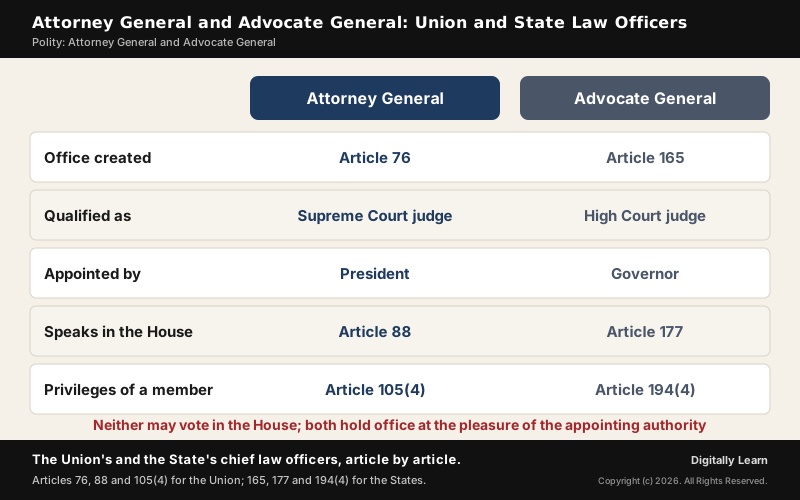
The Attorney General of India is the country's highest law officer under Article 76. Appointed by the President from those qualified to be Supreme Court judges, the office advises the Union government and appears for it in the courts. Each State has an Advocate General under Article 165.
Office of the Attorney General Under Article 76
Attorney General of India: Appointment, Qualifications and Term
The Attorney General for India is the highest law officer in the country. Article 76 creates the office, and the President appoints to it a person who is qualified to be appointed a judge of the Supreme Court. Under Article 124(3) that means a citizen of India who has been a High Court judge for at least five years, or an advocate of a High Court for at least ten years, or who is, in the President's opinion, a distinguished jurist. The appointment is made on the advice of the Union Cabinet.
The Constitution fixes neither a term nor the grounds or procedure for removal. The Attorney General holds office during the pleasure of the President, may be removed at any time, and may resign by writing to the President. By convention the Attorney General resigns when the government that made the appointment resigns or is replaced. The President also decides the remuneration.
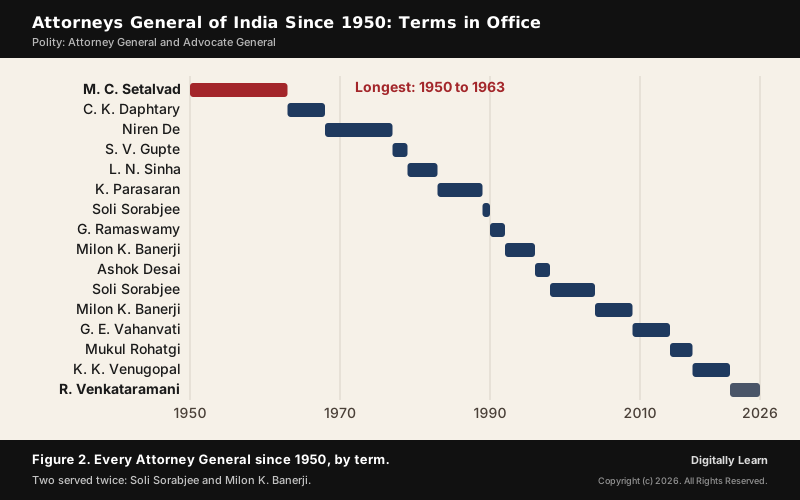
The first Attorney General, M. C. Setalvad, held office from 28 January 1950 to 1 March 1963, the longest term so far. Soli Sorabjee and Milon K. Banerji each served two separate terms. R. Venkataramani has been Attorney General since 1 October 2022, succeeding K. K. Venugopal.
Duties and Functions of the Attorney General
Article 76(2) gives the Attorney General three duties. The first is to advise the Government of India on legal matters the President refers, the second to perform other duties of a legal character the President assigns, and the third to discharge functions conferred by the Constitution or any other law. Under a notification of 26 January 1950, the President assigned three standing duties.
- To appear for the Government of India in every case in the Supreme Court in which it is concerned.
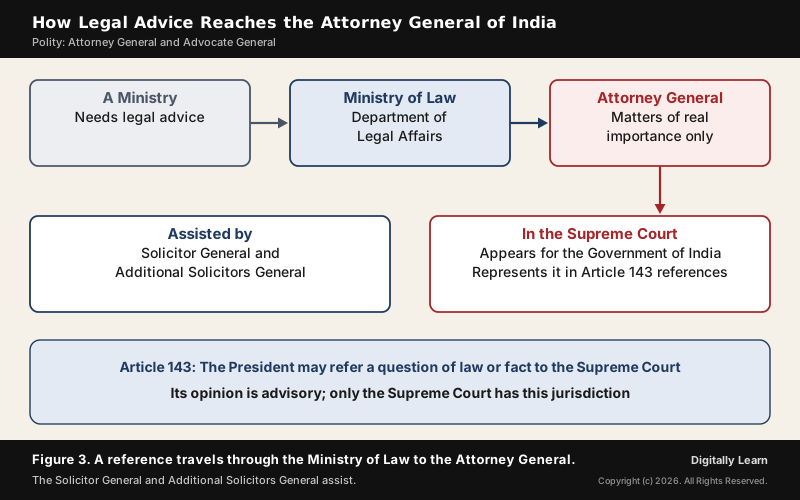
- To represent the Government of India in any reference the President makes to the Supreme Court under Article 143.
- To appear, when the Government of India requires, in any High Court in a case in which it is concerned.
Article 143 lets the President refer a question of law or fact of public importance to the Supreme Court for its opinion. The Court is not bound to give its advice, and the President is not bound to accept it. This advisory jurisdiction belongs to the Supreme Court alone. A High Court has original, writ, appellate and supervisory jurisdiction, but no advisory jurisdiction.
The Attorney General is consulted only on legal matters of real importance, and only after the Ministry of Law has been consulted; every reference reaches the office through the Law Ministry. A further function comes from statute. Under section 15 of the Contempt of Courts Act, 1971, a private person may move the Supreme Court for criminal contempt only with the written consent of the Attorney General or the Solicitor General.
Rights, Privileges and Limitations of the Attorney General
In performing official duties the Attorney General has a right of audience in all courts in India (Article 76(3)). Under Article 88 the Attorney General may speak in, and otherwise take part in the proceedings of, either House of Parliament, a joint sitting, and any parliamentary committee to which the Attorney General is named a member, but cannot vote. Article 105(4) extends to the Attorney General the privileges and immunities of a member of Parliament.
The Attorney General is not a full-time counsel for the government, is not a government servant and is not barred from private practice, but four limitations avoid a conflict of duty.
- No advice or brief against the Government of India.
- No advice or brief in cases where the Attorney General may be called on to advise or appear for the Government of India.
- No defence of an accused person in a criminal prosecution without the government’s permission.
- No appointment as a director of a company or corporation without the government’s permission.
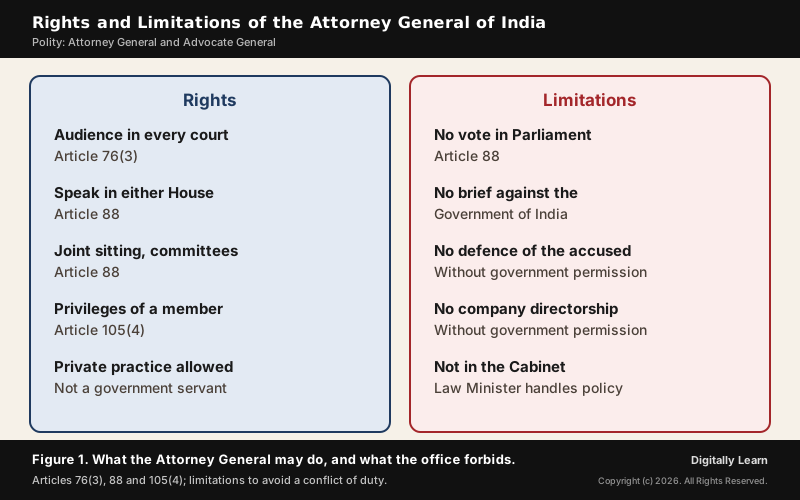
The Attorney General is not a member of the Union Cabinet and has no executive authority; legal policy is the Law Minister's work. A proposal under Jawaharlal Nehru to merge the office with that of the Law Minister did not materialise.
Independence of the Attorney General: Debates and Cases
The Attorney General is appointed on the government's advice, argues its case and, by custom, offers to resign when a new government takes office. Yet the post is created by the Constitution, and its opinions carry weight because they are meant to be independent legal judgement, so the Attorney General's views are open to public scrutiny in a way a private lawyer's advice is not. Several episodes have tested that balance.
- The Emergency: Attorney General Niren De, answering a question from Justice H. R. Khanna, stated that even the right to life could be suspended during the Emergency.
- Taj corridor case (2005): The Supreme Court told the CBI not to go solely on the Attorney General’s opinion, which had absolved Mayawati, and to place all evidence before it.
- Bofors case (2009): Attorney General Milon K. Banerji’s opinion absolving Ottavio Quattrocchi was criticised as devaluing and eroding the standing of the office.
- 2G spectrum case: Goolam Vahanvati became the first Attorney General who had to testify as a witness in a corruption case in a trial court.
Three features of the office support its independence despite the lack of a fixed term. The qualification is that of a Supreme Court judge, the Attorney General is not a government servant and keeps a private practice, and the restrictions on that practice keep private briefs from colliding with the duty to the government.
Solicitor General of India and Other Law Officers
Solicitor General and Additional Solicitors General of India
The Solicitor General of India is the second-highest law officer and assists the Attorney General, helped in turn by Additional Solicitors General. Only the Attorney General's office is created by the Constitution; the posts of Solicitor General and Additional Solicitor General are neither constitutional nor statutory. Their conditions of service are set by the Law Officers (Conditions of Service) Rules, 1987, made under the proviso to Article 309, and the Appointments Committee of the Cabinet appoints them. Tushar Mehta has been Solicitor General since 10 October 2018.
A law officer's duties mirror the Attorney General's. They advise the Government of India on legal matters referred to it, appear for it in the Supreme Court or any High Court, and represent it in references under Article 143. The same restrictions on private practice apply, and a law officer may advise a Ministry or public sector undertaking only when the reference comes through the Department of Legal Affairs.
| Feature | Attorney General | Solicitor General | Advocate General |
|---|---|---|---|
| Source of office | Constitution, Article 76 | Law Officers Rules, 1987 | Constitution, Article 165 |
| Appointed by | President | Appointments Committee of the Cabinet | Governor |
| Qualification | As a Supreme Court judge | Not laid down in the Constitution | As a High Court judge |
| Right to speak in the legislature | Parliament (Article 88) | None | State Legislature (Article 177) |
| Right to vote | No | No | No |
Advocate General of the State: Article 165
Advocate General of the State: Appointment, Functions and Rights
The Advocate General is the highest law officer of a State and corresponds to the Attorney General. Under Article 165 the Governor appoints a person qualified to be a High Court judge. Under Article 217(2), that means a citizen of India who has held judicial office for at least ten years or has been an advocate of a High Court for at least ten years. The Advocate General holds office during the pleasure of the Governor, who also fixes the remuneration, and by convention resigns when the State government that made the appointment leaves office.
The duties follow the Union pattern, covering advice to the State government on legal matters the Governor refers, other legal duties the Governor assigns, and functions under the Constitution or any law. The Advocate General may appear before any court in the State.
Under Article 177 the Advocate General may speak in and take part in the proceedings of the State Legislative Assembly, of both Houses where a State has a Legislative Council, and of any legislature committee to which the Advocate General is named a member, but cannot vote; Article 194(4) gives the privileges of a member of the State Legislature. Under section 15 of the Contempt of Courts Act, a private person may move a High Court for criminal contempt only with the Advocate General's written consent.
Previous Year UPSC-CSE Questions
Previous Year UPSC-CSE Questions By the end you will be able to draft model answers for the following UPSC questions. Each question carries a collapsible framework showing how to approach it in the exam.
- UPSC Prelims 2022 Prelims-GSConsider the following statements:
- Attorney General of India and Solicitor General of India are the only officers of the Government who are allowed to participate in the meetings of the Parliament of India.
- According to the Constitution of India, the Attorney General of India submits his resignation when the Government which appointed him resigns.
Which of the statements given above is/are correct?
How to approach this Prelims question
Approach: Step 1: Statement 1 fails. Article 88 gives the right to speak and take part in Parliament to every Minister and to the Attorney General; the Solicitor General has no such right, so the two are not 'the only officers'. Step 2: Statement 2 fails. The Constitution fixes no term for the Attorney General, who holds office at the President's pleasure; resigning when the government resigns is a convention, not a constitutional requirement.
Trap to watch: Statement 2 tempts because the resignation usually happens; the question asks what the Constitution says.
Key facts to recall:
- (a) 1 only: Wrong. The Solicitor General has no right under Article 88, and Ministers also take part.
- (b) 2 only: Wrong. The resignation rule is a convention, not in the Constitution.
- (c) Both 1 and 2: Wrong. Neither statement is correct.
- (d) Neither 1 nor 2: Right. Article 88 names Ministers and the Attorney General only, and the Constitution sets no resignation rule.
Answer signal: Neither 1 nor 2: Option (d), the official answer, because both statements misstate Article 88 and Article 76.
- UPSC Prelims 2013 Prelims-GSConsider the following statements. The Attorney-General of India can:
- Take part in the proceedings of the Lok Sabha
- Be a member of a committee of the Lok Sabha
- Speak in the Lok Sabha
- Vote in the Lok Sabha
Which of the statements given above is/are correct?
How to approach this Prelims question
Approach: Step 1: Article 88 lets the Attorney General take part in the proceedings of either House, so statement 1 holds. Step 2: It also covers any committee of Parliament of which the Attorney General is named a member, so statement 2 holds. Step 3: The right to speak is expressly given, so statement 3 holds. Step 4: Article 88 ends with 'but shall not by virtue of this article be entitled to vote', so statement 4 fails.
Trap to watch: Statement 4 tempts because the Attorney General takes full part in the House; voting is the one thing withheld.
Key facts to recall:
- (a) 1 only: Wrong. Statements 2 and 3 are also correct.
- (b) 2 and 3 only: Wrong. It leaves out statement 1.
- (c) 1 and 3 only: Wrong. It leaves out membership of a committee (statement 2).
- (d) 1, 2 and 3: Right. Every right except the vote.
Answer signal: 1, 2 and 3: Option (d), the official answer, because Article 88 withholds only the vote.
- UPSC Prelims 2000 Prelims-GSConsider the following statements about the Attorney General of India:
- I. He is appointed by the President of India.
- II. He must have the same qualifications as are required for a Judge of the Supreme Court.
- III. He must be a member of either House of Parliament.
- IV. He can be removed by impeachment by Parliament.
Which of these statements are correct?
How to approach this Prelims question
Approach: Step 1: Statement I holds, because Article 76(1) says the President appoints. Step 2: Statement II holds, because the person must be qualified to be a Supreme Court judge. Step 3: Statement III fails. No membership of Parliament is required, since Article 88 gives the right to take part without being a member. Step 4: Statement IV fails. The Attorney General holds office at the President's pleasure, so there is no impeachment.
Trap to watch: Statement IV tempts because judges are removed by a parliamentary process; the Attorney General is not.
Key facts to recall:
- (a) I and II: Right. Appointment by the President and a Supreme Court judge's qualification.
- (b) I and III: Wrong. Membership of Parliament is not required.
- (c) II, III and IV: Wrong. Statements III and IV are false.
- (d) III and IV: Wrong. Both are false.
Answer signal: I and II: Option (a), the official answer, because the office needs no seat in Parliament and is held at pleasure.
- UPSC Prelims 2009 Prelims-GSConsider the following statements :
- The Advocate General of a State in India is appointed by the President of India upon the recommendation of the Governor of the concerned State.
- As provided in Civil Procedure Code, High Courts have original, appellate and advisory jurisdiction at the State level.
Which of the statements given above is/are correct ?
How to approach this Prelims question
Approach: Step 1: Statement 1 fails. Under Article 165 the Governor appoints the Advocate General; the President plays no part. Step 2: Statement 2 fails. A High Court has original, writ, appellate and supervisory jurisdiction, but no advisory jurisdiction, which Article 143 gives only to the Supreme Court.
Trap to watch: Statement 2 tempts because it lists two real kinds of jurisdiction before adding the advisory one.
Key facts to recall:
- (a) 1 only: Wrong. The Governor, not the President, appoints.
- (b) 2 only: Wrong. High Courts have no advisory jurisdiction.
- (c) Both 1 and 2: Wrong. Neither statement is correct.
- (d) Neither 1 nor 2: Right. Both statements are false.
Answer signal: Neither 1 nor 2: Option (d), the official answer, because the Governor appoints and only the Supreme Court advises.
- UPSC Mains 2025 GS-II"The Attorney General of India plays a crucial role in guiding the legal framework of the Union Government and ensuring sound governance through legal counsel." Discuss his responsibilities, rights and limitations in this regard.
Answer outline: how to structure the answer
What the question asks, the main arguments, relevant examples and the direction of the conclusion. This is not a full model answer.
Introduction: Open with Article 76, under which the Attorney General is the highest law officer, appointed by the President from those qualified to be Supreme Court judges.
Body (sub-themes to develop):
- Responsibilities: Advice on legal matters referred by the President; duties assigned in 1950 (Supreme Court cases, Article 143 references, High Court appearances); functions under law, such as consent to criminal contempt.
- Rights: Audience in all courts (Article 76(3)); speaking in Parliament without a vote (Article 88); a member's privileges (Article 105(4)).
- Limitations: No brief against the Government; no defence of the accused or company directorship without permission; office held at pleasure; no executive authority.
Conclusion: Conclude that the office's value lies in independent legal counsel within the government's own legal team.
- UPSC Mains 2019 GS-II“The Attorney-General is the chief legal adviser and lawyer of the Government of India.” Discuss.
Answer outline: how to structure the answer
What the question asks, the main arguments, relevant examples and the direction of the conclusion. This is not a full model answer.
Introduction: Open with Article 76 and the office's place as India's highest law officer.
Body (sub-themes to develop):
- Chief legal adviser: Advice under Article 76(2) on matters of real importance, referred through the Ministry of Law.
- Lawyer: Appears for the Government of India in the Supreme Court and High Courts, and in Article 143 references; right of audience in all courts.
- Parliamentary role: Speaks in either House and committees under Article 88, without a vote.
- Limits on the description: Not a government servant, private practice allowed, no Cabinet seat or executive authority; assisted by the Solicitor General and Additional Solicitors General.
Conclusion: Conclude that the description holds, with the office's independence resting on its constitutional status and its qualification as a Supreme Court judge.
Sources and Further Reading
- Legislative Department, Ministry of Law and Justice: The Constitution of India
- NCERT: Indian Constitution at Work, Class 11, Chapter 6, Judiciary
- Supreme Court of India: The Constitution (court officers, the Attorney General and law officers)
- India Code: The Contempt of Courts Act, 1971 (section 15)
- The Hindu (Delhi): SC advocate seeks to file contempt plea against CEC, 25 September 2026
- The Hindu (Delhi): States told to furnish details of facilities for senior citizens, 8 September 2026
- The Hindu (Delhi): Speaker seeks AG's advice on petition to disqualify MLA, 10 October 2026
- Wikipedia: Attorney General for India
- Wikipedia: Solicitor General of India
- Wikipedia: Contempt of court in India
Editorial Disclaimer
This article explains the law officers from the Constitution's text and the other sources listed.


