

Overview
Sound waves are mechanical, longitudinal waves: a vibrating object sends a train of compressions and rarefactions through a solid, liquid or gas, and they cannot cross a vacuum. Their frequency sets the pitch, their amplitude the loudness and their mix of overtones the quality; the speed of sound depends on the medium and its temperature, and reflection, the Doppler effect and ultrasound give echoes, sonar and medical scans.
Sound Waves: Mechanical and Longitudinal Waves
Why Sound Waves Are Called Mechanical Waves
Every sound begins with a vibration, a rapid to and fro motion of an object. The human voice comes from vibrating vocal cords, and a stretched rubber band hums when it is plucked. The vibrating object sets the particles of the medium beside it moving; each particle displaces its neighbour and then returns to its place, so the disturbance travels onward while the particles stay where they were.
Waves are of three kinds. Mechanical waves, such as water waves, sound waves and seismic waves, are governed by Newton's laws of motion and exist only within a material medium such as water, air or rock. Electromagnetic waves, such as light and radio waves, need no medium and all travel through vacuum at the same speed, 299,792,458 metres per second. Matter waves belong to moving electrons, protons and atoms, and electron microscopes use them.
A simple experiment shows that sound needs a medium. An electric bell hung inside an airtight glass jar grows fainter as the air is pumped out, although the same current still flows through the bell. With very little air left only a feeble sound is heard: the bell still vibrates, but there is almost no air left to carry its sound.
Sound Waves Are Longitudinal Waves: Compressions and Rarefactions
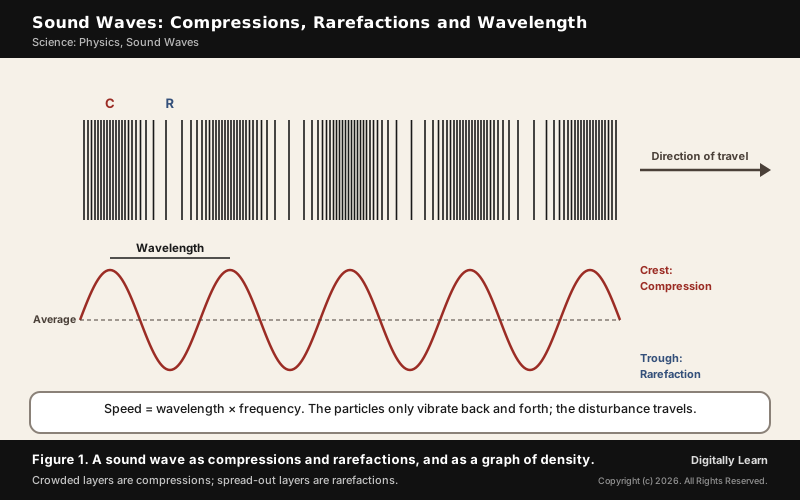
When a vibrating object moves forward, it pushes and compresses the air in front of it, creating a region of high pressure called a compression. When it moves back, it leaves a region of low pressure called a rarefaction. As the object moves back and forth rapidly, a train of compressions and rarefactions travels outward, so sound is a travelling pattern of changes in density and pressure.
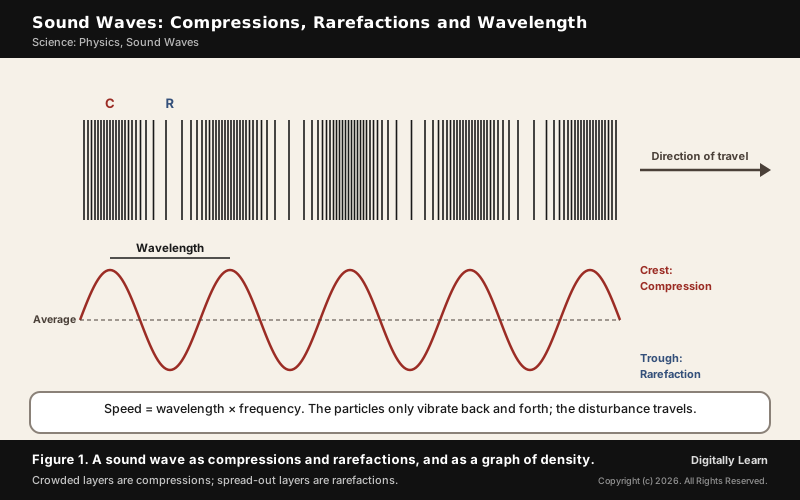
In a longitudinal wave the particles of the medium move back and forth parallel to the direction in which the wave travels, as the coils of a stretched slinky do when one end is pushed. Sound waves are longitudinal waves. In a transverse wave, such as a pulse sent along a string, the particles move perpendicular to the direction of travel.
- Longitudinal waves: Need a medium that resists compression, so they travel through solids, liquids and gases alike.
- Transverse waves: Need a medium that resists shearing, so they travel through solids and along strings but not through fluids.
- Steel bars and rock: Carry both kinds, while air carries only longitudinal waves.
- Light: A transverse wave, but not a mechanical one, since no particles of a medium vibrate.
Characteristics of Sound: Pitch, Loudness and Quality
Frequency, Wavelength and Pitch of a Sound Wave
A sound wave is described by its frequency, its amplitude and its speed. The distance between two consecutive compressions, or two consecutive rarefactions, is the wavelength, measured in metres. The number of complete oscillations of density per second is the frequency, measured in hertz, and the time for one oscillation is the time period, so the frequency equals one divided by the time period.
Speed, wavelength and frequency are tied together: speed equals wavelength × frequency. A wave of frequency 2 kilohertz and wavelength 35 centimetres therefore travels at 700 metres per second and covers 1.5 kilometres in 2.1 seconds. In a given medium under the same conditions the speed of sound is almost the same for all frequencies, so a high note has a short wavelength and a low note a long one.
Pitch is how the brain interprets frequency. The faster the source vibrates, the higher the frequency and the higher the pitch, so a high-pitched sound sends more compressions and rarefactions past a point each second. Objects of different sizes and conditions vibrate at different frequencies. The unit of frequency honours Heinrich Rudolph Hertz, who confirmed Maxwell's electromagnetic theory by experiment.
Amplitude, Loudness, Intensity and the Decibel Scale
The amplitude of a sound wave is the largest disturbance in the medium on either side of the mean value. It depends on how hard the object is made to vibrate: a table struck lightly gives a soft sound of low energy, and struck hard a loud one. Loudness is set mainly by amplitude. A loud sound carries more energy and so travels farther, and every sound grows softer as it spreads out from its source and its amplitude falls.
- Intensity: The sound energy passing each second through unit area, a physical quantity.
- Loudness: The response of the ear to that intensity; two sounds of equal intensity can seem unequally loud because the ear detects one of them better.
- Decibel (dB): One tenth of a bel, a logarithmic unit named after Alexander Graham Bell; a tenfold rise in power is a rise of 10 dB in level.
- dB(A): The form in which India’s noise rules state their limits.
Timbre or Quality of Sound: Tones, Notes and Harmonics
Timbre, or quality, is the characteristic that lets us tell apart two sounds of the same pitch and loudness. A violin and a flute played together in an orchestra reach the ear through the same air at the same speed, yet they sound different. A sound of a single frequency is a tone; a sound made of a mixture of several frequencies is a note and is pleasant to hear, while noise is unpleasant to the ear.
Instruments differ in timbre because each produces, along with its lowest or fundamental frequency, a different mix of overtones. Harmonics are overtones at whole-number multiples of the fundamental, two, three and four times it and so on. The physical features that govern timbre are the frequency spectrum and the envelope of the sound, and a violinist can change it by bowing in different styles or on different parts of the string.
Speed of Sound in Solids, Liquids and Gases
Speed of Sound in Air, Water and Steel
Thunder is heard a little after the flash of lightning is seen because sound travels far more slowly than light. The speed of sound depends on the medium and on its temperature: it falls as we go from solids to liquids to gases, and in any medium it rises with temperature. Solids and liquids are much denser than gases, yet sound travels faster in them because they are far less compressible.
| Medium | State | Speed (m/s) |
|---|---|---|
| Aluminium | Solid | 6,420 |
| Steel | Solid | 5,960 |
| Flint glass | Solid | 3,980 |
| Sea water | Liquid | 1,531 |
| Distilled water | Liquid | 1,498 |
| Hydrogen | Gas | 1,284 |
| Air | Gas | 346 |
| Oxygen | Gas | 316 |
In air, the chief factor is temperature. At a fixed temperature a change of pressure has no effect on the speed of sound, because the density changes in the same proportion and the two effects cancel. In a gas of fixed composition the speed depends only on temperature, varying with the square root of the absolute temperature, and moist air carries sound faster than dry air.
Newton's Formula and the Laplace Correction for the Speed of Sound
Newton first worked out the speed of sound in a gas. He assumed that the pressure changes in a sound wave take place at constant temperature, that is, isothermally. His formula gave about 280 metres per second for air at standard temperature and pressure, about 15 per cent less than the measured value of 331 metres per second.
Laplace found the error. The compressions and rarefactions of a sound wave follow each other so fast that there is too little time for heat to flow and keep the temperature constant, so the changes are adiabatic, not isothermal. Correcting the formula by the ratio of the two specific heats of air, 7/5, gives 331.3 metres per second, which agrees with measurement; this is the Laplace correction.
Mach Number, Supersonic Speed and the Sonic Boom
The Mach number is the ratio of an object's speed to the local speed of sound, named after the Austrian physicist Ernst Mach. At Mach 1 an object moves exactly at the speed of sound; at Mach 0.65 it moves at 65 per cent of that speed, which is subsonic, and at Mach 1.35 it is 35 per cent faster, which is supersonic. Bullets and jet aircraft often travel at supersonic speeds.
Because the local speed of sound depends on temperature, Mach 1 is not a fixed speed. Temperature generally falls with height up to 11 kilometres, and the speed of sound with it: 340.3 metres per second at sea level against 295.0 metres per second at 11 kilometres. The speed of sound rises again only in the stratosphere above about 20 kilometres, so an aircraft flying at Mach 1 at 15 kilometres is slower than one flying at Mach 1 near sea level.
A source moving faster than sound outruns its own pressure waves, which pile up into shock waves carrying a large amount of energy. The sharp, loud sound they produce is the sonic boom. It is not a single bang at the moment of breaking the sound barrier: the boom is continuous, heard by everyone the aircraft passes over, and the shock waves of a supersonic aircraft can shatter glass and even damage buildings. The crack of a bullwhip is a small sonic boom.
Reflection of Sound: Echo, Reverberation and Resonance
Echo, Reverberation and Multiple Reflection of Sound
Sound reflects from the surface of a solid or a liquid as a rubber ball bounces off a wall, and it obeys the same laws of reflection as light: the incident and reflected directions make equal angles with the normal, and all three lie in one plane. A large obstacle, polished or rough, is needed. A shout near a tall building or a mountain comes back a little later as an echo.
The sensation of a sound persists in the brain for about 0.1 second, so a distinct echo is heard only if the reflected sound returns at least 0.1 second later. At 344 metres per second the sound must cover 34.4 metres there and back, so the reflecting surface must be at least 17.2 metres away. The rolling of thunder comes from successive reflections off clouds and land.
In a big hall, sound persists through repeated reflection from the walls until it fades below hearing; this persistence is reverberation. Too much of it is undesirable in an auditorium, so roofs and walls are covered with sound-absorbing materials such as compressed fibreboard, rough plaster or draperies, and even the seats are chosen for how well they absorb sound.
- Megaphones, horns, trumpets and shehnais: A tube followed by a conical opening reflects sound forward towards the audience.
- Stethoscope: The sound of the heartbeat reaches the doctor’s ears by multiple reflection.
- Curved ceilings and soundboards: Spread the reflected sound to every corner of a concert or conference hall.
Resonance, Standing Waves and Beats in Musical Instruments
When a wave reflects back along a string fixed at both ends, the outgoing and returning waves combine into a standing wave, a pattern that does not move along the string. Points of zero amplitude, called nodes, lie half a wavelength apart. Only certain wavelengths fit between the fixed ends, so the string vibrates at a set of natural frequencies that are whole-number multiples of the lowest one, the fundamental or first harmonic.
An air column behaves the same way. A pipe open at both ends has natural frequencies that are whole-number multiples of the speed of sound divided by twice its length; a pipe closed at one end has only the odd harmonics. Each natural frequency is a resonant frequency: a source at that frequency sets the column vibrating strongly, which is resonance. Since the frequency falls as the length rises, a shorter flute gives a higher note.
Two sounds of nearly equal frequency heard together, such as 256 and 260 hertz, produce a slow rise and fall in loudness called beats, repeating at the difference of the two frequencies, here 4 times a second. Musicians use beats to tune their instruments: an instrument sounded against a standard frequency is tuned until the beats disappear.
Doppler Effect, Infrasound and Ultrasound
Doppler Effect: Why a Passing Siren Changes Pitch
Johann Christian Doppler proposed the effect in 1842, and Buys Ballot tested it experimentally in Holland in 1845. A moving source crowds its waves together ahead of it and spreads them out behind, so a listener ahead receives more waves each second, a higher frequency and a higher pitch, and a listener behind receives fewer. The pitch also rises when a listener moves quickly towards a stationary source, and falls when the listener moves away.
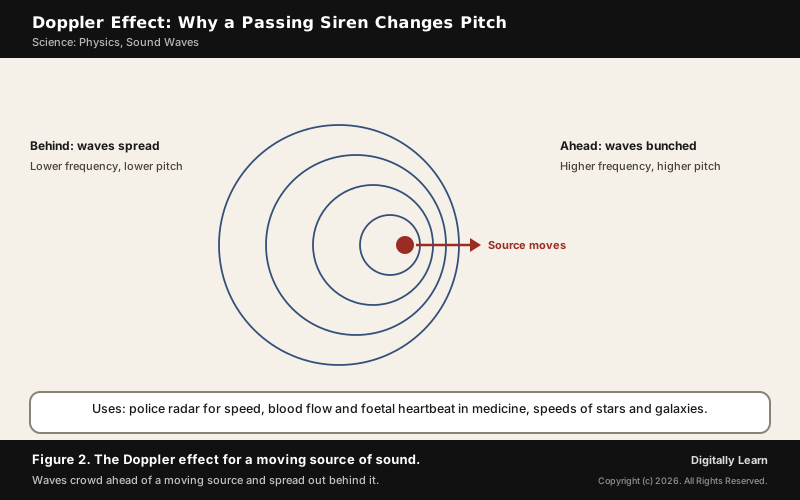
The effect holds for all waves, sound and electromagnetic alike. The change in frequency of a wave reflected from a moving object, the Doppler shift, gives that object's speed, which is why the effect is used wherever speed has to be measured from a distance.
- Police: Checks over-speeding vehicles from the shift in waves reflected from them.
- Airports and defence: Guides aircraft and detects enemy aircraft.
- Medicine: Ultrasonic Doppler sonography follows blood flow, the movement of heart valves and the heartbeat of a foetus; the picture of the heart is an echocardiogram.
- Astronomy: The redshift and blueshift of light give the speeds at which stars and galaxies recede or approach.
Range of Hearing and Infrasound
The human ear hears from about 20 hertz to 20,000 hertz. Children under the age of five and some animals such as dogs can hear up to 25 kilohertz, and as people grow older their ears become less sensitive to higher frequencies. Sound below 20 hertz is infrasound, and sound above 20 kilohertz is ultrasound.
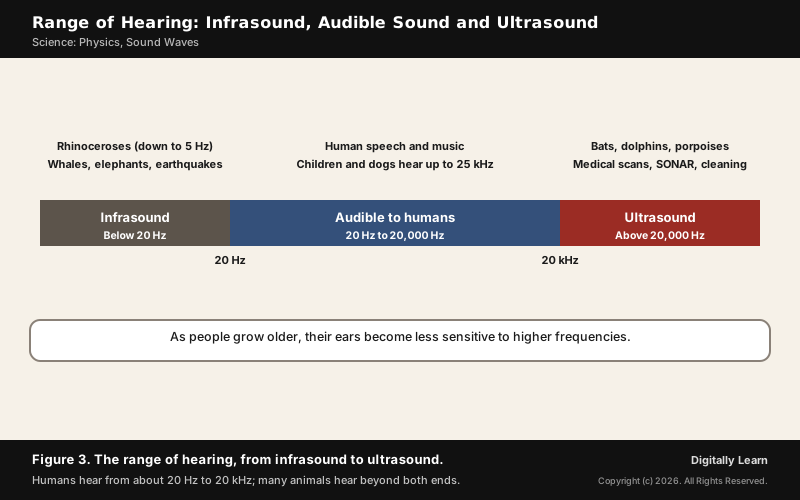
If we could hear infrasound, a swinging pendulum would be as audible as the wings of a bee. Rhinoceroses communicate using infrasound as low as 5 hertz, and whales and elephants produce sound in the infrasound range. Some animals get disturbed before earthquakes, possibly because an earthquake produces low-frequency infrasound before the main shock waves begin.
- Travelling far: Infrasound passes around obstacles with little loss of energy.
- Monitoring: It is used to watch earthquakes and volcanoes and to chart rock and petroleum formations below the earth.
- Nuclear tests: A network of 53 infrasound stations forms part of the International Monitoring System that checks compliance with the Comprehensive Nuclear-Test-Ban Treaty.
Ultrasound Uses and Ultrasonography in Medicine
Ultrasound is high-frequency sound that travels along well-defined paths even in the presence of obstacles, which makes it useful in industry and medicine. Ordinary sound of longer wavelength bends around the corners of a defect and reaches the detector anyway, so only ultrasound reveals a flaw hidden inside a metal block.
- Cleaning: Parts in hard-to-reach places, such as spiral tubes and electronic components, are put in a cleaning solution through which ultrasonic waves are sent, and dust, grease and dirt drop off.
- Detecting flaws: Ultrasound passed through a metal block reflects back from even a small crack or hole, flaws invisible from outside that would weaken a bridge, a building or a machine.
- Breaking kidney stones: Ultrasound breaks small stones into fine grains that are flushed out with urine.
In ultrasonography, ultrasonic waves travel through body tissue and reflect wherever the tissue density changes; the echoes are turned into electrical signals and then into an image of the organ. Doctors image the liver, gall bladder, uterus and kidney to find stones or tumours, and examine the foetus during pregnancy for defects and growth problems. Echocardiography images the heart in the same way. Deep organs such as the liver and kidney are imaged at 1 to 6 megahertz, and shallow ones such as muscle and the thyroid at 7 to 18 megahertz.
SONAR and Echolocation in Bats and Porpoises
SONAR stands for Sound Navigation And Ranging. A transmitter on a ship sends out ultrasonic waves, which travel through water, strike an object on the seabed and reflect back to a detector that turns them into electrical signals. The sound covers the distance twice, so twice the depth equals the speed of sound in sea water × the time between sending and receiving; this method is called echo-ranging.
- Worked example: An echo from the seabed received after 3.42 seconds, at 1,531 metres per second in sea water, gives a depth of 2,618 metres.
- Uses: Measuring the depth of the sea and locating underwater hills, valleys, submarines, icebergs and sunken ships.
- Why sound: Sound waves travel farther in water than radar and light waves, which makes sonar the tool for exploring and mapping the ocean.
Sonar is active or passive. Active sonar sends out a pulse of sound and times its echo to find the range and direction of an object. Passive sonar sends out nothing and only listens, which suits military vessels that do not want to be found and scientists listening to whales. The first patent for an underwater echo-ranging device was filed a month after the Titanic sank in 1912, and sonar was developed in the First World War to counter submarines.
Bats search out prey and fly at night by emitting high-pitched ultrasonic squeaks and detecting their reflections from obstacles and prey; the nature of the echo tells the bat where the object is and what it is like. This echolocation is a biological sonar. Dolphins and porpoises also produce ultrasound, and porpoises use it to navigate and find food in the dark; certain moths, in turn, hear the squeaks of an approaching bat in time to escape.
Human Ear and Noise Pollution
Structure of the Human Ear: How We Hear
The ear converts pressure variations in air at audible frequencies into electrical signals that travel to the brain along the auditory nerve. The outer ear, the pinna, collects sound from the surroundings, and the sound passes down the auditory canal to a thin membrane at its end, the eardrum or tympanic membrane.
- A compression pushes the eardrum inward and a rarefaction lets it move outward, so the eardrum vibrates.
- Three bones in the middle ear, the hammer, anvil and stirrup, amplify these vibrations several times.
- The middle ear passes the amplified pressure variations on to the inner ear.
- The cochlea in the inner ear turns them into electrical signals, which the brain interprets as sound.
People with hearing loss may need a hearing aid, a battery-operated electronic device. Its microphone converts sound into electrical signals, an amplifier strengthens them, and its speaker converts the amplified signals back into sound and sends it into the ear.
Noise Pollution Rules in India: Zones, Loudspeakers and Complaints
Rising noise from industry, construction, generator sets, loudspeakers, music systems and vehicle horns harms human health and psychological well-being. The Noise Pollution (Regulation and Control) Rules, 2000, made under the Environment (Protection) Act, 1986, set ambient noise standards for four kinds of area: industrial, commercial, residential and silence zones. State governments place every area in one of these zones and must keep noise within the standards.
- Silence zones: An area of not less than 100 metres around hospitals, educational institutions and courts may be declared a silence zone.
- Loudspeakers: Need written permission, and may not be used between 10 p.m. and 6 a.m. except in closed premises such as auditoriums, community halls and banquet halls.
- Festival relaxation: A state may allow them until midnight on cultural or religious festive occasions, for not more than fifteen days in a calendar year.
- Complaints: Anyone may complain to the authority when the noise level exceeds the standard by 10 dB(A) or more.
Previous Year UPSC-CSE Questions
Previous Year UPSC-CSE Questions By the end you will be able to draft model answers for the following UPSC questions. Each question carries a collapsible framework showing how to approach it in the exam.
- UPSC Prelims 2007 Prelims-GSConsider the following statements:
- A flute of smaller length gives waves of lower frequency.
- Sound travels in rocks in the form of longitudinal elastic waves only.
Which of the statements given above is/are correct?
How to approach this Prelims question
Approach: Test statement 1 against how pipe length sets frequency, and statement 2 against the kinds of wave a solid can carry.
Trap to watch: The word 'only' in statement 2: solids carry shear waves too.
Key facts to recall:
- Natural frequency of a pipe falls as its length rises
- Solids carry both longitudinal and transverse waves
Answer signal: Neither 1 nor 2: option (d), the official answer.
- UPSC Prelims 2007 Prelims-GSAssertion and Reason:
- Assertion (A): A jet aircraft moving at Mach number equal to 1 travels faster at an altitude of 15 km than while moving at Mach number equal to 1 near sea level.
- Reason (R): The velocity of sound depends on the temperature of the surrounding medium.
How to approach this Prelims question
Approach: Ask how temperature, and so the speed of sound, changes between sea level and 15 km.
Trap to watch: Mach 1 is not a fixed speed; colder air at height makes it slower.
Key facts to recall:
- Speed of sound rises with temperature
- 340.3 m/s at sea level, 295.0 m/s at 11 km
Answer signal: A false, R true: option (d), the official answer.
- UPSC Prelims 2006 Prelims-GSIn which one among the following is the speed of sound maximum?
How to approach this Prelims question
Approach: Rank the media by state first, then by temperature within the gases.
Trap to watch: Hot air beats cold air, but any solid beats both air and water.
Key facts to recall:
- Solids faster than liquids faster than gases
- Solids are far less compressible
Answer signal: Wood, the only solid: option (d), the official answer.
- UPSC Prelims 1995 Prelims-GS108. When the same note is played on a sitar and a flute, the sound produced can be distinguished from each other because of the difference in
How to approach this Prelims question
Approach: Fix what 'the same note' already makes equal, then ask what is left to tell the instruments apart.
Trap to watch: The same note means the same pitch, so options with pitch fall away.
Key facts to recall:
- Pitch follows frequency
- Loudness follows amplitude
- Quality or timbre tells same-pitch sounds apart
Answer signal: Quality only: option (c), the official answer.
Sources
- NCERT: Science (Class IX), Sound
- NCERT: Physics Part II (Class XI), Waves
- NOAA National Ocean Service: What is sonar?
- Central Pollution Control Board: Noise Pollution (Regulation and Control) Rules, 2000
- NASA: X-59 Explainer, Science of Sonic Booms
- Wikipedia: Sound
- Wikipedia: Speed of sound
- Wikipedia: Mach number
- Wikipedia: Sonic boom
- Wikipedia: Decibel
- Wikipedia: Timbre
- Wikipedia: Beat (acoustics)
- Wikipedia: Doppler effect
- Wikipedia: Infrasound
- Wikipedia: Medical ultrasound
- Wikipedia: Sonar
- Wikipedia: Animal echolocation
- Wikipedia: Pre-Conception and Pre-Natal Diagnostic Techniques Act, 1994
- UPSC: Civil Services Examination question papers
Editorial Disclaimer
This article draws on the NCERT textbooks and the other sources listed on this page.


