

Overview
Thermodynamics is the branch of physics that deals with heat, temperature and the conversion of heat into other forms of energy. Its four laws of thermodynamics define temperature (zeroth), conserve energy (first), limit how much heat can become work (second) and set absolute zero as unreachable (third); with specific heat, latent heat and the three modes of heat transfer, they explain cooking, weather, engines and refrigerators.
Heat and Temperature
Difference Between Heat and Temperature
A glass of ice-cold water left on a table in summer warms up, and a cup of hot tea on the same table cools down. In both cases energy flows between the body and its surroundings until they reach the same temperature, and that flowing energy is heat. Heat flows by itself from the hotter body to the colder one.
A body does not contain heat. It has internal energy, the sum of the kinetic and potential energies of its molecules, and heat and work are the two ways of changing that internal energy. Saying that a gas has a certain amount of heat is as meaningless as saying it has a certain amount of work.
Temperature Scales: Celsius, Fahrenheit and Kelvin, and Absolute Zero
A thermometer uses some property that changes with temperature, such as the expansion of mercury or alcohol in a glass tube. Two fixed points define a scale: the ice point and the steam point of water, 0 and 100 on the Celsius scale and 32 and 212 on the Fahrenheit scale, so Fahrenheit has 180 divisions between them where Celsius has 100.
- Conversion: Fahrenheit equals 9/5 times Celsius, plus 32.
- Absolute zero: Minus 273.15 degrees Celsius, the lowest temperature, where every substance has the least possible molecular activity.
- Kelvin scale: Starts at absolute zero with degrees of the same size as Celsius, so kelvin equals Celsius plus 273.15.
- Body temperature: The average human internal temperature is widely cited as 37 degrees Celsius, which is about 310 kelvin.
The kelvin scale is named after Lord Kelvin, who introduced the idea of an absolute zero of temperature. Gas thermometers give the same reading whichever gas is used, and extending their straight-line graphs of pressure against temperature to zero pressure points to minus 273.15 degrees Celsius.
Thermal Expansion and the Anomalous Expansion of Water
Most substances expand on heating and contract on cooling; the increase in size is called thermal expansion, in length, area or volume. A tight metal lid loosens in hot water, and a blacksmith heats an iron ring before fitting it on a wooden cart wheel. Gases expand far more than liquids and solids, and metals more than glass.
- Linear and volume expansion: The coefficient of volume expansion of a solid is three times its coefficient of linear expansion.
- Thermal stress: A rail prevented from expanding develops a large stress that can bend it.
- Low-expansion materials: Pyrex glass and invar, an iron-nickel alloy, expand very little.
Specific Heat Capacity and Latent Heat
Specific Heat Capacity of Water and Heat Capacity
The heat needed to warm a body depends on its mass, the rise in temperature and the kind of substance. Heat capacity is the heat needed to raise the temperature of the whole body by one degree, while specific heat capacity refers to unit mass; heating the same mass of mustard oil by 20 degrees takes less time than heating water.
- Coolant and heater: Water’s high specific heat makes it the coolant in car radiators and the filling in hot water bags.
- Sea breeze: Water warms more slowly than land in summer, so the wind from the sea has a cooling effect.
- Deserts: The ground heats up quickly by day and cools quickly at night.
- Diluting acid: Acid is added to water, not water to acid; water’s larger heat capacity absorbs the heat released, while water poured into acid can boil and spray hot acid.
Calorimetry is the measurement of heat. When a hot body and a cold body are kept together with no heat lost to the surroundings, the heat lost by the hot body equals the heat gained by the cold one; a calorimeter is the insulated vessel used for such measurements.
Change of State and Latent Heat of Fusion and Vaporisation
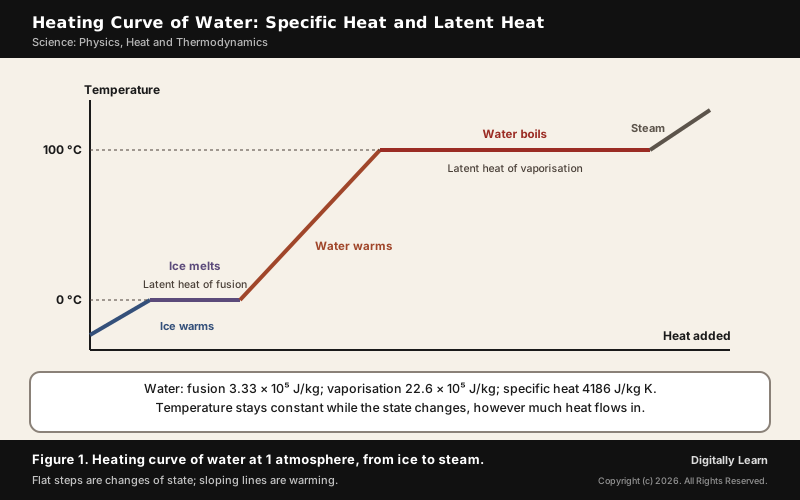
While ice melts or water boils, the temperature does not change even though heat keeps flowing in; the heat goes into changing the state. The heat per unit mass needed for a change of state is the latent heat. For water, melting ice needs 3.33 × 10 to the power 5 joules per kilogram and turning water into steam needs 22.6 × 10 to the power 5 joules per kilogram.
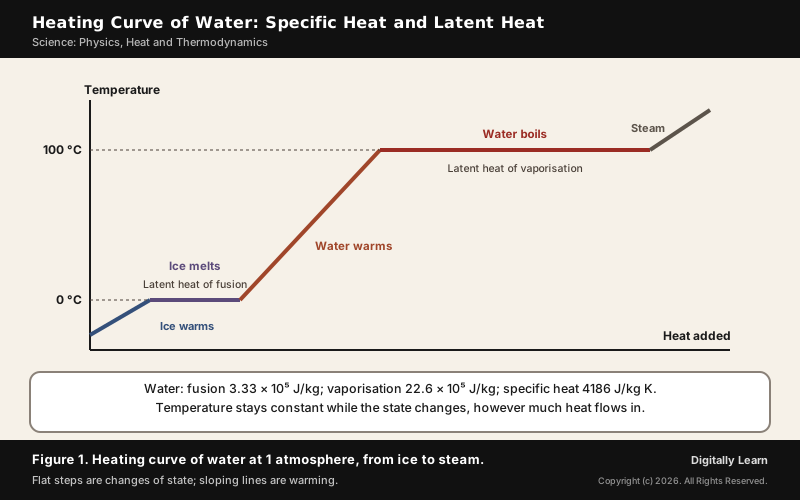
- Melting point: The temperature at which solid and liquid coexist; for water, 0 degrees Celsius.
- Boiling point: The temperature at which liquid and vapour coexist; for water, 100 degrees Celsius at normal pressure.
- Sublimation: A change straight from solid to vapour, as with dry ice (solid carbon dioxide) and iodine.
- Regelation: Ice melts under pressure and refreezes when the pressure is removed; skating works because water forms under the skates.
Boiling Point, Pressure and Altitude: How a Pressure Cooker Works
The boiling point depends on pressure. It rises when the pressure rises and falls when the pressure falls, so cooking is difficult on hills: at high altitude the atmospheric pressure is lower and water boils below 100 degrees Celsius. A pressure cooker does the opposite, raising the pressure so that water boils at a higher temperature and food cooks faster.
The pressure inside a cooker is held by a weighted valve that sits on the vent and lifts to let out excess steam, so the weight of the valve and the size of the vent set the pressure; some cookers let the user change the weight to change the pressure. At one atmosphere above normal, water boils at about 121 degrees Celsius.
Transfer of Heat: Conduction, Convection and Radiation
Conduction and Thermal Conductivity
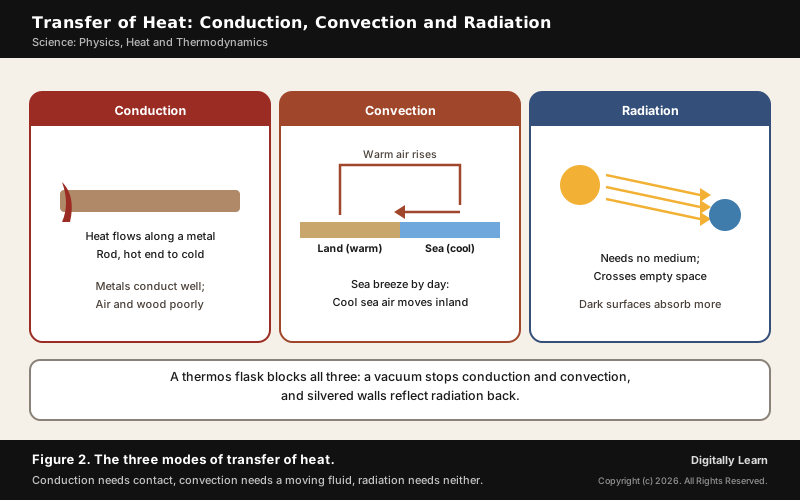
Conduction is the transfer of heat between neighbouring parts of a body because of a temperature difference. Put one end of a metal rod in a flame and the other end soon becomes too hot to hold. The rate of flow depends on the temperature difference, the area of cross-section and the thermal conductivity of the material, and falls with the length of the rod.
- Good conductors: Metals such as silver and copper; copper-bottomed pots spread heat evenly.
- Poor conductors: Wood, glass wool and air; plastic foams insulate because they hold pockets of air.
- Buildings: Concrete roofs get very hot in summer, so a layer of earth or foam insulation is added to keep rooms cool.
Gases are poor conductors and liquids lie between gases and solids. Sometimes fast heat removal is vital: a nuclear reactor needs elaborate heat transfer systems so that the enormous energy released by fission in the core is carried away quickly enough to stop the core from overheating.
Convection: Sea Breezes, Land Breezes and Trade Winds
Convection carries heat by the actual movement of matter, so it happens only in fluids. When a fluid is heated from below, the warm part expands, becomes less dense and rises, and cooler fluid takes its place. In forced convection a pump or fan drives the flow, as in a car's cooling system; the heart does the same for the human body.
- Sea breeze: By day the land heats faster than the sea; warm air over land rises and cooler air blows in from the sea.
- Land breeze: At night the land loses heat faster, the sea is warmer, and the cycle reverses.
- Trade winds: Unequal heating of the equator and the poles sets up a convection current; the earth’s rotation modifies it so that the air descends near 30 degrees north and returns to the equator.
Weather scientists call this contrast differential heating. It can have a large impact on coastal weather through sea and land breezes, and the sea breeze circulation has two opposing flows, one at the surface and a return flow aloft.
Radiation, Black Bodies and Newton's Law of Cooling
Radiation needs no medium. It carries energy as electromagnetic waves at the speed of light, which is how the Sun's heat reaches the earth through empty space. Every body emits thermal radiation, and black bodies absorb and emit it better than light-coloured ones.
- Clothing: White or light clothes in summer absorb the least heat; dark clothes in winter absorb more.
- Cooking pots: Blackened bottoms absorb more heat from the fire.
- Thermos flask: A double-walled glass vessel with silvered walls and a vacuum between them; the silver reflects radiation, and the vacuum stops conduction and convection.
| Mode | How heat moves | Example |
|---|---|---|
| Conduction | Part to part through matter | Hot handle of a pan |
| Convection | The fluid itself moves | Sea breeze |
| Radiation | As waves; no medium needed | Sunlight on the earth |
A hot body cools faster at first and more slowly as it nears room temperature. By Newton's law of cooling, the rate of loss of heat is proportional to the difference between the body's temperature and its surroundings, which holds for small differences, such as a cup of tea cooling on a table.
Laws of Thermodynamics
What Is Thermodynamics? System, State and Internal Energy
Thermodynamics looks at the internal state of a body, not its motion as a whole. When a bullet is fired, its kinetic energy changes; when it stops in a block of wood, that energy becomes heat that warms the bullet and the wood. Pressure, volume, temperature and internal energy are state variables: their values depend only on the present state, not on how the system got there.
A system is in thermal equilibrium when its pressure, volume and temperature stop changing. Two bodies separated by a conducting wall exchange heat until they reach the same temperature, while an insulating, or adiabatic, wall allows no heat to flow.
Zeroth Law and Third Law of Thermodynamics: Temperature and Absolute Zero
R. H. Fowler stated the zeroth law in 1931, long after the first and second laws had been numbered, which is why it came to be called the zeroth. It is the basis of every thermometer: a thermometer shows the temperature of a body only because the two come into thermal equilibrium.
The third law of thermodynamics states that the entropy of a system approaches a constant value as its temperature approaches absolute zero. It was developed by Walther Nernst between 1906 and 1912, who also put it this way: no procedure can reach absolute zero in a finite number of steps.
First Law of Thermodynamics: Energy Conservation and Thermodynamic Processes
The first law explains why no machine can give out more energy than it takes in. Heat and work depend on the path a system follows, but their difference, the change in internal energy, depends only on the starting and final states; in a cyclic process the system returns to its starting state, so the net heat absorbed equals the work done.
- Isothermal: Temperature fixed; for an ideal gas the internal energy does not change, so the heat supplied equals the work done.
- Adiabatic: No heat enters or leaves; work done by the gas lowers its temperature, and work done on it raises the temperature.
- Isochoric: Volume fixed; no work is done and all the heat changes the internal energy.
- Isobaric: Pressure fixed; the heat goes partly into internal energy and partly into work.
Second Law of Thermodynamics: Kelvin-Planck and Clausius Statements
The first law would allow a book on a table to leap up by cooling the table, but that never happens. The second law forbids it, and it sets a limit: no heat engine can be 100 per cent efficient, and no refrigerator can work without external work. Rudolf Clausius is generally regarded as its discoverer, and he introduced entropy: the entropy of an isolated system can never decrease.
- Irreversible processes: The spontaneous processes of nature, such as a hot pan cooling, gas leaking from a cylinder and spreading through a room, or petrol burning, cannot be reversed.
- Causes: Processes that pass through non-equilibrium states, and friction, viscosity and other dissipative effects.
- Reversible process: An idealisation, possible only if the change is slow enough to stay in equilibrium and there is no dissipation.
Heat Engines, Refrigerators and Air Conditioners
Heat Engines, Efficiency and the Carnot Engine
A heat engine takes a working substance through a cycle that turns heat into work. It absorbs heat Q1 from a hot reservoir, releases heat Q2 to a cold one and delivers the difference as work; its efficiency is the work divided by the heat absorbed. The working substance is steam in a steam engine and a mixture of fuel vapour and air in a petrol or diesel engine.
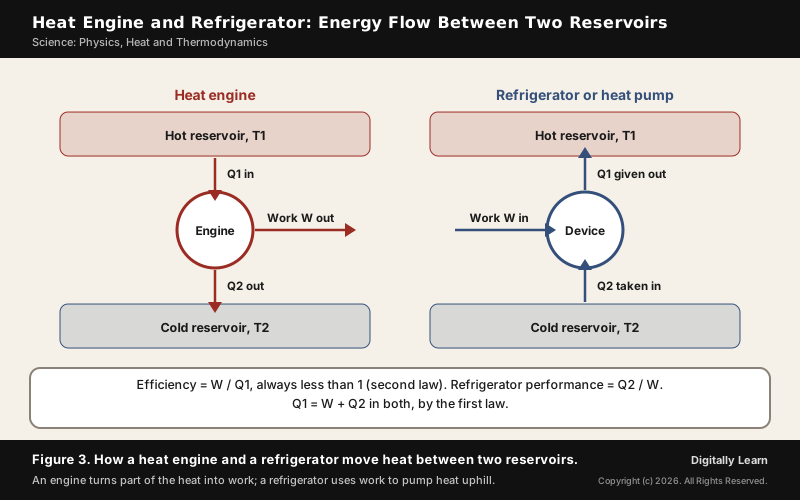
Sadi Carnot, a French engineer, asked in 1824 what the highest possible efficiency is. The answer is an engine working on reversible processes, the Carnot engine: no engine between the same two temperatures can be more efficient, and its efficiency does not depend on the working substance. For it, the ratio of heat released to heat absorbed equals the ratio of the cold and hot absolute temperatures, T2/T1, so its efficiency is 1 minus T2/T1.
Refrigerators, Heat Pumps and Air Conditioners
A refrigerator is a heat engine run backwards. External work is done on the working substance so that it takes heat Q2 from the cold space and gives out heat Q1 to the warmer surroundings. The same device is called a heat pump when its purpose is to heat a room in cold weather rather than to cool a space.
- Coefficient of performance: Heat removed from the cold space divided by the work done; unlike efficiency it can be greater than 1, but by the second law it can never be infinite.
- Evaporator: The coil where the circulating refrigerant absorbs heat from the space being cooled.
- Condenser: The coil where that heat is rejected to the outside air or water.
- Heat pump reversal: In heating mode the outside coil becomes the evaporator and the inside coil the condenser.
Bodies in motion and the forces acting on them, including the work that turns into heat through friction, are covered in Part 1: Newton's laws of motion and gravitation.
Previous Year UPSC-CSE Questions
Previous Year UPSC-CSE Questions By the end you will be able to draft model answers for the following UPSC questions. Each question carries a collapsible framework showing how to approach it in the exam.
- UPSC Prelims 2003 Prelims-GSConsider the following statements:
- Steam at 100 °C and boiling water at 100 °C contain the same amount of heat.
- Latent heat of fusion of ice is equal to the latent heat of vaporization of water.
- In an air-conditioner, heat is extracted from the room air at the evaporator coils and is rejected out at the condenser coils.
Which of these statements is/are correct?
How to approach this Prelims question
Approach: Check each statement against latent heat and the refrigeration cycle.
Trap to watch: Same temperature does not mean same heat content.
Key facts to recall:
- Latent heat of fusion 3.33 × 10^5 J/kg
- Latent heat of vaporisation 22.6 × 10^5 J/kg
- Evaporator absorbs heat; condenser rejects it
Answer signal: Only 3: option (d), the official answer.
- UPSC Prelims 2001 Prelims-GSAssertion and Reason:
- Assertion (A): The boiling point of water decreases as the altitude increases.
- Reason (R): The atmospheric pressure increases with altitude.
How to approach this Prelims question
Approach: Ask how pressure changes with height and how boiling point follows pressure.
Trap to watch: Pressure falls, not rises, with altitude.
Key facts to recall:
- Boiling point falls with falling pressure
- Cooking is difficult on hills
Answer signal: A true, R false: option (c), the official answer.
- UPSC Prelims 2021 Prelims-GSIn a pressure cooker, the temperature at which the food is cooked depends mainly upon which of the following?
- Area of the hole in the lid
- Temperature of the flame
- Weight of the lid
Select the correct answer using the code given below:
How to approach this Prelims question
Approach: Ask what fixes the pressure inside the cooker, since pressure fixes the boiling point.
Trap to watch: A hotter flame only boils the water faster.
Key facts to recall:
- Boiling point rises with pressure
- Weighted valve on the vent sets the pressure
Answer signal: 1 and 3 only: option (c), the official answer.
- UPSC Prelims 1995 Prelims-GS107. The normal temperature of human body on the Kelvin scale is
How to approach this Prelims question
Approach: Add 273 to the body temperature in Celsius.
Trap to watch: 300 K is room temperature, not body temperature.
Key facts to recall:
- Body temperature about 37 °C
- Kelvin equals Celsius plus 273.15
Answer signal: About 310 K: option (d), the official answer.
- UPSC Prelims 1999 Prelims-GSAssertion and Reason:
- Assertion (A): To dilute sulphuric acid, acid is added to water and not water to acid.
- Reason (R): Specific heat of water is quite large.
How to approach this Prelims question
Approach: Link the heat released on mixing to water's ability to absorb it.
Trap to watch: Both statements are true and the reason does explain the assertion.
Key facts to recall:
- Mixing acid and water releases much heat
- Water has a high heat capacity
Answer signal: Both true and R explains A: option (a), the official answer.
Sources
- NCERT: Physics Part II (Class XI), Thermal Properties of Matter
- NCERT: Physics Part II (Class XI), Thermodynamics
- NASA Glenn Research Center: First Law of Thermodynamics
- NOAA JetStream: The Sea Breeze
- PIB: India Cooling Action Plan released (8 March 2019)
- Wikipedia: Laws of thermodynamics
- Wikipedia: Third law of thermodynamics
- Wikipedia: Specific heat capacity
- Wikipedia: Latent heat
- Wikipedia: Pressure cooking
- Wikipedia: Human body temperature
- Wikipedia: Sea breeze
- Wikipedia: Vacuum flask
- Wikipedia: Heat pump
- Wikipedia: Air conditioning
- Wikipedia: Carnot heat engine
- Wikipedia: Sulfuric acid
- UPSC: Civil Services Examination question papers
Editorial Disclaimer
This article draws on the NCERT textbooks and the other sources listed on this page.


